Global warming, climate change, all these things are just a dream come true for politicians. I deal with evidence and not with frightening computer models because the seeker after truth does not put his faith in any consensus. The road to the truth is long and hard, but this is the road we must follow. People who describe the unprecedented comfort and ease of modern life as a climate disaster, in my opinion have no idea what a real problem is.
This is another Bill Gates bought and paid for piece of propaganda:
Everyone remembers the diagram – water evaporates from the ocean, first condensing into clouds, then falling on land as rain, before winding its way back to the sea.
The water cycle, or, more properly, the hydrological cycle, has long been a staple of primary school Geography lessons. For even longer – about 3.8 billion years – it has been sustaining life on Earth.
But hundreds of years of human activity have put immense strain on the system, as well as having a huge sweeping impact on the planet as a whole.
Humankind’s use of water is also compounding the climate crisis. Global temperatures are warming at such a rate that they have warped the earth’s natural cycles, and what was once an easily predictable cycle has now become increasingly erratic, scientists say.
“As a result of rising temperatures, the hydrological cycle has accelerated. It has also become more erratic and unpredictable, and we are facing growing problems of either too much or too little water,” Celeste Saulo, Secretary-General of the World Meteorological Organisation (WMO), warned.
The consequences of this shift have been devastating. On every continent, water is either too plentiful or in desperately short supply, and it’s getting harder to know when and where flooding or drought will strike.
From a violent hurricane season in the Atlantic, to devastating drought in the Amazon and across east Africa, and record flooding on four continents, this year’s extreme weather is a symptom of new volatility in the hydrological cycle, say experts.
Something is wrong with the most basic planetary system of all, but how that disruption makes its mark depends on where you are in the world.
So the Earth’s climate was stable for 3.8 billion years, despite the fact it was much hotter than now for most of that time!
There is the usual nonsense about hurricanes, floods and droughts all getting worse, which is strange given that the IPCC have spent years trying to find evidence of this without success.
But the most noteworthy part about this article is its author, Lilia Sebouai. Obviously she must be an experienced science writer. Well as it turns out, just three years ago, she was working as a bartender!
Are the Telegraph so desperate for Bill Gates’ millions that they are prepared to such risible nonsense?
On Episode #132 of The Climate Realism Show our guest is Steve Milloy, publisher of Junkscience.com, senior fellow at the Energy & Environment Legal Institute, and member of the EPA transition team for the first Trump presidency. The Biden-Harris administration has pledged billions of US tax dollars for “global climate action.” Would it be too late to get a refund on that if Trump is elected? Would a second Trump administration get even more aggressive with producing oil and gas? Could he end the taxpayer-subsidized and failing “green energy” industry with the stroke of a pen? And what will the next four years of climate policy look like if Kamala Harris wins?
The whole world seems to be nervously awaiting the outcome of the presidential election, which is just 10 days away — perhaps no group more than the global climate cabal. Climate and energy policy is a topic barely mentioned on the campaign trail, and in the debates. But voters are going to decide in November whether America keeps spending billions to be a “leader” in global climate action schemes or pull out of the scam altogether … and maybe for good.
On Episode #132 of The Climate Realism Show our guest is Steve Milloy, publisher of Junkscience.com, senior fellow at the Energy & Environment Legal Institute, and member of the EPA transition team for the first Trump presidency. The Biden-Harris administration has pledged billions of US tax dollars for “global climate action.” Would it be too late to get a refund on that if Trump is elected? Would a second Trump administration get even more aggressive with producing oil and gas? Could he end the taxpayer-subsidized and failing “green energy” industry with the stroke of a pen? And what will the next four years of climate policy look like if Kamala Harris wins?
Heartland’s Anthony Watts, H. Sterling Burnett, Linnea Lueken, and Jim Lakely will also cover some of the Crazy Climate News of the week and take your questions in the chat. Join us LIVE at 1 p.m. ET this Friday and every Friday.
For some reason more than a thousand whales, dolphins and porpoises died around the UK’s coastline every year for the last eight years. This is roughly twice as many as in the 25 years before that. What could it be?
For some reason more than a thousand whales, dolphins and porpoises died around the UK’s coastline every year for the last eight years. This is roughly twice as many as in the 25 years before that. What could it be?
Whatever it is, it isn’t windfarms. Greenpeace says so:
“There is no evidence whatsoever linking offshore wind to whale deaths. The manufactured hysteria is the result of fake news promoted by politicians, big oil, and their cronies to save the oil and gas industry”
…”building offshore wind is way, way better for ocean wildlife than fossil fuels”.
And yet there are a thousand dead cetaceans.
Andrew Montford of NetZeroWatch graphed beached dolphins, whales and porpoises against the rise of a new industrial marine machine:
Cetacean Strandings in the UK graphed against offshore wind capacity. @Dissentient
There’s no evidence, say Greenpeace, sounding just like Philip Morris.
We don’t know for sure what is causing so many whales and dolphins to die, but Greenpeace doesn’t even want to find out. The only thing we do know is that Greenpeace is craven, counterfeit, eco-imposter front for the Globalist Blob. As Matt Ridley saidwhat happened to the Precautionary Principle?
The UK’s 2023 annual report to Ascobans* reveals an appalling level of cetacean deaths in British seas, and comes in the wake of record-breaking increases in whale, dolphin and porpoise mortality in recent years. This shocking statistic should be a wake-up call to those planning to further industrialise our seas …
Researchers have known since at least 2013 that pile drivers were permanently deafening porpoises, leaving them, presumably to die miserable deaths wandering blindly through dark or murky seas. Where were all the professors of marine science, paid by the public to know these things, and where was the BBC?
They were all silent for ten years until someone invented and tested “bubble curtains” to protect porpoises, and then they could say “well isn’t that clever”?
Spread the word: fifty years ago environmentalists would have raised hell about a thousand dead whales and dolphins. Today they are a part of the cover up. They’re not even blaming climate change and 0.001 degree of warming. They don’t want to draw attention to the blubber on the beach in case people start asking hard questions.
Greenpeace, WWF, UNEP, they’re all fake environmentalists.
“The apparent increase in major Atlantic hurricanes since 1920 is due to the fact that we now have satellites to observe them in mid-ocean. This is why there is a step change in the 1990s.”
You will recall this graph from the latest piece of BBC disinformation about hurricanes. As I wrote the other day:
“The apparent increase in major Atlantic hurricanes since 1920 is due to the fact that we now have satellites to observe them in mid-ocean. This is why there is a step change in the 1990s.”
This is the full list:
BBC customers would see that graph and naturally assume that hurricanes are getting stronger, (despite that weaselly qualification at the bottom). But prior to satellites and robust hurricane hunter aircraft, most Cat 5 hurricanes could only be identified as such at or close to landfall. And if we only plot these storms, we get a completely different picture:
If anything, Cat 5 hurricanes were much more frequent at times in the past – notably the 1930s.
Since Dean and Felix in 2007, the only year with two Cat 5s, there have been just three – Irma, Michael and Dorian, in 2017, 2018 and 2019 respectively. Put another way, there have been just three in the past seventeen years.
This completely destroys the BBC’s deliberately misleading chart.
Andrew Hagen and Chris Landsea are two of the leading hurricane researchers in the US. Back in 2012, they published this paper, which looked at the issues surrounding the impact of changes in how we monitor hurricanes:
ABSTRACT An investigation is conducted to determine how improvements in observing capabilities and technology may have affected scientists’ ability to detect and monitor Saffir–Simpson Hurricane Wind Scale Category 5 hurricanes in the Atlantic Ocean basin during the mid-twentieth century. Previous studies state that there has been an increase in the number of intense hurricanes and attribute this increase to anthropogenic global warming. Other studies claim that the apparent increased hurricane activity is an artifact of better observational capabilities and improved technology for detecting these intense hurricanes. The present study focuses on the 10 most recent Category 5 hurricanes recorded in the Atlantic, from Hurricane Andrew (1992) through Hurricane Felix (2007). These 10 hurricanes are placed into the context of the technology available in the period of 1944–53, the first decade of aircraft reconnaissance. A methodology is created to determine how many of these 10 recent Category 5 hurricanes likely would have been recorded as Category 5 if they had occurred during this period using only the observations that likely would have been available with existing technology and observational networks. Late-1940s and early- 1950s best-track intensities are determined for the entire lifetime of these 10 recent Category 5 hurricanes. It is found that likely only 2 of these 10—both Category 5 landfalling hurricanes—would have been recorded as Cat- egory 5 hurricanes if they had occurred during the late-1940s period. The results suggest that intensity estimates for extreme tropical cyclones prior to the satellite era are unreliable for trend and variability analysis
Their map is particularly relevant – (RMW is Radius of Maximum Wind):
Apart from Andrew and Mitch, all hit Cat 5 speeds well away from land.
And they conclude that only those two of the ten hurricanes would have been classified as Cat 5s using 1940s technologies – Andrew, which hit Florida as Cat 5; and Mitch, which passed close to the north coast of Honduras.
Using 1950s methods, Felix would also have made Cat 5.
It is also worth noting that even though these three would have been called Cat 5s, the wind speeds estimated for 1940s technology were still less than officially recorded now. Mitch, for instance, is officially 15kts higher than the 1940s estimate.
Hagen & Landsea explain all of this very succinctly:
Note that Cat 4 hurricanes also have been understated in the past.
I have already complained to the BBC about their article, and in particular the graph. Will they ignore what the real hurricane scientists say?
The Story of Climate Change is based on the concept of atmospheric ionization by high energy cosmic rays initiating aerosol and cloud formation. This results in a warming or cooling planet Earth. This cloud albedo effect (Svensmark) is the first leg upon which The Story of Climate Change rests
Does the climate model below (Fig 6) represent a real climate cycle that actually repeats every 675 million years? If so, might the galactic spiral structure with its accompanying cosmic radiation be responsible? Is the spiral structure of the Milky Way “stable”, such that we will encounter the same spiral arms and inter-arm regions over and over as we orbit the gravitational center of the galaxy?
The Story of Climate Change is based on the concept of atmospheric ionization by high energy cosmic rays initiating aerosol and cloud formation. This results in a warming or cooling planet Earth. This cloud albedo effect (Svensmark) is the first leg upon which The Story of Climate Change rests (https://thestoryofclimatechange.substack.com). Galactic cosmic rays, mostly high energy protons, play the central role in this process by ionizing atmospheric gases as they descend into the lower troposphere. Radio observations of exo-galaxies indicate that cosmic rays are galactic plane polarized and are confined to spiral arm structures. This means that during our solar system’s transit through the Milky Way spiral arms the cosmic ray flux will be modulated. High flux levels during spiral arm crossings result in cloudy and cooling climates while lower flux during inter-arm space crossings results in less cloudy and warming climates. These we can call geologic Ice House and Hot House epochs. Our planetary system’s galactic orbit is circular but oscillates in and out of plane manifesting a secondary high frequency cosmic ray flux modulation. This results in a periodic 30-million-year warming-then-cooling cycle (Veizer, Shaviv). These superimposed drivers can be visualized in my 675-million-year climate cycle based on a one-billion-year splice of Veizer and Halverson isotope proxies (part 1, https://thestoryofclimatechange.substack.com/p/the-story-of-climate-change-part-0fd ).
What does this mean?
As our solar system continues to orbit the galactic center, we appear to encounter the same spiral arms and inter-arm regions again and again. If this process influences the climate, the cyclic nature of paleoclimate should be revealed. Assuming that the nearly 13-billion-year-old Milky Way galaxy structure has been stable in aggregate, at least since our system’s inception – about 5 billion years, we will continue to repeat the same pattern and periodicity of climatological conditions into the far future. The spiral arms of the Milky Way appear to us to be rotating but at a slightly different speed than other stars in the disk like our sun. From the solar perspective we appear to be at rest while the galactic structure moves past us and slowly recedes in our wake. It has been estimated that our system orbits the galactic center every 225 million years or so. Our story indicates that three of our galactic orbits will result in one complete spiral structure transit – every 675 million years.
How can this pattern of stars, dust, gas, and energy persist if the objects in the galaxy are moving along their unique orbital paths with their unique orbital periods? Is this “spiral” an illusion or does the phenomenon have a physical explanation? Why are the cosmic rays mostly in the spiral arm structures and absent from the inter-arm regions? Do the spiral arms actually exist discretely as rotating standing gravitational waves or are they a function of rotating density waves propagating through the galactic disk of stars ever renewing their inventory of arm stellar masses? It is a mystery to me and the second leg upon which The Story of Climate Change rests. We do however, live in a metaphorical world. We do many things and think many thoughts because we believe that a carbon dioxide climate driver narrative is true. We can play at that game too. Shall we proceed as if The Story of Climate Change were also true? Beautiful stories may not be wholly true but they can inspire us to venture beyond the mundane – now that’s when the real fun begins.
Let’s imagine …
Let’s imagine the near future, say, 10 to 20 thousand years hence. I think we might assume that humanity will still be the dominant species on the planet as it has been since our exodus from mother Africa about 70 thousand years ago. Shall we consider the future climate landscape if anthropogenic carbon dioxide forces the Earth into a new Hot House environment 5 to 10 degrees Celsius warmer than today? Would you imagine that our climate in 10 thousand years would resemble the Hot House Cretaceous Period of around 75 million years ago? The climate of the dinosaurs. Would we see no polar ice caps, sea levels 300 to 600 feet higher than today, CO2 levels as high as 2000 parts per million – 5 times higher than today, and forests on Antarctica? If we did enter a Hot House how long would it last? Would the Hot House end on its own – if so, why would the temperatures fall? The pattern and periodicity of real paleoclimate change however, do not seem to be well explained by weathering, subduction, and volcanic activity cycles throughout Earth’s geologic past
Of course we would not be forced into a new Hot House. Remember, a Hot House is manifested by inter-arm space crossing during our galactic orbit. Our planet will remain within the cold Sagittarius spiral arm for another 120 million years or so – driving cloudier and cooler climates. We will linger near in-plane within this arm for another 2 to 3 million years driving cloudy and cool climates. The Milankovitch planetary orbital cycles can then show their influence by driving the climate to oscillate between cold glacial expansion and warm inter-glacial periods.
Where are we now? First, we are fully in-plane with the Milky Way and experiencing maximum cosmic radiation with maximum propensity for aerosol and cloud formation. We have been in the Pleistocene Ice Age for about 3 million years. We are in the middle of this most recent 20-thousand-year interglacial period. In 10 thousand years, a mere 300 generations, we will be at lowest planetary obliquity and sliding into the next 80-thousand-year period of glacial expansion. Just a few hundred years after glacial inception the higher latitudes would be uninhabitable with the massive expansion of sea ice onto the continents as glaciers. As the ice expands it makes the albedo of our planet more reflective – returning more sunlight back to space and cooling things off even more. This is ice albedo feedback in action. A runaway Ice albedo process is thought to explain the Snowball Earth scenario 640 million years ago during the Cryogenian period. In 600 generations, 20 thousand years from now, we will be in the cold depths of the expanding ice age. About 1 hundred thousand years the Milankovitch cycles will find a resonance when both obliquity and eccentricity move higher providing more insolation to the higher latitudes. This breaks the ice albedo feedback loop, reversing ice expansion and initiating the next warm interglacial period.
Over the next 3 million years, as the out-of-plane orbital motion of our planetary system reduces cosmic radiation, cloud cover will be reduced driving temperatures warmer. This Pleistocene Ice Age will finally dissipate, leaving behind these glacial-interglacial oscillations – for now. What goes up must come down. In about 15 million years we will reach maximum out-of-plane position with the accompanying warmest temperatures. Our star system once again proceeds back into the galactic plane cooling the planet. 30 million years from now, while crossing deeper into the Sagittarius spiral arm, we will once again be fully in-plane receiving the highest cosmic ray flux, resulting in more ionization, and maximum propensity for cooling cloudiness and glaciers returning. This will mark the entry into the next Ice Age. Since our climate is cyclic, the past climates will be repeated – with a replay of the Marinoan Ice Age of 640 million years ago.
The big wheel keeps on turning
In about 120 million years we will finally cross the Sagittarius spiral arm. We will exit this Ice House with its periodic glacial ages and enter the next Hot House inter-arm space on our way into the next spiral arm region – the Perseus arm. Round and round we go.
With this knowledge and climate foresight of a cooling, icier world what should we do? It is hard to imagine, but we could organize this super organism we call humanity and implement a plan for adapting to the coming cold snap. Albedo modification, space-based solar mirrors driving back the continental and sea ice termini, and CO2 emission expansion might not be powerful enough climate weapons to fight mother nature. But, maybe by then, the climate alarmists would be warning us about the real problem. Humans are notoriously short sighted though – much like the proverbial frog in a slowly freezing pond – before we even realize it, the brutal physics of cold finally catches up with us.
The network of ocean currents which keep the Earth’s climate stable could be about to collapse, scientists have warned.
In an open letter, 44 of the world’s leading climate scientists say that key Atlantic Ocean currents – including the Gulf Stream – are on the brink of failure.
The scientists caution that the collapse of the Atlantic Meridional Overturning Circulation (AMOC) could lead to ‘devastating and irreversible impacts’ which will affect ‘the entire world for centuries to come’.
The resulting climate fallout could plunge the UK into a ‘new Ice Age’, with winter temperatures plummetting up to 15°C (27°F) below the current average.
While the collapse of the Gulf Stream would be disastrous for Britain, that vital current is just one small part of AMOC’s massive global system.
This giant ocean conveyor belt is critical for moving heat around the planet, but research suggests that it has been slowing down and could soon reach a tipping point.
Without urgent action, the scientists warn that AMOC could fail completely within the next few decades.
As warm water travels northwards from the tropics, it hits the sea ice around Greenland and the Nordic countries, cooling and becoming much saltier.
As the water cools it becomes denser, sinking rapidly towards the bottom of the ocean where it flows back southwards before once again warming and rising to the surface.
This process of ‘deep water formation’ is the engine for a vast global conveyor belt which pumps heat and water all around the Atlantic Ocean.
However, studies suggest that AMOC’s deep water engine has started to slow and is now showing worrying signs of breaking down altogether.
As global temperatures rise, melting ice pours fresh water back into oceans, diluting the denser salty water and preventing it from sinking.
As with a lot of climate scams, this one is based on just a few years data, from which the “scientists” conclude that they have identified cataclysmic changes that have not happened for millennia.
Oceanographers have been measuring the AMOC continuously since 2004. The measurements have shown that the AMOC varies from year to year, and it is likely that these variations have an impact on the weather in the UK. However it is too early to say for sure whether there are any long term trends. Before 2004 the AMOC was only measured a few times,
So we only have data since 2004, and the year to year variations are large. To pretend that such a short series is in any way significant is not only unscientific but fraudulent.
It would appear that there is little trend since around 2008.
The idea that the AMOC never changed before 2004 is absurd anyway.
Bob Dickson & Svein Østerhus laid out in their study, “One hundred years in the Norwegian Sea”, the major climatic changes in the Norwegian Sea and the rest of the Arctic:
All were associated with changes in Atlantic currents and the AMOC. The Warming in the North, for instance, occurred because of the influx of warm Atlantic seawater, in exactly the same way as with recent Arctic warming. As the Met Office explain, warm water evaporates leaving saltier water, which sinks because it is more dense. Saltier water of course freezes at lower temperatures, so Arctic sea ice tends to contract. (Note when it freezes, the salt tends to leech out, so either way the sea becomes saltier).
The Great Salinity Anomaly which followed the Warming was the result of that influx of warmer water retreating, in part because of northerly airflow :
These weather patterns are part and parcel of the Arctic Oscillation, another perfectly natural cycle. The anomalously higher pressure over Greenland marks the time of the negative AO:
As fresh, polar water replaced warmer Atlantic water, salinity levels fell – hence the name given to the event. Just as Arctic sea ice had retreated during the Warming, it expanded rapidly during this period. The GSA was not just a phenomenon in the Norwegian Sea, because the polar gyre carried this fresh water around the whole of the Arctic Ocean.
Another factor identified by Dickson and Osterhus in the freshening of the Arctic Ocean is increasing discharge from Eurasian rivers into the basin. A warming climate means a wetter climate in those regions. And more river discharge leads to more sea ice and a colder Arctic.
In other words, these processes tend to be self correcting. Milder weather leads eventually to more sea ice and a colder climate, until eventually the AO flips back to positive again.
I’ll leave the final comment to Dickson & Osterhus:
All these changes were the result of natural processes. There is no evidence that these will change in future.
Here are 10 fundamental questions that climate pant-soilers never answer.
➊ You claim that the Earth is overheating. That it’s “too hot.” So, what is the correct global mean surface temperature (GMST) for life on Earth and why? 🌡️
Here are 10 fundamental questions that climate pant-soilers never answer.
➊ You claim that the Earth is overheating. That it’s “too hot.” So, what is the correct global mean surface temperature (GMST) for life on Earth and why?
Please provide a numerical answer. Use units and round it to the nearest tenth of a degree Celsius. Then, explain why that value is ideal and cite evidence to justify your answer.
➋ What is the correct atmospheric CO₂ level for life on Earth?
What is best to optimize our agricultural productivity?
What CO₂ level will make da weatha less scary?
Give your answer as an exact value as a mole fraction or volume percentage, and then explain why that value is ideal.
➌ What exactly makes CO₂ “pollution”?
The EPA considers CO₂ to be a pollutant, legally speaking, under the Clean Air Act, and their scientific justification is simply that, it “…𝑐𝑜𝑛𝑡𝑟𝑖𝑏𝑢𝑡𝑒𝑠 𝑡𝑜 𝑔𝑟𝑒𝑒𝑛ℎ𝑜𝑢𝑠𝑒 𝑔𝑎𝑠 𝑝𝑜𝑙𝑙𝑢𝑡𝑖𝑜𝑛 𝑡ℎ𝑎𝑡 𝑡ℎ𝑟𝑒𝑎𝑡𝑒𝑛𝑠 𝑝𝑢𝑏𝑙𝑖𝑐 ℎ𝑒𝑎𝑙𝑡ℎ 𝑎𝑛𝑑 𝑤𝑒𝑙𝑓𝑎𝑟𝑒.”
Because by that measure, water vapor should also be classified as a “pollutant” because it’s also a “greenhouse gas” (GHG) — it’s also the most abundant and potent GHG; it absorbs a wider spectrum of IR wavelengths than CO₂.
So, what actually makes CO₂ pollution?
➍ Why are temperature departures from 1850-1900 climate conditions deemed as the human welfare control knob given that the overall human condition has never been better than it is today? How is was climate during the end of the Little Ice Age — the coldest period in the last 10,000-years — preferable to today’s? On what account was the weather more benign? By what measure? Be specific. Tell me how the climate was supposedly less dangerous in the 17-19th centuries.
➎ The Inflation Reduction Act (IRA) that President Biden signed into law in 2022 was popularized as the “biggest climate bill in history,” but ever since the bill was signed, climate alarmists insist climate change has only gotten worse.
➏ If we spend $75 trillion to decarbonize the economy by 2050, by how much will it reduce the GMST by the end of the century? Please provide your answer to the nearest tenth of a degree Celsius and show your calculations.
What does the perfect climate look like? How will we know when we get there? By what measure?
➐ The estimated cost of net zero by the year 2050 in the U.S. is $75 trillion ($3 trillion per year), according to Treasury Secretary Janet Yellen.
And with ~260 million adult taxpayers, it would cost each of us $288,461.54 to get to “net zero emissions” by the target date. That’s 3-6-years’ worth of peoples’ salaries.
Are you willing to shell out that money, or do you just expect that everyone else will foot the bill for you?
Secondly, if you don’t know the answer to question six, then are we supposed to just spend that $75 trillion and see what happens?
➑ If “combating climate change” is a global concerted effort, why do China and India get a free pass to continue emitting carbon dioxide without bound?
➒ Why are you so vehemently opposed to the deployment of nuclear power? It is the safest, most sustainable “carbon-free” energy technology and without the compliance regulations, isn’t expensive when compared to solar PV and wind, which are inefficient, intermittent, costly add-ons to existing electricity generation sources.
➓ If humans are a parasite to the Earth since we are destroying it, why then are you worried that climate change could wipe us all out? Wouldn’t that be better for Earth? Why don’t you be the change you want to see and “net zero” yourself?
I guarantee not one person will give me a coherent point-by-point answer.
A recent article posted by CBS News, Chicago asks the question on nobody’s mind: “Will climate change put the Chicago area at heightened risk for hurricanes?” This question and the thinking behind it are ridiculous. Although it is true that the remnants of tropical storms and hurricanes can reach Chicago, and have in the past, there is little reason to think that climate change will make it more likely to occur in the future or more severe if or when it does.
A recent article posted by CBS News, Chicago asks the question on nobody’s mind: “Will climate change put the Chicago area at heightened risk for hurricanes?” This question and the thinking behind it are ridiculous. Although it is true that the remnants of tropical storms and hurricanes can reach Chicago, and have in the past, there is little reason to think that climate change will make it more likely to occur in the future or more severe if or when it does.
CBS claims that the recent hurricane Helene “brought tropical flooding to inland regions not typically at risk,” warning that it’s now clear that “climate disasters can happen anywhere.” Besides the obvious issue of CBS conflating climate (long term average) with weather (a short term event), it is also untrue that it’s unusual for hurricanes to bring heavy rain inland. In fact, hurricane related flooding has occurred in the Appalachians long before industrialization could be blamed. The flood of 1916 in Asheville, North Carolina was much worse than this recent one.
If that wasn’t silly enough, CBS turns to the unscientific realm of rapid attribution studies to claim that human contributions to climate change “fueled Milton’s rapid intensification, according to Climate Central,” and asks the question “[a]s the impacts of climate change get worse faster, what, if anything, could reach Illinois now or in the future from hurricanes?”
This question carries a tiny thread of truth, that is, that the remnants of tropical storms and hurricanes can and do affect regions far away from the coasts, with CBS giving the examples of Hurricane Ike and Tropical Storm Lowell, the latter of which which caused flooding in Chicago that was severe enough to warrant an emergency declaration in 2008. However, this is not new, and the evidence CBS uses to try to frighten readers into believing that hurricanes will soon pose a greater threat up north is mere propaganda and not real data.
CBS cites Climate Central, a climate activism and advocacy group which is often caught spreading fake news and misleading information about climate science in order to push alarmist narratives. For instance, they touted the University of Maine’s faulty climate reanalyzer in 2023 as though it represented measured data when it does not. CBS also references rapid attribution analyses from groups like World Weather Attribution. Climate Realism has covered their false “science” assertions many times, where they use counterfactual computer models to claim that any given storm is the result of human-caused climate change. There will never be a weather event that World Weather Attribution can’t tie to climate change, because they begin with the assumption that climate change juices every weather event.
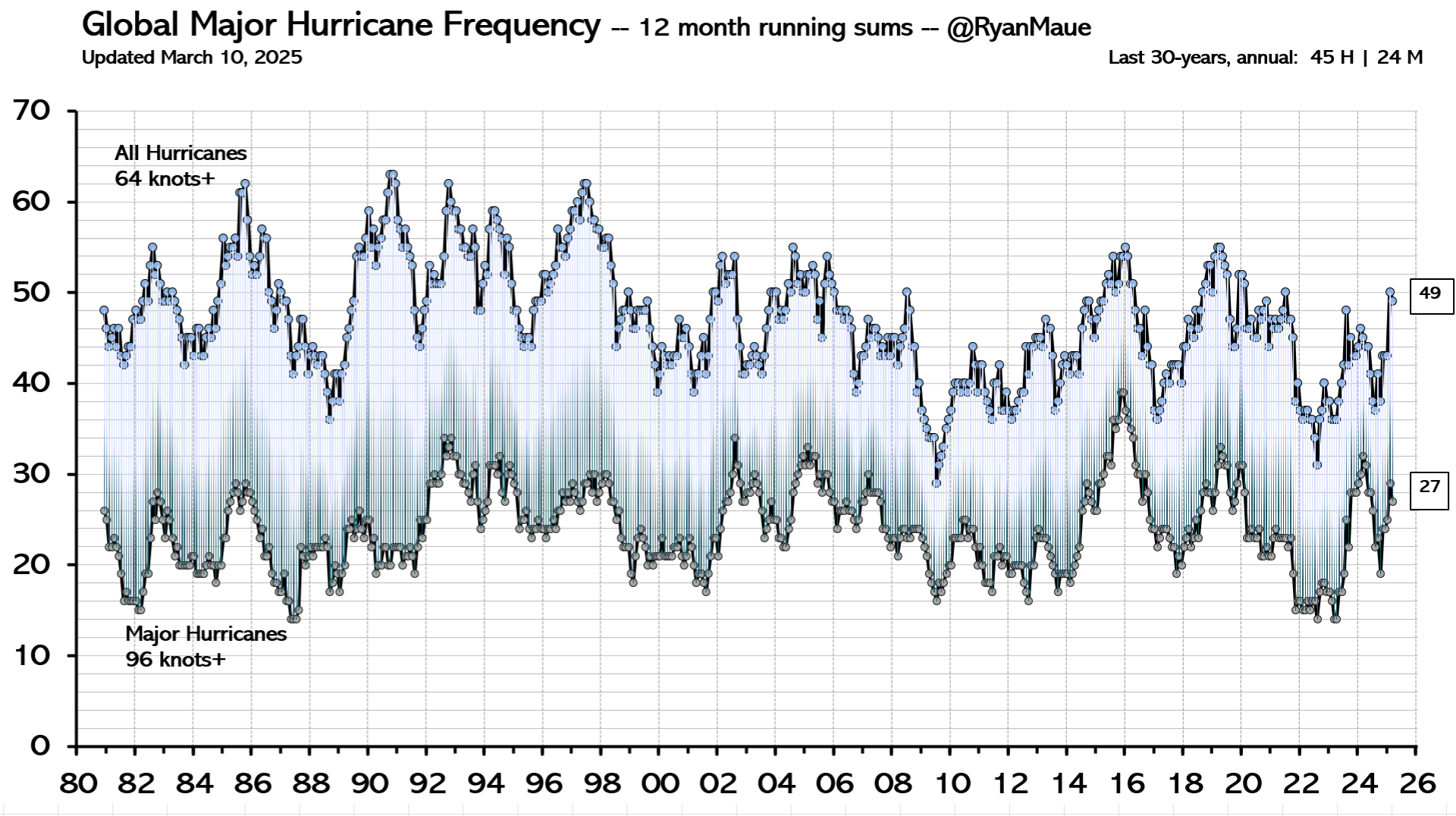
The reason mainstream media organizations like CBS rely on attribution study groups instead of real data, is because the available data do not show that hurricanes are getting more intense, wetter, or more frequent. Although Climate Realism has covered hurricanes many times this season (here, here, and here, just in the last 2 weeks), it is worth going over the facts again.
Major hurricanes, according to global hurricane frequency data, are not getting more common, nor are less powerful hurricanes. (See figure below)
In regards to strength, there is no demonstrable increasing trend in global accumulated cyclone energy. If that’s not enough, the Intergovernmental Panel on Climate Change’s Sixth Assessment Report, in Chapter 12, Table 12.12, identifies no connection between tropical cyclones and climate change. Not in the present, or the future, even under extreme emissions scenarios. (See figure below)
Figure 1: White spaces beside a category indicate evidence of a climate signal is lacking, other colors vary by strength. Bright orange is high confidence of decrease, pale orange is medium confidence of decrease, blue is medium confidence of increase, darker blue is high confidence of increase.
Facts are inconvenient for climate hucksters like CBS, which end up looking like fools trying to ignore reality in order to frighten readers in places like Chicago. Yes, the remnants of a hurricane or tropical storm can make it up to Chicago, but no, there is no indication that such occurrences are common or are set to become a frequent problem in the future. CBS has to know this, otherwise they would not rely so heavily on the nebulous claims of attribution artists.
“I haven’t seen a convincing argument yet about why the climate crisis must be named as such….”
“The climate movement has been led by people who look and think and talk the same for a very long time. If time is short, isn’t this precisely the time to try everything? To broaden out, seek fresh ideas, build a larger, stronger and more connected movement?” (- Amy Westervelt, DRILLED)
Drilled founder and editor Amy Westervelt, like other climate extremists attuned to the real world, is confused and perplexed. She wants to legalize vandalism and whatever else is necessary to wake up the world to what she sees. But reality is reality, from public opinion to CO2 science to climate-model exaggeration to the eco-sins of wind, solar, and batteries.
“Over the past two years, there’s been a sudden and severe backlash to climate protest, both legally and socially,” she recently lamented.
I have to say, the social bit surprised me. Not that people on the street might start to get annoyed with protestors and harass them, as they have been, but that so many in the climate movement itself would turn on protestors in lock step with the state.
It’s been shocking in recent weeks, for example, to see so many climate advocates so callously shrug off the extreme sentences received by Just Stop Oil protestors in the U.K. as something expected and, worse, deserved. We’ve of course been covering the increased criminalization of climate protest at Drilled for going on two years now, but let me re-state for the record: none of the art protests have caused any actual damage.
So Westervelt is mad at the police, the courts, the public, and fellow climate alarmists? Does she have any friends left? Does climate cultism have limits? She continues:
We’re talking about soup and water-based finger paint being smeared on or thrown at glass, which requires about $15 and 20 minutes to clean. The protests are shocking, yes, they make people think a priceless work of art is at risk, yes, and that is the point: everything is at risk, shouldn’t we be shocked? But these protests are not causing damage. Nor are they particularly radical in the context of social movements and civil disobedience (follow and read Dana Fisher for more, including her excellent book Saving Ourselves). So why are they making climate people so mad?
Maybe because the exaggeration is decades old. Maybe because the kids and their leaders look and act more like zombies than normal people. Maybe because deprecating art is like industrial wind and solar scarring the living space…. You decide.
She continues with the latest disturbance:
Last week, the group Climate Defiance interrupted an event held by the Breakthrough Institute to yell at pundit Matt Yglesias over his support of fracking. Now…was this strategically brilliant? I am neither a strategist nor an organizer, so it’s genuinely unimportant what I think, but I will say it certainly seemed to give Yglesias what he is dying for: relevance, attention, and an excuse to criticize the youth climate movement….
She gets personal against many (and perhaps her own) demons:
Perhaps when one is so used to comfort, having a conference panel interrupted for a few minutes feels like violence. What’s more concerning is how much that rather dramatic view seems to echo a mainstream opinion of the climate movement: that protest ought to be civil if it hopes to be effective. Which can’t help but make me think of everything I know about Arthur Brooks who … ran the American Enterprise Institute for years and talked about calls to civility as a way to paint social justice demands as radical. Or of the many ways that calls for civility have always been used as a cudgel against those who confront racism.
False flag, false cause. Green environmentalism can make a better case for carbon dioxide (CO2) than for industrial wind, solar, batteries. She then gets into her defensive crouch.
Amidst all the twitter spats and blog posts arguing whether this or that type of protest “turns people off,” whether it “works,” whether it’s “cringe” is a very big problem that is going largely ignored: Kids are being locked up for years for non-damaging, non-violent protest.
People are being accused of “conspiring against the United States” for smearing fingerpaint on glass, as Joanna Oltman Smith and Tim Martin were. In Germany, the youth activists Last Generation had their homes raided, computers seized, and bank accounts frozen for organizing protests that…sometimes cause traffic jams. That should scare anyone who doesn’t love fascism, whether they think the protests are rude or not. It should certainly concern those who feel as panicked as the climate activists do about the climate crisis that the tools of the state are being used to silence and jail those willing to act in a way that reflects that panic.
Yes, come down hard! The climate nuts must either cease-and-desist–or they will get more violent. The police and courts are proactively doing their job.
Westervelt realizes that the climate message is a tired, old one–and it smacks of elitism.
The unfortunate reality is that climate change has been painted with the “elite liberal” brush since long before it got pulled into recent culture war conversations…. People get too hung up sometimes on hearing their preferred message, on people “believing science,” but if a different route gets us to the same destination …. I haven’t seen a convincing argument yet about why the climate crisis must be named as such (although if you have, or you want to send me yours, please do! As always, I am very open to being wrong.)
The climate movement has been led by people who look and think and talk the same for a very long time. If time is short, isn’t this precisely the time to try everything? To broaden out, seek fresh ideas, build a larger, stronger and more connected movement?
Final Comment
Yes, a whole new strategy is needed by the Deep Ecologists who put a Garden of Eden ahead of human betterment. Job #1 is to end the exaggeration and trash talk against “deniers.” “In Climate Debate, Exaggeration Is a Pitfall,” Fred Krupp of Environmental Defense Fund cautioned:
There has to be a lot of shrillness taken out of our language. In the environmental community, we have to be more humble. We can’t take the attitude that we have all the answers.” – Fred Krupp, Environmental Defense Fund.
Michael Mann, breaking with Extinction Rebellion and with Scientist Rebellion (“performative attention whores”) warned:
hot takes, hyperbole, and polarizing commentary best generate clicks, shares, and retweets. I often encounter, especially on social media, individuals who are convinced that the latest extreme weather event is confirmation that the climate crisis is far worse than we thought…. increasingly today we see it with climate doomists…. This is not true, or at best partly true.
the damage done by deeply misguided individuals who in principle would seem to be on the side of climate action but are instead dividing the community and playing right in the agenda of the forces of inaction.
It’s hard being green; and it’s harder being a climate alarmism in a rational world.
ANSTO – the Australian Nuclear Science and Technology Organisation – recently celebrated 70 years since Australia’s nuclear age began in Sydney. ANSTO is the home of Australia’s most significant landmark and national infrastructure for research. Thousands of scientists from industry and academia benefit from gaining access to state-of-the-art instruments every year.
Cliff Reece reports on the reasons for anti-nuclear distortions in his Spectator Australia article Australia is already a successful nuclear nation. Excerpts in italics with my bolds and added images. H/T John Ray
ANSTO – the Australian Nuclear Science and Technology Organisation – recently celebrated 70 years since Australia’s nuclear age began in Sydney. ANSTO is the home of Australia’s most significant landmark and national infrastructure for research. Thousands of scientists from industry and academia benefit from gaining access to state-of-the-art instruments every year.
Thousands of visitors, including many schoolchildren, have safely toured the site at Lucas Heights, which is located 40km southwest of the Sydney CBD. They had the opportunity to learn a great deal about nuclear science as a result of that experience.
I recently became one of those visitors when I was invited to a 3-hour escorted tour of their facilities. As former Executive Director of the National Safety Council of Australia (NSW/ACT) I was particularly interested in their WHS procedures as well as the management of waste, as the latter could impact on the wider community if poorly managed.
What impressed me most was seeing just how advanced we are as a nuclear nation. Despite being relatively small in scale compared to a full civil nuclear energy plant, it has much the same range of issues and complexities to deal with. And it certainly appears to successfully do so at both their Sydney and Melbourne campuses.
The obvious question is, why is the Albanese Labor-Greens government, together with the Teals, opposed to extending our obvious expertise into producing nuclear energy on a commercial scale, as proposed by Opposition Leader Peter Dutton’s LNP?
As you’d expect, there are a number of reasons for both their reluctance to accept nuclear despite it being cheap, reliable and emissions-free and their manic obsession with unreliable, hugely expensive, and environmentally/socially disastrous wind, solar, and battery renewables.
Political factors play a major part. The Greens and Teals are directly opposed to nuclear, but for different reasons.
The Greens have shown beyond doubt that they want to disrupt society across as many issues as possible. They are doing this on a regular basis – even appearing to stand with crowds that hold sympathies toward recognised terrorist groups.
People who think the Greens are still a well-meaning environmental group like they were under Bob Brown are fooling themselves – they are not!
In the case of the Teals, they started life as political entities via funding from Climate 200, whose primary financial supporters are deeply entrenched in the lucrative and heavily taxpayer-subsidised renewables industry. The Teals are ignorant pawns in the high-stakes game of climate change and the hysterical pursuit of ‘saving the planet’.
There is a lot of money involved in this issue and ordinary Australians are being played by the so-called elites,including left-wing mainstream media such as the ABC.
A good example is the almost total lack of media reporting on the very recent and hugely important US Department of Energy’s Nuclear Lift-off Report that includes significant findings:
The system cost of electricity with nuclear and renewables combination is 30 per cent lower than just renewables.
The jobs from nuclear are 50 per cent higher paying than solar or wind.
Nuclear provides the lowest emissions, is the most reliable form of energy production, has the lowest land use requirement, and lowest material usage.
The report also outlines a pathway for the USA to reach their ambition to triple their nuclear energy capacity by 2050, in direct contradiction of our government’s refusal to even legalise nuclear energy.
It also directly contradicts the policy position of the Albanese government. The report debunks repeated claims that nuclear is ‘too expensive’ and will ‘increase power bills’ and outlines various other benefits of nuclear energy.
The DoE report could not disagree more with Australian anti-nuclear campaigners and the Albanese Labor-Greens government, Teals, and other sources of ignorance.
Their report also completely debunks the much-criticised report produced by CSIRO GenCost that our Minister for Climate Change and Energy, Chris Bowen, refers to constantly as his renewables crusade ‘Bible’. This is despite the fact that the CSIRO GenCost report totally failed to accurately estimate the likely total cost of renewables compared to nuclear.
It also used in its modelling a 30-year life for a nuclear plant instead of the far more accurate 80 years. This created a false financial outcome by not comparing the total cost of nuclear with renewables over an 80-year period.
It also totally neglected the fact that waste management costs for renewables will be many times greater than for nuclear. There will be the need to replace wind turbines and solar panels three or four times during an 80-year period. And who is going to be responsible for dismantling and disposing of the millions of components – some of which have toxic ingredients?
Many people, including some of our top scientists and engineers, believe that the CSIRO GenCost report was simply designed to support the Albanese government’s narrative as depicted in their childish three-eyed fish media splash some months ago.
‘Reckless’: Labor’s nuclear memes ‘undermine AUKUS subs deal’ Labor MPs have been accused of undermining the AUKUS submarine deal with ‘reckless’ anti-nuclear propaganda, as the Coalition calls on Anthony Albanese to rule out a scare campaign. Source: The Courier Mail
We need a government that protects our borders, controls immigration, decreases our cost-of-living, and helps young people to buy their own homes. It’s becoming clearer on a daily basis that none of that will happen under the current Labor-Greens government.
One major impediment to reducing living expenses is the rising cost of energy. Renewables alone will continue to increase the cost of electricity and that will in turn increase the prices paid at our shops and for commercial or residential electricity usage.
Nuclear energy will add to the range of resources available to us – as it has done in many other countries. Nuclear power plants operate in 32 countries and generate about a tenth of the world’s electricity. Most are in Europe, North America, and East Asia. The United States is the largest producer of nuclear power, while France has the largest share of electricity generated by nuclear power, at about 70 per cent.
The only way we are going to catch up with the rest of the world in relation to nuclear energy production is to replace our current government with Peter Dutton’s Liberal-National Coalition. That might be hard to accept for some people – but it’s an undeniable fact.


You must be logged in to post a comment.