Global warming, climate change, all these things are just a dream come true for politicians. I deal with evidence and not with frightening computer models because the seeker after truth does not put his faith in any consensus. The road to the truth is long and hard, but this is the road we must follow. People who describe the unprecedented comfort and ease of modern life as a climate disaster, in my opinion have no idea what a real problem is.
A backstop system designed to prevent blackouts was mobilised for the first time in two years as Britain’s power grid battles low winds and nuclear outages.
The surprise notice for the capacity market, which issues a warning to Britain’s electricity generators, was issued by the National Energy System Operator (Neso) just after midday on Monday.
It told generators to be ready for when demand spikes at 4:30pm, amid fears the amount of spare power capacity had grown unacceptably small compared to demand.
However, the notice was withdrawn just after 2pm.
A spokesman for the Neso insisted it was “confident that electricity margins are sufficient for this evening” and stressed the triggering of the original notice was automatic.
The warning was the first of its kind since November 2022, when a similar notice was issued but later withdrawn as low wind speeds and nuclear power outages piled stress on the electricity system.
Kathryn Porter, an independent energy analyst at Watt Logic, said the likely causes this time around were lower-than-expected wind output, as well as greater-than-expected demand for electricity.
OK, there was never any chance of a blackout. The purpose of the warning is to get sufficient back up capacity in place in time.
But this is still only October, and there is still a lot more wind power than we would get in a real wind drought in midwinter. Note that wind dropped to 800 MW on Sunday evening
Today wind power has fallen to 2 GW, about 7% of capacity, while demand has peaked at 35 GW – in winter that could easily rise to 45 GW or more.
Interconnectors have been bringing in 4 GW, but the backbone has been 20 GW of CCGT and 4 GW of nuclear. But we already know that all the nuclear bar Sizewell B will be gone by 2028.
Even supposing Miliband gets to triple wind power by 2030, that would still only give us 6 GW, at a time when demand will probably have gone up by that much as well.
Add to that 5 GW of biomass and other bits and pieces, and we will still be potentially 40 GW short in midwinter.
Meanwhile crazy Ed Miliband plays a ukulele next to a wind mill!
A new study provides still more evidence the Arctic was warmer than it is today as recently as a few thousand years ago.
In 2020 the well-preserved carcass of a Yakutian brown bear (Ursus arctos) was discovered buried in permafrost on the terrain of the treeless tundra Bolshoy Lyakhovsky Island in the Arctic Ocean, 73°N.
The Yakutian brown bear currently occupies only the forested regions of Eurasia, with a northern limit of northern Yakutia (Republic of Sakha), 65°N.
The female bear’s age has been dated to approximately 3500 years ago, during the Middle to Late Holocene. At that time the Arctic was warm enough at that latitude to support vegetation (grasses, shrubs) that only persist in the northern Yakutia region today.
The authors suggest brown bears may have been permanent residents of the Siberian Arctic’s islands from about 5000 years ago until a few thousand years ago, when, as today, the Arctic became too cold for the vegetation production requisite for their sustenance.
In the same vein, the Arctic’s Wrangel Island (71°N) is home to extensive mammoth remains. Radiocarbon dating indicates the woolly mammoth continued living on this island until 3700 years ago, or until the Arctic climate became too cold to provide enough grass year-round to sustain them (Bryson et al., 2010, Arppe et al., 2019).
A small mammoth is modeled to have conservatively required 25 kg of grass per day to survive. Mean July temperatures decreased from above 5°C during the Early Holocene to below 2.5°C – the threshold for grass production – by about 4000 years ago. Consequently, without enough year-round grass to feed on, the woolly mammoth died out (Bryson et al., 2010).
Other research (Boeskorov, 2020) has provided further evidence the Arctic climate was hospitable to grass-eating megafauna until as recently as a few thousand years ago.
The remains of wild horses, musk ox, and bison have been located north of the Arctic circle in the East Siberian Sea (Arctic Ocean) dating to 5300 to 2200 calibrated years before present. The northernmost Siberian climate is far too cold to sustain these large mammals with enough food year-round today.
The study published in Nature Geoscience, titled “Sustained Greening of the Antarctic Peninsula Observed from Satellites,” focuses on the observed increase in vegetation, particularly moss-dominated ecosystems, on the Antarctic Peninsula (AP). While it attributes this “greening” to recent regional warming trends, the paper conspicuously neglects the broader global phenomenon known as carbon dioxide (CO2) fertilization or global greening, which has been documented worldwide.
The study published in Nature Geoscience, titled “Sustained Greening of the Antarctic Peninsula Observed from Satellites,” focuses on the observed increase in vegetation, particularly moss-dominated ecosystems, on the Antarctic Peninsula (AP). While it attributes this “greening” to recent regional warming trends, the paper conspicuously neglects the broader global phenomenon known as carbon dioxide (CO2) fertilization or global greening, which has been documented worldwide. Instead, it takes a rather narrow and selective approach, focusing on the correlation between temperature rise and greening in this specific cold-climate ecosystem, largely ignoring the established role of CO2 in enhancing plant growth globally.
Abstract
The Antarctic Peninsula has experienced considerable anthropogenic warming in recent decades. While cryospheric responses are well defined, the responses of moss-dominated terrestrial ecosystems have not been quantified. Analysis of Landsat archives (1986–2021) using a Google Earth Engine cloud-processing workflow suggest widespread greening across the Antarctic Peninsula. The area of likely vegetation cover increased from 0.863 km2 in 1986 to 11.947 km2 in 2021, with an accelerated rate of change in recent years (2016–2021: 0.424 km2 yr−1) relative to the study period (1986–2021: 0.317 km2 yr−1). This trend echoes a wider pattern of greening in cold-climate ecosystems in response to recent warming, suggesting future widespread changes in the Antarctic Peninsula’s terrestrial ecosystems and their long-term functioning.
This omission is significant because the greening of cold regions like the Antarctic Peninsula could easily be explained as part of the broader CO2-driven global greening trend, which has been observed across a variety of ecosystems, from tropical forests to temperate and boreal regions. Global greening is not just limited to cold-climate ecosystems; rather, it’s a pervasive effect driven by increased atmospheric CO2, which enhances plant growth efficiency through a process known as carbon fertilization. Yet, the authors of this study appear to cherry-pick data and studies focusing almost exclusively on temperature as the driver of this greening, while downplaying or ignoring the impact of CO2 enrichment, a factor that has been widely accepted in the scientific community.
The Premise of the Study and Its Narrow Focus on Temperature
The core premise of the study is that the observed greening of the Antarctic Peninsula over recent decades is primarily the result of warming driven by anthropogenic climate change. The authors reference warming trends over the past 60 years, particularly on the West Antarctic and Antarctic Peninsula, regions that have experienced some of the fastest temperature increases globally. They highlight that despite a pause in warming between 1999 and 2014 due to natural variability, the long-term warming trend is projected to continue at 0.34°C per decade until 2100.
The study uses satellite data from 1986 to 2021, applying normalized difference vegetation index (NDVI) and Tasseled Cap Greenness (TCG) as proxies for vegetation cover. Their analysis suggests a significant increase in moss-dominated ecosystems, with vegetation cover expanding from 0.863 km² in 1986 to 11.947 km² in 2021, and an accelerated rate of change in recent years (2016–2021) compared to the overall study period.
The authors link this greening primarily to temperature increases, citing the lengthening of growing seasons, warmer conditions, and increased moisture availability due to reductions in sea ice extent. However, they make only cursory mention of the larger, well-established phenomenon of CO2 fertilization and its role in global plant productivity increases.
Ignoring the Evidence for Global CO2 Fertilization
One of the major shortcomings of this study is its failure to consider or adequately address the global impact of increased atmospheric CO2 concentrations, which are well known to enhance plant growth across a wide range of ecosystems. The phenomenon of CO2 fertilization has been extensively documented in studies like the one by Zhu et al. (2016), which found that global leaf area increased by over 10% in the past two decades, largely driven by CO2 enrichment.
The Antarctic Peninsula, though a unique and cold ecosystem, is not immune to the effects of global processes. The rise in atmospheric CO2 concentrations has been shown to enhance photosynthesis and water-use efficiency in plants, enabling them to thrive even in areas where water or temperature might otherwise be limiting factors. This is particularly relevant in cold, high-latitude ecosystems where the growing season is short, and any enhancement in plant productivity due to higher CO2 levels could have an outsized impact on vegetation cover.
The fact that the authors of this study chose to ignore this well-documented global trend raises questions about the selectivity of their analysis. While they acknowledge that warming temperatures may play a role in greening, they fail to adequately explore how increased CO2 levels could be contributing to the observed changes in vegetation cover on the Antarctic Peninsula. By focusing almost exclusively on temperature as the driver of greening, they present an incomplete picture of the underlying processes.
Cherry-Picking Temperature Data
Another issue with the study is the apparent cherry-picking of temperature data to support the claim that warming is the primary driver of greening. The authors note a “recent pause in warming” between 1999 and 2014 but argue that the overall trend is one of continued warming. However, this “pause” is more than a minor footnote—it suggests that temperature is not the only or even the primary factor driving changes in vegetation cover.
In fact, the recent slowdown in warming across the Antarctic Peninsula, linked to natural variability, challenges the notion that temperature alone is responsible for the observed greening. If warming had paused or even reversed during this period, one would expect a corresponding slowdown in greening. Yet, the study finds that the rate of greening has accelerated in recent years, suggesting that factors other than temperature are at play.
This brings us back to CO2 fertilization. Even during periods of stable or declining temperatures, plants can continue to thrive and expand their ranges due to increased atmospheric CO2, which enhances their photosynthetic capacity and water-use efficiency. The failure to consider this factor in the analysis is a glaring omission, especially when the authors attempt to attribute all observed greening to temperature increases.
The Global Context of Greening
To better understand the limitations of this study, it’s useful to place the findings in the context of global greening trends. The Earth’s land surface has been “greening” for several decades, with large increases in leaf area across tropical forests, savannas, and boreal regions. This greening has been driven by a combination of factors, including CO2 fertilization, nitrogen deposition, and land-use changes, with CO2 enrichment being the dominant factor.
Even in high-latitude regions, such as the Arctic and Antarctic, where temperatures have risen faster than the global average, CO2 fertilization plays a critical role. In these cold environments, the growing season is short, and any increase in photosynthetic efficiency can have a significant impact on vegetation cover. For example, in the Arctic, researchers have documented a similar greening trend, which has been attributed to both warming temperatures and increased CO2 availability.
The failure of the authors to engage with this broader body of literature on global greening and CO2 fertilization creates a skewed narrative. By attributing the greening of the Antarctic Peninsula almost exclusively to temperature increases, they overlook the more comprehensive explanation provided by global trends in plant productivity and atmospheric CO2 concentrations.
Conclusions: A Narrow View of a Global Phenomenon
The study of the Antarctic Peninsula’s greening presents an interesting case of vegetation expansion in one of the planet’s coldest regions, but it suffers from a narrow and selective approach to explaining the phenomenon. By focusing almost exclusively on temperature as the driver of greening, the authors ignore the well-established global impact of CO2 fertilization, which has been shown to enhance plant growth across a wide range of ecosystems.
This selective focus on temperature is problematic for several reasons. First, it overlooks the fact that CO2 fertilization can drive plant productivity even in the absence of significant temperature increases. Second, it downplays the global context of greening, which has been observed in ecosystems ranging from tropical forests to Arctic tundra. Finally, by cherry-picking temperature data and ignoring periods of warming “pauses,” the authors present an incomplete picture of the factors driving vegetation change in the Antarctic Peninsula.
Ultimately, this study reflects a broader trend in climate science, where researchers often focus on temperature as the primary driver of environmental change while neglecting the significant role of CO2. While temperature undoubtedly plays a role in shaping ecosystems, it is only part of the story. The global greening phenomenon, driven by increased atmospheric CO2, is a critical factor that must be considered in any comprehensive analysis of vegetation change, whether in the Antarctic or elsewhere. It’s difficult to believe the level of myopia demonstrated by these experienced researchers was not intentional.
The UK needs a comprehensive plan to reduce demand, reuse and recycle critical materials, such as lithium, to meet its net zero strategy goals and strengthen economic security, according to a report by the National Engineering Policy Centre, led by the Royal Academy of Engineering.
The report highlights the UK’s reliance on critical materials like lithium for batteries and magnesium for steel production, which are primarily sourced from global mining operations.
Key recommendations include reducing electric vehicle battery sizes by 30%, which could cut the UK’s lithium needs by 17%.
Professor Joan Cordiner, Chair of the National Engineering Policy Centre Working Group on Materials and Net Zero, said: “The way we extract and consume materials is unsustainable and we must address it urgently.
“Our report highlights the rising demand for critical materials, driven in part by their use in batteries, power systems and electronics.
“We are not the only country that will be competing for these finite minerals and we are calling on the new government to develop a materials strategy that addresses demand and reuse of critical materials.
“For example, if we reduced the size of the UK’s larger electric vehicle batteries by 30% we could cut our lithium demand by 17% and save 75 million tonnes of rock mined for lithium by 2040 – that’s the equivalent of 19 Wembley Stadiums full of rock.”
Major shifts have been taking place in the race to commercialize nuclear fusion, but one high school senior has shaken the fusion world by building a nuclear fusion reactor as a high school science project
Major shifts have been taking place in the race to commercialize nuclear fusion, but one high school senior has shaken the fusion world by building a nuclear fusion reactor as a high school science project.
Cesare Mencarini, an Italian studying in the United Kingdom, taught himself to code and how to work with electrical systems. He searched YouTube and the Internet and built a custom-made reactor that was controlled and hosted from a Raspberry Pi system. His reactor achieved plasma, the fourth state of matter, a crucial step in the fusion process, by effectively using high voltage to heat atoms to the required temperatures.
His work has earned him a college scholarship, where he will be working on larger reactors. Mencarini explains that “I had to adapt the design to fit in with the budget and my aim is to encourage other young people to develop ideas and think about how we can improve our world and be innovative.”
Mencarini’s success should be an inspiration to the thousands of scientists affiliated with the European Organization for Nuclear Research (CERN), where, in the wake of the Russian invasion of Ukraine, the CERN Council in June 2022 decided to end cooperation with Russia, affecting 500 scientists affiliated with Russian institutions.
While about 100 of the Russian-affiliated scientists have found other sponsorship and will continue working with CERN, the Russian government withdrew US$46.8 million from the financing of the upgrading of CERN’s large hadron collider and will no longer supply 4.6% of the LHC’s experimental budget.
On another front, CERN last November signed an agreement with members of EUROfusion, a European consortium of fusion research laboratories, to facilitate collaboration on development of innovative technologies for future colliders and nuclear fusion reactors. EUROfusion’s laboratories are creating a technical design of a fusion demonstration power plant (DEMO) to succeed ITER (the International Fusion Reactor).
ITER, one may recall, was launched in 1985 by a consortium including China, India, Japan, Korea, Russia, the United States, and the European Union and supported by the European Atomic Energy Community (which itself was created by the Euratom Treaty in 1957). Its mission was to bring fusion to a point where a demonstration fusion reactor could be designed.
Construction of the ITER tokamak began in 2010, and in May 200 the 1,250-tonne cryostat base was installed at the 42-hectare site. The latest news from ITER is a plan to build a more complete machine than was initially planned, with achievement of full magnetic energy by 2036 and the start of the deuterium-tritium operation phase by 2039. Expect new information at the ITER Council meeting this November.
While the European efforts are slowing down, the hunt for nuclear fusion is escalating in the United States, and notably in Wisconsin.
At the National Ignition Facility in Livermore, California, a significant advancement in fusion ignition was achieved in December 2022 using 192 lasers concentrated on a minuscule gold cylinder consisting of a diamond capsule loaded with deuterium and tritium. At one moment, hydrogen atoms integrated into helium, emitting energy of 3.15Mj that exceeded the 2.05Mj contribution from the lasers.
The success of this experiment symbolized a model change in the nuclear energy segment. It also prompted renewed curiosity as well as financing in fusion energy, which promises practically unlimited power with no safety hazards with little if any waste issues. The challenge remains to sustain the fragile balance of conditions essential to fusion.
On another front, MIT researchers just published results of a study that addressed the problem of building tokamats that can withstand the incredibly hot plasma. Senior researcher Ju Li described the method for drawing away problematic helium atoms that can wreak havoc on the tokamak’s inner walls by dispersing iron silicate into the bulk metal.
A July survey by the Fusion Industry Association reported that among 45 private fusion companies worldwide, 25 were headquartered in the United States. Perhaps the biggest news on the U.S. fusion front is emerging from three of these firms that were spun out of the University of Wisconsin at Madison – Realta Fusion, Type One Energy, and SHINE Technologies.
On July 15, Realta Fusion scientist Elliot Claveau reported that his team had generated a beam of superheated plasma for the first time at the Wisconsin HTS Axisymmetric Mirror (WHAM) project being conducted at the University of Wisconsin Plasma Physics Laboratory in Stoughton.
WHAM was created in 2020 as a partnership between UW-Madison, MIT, and the company Commonwealth Fusion Systems, who had received $10 million in grants from the U.S. Department of Energy, as well as funding support from UW-Madison. WHAM is now operating as a public-private partnership between UW-Madison and Realta Fusion, which was spun out of the university.
Just one week later, scientists at SHINE Technologies in Janesville showcased their FLARE™, billed as the world’s most powerful continuous fusion neutron system at the IEEE Nuclear & Space Radiation Effects Conference and at the Technology of Fusion Energy Meeting (TOFE). FLARE™, an acronym for Fusion Linear Accelerator for Radiation Effects, produced 50 trillion nuclear fusion neutrons per second.
FLARE™ can complete tests in hours that heretofore took weeks. This allows for shorter development cycles and faster iteration in developing radiation-hardened components. As a result, the Department of Defense will be able to much more quickly determine how much radiation our defense systems and withstand before they are disrupted or destroyed.
The third ring came on July 30, when Wisconsin-born Type One Energy, which recently relocated to Oak Ridge, Tennessee, announced it had raised over $82 million in seed funding for a fusion prototype based on work of scientists at its Madison office. Bill Gates’ Breakthrough Energy Ventures led the extension, with Australia-based Foxglove Ventures and New Zealand-based GD1 also contributing.
Type One’s reactor is a stellarator, whose shape has been called a cronut – a circle that is warped and bulging. The shape is defined by magnets that exert the specially shaped field that confines the superheated plasma necessary for fusion reactions. The stellarator requires a tremendous amount of computing power to fine-tune the design to make it work. Type One was spun out of the University of Wisconsin, which is also operating a stellarator.
CEO Christofer Mowry says the next step is finalizing the core reactor design, then building a prototype reactor called Infinity One as well as designing a pilot reactor by 2030. According to Mowry, “When Infinity One operates and we test it, it’s actually verifying the key design aspects of the pilot plant.”
Wisconsin’s presence in the nuclear fusion industry began with the founding in 1971 of the Fusion Technology Institute at the University of Wisconsin-Madison. Realta’s Furlong says, “There’s this huge potential to marry Wisconsin’s manufacturing capabilities with its research capabilities and create this new industry which could just generate a huge economic engine for the state.”
Furlong added, “What Detroit was for the global automobile industry in the 1950s, what Houston is today in the global oil and gas sector … I can see Wisconsin being the global hub for the fusion industry in the 21st Century.” And SHINE CEO Greg Piefer says, “I think the thing we all agree on … is that an advanced society will make its energy from fusion.”
Grow your own fruit and veg – and destroy the planet. Allotment produce, much prized by proud food-growing citizens the world over, has six times the ‘carbon’ footprint of conventional agriculture, according to a recent paper published by Nature. “Steps must be taken to ensure that urban agriculture supports, and does not undermine, urban decarbonisation efforts,” demand the authors. What have these people been smoking? Surely not some of the puff circulating at the recent Psychedelic Climate Week in New York. Highlights included a discussion on funding ketamine-assisted therapy and a panel on ‘Balancing Investing and Impact with Climate and Psychedelic Capital’.
Grow your own fruit and veg – and destroy the planet. Allotment produce, much prized by proud food-growing citizens the world over, has six times the ‘carbon’ footprint of conventional agriculture, according to a recent paper published by Nature. “Steps must be taken to ensure that urban agriculture supports, and does not undermine, urban decarbonisation efforts,” demand the authors. What have these people been smoking? Surely not some of the puff circulating at the recent Psychedelic Climate Week in New York. Highlights included a discussion on funding ketamine-assisted therapy and a panel on ‘Balancing Investing and Impact with Climate and Psychedelic Capital’.
The lead authors of the Nature paper are academics working out of the School for Environment and Sustainability at the University of Michigan. They suggest using urban farms as sites for “education, leisure and community building”. Perhaps the locals could sit cross-legged and listen to early Pink Floyd music. Maybe clap the setting sun to some Atom Heart Mother. Excuse your correspondent if he cannot take this paper seriously. It is a classic example of greens picking on a human activity – almost any will do – and complaining that it causes the devil-gas carbon dioxide to be released. At the recent New York climate happening, according to the Guardian, revellers were told that using hallucinogens can spark “consciousness shifts” to inspire climate-friendly behaviour. What climate friendly behaviour, one might ask, given that almost anything humans do to improve their lot of Earth is demonised by an increasingly weird millenarian green cult.
The authors of the Nature paper seem to have a particular down on home composting. Poorly-managed composting is said to exacerbate the release of greenhouse gases (GHGs). “The carbon footprint of compost grows tenfold when methane-generated anaerobic conditions persist in compost piles,” it says. This is particularly common during small-scale composting, apparently. With a seeming complete ignorance of how small allotments farming functions, the authors suggest that “cities can offset this risk by centralising compost operations for professional management”.
Wherever these cultists look, there are gases being released that are contributing to their invented existential climate crisis. The high application rates of compost in urban agriculture can also lead to nitrous oxide, we’re told. Needless to say, “strategic management of application scheduling and fertiliser combinations may be required to minimise emissions”.
For allotment holders, few pleasures in life compare with a break from arduous work and a hot cup of tea in the shed. Surrounded by the tools of the trade, it is the labourer’s equivalent of passing around a few liveners at National Climate Week, with the added attraction that it doesn’t turn you into a self-important dope. But such pleasure will come to an end if the climate cops have their way. Infrastructure, we’re told, is the largest driver of carbon emissions at what are termed “low-tech” urban agricultural sites. As well as sheds, this includes beds (for vegetables, not a crash pad for ketamine heads) and compost facilities. A raised bed built and used for five years will have approximately four times the environmental impact as one used for 20. Other infrastructure supplies are said to include fertiliser, gasoline and weed block textile.
Plants need water, but only the right sort of water can help save the planet. In their site samples, the researchers found that most allotment-holders use potable municipal water sources or groundwater wells. Big no, no, of course, since such irrigation emits GHGs from pumping, water treatment and distribution. “Cities should support low-carbon (and drought-conscious) irrigation for urban agriculture via subsidies for rainwater catchment infrastructure, or through established guidelines for greywater use,” it is suggested. Presumably, the subsidies will come from the magic bread tree and the infrastructure will be of the special type that does not produce GHGs.
This crackpot climate paper is just the latest sign that the green movement is riven with disagreements as its climate crisis grift starts to fall apart in the face of reality. There are no realistic back-ups for intermittent wind and solar, while carbon capture is a colossal and potentially dangerous waste of money. Without hydrocarbon use, humankind is doomed. Billions will die and society will be returned to the dark ages. Hydrocarbons are ubiquitous in modern society, and so almost everything that humans do to survive and thrive on a dangerous planet can be demonised. Eventually, you end up with Sir David Attenborough making the appalling observation that it was “barmy” for the United Nations to send bags of flour to famine-stricken Ethiopia. Or to read earlier this year the tweet from the United Nations contributing author and UCL professor Bill McGuire that the only “realistic way” to avoid catastrophic climate breakdown was to cull the human population with a high fatality pandemic.
Many green extremists seem to take the view that anything humans do, including growing their own veg, is causing existential harm to the planet. What they really hate, some may conclude, are humans themselves. Treble bongs all round.
Chris Morrison is the Daily Sceptic’s Environment Editor.
Two major hurricanes hitting the same region of the country just weeks apart are not moving the needle for most congressional Republicans when it comes to endorsing tougher action against climate change.
Two major hurricanes hitting the same region of the country just weeks apart are not moving the needle for most congressional Republicans when it comes to endorsing tougher action against climate change.
After Hurricanes Helene and Milton devastated huge swaths of the Southwest and continue to stress the limits of federal disaster relief coffers, Republicans are by and large still not ready to change the way they react and respond to natural disasters, which studies show to be growing in both intensity and frequency as global warming persists.
Their reasons range broadly from questioning the science to offering solutions different to what advocates and other experts say is needed. Most Republicans don’t see climate change as a crisis and the storms aren’t changing that.
“As Governor [Ron] DeSantis noted … major hurricanes are a natural phenomenon that have been a part of Florida life dating back to the 1800s,” said Rep. Daniel Webster (R-Fla.), whose district was affected by both storms.
Webster was one of 42 GOP members of the House and Senate contacted by POLITICO’s E&E News this week, asking if they believed the severity of the storms were exacerbated by global warming and if those storms would motivate lawmakers to endorse reducing greenhouse gas emissions — many of them from burning fossil fuels — that scientists call the major cause of climate change.
…
In the end, only three House Republicans and one Republican senator — Marco Rubio of Florida — responded to the requests. None of them attributed the strength of the storms to climate change.
“Congresswoman Mace is a strong advocate for bipartisan action on extreme weather and clean energy, but she’s also clear-eyed about Biden-Harris and the Left’s reckless climate spending,” said Gabrielle Lipsky, a spokesperson for Rep. Nancy Mace (R-S.C.), who represents coastal Charleston and is a member of the Conservative Climate Caucus.
I should think that when enough time has passed, the current leaders of the free world – but especially the scientists who advise them – will be remembered in the history books as rather deceitful. That after a few hundred years of a period of Enlightenment there was a transition back to a period of ignorance. This must especially be the case when it comes to how they explain that energy moves in the atmosphere, especially heat.
I should think that when enough time has passed, the current leaders of the free world – but especially the scientists who advise them – will be remembered in the history books as rather deceitful. That after a few hundred years of a period of Enlightenment there was a transition back to a period of ignorance. This must especially be the case when it comes to how they explain that energy moves in the atmosphere, especially heat.
It doesn’t matter whether I am referring to the right or left of politics, they are choosing to be political rather than thoughtful. Of course there are always exceptions, and I have particularly enjoyed recent email exchanges with Christopher Game.
It doesn’t matter whether they are referring to convection or some other method of energy transfer, the modern scientist, especially the consensus scientist, but also for example, Peter Ridd, usually insist on referring to it as heat.
After Will Happer visited Australia last year and gave his lectures about ‘integrity in science and attacks on carbon dioxide’ at the invitation of the Institute of Public Affairs, I was curious to know where he sourced the key charts that he showed, specifically charts about expected radiant energy loss from Earth at different wavelengths. There was no attribution, and Happer was vague when I emailed him. For sure the charts had been redrawn, but from where was he sourcing the essence of this narrative and these numbers.
Eventually I found versions of key charts in a book by one of his colleagues from Princeton University, S. George Philander.
There is a chart on page 113 of this same book (Is the Temperature Rising? The Uncertain Science of Global Warming) that Happer didn’t show in his presentation that purports to show ‘heat that Earth radiates to space’ as relatively constant never mind the latitude.
I have been thinking about this issue of where most radiant energy is lost, from which latitudes and how.
It is my understanding that an altitude of about 5 kilometres the concentration of greenhouse gases in the overlying atmosphere is so small that ‘heat’ can be radiated freely to space irrespective of the latitude.
I also understand that at this altitude the temperature is rather cold, that it will be well below zero degrees Celsius, which begs the question of why it is referred to as heat loss at all. I guess all of this is in keeping with the underlying paradigm that is about average temperatures and overheating.
CO2 Coalition Chair William Happer was hosted by Institute of Public Affairs in Australia and provided a presentation to an audience in Brisbane about integrity in climate science and the attacks on carbon dioxide.
In addition to his Brisbane presentation, Happer also spoke to audiences in Perth, Melbourne while touring Australia.
A recent post by CBS News, titled “Top 10 deadliest hurricanes in U.S. history,” presents a factual discussion of the 10 deadliest hurricanes that made landfall in the United States. Refreshingly, CBS did not attempt to attribute the deadly hurricanes to climate change.
A recent post by CBS News, titled “Top 10 deadliest hurricanes in U.S. history,” presents a factual discussion of the 10 deadliest hurricanes that made landfall in the United States. Refreshingly, CBS did not attempt to attribute the deadly hurricanes to climate change.
The post begins by quoting the Colorado State University Tropical Meteorology Project prediction that this season would be “well above average” for major hurricanes making landfall in the United States and Caribbean. While some media outlets, including CBS in other posts (covered by Climate Realismhere), do try to cram a human-caused climate change narrative into stories covering this hurricane season, this one does not. Instead, it merely lists the top ten storms with the highest death tolls, and the post itself actually serves to undermine climate alarmist claims about the “unprecedented” nature of recent storms.
Of the ten storms listed:
4 happened before the year 1900;
The Great Galveston hurricane of 1900 killed the most people of all at up to 12,000 people;
Only Katrina (1,200 dead in Louisiana, 2005) and Maria (2,975 dead in Puerto Rico, 2017) occurred within the last three decades.
It is an open question, however, whether Maria should actually make the list since the death toll from the hurricane itself was 64. The 2,975 number comes from an counterfactual attribution study, the kind Climate Realism has critiqued previously here and here, for example, in which the authors looked at historical death patterns in and around the time of the hurricane, and attributed any excess deaths to the hurricane – an “estimate how many people would have died had Hurricane Maria not hit the island.” Had attribution studies been conducted for each and every hurricane on the list, it is likely their death tolls would have been much higher as well.
Helene has a current death toll of 238, according to the report, but that number is likely to climb as more wreckage is combed through and missing persons are identified. At the time of writing, no death statistics are available for Milton.
There is no clear pattern to this data, for two major reasons.
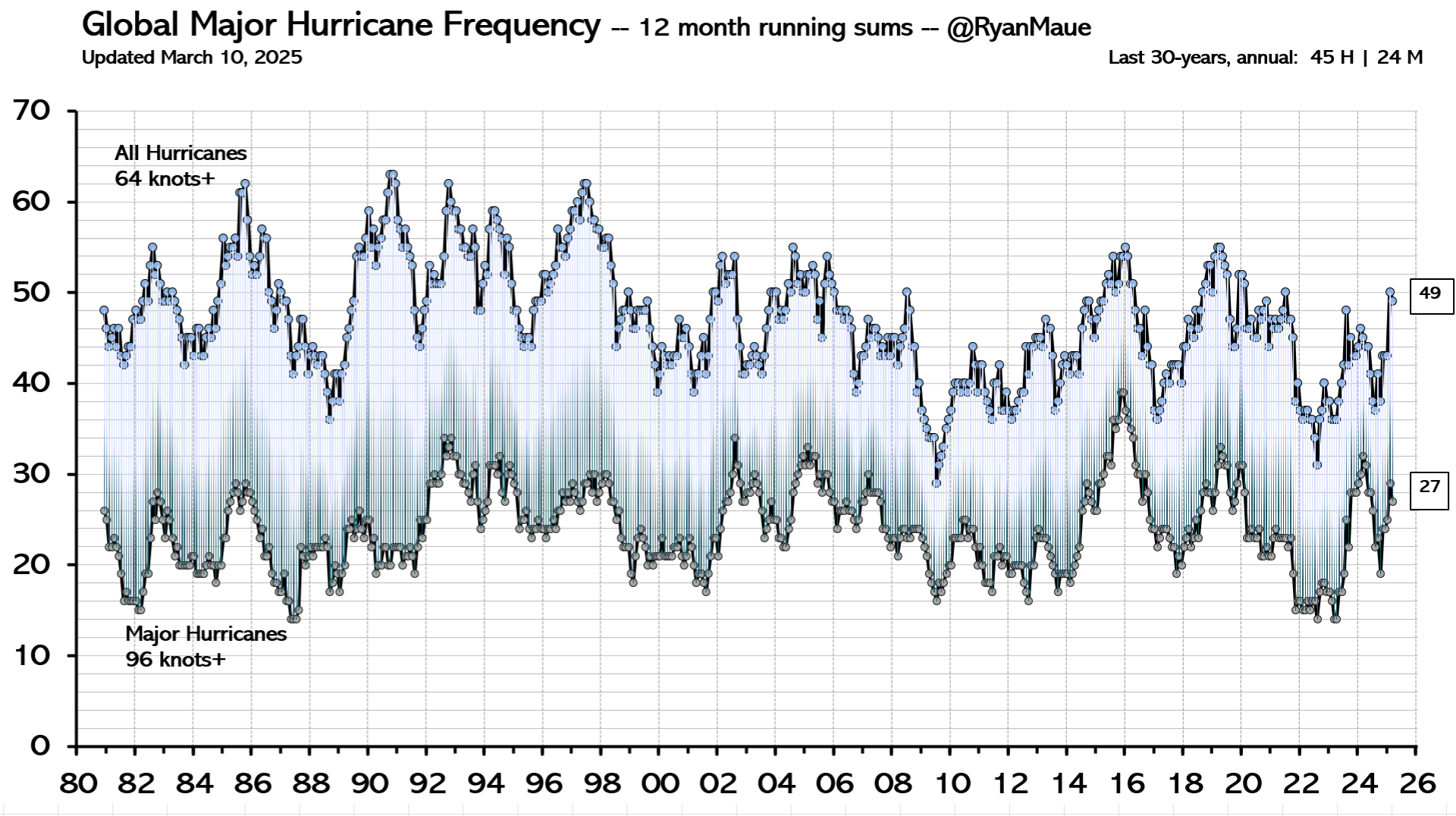
First is that there is no pattern of increasingly severe storms. The available hurricane and tropical cyclone data simply do not show that hurricanes are getting more intense, severe or frequent over time. Climate Realism has covered the data, sometimes at the state-specific level, dozens of times. Even the Intergovernmental Panel on Climate Change (IPCC) agrees, stating in their 2021 AR6 Working Group report that identifying past trends in tropical storm metrics is a “challenge.”
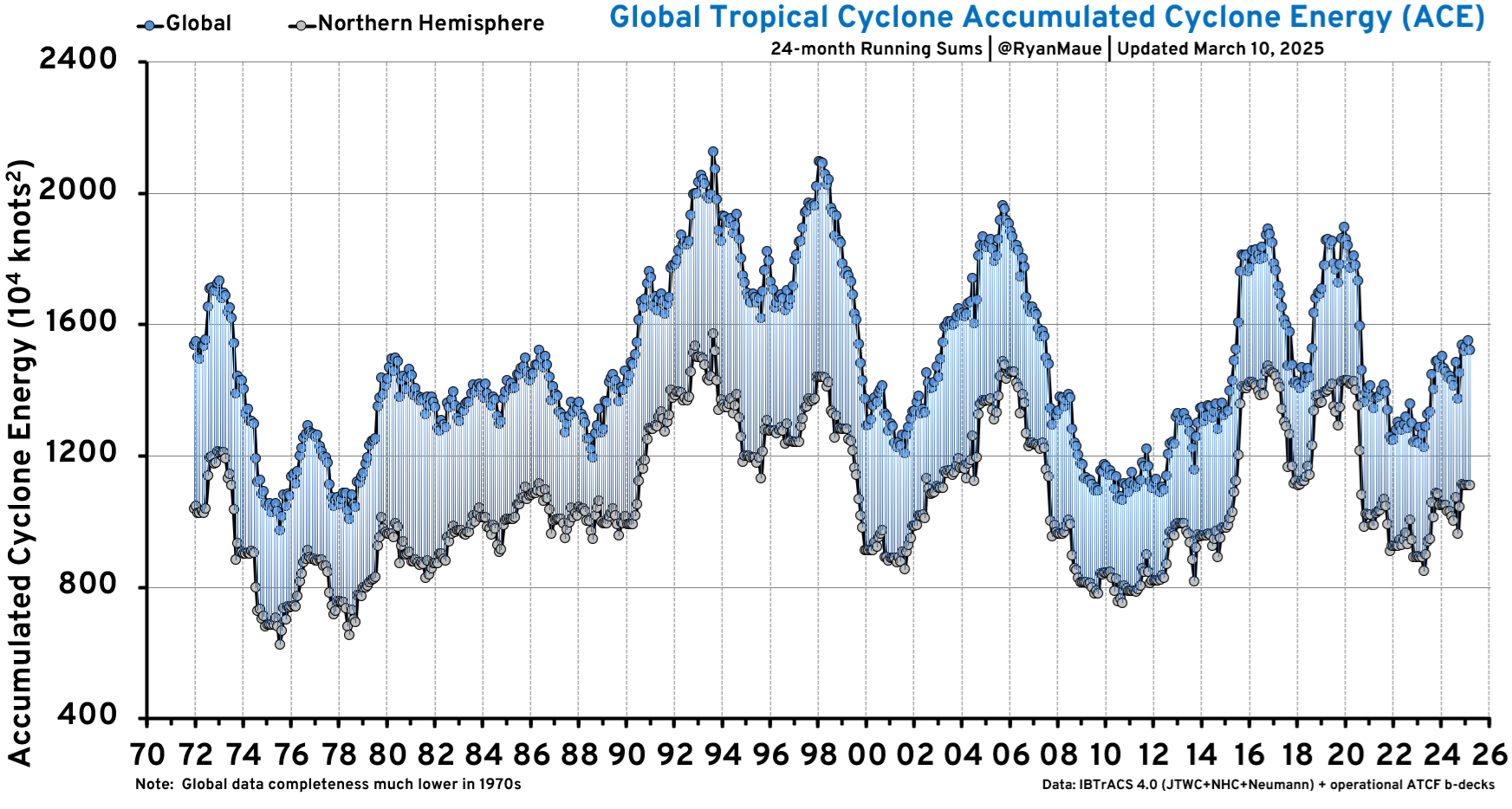
Since the beginning of more accurate data collection in the 1970s, there is no trend whatsoever for global tropical cyclone frequency, or global accumulated cyclone energy (ACE). (See figures below)
Figure 2: Last 50-years+ of Global and Northern Hemisphere Accumulated Cyclone Energy: 24 month running sums. Note that the year indicated represents the value of ACE through the previous 24-months for the Northern Hemisphere (bottom line/gray boxes) and the entire global (top line/blue boxes). The area in between represents the Southern Hemisphere total ACE. Source: Ryan N. Maue, “Global Tropical Cyclone Activity,” Climate Atlas, accessed October 10, 2024 https://climatlas.com/tropical/global_running_ace.png
Despite a much larger population in the Hurricane bullseye zone on the coasts now than in the past, most of top ten deadliest hurricanes occurred in the more distant past. Why? Because of improved early warning systems resulting in evacuations and infrastructure in the United States having been hardened against severe weather due stronger building standards and technology. Also, many deaths due to exposure to the elements have been prevented by modern generators and the speed with which emergency personnel can get into communities and power is restored. These improvements would not have been possible without fossil fuels and their byproducts, which climate alarmists seek to eliminate.
Every deadly storm is a tragedy, and it is just as much of a mistake to downplay the danger and damage from tropical cyclones as it is to hype them up and try to connect them to climate change. In this instance, CBS gave a simple, factual account detailing the somber history of severe hurricane landfalls in the United States and its territories. Bravo, CBS. See if you can follow this up by sticking the facts about severe weather in the future.
Terrence Keeley is a long-time ESG practitioner who until recently headed the official institutions group in the world’s largest asset manager BlackRock advising sovereign wealth funds, central banks, finance ministries, and public pension funds. He claimed in 2022 that “ESG investing could well be the biggest thing in finance since the Dutch East India company issued shares in 1602…ESG’s success or failure could literally impact every living creature on Earth.”
Terrence Keeley is a long-time ESG practitioner who until recently headed the official institutions group in the world’s largest asset manager BlackRock advising sovereign wealth funds, central banks, finance ministries, and public pension funds. He claimed in 2022 that “ESG investing could well be the biggest thing in finance since the Dutch East India company issued shares in 1602…ESG’s success or failure could literally impact every living creature on Earth.”
Mr. Keeley’s boss, Larry Fink, chief executive of BlackRock, was equally hyperbolic in his annual letter to CEOs in early 2020:
We believe that sustainability should be our new standard for investing…all investors – and particularly the millions of our clients who are saving for long-term goals like retirement – must seriously consider sustainability in their investments…I believe we are on the edge of a fundamental reshaping of finance.
Alas, the ESG and sustainability movement, a financial juggernaut in its heyday, has performed poorly in the past two years.
This poor performance has been a result of a combination of factors including the boomeranging impact of Western sanctions on Russia energy exports, the collapse of “clean” energy stocks, the rise in interest rates, and the widespread backlash against ‘woke capitalism’ and climate change regulations in Europe and the U.S.
ESG investment momentum has slowed on both sides of the Atlantic since 2022. In 2022, for the first time in more than a decade, investors pulled more money from funds marketed as “sustainable” than they added. In the first half of 2024, the U.S. ESG market experienced net outflows of over $13 billion, on the heels of a $9 billion outflow in 2023. Morningstar, a financial research firm, found nearly 2,500 fewer sustainable funds globally in 2023 relative to the prior year and 2024 is on track for an even steeper plunge.
According to Torsten Lichtenau, Bain and Company’s global carbon transition practice lead, “When you look at the importance of [environmental, social and corporate-governance efforts], you can clearly see a huge peak in 2021 to 2022 where there was also a lot of action off the back of the Glasgow COP26 climate conference in 2021. Now it’s dropped back to 2019 levels.”
Competitive Sustainability
Enter “competitive sustainability”, a buzz phrase of choice of its most vociferous proponents. The European Commission’s 2022 Annual Sustainable Growth Survey (ASGS) presented a “competitive sustainability” agenda for the EU covering four dimensions: productivity, environment, fairness, and stability. In a word salad worthy of Brussel’s unelected bureaucrats, it describes the agenda as one where “a fair, just, green and digital transition which requires sustainable social conditions, will serve as a foundation for future prosperity and resilience. Well-designed labour market policies and social protection systems are the basis for resilience and inclusive growth.”
In offering a Panglossian world where all good things go together – high productivity, environmental sustainability, fairness and stability – “competitive sustainability” is now the battle cry for the Cambridge Institute of Sustainable Leadership (CISL). It is mom’s venerable apple pie, something no reasonable person could object to. There are no difficult trade-offs to be made since “competitive sustainability” ensures both economic growth and environmental sustainability, not to mention equity and stability.
In an article published in the Financial Times last month, the interim CEO of CISL Lindsay Hooper begins by saying: “The business case for sustainability is clear: companies cannot thrive on a planet suffering from cascading crises and unmanageable risks. Yet, despite decades of corporate commitments, businesses continue to damage the planet, carbon emissions to rise and fossil fuel companies to chase growth.”
Ms. Hooper asserts that “It is time to confront the uncomfortable truth: ESG as it stands – grounded in disclosures and voluntary market action – will not deliver the necessary change. The solution is a radical shift towards ‘competitive sustainability’.”
What does this “radical shift” entail? To deliver change, Ms. Hooper says we must “redesign” penalties and incentives which “will require a critical mass of businesses to push for government action”. Evidently, market decision-making in the context of disclosure rules and voluntary action by company executives is not enough. She finds it imperative that governments “create conditions that make it economically compelling to phase out damaging activities. Otherwise businesses that voluntarily transition will be undermined by those that don’t.”
There we have it, straight from the hallowed halls of academe. Governments – presumably advised by sustainability-congruent academics – must replace markets by diktats that determine which industries are pursuing “damaging activities” and need to be proscribed, and which are not. An extreme case of governments picking winners.
The familiar trope of market myopia is trotted out by Ms. Hooper: “As long as the market rewards short-term gains over long-term resilience, businesses will harm the planet, and markets will destroy the foundations on which they depend.” Evidently, Mr. Hooper seems not to be too concerned about the “short-termism” of governments bound by electoral cycles.
Meanwhile, in the Real World…
Firms favoured by ESG investment metrics – the “non-damaging activities” as per Ms. Hooper – such as wind and solar system providers, electric vehicle manufacturers, “green” hydrogen producers, and other such “sustainable” entities have been having a hard time after initial enthusiasm and high IPO values.
The Renewable Energy Industrial Index (RENIXX) is a global stock capitalisation index of the 30 largest renewable energy industrial companies in the world including First Solar, Gamesa, Orsted, Plug Power, Solarcity, Tesla, and Vestas. Established on May 1, 2006, with an initial value of 1,000 points, the index stood at 1,013 points on September 25th, essentially registering zero value growth over the last 18 years. In comparison, the S&P 500 Index more than quadrupled over the same period. The RENIXX is down three years in a row from 2021, losing half its value. It should be noted that that this performance would have been far worse if the outperforming Tesla stock was removed from the index.
The iShares Global Clean Energy ETF aims to “target access to clean energy stocks around the world”. Last year its value fell by 26.1% and from its inception in 2008 it has lost about 60% of an initial investment of $10,000.
Perhaps the best example of ESG-inspired debacles is provided by bp, the hitherto “woke” oil company that has used lower-case letters for its name and logo since 2000. In the high road of the climate crusade, marked by corporate brochures extolling social responsibility and environmental sustainability, the company was first among its peers. Its then-CEO John Browne – now Lord Browne – declared in a 2020 speech at Stanford University: “We need to reinvent the energy business. We need to go beyond petroleum.”
According to an article in the Telegraph published on Monday, bp has abandoned its target to cut oil and gas production by 2030 “as its new chief executive scales back a switch to green energy to boost its share price”. Its new CEO Murray Auchincloss plans to focus on investments in oil and gas projects in the Middle East and the Gulf of Mexico to boost output. Quite unsurprisingly, in the real world where money matters, the company’s shares rose as much as 1.3% after the story was first reported by Reuters. Perhaps rather late in the day, the company’s senior management has decided that its fiduciary duties to maximize shareholder profits trump its devotion to “sustainability”.
Them Weasel Words
The question about the ethically appropriate role of business firms in societies in which they operate is as old as the business firm itself. Adam Smith, a keen observer of businesses – he authored An Inquiry into the Nature and Causes of the Wealth of Nations after all – was not at all uncertain in his response to this question in 1776: it is from the appeal to the self-interest of the butcher, the brewer and the baker that we expect our dinner, not to their benevolence. He had also “never known much good done by those who affected to trade for the public good”.
Almost two centuries later, Smith’s most famous acolyte Milton Friedman was just as clear: “There is one and only one social responsibility of business – to use its resources and engage in activities designed to increase its profits so long as it stays within the rules of the game, which is to say, engages in open and free competition without deception or fraud.”
He too was distrustful of businessmen who talk of promoting desirable social ends, for they are “unwitting puppets of the intellectual forces that have been undermining the basis of a free society these past decades”.
In the battle of the greatest weasel words of recent years, “ESG” and “competitive sustainability”, along with their corollaries such as “energy transition” and “net zero by 2050”, surely come out at the top.
It is not capitalist free markets but those that seek to replace them that threaten to destroy the foundations of modern civilization.
Dr. Tilak K. Doshi is an economist, a former contributor to Forbes, and a member of the CO2 Coalition.


You must be logged in to post a comment.