Global warming, climate change, all these things are just a dream come true for politicians. I deal with evidence and not with frightening computer models because the seeker after truth does not put his faith in any consensus. The road to the truth is long and hard, but this is the road we must follow. People who describe the unprecedented comfort and ease of modern life as a climate disaster, in my opinion have no idea what a real problem is.
A team of scientists is looking to dump chemicals into waters off the coast of Massachusetts this summer to research whether doing so could be an effective counter to ocean acidification and climate change, according to The Wall Street Journal.
A team of scientists is looking to dump chemicals into waters off the coast of Massachusetts this summer to research whether doing so could be an effective counter to ocean acidification and climate change, according to The Wall Street Journal.
The project would see researchers from the Woods Hole Oceanographic Institution (WHOI) pour approximately 6,000 gallons of sodium hydroxide — a component of lye — into waters ten miles away from Martha’s Vineyard, Massachusetts, in August 2024, according to the WSJ. The research project, estimated to cost about $10 million in total, will receive taxpayer funds from the National Oceanic and Atmospheric Administration (NOAA) provided the Environmental Protection Agency (EPA) signs off on releasing the chemicals.
The underlying concept is to see if the basic sodium hydroxide can reduce the acidity of ocean waters and make those waters more efficient repositories of carbon dioxide, according to the WSJ. Sodium hydroxide is a common ingredient in soaps and cleaning solutions, and it can be harmful to humans in high concentrations, according to the Tennessee Department of Health. (RELATED: Eco-Activists, Climate Scientists Quietly Met To Discuss Tinkering With The Sun)
“When you have heartburn, you eat a Tums that dissolves and makes the liquid in your stomach less acidic,” Adam Subhas, a WHOI scientist who is poised to serve as the project’s main investigator, told the WSJ. “By analogy, we’re adding this alkaline material to seawater, and it is letting the ocean take up more CO2 without provoking more ocean acidification. Everything that we’re seeing so far is that it is environmentally safe.”
NOAA will provide some of the funding for the project, which is also being supported financially by private donors and two philanthropic organizations, according to the WSJ. Neither NOAA nor WHOI immediately responded to requests for comment, which included inquiries about the identities of the organizations and donors backing the project.
“EPA will follow the permitting process as described in the Marine Protection, Research, and Sanctuaries Act regulations before reaching a final determination to approve or deny the permit application,” a spokesperson for the agency told the Daily Caller News Foundation. “Once EPA receives a complete permit application, the agency will provide notice to the public and will invite public comment on the permit application and EPA tentative determination on whether to issue a permit.”
WHOI’s intention to test the efficacy of tinkering with ocean chemistry reflects a wider emergent trend of climate scientists pushing so-called “geoengineering” projects, according to the WSJ. The basic idea of geoengineering is altering some physical or chemical aspect of an environmental system in order to counteract climate change.
Other geoengineering projects that are being considered or funded by the government, private sector or major donors include systems that shoot particles 60,000 feet into the air to reflect sunlight and cool the atmosphere, and another project that aims to enlarge and brighten clouds to increase reflectivity, according to the WSJ.
All content created by the Daily Caller News Foundation, an independent and nonpartisan newswire service, is available without charge to any legitimate news publisher that can provide a large audience. All republished articles must include our logo, our reporter’s byline and their DCNF affiliation. For any questions about our guidelines or partnering with us, please contact licensing@dailycallernewsfoundation.org.
If you care enough to know what damage, real damage, from a cyclone looks like at a coral reef, get yourself to Townsville and book a trip with Adrenalin Snorkel and Dive to John Brewer Reef.
If you care enough to know what damage, real damage, from a cyclone looks like at a coral reef, get yourself to Townsville and book a trip with Adrenalin Snorkel and Dive to John Brewer Reef.
It is not hard to describe parts of John Brewer Reef three weeks after cyclone Kirrily. My dive buddy, and one of the best underwater cinematographers in the world, Stuart Ireland, described what was once my favourite underwater crevasse overlaid with massive, perfectly arranged, pink plate corals, he now describes it as:
‘Bull in a China Shop Alley.’
All the corals have been picked-up, flipped-over, and smashed-up, at this section of John Brewer Reef.
Large sections of reef have been ‘demolished’, John Brewer Reef, February 15, 2024.
The plate corals were once so large, and back in April 2022, it was all so aesthetically pleasing because the corals were the right way up, growing together, tastefully arranged, delicately balanced, at varying heights, and a lovely pink.
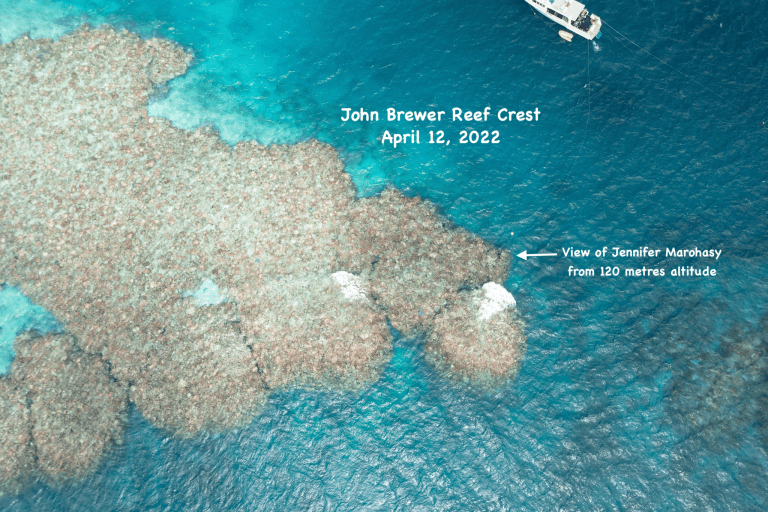
Before Tropical Cyclone Kerrily, this section of new growth reef photographed by Leonard Lim in April 2022.
Many of these massive corals that you can see in our film, ‘Bleached Colourful’, they have been lifted and flipped over. Such was the power of tropical cyclone Kirrily, barely a category three system as it passed over John Brewer reef.
If you enjoy a good horror film, and you fancy yourself as much more than an armchair environmentalists get out to this reef. Now.
I described this reef, John Brewer Reef, as the most colourful and beautiful reef that I have ever seen, that was when this same coral reef was making headlines around the world as being at the epicentre of a sixth mass coral bleaching, that was in April 2022 – two years ago. There were a few corals that had bleaching white, but most of the reef was intact and so colourful.
Cyclone Kirrily passed directly over the top of John Brewer Reef on Thursday January 25, 2024. As you might visit a friend in hospital consider taking the time to swim with these corals now – the corals as they struggle in recovery.
Information on the path of the cyclone, downloaded from the Townsville Bulletin website. On the afternoon of January 25, 2024, the cyclone was sitting over John Brewer Reef.
There are patches of coral that survived the cyclone at John Brewer Reef; there is coral that is still intact and upright with so many fishes, including most of the corals below 7 metres. So, you can still see good coral and lots of colourful fishes, especially if you go deep.
There are sections of intact coral, and so many colourful fish … still at John Brewer Reef.
But my favourite crevasse, and across the reef crest, well the large staghorn/branching corals have been mowed to stubble at the reef crest, and many of the plates scoured back to ugly grey with a thin layer of light green algae.
Dive Master, Skipper and Owner of Adrenalin Snorkel and Dive, Paul Crocombe, assures me these are a perfect surface now for mass recruitment, mass recruitment after the next coral spawning.
He is confident there will be a mass of dinner size plate corals across the reef crest at John Brewer within 5 years.
In the meantime, I’m planning to visit for the spawning in November, and I plan to return after that to see the very first polyps establish and so hopefully – there will be mass recolonisation of this reef crest.
John Brewer reef crest, February 15, 2024 with Paul and Jen on scuba. This is a screenshot from a documentary we are making about coral reefs and cyclones.John Brewer’s reef crest is a bit green , at the moment.John Brewer’s reef crest was a much healthier pink, back in April 2022.
*****
Book your trip with Adrenalin Snorkel and Dive. This is a once in a lifetime opportunity to see a reef scoured by a cyclone, particularly given both the number and intensity of cyclones is on the wane. Thank goodness.
The number and intensity of severe cyclones impacting the Australian regions, including the Queensland coastline, has been declining according to official Bureau of Meteorology data.
The first part of this series discussed some of the shortcomings of the renewable/nonrenewable dichotomy. Renewable generation resources are not necessarily sustainable or environmentally sound and non-renewable options can be clean and highly sustainable.
“Renewables”: some resources support a healthy grid, other challenge it
The first part of this series discussed some of the shortcomings of the renewable/nonrenewable dichotomy. Renewable generation resources are not necessarily sustainable or environmentally sound and non-renewable options can be clean and highly sustainable. For example, you will find many ardent environmentalist groups strongly opposed to “renewable” biomass generation. Similarly, more and more environmentalists are dropping their objections to “nonrenewable” nuclear power. For those who are concerned with the health of the planet as well as those who want to use the earth for human flourishing the renewable/nonrenewable dichotomy is losing relevance. Referring generally to “renewable” and “nonrenewable” resources or structuring policy to favor renewable does more harm than good as we face the complicate challenges ahead in maintain an adequate electric power supply in an environmentally responsible manner.
This posting examines the impacts of various generation alternatives s on the power system and the electric grid. Renewable resources do not have a general impact on the grid; impacts vary by resource type. The various renewable resources alternatives available today differ greatly in how they impact the grid and should not be clustered. Hydro resources with storage for example, work well to support the electric grid. In fact, it may be the best resource available considering the varied needs of the major grids. Demanding loads that stress the system are often best located near hydro resources. Other “renewable” resources to a greater or lesser extent may present challenges to the operation of the grid and grid reliability. In assessing the challenges of changing resources, reports that a particular grid is operating with 80% renewables may be impressive or virtually meaningless. Of course, a grid can function well depending on 80% hydro resources, or 78% hydro and 2% wind and solar. That’s very different and much less challenging than operating a grid with a penetration level of 40% wind and solar. Let’ look at some of the important characteristics of generation resources and how they differ among resource types.
Generation alternatives, especially some renewables, differ greatly in how and when they supply power. Starting out, the first question, “is the provided energy dependable?” The chart below is the daily output taken from A solar array It shows the energy produced on a typical sunny day with clouds rolling by. You can see the unpredictability introduced by random clouds superimposed upon the predictable daily curve made by the suns path. A bigger footprint or aggregating more farms would tend to smooth the output and increase predictability. But even when greatly smoothed, the energy output is following the sun not the system load.
Electric generation in the form of alternating power has to match load on an instantaneous basis. It’s important that the total generation supply be able to match the load as it ramps up or down. Resources that are dependable and can ramp up and ramp down to follow changes in load are very valuable allowing system operators to depend on them. Plants with the best dispatchability include hydro storage facilities, natural gas plants and batteries/storage. In the middle are plants which provide dependable baseload but are more limited in how well they follow load. These plants rang from coal, combined cycle gas plants, biomass and geothermal to nuclear. Wind and solar generally complicate load following as they are not dependable or able to follow load without attached storage. Run of river hydro is rare and to the extent it is unpredictable it can create difficulties. Speaking generally of the dispatchability of “renewable” resources makes little sense.
One manifestation of load following problems is known as the “duck curve”. In 2014 I warned of the emerging duck curve here and discussed in depth issues related to dispatchability for various generation resources. Since then, as expected, it has worsened considerably. The chart shows that as solar kicks in and fades out, the remaining resources have to ramp up and ramp down at a very steep rate that greatly challenges system operation.
While the daily impacts of solar resources ramping in and out present challenges, at least solar is somewhat predictable. Wind in some locations at sometimes is predictable to a degree but in other locations and at other times it can be highly variable. Sometimes wind and solar track load changes and sometimes they work against the variance in load.
This variability presents problems beyond load following. Generating resources that can’t be counted on need back up resources. If resources might become available, dependable generation must back up those resources. As noted above hydro and batteries can work well to balance energy and it can be easy to have them on standby for that purpose. Other resources however mut be committed and running on line at lower generation levels or depending on the timeframe, in standby mode. Also coal and gas generation have start up times which may delay their availability as well as minimum cool down periods during which they cannot be operated.
I am not trying to go into detail about the intricacies of scheduling and dispatch here, but rather trying to illustrate that generation availability can create challenges that are highly dependent upon the available resource mix and the specific characteristic of the individual resources. All individual renewable and non-renewable resources have their own unique characteristics. When we wonder as to how the grid might responds to renewable, we need to know which renewables are under consideration.
VRE and IRES: The Good and the Bad of these Terms
Some of you may want to remind me that some technical work does break down renewables into a separate Variable Renewable Energy (VRE) group or Intermittent Renewable Energy Source (IRES) group when discussing issues of reliability. Certainly, speaking specifically of the challenges of integrating large amounts of VRE or IRES into the grid is an improvement over discussing the challenges of generic unspecified renewable resources. Referring to VRES and IRES can be seen as somewhat a step in the right direction consistent with the recommendations here for clearer language, but we can do better.
The term renewable in both IRES and VRE is redundant. There are no significant nonrenewable generating options that are variable or intermittent in nature. (There are limited amounts of run of river hydro in some areas.) However, my major concern with this term is that it does not recognize the larger problem currently inherent with most intermittent renewable resources. In the series Academics and the Grid, I argued that it seems like there is a deliberate effort to hide the real challenges of a net zero transition by focusing almost exclusively on the problems associated with intermittency. These names seem to help promote the misconception that variability or intermittency stand as the major challenge. .
Imagine a factory with a problem that workers are showing up late and mostly all of them are intoxicated. Upper management instead of reacting to the very real concerns around inebriated employees, focuses instead on tardiness. They bring in experts to help ensure employees show up on time and provide innovative scheduling so that gaps can be covered with extended hours once the employees show up. To the extent that the measures address the problems of “tardy” employees and that they are able to cover the hours, the more problems associated with intoxication will show up. Maybe the business fears that if the intoxication problem becomes known they will have to slow down, make major changes, maybe lose some contracts. One can imagine that a business might short term want to hide the problem of “intoxication” so that it does not impact near term goals, but for long term success it must be confronted.
The big problem with wind and solar generating resources seems almost hidden in a similar manner. Many do not want to see the march towards “renewables” slowed. It’s obvious there are problems with increasing “ the level of available renewables, but if most of the talk about the smaller problems and the greater public ignores the larger problems, perhaps this is better for the current “momentum” of available renewable options. The focus on intermittency is distracting relevant actors from the bigger looming problems ahead. Far too many policy makers think that batteries or other solutions to the intermittency problem will enable us to march ahead towards net zero with resources that currently are not up to the task.
The Big Looming Problem Associated with Increasing Wind, Solar and Batteries
The major challenges associated with increased penetration of wind and solar generation are not caused by intermittency, but rather from how the energy is injected into the grid. The electric energy produced by wind and solar is transformed by a power converter using inverters in order to synchronize with the oscillating grid. In terms of reliability, resources that spin in synchronism with the grid as electric energy is produced are much better for the grid than those resources which use inverter-based technology to convert direct for grid injection. Resources that spin with the system are called synchronous resources, while inverter-based generation is called asynchronous generation. Note – Although wind turbines spin, they do so at variable speeds, requiring them to produce direct current power which must be then be converted to AC before entering the grid.
Synchronous resources readily provide inertia and essential reliability services which support the grid. In addition to dispatchability, hydro resources are valuable because they spin in synchronism with the grid. They are typically large and among spinning resources they have great grid supporting characteristics. Good spinning resources also include nuclear, coal, geothermal, natural gas, biomass, geothermal and molten salt thermal solar plants. In terms of supporting grid reliability, wind and solar resources which rely on asynchronous inverter-based technologies are at the other extreme.
It’s important that we distinguish between inverter-based technology and spinning machines because there is a strong potential to improve inverter-based technology. To some extent now, with additional features, power converters can roughly emulate some behaviors of rotating machines and help provide important reliability functions to the grid. There is hope that inverter-based generating resources will be better able to approximate spinning generation in future years. The National Renewable Energy Laboratory (NREL) recognizes that:
Managing the stability of electric power systems is based on decades of experience with large, synchronous generators. Today’s electric power systems have increasing numbers of nontraditional sources, such as wind and solar power, as well as energy storage devices, such as batteries. In addition to the variable nature of some renewable generation, many of these resources are connected to the power system through electronic power inverters.
The operation of future power systems must be based on the physical properties and control responses of traditional large, synchronous turbine generators as well as inverter-based resources. But there is no established body of experience for operating hybrid power systems with significant inverter-based resources at the scale of today’s large interconnections. To operate such systems, the assumptions that underlie generation design and control must be reexamined and modified—or even redefined—to take account of the challenges and opportunities presented by inverter-based generation.
Most inverter controllers today are grid-following and built on the assumption that system voltage and frequency are regulated by inertial sources. Such control approaches cannot guarantee system stability in low-inertia setting and are unlikely to sustain an inverter-dominated infrastructure. This limitation has inspired an investigation into grid-forming control methods for power electronic inverters, which provide functionalities that are traditionally provided by synchronous machinery.
Certainly, progress can be made. However, the Eastern Interconnection in the United States in the largest, most complicated machine in the history of the world. The challenge of adding significant amounts of asynchronous inverter-based generation increases the complexity tremendously. I have written extensively on the challenges of increasing the levels of penetration from asynchronous generation sources here, here, here, here and here. I believe that running any large complex grid without support from large rotation machines in very close to impossible within planning time frames. I see the challenge of allowing high penetration levels of asynchronous inverter-based resource as tougher than rocket science or brain surgery. Such an achievement would go beyond the moon landing, the sequencing of the human genome, the atomic bomb or a cure for the common cold.
Many entities, including the National Renewables Energy Laboratory, FERC, and NERC, are working hard to improve the functionality of asynchronous inverter based technology. They may well meet their goals to allow better grid support from these resources within the next five to ten years. Better support is possible. But that will still be a long way from eliminating the grids reliance on rotating machines.
Those who are more optimistic about the development of such technologies may end up being right. I hope so. It may be that we may have functional large grids driven by wind, solar and batteries within the lifetimes of some of our readers. But to get there, we have to recognize and acknowledge the difficulties inherent in such a transformation. Those who assume or pretend that there is no problem are either woefully ignorant or ignoring the looming problem in favor of short-term goals. Unfortunately, the challenges of asynchronous inverter based generation will not be adequately addressed of ever fixed if they are hidden.
Conclusion
Generically speaking about the impact of renewables on the grid, or what renewables can accomplish generates more confusion than clarity. Power system engineers know that it is easier to add wind, solar and batteries where there are existing supportive large hydro resources. It is harder to add wind, solar and batteries where the other resources are not that strong. Comparing the penetration levels of renewable generation for different areas with vastly differing amounts of hydro can be misleading, especially when hydro is included in the renewable category. Failing to distinguish between the capabilities of hydro, and wind and solar can lead to unrealistic selections for low hydro areas. Misconceptions on capabilities are especially a concern as existing hydro resources are increasingly challenged.
Large grids certainly can operate reliability without fossil fuel generation. Large grids can operate on 100% “renewable” energy. Reliability is not a function of the source of the energy input to the grid, but rather how that energy is injected into the grid. If solar powers spin a generator in synchronism with the grid (perhaps through the use of molten salt) that better supports reliability. If wind turbines could be made to spin only in synchronism with the grid, that would aid reliability. If the energy from hydro flows were captured with variable dc motors and injected to the grid with inverters, reliability concerns would increase. As the grid changes and we address reliability, is so much easier, direct and honest to speak of synchronous generation and inverter-based generation. The impact of “renewables” on reliability is too vague to be meaningful. Although this is the case, you frequently see references to renewable percentages which do not distinguish among the resources employed. These figures are quoted by those who want to push a perspective and they impact policy makers.
We do not face a challenge in integrating large amounts of renewable generating resources into the grid. We face operational challenges from intermittent resources. We face large reliability challenges from integrating large amounts of asynchronous inverter-based generation into the grid. The better the problem is understood, the better the problem can be addressed. We many disagree on the scope and magnitude of problems caused by intermittency as well as by asynchronous inverter-based generation. But be assured addressing the emerging problems will be go smoother, the more precisely the problems and successes are identified and defined.
In 1899 there was a large swath of the Southern USA that was used for Commercial Citrus Growing. Citrus Trees do not tolerate hard freezing. In fact they are tropical plants with only very slight ability to withstand freezing conditions.
Well since this question has only been answered by those who want to say no such science exists It has to be answered.
Here is an absolute proof that there is no global warming going on. It absolutely has no denial possible.
In 1899 there was a large swath of the Southern USA that was used for Commercial Citrus Growing. Citrus Trees do not tolerate hard freezing. In fact they are tropical plants with only very slight ability to withstand freezing conditions. Their fruit is even more tender, and so a Commercial Producer cannot tolerate any significant extended freezing. In Florida for example the Citrus producers have methods to withstand FROST. These are pretty amazing. (See photo above)
They literally spray their trees with water so that as the water freezes it prevents the citrus from freezing as the sugar content keeps the freezing point slightly lower than water. This method only works against light freezes of short duration. It often results in having to sell the crop in a rush to juice operations at loss of value.
So Citrus Commercial Production is prevented in all but areas with 365 day growing seasons.
The large swath of growing included about 1/2 of eastern Texas essentially south of Tyler Texas. It included almost all of Louisiana south of Interstate 20. It included Most of Mississippi south of Jackson and across Alabama up to Evergreen. It then extended across Georgia essentially from Columbus to Augusta and then up South Carolina all the way to North Carolina and a coastal strip of North Carolina up to almost Virginia. It also included All of Florida.
Basically this map shows in Zone 8b and slightly into Zone 8a the region that used to raise citrus. Today none can be raised outside of Zone 9b or higher. Actually the only safe in zone 10.
Today due to severe cooling of the environment, it only includes 4 of the most southern counties along the Rio Grande Valley in Texas and the southern part of Florida. Over the past 120 years, this has almost deleted Citrus growing from much of the southern part of North America.
This is the remaining Florida range of Citrus.
There is no remaining commercial citrus in Louisiana, Mississippi, Alabama, Georgia, South Carolina or North Carolina.
Now if you were to pick any location that was better for determining the global temperature you could not do it. This is the focal point for all of the global heat circulation of the world’s oceans. The heat focuses on the Yucatan Channel, goes through into the Gulf of Mexico forms a loop, shearing off much rainfall and heat into the Southeastern USA and subsequently going out the Florida Strait as the Gulf Stream, the world’s largest and warmest ocean current.
As such the temperature and climate of the area is the best representation of the world climate condition.
This is the reason that of the wettest states in the USA 4 of the top 5 are in this area.
Now that is fact. That is solid evidence. Silly claims and graphs cannot refute it.
Now some may point to an occasional remaining group of trees or such , but the fact is that commercial citrus is out of that region. The remnants are proof of exactly what I have said here.
Probability of a Hard Freeze under ENSO neutral conditions. Source: National Weather Service
After years of scant rainfall in a remote region of Sri Lanka, farmer Renuka Karunarathna’s crops failed and as the family’s income dwindled, her husband took his anger out on her, beating her so badly she had to go to a hospital.
“I have got beaten up so many times,” Karunarathna told said in her village of Sapumal Thenna in Sri Lanka’s North Central Province. “I suffer a lot.”
Domestic violence is a little-studied side effect of climate change, especially in poorer nations where increasingly frequent heat waves, droughts, floods and storms can exacerbate economic hardship, which in turn can fuel anger and violence.
…
Although Sri Lanka has few detailed statistics on the links between climate change-related crop failures and gender-based violence, Rashmini de Silva, a gender and climate change researcher, said when basic needs are not being met, women can suffer physical, verbal and psychological abuse.
“There are records of domestic violence where men beat their wives, when even the smallest issues in regard to buying food or expenses for children’s education or farming have to be discussed,” she said.
I’m utterly disgusted by this attempt to excuse bullying and violence against women as a climate change issue.
Is claiming climate change made someone use violence against his family any different from claiming the devil made me do it? The devil is the person inflicting the violence.
The reason men beat their wives is they are useless excuses for men. They haven’t got the guts to take on someone who can hit back. Even worse, the abused woman’s brothers and father are too gutless to protect their sister or daughter.
To try to use climate change as an excuse for such vile cowardice, all I can say is Sri Lanka and anywhere else which tolerates such behaviour needs to take a good look in the mirror, and stop making excuses for violent thugs.
Cultural violence against women is fixable, either through legal changes or other means. Women in India, next door to Sri Lanka, finally got fed up with cultural tolerance of violence against women, and the refusal of authorities to act. Nowadays men in India who hurt women live in fear of being beaten by stick wielding female vigilante gangs.
The legislation I am referring to is, of course, NDP MP Charlie Angus’ Bill C-372: An Act respecting fossil fuel advertising. You can’t help but burst out laughing if you read that Act’s name, and compare it to its contents.
Comedian Yakov Smirnov reminisced in 2014: “As a comedian in the Soviet Union, I was censored by the “Department of Jokes.” Well, actually it was called the Humor Department of the Censorship Apparatus of Soviet Ministry of Culture. I think they were hoping that by the time you finished saying their name, you’d be too exhausted to tell more jokes.”
The CIA, bless their hearts, translated the 1956 Soviet RSFSR Criminal Code, which you may know as Ugolovnyy Kodeks RSFSR if you run in such circles. It is a fascinating read, full of concepts like social danger, counterrevolutionary crimes, odd qualifiers (“This section shall not apply to persons who commit crimes in a state of intoxication.”), etc. Crimes against the Soviet system had their own preeminent status, as somewhat comedically noted (comedically because I did not have to live under it…):
You might wonder what kind of weirdo would go rummaging through such a document. I can’t answer that question specifically, weirdness has many stripes, but I can say that I know I did, and you may measure that as you will. The machinations of the old Soviet system have long been fascinating. It was somewhat startling then to read some recent proposed Canadian legislation and have a tiny voice sear through my brain saying “You’ve seen this before somewhere.”
Yakov Smirnov again: “So, a communist party official goes to a factory and says to one of the workers, ‘If you had a glass of vodka could you work today?’ The worker said, ‘I guess I could.’ ‘If you had two glasses of vodka, could you work?’ He said, ‘I guess I could.’ ‘If you had three glasses of vodka, could you work?’ He said, ‘I’m here, aren’t I?’ That joke did not pass.”
The legislation I am referring to is, of course, NDP MP Charlie Angus’ Bill C-372: An Act respecting fossil fuel advertising. You can’t help but burst out laughing if you read that Act’s name, and compare it to its contents.
The draft bill specifies penalties for producers (“on conviction on indictment to a fine not exceeding $1,000,000 or to imprisonment for a term not exceeding two years, or to both”) and individuals of any stripe (“Every person, other than a producer, who contravenes section 6 is guilty of an offence and liable on summary conviction to a fine not exceeding $500,000.”)
The true scope of the legislation is driven home even more forcefully elsewhere in the bill, and no, it does not stop at advertising. This is Bill C-372’s definition of ‘promotion’ [emphasis added]: promotion means a representation about a product or service by any means, whether directly or indirectly, including any communication of information about the product or service and its price and distribution, that is likely to influence and shape attitudes, beliefs and behaviours about the product or service.”
Don’t be silly, says the NDP, we’re not censoring anyone; the legislation is only aimed at false advertising. Sheesh, comrades, read the title. Mr. Angus himself, on Twitter: “Not to panic. #BillC372 doesn’t jail people for liking fossil fuels. It’s simply focused on false advertising…”
Really? From Bill C-372 itself: “8 It is prohibited for a person to promote a fossil fuel or the production of a fossil fuel…(b) in a manner that states or suggests that a fossil fuel or the practices of a producer or of the fossil fuel industry would lead to positive outcomes in relation to the environment, the health of Canadians, reconciliation with Indigenous peoples or the Canadian or global economy.”
Take a breather for one more memory from Mr. Smirnov: “It could take years to get a car in Soviet Russia at that time. So the guy goes to the car dealer and says, ‘I’d like to buy a car.’ The sales manager said, ‘Okay, put your name on the list, and come back in 20 years to pick up your car.’ The guy said, ‘Do I come back in the morning or in the afternoon?’ The manager said, ‘What’s the difference? It’s 20 years from now.’ The guy said, ‘The plumber is scheduled to come that morning.’ That joke did not pass either.”
OK, back to business. It will be necessary to address the catcalls that will be emanating forth from the bill’s defenders, guffawing in their lattes that someone would compare Soviet laws with Canada’s.
Remember a few paragraphs before, this nugget from Angus’ Act: “The draft bill specifies penalties for producers (“on conviction on indictment to a fine not exceeding $1,000,000 or to imprisonment for a term not exceeding two years, or to both.”
Hey, would you look at that…
Beyond the sentencing parallels, the overarching and all-encompassing murkiness is startling. A ‘representation about a product that is likely to influence or shape attitudes’ is so astonishingly broad that it catches almost any dialogue about fossil fuels at all. One could argue that influencing people negatively about fossil fuels would create a criminal, according to this legislation. That’s how broad and insidious it is; the bill seeks the power to control the narrative, however the authors would like to define it. The draft legislation is astonishingly even more broad based than the Soviet law 59-7, which only creates a criminal if the person did something ‘designed to arouse national enmity or discord’. According to the NDP, you would be guilty for simply ‘influencing or shaping attitudes’.
Almost everyone that speaks about energy would be a criminal under this legislation. Even Justin Trudeau, believe it or not. From the Liberal Party website: “We also believe that TMX could solve a core economic challenge we currently face.” That statement clearly violates ‘promoting the production of a fossil fuel…in a manner that states or suggests that a fossil fuel or the practices of a producer or of the fossil fuel industry would lead to positive outcomes in relation to the environment, the health of Canadians, reconciliation with Indigenous peoples or the Canadian or global economy.’
What can one conclude, when draft censorship legislation catches almost everyone that comments on energy? Which by definition is true, because if one speaks of fossil fuels long enough, with a clear brain, it will be necessary to admit fossil fuels are at least in some way beneficial for society.
The draft legislation is clearly laughable, but consider the very useful side effect. Like a phoenix rising from the ashes is something wonderful about all this legislative brain-gunk, and how it actually can help clarify and clear the air. Bear with me for a second before getting to that.
In the days after Angus’ press conference announcing the draft legislation, his supporters took to the airwaves in support. This tweet was from a writer at the far-end-of-spectrum National Observer: “You’ve hit a nerve @CharlieAngusNDP. One can measure the merit & strength of a climate policy by the reaction of the oil and gas companies and their political/media defenders.”
Think about the quality of thought that would “measure the merit & strength” of a censorship policy based on how upset the people being censored become. A naked and value-less attempt at provocation. An abdication of reason, an abdication of constructiveness, a purposeful attempt to do nothing more than get under someone’s skin.
The same vicious vacuousness forms the core of Angus’ attempt to do whatever it is he’s trying to do. In his new conference, he compared fossil fuels to tobacco, repeatedly, which is a handy shortcut indeed, because that comparison is the seal of authenticity – guaranteed ignorance, present. Comparing tobacco to fuel is a complete forfeiture of common sense: Tell us how you heat your home with tobacco. Tell us how a farmer fills his tractor with tobacco to grow your food. Tell us how virtually every consumer product and medical staple is made from tobacco.
When you think about it, this draft legislation and supportive reactions remind one of Alex Jones. Yes, that Alex Jones, the Infowars shotgun-mouth guy that claimed the Sandyhook elementary school massacre never happened. The type of guy that will stare the camera in the eye and declare Joe Biden or Hilary Clinton to be pedophiles. He’s a bombastic schnook that thunders away relentlessly, drifting further and further from sane dialogue like a boat that’s lost its tether. (I watched Alex Jones enter a ‘debate’ about the events of January 6. A person from each side presented arguments that were researched and reasoned. Jones floated in the middle, hovering and shouting, unable to rise to the level of the surrounding discourse in any vislble way. It was painful.)
You might ask what those could possibly have in common – hard left and hard right. Here’s the beauty of free speech: When every voice is allowed to be heard, the common person with any reasoning capability whatsoever can spot the lunatic. It doesn’t matter what your middle of the road political leanings are, there is a wide swath of people that just know instinctively to distance themselves.29dk2902lhttps://boereport.com/29dk2902l.html
Here’s what’s so awesome: When free speech is allowed, the lunatics plaster the fact that they’re lunatics right across their foreheads. They self-identify as such. We know who to exclude from civilized and/or constructive conversations. To a rational person, it becomes impossible to ‘take sides’ with these people, even if you agree with the underlying thesis they vaguely try to stand on.
The outstanding Tara Henley, an ex-CBC journalist now independent, had these excellent thoughts on her Substack the other day, in reference to what she calls identitarian moralism: “The problem with this ideology, I think, is that it has taken the very good instincts of very many well-meaning Canadians — This thinking has dominated the media. It’s a very difficult thing to unpack, because it is presented as a moral imperative. ‘If you are a decent person, this is how you should think about the world.’… Many of the arguments that I had in the newsroom, for example, were about pointing out that this is a political ideology and we are politicizing content… It’s very divisive. Many of its ideas go against the liberal, pluralistic ethos that many of us have been raised with.”
The liberal, pluralistic ethos Henley refers to is arguably one that we most want to see. Acceptance of various viewpoints, with the most important overriding criteria that they be grounded in reality. Universalities have to be.
There is no good path forward if thinking like this legislation is part of the discourse. It doesn’t fit with anything a society should be working towards, even if working towards a better environment. We have a lot of work to do. No productive person should be wasting a second even contemplating hate-filled fringe output, but because it is not fringe – taxpayers in one way or another funded this censorship legislation, right into the house of parliament – we can’t entirely ignore it.
Canada has a million things to fix, like the cost of living, like housing, or Indigenous drinking water, or our lamentable military capabilities. As part of the global energy community we are part of many fantastic new energy developments that we can build, and build especially well, if we leverage the full might of our hydrocarbon sector, and not work to erase it. There is no room in the discourse for the spectrum-end wingnuts.
Having said that, the last thing we want to do, or should do, is silence them, censorship is for doomed dictatorships. But we don’t have to fixate on them – the best thing is to just step around them and get to work.
Energy conversations should be positive, grounded in reality, and…funny! Life depends on it, both the energy and the humour. Find out more in “The End of Fossil Fuel Insanity” at Amazon.ca, Indigo.ca, or Amazon.com. Thanks!
Read more insightful analysis from Terry Etam here, or email Terry here.
The Valparaíso region of Chile is wealthy and densely populated, but last Friday there was little to warn residents living in the green hills and valleys that a firestorm packing the power of several hydrogen bombs was to hit.
Fabiola Camilla, a 31-year-old mother of two, watched her seven-year-old daughter playing at her birthday party. She recalled nothing out of the ordinary, other than the warm, dry weather the currents of El Niño had brought to an area known locally as the Jewel of the Pacific.
There was also a fierce wind, said Misael Vergara Tapia, a resident of the neighbouring village of Achupallas. “A hot wind … a wind we had never felt before.”
From this idyll erupted hell. Moments later, fire was leaping from house to house, setting entire neighbourhoods ablaze and threatening the lives of thousands. “It was like a tornado of fire,” said Misael, 67. “In five minutes, you couldn’t see more than half a metre in front of you. Everyone was shouting, calling for their family. People died on the streets, in their cars.”
The wildfire is the worst disaster to hit Chile for more than a decade. At least 131 people have died, with a further 370 still missing. The hillside neighbourhoods it ripped through, destroying more 15,000 homes, are now a scorched wasteland of broken cement and steel.
Firestorms of this magnitude are a terrifying phenomenon, moving so fast and with such energy that they can kill people hundreds of metres away through radiant heat alone. But it is not unique.
Hawaii, California, France, Portugal, Canada, Greece and Australia have all been hit in recent years. In July 2022, when temperatures reached 40C for the first time in the UK, the residents of Wennington in east London witnessed nearly 20 houses burn down in a matter of minutes. The spark was a compost heap that had spontaneously combusted.
Experts are now asking: What’s causing these infernos? And is there anything that can be done to stop them?
Chile’s forest fire, like most, was preceded by unusually high temperatures, low humidity, and strong winds.
The blaze started at midday in forested mountainous areas, and by the afternoon had swept northwards into the city of Viña del Mar, home to 330,000 people, and the smaller urban areas of Quilpué, Limache, and Villa Alemana.
Wildfires have become three times as common in Chile in recent years, according to a recent report in Nature.
Officials say some are started intentionally and that extreme weather conditions – “fire weather” – are responsible for their rapid spread.
“Fires are increasing due to the combination of El Niño and global warming,” said Dr Raúl Cordero, climate professor at the University of Groningen and the University of Santiago.
“The years where fires are more frequent are the years of El Niño. The effects of global warming on the weather cannot be ignored anymore.”
Dr Cordero says that the main anomaly on the day of last week’s inferno was the extreme temperatures. “In the epicentre, on Friday and Saturday, it was 36 degrees – a likely all-time record for this city,” he said.
The Valparaiso region is in the central region of Chile, which has a Mediterranean climate. In other words, one which during El Nino is very hot and dry, and therefore prone to fires.
And it is this region where the native forests have been almost totally replaced by invasive species, including eucalyptus. Most of the clearing of native forests has taken place in recent decades:
On episode 98 of Climate Change Roundtable, The Heartland Institute’s Anthony Watts, H. Sterling Burnett, and special guest Steve Milloy cover the most important climate related stories of the past few weeks and provide rebuttal, commentary, and humor.
The Climate Trial of the Century is over, we followed the trial every day for nearly four weeks, and during that time, we missed a lot of climate stories we’d normally cover. You can thank Michael Mann for this lapse.
On episode 98 of Climate Change Roundtable, The Heartland Institute’s Anthony Watts, H. Sterling Burnett, and special guest Steve Milloy cover the most important climate related stories of the past few weeks and provide rebuttal, commentary, and humor.
JPMorgan Asset Management (JMAM) and State Street Global Advisors will not be renewing membership in Climate Action 100+, a coalition of investors and asset managers with a combined $68 trillion under management that pushes corporations to reduce emissions and adopt climate risk disclosure practices, according to Financial Times.
Several of the largest asset managers in the U.S. are withdrawing from a major coalition of companies focused on advancing green investment strategies and climate-sensitive corporate management.
JPMorgan Asset Management (JMAM) and State Street Global Advisors will not be renewing membership in Climate Action 100+, a coalition of investors and asset managers with a combined $68 trillion under management that pushes corporations to reduce emissions and adopt climate risk disclosure practices, according to Financial Times. BlackRock — the largest asset manager in the world — is scaling back its involvement with Climate Action 100+, withdrawing from the coalition as a corporate member but staying involved through its smaller international arm.
Climate Action 100+ and Ceres — a green shareholder activist group that co-founded the coalition — are currently under investigation by the House Judiciary Committee, which is alleging that the coalition’s advancement of progressive Environmental, Social and Corporate Governance (ESG) policies may constitute non-competitive activity in violation of U.S. antitrust law.
“Today’s decisions by JPMorgan and State Street are big wins for freedom and the American economy, and we hope more financial institutions follow suit in abandoning collusive ESG actions,” House Judiciary Committee Chairman Jim Jordan wrote of the withdrawals in a statement posted to X, formerly Twitter.
JPMAM has built up a team of about 40 professionals who specialize in sustainable investing, providing it the ability to pursue its own climate-oriented strategies, a JPMAM spokesperson told Financial News.
“Given these strengths and the evolution of its own stewardship capabilities, JPMAM has determined that it will no longer participate in Climate Action 100+ engagements,” the spokesperson told Financial News.
JPMAM and State Street are the latest major Western firms to drop out of climate-oriented corporate initiatives. Vanguard, another massive asset manager, withdrew from the Net Zero Asset Management initiative in 2022, while major insurers including Lloyd’s of London, Allianz and Axa all pulled out of the Net-Zero Insurance Alliance in 2023, according to Reuters.
“After careful review, State Street Global Advisors has concluded the enhanced Climate Action 100+ Phase 2 requirements for signatories will not be consistent with our independent approach to proxy voting and portfolio company engagement,” a spokesperson for State Street told the Daily Caller News Foundation. “As a result, we have decided to withdraw from Climate Action 100+.”
BlackRock, which did not fully withdraw from the coalition as JPMAM and State Street did, had arrived at the decision to change its level of engagement with Climate Action 100+ a few weeks ago, a spokesperson for the company told the DCNF.
“BlackRock has also changed its relationship with Climate Action 100+ as a result of changes Climate Action 100+ has made to its strategy. BlackRock became a signatory to Climate Action 100+ in Q1 2020, at a time when Climate Action 100+ was focused on corporate disclosure,” a note from BlackRock regarding the change of its relationship with Climate Action 100+ reads. “In June 2023, Climate Action 100+ published its phase 2 strategy which comes into effect in June 2024. This new strategy will require signatories to make an overarching commitment to use client assets to pursue emissions reductions in investee companies through stewardship engagement. In our judgment, making this new commitment across our assets under management would raise legal considerations, particularly in the U.S.”
Climate Action 100+ does not comment on the circumstances surrounding individual departures from its ranks, a spokesperson told the DCNF.
JPMAM did not respond immediately to a request for comment.
All content created by the Daily Caller News Foundation, an independent and nonpartisan newswire service, is available without charge to any legitimate news publisher that can provide a large audience. All republished articles must include our logo, our reporter’s byline and their DCNF affiliation. For any questions about our guidelines or partnering with us, please contact licensing@dailycallernewsfoundation.org.
An article in Time Magazine (Time) claims that January 2024 was the hottest ever on record for the planet. Titled, 2024 Had the Hottest January on Record Following 2023’s Hottest Year on Record the article is based on a single source of temperature data. Data from multiple other sources of temperature measurements refute this claim.
An article in Time Magazine (Time) claims that January 2024 was the hottest ever on record for the planet. Titled, 2024 Had the Hottest January on Record Following 2023’s Hottest Year on Record the article is based on a single source of temperature data. Data from multiple other sources of temperature measurements refute this claim.
Time refers to the Copernicus EU climate service as the source for its alarming claim. Copernicus EU issued press release claiming:
January 2024 was the warmest January on record globally, with an average ERA5 surface air temperature of 13.14°C, 0.70°C above the 1991-2020 average for January and 0.12°C above the temperature of the previous warmest January, in 2020.
…
The month was 1.66°C warmer than an estimate of the January average for 1850-1900, the designated pre-industrial reference period.
The problem with that is that they are using a reference period of 1850 to 1900 that no other climate data source uses; a period, not coincidentally, more than 100 years of global warming ago when the Earth was cooler than today. For example, NASA Goddard Institute for Space Studies (GISS) produced a map of the globe that shows a significantly lower global temperature for January 2024.
The GISS global value was just 1.20°C compared to the 1.66°C claimed by Copernicus is different because NASA GISS is using a base period of 1951 to 1980. Copernicus seemingly cherry picked the reference period to fit the climate crisis narrative, and Time was too uninterested in seeking and presenting the truth to investigate the extraordinary claim, instead reporting it as an unchallenged fact.
The satellite global temperature value is just 0.86°C, essentially half of what Copernicus claims at 1.66°C.
While it is not the globe, the United States (U.S.) is often cited as being a leading metric for climate change by both media and scientific sources. This is because the U.S. has more temperature stations per land area than any other region included in the global climatological network. As such, its readings have an outsized impact on global average temperature measurements. Yet when you examine the data from the US Climate Reference Network (USCRN), the best and most state-of-the-art surface measurement system in the world we find that not only was January 2024 not the hottest on the record it was below normal in temperature:
At -0.14°F (-0.08°C), there is certainly no cause for alarm about temperature in the United States. Yet Time does not mention any of these other sources.
It gets worse than the simple subversion of science by omission of critical facts. Time quoted a spokesperson for Copernicus in the article:
“Rapid reductions in greenhouse gas emissions are the only way to stop global temperatures increasing,” Samantha Burgess, deputy director of the Copernicus Climate Change Service, said in a statement.
That statement is nothing more than political advocacy calling for the reduction of greenhouse gases through restrictions of economies, rather than simply reporting the science. By using that quote, Time is complicit in pushing advocacy over science.
Time’s article is yet another ugly example of mainstream media preferring to push an alarming climate change narrative rather than reporting all of the facts, in context, honestly, and without bias. Shame on Time for failing to adhere to the most basic journalistic standards.




You must be logged in to post a comment.