The Independent is Wrong – Coffee, Chocolate, and Wine Are Thriving

The Independent’s recent article, “Engineering climate may not be enough to save coffee, chocolate, and wine,” warns that even extreme geoengineering might not preserve “luxury crops” in a warming world. The whole story is based on a false premise that some technological fix is necessary to prevent crops like cocoa, coffee, and wine grapes from declining. The writer’s mistake is to rely on flawed computer model projections rather than real-world agricultural data that show the crops the story claims are under threat are actually thriving in today’s slightly warmer world.

A luxurious setting featuring a glass of red wine, a bottle labeled 'Chocolate,' various chocolates on a platter, two cups of coffee, and a green grape bunch on a wooden table, surrounded by a cozy, elegant interior.

From ClimateRealism

By Anthony Watts

A news article from The Independent discusses the challenges of saving luxury crops like coffee, chocolate, and wine through climate engineering, with the word 'BOGUS' prominently displayed over an image of cacao beans drying outdoors.

The Independent’s recent article, “Engineering climate may not be enough to save coffee, chocolate, and wine,” warns that even extreme geoengineering might not preserve “luxury crops” in a warming world. The whole story is based on a false premise that some technological fix is necessary to prevent crops like cocoa, coffee, and wine grapes from declining. The writer’s mistake is to rely on flawed computer model projections rather than real-world agricultural data that show the crops the story claims are under threat are actually thriving in today’s slightly warmer world. An understanding of crop biology indicates crop yields and production should continue to improve in the future.

The study behind the article relied on simulations of stratospheric aerosol injection (SAI), a highly controversial technique that would spray reflective particles into the upper atmosphere to block sunlight, cooling the Earth. SAI is increasingly promoted as a last-ditch tool to “fix” global warming, but the science and potential side effects make it a profoundly bad idea. The models used to justify SAI’s necessity already exaggerate warming by a wide margin, so any proposed “correction” risks overshooting reality. Studies have warned that SAI could severely disrupt global precipitation patterns, may impact global systems and human health outcomes, which could undermine food and water security far more than modest warming would. The cooling effects of volcanic eruptions — often cited as SAI’s natural analogue — also illustrate its dangers. After Mount Pinatubo’s 1991 eruption, global temperatures dropped briefly, but so did rainfall, crop yields, and sunlight reaching the surface. Moreover, research from the American Geophysical Union shows that stopping aerosol injections suddenly could trigger rapid rebound warming worse than the original problem. In short, SAI would amount to a global-scale experiment with unpredictable consequences, addressing symptoms rather than causes and risking climatic side effects no computer model can reliably forecast.

Researchers cited by the Independent concluded that while SAI might reduce global temperatures, it would not reliably protect coffee, cacao, or wine grapes from future climate shifts. What the article doesn’t mention is that such predictions come from models that have repeatedly exaggerated past warming trends. According to Climate at a Glance: Climate Model Fallibility, climate models “run hot,” overstating observed temperature changes by roughly a factor of two. If the models are off in their temperature projections,  any conclusions drawn about future agricultural impacts are equally suspect.

The problem is that the Independent’s reporter, Emily Beament, presents these simulations as if they reflect reality. They do not. Real-world crop data tell a very different story. In the actual world, the three crops supposedly in peril are thriving. Climate Realism has repeatedly demonstrated that global coffee output has been rising for several decades, setting new records and repeatedly debunking sporadic warnings of decline. Higher carbon dioxide concentrations act as plant fertilizer, enhancing photosynthesis and improving drought resistance—factors that have helped coffee plantations, not harmed them.

The same pattern holds for chocolate. West Africa, which provides about 70 percent of the world’s cacao, continues to produce robust harvests. Climate Realism has pointed out in Chocolate Shortages? Not in the Real World that production trends remain strong, and farmers are adapting successfully through irrigation improvements and hardier hybrid plants. There is no evidence of a climate-driven collapse, only the ongoing evolution of agricultural practice that has always defined farming.

Even wine grapes, the article’s third “endangered” crop, have prospered. A warmer world has actually expanded vineyard regions, especially in northern Europe. Climate Realism reported in Warmer Weather Is Expanding, Not Shrinking, Wine Regions that England now produces high-quality sparkling wines in areas once considered too cold for grape cultivation. Meanwhile, global grape yields continue rising, with improved quality linked to longer growing seasons and CO₂ enrichment.

Hard numbers confirm these assertions. The United Nations Food and Agriculture Organization (FAO) reports that since 2000:

  • global coffee yields have increased by approximately 30 percent;
  • cacao yields grew by nearly 10 percent;
  • and grape yields continue to hit or approach record levels, rising by more than 25 percent.

These are not the statistics of crops “under threat.” They are indicators of a more productive, resilient agricultural sector benefiting from modest warming and the fertilizing effects of carbon dioxide. (see the figure, below)

Line graph showing global yields of coffee, cacao, and wine grapes from 2000 to 2022, indicating an increase in yields over time.

The Independent’s article also fails to distinguish between natural climate variability and long-term trends, instead lumping all weather fluctuations, what they call “worsening weather extremes of climate change,” as another factor affecting crop yields. The facts say otherwise, showing severe weather is not increasing globally. Real-world data show no significant increase in extreme weather over the past 100 years. Nor does the Independent address the extensive body of satellite data from NASA showing that the planet has become significantly greener over the past four decades, a trend confirmed by multiple studies on CO₂ fertilization and vegetation growth. As a result, cropland productivity is up, not down, across much of the globe.

In the end, the Independent’s warning that your morning coffee, your chocolate bar, and your evening glass of wine are in jeopardy is falsified by actual data. The Independent’s hyperbolic, alarming claims about coffee, cocoa, and grapes are based on the outputs of notably flawed computer models, and quotes from a single researcher.

By omitting any reference to actual crop performance, the piece reads less like reporting and more like a climate advocacy handout. A sincere journalistic effort would have compared model predictions with field results, consulted agricultural experts, and reviewed FAO data before repeating unverified, patently false claims of climate-driven decline. The failure to do so is indicative of the seriously flawed and ideologically compromised way that the mainstream media covers climate change.

Shock COP Dirty Secret: At Least Half the Balsa Wood in Wind Turbine Blades is Illegally Logged in Amazonian Rainforests

How clean is clean when the rainforest pays the price?
The wood’s unique qualities make it ideal as a core for the giant blades attached to wind turbines. Ecuador produces over 90% of balsa due to unique climatic conditions in this particular area of the Americas.

Diagram illustrating the structure of a wind turbine blade, highlighting components such as the core material (balsa wood), spar, shear web, and structural adhesive.

From The Climate Sceptic

By Chris Morrison

Two men on a wooden boat navigating a river lined with lush greenery, with a log raft visible in the water.

How clean is clean when the rainforest pays the price?

Protecting the Amazon rainforest is one of the main goals of COP30, with the location in the Brazilian city of Belém chosen to emphasise what is described as the crucial role that such forests play in global climate regulation, biodiversity and “carbon” storage. It is bad enough that 100,000 mature rainforest trees had to be cut down to build a ‘Highway of Shame’ to speed COP delegates around town this week and next. But a far greater scandal, which today the Daily Sceptic brings to wider public attention, is the illegal logging of balsa wood in the Ecuadorian rainforest to supply rocketing demand from mostly Chinese wind turbine manufacturers. Such is the need for the strong but extraordinarily lightweight wood; it is estimated that at least 50% of the world’s balsa demand is currently being supplied by illegal logging in virgin rainforest.

The wood’s unique qualities make it ideal as a core for the giant blades attached to wind turbines. Ecuador produces over 90% of balsa due to unique climatic conditions in this particular area of the Americas. Much of it was previously obtained from plantations, but a ‘balsa boom’ over the last five years has depleted these resources and shortages have been made good by plundering the rainforest. And plunder is hardly an exaggeration, with trees apparently being removed from some of the most protected areas of the Ecuadorian forest.

Last year, the Environmental Investigation Agency produced a damning report that found many producers blended plantation wood with illegally harvested wild balsa from Amazon forests, including the Yasuni Biosphere Reserve, home to uncontacted indigenous groups. Its key finding is reprinted below:

According to EIA’s investigation this skyrocketing demand has had a long lasting effect. It appears that since the 2019–2020 balsa boom, the entire balsa production sector continues to depend upon the logging of natural forests, with a blending of plantation vs natural forest that allegedly varies between10% and 70% depending on exporter. These mixing practices in Ecuador have global repercussions.

Curiously, this shocking report, that seriously undermines the ethical production chain of wind turbines, failed to get a mention in the mainstream media. The EIA is not a small unknown operation, rather it is a substantial well-funded NGO founded in 1984 in the UK, with offices in the US and Europe. The Net Zero fantasy requires the planet to be blanketed with wind turbines, and this obviously overrules any ecological concerns. Bats and birds can be killed in their millions, whales beached on shorelines and entire local ecosystems disrupted, but the political activists don’t seem to care. If anything is said, it is little more than justifying and accepting the ecological consequences for the greater Net Zero good. For instance, in the UK the Bat Conservation Trust states that “climate change” is a significant threat to bat populations. “We need renewable energy to help mitigate for climate change for the benefit of the bats, people and the wider environment,” it adds.

Until recently, balsa wood was a small market, its uses including model aircraft and surfboards. The balsa boom led by wind blade demand means the current market is estimated at an annual value of at least $200 million. The balsa tree (Ochroma pyramidale) is fast growing in the right tropical conditions. If it wasn’t for the enormous demand created by the wind industry, it could be harvested on plantations as a sustainable commodity. As it is, recent and continuing demand has exhausted many plantations and denuded areas of virgin rainforest. In a wild setting, balsa trees often fill in natural gaps. Harvesting them creates sudden clear spaces that disturb the complex webs of life that support thousands of animal and plant species. Although fast growing in rich soils, regeneration in the rainforest can be much slower due to poor quality ground and local erosion caused by canopy removal.

To this day, balsa wood has numerous advantages as a core wind blade material over possible plastic foam substitutes. It has superior strength and stiffness compared to foam materials, and this allows for thinner core layers in high load areas like a blade’s root. This helps overall weight to be reduced without any reduction in overall engineering integrity. Prices of balsa wood are generally considered competitive, not least it would seem because production of plantation timber is massively boosted by the illegal logging.

The EIA report is worth reading in full. Mainstream media might even consider reporting its findings. The EIA investigators toured many of the illegal logging sites and charged that most, if not all, exporters quickly turned to natural forests as a “convenient and immediate available replacement” when plantations were quickly depleted of older trees from around the turn of the decade. It was found that balsa was extracted from Ecuador’s Amazonian heartland, “much of it spanning some of the last intact forest landscapes in the country”. These were said to be unique protected areas and emblematic indigenous territories. Traders are said to have told EIA that the logging of balsa was taking place “from north to south across most of the Amazonian provinces of the country”.

The EIA recommended that wind blade manufactures and wind power developers suspend the use of balsa until Ecuadorian supply chains are traced and transparent. The answer to that, as Britain’s unhinged energy secretary Ed Miliband once sang, is blowing in the wind.

Chris Morrison is the Daily Sceptic’s Environment Editor. Follow him on X.

A logging machine and workers in a deforested area, surrounded by cut trees, showcasing the impact of illegal logging.

Who will Pay for President Lula da Silva’s COP30 Rainforest Fund?

“That consensus has gone”
President Trump, who is not attending the meeting in the Amazonian city of Belém, was called a liar by the leaders of Colombia and Chile for his rejection of climate science.

An artistic depiction of the COP30 climate conference scene, showcasing a large gathering of people in a tropical environment with mountains and greenery in the background.

From Watts Up With That?

Essay by Eric Worrall

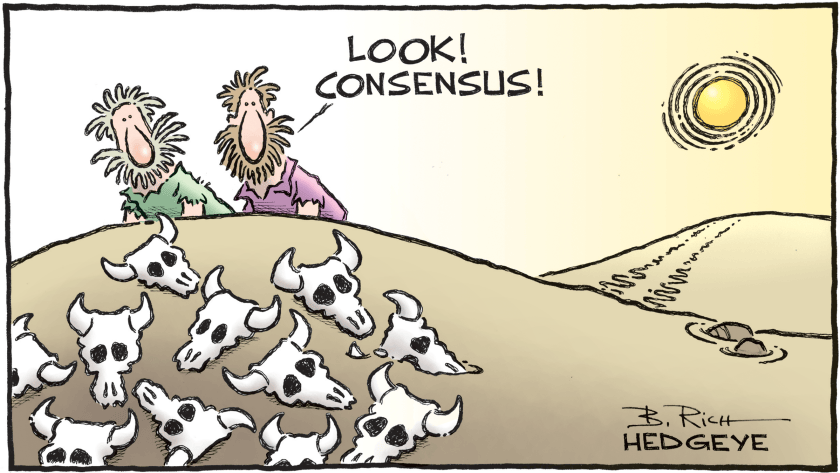
A cartoon depicting two characters on a hill, pointing at a pile of animal skulls, with one character exclaiming 'LOOK! CONSENSUS!' under a bright sun.

“That consensus has gone”

COP30: World leaders take aim at Trump for climate inaction

Esme Stallard, Climate and science reporter, BBC News 
Matt McGrath, Environment correspondent, BBC News

…

President Trump, who is not attending the meeting in the Amazonian city of Belém, was called a liar by the leaders of Colombia and Chile for his rejection of climate science.

UK Prime Minister Sir Keir Starmer acknowledged the waning political support on climate change. He said it had been a unity issue internationally and, in the UK, but “today sadly that consensus is gone“.

…

Many leaders from the world’s largest nations – India, Russia, US and China – are notably absent from this year’s summit.

…

Only a few dozen leaders have turned up here in Belém, and a majority of countries have failed to submit new plans to cut carbon emissions, the root cause of rising temperatures.

…

Despite Starmer acknowledging that global political support for the climate movement is waning, he told the gathering of those that were present: “My message is that the UK is all-in.“

However, on Wednesday night, in a blow to the Brazilian hosts, the UK chose to opt out of its flagship $125bn (£95bn) fund to support the world’s rainforests.

President Lula hoped that $25bn could be raised for the Tropical Forests Forever Facility from public sources – mainly from developed countries like the UK – to support governments and communities protecting the world’s rainforests like the Amazon and the Congo Basin.

…Read more: https://www.bbc.com/news/articles/cn4j8dgnj1wo

I understand President Lula Da Silva’s climate angst. I mean, Lula went all out to throw big party, sent everyone an invitation, but hardly anyone bothered to show up. And the few that did show up drank all the beer without throwing enough cash in the tip box.

To be fair, maybe the weather in Belém deterred leaders of temperate countries. Belém is a steamy inland tropical jungle town just south of the equator, where even the night time temperature is in the mid 70s. Humidity rarely drops below 70%, and likely approaches 100% during rain showers. Not everyone likes that kind of weather.

Maybe next time COP is hosted in a South American nation, they should pick somewhere high up in the Andes, so participants can go for a stroll and look at a melting glacier. Somewhere like La Rinconada in Peru. Otherwise COP might degenerate into a cargo cult style gathering where only leaders of poor nations attend, hopeless gatherings of true believers gazing forlornly at the sky, hugging each other to keep the dream alive while waiting for the free money to drop from the heavens.

Wrong, Detroit Free Press, Hurricane Melissa Wasn’t Caused by Climate Change

In a Detroit Free Press (FP) opinion piece, “Climate change denial can’t stand up to Category 5 Hurricane Melissa,” meteorologist Paul Gross claims that Hurricane Melissa proves climate change is making hurricanes stronger, faster, and more destructive. This is false. Hurricanes are weather, not climate. A single storm—or even a series of active storm seasons—says nothing about long-term global trends. No data or credible scientific opinion supports the claim that Hurricane Melissa is an indicator of the effect of climate change on hurricane formation.

Satellite image of Hurricane Melissa, showcasing its defined eye and cloud spirals over the Gulf Coast region.

From ClimateRealism

By H. Sterling Burnett

Screenshot of a Detroit Free Press opinion article discussing Hurricane Melissa and climate change, with the phrase 'FAKE NEWS' prominently overlaid.

In a Detroit Free Press (FP) opinion piece, “Climate change denial can’t stand up to Category 5 Hurricane Melissa,” meteorologist Paul Gross claims that Hurricane Melissa proves climate change is making hurricanes stronger, faster, and more destructive. This is false. Hurricanes are weather, not climate. A single storm—or even a series of active storm seasons—says nothing about long-term global trends. No data or credible scientific opinion supports the claim that Hurricane Melissa is an indicator of the effect of climate change on hurricane formation.

Gross cites Melissa’s Jamaica landfall as “the strongest Atlantic hurricane strike in recorded history,” but this is false. Melissa was not the most powerful hurricane ever to form or to make landfall in recorded history. Building on this falsehood, Gross goes on to state that powerful storms, like Milton in 2024 and Otis in 2023, are proof positive that climate change is making hurricanes more powerful than ever. Gross writes that “climate change denial can’t stand up to the data.” In fact, it’s his argument that doesn’t stand up to the data.

Hurricane Rita, 20 years and millions of tons of carbon dioxide emissions ago, was as powerful as Milton. And Hurricane Otis, a compact and powerful Pacific hurricane, was not record breaking for wind speeds, exceeded by Hurricane Patricia in the Eastern Pacific, and Typhoon Tip, from 46 years ago, in the Western Pacific. Since Gross can’t get these basic facts straight, one should not trust his assertion that climate change is creating more powerful hurricanes.

The real evidence—from the National Oceanic and Atmospheric Administration (NASA) and the U.N. Intergovernmental Panel on Climate Change (IPCC)—shows no statistically significant trend of increasing hurricane strength, frequency, or landfall intensity. That’s not denial; that’s science.

Gross’ argument is built entirely cherry-picked weather events, not long-term climate evidence. As Climate at a Glance: Hurricanes explains, there has been no increase in either the number or intensity of hurricanes worldwide during the past century, even as global carbon dioxide concentrations have risen sharply.

The IPCC agrees. Its most recent Sixth Assessment Report found “low confidence in any long-term trends in hurricane activity.” Specifically, Chapter 12 of the IPCC AR6 Working Group I report concluded that there is no detectable increase in global tropical cyclone frequency or landfall intensity. In other words, there is no measurable evidence linking stronger hurricanes to human-caused climate change. See the Figure 1 table below, specifically the highlighted section:

A detailed table presenting climatic impact types, including categories like heat, wind, and coastal factors. It highlights the emergence of various climatic impacts, showing historical data and projections for future trends.
Figure 1. Table 12.12 from Page 90 – Chapter 12 of the UN IPCC Sixth Assessment Report. Emergence of Climate Impact Drivers (CIDs) in time periods. The color corresponds to the confidence of the region with the highest confidence: white colors indicate where evidence of a climate change signal is lacking or the signal is not present, leading to overall low confidence of an emerging signal. See the key at the bottom for the meaning of all colors.

Gross’ claim that Hurricane Melissa is proof of climate-driven intensification also ignores the fundamental difference between causation and correlation. Warm ocean water certainly provides energy for hurricanes—that has always been true—but attributing any single storm’s strength to “climate change” is scientifically unsound. Hurricane formation and rapid intensification depend on a combination of atmospheric factors, including wind shear, humidity, and upper-level pressure dynamics, none of which are directly caused by global temperature trends.

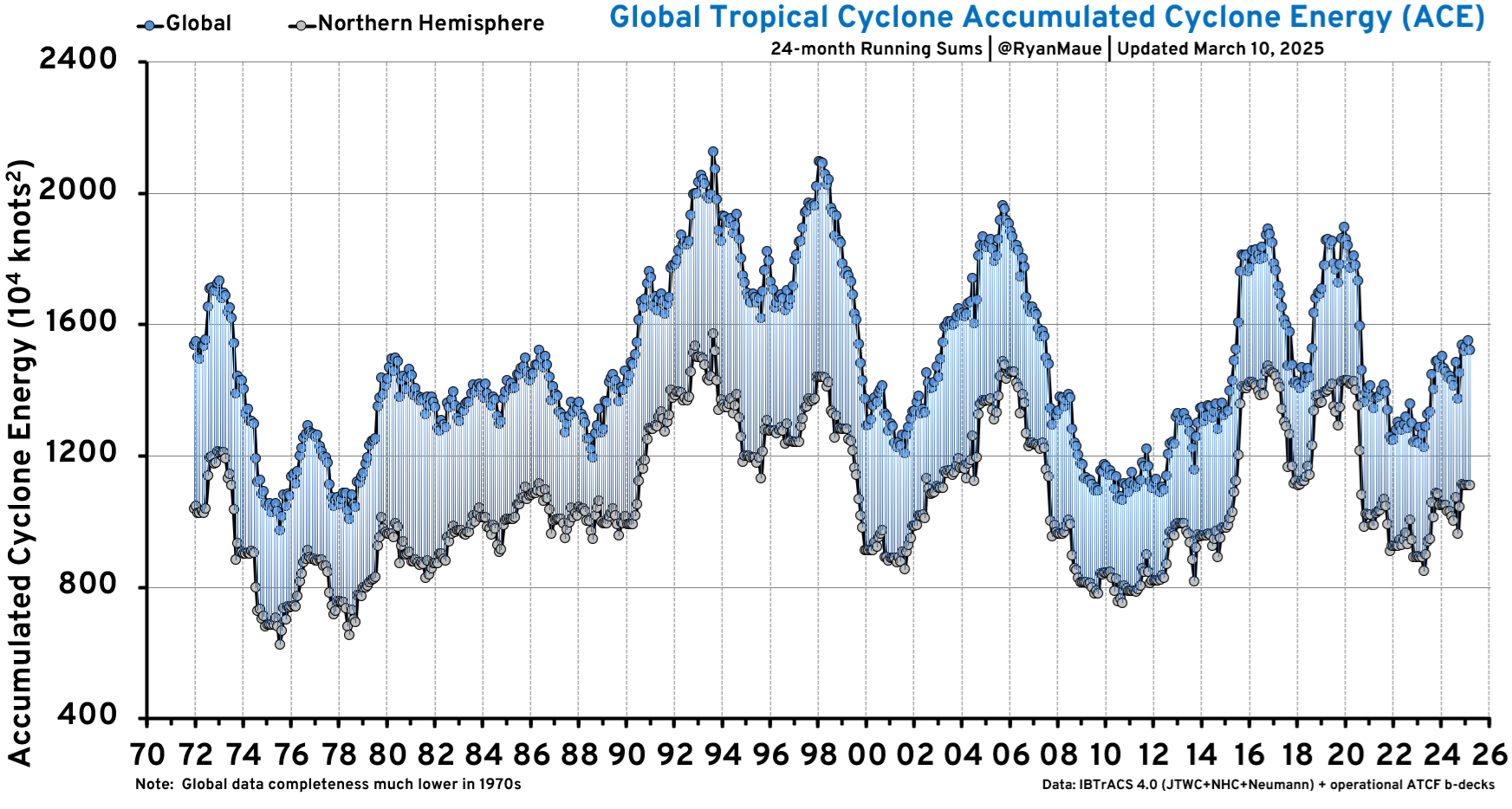
Also, there has been no sustained increase in Accumulated Cyclone Energy, a measure of intensity, over more than 50 years, as demonstrated in Figure 2 below.

Graph showing Global Tropical Cyclone Accumulated Cyclone Energy (ACE) from 1970 to 2025, with data points and shaded areas representing variations in cyclone energy for the global and Northern Hemisphere.
Figure 2: Last 50-years+ of Global and Northern Hemisphere Accumulated Cyclone Energy: 24 month running sums. Note that the year indicated represents the value of ACE through the previous 24-months for the Northern Hemisphere (bottom line/gray boxes) and the entire global (top line/blue boxes). The area in between represents the Southern Hemisphere total ACE. Source: Ryan N. Maue, “Global Tropical Cyclone Activity,” Climate Atlas, https://climatlas.com/tropical/global_running_ace.png

The “rapid intensification” phenomenon that Gross cites as a hallmark of climate change is not new. As Climate Realism has documented repeatedly, improved satellite monitoring and better detection methods since the 1970s make today’s storms appear more frequent and extreme simply because modern technology captures every detail that earlier weather observers missed. Earlier storm intensities were also harder to measure, making today’s apparent “increase” partly a result of better weather detection technology such as satellites, radar, and continuous monitoring. Past storms often were very strong and intensified rapidly—they just weren’t observed continuously from space or by coastal technology such as NEXRAD Doppler Radar, which didn’t exist before 1990.

Gross also doesn’t account for other factors that impact water temperatures, like the strong El Nino event from 2023 to 2024 that produced unusually warm waters that persisted in 2025, and reductions in ship emissions that research suggests has contributed to warmer ocean temperatures as more sunlight reached and warmed the surface waters.

Moreover, when analyzing the long-term record, natural ocean cycles dominate hurricane variability. The Atlantic Multidecadal Oscillation (AMO) drives multi-decade swings in hurricane frequency and intensity. Periods of increased storm activity, such as those seen in the 1940s to 1960s, occurred during cooler global temperatures. The 1935 Labor Day Hurricane, for example, remains one of the most intense storms to ever hit the United States—and it happened long before modern carbon dioxide emissions were significant.

Yes, Hurricane Melissa was a powerful storm, and all other things being equal, warmer water should produce more powerful hurricanes. But all other things are not equal, and water temperature is just one factor driving hurricane formation and intensity. Nature has produced strong storms for centuries. To claim that a single storm “proves” anything about global climate change is a red herring—a rhetorical trick used to distract from the lack of long-term supporting data. The actual data speak louder than opinions and states it plainly: “Global hurricane frequency and intensity show no meaningful trend in response to global warming.”

Some opinion pieces are so factually deficient they don’t merit publication. Gross’ hyperbolic and inaccurate piece about Hurricane Melissa is one such piece. Sadly, the Detroit Free Press lacked the discernment and objectivity to deny Gross a platform for his patently false claims. Hurricanes have always been part of life on this planet. They wax and wane with natural ocean cycles—not carbon dioxide levels. What has changed isn’t the weather, it’s the narrative the mainstream media continues to push that climate change is responsible for everything bad.

EV Driving Will Be Unaffordable for Those Without Off Street Parking

We have six new rapid EV chargers just installed at our local shopping centre, which have replaced 50kW chargers.

A man sits inside a modern electric vehicle with charging cables visible, looking anxious while surrounded by a group of zombie-like figures in a dimly lit environment.

From NOT A LOT OF PEOPLE KNOW THAT

By Paul Homewood

EV charge station details for Fox Valley 01 and Fox Valley 02, including connector types, maximum power, and pricing.

We have six new rapid EV chargers just installed at our local shopping centre, which have replaced 50kW chargers.

With news this week that EV’s will face pay-per-mile charges from 2028, these new chargers are a reminder that driving will become not only unpractical but unaffordable for anybody without off street parking. It is estimated that this is the case for at least 40% of car owners.

Let’s take the Kia EV3 as an example. This is Kia’s compact SUV, with OTR price of £36005 for the 81 kWh basic version. This is about £10,000 more than an equivalent petrol model.

It has a claimed range of 375 miles, but this will be more like 230 miles in real world conditions, according to Grok:

Table displaying the estimated range and efficiency of an electric vehicle with an 81.4 kWh battery under various driving conditions.

Efficiency is reckoned at 3.3 to 4.0miles/kWh – call it 3.6 miles.

On annual mileage of 10,000, electricity consumption would be 2777 kWh. And at 89p/kWh, which is the price at our new charging station, that works out at a cost of £2471 a year.

A diesel would run at maybe 40 mpg, which at current prices comes to £1590 a year. But half of that is fuel duty – pre tax, the annual cost would be about £800.

One way or another, our Kia EV3 driver will have to pay that tax eventually, on top of his charger bill of £2471.

Quite simply, ordinary people will not be able to afford to run their already expensive to buy car, if they are forced to use public chargers.

Which has probably been the Government’s plan all along!

What the nuke bros can learn from the navy — and what they can’t

Every few weeks, some deep-tech influencer posts on X something like this, “If the Navy can run hundreds of nuclear reactors safely and cheaply, why can’t the private sector?” Or alternatively, they ask, “Why can’t the navy run the nuclear private sector?”

A submarine surfacing in the ocean with an aircraft carrier in the background.

From CFACT

By CFACT Ed, Rabbi Yechezkel Moskowitz

Every few weeks, some deep-tech influencer posts on X something like this, “If the Navy can run hundreds of nuclear reactors safely and cheaply, why can’t the private sector?” Or alternatively, they ask, “Why can’t the navy run the nuclear private sector?”

It’s a fair question — and a flawed one. The Navy didn’t make nuclear work because it was simple; it made it work because it was sacred. Admiral Hyman Rickover built a system designed not to fail standardized, centralized, and ruthlessly disciplined. It served its mission perfectly. But what works for warships doesn’t always work for markets. Rickover’s genius was that he eliminated uncertainty. Every submarine and carrier reactor shared the same DNA. Training, design, operations — all uniform, all accountable to one command. That’s why the Navy’s record is spotless. The Ford-class carrier’s twin A1B reactors can operate for fifty years with only one refueling — a feat of engineering discipline as much as physics. Rickover’s model worked because the Navy had one job: deterrence and defense. It didn’t need ten competing designs. It needed one that never failed. In other words, in that world, standardization isn’t bureaucracy — it’s survival.

But the private sector plays a different game. It thrives on iteration, competition, and failure that leads to progress. Rickover’s model worked for the Navy precisely because it removed those variables. He built a monopoly on excellence — and that was exactly what the Cold War required. But if we apply that same command-and-control philosophy to commercial nuclear, we don’t get innovation — we get procurement. And when government procurement becomes industrial policy, we end up with a handful of politically protected players instead of a dynamic marketplace. That’s not how you rebuild a nuclear economy. That’s how you stall one.

None of this is to say Rickover was wrong — only that he was right for his mission. The Navy’s nuclear program exists to guarantee performance under the most extreme conditions imaginable. A free market has a different mission: to discover what works best by letting ideas compete on merit. If the government locks us into one “approved” design or technology class, it isn’t creating stability — it’s picking winners and losers before the race even starts. That said, the private sector doesn’t need to abandon Rickover’s discipline; it needs to adapt to it with a new set of rules that works for an environment of innovation and progress. The nuclear startup scene needs to learn from his focus on safety, standardization, and lifetime reliability. But also embrace what his world couldn’t: openness, competition, and creative risk. We don’t need forty unproven startups chasing hype, we already have folks calling next-gen nuclear nuke bros and claiming there is an SMR bubble, so some choices are going to be made, and we need to allow a handful of strong contenders to rise or fall based on results, not relationships. No old school nuclear nuke bro start-up should ever be too big to fail.

The right framework is a hybrid — the Navy’s rigor married to the market’s dynamism. Set the boundaries, keep the standards high, and let the best reactors win. The federal government’s role should be to build the field, not pick the team. To get there, we need policy alignment — the kind seen under the Trump administration, which deserves credit for re-centering nuclear energy as a matter of national strength. By tying energy, security, and industrial policy together and supporting advanced reactor licensing and public-private partnerships through DOE, we are seeing, for the first time in decades, that Washington is treating nuclear not as a regulatory burden but as a strategic asset.

That mindset shift must continue. We need the same clarity that Rickover demanded of his sailors: know the mission, execute it flawlessly, and never confuse caution with cowardice. But the mission today isn’t deterrence — it’s deployment. As the DOE begins working on accelerating the deployment of advanced reactors, we must standardize where it matters — fuels, safety protocols, regulatory pathways and supply chains — and compete where it counts: in design, cost, and performance. If the U.S. wants to lead the second nuclear era, it must allow multiple paths to success under one uncompromising standard of safety and excellence and ensure that merit — not politics — is what wins the day.

Rickover’s Navy proved that nuclear power could be safe, reliable, and enduring. Now it’s up to the private sector to prove it can also be scalable, efficient, affordable, and competitive on the national and international stage Because while in the Navy, one reactor powers the fleet. In an evolving energy market, ever hungry for more power, only competition powers progress.

This article originally appeared at Real Clear Energy

The Church of Climate Loses Its Pulpit at CBS

Cutting the “climate desk” wasn’t censorship — it was a long-overdue correction to years of sanctimony.

A mystical scene depicting five figures in robes sitting around a glowing light at the base of a large, ancient tree in a dense forest, evoking a sense of reverence and connectedness to nature.

From Watts Up With That?

Cutting the “climate desk” wasn’t censorship — it was a long-overdue correction to years of sanctimony.

Exterior view of CBS News building, prominently displaying the CBS NEWS sign, with storefronts below including Skechers.

The great tragedy of our time, at least to those who dwell in the climate-alarmist press, is not hurricanes, floods, or famine—but a network trimming its propaganda department. When CBS News laid off most of its “climate crisis” staff, the media class responded as though free speech itself had been outlawed. According to Truthout, “CBS News has fired most of its climate crisis production staff” and, in the process, “gutted” its sacred climate desk. The story was dressed up as an obituary for truth itself, complete with talk of “bloodbaths” and “new conservative management”.

To anyone outside the activist echo chamber, it looked like a normal corporate reshuffling. CBS’s parent company had merged with Skydance, and the incoming leadership did what executives always do after mergers—trim redundancies, change direction, and try to make the business profitable again. But to those who had mistaken climate coverage for a holy mission, this was blasphemy.

At the heart of the melodrama was Tracy Wholf, the now-former head of CBS’s climate desk, who had urged colleagues to insert a line into hurricane coverage reading: “The above-average Atlantic Ocean temperatures, made worse by climate change, helped Melissa rapidly intensify into a category 5 storm.” That suggestion was presented in Truthout as “accurate reporting.” In reality, it was speculative editorializing—a sentence of moral certainty grafted onto a story about weather.

This small episode tells a much larger story about what has happened to journalism. A decade or two ago, environmental reporting was about inquiry—asking questions, weighing data, distinguishing between what’s known and what’s conjecture. Today, it’s about ritual. Every storm, drought, or wildfire must include the catechismal line that it was “made worse by climate change.” It doesn’t matter that the claim is rarely quantifiable and often contested. The purpose isn’t to inform; it’s to reassure the faithful that the narrative still holds.

When CBS’s new management decided to end that practice, it didn’t silence science—it disrupted a form of sermonizing. The layoffs weren’t about censoring truth; they were about ending a pattern of prepackaged conclusions masquerading as news. That’s why the reaction has been so ferocious. What the press corps mourns is not a loss of information but a loss of control over the story line.

The irony is that even in its coverage of the hurricane, the “climate desk” offered little actual evidence. It leaned on an “attribution study” from Imperial College claiming that Hurricane Melissa’s winds were seven percent higher than they would have been without climate change. Seven percent—an estimate derived from a computer model run on assumptions stacked upon assumptions. This kind of statistical acrobatics is then presented as certainty, with phrases like “we know that warming ocean temperatures are being driven almost exclusively by increasing greenhouse gases.” Such declarations are indistinguishable from theology: the conclusion is predetermined, the variables chosen to affirm belief, and dissent treated as heresy.

The truth is that the media’s climate beat has long since ceased to function as journalism. Its purpose became to moralize, to scold, to reinforce the idea that every gust of wind is proof of humanity’s original carbon sin. And when that kind of moral messaging fails to hold an audience—when viewers start tuning out—the newsroom doubles down, convinced that the problem is not with the message but with the unconverted.

What CBS seems to have realized, whether intentionally or by accident, is that audiences might prefer news to narrative. Removing a department dedicated to producing climate catechism isn’t “gutting science coverage.” It’s cleaning house. A network that stops treating speculation as revelation has not gone rogue; it’s rediscovering the difference between analysis and advocacy.

And that’s precisely why the reaction has been so overwrought. When a newsroom dares to treat climate as a subject rather than a religion, the self-appointed guardians of orthodoxy cry “censorship.” Yet no one has been banned from reporting on weather, hurricanes, or environmental trends. The only thing that’s been silenced is the reflexive insistence that every data point confirm the same story.

The deeper issue here isn’t about CBS or even about climate. It’s about the collapse of journalistic humility. Reporters once understood the limits of their knowledge. They knew the difference between evidence and inference, between data and doctrine. Today, many mistake conviction for clarity. The mission is no longer to seek truth but to defend the truth already chosen.

If CBS is taking a step back from that mindset, it’s not an act of suppression—it’s a return to sanity. The press can still cover environmental issues, but perhaps now it will have to do so without assuming the conclusions in advance.

In that sense, the elimination of the “climate desk” may be the healthiest newsroom reform we’ve seen in years. For too long, climate journalism has been less about discovery and more about repetition. If this marks a turn back toward skepticism, evidence, and proportion, then CBS hasn’t gutted journalism—it has revived it.

H/T Mumbles McGuirck

Hurricane Forecast Was Overly Alarmist (Again)…Atlantic Season Ending Near Normal

The US National Oceanic and Atmospheric Administration (NOAA) predicted that an above average Atlantic hurricane season for 2025.

A vibrant ocean scene with rolling waves and large, fluffy white clouds in a clear blue sky.

From No Trick Zone

By P Gosselin 

The US National Oceanic and Atmospheric Administration (NOAA) predicted that an above average Atlantic huricane seacon for 2025.

Now that the season is winding down, we are able to start concluding and summarizing the season: it’s going to come in as near normal activity. The forecast made earlier this year was a bit on the hyped side.

Hurricane season forecasts have not really improved, despite all the claims that models are better than ever:

“In my 30 years at the National Weather Service, we’ve never had more advanced models and warning systems in place to monitor the weather,” said NOAA’s National Weather Service Director Ken Graham. “This outlook is a call to action: be prepared. Take proactive steps now to make a plan and gather supplies to ensure you’re ready before a storm threatens.”

NOAA’s outlook for the 2025 Atlantic hurricane season, which goes from June 1 to November 30, predicted a 60% chance of an above-normal season, and a 10% chance of a below-normal season. The agency forecast a range of 13 to 19 total named storms (winds of 39 mph or higher). Of those, 6-10 were forecast to become hurricanes (winds of 74 mph or higher), including 3-5 major hurricanes (category 3, 4 or 5; with winds of 111 mph or higher).

Near average season

According to data from the Univestity of Colorado, the season is now slightly above average (November 7) in terms of accumulated cyclone energy:

Line graph comparing observed North Atlantic cyclone energy versus climatology from January 2001 to November 2025.
Source: University of Colorado. 

Though more activity may occur before the end of the month, currently there are no signs of tropical storms in the Atlantic.

Global overall trend

Alarmists have claimed tropical storm activity would increase with the onset of global warming. Though the globe has warmed over the past 50 years, global cyclone activity has not escalated as feared:

Graph depicting global major hurricane frequency over a 12-month period, showing trends from 1980 to 2025 with data points for all hurricanes and major hurricanes.
Twleve-month running average counts of global hurricanes (top) and major hurricanes (bottom), 1980 to March 10, 2025. Source: Ryan Maue.

Quite to the contrary, the overall trend has been somewhat downard since 1990, with no real trend since 1970:

Graph showing Global Tropical Cyclone Accumulated Cyclone Energy (ACE) over time, highlighting trends in cyclone energy from 1970 to 2025.
Total annual global ACE (which integrates frequency and intensity) 1970 to March 10, 2025. Source: Ryan Maue.

The reality hasn’t cooperated with the alarmist climate hype. It’s been a disappointing season for catastrophe prophets.

Fake News BBC Push Reef Scare Again

Now I wonder why 2C has so much significance? Or 2050? Could it be that they are crucial elements of the Paris Agreement?
Why not 2060, or 2070, or 2045?

Colorful coral formations and tropical fish underwater, showcasing the biodiversity of a coral reef.

From NOT A LOT OF PEOPLE KNOW THAT

By Paul Homewood

h/t Ian Cunningham

Just in time for COP30 – what a coincidence!

Screenshot of a BBC news article headline discussing the Great Barrier Reef and the potential for recovery if global warming is limited to below 2 degrees Celsius.

The Great Barrier Reef is headed for a “grim future” and will suffer a “rapid coral decline” by 2050 but parts may recover if global warming is kept below 2C, a new study has found.

Researchers at the University of Queensland (UQ) used modelling to simulate the lifecycles of certain coral species and found that some were better at adapting to warmer oceans and could help new coral grow.

Reefs near cooler-water currents were also more resilient, giving a “glimmer of hope” to the natural wonder, which has suffered severe climate-induced heat stress in recent years.

The study warned that curbing carbon emissions was crucial to allow coral to recover and avoid a “near collapse” of the reef.

Dr Yves-Marie Bozec, who led the research, said the modelling of more than 3,800 individual reefs that make up the Great Barrier Reef looked at their “eco-evolutionary dynamics”. This included how corals interact with each other, how they deal with warmer water and corals in naturally cooler areas.

“We ran all of those factors with the most up-to-date climate projections – and the news was not good,” he said.

“We forecast a rapid coral decline before the middle of this century regardless of the emissions scenario.”

The Great Barrier Reef is one of the world’s most biodiverse ecosystems, stretching more than 2,300km (1,400 miles) off Australia’s north-east coast.

It has suffered four significant marine heatwaves between 2016 and 2022, causing much of its coral to expel the algae which gives them life and colour – a process called bleaching, which is often fatal.

A recent report found that parts of the Great Barrier Reef had suffered the largest annual decline in coral cover since records began nearly 40 years ago.

Dr Bozec said some parts of the reef “may partially recover after 2050, but only if ocean warming is sufficiently slow to allow natural adaptation to keep pace with temperature changes”.

“Adaptation may keep pace if global warming does not exceed two degrees by 2100. For that to happen, more action is needed globally to reduce carbon emissions which are driving climate change.”

Dr Bozec said: “The window for meaningful action is closing rapidly but it hasn’t shut”.

Under the Paris agreement, almost 200 nations have pledged to limit global temperature rises to 1.5C and to keep them “well below” 2C above those recorded in pre-industrial times, generally considered to mean the late 19th Century.

https://www.bbc.co.uk/news/articles/cx274lj661lo

Illustration depicting various animated characters around a sign that reads 'FAKE NEWS GENERATOR', highlighting themes of misinformation.

Now I wonder why 2C has so much significance? Or 2050? Could it be that they are crucial elements of the Paris Agreement?

Why not 2060, or 2070, or 2045?

And given that we have supposedly already has 1.5C of warming since the 1800s and the world’s coral remains as abundant ever, I hardly think another half a degree will make the slightest difference.

This new study, as seems to be the case with every alarmist study these days, does not analyse historical data. Instead it, in its own words, simulates coral eco-evolutionary dynamics across 3800 reefs of Australia’s Great Barrier Reef under current climate projections. In other words, good old computer modelling!

You might have thought that if the world’s coral, or the Great Barrier Reef itself, was already under so much stress, the data would be readily available to prove it. After all, we have supposedly had four significant marine heatwaves in the last decade alone on the GBR.

But the study does attempt to analyse or present this data, because the authors know full well the answers would destroy their agenda – not to mention the chance for more grant money.

The whole basis of their argument is, in any case, illogical. The world’s coral has been in existence for thousands of years. The GBR, for instance, is believed to have started growing about 8000 to 10000 years ago, as sea levels rose at the end of the Ice Age. It actually sits atop older limestone platforms from Pleistocene-era reefs.

The reef is remarkably resilient, having endured multiple cycles of bleaching and recovery and climate swings. The same of course applies to reefs elsewhere in the world.

Corals would in fact thrive in a warmer world, spreading to seas that are currently too cold.

But this study misunderstands the science of ocean warming. Seas are not warmed by the atmosphere, but by the sun. That is why tropical seas are warmer than the North Sea – because the sun’s energy is more concentrated in the Tropics. Indeed, seas warm the atmosphere not the reverse.

Also, the higher sea levels predicted would offset higher sea temperatures. Corals are most affected by heat when exposed to the sun when sea levels drop, which occurs during El Nino on the GBR. Higher sea levels would therefore protect the reef from excessive exposure to the sun.

I’ll leave it to Dr Peter Ridd to summarise the facts, rather then the myth the BBC peddles:

Cover of the report 'Coral in a Warming World: Causes for Optimism' by Peter Ridd, featuring vibrant underwater coral and two yellow butterflyfish.
Executive summary highlighting the reliability of long-term coral cover data from the Great Barrier Reef, noting fluctuations in coverage and emphasizing no major loss across its individual reefs.
A text excerpt discussing coral bleaching and recovery in the Great Barrier Reef, emphasizing recent findings and challenges related to climate change and coral resilience.