Global warming, climate change, all these things are just a dream come true for politicians. I deal with evidence and not with frightening computer models because the seeker after truth does not put his faith in any consensus. The road to the truth is long and hard, but this is the road we must follow. People who describe the unprecedented comfort and ease of modern life as a climate disaster, in my opinion have no idea what a real problem is.
Absurdities abound at this year’s United Nations Climate Summit, COP30, in Brazil. This is not unique to these annual gatherings, yet never cease to amaze.
UN & China make impervious demands for cash & control
Belém, Brazil
Absurdities abound at this year’s United Nations Climate Summit, COP30, in Brazil. This is not unique to these annual gatherings, yet never cease to amaze.
The standouts at this year’s summit thus far start at the top, with UN Secretary-General António Guterres, whose opening speech raised hysteria and gaslighting to new heights. China’s Vice Premier, whose nation seeks global dominance, also weighed in with calls to uphold “true multilateralism… [and] coordination.” The host country’s president, Luiz Inácio Lula da Silva of Brazil, screeched about those in opposition to the UN’s climate agenda, evidently with U.S. President Donald Trump living rent-free in his cranium.
It’s all too rich for leading globalists demanding more cash and control over the sovereignty of individual nations, including their economies and living standards — just to keep the average global temperature increase from exceeding 1.5 degrees a quarter century from now, which they assume will occur — but cannot prove — based on carbon emissions.
Secretary-General Guterres claims that “science now tells us that a temporary overshoot of the 1.5 [degree] limit starting at the latest in the early 2030s is inevitable.” This “overshoot,” he claims, “could push ecosystems past irreversible tipping points to unlivable conditions and amplify threats to peace and security … more hunger, displacement, and loss.”
As is so common with these screeds, “science” is mentioned, but none was given by the secretary-general, nor by anyone else at the podium. No data and zero evidence of forthcoming catastrophe were presented. Rather, even as emissions have increased, World Bank data show that global poverty is way down in the last three decades, especially in nations with their own oil and gas development, from the United Arab Emirates to Azerbaijan, the two previous hosts of UN climate summits. Climate policies do not reduce poverty — they will increase it in developed and developing countries alike by raising the cost of all energy.
Climate change policies won’t help people in Belém shanty towns.
As we have noted, Bill Gates himself evidently is done with such fatuous existential climate claims and has called for refocusing resources on directly fighting poverty and disease among the world’s poor, rather than on spurious attempts to alter global temperature.
The secretary-general’s claim of a nexus between climate change and “threats to peace and security” is especially insulting to populations suffering in war zones. Are there any Ukrainians or Israelis blaming the climate for being invaded by their hostile neighbors? Was “climate change” motivating Vladimir Putin or Hamas to launch their attacks?
The truth is, Secretary-General Guterres and his fellow travelers are demanding $300 billion in annual contributions, growing to $1.3 trillion annually, mostly from the United States and Europe, to fund their climate fantasies throughout the developing world. These projects certainly will enrich corporations, lawyers, and NGO bureaucracies, but will do nothing to ameliorate hunger or mitigate disease.
Last year at COP29 in Baku, self-congratulations among the climate delegates were pervasive with their agreement for nations to provide carbon mitigation plans and new financial commitments. Most nations have done little to nothing since. With so many countries annually refusing to cough up such largesse, Guterres sounds more desperate and dishonest with every COP summit.
Then there is the People’s so-called Republic of Communist, dictatorial China. Vice Premier Ding Xuexiang said that nations need to cooperate more on expanding “green technology” and pushed for more “global climate governance… [for] global sustained development.” This from a nation that is expanding coal capacity and production in 2025 at the fastest rate in nearly a decade, according to the Centre for Research on Energy and Clean Air.
According to this report, China has failed to live up to its pledges on using coal in a more supporting role for renewable energy and to phase down coal production. Still, the CREA report, while documenting China’s coal expansion, speculates that it “signals … a last-ditch effort before China’s 2030 carbon peaking deadline,” after which it “should be the priority to meet climate goals.”
I have a bridge in Brooklyn to sell to these geniuses and every UN bureaucrat who takes China’s word on climate “goals” or “commitments.” They never have, and never will.
Lastly, on a note of hilarity, Brazil’s President Lula da Silva said the world must “overcome fossil fuels” and defeat those “extremist forces [that] invent untruths” about climate change. Those who oppose the UN climate agenda, he said, will “perpetuate social and economic disparities.”
This thinking is backward, as Belem’s own shanty towns reveal. Oil, coal, and gas fueled development in every first-world nation and improved living standards for more than a century. These sources are needed more in the developing world, which is why China is relentless on coal expansion.
Solar and wind energy, which rely on fossil-fuel backup, remain a tiny percentage of the energy mix. Attempting to impose such sources on any nation’s people — rich, poor, or middle class — is foolhardy and impractical.
Unfortunately, such impediments to energy reality are no barrier to national leaders gaslighting and fantasizing at UN climate conferences.
Miliband has been a threat to national security for years!
From the Telegraph:
It sounds like a Hollywood action blockbuster, possibly starring Bruce Willis, Keanu Reeves or Jason Statham: bleary-eyed commuters heading to work on the bus are plunged into a real-life nightmare when it is commandeered by evil Chinese technicians under the orders of Beijing.
Except rather than just some silly film script, it is the sort of terrifying scenario that could one day occur in this country after so-called “kill switches” were found on Chinese buses flooding Europe – including the UK.
The alarming discovery was made by Oslo’s transport operator Ruter after engineers looked under the bonnet of hundreds of electric buses bought from the Chinese manufacturer Yutong.
The detection of software that allowed it to be “stopped or rendered inoperable” remotely by its manufacturer has massive ramifications, not just for our own transport system, but Ed Miliband’s blind pursuit of net zero.
China’s Ming Yang has announced it is building a wind turbine factory in Scotland. Yet to allow this to happen would be to ignore warnings from the Ministry of Defence about the installation of sensors in Chinese-made turbines that can spy on British seas, defence submarine programmes and the layout of our energy infrastructure.
Yutong has said that it “strictly complies with the applicable laws, regulations and industry standards of the locations where its vehicles operate”. It also insists that its data is “protected by storage encryption and access control measures” that “no one is allowed to access or view this data without customer authorisation”.
That may sound reassuring but as Sir Iain Duncan Smith quite rightly points out, China’s authoritarian regime is set up in a way that renders such guarantees largely meaningless.
“Everything that China does is covered by the national security law in China, and that means every single company has to co-operate with the Chinese authorities in handing over data,” Sir Iain said.
Personally, I believe that almost total reliance on China for solar panels, batteries, rare earths and increasingly electric cars is a much bigger security threat than kill switches on buses.
I shall end with two unanswered questions. The reason for that lies in a story with eight decimal places of recondite mystery and scarcely believable deductions. One last glimpse of reality: the mean temperature of the world at the moment (early November) is hovering around 14 deg C, which is never used because it does not convey a sufficient element of danger in the global warming message. Fourteen degrees Celsius or fifty-seven Fahrenheit are not messages of imminent doom. Either one is the annual mean temperature of Bordeaux, San Francisco or Canberra.
I shall end with two unanswered questions. The reason for that lies in a story with eight decimal places of recondite mystery and scarcely believable deductions. One last glimpse of reality: the mean temperature of the world at the moment (early November) is hovering around 14 deg C, which is never used because it does not convey a sufficient element of danger in the global warming message. Fourteen degrees Celsius or fifty-seven Fahrenheit are not messages of imminent doom. Either one is the annual mean temperature of Bordeaux, San Francisco or Canberra.
Therefore the Wise Ones have decided that any global temperature given to the masses must always be shown as a difference from the mean of the half-century 1850-1900, which, they say, is representative of our world in smoke-free pre-industrial times. That period also happens to be towards the end of the Little Ice Age, which, the Met Office says, had ‘particularly cold intervals beginning in about 1650, 1770 and 1850.’ Cold spell beginning in 1850? Interesting.
Thus it was that on 10 January this year the Met Office told us that ‘The global average temperature for 2024 was 1.53±0.08°C above the 1850-1900 global average,’ This is an extraordinarily accurate figure but the World Meteorological Organisation has much the same: ‘The global average surface temperature [in 2024] was 1.55 °C … ± 0.13 °C … above the 1850-1900 average, according to WMO’s consolidated analysis.’ Ignore the scarcely believable accuracy of those second decimal places, there’s worse to come.
The obvious question is: Why were those fifty years chosen as the fundamental reference period? The answer is easily found: ‘Global-scale observations from the instrumental era began in the mid-19th century for temperature,’ says the Intergovernmental Panel on Climate Change (IPCC) in their Fifth Assessment Report (Section B, page 4.) An associated IPCC Special Report (FAQ1.2 para 4) explains that ‘The reference period 1850–1900 … is the earliest period with near-global observations and is … used as an approximation of pre-industrial temperature.’ Note the categoric statements that sufficient data is available in that nineteenth century fifty-year period to calculate the global mean temperatures.
In 1850, may I remind you, Dickens was writing David Copperfield, California was admitted to the Union as the 31st state and vast areas of the earth were still unexplored. 1900 brought the Boxer Rebellion (China), the Boer War (South Africa) and the Galveston hurricane (USA). There were still quite large areas awaiting intrepid explorers.
I was curious about how in olden times those global temperatures were actually measured, but after a painstaking search of websites and yet again proving that AI-derived information can be both wrong and misleading, I turned in despair to the Met Office enquiry desk. Their reply was long and very detailed. No actual data, but several clues as to where to search. Very interesting clues.
The IPCC report above claiming ‘global-scale observations’ is obviously true, because the World Meteorological Organisation has a comprehensive graph showing six different global mean temperature measurements of the difference from the 1850-1900 period. But a link ‘Get the data’ on the same page leads to the following curious table of the Met Office anomalies:
1850 -0.1797 1851 -0.0592
then every year to
1899 0.0128 1900 0.1218
then every year to
2023 1.4539 2024 1.5361
There is even more accurate Met Office data from the past, this time anomalies relative to the 1961-1990 period but this time totally unbelievable, all from HadCRUT5.1.0.0, Summary Series, Global, CSV file, Annual.
1850 -0.42648312 1851 -0.2635183
then every year to
1899 -0.34430692 1900 -0.2301605
then every year to
2024 1.1690052
Dig further and monthly values are produced. You can’t help being suspicious of even two decimal places, let alone eight. I dug deeper. I found graphs.
They show northern and southern hemispheres separately, with both station count and coverage percentage. They are from a paper: Hemispheric and large-scale land surface air temperaturevariations: An extensive revision and an update to 2010, P.D. Jones et al. Page 48, line 1120. They show the number of recording stations and the hemisphere percentage covered from 1850 to 2010.
Very similar pictures are also shown in Land Surface Air Temperature Variations Across the Globe Updated to 2019: The CRUTEM5 Data Set, T J Osborn et al, para 5.1 fig 6, and Hemispheric Surface Air Temperature … to 1993, P D Jones 1993, page 1797.
Surely not? There must be a mistake somewhere. But there’s nothing like a graph in scientific peer-reviewed papers for providing clear and unequivocal information. If you still think this just cannot be true, then look further at the American Meteorological Society map of station density 1861-1890 (Section 5 of Journal), or a classic Bartholomew map of world reporting stations in 1899.
The information supplied by the Met Office led me to a meandering pathway of scientific papers covering thirty-odd years of intensive research into the problem of accurately measuring global mean temperatures from 1850 onwards. The path seems to have ended in a swirling fog.
Those graphs show that even by 1900 only about 15% of the earth had recording stations. And the 1850 data is apparently extracted from only around 4%.
How can world temperatures be measured that accurately with such an impossibly small amount of data – almost nothing from the oceans and most of the rest from North America and Western Europe?
It wouldn’t really matter except for someone having decided that current global mean temperatures should always be shown to the worried world as anomalies compared with the 1850-1900 data, which is itself possibly a cooler climatic period. The intention must be to demonstrate clearly that there is no doubt that we are indeed warming up dangerously, and if we don’t do something about it soon it will be too late and don’t say we didn’t warn you.
But, and this is one huge ‘but’, how can the 1850 mean global temperature be recorded, for instance, as -0.1797 deg C less than the mean of 1850-1900, when it seems that reporting stations covered only about 4% of the earth at that time? And why to a totally unrealistic ten-thousandth of a degree?
I did warn you this would end with two unanswered questions, and here they are, both about that fifty-year 1850-1900 period:
Where can we consult the actual original global data?
How were those incredibly accurate anomaly figures calculated?
The climatists have seized on this unusual warming as proof their Zero Carbon agenda is needed, without addressing how impossible it would be for CO2 warming the air to raise ocean temperatures. It is the ocean that warms the air, not the other way around.
The best context for understanding decadal temperature changes comes from the world’s sea surface temperatures (SST), for several reasons:
The ocean covers 71% of the globe and drives average temperatures;
SSTs have a constant water content, (unlike air temperatures), so give a better reading of heat content variations;
A major El Nino was the dominant climate feature in recent years.
Previously I used HadSST3 for these reports, but Hadley Centre has made HadSST4 the priority, and v.3 will no longer be updated. I’ve grown weary of waiting each month for HadSST4 updates, so the July and August reports were based on data from OISST2.1. This dataset uses the same in situ sources as HadSST along with satellite indicators. Now however, the US government is shut down and updates to climate datasets are likely to be delayed. Reminds of what hospitals do when their budgets are slashed: They close the Maternity Ward to get public attention.
So this October report is based again on HadSST 4, but with a twist. The data is slightly different in the new version, 4.2.0.0 replacing 4.1.1.0. Product page is here.
The Current Context
The chart below shows SST monthly anomalies as reported in HadSST 4.2 starting in 2015 through October 2025. A global cooling pattern is seen clearly in the Tropics since its peak in 2016, joined by NH and SH cycling downward since 2016, followed by rising temperatures in 2023 and 2024 and cooling in 2025.
Note that in 2015-2016 the Tropics and SH peaked in between two summer NH spikes. That pattern repeated in 2019-2020 with a lesser Tropics peak and SH bump, but with higher NH spikes. By end of 2020, cooler SSTs in all regions took the Global anomaly well below the mean for this period. A small warming was driven by NH summer peaks in 2021-22, but offset by cooling in SH and the tropics, By January 2023 the global anomaly was again below the mean.
Then in 2023-24 came an event resembling 2015-16 with a Tropical spike and two NH spikes alongside, all higher than 2015-16. There was also a coinciding rise in SH, and the Global anomaly was pulled up to 1.1°C in 2023, ~0.3° higher than the 2015 peak. Then NH started down autumn 2023, followed by Tropics and SH descending 2024 to the present. During 2 years of cooling in SH and the Tropics, the Global anomaly came back down, led by Tropics cooling from its 1.3°C peak 2024/01, down to 0.6C in September this year. Note the smaller peak in NH in July 2025 now declining along with SH and the Global anomaly cooler as well. In October the Global anomaly nearly matched the mean for this period
Comment:
The climatists have seized on this unusual warming as proof their Zero Carbon agenda is needed, without addressing how impossible it would be for CO2 warming the air to raise ocean temperatures. It is the ocean that warms the air, not the other way around. Recently Steven Koonin had this to say about the phonomenon confirmed in the graph above:
El Nino is a phenomenon in the climate system that happens once every four or five years. Heat builds up in the equatorial Pacific to the west of Indonesia and so on. Then when enough of it builds up it surges across the Pacific and changes the currents and the winds. As it surges toward South America it was discovered and named in the 19th century It iswell understood at this point that the phenomenon has nothing to do with CO2.
Now people talk about changes in that phenomena as a result of CO2 but it’s there in the climate system already and when it happens it influences weather all over the world. We feel it when it gets rainier in Southern California for example. So for the last 3 years we have been in the opposite of an El Nino, a La Nina, part of the reason people think the West Coast has been in drought.
It has now shifted in the last months to an El Nino condition that warms the globe and is thought to contribute to this Spike we have seen. But there are other contributions as well. One of the most surprising ones is that back in January of 2022 an enormous underwater volcano went off in Tonga, and it put up a lot of water vapor into the upper atmosphere. It increased the upper atmosphere of water vapor by about 10 percent, and that’s a warming effect, and it may be that is contributing to why the spike is so high.
A longer view of SSTs
The graph above is noisy, but the density is needed to see the seasonal patterns in the oceanic fluctuations. Previous posts focused on the rise and fall of the last El Nino starting in 2015. This post adds a longer view, encompassing the significant 1998 El Nino and since. The color schemes are retained for Global, Tropics, NH and SH anomalies. Despite the longer time frame, I have kept the monthly data (rather than yearly averages) because of interesting shifts between January and July. 1995 is a reasonable (ENSO neutral) starting point prior to the first El Nino.
The sharp Tropical rise peaking in 1998 is dominant in the record, starting Jan. ’97 to pull up SSTs uniformly before returning to the same level Jan. ’99. There were strong cool periods before and after the 1998 El Nino event. Then SSTs in all regions returned to the mean in 2001-2.
SSTS fluctuate around the mean until 2007, when another, smaller ENSO event occurs. There is cooling 2007-8, a lower peak warming in 2009-10, following by cooling in 2011-12. Again SSTs are average 2013-14.
Now a different pattern appears. The Tropics cooled sharply to Jan 11, then rise steadily for 4 years to Jan 15, at which point the most recent major El Nino takes off. But this time in contrast to ’97-’99, the Northern Hemisphere produces peaks every summer pulling up the Global average. In fact, these NH peaks appear every July starting in 2003, growing stronger to produce 3 massive highs in 2014, 15 and 16. NH July 2017 was only slightly lower, and a fifth NH peak still lower in Sept. 2018.
The highest summer NH peaks came in 2019 and 2020, only this time the Tropics and SH were offsetting rather adding to the warming. (Note: these are high anomalies on top of the highest absolute temps in the NH.) Since 2014 SH has played a moderating role, offsetting the NH warming pulses. After September 2020 temps dropped off down until February 2021. In 2021-22 there were again summer NH spikes, but in 2022 moderated first by cooling Tropics and SH SSTs, then in October to January 2023 by deeper cooling in NH and Tropics.
Then in 2023 the Tropics flipped from below to well above average, while NH produced a summer peak extending into September higher than any previous year. Despite El Nino driving the Tropics January 2024 anomaly higher than 1998 and 2016 peaks, following months cooled in all regions, and the Tropics continued cooling in April, May and June along with SH dropping. After July and August NH warming again pulled the global anomaly higher, September through January 2025 resumed cooling in all regions, continuing February through April 2025, with little change in May,June and July despite upward bumps in NH. Now temps in all regions are cooling August and September 2025.
What to make of all this? The patterns suggest that in addition to El Ninos in the Pacific driving the Tropic SSTs, something else is going on in the NH. The obvious culprit is the North Atlantic, since I have seen this sort of pulsing before. After reading some papers by David Dilley, I confirmed his observation of Atlantic pulses into the Arctic every 8 to 10 years.
Contemporary AMO Observations
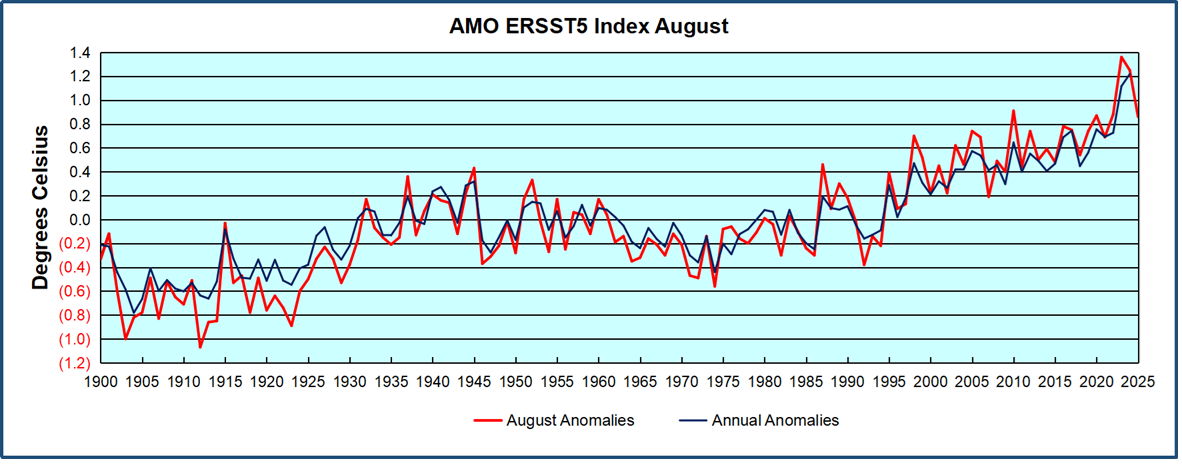
Through January 2023 I depended on the Kaplan AMO Index (not smoothed, not detrended) for N. Atlantic observations. But it is no longer being updated, and NOAA says they don’t know its future. So I find that ERSSTv5 AMO dataset has current data. It differs from Kaplan, which reported average absolute temps measured in N. Atlantic. “ERSST5 AMO follows Trenberth and Shea (2006) proposal to use the NA region EQ-60°N, 0°-80°W and subtract the global rise of SST 60°S-60°N to obtain a measure of the internal variability, arguing that the effect of external forcing on the North Atlantic should be similar to the effect on the other oceans.” So the values represent SST anomaly differences between the N. Atlantic and the Global ocean.
The chart above confirms what Kaplan also showed. As August is the hottest month for the N. Atlantic, its variability, high and low, drives the annual results for this basin. Note also the peaks in 2010, lows after 2014, and a rise in 2021. Then in 2023 the peak reached 1.4C before declining to 0.9 last month. An annual chart below is informative:
Note the difference between blue/green years, beige/brown, and purple/red years. 2010, 2021, 2022 all peaked strongly in August or September. 1998 and 2007 were mildly warm. 2016 and 2018 were matching or cooler than the global average. 2023 started out slightly warm, then rose steadily to an extraordinary peak in July. August to October were only slightly lower, but by December cooled by ~0.4C.
Then in 2024 the AMO anomaly started higher than any previous year, then leveled off for two months declining slightly into April. Remarkably, May showed an upward leap putting this on a higher track than 2023, and rising slightly higher in June. In July, August and September 2024 the anomaly declined, and despite a small rise in October, ended close to where it began. Note 2025 started much lower than the previous year and headed sharply downward, well below the previous two years, then since April through September aligning with 2010. Now in October there was an unusual upward spike.
The pattern suggests the ocean may be demonstrating a stairstep pattern like that we have also seen in HadCRUT4.
The rose line is the average anomaly 1982-1996 inclusive, value 0.18. The orange line the average 1982-2025, value 0.40 also for the period 1997-2012. The red line is 2015-2025, value 0.68. As noted above, these rising stages are driven by the combined warming in the Tropics and NH, including both Pacific and Atlantic basins.
The oceans are driving the warming this century. SSTs took a step up with the 1998 El Nino and have stayed there with help from the North Atlantic, and more recently the Pacific northern “Blob.” The ocean surfaces are releasing a lot of energy, warming the air, but eventually will have a cooling effect. The decline after 1937 was rapid by comparison, so one wonders: How long can the oceans keep this up? And is the sun adding forcing to this process?
USS Pearl Harbor deploys Global Drifter Buoys in Pacific Ocean
Let us travel back to April 2012 and revisit an important milestone in BBC climate reporting – what is thought to be the last recorded sighting of genuine journalistic inquiry. Richard Knight noted an extremist claim that up to 150 mostly animal species are lost every day, but then went on to observe that if the claim was really true, should we not expect the International Union for Conservation in Nature to list more than 801 extinct species in the last 512 years. Fast forward 10 years and Esme Stallard was honking without any alternative view that “the extinction of species is now happening between 1,000 and 10,000 times quicker than scientists would expect to see”.
Let us travel back to April 2012 and revisit an important milestone in BBC climate reporting – what is thought to be the last recorded sighting of genuine journalistic inquiry. Richard Knight noted an extremist claim that up to 150 mostly animal species are lost every day but then went on to observe that if the claim was really true, should we not expect the International Union for Conservation in Nature to list more than 801 extinct species in the last 512 years. Fast forward 10 years and Esme Stallard was honking without any alternative view that “the extinction of species is now happening between 1,000 and 10,000 times quicker than scientists would expect to see”. Humans could be causing the “sixth mass extinction”, scientists are said to have warned. Over the last two decades, climate science reporting at the BBC has been reduced to cherry-picking the worst ‘scientists say’ clickbait remarks to promote the hard-Left Net Zero fantasy. Debate has been abolished, the scientific inquiry process trashed, and the intelligence of the British public insulted on a daily basis. It’s almost as if the BBC decided to convince everyone that a woman can have a penis.
In the wake of the BBC’s decision to mark its own homework by referring climate change reporting to its Editorial Guidelines and Standards Committee, we would do well to acknowledge the sheer enormity of the crime against investigative journalism that has been perpetrated for over two decades. It is an appalling story of journalists kowtowing to a prevailing narrative. They have been willing and able to take a central role in inducing a mass climate psychosis in the general public that has been designed for purely political purposes.
The BBC climate conspiracy – what other word is appropriate? – can be traced back 25 years to the activities of the then climate chief Roger Harrabin. In 2006 he led a secret editorial meeting, heavily weighted with activists, that attempted to redefine the editorial balance between competing climate change opinions. Natural forces were to be downplayed in favour of the unproven suggestion that any current global warming was mostly caused by humans burning hydrocarbons. At the time, the BBC tried to keep the science wrecking-ball meeting secret, but a few years later details were leaked showing that most of the delegates were highly supportive of the green agenda. Such was the editorial power of Harrabin and his ilk, sceptical and alternative views on climate change started to be removed from BBC content. In 2018, the then director of news and current affairs Fran Unsworth determined that sceptics were no longer to be invited regularly, an effective ban on discussing the scientific process that remains in force to this day.
Few activist endeavours fail the Popperian ‘falsification’ science test more than the attribution of single weather events to human causes. Computer models are used to almost instantly attribute a single bad weather event to the burning of hydrocarbons, a tactic that plays into the promotion of Net Zero. The results are worthless guesses, not least because it is impossible to ‘model’ the chaotic and non-linear atmosphere. The long-time science writer Roger Pielke takes a similar view: “I can think of no other area of research where the relaxing of rigour and standards has been encouraged by researchers in order to generate claims more friendly to headlines, political advocacy and even lawsuits.” Needless to say, attribution studies and their ‘garbage in, garbage out’ results are a mainstay in BBC climate reporting.
Countless BBC reports state that extreme weather is getting worse. Across the network, Attenborough, with over 70 years’ experience in sniffing the direction of the BBC wind, and Packham, along with their many disciples, have been allowed to scream ‘FIRE!’ in the theatre of climate absurdities across all channels. This type of continuous gaslighting even persuaded the Prince of Wales to get in on the act last week at COP30. Point of information for the Pontificating Prince: Arctic Sea ice extent has been stable since 2005 – even the Guardiannow admits that. Mere data tell a different story on extreme weather, with the IPCC admitting that most types have shown no recent discernible increase. Meanwhile, hydrocarbon-produced wealth has led to a reduction of 99% in the number of fatalities around the world due to bad weather events over the last century. Climate ‘refugees’ are not a problem, not least because nobody can actually define what they are. Meanwhile, global ‘greening’, helped by a little extra carbon dioxide in the atmosphere, is helping to feed the world.
Little if any of this is reflected in BBC coverage. Instead the former editor of Radio 4 flagship Today, Sarah Sands, laments how the British politician Nigel Lawson managed to slip the guard in a BBC studio and observe the lack of increasing extreme weather. Writing in an attribution guide for journalists published by the World Weather Attribution operation, she said she wished she had such a service to effectively challenge his claims. These days, she enthused, attribution studies have given us significant insight into the horsemen of the climate apocalypse. “We have evidence and we have facts. They are a secure foundation for news,” she claimed. The less kind might ask if some people at the BBC know what facts, evidence and news actually are.
These days it is common for companies to hand out ‘Journalist of the Year’ awards featuring their name and trade to specialist writers. It is not something independent journalists should even consider, but the bung of a couple of grand and bragging rights (once the corporate name and trade is omitted) is a minor if silly offence against editorial independence. Younger, naïve journalists might think it looks good on the CV. But raise the award to, say, €100,000 and more serious questions can be raised. Should journalists take such enormous sums of cash from people they might write about, whatever way it is given? The BBC’s Matt McGrath had no problems with this since he accepted a 2019 award from the philanthropic foundation of the Spanish bank BBVA for his “rigorous and assessable coverage of environmental issues”. BBVA is heavily involved in green financing and has since made €100,000 payments to the Guardian (what a surprise) and Marlowe Hood of Agence France-Presse who describes himself as the “Herald of the Anthropocene”.
How the dots join up in the best alarmist circles. In 2022, four Italian scientists led by Professor Gianluca Alimonti published a paper in Nature that said there was not a climate crisis and there was little evidence that extreme weather was getting worse. All hell broke out when the paper went viral on social media and a group led by a Guardian writer, Marlowe Hood, and World Weather Attribution Head Dr Frederike Otto banded together to get it retracted. They succeeded, with Otto, a regular commentator on attribution for the BBC, claiming the paper had not been written in “good faith”. Hood was even more forthright, sneering:” It may be akin to removing a speck of dust from a rubbish heap, but I confess to taking satisfaction in seeing this egregiously bad climate study retracted.” For his part, Pielke observed that the retraction was one of the “most egregious failures of scientific publishing that I have seen”.
For the last 25 years, the reporting of climate science at the BBC has been a joke. This is particularly unfortunate for those who own a television receiver. They might have no wish to consume the BBC’s skewed output on climate and many other issues, but they are often forced to pay a regressive annual tax of £174.50 to the state corporation. The ghastly enforcement of a strict ‘settled’ climate policy has led to the publication and broadcast of countless one-sided articles and programmes. Many of them have been effectively debunked, shown to be the clickbait scary nonsense they are. The Daily Sceptic and its contributors have done their share of the heavy lifting, but the big shout out must go to the indefatigable Paul Homewood who for many years has been a constant thorn in the once armour-plated hide of the BBC. A number of his official complaints to the BBC were noted in a Telegraph article reporting on the BBC inquiry.
The BBC is not alone in its fantasy reporting. Most mainstream media have been happy to print poppycock climate propaganda in the interest of keeping the elite Net Zero narrative going. The eminent MIT Emeritus Professor Richard Lindzen says the current climate narrative is “absurd”, but trillions of dollars says it is not “absurd”. But Net Zero is starting to collapse around the world, leaving fading outlier countries like the de-industrialising UK and Germany as the canaries in the emptying mine. Trump’s America is resuming normal industrial progress, so there is less need for a chirping mainstream media chorus of climate catastrophe. The incorrectly-named climate science department at the BBC does not need to be reformed, it just needs to be shut down.
Chris Morrison is the Daily Sceptic’s Environment Editor. Follow him on X.
President Donald Trump clearly has the climate cultists and green grifters among his top targets during his very busy second term, which began with his signing an executive order in January to halt new or renewed offshore wind leases.
President Donald Trump clearly has the climate cultists and green grifters among his top targets during his very busy second term, which began with his signing an executive order in January to halt new or renewed offshore wind leases.
Now it looks like the plug is going to be pulled from a massive offshore East Coast wind farm project.
Back in September, I reported that federal regulators were moving to revoke approval of SouthCoast Wind’s construction and operations plan, the final major permit required before offshore turbine installation. The project, located about 23 miles south of Nantucket, was slated to build up to 141 turbines supposedly capable of powering roughly 840,000 homes in Massachusetts and Rhode Island.
A federal judge has now ruled that the Trump administration may proceed with revoking federal permits for the project.
The Trump administration signaled its intent to reconsider the permit in September, claiming that the Environmental Impact Statement for the project may have “understated or obfuscated impacts” that would possibly result in noncompliance with the Outer Continental Shelf Lands Act.
District Court for the District of Columbia judge Tanya Chutkan, who was appointed by President Barack Obama, ruled in favor of the White House Tuesday, saying that the project developers would not suffer from “immediate and significant hardship” if the administration proceeded with the reconsideration.
The decision effectively allows the administration to strip the project of its federal approval, blocking it from being built under President Donald Trump’s second term.
The Trump administration argued that the environmental impacts may have been understated or misrepresented, invoking the Outer Continental Shelf Lands Act to justify the permit review.
The Trump administration said in September that it would weigh whether to revoke the Biden-era approval of the project. Months earlier, in March, the town of Nantucket sued the Bureau of Ocean Energy Management in an effort to block the project. The town accused the agency of failing to comply with environmental and historical preservation laws when it issued the permit.
Soon after returning to the White House, Mr. Trump issued a sweeping order to halt all leasing of federal lands and waters for new wind farms. His administration has since gone after several wind farms that had been given federal permits by the Biden administration and were either under construction or about to start.
Despite this decision, eco-activist bureaucrats will continue to thrust the green-energy fantasies upon an unwilling population. Despite the judge’s ruling, which is likely to lead to the loss of a permit, regulators have approved construction of the transmission line for the wind farms.
…[T]he path is clear for the Massachusetts offshore wind project to run power lines up the Sakonnet River and across Portsmouth to Mount Hope Bay, with approval from the Rhode Island Energy Facility Siting Board on Tuesday.
Power purchase agreements between the project developer and Massachusetts and Rhode Island utility suppliers are not yet signed — despite a Nov. 1 deadline — amid continued uncertainty over the staying power of offshore wind under the Trump administration.
…Ronald Gerwatowski, chairman of the Rhode Island Energy Facility Siting Board, acknowledged the “new level of uncertainty” surrounding SouthCoast Wind. But, that did not deter the three-member panel from concluding its yearslong review for the transmission lines that will connect the project, once built, to the onshore electric grid.
“I am very satisfied with the application,” Gerwatowski said Tuesday. “By the time we reached the evidentiary stage, there was no evidence that would support the denial of this license.”
However, the federal court ruling is a big win for local residents and marine life…especially the whales.
The 30th World Climate Conference in Belém is not yet over, but it is already becoming apparent that the event, announced as the “Conference of Truth,” will go down in the history of climate conferences as a turning point.
The global temperature did not change in October compared to August. The cooling trend remains intact. The American National Oceanic and Atmospheric Administration (NOAA) foresees a cool LA NINA developing in the Pacific this winter, which will lead to a further decline in global temperatures as well.
Belém – All that fuss for nothing
The 30th World Climate Conference in Belém is not yet over, but it is already becoming apparent that the event, announced as the “Conference of Truth,” will go down in the history of climate conferences as a turning point.
No head of state from the four largest CO2-emitting nations—China (33%), the USA (12%), India (8%), and Russia (5%)—is showing up in Belém.
Even before the conference, the New York Times headlined: “The whole world is fed up with climate policy.” And the fact that Bill Gates, one of the biggest supporters and sponsors of climate policy, explicitly warned against excessive, shortsighted climate policy just 14 days before the conference, and put prosperity back in focus — a major blow.
Glenn Beck, a prominent American television host, explains the change of heart by Bill Gates: “It’s not about science, it’s about Trump.” Expressed differently: it’s not about conviction; it’s about damage control for his own company, which is planning multibillion-dollar investments in data centers in the USA and globally. And given the situation, these will have to rely on electricity from new gas-fired power plants in the short term, as the reactivation of old nuclear power plants will not suffice, and the construction of new nuclear power plants will still take several years in the USA.
Only 1/3 of the states actually submit a plan
For the Climate Conference in Belém, states had to report on their future plans for the use of coal, oil, and gas. The fact that only one-third even submitted a statement already hints at the dissolving importance of the climate issue in most nations around the world. But the reports that were submitted are revealing. Most states reported continuously increasing use of coal, oil, and gas. The reports show an increase in global coal usage by 30%, oil by 25%, and gas by 40% by 2030 compared to 2015. The Intergovernmental Panel on Climate Change (IPCC) hoped to reduce global CO2 emissions by 45% by 2030 compared to 2015; now they are continuing to rise.
Only Europe onboard
Only Europe remains unshakably committed to the goal of achieving Net Zero CO2 emissions by 2050. Germany, the industrial heart of Europe, is even more ambitious and, according to Axel Bojanowski, is “the ‘leader’ among industrialized countries: It aims to be climate-neutral by 2045 – a self-destructive plan: Germany’s reduction will inevitably be compensated by rising emissions in other EU countries. This is because the European Emissions Trading System ensures that emission allowances not used in Germany are consumed in other EU countries.
It is becoming increasingly clear what the Wall Street Journal meant when it called Germany’s energy policy the ‘dumbest in the world.’
A few days before the conference, the European states agreed on a common goal, namely, to achieve a 90% CO2 reduction by 2040 compared to 1990. 5% of the self-commitment could come from emission reductions abroad, which, of course, must also be expensively paid for. The German Minister for the Environment celebrated this agreement as “good news for the German economy, as everyone would now have the same competitive conditions.”
This statement reveals how little the German federal government, and its ministers understand about the global economy. As if German industry only exports goods to European countries. German goods, however, compete in a global market that does not have the burdens of CO2 taxes and high energy prices on German products and can therefore always offer them more cheaply. 50% of exports go to countries outside the EU.
Chancellor Merz and his Environment Minister Schneider are blatantly downplaying the German situation. Germany has set self-imposed shackles with the Climate Protection Act that will become highly painful in the coming years.
German climate policy: “script for an economic catastrophe”
Welt journalist Axel Bojanowski: “The German Climate Protection Act, cemented by the Federal Constitutional Court, seems to be a script for an economic catastrophe. It only allows Germany a remaining budget of 6.7 gigatons of CO2, which is likely to be used up by the early 2030s. According to the law, penalties, shutdowns, and restrictions on freedom are then threatened to meet the climate goals.”
6.7 gigatonnes was the remaining permissible budget after the ruling of the Federal Constitutional Court from 2020 onwards. As of today, only 3.6 gigatonnes of this remain. The buffer is reduced by about 0.5 gigatonnes each year. By 2032 at the latest, the remaining budget will be exhausted, and Germany will have reached the end of the line set by the Federal Constitutional Court. This will happen in the next legislative period, not just in 2040.
Chancellor Merz whitewashes
And in his 5-minute speech in Belém before a half-empty hall, Chancellor Merz spreads negligent whitewashing: “The economy is not the problem. Our economy is the key to protecting our climate even better.” Does the Chancellor not know the perilous state our industry is in?
Scandal surrounds tropical forest fund (TFF)
Probably the only outcome of the Belém conference will be the establishment of an investment fund, proposed by Brazilian President Lula, to finance the protection of tropical forests.
The fund works as follows: Donor countries pay $25 billion into the fund. Private investors (investment funds) are supposed to pay in $100 billion. The donor countries receive a return of about 4.0-4.8%, which corresponds to the return on their government bonds, as they generally have to raise the money through government debt. The return for private investors is 5.8% to 7.2%. The fund’s money is invested in emerging market government bonds, which yield comparatively high interest due to the higher risk (Brazilian government bonds are currently at 12.25%). Private investors are served first, followed by the donor countries. If anything remains after the distribution of profits to private investors and donor countries, the amount is paid out to 74 countries with tropical forests. It is hoped that this way, $3-4 billion will be distributed annually to the tropical forest countries.
The catch is this: To entice investors, private investors are given preference in the payment sequence: first the private ones, then the donor states. Furthermore, the donor countries must insure the fund against default. A default by an emerging market could quickly lead to the fund’s insolvency. In that case, the taxpayers of the donor countries would be held liable and, in an extreme scenario, lose their capital.
Disadvantageous for the German taxpayer
In preparation for Belém, there was fundamental disagreement over Germany’s participation in the fund between the Ministry of Finance and the Chancellor’s Office. The Chancellor’s Office clearly advocated for participation and a contribution of at least $1 billion. It was assisted by the Ministry for the Environment under Minister Schneider and the Ministry for Economic Cooperation and Development under Minister Alabali-Radovan. The Ministry of Finance, under Lars Klingbeil, strongly objected, viewing the fund as a billion-dollar risk and doubting the viability of the fund’s structure.
And indeed, the model is structurally disadvantageous for the German taxpayer. One could also say: We are subsidizing the returns of private investors with public money and providing the default guarantee for BlackRock and Co. That is why the Federal Ministry of Finance is persistently blocking Germany’s participation in the fund. It can be unequivocally stated that the Federal Ministry of Finance has thus far bravely defended the interests of the German taxpayer against the interests of BlackRock and Co.
This is the background to Chancellor Merz being unable to name a figure (“a noteworthy amount”) in Belém. The billion € or $ is now supposed to be found in the budget reconciliation for the 2026 federal budget, which is taking place this week, so that the federal budget can be adopted on November 28. It is to be expected that the SPD will concede. But it could be a Pyrrhic victory for Chancellor Merz, who would then visibly be prioritizing the interests of international financial investors, especially if the fund were to run into difficulties.
Whether the fund will ultimately materialize is still questionable, as it only comes into effect if the donor states commit to $10 billion. So far (excluding Germany), $5.6 billion has been raised.
The USA and the UK have already declined.
If the fund comes into being, the investment companies will profit first, with high returns secured by states, and then the emerging markets, which can sell their high-risk government bonds. Whether the tropical forest will benefit in this confusing financial jungle is not yet certain. The biggest risk remains with the donor countries, who are putting their taxpayers’ money at risk with the catchy story of saving the rainforest.”
As if the circus at the UN COP in Belem were not enough, Rafael Pinto Borges of Portugal unsparingly exposes the decline of the UN into hypocracy and irrelevance. His article at European Conservative is The Sad Suicide of the UN. Excerpts in italics with my bolds and added images.
More than 80 people were arrested during operation against the Red Command in Rio de Janeiro. Reuters.
The United Nations weighed in once more—and, once more, the world rolled its eyes. Immediately after a police raid in Rio de Janeiro that claimed the lives of over one hundred, the UN’s Human Rights Office vehemently denounced Rio de Janeiro’s conservative governor, Cláudio Castro, for what it called a “deadly operation” of “extreme, lethal consequences”. What it left out is that all of the victims were policemen or narcoterrorists. There were no civilian casualties. Not one.
It didn’t make any difference. This is an institution that has long lost its taste for facts. What drives it now is theatre—ritual condemnation on the altar of human rights, the last moral capital of a useless and toothless bureaucratic colossus with very little discernible use. The UN has its preferential villains: strong states asserting their sovereignty, governments that boldly police their own streets, and leaders that still believe law and order are the lifeblood of civilisation. The Brazilian federal government of left-wing President Lula da Silva, of course, had nothing to do with it; the raid was wholly the brainchild of Rio de Janeiro’s conservative leadership. And that is why, like Hungary when it strives to defend its borders or Poland under the previous PiS government when it tried to shield its sovereignty from wanton, undue EU interference, so too was Rio de Janeiro immediately badmouthed by these faux harbingers of virtue. One hopes that Castro will ignore the UN’s calls to surrender his city to criminal gangs and, instead, continue to hit them hard.
This latest, shameful episode comes to confirm, once again, the moral bankruptcy of the United Nations. The UN has—deservedly—become what it was meant not to become: a pulpit. It is now an international moral church of sorts whose priests sit in Geneva and New York and whose scripture is dictated by the bien-pensant Left. It makes a charade of the very notion of impartiality.
Indeed, in Brazil’s case, it barely seems to notice that Rio’s drug barons are able to control entire slums as feudal fiefdoms; it doesn’t pity the hundreds of thousands of ordinary, innocent people who live under the bloodthirsty tyranny of organised crime. It doesn’t care that this malignant tumour spreads its evil internationally, with the operatives entrenching themselves as a powerful presence in Portugal and elsewhere in Europe as well as poisoning increasing numbers of Europeans with their drugs. More than any other global institution, the UN has now degenerated into an international of wokery: Its nonsense on ‘systemic violence’ and ‘structural racism’ has replaced analysis or common sense.
Moral theatre has done away with moral clarity.
This charade isn’t even hypocritical anymore. Hypocrisy, after all, involves some perception of right and wrong—it might be ugly, but it is not oblivious. The UN, meanwhile, does not even pretend to be a servant of a moral order rooted in law anymore. It serves only the balance of its own internal politics. The bureaucracy survives by condemning only those who it is safe to condemn.
The irony is that the UN was established specifically to avoid this fate. It was meant as a forum for sovereign countries, not as an ultra-politicised court. But sovereignty has become a meaningless word for the UN, captured as it has been by latte-sipping liberal globalists. Those who currently populate the institution speak in the banal Esperanto of Western left-wing midwitery. They seldom have any meaningful political experience. They are alien to reality, and reality is alien to them.
The UN’s condemnation of Brazil is a perfect example of this pernicious catechism. The real Marx, whatever his faults, would have stood up to applaud the destruction of the vile lumpenproletarian hellholes of the Brazilian favela; he would have cheered for the liberation of working-class communities from the iron rule of the drug lords. Engels, similarly, would have condoned Hungary for protecting its working people from the incoming hordes of cheap, socially disruptive labour with which Merkel and those before and after having systematically asphyxiated Europe. The UN’s current mainstream sensitivity is not even classically left-wing; it betrays a mindset that is specifically and unequivocally drawn from modern bourgeois-bohème Western leftism.
Meanwhile, genuine atrocities—the mass slaughter of Christians in Nigeria or Syria, the abominable massacres in Sudan, the rampant gang rule and cannibalism in Haiti, with the UN still failing to fund the mission approved in 2023—continue unabated. They are referred to, if at all, as asterisks to reports written in the language of cowardice. The UN moral vocabulary has become utterly risible.
The price of all this corruption is irrelevance. No serious power finds the UN credible anymore. The Security Council is an opera of vetoes; its resolutions carry no weight at all. Peacekeeping missions fail, humanitarian aid organisations rot in corruption scandals, and the lofty words of the Charter are heard echoing through empty chambers.
If the UN is to survive the coming decades, it will not be through reform but through restoration. It must return to its founding principle: that of an assembly of equal, sovereign states bargaining over their mutual interests and concerns, not as a platform for empty virtue signaling. And if it can’t, it will wither away—perhaps not with a bang, but with a yawn of irrelevance.
And maybe, in the end, that would be the most ethical thing it could do.


You must be logged in to post a comment.