Global warming, climate change, all these things are just a dream come true for politicians. I deal with evidence and not with frightening computer models because the seeker after truth does not put his faith in any consensus. The road to the truth is long and hard, but this is the road we must follow. People who describe the unprecedented comfort and ease of modern life as a climate disaster, in my opinion have no idea what a real problem is.
For as well as being blessed with sun-kissed paradise islands and pale, white sands, this tourist haven is cursed with mounting evidence of an environmental catastrophe.
The country is portrayed by travel companies as a tropical paradise
To the naked eye, the signs of climate change are almost imperceptible, but government scientists fear the sea level is rising up to 0.9cm a year.
Since 80% of its 1,200 islands are no more than 1m above sea level, within 100 years the Maldives could become uninhabitable.
Since then, twelve new airports have been opened on the Maldives, plus a new passenger terminal at the Velana International Airport.
Velana Int Airport
Tourists numbers have tripled to more than 2 million last year. Tourism now drives 28% of GDP, supported by more than 170 resorts. Last year alone, another seven new resorts were opened.
Far from disappearing beneath the waves, the Maldives are thriving!
U.S. Ambassador to the United Nations Mike Waltz told Breitbart News exclusively of how President Donald Trump and his cabinet rallied at the 11th hour to thwart globalists from creating a “global green tax” that he argued would have created a “U.N. climate slush fund.”
NEW YORK — U.S. Ambassador to the United Nations Mike Waltz told Breitbart News exclusively of how President Donald Trump and his cabinet rallied at the 11th hour to thwart globalists from creating a “global green tax” that he argued would have created a “U.N. climate slush fund.”
“They were this close to mandating that we basically have a Green New Deal in our global shipping fleet,” Waltz told Breitbart News on the floor of the U.N. General Assembly in the interview taped on Thursday, Oct. 23. “Eighty percent of our economy is based on trade. It would have been devastating. In fact, it would have added a billion dollars a month to the cost of sending our goods around the world or receiving goods. We got fired up as a cabinet — the EU, Brazil, and others thought this thing was a done deal. We got everybody involved, including the president. He came in off the top ropes, and we defeated that vote. I think we just saved the American consumer a massive, massive — what would have been the first U.N. tax in global history just this past week. So that’s the kind of fighting that we’re doing in the types of these organizations, and the kind of wins that we have to deliver for the American people.”
Waltz further explained that the tax that would have been created would have targeted U.S. ships and forced them either to pay billions in global taxes or go through retrofitting in China to use European-backed power sources — but ultimately this has been stopped. He does expect the globalists who pushed this effort to try again, but he said next time the Trump administration will be even more prepared and will stop it again.
“If we had coal fired, gas fired, oil fired ships, this global organization was going to impose a fine on those shipping companies, of course, and that would have been to the tune of a billion dollars a month globally that would have been passed on to the consumers, obviously,” Waltz said. “That money then would have would have formed a U.N.-run green climate slush fund to the tune of $12 to $15 billion a year that would have turned around and done more and more of this. It really would have been the first global green tax, and I think we would have felt it through inflation. We would have felt it on our consumer shelves, and it would have been yet another assault on the American oil and gas industry.
Published by European Maritime Safety Agency
“We said there will be consequences if you do this and we laid out what those consequences were. Now, we were accused of being diplomatic gangsters and bullies and what have you. But look, it was they who are being the climate bullies and we’re not going to allow them to do that to our shipping fleet. If it had happened, here was the real secret. The EU was subsidizing all the biofuels that they wanted to push to our ships and the only place we could retrofit our ships were in Chinese ports and shipyards. So this would have been a win for the EU, a win for China, a loss for the United States. We said, ‘We’re not going to have it,’ and we got in there and won.”
So, are they trying again? Of course they’re going to try again. As we came at this, frankly, a little bit last-minute, we won, but we delayed the vote until next year. We’re going to make our position crystal clear, and I don’t think this thing is going to get through now. This is just the tip of the iceberg. It’s what’s happening in these over 80 organizations around the world. What it really amounts to is a climate ideology that is nonsensical. It’s an ideology that just doesn’t make sense. For example, in AI [artificial intelligence], a big piece of that is power. You can’t power AI through wind and solar — you just can’t — and we already know the President’s problems with wind. We already know that the vast majority of solar panels are made where? In China.
But we need an all-of-the-above solution. We need nuclear, we need gas, we need oil, we need coal, and those other renewable forms of energy in order to win. But what we find is even when we reach, say, some kind of trade deal with a country or with the EU, then they try to back door these regulations in favor of them and against us through these international organizations that are often under the U.N. umbrella. That’s why we need fighters in here. I have Tammy Bruce who will be going to the Senate to be the Deputy Ambassador here. We have myself, and we have other members of the team that 100 percent believe in the President’s America first agenda. We’re going to start fighting and blocking and tackling in these organizations.”
Addendum on Biofuels, the worst energy choice, disqualified for “All of the Above”
Put simply, power density is just how much stuff it takes to get your energy; how much land or other physical resources. And we measure it by how many watts you can get per square meter, or liter, or kilogram – which, if you’re like us…probably means nothing to you.
So let’s put this in tangible terms. Just about the worst energy source America has by the standards of power density are biofuels, things like corn-based ethanol. Biofuels only provide less than 3% of America’s energy needs–and yet, because of the amount of corn that has to be grown to produce it … they require more land than every other energy source in the country combined. Lots of resources going in, not much energy coming out–which means they’re never going to be able to be a serious fuel source. Moreover, it cannibalizes arable land needed for food.
There has been a new development for New York’s Climate Leadership & Community Protection Act (Climate Act) net-zero plan. On Oct. 24, 2025, the New York Supreme Court issued a decision and order in a case pitting environmental organizations against the New York State Department of Environmental Conservation (DEC). The judge ordered DEC to issue final regulations establishing economy-wide greenhouse gas emission (GHG) limits on or before Feb. 6, 2026.
There has been a new development for New York’s Climate Leadership & Community Protection Act (Climate Act) net-zero plan. On Oct. 24, 2025, the New York Supreme Court issued a decision and order in a case pitting environmental organizations against the New York State Department of Environmental Conservation (DEC). The judge ordered DEC to issue final regulations establishing economy-wide greenhouse gas emission (GHG) limits on or before Feb. 6, 2026. The Climate Act has always been more about appealing to certain constituencies than trying to save the planet but now the politicians are going to have to consider the consequences if they do not step up and think about making revisions.
Decision Summary
Supreme Court Judge Julian Schreibman’s decision describes how New York got to where they are. He wrote:
In the present case, in 2019, the Legislature passed the Climate Act with the express goal of making New York a leader in addressing climate change through reduced emissions of greenhouse gases. The Climate Act specifically committed the state to achieving a 40% reduction in greenhouse gas emissions by 2030, and an 85% reduction by 2050, measured against 1990 emissions levels.
The decision goes on to explain that the Climate Act implementation plan has three steps:
DEC was required to set emission limits for the reduction targets;
The Climate Action Council, “an advisory group made up of 22 members with relevant expertise”, was given two years to prepare a Scoping Plan containing recommendations for “attaining statewide greenhouse gas emissions limits”; and
The DEC was required to issue regulations that would achieve the mandated emissions reductions following the findings of the Scoping Plan.
The State met the first two requirements but the regulations that were supposed to be released by January 1, 2024, were not promulgated. On March 31, 2025, a group of environmental advocates filed a petition pursuant to CPLR Article 78 alleging, among other things, that DEC had failed to comply with the timeframe.
The petition from the environmental advocates states:” The Scoping Plan recommends that New York implement a “cap-and-invest” system to ensure that the state meets those limits.” This is supposed to provide a cost-effective way to ensure compliance with the Climate Act emission limits. As explained here, my comments on the Draft Scoping Plan explained why it would not work as claimed. My comments were never acknowledged, much less discussed by the Council. Now that dreams cannot avoid reality, the State’s argument in the case boils down to:
Petitioners have not shown a plausible scenario where the 2030 greenhouse gas reduction goal can be achieved without inflicting unanticipated and undue harm on New York consumers, and the concrete analysis in the 2025 Draft Energy Plan dispels any uncertainty on the topic: New Yorkers will face alarming financial consequences if speed is given preference over sustainability.
Schreibman’s decision noted that the State had made a persuasive argument that there were issues related to achieving the emissions targets. However, he notes:
The Legislature has not empowered DEC to set its own targets, to achieve results within a range, or to simply to make progress. Instead, it has specified a result and required DEC to issue regulations that “shall” fulfill it.
Faced with this mandate, DEC does not have the discretion to say no or to decide that it has the authority to choose not to follow the express legislative directive at issue. Under our system of separation of powers, upon concluding, based on its subject-matter expertise, that achieving the goals of the Climate Act might be “infeasible” for the reasons stated, DEC had two options. One, it could issue compliant regulations anyway, and let the chips fall where they may for the State’s political actors. Or, two, it could raise its concerns to the Legislature so that the State’s elected representatives could make a determination about what costs their constituents can or cannot bear in the pursuit of reining in climate change.
The decision concludes:
The Court has no more authority to set climate policy than DEC and would generally expect to have less. However, bearing in mind the factors and issues addressed by the parties, the Court considers that, at this point, it would be improvident to order relief before the next regularly scheduled session of the Legislature convenes. The Court takes judicial notice that the next such session is scheduled to commence in January 2026. If legislative action modifies DEC’S obligations under the Climate Act, DEC will act in accordance therewith. In the absence of legislative relief, however, respondent shall “promulgate rules and regulations to ensure compliance with the statewide emissions reductions limits” set forth in the Climate Act no later than February 6, 2026. Respondent is cautioned that, having afforded it with the time to both further develop its regulations and address its concerns to the political branches, the Court is highly unlikely to grant extensions of this deadline.
Going Forward
The judge ruled that DEC must either issue compliant regulations or tell the Legislature that they must change the law. In the cap-and-invest approach pollution permits to operate (aka allowances) are set equal to the emission targets. Judge Schreibman said DEC could “issue compliant regulations and let the chips fall where they may for the State’s political actors”. The Clean Energy Standard Biennial Review and the Draft Energy Plan both concluded that GHG emissions in 2030 would exceed the emission target. If that projection occurs, then there will not be enough allowances and the only way for entities to comply with the law is to stop operating. That would create an artificial energy shortage. It is disappointing that the State’s argument did not raise this possibility. However, it would not matter because DEC can only issue compliant regulations or the politicians must act to revise the law.
An article by Greenberg Traurig notes that issuing compliant regulations by February 6, 2026 is “virtually impossible” for DEC to comply because:
State Administrative Procedure Act § 202, which specifies that draft regulations are subject to a minimum 60-day public comment period. Additionally, it takes the Department of State at least two weeks to publish draft regulations in the State Register after being provided with the same by an agency. Finally, there would likely be thousands of public comments to which DEC would be required to respond.
It seems equally unlikely that DEC “could raise its concerns to the Legislature so that the State’s elected representatives” could revise the law in this timeframe.
The Greenberg Traurig article describes the third possible option:
All of this may be rendered moot, however, if DEC appeals the decision – a viable option given Gov. Hochul’s public statement following the decision – and appropriate amendments are made to ECL § 75- 0109(1) in the next legislative session.
Colin Kinniburgh wrote a recent article about the decision that indicates that the third option is likely:
Now, Hochul is slamming the court order as unrealistic in light of President Donald Trump’s war on renewable energy and the ongoing economic fallout from the Covid-19 pandemic. Speaking to reporters Monday, she made clear that she has no intention of reviving the cap and invest program in the coming months. Instead, she plans to appeal the ruling and seek a deal with the legislature to amend the climate law.
“We have time to work it out,” she said. “We’ll work on appeal. We’ll sit down and talk to the legislature [about] what’s within the realm of possibility and reality here in light of all these changed circumstances.”
In my opinion, appealing the ruling is not going to change the decision. It is clear cut. DEC had to promulgate regulations that meet the Climate Act law. Even though they know it won’t work and will cost too much, that does not matter. The only way to change the requirement is to hold the politicians accountable and have them change the law. Appealing will just push the nasty ramifications of political accountability off, probably past the Gubernatorial election. How convenient.
My Recommendation
I am very frustrated with the Climate Act net zero transition because the reality is that there are so many issues coming up with the schedule and ambition of the Climate Act that it is obvious that New York needs to pause implementation and figure out how best to proceed. In my opinion, the best way to proceed is to couple a revised Climate Act schedule with clearly defined standards for affordability, reliability, and environmental impacts. A trackable metric for each should be developed and a tracking system be put in place. The key point is that the law should be modified so that there are consequences when those metrics are exceeded.
The process to establish these metrics should incorporate extensive public participation. New Yorkers need to understand the range of costs, impacts on personal choice, and changes to lifestyles that are buried in the Scoping Plan and Energy Plan. If these safety valve metrics have reasonable limits, I expect that affordability, reliability, and environmental impacts targets will be exceeded as soon as tracking begins. That is the point. Eliminating fossil fuels sounds has been portrayed as simple and cheap but the reality is very different.
Conclusion
The Climate Act has always been about politics and appeasing certain constituencies with climate “leadership”. Now the State admits the costs will cause undue harm to consumers. The politicians who supported the Climate Act did not include defined affordability and reliability risk limits, a feasibility analysis, or concrete implementation plans. The necessity to consider a pragmatic approach is undeniable now. Will the politicians step up and address the issues identified in the last five years of implementation experience? That would require admission that their grandiose plans are not working but failing to act will impact consumers. I suspect that politicians will selfishly kick the can down the road and hope that their constituents don’t vote them out in the next election.
Roger Caiazza blogs on New York energy and environmental issues at Pragmatic Environmentalist of New York. This represents his opinion and not the opinion of any of his previous employers or any other company with which he has been associated.
Yet that’s essentially how America has handled the metals and minerals that are vital to our defense, medical, communication, automotive, aerospace, lasers, computer/AI/data centers, and every other sector of our economy. They are worth multi-trillions of dollars and are the foundation for jobs, living standards, national security, “green” energy and more.
You’d be crazy to buy a car based on its shiny exterior, dazzling instruments, and gorgeous leather interior — without examining the engine or taking a test drive.
Yet that’s essentially how America has handled the metals and minerals that are vital to our defense, medical, communication, automotive, aerospace, lasers, computer/AI/data centers, and every other sector of our economy. They are worth multi-trillions of dollars and are the foundation for jobs, living standards, national security, “green” energy and more.
In the Stone Age, humans relied on flint and obsidian. The Bronze Age utilized copper, tin, and lead, plus gold and silver. The Iron Age prioritized iron and carbon. Today, we need almost every element in the periodic table, plus countless non-metallic minerals.
However, without any attempt to determine what deposits might lie beneath, decision-makers have made hundreds of millions of acres of America’s “public lands” off-limits to exploration and mining, primarily in Alaska and the eleven states west of the Dakotas. They’re managed by federal agencies for nearly every activity and value except potential subsurface treasures.
In fact, well over two-thirds of those lands have been effectively placed under lock and key — an area larger than Arizona, Colorado, Montana, New Mexico, Utah, and Wyoming combined!
Of course, some places are so unique, magnificent, or ecologically priceless that they should be off-limits to resource extraction — from Arches to Zion National Park. But America cannot afford wide buffer zones around them, much less buffer zones around the buffer zones.
Moreover, countless other areas have also been closed off — some by acts of Congress, others by presidential or bureaucratic decree, or unending wilderness and wildlife studies — all with virtually no consideration of subsurface values. Sometimes federal officials even refuse to follow the law because they “don’t think Congress should have enacted laws allowing exploration.”
Many are in regions that in past eons were the most geologically active in North America. Processes unleashed by plate tectonic, volcanic, and other forces all but ensure that these lands contain highly mineralized zones, many with world-class deposits of gold, silver, platinum, molybdenum, chromium, antimony, titanium, copper, cobalt, lithium, graphite, and other critically needed metals and minerals.
The Comstock Lode and other magnificent discoveries in past centuries further attest to their potential.
Today, the United States is dangerously dependent on foreign nations for 50 to 99% of 34 vital metals and minerals … and 100% of 15 others. China is our primary supplier for 24 of them; Russia for six. In fact, China controls some 80% of global mining and more than 90% of refining and processing for all 17 rare earth metals. Virtually all graphite, natural and synthetic, is processed in China for export to EV, Powerwall, and other lithium-ion battery makers worldwide.
Current policies leave the United States vulnerable to political, economic, and military pressure. Revising them and properly evaluating our public lands’ resource base will take decades, but the process must begin now – for rare earth elements (REEs) and other critical and strategic materials.
Exploratory work has virtually no noticeable impacts on lands or wildlife. Remote-sensing technologies on satellites, airplanes, and drones will collect data on gravitational, magnetic, electromagnetic, and other anomalies and trends across large regions, enabling geologists to zero in on mineralized areas.
Aerial and ground-based mapping of outcrops, rock samples, and soil tests, combined with reviews of historical mining and exploration, then pinpoint locations where small drilling rigs collect rock cores and downhole instrumental data to evaluate mineral content in multiple locations throughout a prospect. All of this helps geologists create 3-D computerized profiles of possible subsurface ore bodies.
Eventually, they learn enough to determine whether a prospect warrants entering the years-long planning, permitting, and financing process.
Any open-pit or underground mining may change land contours, perhaps dramatically, from what we see today. But this is for major metal ore bodies that are vitally important to America; occur very rarely; and average 3-5 square miles (Washington, DC is 61 sq mi) for open-pit mines, including the mine, processing plants, waste dumps (overburden and tailings), settling ponds, access roads, and inactive areas.
All U.S. operations are conducted under strict environmental protection, pollution prevention, waste rock disposal, workplace safety, and land reclamation regulations.
However, anti-mining activists want no mining and use hypothetical land disturbance, pollution, and endangered species claims to justify delaying, blocking, and bankrupting all these activities, even initial exploration, even for materials required for wind, solar, and battery technologies. They absurdly claim even a single mine will forever destroy the purity and sanctity of a designated wilderness or other wild area literally the size of Rhode Island, Delaware, or Vermont.
Hypocritically, they express few concerns about wind, solar, and transmission line projects that blanket, disrupt, and destroy tens or hundreds of square miles of scenic and habitat lands, and kill countless birds, bats, and terrestrial wildlife — or grid-scale battery installations that threaten human lives.
The Trump administration is advancing multiple strategies to address this national security craziness.
To ensure near-term replacements for REEs and other materials that China has strategically monopolized, last week President Trump announced U.S. investment deals with Australia, which already has 89 active rare earth exploration projects and will also work with the U.S. to build less-polluting processing plants and improve supply chains down under. He is pursuing similar details with other friendly nations.
Other plans include strategic mineral “price floors” that will let governments support domestic mining operations facing sudden threats of collapsing prices and bankruptcy. These threats arise due to major producers flooding global markets with materials extracted and processed cheaply because their countries have no or minimal environmental and workplace safety rules.
This week, Mr. Trump and Chinese Premier Xi Jinping agreed to a one-year easing of controls China had placed on rare earth mineral exports. Beijing had planned to impose stringent export controls on “every element of production” associated with REEs. If “even a single gram” of any rare earth mined, processed, or refined in China was in a U.S. medical, military, or other product, Beijing could veto its sale worldwide.
The Trump administration is also reexamining U.S. land-use and withdrawal policies, streamlining the construction and operating permit process, issuing permits that have sat in bureaucratic limbo for years, seeking ways to limit or resolve environmentalist lawsuits against world-class deposits, reducing or removing excessive and unnecessary permitting obstacles, and spurring research into systems for processing and refining REEs and other metals and minerals that result in fewer toxic effluents.
America can no longer let environmental values and ideologies trump or override vital national defense, economic, and security needs. The United States has long sacrificed access to vital mining prospects in favor of ecological values.
Now we must begin temporarily impacting some pristine areas to locate, evaluate, and extract strategic materials — and end our dangerous and needless dependence on unfriendly and unreliable sources, before returning the lands to near-pristine conditions once mining is completed.
Reaching net zero carbon emissions is not cheap, if it is even achievable. Some people believe that it is not possible. According to a draft government plan, India, the third largest greenhouse gas emitter in the world, will need as much as $21 trillion to achieve its climate goals and lift its population out of poverty.
Reaching net zero carbon emissions is not cheap, if it is even achievable. Some people believe that it is not possible. According to a draft government plan, India, the third largest greenhouse gas emitter in the world, will need as much as $21 trillion to achieve its climate goals and lift its population out of poverty.
Via Bloomberg, its plan is to hit peak emissions in 2045, and net zero emissions in 2070, seeking to achieve climate and economic development goals simultaneously, with low-carbon options proposed for much of its yet-to-be-built residential and industrial infrastructure. In the past, India’s priorities have been economic growth and energy security, leading it to heavily depend on coal, which provided 75% of its electricity in 2024.
According to Bloomberg, much of the draft plan for decarbonizing India’s economy is dependent on technologies that are still under development. For example, the draft plan assumes widespread industrial use of carbon capture technology, which has yet to be tested in the country and has had limited success to date globally.
As reported by Bloomberg, under the plan, the government expects renewables to supply 65% of its total energy mix by 2070, with nuclear accounting for 11%. In 2024, renewables supplied just 3.4% of India’s energy. Coal would provide just 4% in 2070, down from 59% in 2023. Nuclear capacity would need to reach 300 gigawatts, compared with less than nine gigawatts today — a factor increase of 33.
According to Bloomberg, if the country stays on its current trajectory, coal’s share is expected to make up close to 30% of the overall energy mix in 2070, while renewables would account for about a third. Regardless of its climate targets, the country is expected to add a large amount of solar and wind capacity, along with expensive batteries to provide back-up power when the sun does not shine and the wind does not blow. It is also expected to move towards greater electrification of its economy.
Despite having a draft plan, India has not yet submitted it to the United Nations. Countries are expected to submit climate plans that extend to 2035 at the U.N. climate summit, Conference of the Parties 30 (COP30), in Brazil next month.
China, the world’s largest emitter, has indicated that it expects to reduce emissions by as much as 10% from its peak by 2035. China’s commitment could potentially strengthen its global lead in producing electric vehicles and solar panels.
Few people realize that policies to mitigate greenhouse gas emissions eat into the hands of China, which is endowed with few oil and gas resources compared to the United States, but has invested in minerals needed for “clean” technologies that make the United States and Europe dependent upon it.
The Chinese have spent decades preparing for the West’s energy transition to renewable energy and electric vehicles, and it will take the West decades to catch up. In the meantime, China will be selling its comparably inexpensive electric vehicles, solar panels, and other “green” technologies to Western countries, increasing its economic growth and the wealth of its citizenry.
Net Zero Feasibility
“Net zero 2050 is just a colossal train wreck … It’s just a monstrous human impoverishment program and of course there is no way it is going to happen,” according to U.S. Energy Secretary Chris Wright. Wright argues that climate change is a global challenge that “deserves attention,” but criticizes “climate alarmists,” particularly since their harsh warnings and climate models have not produced expected results.
Wright has also said, “Net zero 2050 is a sinister goal, it’s a terrible goal. … It’s both unachievable by any practical means [and] the aggressive pursuit of it … has not delivered any benefits, but it’s delivered tremendous costs.”
The costs are due to the fact that countries that set net zero goals simply “export your industry,” which is happening in most of Europe. Businesses cannot tolerate the higher energy costs that result from the net zero transition. The fallacy that it will be cheaper is not the case. Those costs are clearly indicated by India’s cost estimate for achieving net zero by 2070, 20 years later than the 2050 goal for industrialized nations.
Analysis
The immense costs that India requires to transition its economy away from natural gas, oil, and coal should come as no surprise, considering the extent to which it relies on these resources, primarily coal. As the second-largest global coal consumer, exceeding the combined coal consumption of Europe and North America in 2023, India is unlikely to replace its coal consumption with intermittent, “green” sources anytime soon.
India’s coal consumption should be celebrated as a success story, allowing the country to increase electricity access from 60% in 2000 to nearly 100% in 2025. Because transition from coal to renewables could put these gains at risk, Chris Wright is correct to call all net-zero 2050 “a monstrous human impoverishment program.”
The construction of vast solar farms to help meet the Government’s green energy targets could lead to a quarter of the UK’s farmland being taken out of production, a study from a cross-party committee said on Monday.
This risks Britain’s food production falling by one-third over the next few decades unless urgent action is taken, said the report from the science and technology in agriculture committee.
George Freeman, who chairs the committee, said: “We need to support farmers to grow more of our food. We’re heading for a situation where we could easily see a very serious food security crisis.”
In the past 25 years, the UK has lost over 1.8 million acres of farmland – a 4.4pc decline – contributing to a 12pc fall in food production.
Fears are now growing that the trend could accelerate as the Government ramps up its solar blitz.
Renewable energy companies are currently paying farmers over £1,000 an acre to allow the construction of solar panels on their land – around ten times as much as a landowner would receive in rent for allowing cattle to be grazed.
Mr Miliband is currently pushing through an 8,000-acre “mega solar farm” in central Norfolk, which is part of Mr Freeman’s constituency.
“To call it a farm is an insult to a proud farming county. We simply cannot afford to lose prime farmland to meet renewable energy targets,” he said.
Harrison Ford has said that Donald Trump’s assault upon measures to address the climate crisis “scares the shit out of me” and makes the US president among the worst criminals in history.
In a blistering attack upon the president, Ford told the Guardian that Trump “doesn’t have any policies, he has whims. It scares the shit out of me. The ignorance, the hubris, the lies, the perfidy. [Trump] knows better, but he’s an instrument of the status quo and he’s making money, hand over fist, while the world goes to hell in a handbasket.”
…
Climate change was “the greatest con job ever perpetrated on the world”, Trump said during a speech to the United Nations last month. “If you don’t get away from this green scam, your country is going to fail. You need strong borders and traditional energy sources if you are going to be great again.”
…
“I knew it was coming, I have been preaching this stuff for 30 years,” Ford said of these climate-fueled disasters. “Everything we’ve said about climate change has come true. Why is that not sufficient that it alarms people that they change behaviors? Because of the entrenched status quo.”
Harrison Ford you have it all wrong – we climate skeptics are inspired by your example.
I think I can safely speak for everyone on WUWT, that thanks to Harrison Ford’s climate leadership, we hereby all agree to only fly in private jets when we have to, when we can afford it, when it is convenient, when we feel like it, or when we can’t be bothered to wait in the airport queue.
Across on Robin’s thread, a discussion arose about the moral responsibilities, if any, that our UK government may have while it persists with Net Zero in the light of the evident damage that the policy is doing to our society and our economy.
An extended response to a criticism of the first charge in the rap sheet
Introduction
Across on Robin’s thread, a discussion arose about the moral responsibilities, if any, that our UK government may have while it persists with Net Zero in the light of the evident damage that the policy is doing to our society and our economy.
The discussion started to take off in earnest with my comment here which drew responses from several perspectives. However, I was unconvinced by those arguments that largely absolved the government of such responsibilities and so in reply, and in a slightly tongue-in-cheek way, I drew up a short rap or charge sheet of government failings as I perceived them to be.
My rap sheet elicited a critique, partly from a devil’s advocate perspective (i.e. from the Establishment’s perspective), that encouraged me to set out in more complete detail the case against the government. To avoid hijacking Robin’s important thread my long response was initially transferred to the Net Zero Democracy thread because my argument deals more with governance/democratic failings than with weaknesses in the policy itself. However, the arguments are sufficiently numerous and varied that a separate standalone article for them is probably more suitable, which is why this new thread has been created.
Please note that the argument below relates only to the defence of the first of the critiques made against my rap sheet – hence, other responses may follow from me and others in due course as we advance through the charges.
In order to demonstrate the asymmetry in the battle of ideas (and the battle for resources) between Establishment and sceptics it is necessary to consider both scientific and organisational issues.
SCIENTIFIC ISSUES
In a dangerous world, one of the key requirements of the government of a sovereign state is that it should be alert to threats. So as not to waste precious resources, government needs to classify those threats and address the most serious in a timely and proportionate manner. For example, coastal defence of an island nation against the sea is an ever-present concern to be addressed by the state itself. However, global warming/cooling might be viewed as another possible threat but, depending upon the cause(s), it may require concerted international action.
In the 1970s the consensus in the scientific climate community was that descent into a new ice age was an imminent possibility. In response the BBC produced a TV programme by Nigel Calder called ‘The Weather Machine’; it also produced a book with the same title [Ref. 1] but included a subtitle, ‘The Threat of Ice’. However, shortly afterwards, global temperatures started to increase, and the scientists started to worry instead about excessive global warming. It was conjectured that the increased concentration of atmospheric CO2, largely due to fossil fuel combustion by humanity, might be the primary driver of rising temperatures.
Because CO2 is, globally, a well mixed gas the governments of the world responded in a timely manner and set the global scientific community to study the matter (notably anthropogenic CO2 forcing rather than natural variability) with an expanding scientific workforce commensurate with the possibly existential risk; government bureaucracy, especially in the West, was also expanded to coordinate response to the perceived temperature and related climate change threats. The mainstream media also took increased and often lurid interest in the temperature rise projections of several degrees Celsius per century coming from the computer models of the climate. Models have their uses, but scientific endeavour requires measurements in order to base theory in physical reality.
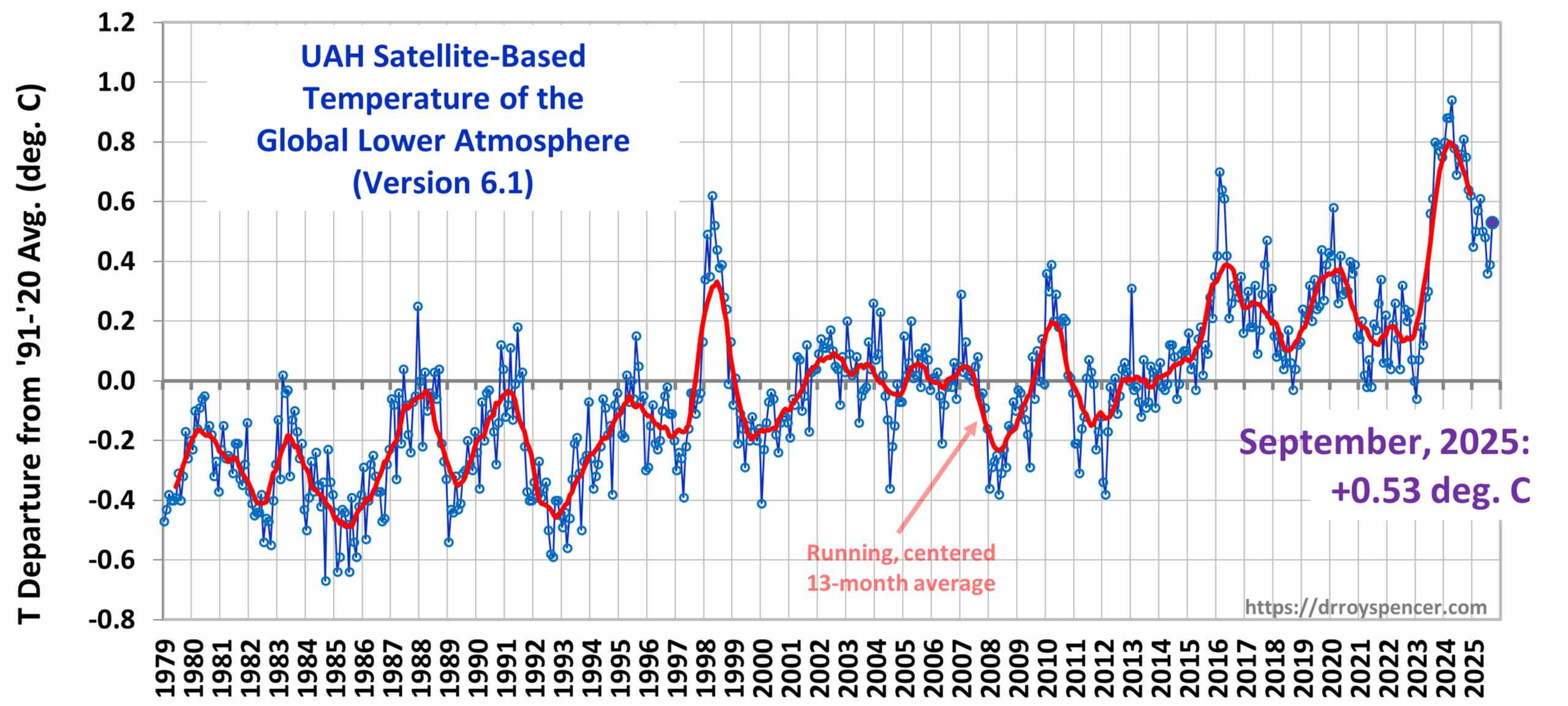
Fortunately, worldwide temperature measurements started to be available from 1979 with the first satellite-based temperature measurement technology [Ref. 2]. The satellite record is now the better part of half a century old and so comparison can be made between alarmist models and physical reality (with the latter measured by, and with agreement between, satellites and balloons/radiosondes).
The satellite measurements show that the global average temperature of the lower atmosphere is about one degree Celsius warmer now than when satellite records began [Note 1]. Temperature has been measured to rise and fall, typically over scales of about 4 years, with the current temperature having first been exceeded in 1998 (i.e. over 25 years ago in a record less than twice that age). It thus seems appropriate at this point to quote prof. Richard Lindzen, “The influence of mankind on climate is trivially true and numerically insignificant.”
Furthermore, it has been known for some 10 years that the majority of climate models predict greater warming than has been measured in practice [Refs. 4 and 5]. To quote from the Executive Summary of [Ref. 5],
The world’s several dozen global climate models offer little guidance on how much the climate responds to elevated CO2 … Global climate models generally run “hot” in their description of the climate of the past few decades … The combination of overly sensitive models and implausible extreme scenarios for future emissions yields exaggerated projections of future warming … Both models and experience suggest that CO2-induced warming might be less damaging economically than commonly believed, and excessively aggressive mitigation policies could prove more detrimental than beneficial … U.S. policy actions are expected to have undetectably small direct impacts on the global climate, and any effects will emerge only with long delays …
Given that (i) democratic governments typically have an electoral cycle of about 5 years, (ii) the physical temperature record (as contrasted to the output of computer models) shows only modest temperature rise over decades, and (iii) as just noted even large very economies (e.g. USA) are expected to have only a tiny and slowly-emerging influence on climate, the question arises, “Why have Western governments continued to spend so much time and treasure trying to mitigate (rather than adapt to) climate change? To try to answer that question it is necessary to consider organisational issues at national and international levels.
ORGANISATIONAL ISSUES
As noted above, governments have created armies of climate scientists and civil servants to address anthropogenic-driven climate change which seems to be, at worst, but a small and slowly emerging threat, or indeed a benefit when increased greening from CO2 fertilisation is included [Ref. 6]. In a dangerous but rational world such small threats/definite benefits would be relegated to ‘watching brief’ status in the nation’s risk register.
However, what is to be done with the aforementioned standing army of scientists and functionaries who, not wanting to lose their jobs [Refs. 7 and 8], argue for continued hyper-vigilance via the Precautionary Principle? Is there any mechanism to move them onto study more serious and more imminent threats? Well, without civil service etc. reform [Note 2] it appears, as reported by Endress [Ref. 9], that such change may be very difficult to achieve:
A particularly powerful type of rent-seeking coalition … is termed “the iron triangle” because of the strength of the collaborative relationships among a triad of actors: politicians … government bureaucrats … and private sector interest groups … The iron triangle is durable and impenetrable because it functions as a highly efficient, three-cornered, rent-seeking machine.
Endress continued with a prescient warning for our own days,
Nowhere (except perhaps in health care) do third-best politics sink … best economic considerations as deeply as in the realm of energy policy.
To illustrate briefly how scientists supporting the government’s alarmist warming case have contributed to iron triangle behaviour, it is helpful to understand the principles of best scientific practice. These were set out decades ago by Merton [Ref. 10], of which the following two are relevant for present considerations:-
…disinterestedness: scientific institutions act for the benefit of a common scientific enterprise, rather than for specific outcomes …
…organized skepticism: scientific claims should be exposed to critical scrutiny before being accepted: both in methodology and institutional codes of conduct.
Read a couple of comments [Ref. 11] by climate scientist prof. Phil Jones and consider whether they are consistent with best practice:-
(i) “I can’t see either of these papers being in the next IPCC report. Kevin and I will keep them out somehow – even if we have to redefine what the peer review literature is!” (ii) “Why should I make the data available to you, when your aim is to try and find something wrong with it?”
For those wishing to pursue the many breaches of best scientific practice within the climate science community [Refs. 12 and 13], though slightly dated, may be useful. These breaches are highly important because they have helped to steer and distort government climate and energy policy over decades. The broader issue of separating climate politics from alarmism is addressed by prof. Mike Hulme in [Ref. 14].
Among the organisational failures arising from an energy policy that has been driven by climate alarmism are the omission of adequate risk and cost-benefit analyses justifying the rapid roll out of modern renewables rather than a considered, staged deployment starting with a variety of pilot projects. This failure has led to huge costs to be covered by tax- and energy bill-payers. Perhaps this failure is due in part to policy capture by activists, or as prof. Lindzen [Ref. 15] puts it,
To say that climate change will be catastrophic hides a cascade of value-laden assumptions that do not emerge from empirical science.
A further misdirection by the Establishment is to rely on the concept of ‘consensus’ within a highly contested scientific debate about a highly complex multifactorial topic such as climate [Note 3]. In a different context Albert Einstein had to deal with this issue about a century ago; my computer gave this AI overview of his situation,
When a book was published titled ‘One Hundred Authors Against Einstein’ to disprove his theory of relativity, he famously retorted, “Why one hundred? If I were wrong, one would have been enough!”. Einstein’s response highlighted the scientific principle that a single, valid contradictory fact is enough to disprove a theory, rather than the need for a collective opinion.
With all the distortions noted above it is perhaps unsurprising that Western governments (which, following World War 2, had invested so much political capital in the United Nations Organisation) have promoted the series of COP (Conferences of the Parties) as a vehicle for their ‘war’ on anthropogenic CO2. The COP of late 2009 in Copenhagen marked a watershed moment in the COP series; it was then and there that the West’s governments, notably Europe’s governments, failed to persuade the rest of the world to adopt an enforceable framework for CO2 reduction. As Rupert Darwall [Ref. 16] put it,
Now the Europeans were not only isolated. They had been crushed. For them, climate change was an existential issue. There could be no more important business than saving the planet … There was just enough in the Accord to keep the whole negotiating process going indefinitely and provide cover for European governments to continue with their global warming policies. Everything could go on much as before.
And so, some 16 years later, it still continues much as before i.e. with all the baked in errors of science, organisation and resultant policy.
CONCLUSIONS
I have attempted to show that climate and energy policy has been distorted due to significant scientific and organisational errors such that, although the Establishment (currently) enjoys numerical superiority over the sceptics, it does not enjoy superiority in the quality of its arguments – far from it! This asymmetry reveals itself also in public behaviour with the Establishment denigrating non-believers in the most derogatory terms; such denigration is not, I argue, warranted given the poor quality of the Establishment’s methodologies. Indeed, much needs to be done to set the Establishment’s house in order and thereby set the West (and notably the Europeans) back on the path to (i) reliable and affordable energy, (ii) much improved democratic governance, and (iii) scientific rectitude.
Finally, it may be appropriate to quote Einstein again [Ref 17], “The only thing more dangerous than ignorance is arrogance.” If the great man were alive today I wonder whether he would have anything to say about the combination of arrogance and wilful ignorance. They seem, from my perspective, to have been exceedingly destructive for the West in recent decades.
NOTES
To put the 1 degree Celsius temperature rise in context it is helpful to recall that, in very approximate figures, global average surface temperature is 15 degrees Celsius and the absolute zero of thermal energy is minus 273 Celsius. Hence the 1 degree rise represents a change of less than half of 1% over about half a century.
A major lesson to be taken from the response to the global warming issue is the need in every case to avoid one-sided or motivated reasoning; balanced argumentation (via, for example, red-v-blue team review) is always required. Claims such as, “The science is settled!”, should always viewed with the greatest scepticism [cf. Ref. 10].
By contrast Maxwell’s discovery of the laws of electromagnetism (as set out in the equations named after him) enjoy an almost universal consensus because, although mathematically complex, they deal with a single domain of knowledge, whereas many scientific domains are involved in determining the even more complex topic of climate.
REFERENCES
Nigel Calder, “The Weather Machine”, BBC, 1974. Note the subtitle on the dustcover, “And the Threat of Ice”.


You must be logged in to post a comment.