Global warming, climate change, all these things are just a dream come true for politicians. I deal with evidence and not with frightening computer models because the seeker after truth does not put his faith in any consensus. The road to the truth is long and hard, but this is the road we must follow. People who describe the unprecedented comfort and ease of modern life as a climate disaster, in my opinion have no idea what a real problem is.
In the latest illustration of why you can’t rely on wishful thinking as a power source, the UK and Germany faced a harsh lesson in “Dunkelflaute.” For those not familiar with this charming German term, it means “dark doldrums”—or, in practical terms, a blackout in renewable power. While we’ve been lectured about the virtues of a green energy future, these countries got a taste of the reality: when the wind stops blowing, the entire grand plan goes belly-up.
In the latest illustration of why you can’t rely on wishful thinking as a power source, the UK and Germany faced a harsh lesson in “Dunkelflaute.” For those not familiar with this charming German term, it means “dark doldrums”—or, in practical terms, a blackout in renewable power. While we’ve been lectured about the virtues of a green energy future, these countries got a taste of the reality: when the wind stops blowing, the entire grand plan goes belly-up.
This past Tuesday, Britain’s much-heralded wind farms managed to cover a pitiful 3-4% of electricity demand during peak hours. The National Grid had no choice but to ramp up gas-fired plants, which handled a whopping 60% of demand. Meanwhile, solar and biomass did their best to chip in, but as always, they came up short. Across the Channel, Germany experienced similar woes. Wind speeds dropped so low that turbines were spinning at a meager 7% of their theoretical capacity. Once again, it was back to coal and gas—those supposed relics of the past that are actually the backbone of modern energy security.
The “Green” Fantasy vs. Reality
Here’s what the climate evangelists won’t admit: renewable energy is a fair-weather friend. When the high-pressure systems settle in, the wind dies, and the sun disappears behind clouds, the whole green energy charade falters. Dunkelflaute is a reality every winter in Europe. Yet, this doesn’t stop policymakers from pushing for an energy system increasingly dependent on wind and solar, demanding that we double down with offshore wind farms and solar panels as if weather-dependent power will suddenly become reliable.
According to the UK’s National Energy System Operator (NESO), achieving “clean power by 2030” requires nothing short of a “Herculean effort.” We’re talking about doubling onshore wind capacity, tripling offshore wind, and quadrupling solar power. And even with all of that, there’s an acknowledgment that the system will need significant backup from nuclear power, battery storage, and, yes, gas plants. It’s as if they know this plan doesn’t hold up without fossil fuels lurking in the background, ready to save the day.
Unpacking the Fantasy Numbers
To prop up this fantasy, NESO envisions a massive expansion of not only wind and solar farms but also “system flexibility.” What does that mean? Well, they expect the public to adjust their energy usage based on availability. Imagine being asked to cook dinner at 2 p.m. because the wind happens to be blowing. This is the absurdity we’re being sold: an “eco-friendly” lifestyle where you’re at the mercy of the weather.
Then there’s the infrastructure needed. NESO’s pathway demands thousands of miles of new cables, pylons, and a reworked planning system to connect all these intermittent sources. And after all that, they admit gas will still be part of the equation, justifying its role as “backup.” In plain terms, gas will continue to do the heavy lifting during Dunkelflautes.
The Never-Ending Need for Fossil Fuels
Chris Stark, one of the government’s leading voices in this green campaign, recently acknowledged on social media that gas is, for now, the main “backup.” In his words, they hope to replace it with “low-carbon flexibility,” which is code for technology that doesn’t yet exist at the scale required. Meanwhile, we’re supposed to celebrate incremental shifts in “renewable generation,” especially in offshore wind—despite its sky-high costs and inconsistency.
Stark and his colleagues envision an elaborate future where energy storage and “flexibility” will reduce gas dependence. But let’s not kid ourselves. Even if small, “low-carbon” energy sources are developed, they won’t magically replace gas. We’re talking about filling a chasm of energy needs with a handful of experimental technologies.
Why This Matters
The truth here is painfully simple. Europe’s renewable dream relies on natural gas, coal, and nuclear. Without these, the entire system is a non-starter. Dunkelflaute is just the latest chapter in a long saga showing that renewables, as they stand today, cannot sustain a modern grid. And while the green lobby loves to demonize fossil fuels, they remain essential, especially when the wind stops.
The takeaway? We can’t afford to abandon reliable energy sources in favor of a pipe dream. If Europe and the UK want to avoid future Dunkelflautes, they’ll need to face reality and embrace a balanced, reliable mix of energy sources—one that doesn’t leave entire nations powerless in the dark.
Germany’s fragile government has collapsed after Olaf Scholz fired his finance minister on Wednesday evening.
The Chancellor sacked Christian Lindner after days of crisis talks and amid a deluge of rumours that his turbulent coalition was about to come to an end.
German Chancellor Olaf Scholz gives a statement after a meeting with government leaders in Berlin, Germany, Wednesday, Nov. 6, 2024. (AP Photo/Markus Schreiber)
Fragile coalition crumbles after days of crisis talks, with elections expected as soon as March, six months ahead of schedule
Germany’s fragile government has collapsed after Olaf Scholz fired his finance minister on Wednesday evening.
The Chancellor sacked Christian Lindner after days of crisis talks and amid a deluge of rumours that his turbulent coalition was about to come to an end. The Telegraph has the story.
In a statement to the press on Wednesday evening, the chancellor accused his finance minister of “breaking his trust” and putting the “short-term survival of his party over the wellbeing of the country.”
Mr Scholz, 66, said that he would put his chancellorship to a vote of confidence in January, a move that will clear the way for early elections in March.
Mr Lindner, head of the pro-business Free Democrats, had been pushing for corporate tax relief and a delay to net zero targets as part of a comprehensive package to get the economy moving after years of stagnation.
Mr Scholz claimed that he made a “generous offer” to Mr Lindner but that the finance minister “showed no interest whatsoever in accepting this offer for the good of the country”.
“Too often, Mr Lindner has blocked laws in an irrelevant manner, too often he has engaged in petty party-political tactics, too often he has broken my trust,” Mr Scholz said.
Mr Lindner hit back in a statement made shortly after in which he accused Mr Scholz of “not having the strength to give our country a new start.”
He added that the Chancellor had tried to get him to suspend the country’s strict debt brake rules, something he refused to accept.
At the end of last week, Mr Lindner set out his conditions for staying in the government in an internal paper that called for an “economic transformation”.
Among the measures were a demand to cut the corporate tax level, freeze all new business regulations and push back the target of achieving net zero by five years.
The paper was immediately rejected by Mr Scholz’s Social Democrats and the Greens, the third party in the coalition.
Mr Scholz began non-stop crisis meetings with his finance minister and vice-Chancellor Robert Habeck of the Greens on Monday, but the three men failed to reach agreement.
Climate Depot’s Marc Morano: “Congratulations to President Trump and Sen. J.D. Vance. Finally, US leadership has returned to fight the international climate agenda. The U.S. will finally have a president back in the Oval Office who will be pro-science, pro-environment, and fight the demented net zero climate agenda, the Green New Deal, and the UN climate treaty process.
President Trump will also be able to face off against the ridiculous, unsustainable, and unscientific claims that emanate from our most esteemed institutions. America will once again be a beacon of scientific realism regarding climate change and energy policy. Bravo!”
Trump has vowed to increase U.S. production of fossil fuels by easing the permitting process for drilling on federal land and would encourage new natural gas pipelines. He has said he would reauthorize oil drilling in the Arctic National Wildlife Refuge in Alaska.
Whether the oil industry follows through and raises production at a time when oil and gas prices are relatively low remains to be seen.
He has said he will again pull the United States out of the Paris Climate Accords, a framework for reducing global greenhouse gas emissions, and would support increased nuclear energy production.
He would also roll back Democratic President Joe Biden’s electric-vehicle mandates and other policies aimed at reducing auto emissions.
He has argued that the U.S. needs to be able to boost energy production to be competitive in developing artificial intelligence systems, which consume large amounts of power.
Climate Depot’s Marc Morano: “Congratulations to President Trump and Sen. J.D. Vance. Finally, US leadership has returned to fight the international climate agenda. The U.S. will finally have a president back in the Oval Office who will be pro-science, pro-environment, and fight the demented net zero climate agenda, the Green New Deal, and the UN climate treaty process.
President Trump will also be able to face off against the ridiculous, unsustainable, and unscientific claims that emanate from our most esteemed institutions. America will once again be a beacon of scientific realism regarding climate change and energy policy. Bravo!”
#
The U.S. presidential election has massive consequences for the climate change agenda. CFACT will be on the ground again this year following the UN’s every effort to squelch your freedom and continue the dark path of net-zero rationing of energy, food, freedom of movement, and free speech. The CFACT team traveling to Azerbaijan will be led by veteran UN experts Craig Rucker — who has attended 26, and Marc Morano, who will be attending his 20th out of the past 29 international UN summits.
Azerbaijan is the third petro-state in a row to host the COP summit, with Egypt, and Dubai the previous two years. This year’s summit is being dubbed the “finance COP” because climate and green energy lobbyists are descending on the event to try to funnel even more U.S. taxpayer money into their pockets.
CFACT’s Marc Morano, who runs Climate Depot, commented:
“With Donald Trump winning the US presidential election, the United Nations COP29 will turn into a giant wake, with the United Nations facing defeat of their anti-human climate agenda. The entire climate agenda is facing utter and complete collapse due to its unrealistic mandates and targets. Failure across the board is occurring, from emission targets to anemic electric vehicle sales to pushback by farmers fighting back against agricultural climate restrictions. A Trump victory will help push the United Nations and its net zero agenda into the dustbin of history. I will be on the ground with other team members to report daily on what’s happening post-election at one of the most consequential UN climate summits.”
American Energy Alliance’s Statement on President Trump’s Victory
WASHINGTON DC (11/06/2024) – According to AP News, President Donald J. Trump has been declared the winner of the 2024 presidential election. A major theme of President Trump’s campaign was his intention to promote policies that make energy and electricity more affordable for everyday Americans. The American Energy Alliance endorsed candidate Trump.American Energy Alliance President Thomas Pyle issued the following statement on President Donald J. Trump’s victory in the 2024 presidential election:“Congratulations to President Donald J. Trump on his election victory. Throughout his campaign, President Trump expressed his unabashed support for American energy. He promised to embrace domestic oil and gas production, lower energy and electricity prices, and undo the inflationary Biden-Harris Green New Deal policies, especially the wasteful taxpayer funded subsidies in the so-called Inflation Reduction Act. That’s because President Trump understands that affordable and reliable energy is critical to our economic well-being and our national security.“We look forward to working with President Trump to unleash our energy potential, preserve the right for Americans to choose the types of cars and trucks that best suit our needs, and unwind the Biden-Harris administration’s regulatory onslaught on American energy producers.”
While climate policy wasn’t the star of this recent election, the results carry significant implications for the climate agenda. Voters weren’t casting ballots explicitly for or against green energy mandates, net-zero goals, or climate “emergencies.” Yet, indirectly, they sent a strong signal: the public isn’t fully buying into the costly, disruptive climate policies that have become a pillar of certain political platforms.
While climate policy wasn’t the star of this recent election, the results carry significant implications for the climate agenda. Voters weren’t casting ballots explicitly for or against green energy mandates, net-zero goals, or climate “emergencies.” Yet, indirectly, they sent a strong signal: the public isn’t fully buying into the costly, disruptive climate policies that have become a pillar of certain political platforms. As the dust settles, the reality is clear—the green agenda just lost substantial footing, and its backers will have to reckon with what that means moving forward.
Climate Policy as a Secondary Issue with Primary Ramifications
It’s true; voters in this election were concerned primarily with issues closer to home—economic stability, inflation, job security, and immediate energy costs. But even as climate policy took a back seat in the campaign discourse, its implications loomed in the background. In states where green mandates have been most aggressive, energy prices have soared, job sectors have been strained, and the promise of renewable jobs hasn’t materialized to the extent promised. These factors, while not always top-of-mind in election messaging, have clearly made an impression on the public.
What we’re seeing is a kind of indirect referendum on the climate policies that have dominated recent years. Voters may not have explicitly voted on green policies, but the growing awareness of the trade-offs involved is unmistakable. The failure of candidates most closely aligned with aggressive climate agendas shows an implicit but impactful rejection of policies that prioritize carbon cuts and renewables at the expense of reliable, affordable energy.
The Green Agenda Takes a Back Seat
For years, climate alarmism has driven policy without substantial public scrutiny. Climate mandates were passed through sweeping bills, and green energy was sold as the inevitable future. However, this election signals a turning point. The quiet but firm message from voters was that climate goals can’t overrun practical concerns, especially as they impact household budgets and energy security.
The hard truth is this: while voters might generally support the idea of a cleaner environment, they’re clearly unwilling to shoulder the disruptive and costly consequences that come with rushed climate policies. Skyrocketing energy bills, faltering grid reliability, and the disappearance of traditional energy jobs are realities that weigh heavily on ordinary Americans. People may want a healthy planet, but they also want heat in the winter, affordable gas, and the economic security that has long come from stable energy industries.
The Implications for Policymakers
For climate policymakers, this election result is a wake-up call to recalibrate. The defeat of the green agenda in the background of these results reveals the limits of popular patience for top-down mandates that affect daily life. If lawmakers are paying attention, they’ll see that policies need to be practical, affordable, and adaptable, not dictated by climate scenarios that, however dire they may sound, lack resonance with the average voter’s immediate concerns.
In a way, this setback offers policymakers a chance to focus on balanced, flexible environmental strategies that don’t overburden citizens. The public’s quiet rejection of extreme climate policy can become an opportunity to develop approaches grounded in technological innovation, market-driven solutions, and gradual, economically viable transitions.
The Rise of Climate Realism
What this election suggests is that the era of unchecked climate alarmism may be shifting toward a more pragmatic, “climate realist” approach. Without overtly campaigning against green policies, voters have essentially said they’re not ready to make the kinds of sacrifices these policies demand. They’re looking for solutions that work with, not against, economic realities.
For the climate realist movement, these results represent a subtle but notable victory. The public has, in effect, rejected the notion that immediate, radical changes are the only solution to climate challenges. Instead, the message seems to be: take a measured approach, one that respects economic priorities and job security while still working toward environmental improvements.
A New Path Forward
As we look to the future, it’s evident that climate policy advocates must adjust their strategies. The message from the voting booth is unmistakable: the electorate is open to responsible environmental policy but weary of climate policies that impose financial strain without clear, tangible benefits. The public’s voice in this election suggests they’d rather see a steady, innovation-driven approach that strengthens—rather than weakens—their communities and the economy.
This election, though not explicitly about climate, may go down as a turning point for climate policy itself. Voters signaled that they won’t accept environmental goals at any cost, especially when that cost is borne by the average household. It’s a call for a shift from alarmist narratives to a practical, results-driven approach that respects both the environment and the economy.
Funding to build the UK’s largest hydrogen production facility in Bradford has been confirmed by Chancellor Rachel Reeves.
Bradford Low Carbon Hydrogen, a redevelopment of a former gas storage site, is the largest of 11 green hydrogen projects set to receive a share of £2bn from the government.
The Bradford project, which already has planning permission, is expected to create up to 125 new jobs for the city.
It will have the capacity to produce 12.5 tonnes of hydrogen each day, removing around 800 diesel buses from West Yorkshire’s roads on a daily basis.
The project is being delivered by joint venture partners N-Gen and Hygen, with support from Bradford Council.
Hydrogen production will secure the future of Bradford’s Birkshall site which has a rich heritage stretching back almost 100 years, according to the Local Democracy Reporting Service.
It was previously home to three large gas holders, with the site producing and storing gas for use by the city’s homes and businesses.
Hydrogen does not emit carbon when burned, meaning it can support the decarbonisation of several sectors, including heavy transport such as HGVs and buses.
Labour’s manifesto promised we would have a zero carbon electricity system by 2030. It is a pledge that Ed Miliband has been making for years, not least in his party conference speech last year, and it was also one of Labour’s ‘Five Missions for a Better Britain’ policy pledge launched last year.
Labour’s manifesto promised we would have a zero carbon electricity system by 2030. It is a pledge that Ed Miliband has been making for years, not least in his party conference speech last year, and it was also one of Labour’s ‘Five Missions for a Better Britain’ policy pledge launched last year.
It would therefore be reasonable to presume that Miliband actually had a detailed plan of how he would achieve this and how much it might all cost. It came as a surprise then when, shortly after taking office, he asked the National Energy System Operator, NESO, to provide practical advice on achieving his target.
NESO has now responded with some bad news.
Many energy experts have long argued that a zero carbon grid simply is not possible at these timescales, because you cannot run a grid predominantly on intermittent renewable energy. It turns out that NESO, whose job is to make sure that Britain has the electricity it needs every second of the day, agrees.
Their report sent to Ed Miliband emphasises that we will need to retain a full fleet of gas power plants, to fire up when the wind does not blow and the sun does not shine:
This really is a damning indictment not only of Labour’s energy policy, but also of the whole Net Zero agenda and its reliance on intermittent renewable energy.
Even though NESO says that gas power will only supply 5% of our electricity, there will be many days when we will still need it for half or more. And keeping a fleet of gas plants on standby creates problems of its own. They will need to be fully manned, maintained and ready to fire up as and when needed, all of which will cost a lot of money. With these plants standing idle most of the time, operators will demand billions in standby payments, all of which will end up on our energy bills.
The NESO report also confirms that the increase in wind and solar power demanded by Miliband will drastically increase bills, not lower them as we were promised.
Not only is renewable energy more expensive to produce than gas generation, there are indirect costs to consider, such as paying for standby capacity, costs of storage, curtailment payments when we have too much wind and grid upgrades.
Analysis of NESO data suggests that annual costs could be £20 billion higher by 2030 if Miliband’s plans are carried through.
NESO also says that annual investment of £48 billion will be needed between now and 2030 to achieve targets.
But all of this expenditure will merely end up duplicating what we already have.
If this was not all bad enough, over reliance on intermittent renewables will mean that we will end up having energy rationing. According to NESO, households will have to switch off appliances at times of peak demand. Currently, of course, gas generation is turned up and down to match demand.
NESO hopes the public will do it voluntarily! Good luck with that.
Unsurprisingly, Ed Miliband has already been bragging that this new report proves that his clean power plan is both achievable and will lead to cheaper electricity. Both are outright lies.
But it looks like we will learn this the hard way.
Shame on the Telegraph for publishing this rubbish:
Climate change is fuelling Britain’s mental health crisis, according to the UK Health Security Agency, amid a crunch in the jobs market with millions of working-age adults off sick.
Extreme weather including heatwaves and floods is directly harming people’s health, while the sustained threat of a worsening climate is increasing “psychological distress” on the population, the agency warned.
It is compiling a report on the links between climate change and mental health, as well as the groups most at risk and potential interventions to ease the impact.
The agency has launched a call for evidence, seeking proposals on ways to support sufferers.
The UK Health Security Agency replaced Public Health England in 2021 as the government body responsible for protecting the health of the British public.
The NHS is under growing strain from the increasing demand for mental health services, while the economy is also suffering severely as widespread health problems keep a growing number of adults off work.
Previously I have demonstrated that changes in atmospheric CO2 levels follow changes in Global Mean Temperatures (GMT) as shown by satellite measurements from University of Alabama at Huntsville (UAH). That background post is reprinted later below.
My curiosity was piqued by the remarkable GMT spike starting in January 2023 and rising to a peak in April 2024. I also became aware that UAH has recalibrated their dataset due to a satellite drift that can no longer be corrected. The values since 2020 have shifted slightly in version 6.1, as shown in my report yesterday UAH October 2024: NH and Tropics Lead Global Cooling.
In this post, I test the premise that temperature changes are predictive of changes in atmospheric CO2 concentrations. The chart above shows the two monthly datasets: CO2 levels in blue reported at Mauna Loa, and Global temperature anomalies in purple reported by UAHv6.1, both up to October 2024. Would such a sharp increase in temperature be reflected in rising CO2 levels, according to the successful mathematical forecasting model?
The answer is yes: that temperature spike results in a corresponding CO2 spike as expected.
Above are UAH temperature anomalies compared to CO2 monthly changes year over year.
Changes in monthly CO2 synchronize with temperature fluctuations, which for UAH are anomalies now referenced to the 1991-2020 period. CO2 differentials are calculated for the present month by subtracting the value for the same month in the previous year (for example October 2024 minus October 2023). Temp anomalies are calculated by comparing the present month with the baseline month. Note the recent CO2 upward spike and drop following the temperature spike and drop.
The final proof that CO2 follows temperature due to stimulation of natural CO2 reservoirs is demonstrated by the ability to calculate CO2 levels since 1979 with a simple mathematical formula:
For each subsequent year, the CO2 level for each month was generated
CO2 this month this year = a + b × Temp this month this year + CO2 this month last year
The values for a and b are constants applied to all monthly temps, and are chosen to scale the forecasted CO2 level for comparison with the observed value. Here is the result of those calculations.
In the chart calculated CO2 levels correlate with observed CO2 levels at 0.9987 out of 1.0000. This mathematical generation of CO2 atmospheric levels is only possible if they are driven by temperature-dependent natural sources, and not by human emissions which are small in comparison, rise steadily and monotonically. For a more detailed look at the recent fluxes, here are the results since 2015, an ENSO neutral year.
For this recent period, the calculated CO2 values match the annual lows, while some annual generated values of CO2 are slightly higher or lower than observed at other months of the year. Still the correlation for this period is 0.9928.
Key Point
Changes in CO2 follow changes in global temperatures on all time scales, from last month’s observations to ice core datasets spanning millennia. Since CO2 is the lagging variable, it cannot logically be the cause of temperature, the leading variable. It is folly to imagine that by reducing human emissions of CO2, we can change global temperatures, which are obviously driven by other factors.
Background Post Temperature Changes Cause CO2 Changes, Not the Reverse
This post is about proving that CO2 changes in response to temperature changes, not the other way around, as is often claimed. In order to do that we need two datasets: one for measurements of changes in atmospheric CO2 concentrations over time and one for estimates of Global Mean Temperature changes over time.
Climate science is unsettling because past data are not fixed, but change later on. I ran into this previously and now again in 2021 and 2022 when I set out to update an analysis done in 2014 by Jeremy Shiers (discussed in a previous post reprinted at the end). Jeremy provided a spreadsheet in his essay Murray Salby Showed CO2 Follows Temperature Now You Can Too posted in January 2014. I downloaded his spreadsheet intending to bring the analysis up to the present to see if the results hold up. The two sources of data were:
Uploading the CO2 dataset showed that many numbers had changed (why?).
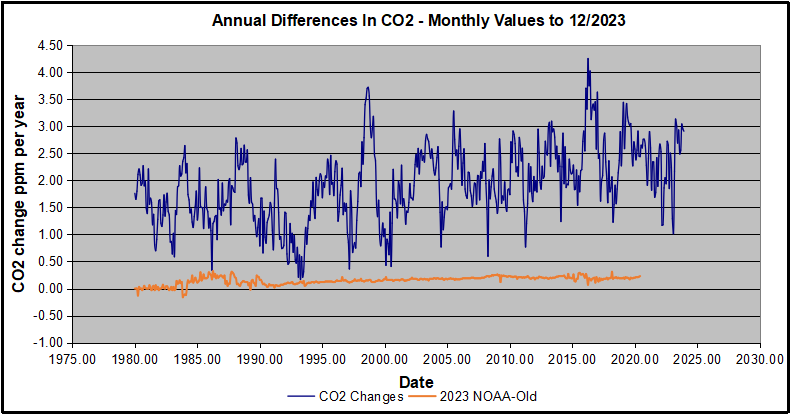
The blue line shows annual observed differences in monthly values year over year, e.g. June 2020 minus June 2019 etc. The first 12 months (1979) provide the observed starting values from which differentials are calculated. The orange line shows those CO2 values changed slightly in the 2020 dataset vs. the 2014 dataset, on average +0.035 ppm. But there is no pattern or trend added, and deviations vary randomly between + and -. So last year I took the 2020 dataset to replace the older one for updating the analysis.
Now I find the NOAA dataset starting in 2021 has almost completely new values due to a method shift in February 2021, requiring a recalibration of all previous measurements. The new picture of ΔCO2 is graphed below.
The method shift is reported at a NOAA Global Monitoring Laboratory webpage, Carbon Dioxide (CO2) WMO Scale, with a justification for the difference between X2007 results and the new results from X2019 now in force. The orange line shows that the shift has resulted in higher values, especially early on and a general slightly increasing trend over time. However, these are small variations at the decimal level on values 340 and above. Further, the graph shows that yearly differentials month by month are virtually the same as before. Thus I redid the analysis with the new values.
Global Temperature Anomalies (ΔTemp)
The other time series was the record of global temperature anomalies according to RSS. The current RSS dataset is not at all the same as the past.
Here we see some seriously unsettling science at work. The purple line is RSS in 2014, and the blue is RSS as of 2020. Some further increases appear in the gold 2022 rss dataset. The red line shows alterations from the old to the new. There is a slight cooling of the data in the beginning years, then the three versions mostly match until 1997, when systematic warming enters the record. From 1997/5 to 2003/12 the average anomaly increases by 0.04C. After 2004/1 to 2012/8 the average increase is 0.15C. At the end from 2012/9 to 2013/12, the average anomaly was higher by 0.21. The 2022 version added slight warming over 2020 values.
RSS continues that accelerated warming to the present, but it cannot be trusted. And who knows what the numbers will be a few years down the line? As Dr. Ole Humlum said some years ago (regarding Gistemp): “It should however be noted, that a temperature record which keeps on changing the past hardly can qualify as being correct.”
Given the above manipulations, I went instead to the other satellite dataset UAH version 6. UAH has also made a shift by changing its baseline from 1981-2010 to 1991-2020. This resulted in systematically reducing the anomaly values, but did not alter the pattern of variation over time. For comparison, here are the two records with measurements through December 2023.
Comparing UAH temperature anomalies to NOAA CO2 changes.
Here are UAH temperature anomalies compared to CO2 monthly changes year over year.
Changes in monthly CO2 synchronize with temperature fluctuations, which for UAH are anomalies now referenced to the 1991-2020 period. As stated above, CO2 differentials are calculated for the present month by subtracting the value for the same month in the previous year (for example June 2022 minus June 2021). Temp anomalies are calculated by comparing the present month with the baseline month.
The final proof that CO2 follows temperature due to stimulation of natural CO2 reservoirs is demonstrated by the ability to calculate CO2 levels since 1979 with a simple mathematical formula:
For each subsequent year, the co2 level for each month was generated
CO2 this month this year = a + b × Temp this month this year + CO2 this month last year
Jeremy used Python to estimate a and b, but I used his spreadsheet to guess values that place for comparison the observed and calculated CO2 levels on top of each other.
In the chart calculated CO2 levels correlate with observed CO2 levels at 0.9986 out of 1.0000. This mathematical generation of CO2 atmospheric levels is only possible if they are driven by temperature-dependent natural sources, and not by human emissions which are small in comparison, rise steadily and monotonically.
Comment: UAH dataset reported a sharp warming spike starting mid year, with causes speculated but not proven. In any case, that surprising peak has not yet driven CO2 higher, though it might, but only if it persists despite the likely cooling already under way.
Previous Post: What Causes Rising Atmospheric CO2?
This post is prompted by a recent exchange with those reasserting the “consensus” view attributing all additional atmospheric CO2 to humans burning fossil fuels.
The IPCC doctrine which has long been promoted goes as follows. We have a number over here for monthly fossil fuel CO2 emissions, and a number over there for monthly atmospheric CO2. We don’t have good numbers for the rest of it-oceans, soils, biosphere–though rough estimates are orders of magnitude higher, dwarfing human CO2. So we ignore nature and assume it is always a sink, explaining the difference between the two numbers we do have. Easy peasy, science settled.
What about the fact that nature continues to absorb about half of human emissions, even while FF CO2 increased by 60% over the last 2 decades? What about the fact that in 2020 FF CO2 declined significantly with no discernable impact on rising atmospheric CO2?
These and other issues are raised by Murray Salby and others who conclude that it is not that simple, and the science is not settled. And so these dissenters must be cancelled lest the narrative be weakened.
The non-IPCC paradigm is that atmospheric CO2 levels are a function of two very different fluxes. FF CO2 changes rapidly and increases steadily, while Natural CO2 changes slowly over time, and fluctuates up and down from temperature changes. The implications are that human CO2 is a simple addition, while natural CO2 comes from the integral of previous fluctuations. Jeremy Shiers has a series of posts at his blog clarifying this paradigm. See Increasing CO2 Raises Global Temperature Or Does Increasing Temperature Raise CO2 Excerpts in italics with my bolds.
The following graph which shows the change in CO2 levels (rather than the levels directly) makes this much clearer.
Note the vertical scale refers to the first differential of the CO2 level not the level itself. The graph depicts that change rate in ppm per year.
There are big swings in the amount of CO2 emitted. Taking the mean as 1.6 ppmv/year (at a guess) there are +/- swings of around 1.2 nearly +/- 100%.
And, surprise surprise, the change in net emissions of CO2 is very strongly correlated with changes in global temperature.
This clearly indicates the net amount of CO2 emitted in any one year is directly linked to global mean temperature in that year.
For any given year the amount of CO2 in the atmosphere will be the sum of
all the net annual emissions of CO2
in all previous years.
For each year the net annual emission of CO2 is proportional to the annual global mean temperature.
This means the amount of CO2 in the atmosphere will be related to the sum of temperatures in previous years.
So CO2 levels are not directly related to the current temperature but the integral of temperature over previous years.
The following graph again shows observed levels of CO2 and global temperatures but also has calculated levels of CO2 based on sum of previous years temperatures (dotted blue line).
Summary:
The massive fluxes from natural sources dominate the flow of CO2 through the atmosphere. Human CO2 from burning fossil fuels is around 4% of the annual addition from all sources. Even if rising CO2 could cause rising temperatures (no evidence, only claims), reducing our emissions would have little impact.
For decades environmentalists raised questionable, but often successful, objections to block mines, pipelines, nuclear power, and oil and gas operations.
Now, as Shakespeare’s Hamlet might say, they are “hoisted by their own petards,” referring to a small explosive device used in siege warfare.
Vertical axis wind turbines generator farm for renewable sustainable and alternative energy production along coast baltic sea near Denmark. Eco power, ecology.
For decades environmentalists raised questionable, but often successful, objections to block mines, pipelines, nuclear power, and oil and gas operations.
Now, as Shakespeare’s Hamlet might say, they are “hoisted by their own petards,” referring to a small explosive device used in siege warfare.
In a bit of irony, the very legal and regulatory obstacles the Greens erected and deployed against fossil fuel companies they were opposed to are now coming back full circle to explode in their faces, blocking and hindering their beloved solar and wind projects. Even more poetically just, it has often been the “little guys” environmentalists have insisted they care so deeply about who are the ones wielding the weapons.
Energy expert and journalist Robert Bryce notes that farming families, small rural communities and Native American Tribes have rejected or restricted 35 wind and 58 solar projects this year, through September. Since 2015, these “little guys” have stymied a whopping 735 “renewable energy” projects across the USA.
Who could blame them? The bad news for the Greens is these locals are challenging their beloved “climate-friendly” projects, using the environmentalists’ own legal roadmaps … and winning.
In Idaho, local preservationists opposed the Lava Ridge Wind Project, which would install hundreds of 700-foot-tall turbines within eyeshot of the Minidoka National Historic Site, where a World War II Japanese internment camp was located. They have been joined by local officials, the Idaho legislature, governor, lieutenant governor, attorney general and both US senators in demanding that the US Bureau of Land Management scrap the project.
The unprecedented defiance convinced a nearby county to implement a moratorium on wind and solar farms the Biden-Harris Administration wanted as part of its climate agenda.
In next-door Oregon, Native Americans filed lawsuits to challenge a deepwater offshore wind project – which arguably makes no energy, economic, engineering or environmental sense. Even liberal Governor Tina Kotek has now changed her position on offshore wind, and an October auction was postponed because no company was interested in bidding.
In California, local officials and landowners oppose the proposed 320-MW Seguro battery energy storage facility, after a series of battery fires in EVs and at battery factories and energy storage facilities.
Heading east, after a decade-long legal battle, Oklahoma’s Osage Nation forced wind energy developers to tear down and remove dozens of turbines, because they had not obtained leases or permits to install the turbines and power lines on Native lands beforehand.
In Wisconsin, the Engelstad family and other locals are battling the Koshkonong solar project near Christiana, Wisconsin. It would blanket 6,400 acres (10 sq mi) of prime agricultural land and put a 667-MWh battery storage system hundreds of feet from an elementary school.
Along the Atlantic coast, multiple groups have helped to cancel the Ocean Wind 1 and 2 projects (NJ), put Atlantic Shores North and South (NJ) under pressure, make Skipjack Wind (MD) less promising, and subjected Coastal Virginia Offshore Wind and other offshore wind projects to litigation over harm to endangered whales.
Multi-hundred-mile transmission lines – including the Grain Belt Express (Kansas-Missouri-Illinois-Indiana) and Piedmont Reliability (Pennsylvania-Maryland-Virginia) – also face intense pushback.
The list of delayed, cancelled or stymied projects goes on and on.
Local residents, developers, regulators, permitting agencies and insurers are rightly concerned about the impacts of so-called “green” energy. It is they who must consider its major issues that have received scant scrutiny in the past. They must address questions such as what to do with the thousands of solar panels or hundreds of wind turbines get worn out after 20 years … or maybe destroyed by hail, tornados or hurricanes. It is they who must figure out who pays for dismantling, removing and disposing the trash, and in whose backyard do those billions of pounds of trash go.
Case in point, Iowa Attorney General Brenna Bird recently sued a waste disposal company for failing to cut up, transport, recycle and otherwise properly dispose of 1,300 broken and decommissioned wind turbine blades, which the company simply left piled up at multiple locations across the state.
As green ventures collapse, there’s a reckoning environmentalists must come to grips with – they no longer have the public trust. They will have to make their case to state and local officials who, to quote Shakespeare, will determine whether green energy projects are “to be, or not to be.” This may become much more difficult to do.
Getting up in the middle of the night to run the washing machine will help. Downsizing to a slightly smaller TV might make a small difference. And of course switching off your mobile for a few hours every day may have to be mandatory, not just to avoid all the craziness on social media, but to keep the grid running.
Ed Miliband can’t seriously expect British voters ration their electricity usage
Getting up in the middle of the night to run the washing machine will help. Downsizing to a slightly smaller TV might make a small difference. And of course switching off your mobile for a few hours every day may have to be mandatory, not just to avoid all the craziness on social media, but to keep the grid running. The Telegraph has the story.
The National Energy System Operator has this week warned the Energy Secretary Ed Miliband that it will take a “Herculean effort” by the whole country to make sure we can keep the power system running while ending the use of fossil fuels by 2030. But hold on. That is crazy. And if Miliband does mandate power cuts, as looks increasingly likely, it will surely bring down the government – and rightly so.
When the government set the target of making the UK’s electricity grid completely free of fossil fuels by 2030 we were told repeatedly that renewable energy would be cheaper, cleaner, create hundreds of thousands of “well-paid green jobs”, end dependency of foreign powers, and turbo-charge investment and growth. We would set an example to the world on climate change, while getting richer at the same time.
The trouble is, it is not working out quite as planned. According to the slightly sinister sounding Neso, millions of households may have to be persuaded to shift their power consumption to even out the load on the grid. Wind and solar power are so variable, and capacity so limited, that if we all start boiling the kettle at the same time the whole system will crash.
It is not hard to see the slippery slope here. Sure, it may start with “persuading” us to change the way we use power, perhaps with some increasingly deranged TikToks from “Green Ed” himself showing us how to cook dinner in the middle of the night. Soon afterwards, there will be rationing, and after that power cuts, with the grid switched off at regular intervals. Brownouts, as they are known in South Africa, and a few other third world countries, will become a regular feature of our lives.
And yet, that is surely completely unnecessary. It is not as if a functioning 24-7 electrical grid is a new technology. Indeed, the world’s first power station was opened in Holborn, in London, in 1882 by Thomas Edison. We used to lead the world in generating electricity.


You must be logged in to post a comment.