Global warming, climate change, all these things are just a dream come true for politicians. I deal with evidence and not with frightening computer models because the seeker after truth does not put his faith in any consensus. The road to the truth is long and hard, but this is the road we must follow. People who describe the unprecedented comfort and ease of modern life as a climate disaster, in my opinion have no idea what a real problem is.
The U.K. Health Security Agency (UKHSA) is calling for evidence to show that climate change is causing “mental health” problems. The agency notes that climate change can have psychological implications through growing awareness of the issue, “leading to psychological distress”. Of course it might help if the UKHSA was not itself a major promoter of fake climate alarm.
The U.K. Health Security Agency (UKHSA) is calling for evidence to show that climate change is causing “mental health” problems. The agency notes that climate change can have psychological implications through growing awareness of the issue, “leading to psychological distress”. Of course it might help if the UKHSA was not itself a major promoter of fake climate alarm. Last December it claimed that London could suffer endemic dengue fever by 2060 based on, among a number of implausible assumptions, the idea that the temperature would rise by 4°C in less than 80 years. Professor Paul Reiter, retired Professor of Insects and Infectious Diseases at the Pasteur Institute in Paris, branded the dengue and other mosquito-borne diseases claims as “entirely fictional” and “shameless”.
The activities of Government bodies such as the UKHSA have made it difficult to distinguish between genuine psychological anguish and young spoilt adults with unchallenged luxury death-cult beliefs who just don’t appear to fancy a lifetime of striving and work. Some of them don’t even seem to want to have sex and procreate, so perhaps they are a bit doolally after all! For those worried about the weather, as less-informed populations have been through the ages, a better solution might be a course in critical thinking. This would enable them to understand the science and become less reliant on Net Zero-promoting fanatics like the UKHSA.
What an appalling waste of public money this proposed UKHSA make-work report will be. Submissions of “case studies” are invited, “which demonstrate provision of mental health interventions in relation to climate change and extreme weather events”. Climate change is said to be having a “substantial impact on both physical and mental health and will continue to do so in the future as increased frequency and intensity of climate related events (such as heatwaves, flooding and droughts) occur”.
Rather than peddling this activist wish-list nonsense, British taxpayer money would be better spent noting that climate data going back 100 years show little or no evidence of ‘extreme’ weather events increasing, an opinion largely backed up by the Intergovernmental Panel on Climate Change. Instead, the UKHSA is pandering to the hysterical antics of over-indulged kidults reacting to the “join the weather dots, jail the deniers” hokum spread by figures such as Jim Dale and Dale Vince. Of course one must not entirely blame the two Dales. BBC Verify/Vilify Climate Correspondent Marco Silva recently returning from a Green Blob-funded six-month course where one of the past tasks has been to take a mango and write a story about how it is less tasty than last year due to climate change.
The “call for evidence” by the UKHSA is framed by claiming: “It is vital that the evidence and guidance produced addresses the needs of stakeholders and is presented in a way that is usable to inform action.” In other words, the UKHSA is repeating the formula from the dengue scare and causing alarm that feeds into demands that we stop the climate changing by going to Net Zero.
Which is a shame, since Net Zero is dead – killed off on November 5th by the return of President Trump. The upcoming COP will be a wake – developing countries will demand free money or “climate reparations” as they call it, China and India will pay lip service. But without the backing and money of the most powerful country in the world, the idea that you can run stuff without hydrocarbon energy and processes is a lost cause. It will not die easily, particularly in the European countries. The U.K. will suffer egregiously if fanatics in the new Labour Government continue to hold sway. Net Zero promotion and the agitprop that underpins its survival are deeply embedded within political and bureaucratic elites, as the latest stunt from the UKHSA demonstrates.
Net Zero may be dying but its propensity to cause heavy economic and societal damage will linger. For too long activists have managed to spread the lie that the science around the opinion that humans are causing most climate change was ‘settled’. In the interests of promoting the authoritarian green agenda, the long established scientific process of rigorous questioning and inquiry was trashed and discarded. To not much surprise, both the Dales are in favour of jailing people they call “deniers”. One of the speakers on Marco Silva’s course, run by the Reuters Institute, has also considered such drastic penalties. On the heels of ‘settled’ science comes emotion, a far more effective political weapon when command and control is the order of the day.
Few weaponise climate emotion better than the Guardian newspaper. Last May, Damian Carrington said he had polled 400 “scientists” and the conclusion was that the world was heading towards a “semi-dystopian” future. Sadly, some of the “scientists involved”, while no doubt academic bigwigs in their own right, turned out to be a little light on scientific qualifications. Professor Lorraine Whitmarsh, for instance, is an “environmental psychologist” whose first degree was in theology and religious studies with French. A few disobliging comments followed, no doubt there were a few hurty tweets on X, and now Carrington has struck back on their behalf. The ‘gaslighted’ researchers claim that “embracing their emotions was necessary to do good science”. Those dismissing their fears as doom-laden and alarmist, “were speaking frequently from a position of privilege in Western countries”.
These days emotion reigns supreme and happily everyone can identify as a climate scientist. Ahead of the recent U.K. General Election, Green Blob-funded Bob Ward from the Grantham stable organised a petition signed by 408 “scientists” calling for an ambitious programme of green policies. The BBC referred to “the most distinguished” of the country’s climate scientists, while Bob Ward tweeted, “be ambitious on climate, scientists urge”.
Scientists you say? The first claimed scientist in the alphabetical list was an Associate Professor of Accounting, the second was a geographer specialising in “disaster risk reduction”, while the third was an archaeologist.
Chris Morrison is the Daily Sceptic’sEnvironment Editor.
If Ed Miliband’s promise to cut heating bills by £300 and deliver “100% clean power by 2030” were a movie, it’d be a sci-fi comedy, complete with magical wind farms and planning commissions that work as efficiently as Santa’s workshop. Unfortunately, the joke is on the UK, as this farce comes with a hefty price tag for everyday Brits. Strap in, folks, because this is where green pipe dreams meet the cold, hard wall of reality.
If Ed Miliband’s promise to cut heating bills by £300 and deliver “100% clean power by 2030” were a movie, it’d be a sci-fi comedy, complete with magical wind farms and planning commissions that work as efficiently as Santa’s workshop. Unfortunately, the joke is on the UK, as this farce comes with a hefty price tag for everyday Brits. Strap in, folks, because this is where green pipe dreams meet the cold, hard wall of reality.
The NESO Report: Reality’s Not-So-Subtle Smackdown
The National Electricity System Operator (NESO) has essentially dropped a truth bomb on Miliband’s fantasy. Let’s recap the highlights:
No £300 Savings: At best, Miliband’s grand plan won’t save anyone a penny. Even with NESO’s so-called “Herculean effort,” costs remain the same. Best case. This isn’t a vision—it’s a mirage.
Infrastructure Mayhem: To even stay in the ballpark of this plan, we’d need to double the number of pylons and cables in the next five years. For context, that’s twice the infrastructure we’ve built over the past decade. Oh, and all this while communities object and supply chains choke on global shortages.
Deadline-Driven Disaster: Miliband’s team insists every single network project must finish on time. But let’s face it, nothing in government ever finishes on time—except maybe raising your taxes. Miss those deadlines, and we’re stuck with “constraint payments,” where wind farms literally get paid to do nothing.
Green Dreams, Green Levies
While Miliband fantasizes about a carbon-free paradise, ordinary Brits are stuck with the bill—literally. Green levies on electricity are set to rise by an extra £120 per household annually. That’s right, you’re funding this delusion, one painful payment at a time. And as the pace of wind power contracts accelerates, those levies will only go up, because why not pile more weight on the middle class?
But wait, there’s more! The entire plan hinges on gas prices hitting 100p per therm and carbon prices tripling by 2030. Right now, gas is priced at a far more modest 70p per therm, with carbon stuck at £38 per ton. Unless Miliband has a crystal ball—or a way to manipulate global energy markets—these numbers don’t pencil out.
The Offshore Wind Fiasco
Let’s talk offshore wind, the cornerstone of this green utopia. NESO insists we need to contract as much offshore capacity in two years as we did in the last six. Ambitious? Try laughable. Even if every turbine magically appeared on time, we’d still rely on gas to set prices nearly half the time. So, for all the expense and upheaval, you’re barely making a dent in “volatile gas pricing.” Brilliant.
Why This Plan Fails—Spectacularly
Here’s the harsh truth: Ed Miliband’s plan is a house of cards built on shaky assumptions. It assumes gas prices will soar (the International Energy Agency thinks the opposite). It assumes we’ll build infrastructure faster than ever before (despite worker shortages and community resistance). It assumes carbon prices will triple (without triggering a political revolt). And all of this for what? To cut gas pricing from 58% of the time to…47%. That’s not progress; that’s rearranging deck chairs on the Titanic.
Conclusion: Don’t Fall for the Green Grift
Miliband’s proposal isn’t a plan—it’s an ideological fever dream dressed up as policy. It’s the kind of scheme only a true leftist could love: long on promises, short on math, and guaranteed to make your life harder. While elites sip their soy lattes and pat themselves on the back, you’re left footing the bill for their green fantasies.
The NESO report doesn’t just poke holes in Miliband’s vision—it torpedoes it. So, let’s stop pretending this plan is anything other than what it is: a colossal joke at the expense of the British public. You deserve better than this shameless grift. If Ed Miliband wants to play superhero, he should stick to Halloween costumes, not your heating bill.
If you want to know in about two minutes what the President-elect of the United States really thinks about the climate change agenda, watch and listen here. Hint: he doesn’t think well of “renewable” wind energy or much else on the climate docket. Neither does his Vice President-elect, J.D. Vance, who described it thus, “I think wind [power] is the biggest scam out there; it’s total [b.s.].”
“Darling, I’d like to watch the president tonight on television”.
[She responded:] “No you can’t; the wind isn’t blowing.
There’s no television tonight darling, the wind isn’t blowing”.
–Donald Trump
Istanbul, Turkey
If you want to know in about two minutes what the President-elect of the United States really thinks about the climate change agenda, watch and listen here. Hint: he doesn’t think well of “renewable” wind energy or much else on the climate docket. Neither does his Vice President-elect, J.D. Vance, who described it thus, “I think wind [power] is the biggest scam out there; it’s total [b.s.].”
I found this clip on my way with CFACT leadership to the COP29 United Nations Climate Summit in Baku, Azerbaijan, with a stop-over in the historic city of Istanbul, Turkey for a pre-conference meeting and time-zone adjustment.
Having already served four years as president, Mr. Trump’s climate policies are all too familiar to the climate change cottage industry’s mass annual gathering. His second term election victory this week may turn COP29 into a proverbial funeral parlor.
U.S. Senator Bernie Sanders, the socialist from Vermont and climate fanatic extraordinaire, last week on the eve of the election warned that if Trump wins, “the global struggle against climate change is over; because if the largest economy in the world, the United States, pulls back, so will China, so will Europe.”
Fresh from his re-election to the Senate at age 83, Sen. Sanders’ climate warning became more palpable with Donald Trump’s own re-election to the presidency. But, the senator’s naivete was on display in that he fails to realize China has zero interest or intention of implementing any climate change agenda, and that Europe already is “pulling back” from climate policies.
Then there is the former Vice President, Al Gore, the vapid U.S. Pope Emeritus of Climate Change, who also is having a bad week on the eve of COP29. In an email to his list, Mr. Gore described the election’s aftermath as “dark days” for the climate change efforts, and facetiously conflated the issue to Martin Luther King, Jr. and the civil rights struggle. But, hey, “we can’t linger in despair,” Mr. Gore wrote. “Our planet doesn’t have time for that.”
The Climate Summit this week upcoming is being referred to as the “Climate Finance COP” with the hope that the “New Collective Quantified Goal” will double from the $100 billion in annual funding commitments to $200 billion. The problem is that nations fell well short of the $100 billion, which makes it sheer fantasy they would fulfill twice that amount. This is especially true from the incoming Trump administration and soon with Republican majority control of Congress, which has no appetite for climate spending. Nonetheless, watch for some amorphous “pledge” at the conclusion of the Summit for some fantastical increase in commitments, upon which everyone will declare the gathering yet another roaring success, then jet home to reality.
Another major agenda item for the Climate Summit is to follow through on last year’s COP28 “historic agreement” to “transition away from fossil fuels in energy systems.” That, too, is not going so well since oil and gas development and exports have increased in the U.S. (under the outgoing Biden administration, no less), in Azerbaijan (ironically, the host country of COP29), and other nations.
There also will be more hollow commitments to increase renewable energy capacity and energy efficiency in a vain attempt to reduce global fossil fuel demand.
To state the obvious, Donald Trump’s re-election to the presidency is, to put it mildly, a fly in the ointment of the UN’s climate “pledges,” “commitments,” and “goals.”
Just days following his re-election, the Trump transition team is drafting executive orders to withdraw from the Paris Climate Accords and to open up western federal lands for new oil development and mining. President Trump had withdrawn from the Paris agreement during his first term, only to have President Joe Biden rejoin.
The President-elect also is contemplating relocating several federal agencies out of Washington, D.C., among them is the Environmental Protection Agency and its 7,000 bureaucrats. My own recommendation is to transfer the new EPA headquarters to scenic Fairbanks, Alaska, north of Mount Denali, to get a first-hand, daily experience how much the planet is warming. (Note: the temperature in Fairbanks this coming week will range from minus-9 to 12 degrees).
During this all-to-brief layover in Istanbul we casually are encountering the friendly Turkish people, all of whom knew the name “Trump,” regardless of whether they spoke English, and nearly all of whom welcomed his return as U.S. president.
While hardly a scientific sample, I expect a sharp contrast among climate summiteers in nearby Azerbaijan to be decidedly cooler to Donald Trump’s triumphant return to power.
The paper appearing in Nature “An assessment of whether long-term global changes in waves and storm surges have impacted global coastlines” emerges with good news: The coasts of the world’s oceans are stable.
Al Gore doesn’t have to worry about his beachfront home.
Al Gore doesn’t have to worry about his beachfront home.
Germany’s European Institute for Climate and Energy (EIKE) here presents its newest video (in Germany) that features the recent study on sea level rise and its impact with respect to significant wave heights, storm surges and coastlines.
According to the authors of the Nature publication, there’s limited evidence for wave and storm surge impact on long-term shoreline change and the available datasets do not show a clear correlation between long-term shoreline change and changes in wave and storm surge over the past three decades.
Moreover, there have been minimal changes in significant wave height and storm surge over the past 30 years, and they are likely too small to have a measurable impact on sandy shorelines.
Other factors such as sea level rise, terrestrial sediment sources, alongshore sediment transport, fluvial sediment loads, land reclamation, and local sediment sinks/sources can significantly impact shoreline position, and thus may mask any clear relationship between wave/surge forcing and shoreline response over the past 30 years.
In essence, while wave and storm surge can influence coastal erosion, the available data does not provide conclusive evidence of their significant impact on long-term shoreline change over the past three decades.
Toyota’s North American Chief Operating Officer (COO) Jack Hollis criticized U.S. policies promoting electric vehicle adoption (EV) on Friday, according to Bloomberg.
Toyota’s North American Chief Operating Officer (COO) Jack Hollis criticized U.S. policies promoting electric vehicle adoption (EV) on Friday, according to Bloomberg.
The Toyota COO said that electric vehicle policies are “de facto mandates” that are not in sync with consumer demand, according to Bloomberg. Hollis also said that EV mandates such as those in California are impossible to meet, according to CNBC.
“The whole EV ecosystem is ahead of the consumer,” Hollis told reporters Friday, “It’s not in alignment with consumers. It’s just not.”
Various American automakers have backpedaled on EV goals despite the current administration funneling billions of dollars in subsidies as part of its EV agenda. The California Air Resources Board’s “Advanced Clean Cars II” regulations require that 35% of 2026 model-year vehicles be zero-emission.
“I have not seen a forecast by anyone … government or private, anywhere that has told us that that number is achievable. At this point, it looks impossible,” Hollis said of the zero-emission regulations. “Demand isn’t there. It’s going to limit a customer’s choice of the vehicles they want.”
Many automakers have experienced issues with EV sales, including used EV models experiencing drastic price cuts due to slackening consumer demand. Ford Motor Company announced in October that it lost an additional $1.2 billion on EVs in the third quarter and announced in September that it would offer free EV chargers and home installations to incentivize customers.
Toyota did not immediately respond to a request for comment from the Daily Caller News Foundation.
All content created by the Daily Caller News Foundation, an independent and nonpartisan newswire service, is available without charge to any legitimate news publisher that can provide a large audience. All republished articles must include our logo, our reporter’s byline and their DCNF affiliation. For any questions about our guidelines or partnering with us, please contact licensing@dailycallernewsfoundation.org.
I am ue this tweet about the weather to represent what is going on about “expert ignorance” in this country across the board. Every time I see a weather-related tweet from climate experts, it usually reveals an extreme flashflood of ignorance about the weather. This is because they DON’T FORECAST THE WEATHER ON A GLOBAL SCALE. That is huge. It teaches you humility AND you learn how the weather works.
So let us look at this tweet reaction from Dr Michael Mann:f
The problem is it used to be a whole lot worse. Check this out
So can the tweeter a monster in 1932 that ran up almost half the ace points (71) of what this season is now ( a bit over 150)
or this, Kate in 1985 a cat 2 landfall on Nov 21 which was a 3 later and further north than Rafael
I am ue this tweet about the weather to represent what is going on about “expert ignorance” in this country across the board. Every time I see a weather-related tweet from climate experts, it usually reveals an extreme flashflood of ignorance about the weather. This is because they DON’T FORECAST THE WEATHER ON A GLOBAL SCALE. That is huge. It teaches you humility AND you learn how the weather works.
EVERY METEOROLOGY SCHOOL SHOULD HAVE A 2-YEAR RUNNING CLASS THAT EVERY STUDENT HAS TO TAKE FORECASTING THE WEATHER GLOBALLY. Putting out forecasts for the US and defending them based on what you see on a global scale. Hey PSU I would be glad to set it up and teach it ( fat chance). But if you walked in my shoes you would understand how comments like that simply make you roll your eyes.
I don’t follow Dr.Mann. He pre-emptively blocked me, a real sign of arrogance IMO as he had to assume he was so important that I would be waiting on his every tweet. I have never done something like that, If you get blocked by me it’s because you get abusive. And someone has to tell me about it because I don’t read the responses. Why? Because I figure my site is so people can say whatever the heck they want as long as they don’t start abusing me. If you only have 350 followers, and I have 87k followers, guess what, you get a platform to be seen and heard. That is how freedom, the same freedom the left wing wants to destroy, works.
In any case, people send me tweets, which I rarely comment on. They do so because he was here at Penn State and so perhaps they want to get under my skin. Believe me, our wrestling team represents excellence far more to me as an example of hard work, discipline and belief producing results.
Its no coincidence a guy like Tony Bobulinski walked on here and became a captain on the team, no small fete as we were a top 10 team when I was here and when he was here. Of course the current coaching staff has taken it a step further.
But I am using this tweet to exemplify the ramp-up ( if it is possible) in climate hysteria that is going to occur once President Trump gets in. It must be resisted in 2 ways. 1) Pre-emptive forecasting of major events so people understand why they are evolving. 2 Combatting the people that don’t use weather except to suit their purpose. I am hoping I can help the president on these and other matters which I was not doing in the first administration, though I would have loved to.
We said late last year this hurricane season would start early and end late, and the end game would come out of the western Caribbean. From October 10 we said the end game idea was right and it would come out of the western Caribbean in early November. If you are not studying the weather but instead hurling insults at your political enemies, you are likely not aware of this. The September 5 blog here on the rest of the hurricane season and the following blog on the why behind the hurricane season, nailed the large-scale driver reasons for what was going on and why the worst was yet to come. So people thinking this way could not have been watching this rotation of the MJO which we timed up for you for the Helene/Miltion burst. If one was, why would you say that? So the expected shows up and then they come out and say that this is going to get worse, on a storm we knew would ramp up to a major before it was even classified due to pattern recognition In fact, the worry about this from 10 days out. if you listened to Sean Hannity I had a concern it could impact the election. Thankfully it did not but it was certainly on the map and did cause tropical storm conditions on the keys. If you follow me on Twitter or weatherbell.com or my show, The Wise Guys of Weather on AM 970 the Answer in NYC 5 pm Sunday you knew what was going on.
But the guys trying to push this down our throats do this all the time. They exaggerate the weather. So without picking on him personally, just using this as an example for anyone using Rafael as a sign of impending doom explain why, with the oceans being so warm now, GLOBAL ACTIVITY IS DOWN? Can they explain the other November hurricanes before 1950?
So how did I put this out on Dec 7 showing where they would go and labeled it a season from hell
(There will be no early season forecast this year as the indicators are not as strong)
Do they make a forecast for where they would go that people can use, or just get in the number game that is a huge red herring? So can we see a map of what was forecast, instead of waiting unti it happens, and saying see, it’s getting worse?
Do you know that Florida South of West Palm Beach has only been hit one time by a major from the Atlantic since 1951 after sustaining 4 hits in that area in the 1941-1950 period.. Or how about New England, no landfalls since 1991 after 7 in the period 1938-1991? How can you explain that if all hell is breaking loose and its going to get worse? Has to get worse, it can’t get any quieter.
So here is what we must conclude about statements like this.
1) The people know about them and simply hide it.
2) Do not know about them and simply spout it out because no one else does either, so they can prey on people to convince them the planet is about to blow a gasket.
Either way, it is pushing an exaggerated weather to push the climate agenda that they are not going to stop with, and are likely to ramp up even more.
My suggestion to the leftist climate deniers ( they deny by omission the past and perspective). Take two years off and just try to forecast the weather. It might open your eyes.
There has been a great deal of “model bashing” here and elsewhere in the blogs whenever climate model predictions are mentioned. This essay is a very long effort to cool off the more knee-jerk segment of that recurring phenomenon.
There has been a great deal of “model bashing” here and elsewhere in the blogs whenever climate model predictions are mentioned. This essay is a very long effort to cool off the more knee-jerk segment of that recurring phenomenon.
We all use models to make decisions; most often just tossed together mental models along the lines of: “I don’t see any cars on the road, I don’t hear any cars on the road, I looked both ways twice therefore my mental model tells me that I will be safe crossing the road now.” Your little ‘safe to cross the road?’ model is perfectly useful and (barring evidence unknown or otherwise not taken into account) and can be depended upon for personal road-crossing safety.
It is not useful or correct in any way to say “all models are junk”.
“Climate modelers run the climate simulation computer code they’ve written on the NASA Center for Climate Simulation (NCCS) supercomputers. When running their mathematical simulations, the climate modelers partition the atmosphere into 3D grids. Within each grid cell, the supercomputer calculates physical climate values such as wind vectors, temperature, and humidity. After conditions are initialized using real observations, the model is moved forward one “time step”. Using equations, the climate values are recalculated creating a projected climate simulation.”
“A general circulation model (GCM) is a type of climate model. It employs a mathematical model of the general circulation of a planetary atmosphere or ocean. It uses the Navier–Stokes equations on a rotating sphere with thermodynamic terms for various energy sources (radiation, latent heat). These equations are the basis for computer programs used to simulate the Earth’s atmosphere or oceans. Atmospheric and oceanic GCMs (AGCM and OGCM) are key components along with sea ice and land-surface components.”
I am open to other definitions for the basic GCM. There are, of course, hundreds of different “climate models” of various types and uses.
But let us just look at the general topic that produces the basis for claims that start with the phrase: “Climate models show that…”
Here are a few from a simple Google search on that phrase:
There are innumerable examples. But let’s ask: “What do they mean when they say ‘Climate science predicts…’?”
In general, they mean either of the two following:
1) That some climate scientist, or the IPCC, or some group in some climate report, states [or is commonly believed to have stated, which is very often not exactly the case] that such a future event/condition will occur.
2) Some climate model [or some single run of a climate model, or some number of particular climate model outputs which have been averaged] has predicted/projected that such a future event/condition will occur.
Note that the first case is often itself based on the second.
Just generally dismissing climate model results is every bit as silly as just generally dismissing all of climate skepticism. A bit of intelligence and understanding is required to make sense of either. There are some climate skepticism points/claims made by some people with which I disagree and there are climate crisis claims with which I disagree.
But I know why I disagree.
Why I Don’t Accept Most Climate Model Predictions or Projections of Future Climate States
Years ago, on October 5, 2016, I wrote Lorenz validated which was published on Judith Curry’s blog, Climate Etc.. It is an interesting read, and important enough to re-read if you are truly curious about why numerical climate modeling has problems so serious that is has become to be seen by many, myself included, as only giving valid long-term projections accidentally. I say ‘accidentally’ in the same sense that a stopped clock shows the correct time twice a day, or maybe as a misadjusted clock, running at slightly the wrong speed, gives the correct time only occasionally and accidentally.
I do not say that a numerical climate model does not and cannot ever give a correct projection.
“To explore the possible impact of miniscule perturbations to the climate — and gain a fuller understanding of the range of climate variability that could occur — Deser and her colleague Jennifer Kay, an assistant professor at the University of Colorado Boulder and an NCAR visiting scientist, led a project to run the NCAR-based Community Earth System Model (CESM) 40 times from 1920 forward to 2100. With each simulation, the scientists modified the model’s starting conditions ever so slightly by adjusting the global atmospheric temperature by less than one-trillionth of one degree, touching off a unique and chaotic chain of climate events.” [ source ]
What are Deser and Kay referring to here?
“It’s the proverbial butterfly effect,” said Clara Deser… “Could a butterfly flapping its wings in Mexico set off these little motions in the atmosphere that cascade into large-scale changes to atmospheric circulation?”
Note: The answer to the exact original question posed by Edward Lorenz is “No”, for a lot of reasons that have to do with scale and viscosity of the atmosphere and is a topic argued endlessly. But the principle of the matter, “extreme sensitivity to initial conditions” is true and correct, and demonstrated in Deser and Kay’s study in practical use in a real climate model. – kh
What happened when Deser and Kay ran the Community Earth System Model (CESM) 40 times, repeating the exact same model run forty different times, using all the same inputs and parameters, with the exception of one input: the Global Atmospheric Temperature? This input was modified for each run by:
less than one-trillionth of one degree
or
< 0.0000000000001 °C
And that one change resulted in the projections for “Winter temperature trends (in degrees Celsius) for North America between 1963 and 2012”, presented as images:
First, notice how different each of the 30 projections are. Compare #11 to #12 right beside it. #11 has a cold northern Canada and Alaska whereas #12 has a hot northern Canada and Alaska, then look down at #28.
Compare #28 to OBS (observations, the reality, actuality, what actually took place). Remember, these are not temperatures but temperature trends across 50 years. Not weather but climate.
Now look at EM, next to OBS in the bottom row. EM = Ensemble Mean – they have AVERAGED the output of 30 runs into a single result.
They set up the experiment to show whether or not numerical climate models are extremely sensitive to initial conditions. They changed a single input by an infinitesimal amount – far below the actual real world measurement precision (or our ability to measure ambient air temperatures for that matter). That amount? One one-trillionth a degree Centigrade — 0.0000000000001 °C. To be completely fair, they changed is less than that.
In the article the authors explain that they are fully aware of the extreme sensitivity to initial conditions in numerical climate modelling. In fact, in a sense, that is their very reason for doing the experiment. They know they will get chaotic (as in the field of Chaos Theory) results. And, they do get chaotic results. None of the 30 runs matches reality. The 30 results are all different in substantial ways. The Ensemble Mean is quite different from the Observations, agreeing only that winters will be somewhat generally warmer – this because models are explicitly told it will be warmer if CO2 concentrations rise (which they did).
But what they call those chaotic results is internal climate variability.
That is a major error. Their pretty little pictures represent the numerically chaotic results of nonlinear dynamical systems represented by mathematical formulas (most of which are themselves highly sensitive to initial conditions), each result fed back into the formulas at each succeeding the time step of their climate model.
Edward Lorenz showed in his seminal paper, “Deterministic Nonperiodic Flow”, that numerical weather models would produce results extremely sensitive to initial conditions and the further into the future one runs them, the more time steps calculated, the wider and wide the spread of chaotic results.
What exactly did Lorenz say? “Two states differing by imperceptible amounts may eventually evolve into two considerably different states … If, then, there is any error whatever in observing the present state—and in any real system such errors seem inevitable—an acceptable prediction of an instantaneous state in the distant future may well be impossible….In view of the inevitable inaccuracy and incompleteness of weather observations, precise very-long-range forecasting would seem to be nonexistent.”
These numerical climate models cannot notfail to predict or project accurate long-term climate states. This situation cannot be obviated. It cannot be ‘worked around’. It cannot be solved by finer and finer gridding.
Nothing can correct for the fact that sensitivity to initial conditions — the primary feature of Chaos Theory’s effect on climate models — causes models to lose the ability to predict long-term future climate states.
Deser and Kay clearly demonstrate this in their 2016 and subsequent papers.
What does that mean in the practice of climate science?
That means exactly what Lorenz found all those years ago — quoting the IPCC TAR: “The climate system is a coupled non-linear chaotic system, and therefore the long-term prediction of future climate states is not possible.”
Deser and Kay label the chaotic results found in their paper as “internal climate variability”. This is entirely, totally, absolutely, magnificently wrong.
The chaotic results, which they acknowledge are chaotic results due to sensitivity to initial conditions, are nothing more or less than: chaotic results due to sensitivity to initial conditions. This variability is numerical – the numbers vary and they vary because they are numbers [specifically not weather and not climate].
The numbers that are varying in climate models vary chaotically because the numbers come out of calculation of nonlinear partial differential equations, such as the Navier–Stokes equations, which are a system of partial differential equations that describe the motion of a fluid in space, such as the atmosphere or the oceans. Navier-Stokes plays a major role in numerical climate models. “The open problem of existence (and smoothness) of solutions to the Navier–Stokes equations is one of the seven Millennium Prize problems in mathematics” — a solution to the posed problem will get you $ 1,000,000.00. For that reason, a linearized version of Navier-Stokes is used in models.
How does this play out then, in today’s climate models – what method is used to try to get around these roadblocks to long-term prediction?
“Apparently, a dynamical system with no explicit randomness or uncertainty to begin with, would after a few time steps produce unpredictable motion with only the slightest changes in the initial values. Seen how even the Lorenz equations (as they have become known over time) present chaotic traits, one can just imagine to what (short, presumably) extent the Navier-Stokes equations on a grid with a million points would be predictable. As previously mentioned, this is the reason why atmospheric models of today use a number of simplifying assumptions, linearizations and statistical methods in order to obtain more well-behaved systems.” [ source – or download .pdf ]
In other words, the mantra that climate models are correct, dependable and produce accurate long-term predictions because they are based on proven physics is false – the physics is treated to subjective assumptions ‘simplifying’ the physics, linearizations of the known mathematical formulas (which make the unsolveable solveable) and then subjected to statistical methods to “obtain more well-behaved systems”.
Natural variability can only be seen in the past. It is the variability seen in nature – the real world – in what really happened.
The weather and climate will vary in the future. And when we look back at it, we will see the variability.
But what happens in numerical climate models is the opposite of natural variability. It is numerical chaos. This numerical chaos is not natural climate variability – it is not internal climate variability.
But, how can we separate out the numerical chaos seen in climate models from the chaos clearly obvious in the coupled non-linear chaotic system that is Earth’s climate?
[and here I have to fall back on my personal opinion – an informed opinion but only an opinion when all is said and done]
We cannot.
I can (and have) shown images and graphs of the chaotic output of various formulas that demonstrate numerical chaos. You can glance through my Chaos Series here, scrolling down and looking at the images.
It is clear that the same type of chaotic features appear in real world physical systems of all types. Population dynamics, air flow, disease spread, heart rhythms, brain wave functions….almost all real world dynamical systems are non-linear and display aspects of chaos. And, of course, Earth’s climate is chaotic in the same Chaos Theory sense.
But, doesn’t that mean that the numerical chaos in climate models IS internal or natural variability? No, it does not.
A perfectly calculated trajectory of a cannonball’s path based on the best Newtonian physics will not bring down a castle’s wall. It is only an idea, a description. The energy calculated from the formulas is not real. The cannonball described is not a thing. And, to use a cliché of an adage: The map is not the territory.
In the same way, the numerical chaos churned out by climate models is similar in appearance to the type of chaos seen in the real world’s climate but it is not that chaos and not the future climate. Lorenz’s ‘discovery’ of numerical chaos is what led to the discoveries that Chaos Theory applies to real world dynamical systems.
Shown are the projected paths produced by our leading hurricane models as of 1200 UTC on 6 November 2024. The messy black smudge just above western Cuba is the 24 hour point, where the models begin to wildly diverge.
Why do they diverge? All of the above – everything in this essay — these hurricane path projections demonstrate a down-and-dirty sample of what chaos does to weather prediction and thus climate predictions. At just 24 hours into the future all the projections begin to diverge. By 72 hours, the hurricane could be anywhere from just northwest of the Yucatan to already hitting the coast of Florida.
If you had a home in Galveston, Texas what use would these projections be to you? If NCAR had “averaged” the paths to produce a “ensemble mean” would it be more useful?
Going back up to the first image of 30 projected winter temperature trends, a very vague metric: Is the EM (ensemble mean), of those particular model runs, created using one of the methods suggested by Copernicus Climate Change Service, more accurate than any of the others futures? Or is it just accidentally ‘sorta like’ the observations?
# # # # #
Author’s Comment:
This is not an easy topic. It produces controversy. Climate scientists know about Lorenz, chaos, sensitivity to initial conditions, non-linear dynamical systems and what that means for climate models. The IPCC used to know but ignores the facts now.
Some commenter here will cry that “It is not an initial conditions problem but a boundaries problem” – as if that makes everything OK. You can read about that in a very deep way here. I may write about that attempt to dodge reality in a future essay.
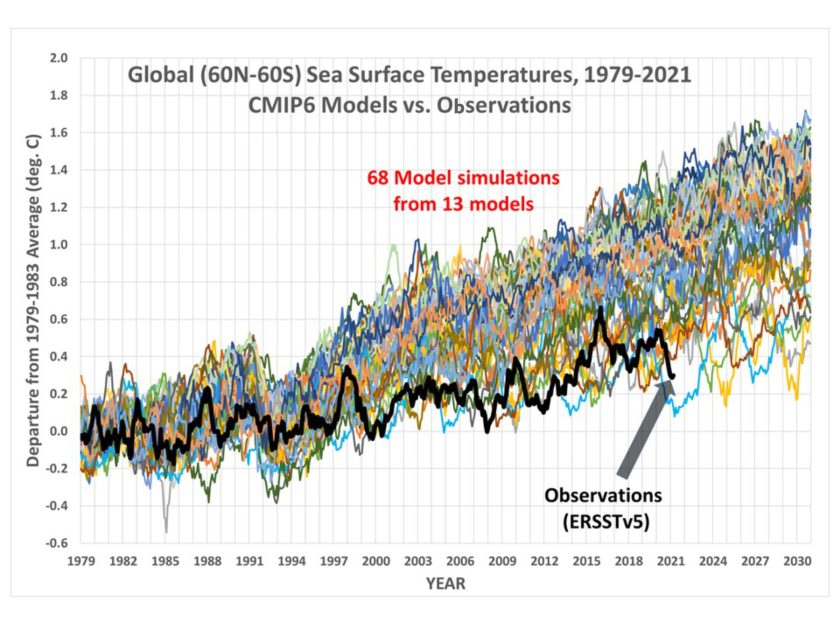
“What nobody is acknowledging is that current climate models, for all of their computational complexity and enormous size and expense, are still no more than toys, countless orders of magnitude away from the integration scale where we might have some reasonable hope of success. They are being used with gay abandon to generate countless climate trajectories, none of which particularly resemble the climate, and then they are averaged in ways that are an absolute statistical obscenity as if the linearized average of a Feigenbaum tree of chaotic behavior is somehow a good predictor of the behavior of a chaotic system! … This isn’t just dumb, it is beyond dumb. It is literally betraying the roots of the entire discipline for manna.”




You must be logged in to post a comment.