Morano on Fox & Friends on Harrisโ€™s plastic straw ban reversal & collapsing EV sales & offshore wind fiasco

Vice President Harris is flip-flopping on yet another issue: banning plastic straws. โ€ฆNow, her team says she doesnโ€™t support banning plastic straws. Here to react is climate depot.com publisher Marc Morano. So what is this epiphany about what made her change her mind about plastic straws?

From CFACT

By Marc Morano

Fox and Friends โ€“ Fox News Channel โ€“ Broadcast September 7, 2024

Partial transcript:

Rachel Campos-Duffy: Vice President Harris is flip-flopping on yet another issue: banning plastic straws. โ€ฆNow, her team says she doesnโ€™t support banning plastic straws. Here to react is climate depot.com publisher Marc Morano. So what is this epiphany about what made her change her mind about plastic straws?

Marc Morano: We donโ€™t know because, like every other epiphany sheโ€™s had, whether itโ€™s on fracking now, EVs, oil, and gas โ€“all of these reversals of her previous opinions are quietly released by basically unnamed campaign officials. The campaign now says she no longer supports that. Huh? what, no explanation given?! The obvious answer is she knows that plastic straw bans are wildly unpopular, and sheโ€™s doing everything she can to scrub her history of the fact that she was the original co-sponsor of AOCโ€™s Green New Deal back in 2019. She is desperate. Keep in mind in the DC government right now in Washington DC, they have straw cops out, and they have tip lines for your neighbors to snitch on small businesses โ€” everything from Uber Eats to your local corner restaurant โ€” if you catch them serving foam or plastic straws or cups. They want you to snitch. People have had it with these kinds of bans and this nonsense.

Rachel Campos-Duffy: Yeah, they absolutely have.  Letโ€™s talk about Volvo because there was a lot of euphoria on the greeny side about EVs. Everything was going to go to EVs, but the demand for it just never materialized.

Marc Morano: Whatโ€™s happening here: this is Volvo joining VW,  joining Ford,  joining Chrysler (Stelantis),  joining Mercedes,  joining Porsche,  joining Tesla โ€” we are seeing an utter wholesale collapse of the demand for any EVs. In other words, I think it was a Toyota vice president who actually said most of the people who wanted an EV had already bought it. What does that mean?  7% of cars, maybe a little over that over that, are EVs.

Volvo realized that they had a goal of 100% electric by 2030. Guess what their numbers are in 2024? Theyโ€™re barely at 25%, but theyโ€™re not even at 25%. Itโ€™s all virtue signaling. Itโ€™s corporate government collusion, ultimately. These companies are taking hundreds of millions in federal funds. Look at what Stellantis did; it took hundreds of millions of federal money for EVs, saw no sales demand, and now theyโ€™re laying off Michigan workers. They took American taxpayer money โ€” a foreign-owned corporation โ€” and now theyโ€™re taking the money and running, and American workers are suffering. Thatโ€™s the reality of the EV mandates and the gas-powered car bans of this Administration.

Rachel Campos-Duffy: We also have to talk about windmills because thereโ€™s also been a problem there as well. So these windmills โ€” I donโ€™t like them. I think theyโ€™re ugly. I think theyโ€™re bird killers, and I think theyโ€™re whale killers. Now, pieces of them are falling off of Marthaโ€™s Island, and all the rich people are getting upset, so letโ€™s talk about these windmills.

Marc Morano: Everyoneโ€™s like, โ€˜Well, we have to have wind and solar!โ€™ But 82% of U.S. energy is from fossil fuels. The global electricity rate for solar and wind does not even hit 14% โ€” itโ€™s like 13.9% โ€” there is no there at the moment. The idea that we can mandate these sources of energy is absurd. Thereโ€™s no cost-benefit analysis. In other words,  they donโ€™t produce electricity. Now, having said that, we have conservation groups saying that in the last half of a century, theyโ€™ve never seen whale mortality, whale deaths like weโ€™re seeing now, and theyโ€™re linking it to offshore wind. Remember, every offshore windmill you see โ€” the length the blades are the length of a football field, the height is as high as the Eiffel Tower, and the turbines go 200 miles an hour.

Of course, off Marthaโ€™s Vineyards, these giant windmills broke off, and now we have shards of fiberglass all over some of the wealthiest beaches in the world. The way to end these wind mandates and subsidies is to get rich people โ€” who normally virtue signal โ€” โ€˜Oh, of course, we want windmillsโ€™ โ€” but once itโ€™s in their backyard, we may see the end of this nonsense.

Rachel Campos-Duffy: Iโ€™m glad you described how large they are. They are impossible to dispose of; theyโ€™re an ecological disaster. Marc Morano, always great having you on. Thanks for joining us this morning.

Marc Morano: Thank you, Rachel.  Appreciate it.

Rachel Campos-Duffy: So much green insanity.

Tropical Storm Francine Arrives โ€“ Just in Time

Compared to the historical record, the 2024 Hurricane season is running at a little less than 50%.

From Watts Up With That?

Brief News Note by Kip Hansen

Just in time to beat the โ€œhurricane season peak  deadlineโ€, NOAAโ€™s National Hurricane Center declared the Potential Tropical Storm Six to be Tropical Storm Francine:

10:00 AM CDT Mon Sep 9

Location: 23.0ยฐN 94.9ยฐW

Moving: NNW at 5 mph

Min pressure: 1002 mb

Max sustained: 50 mph

From the Discussion section: 

โ€œTropical Storm Francine Discussion Number   4

NWS National Hurricane Center Miami FL       AL062024

1000 AM CDT Mon Sep 09 2024

The structure of the system on satellite imagery has improved this

morning, with a large circular region of cold convection between -70

to -85 near the estimated center. An Air-Force Reconnaissance

Aircraft is sampling the system this morning and earlier found a

cyclonic wind shift from southeasterly to northwesterly flow near

the center of the mass of deep convection. This data provides enough

evidence that a well-defined circulation now exists, and thus PTC

Six has become Tropical Storm Francine with sustained winds of   

45 kt this advisory.

The estimated motion is still tricky given the center only recently

formed but is estimated still off to the north-northwest at    340/4

kt. The system is expected to gradually turn northward and then

north-northeastward as it moves between a mid-level ridge centered

over Cuba and a broad mid- to upper-level trough located to its

northwest over Texas. The guidance this cycle has shifted a little

eastward and faster, and the NHC track forecast was once again

nudged in that direction. The current track splits the difference

between HCCA and TVCN and still shows Francine moving ashore of

Louisiana sometime on Wednesday evening. There remains a decent

amount of track uncertainty with the GEFS and EPS ensembles showing

along-track spread implying some speed differences near landfall.

While the system is now a tropical storm, the inner core wind field

per reconnaissance observations is still broad and in the organizing

stage, and initial intensification will be gradual. However, after

an inner-core becomes established, and assuming the cycloneโ€™s

vertical structure becomes aligned, a period of more significant

intensification is possible while storm is embedded in a low shear,

high mid-level moisture, and over very warm 30-31 C sea-surface

temperatures.  The SHIPS rapid intensification (RI) indices are

pretty elevated, and a period of RI could also occur between   24-48

h. For now, the NHC intensity forecast will not explicitly forecast

RI, but is higher than the previous cycle and shows a 75 kt peak in

48 h, in good agreement with the intensity consensus aids. After

that period, southwesterly vertical wind shear quickly increases

from 10 kt to more than 30 kt and the intensity could plateau as it

approaches the northwestern U.S. Gulf coastline, though the system

is forecast to remain a hurricane at landfall. The NHC intensity

forecast continues to be in good agreement with the consensus aids,

but is a bit under the HAFS-A/B and COAMPS-TC models.

Given the latest forecast, a Hurricane Watch has been issued for

the Louisiana coastline from Cameron to Grand Isle, and a Storm

Surge Watch has been issued from High Island, TX eastward to the

Mississippi/Alabama Border.โ€

Thus, for the season to date we now have this:

# # # # #

Authorโ€™s Comment:

Compared to the historical record, the 2024 Hurricane season is running at a little less than 50%.

The Two-Day and Seven-Day forecasts show a couple of things in the pipeline โ€“ which may develop into tropical storms.

And thatโ€™s the news.

# # # # #

September Snowmageddonโ€ฆ Winter Outbreak In Alps Later This Weekโ€ฆUp To 3 Meters Of Snow!

German online weather siteย Das Wetter here reports: โ€œUp to 3 meters of fresh snow is possible at high altitudes in the Alpsโ€ and: โ€œEven in Garmisch-Partenkirchen and Oberstdorf it could turn white beginning Friday.โ€

From NoTricksZone

Byย P Gosselin

German online weather siteย Das Wetter here reports: โ€œUp to 3 meters of fresh snow is possible at high altitudes in the Alpsโ€ and: โ€œEven in Garmisch-Partenkirchen and Oberstdorf it could turn white beginning Friday.โ€

Europe had been basking in late summer warmth, but the weather is now changing dramatically as a so-called Vb weather situation is poised โ€œto put large parts of the region in a state of emergency.โ€

Some weather models are showing 200 to 400 liters of rain and snow per square meter within 7 days. The Alps and parts of Eastern Europe are expected to be hard hit by flooding especially on parts of the Czech Republic and Poland.

โ€œThe sudden cold snap means that snow is already falling in the Alps from 1000 meters upwards. And not in short supply: up to 3 meters of fresh snow is possible at high altitudes โ€“ conditions that are only known from the depths of winter. Places like Oberstdorf and Garmisch-Partenkirchen are particularly affected, with heavy snowfall expected on Friday and Saturday,โ€ reports Das Wetter.

Such massive amounts of snow could mean that the ground there wonโ€™t be seeing daylight until next summer.

โ€œSevere winter outbreakโ€

Meanwhile, German meteorologist Dominik Jung today reports at his daily video update of โ€œa severe winter outbreakโ€ for the Alps.

โ€œSnow could fall at elevations down to 1000 meters. Friday and Saturday morning, snow is possible down to 700 meters above sea level,โ€ reports Jung, noting that this is โ€œrelatively earlyโ€ for this time of year.

โ€œSnow this low in the mountains this time of the year is rather unusual. Snow down to 1000-1500 meters happens occasionally. But at 700 meters, itโ€™s more of an exception,โ€ says Jung.

Return to Myrmidon, Part 1. Inaugural Megafauna Expedition, September 2024

How is it that Australiaโ€™s Great Barrier Reef is still one of the Seven Natural Wonders of the World and visible from outer space.

How is it that we can revisit the corals at Myrmidon Reef โ€“ an ancient, detached platform existing beyond the barrier reef proper, exposed to the full force of the Pacific Ocean โ€“ it persists, essentially unchanged season after season.

From Jennifer Marohasy

Byย jenniferย 

How is it that Australiaโ€™s Great Barrier Reef is still one of the Seven Natural Wonders of the World and visible from outer space.

How is it that we can revisit the corals at Myrmidon Reef โ€“ an ancient, detached platform existing beyond the barrier reef proper, exposed to the full force of the Pacific Ocean โ€“ it persists, essentially unchanged season after season.

Aerial looking towards the Garden of Porites and the MV Sea Esta

Despite claims of repeated mass coral bleaching and the reality of severe tropical cyclones, this reef, Myrmidon reef is little changed.

Its waters are still warm and clear โ€“ crystal clear.  In the โ€˜Garden of Poritesโ€™, in the back lagoon, there are still monster corals more than 3 metres in diameter.  These colonies persist as blocks, each of one colour: in olive green, or brilliant blue, while others are a golden yellow.

Can we acknowledge the size and strength of these corals.  What can we learn from them?  What makes this coral reef, and so many others at the Great Barrier Reef so resilient.

*****

After my first visit to Myrmidon Reef, on December 1, 2020 with Shaun Frichette and Stuart Ireland I penned something about that experience, and the shark, โ€™tis here.   That was four years ago.

All the photographs in this post were taken by Stuart Ireland.

The feature photograph is of Simon Fenwick in the Garden of Porites at Myrmidon Reef on Friday, 6th September 2024.  Simon is a Sydney-based philanthropist who sponsored the charter of the MV Sea Esta for the inaugural Megafauna Expedition.

Rising Runways, Sinking Narratives: Maldives Debunk Climate Fears

For decades, weโ€™ve been told that island nations are on the brink of disappearing beneath the waves, their inhabitants destined to be victims of climate changeโ€™s catastrophic effects. Yet, developmental activity in some of these countries tell a different story.

In recent years, the Maldives have embarked on an ambitious program of developing more than a dozen new airports, a move that seems to fly in the face of dire predictions about the countryโ€™s future.

From Watts Up With That?

By Vijay Jayaraj

For decades, weโ€™ve been told that island nations are on the brink of disappearing beneath the waves, their inhabitants destined to be victims of climate changeโ€™s catastrophic effects. Yet, developmental activity in some of these countries tell a different story.

In recent years, the Maldives have embarked on an ambitious program of developing more than a dozen new airports, a move that seems to fly in the face of dire predictions about the countryโ€™s future.

This contrast between an apocalyptic narrative and a seemingly optimistic reality raises important questions about the accuracy of doomsayersโ€™ predictions and the actual nature of island geomorphology โ€“ the rise and fall of terrestrial features.

Maldivesโ€™ Infrastructure Boom Belie False Fears

An archipelago of 1,192 coral islands grouped into 26 atolls, the Maldives have been investing heavily in its aviation infrastructure. A 1.3 million passenger terminal is a part of the recent upgrades at Hanimadhoo International Airport, just one of the 18 airports in the country.

Another major revamp is happening at the Velana International Airport. The new expansion will meet the growing demands of tourism and trade. It is expected to accommodate 25 million passengers per year, which is almost six times the volume in 2022.

The new cargo terminal at Velana is projected to handle 100,000 metric tons by 2025 and 300,000 metric tons by 2050. The airport will also have a new runway, a seaplane terminal and storage capacity for 100 million liters of fuel.

This year, Maldives President Dr. Mohamed Muizzu announced a decree to construct additional airports across nine different islands. The decree also signaled the development of a second airport in Laamu Atoll and new airports at GA Villingili and GDh Thinadhoo.

In all, forecasts show the operation of a dozen new airports within the next 10 years, in addition to the existing 18 airports. These investments represent a significant commitment to long-term infrastructure development.

They also require substantial modifications to the islands, including land reclamation and coastal engineering works. Such projects would be difficult to justify if Maldivian leadership truly believed the nation was on the verge of inundation.

Expansion and Sinking: Island Science

The United Nationโ€™s Intergovernmental Panel on Climate Change (IPCC) has consistently identified small island states as being at high risk from sea-level rise. The IPCCโ€™s reports are regarded as the bible for national policymakers across the globe.

However, the reality on the ground โ€“ and in the water โ€“ is more complex than these dire predictions suggest. Islands, particularly coral atolls like those that make up the Maldives, are dynamic systems that respond to environmental changes in complex ways.

Theyโ€™re not static landmasses but are constantly changing shape and size in response to waves, currents and the deposition of sediments. This dynamic nature means that islands can, under certain circumstances, grow.

A scientific study published in 2020 examined shoreline changes due to land reclamation and coastal development in 607 islands across 23 atolls in the Maldives. They found that between 2004-2006 and 2014-2016, 59% of islands remained stable, 24% expanded, and less than 17% contracted.

Similarly, there are cases of natural increases in landmass. A landmark study published in the journal Nature Communications in 2018 examined changes in 101 islands of the Pacific atoll nation of Tuvalu over a period of 40 years. Despite sea-level rise, the total land area of the islands had increased by nearly 3%. On an individual basis, 74% of the islands had grown, while only 14% had shrunk.

The rate of increase in sea level of 1.5 millimeters per year during 1958-2014 is nowhere near being dangerous. This is nothing compared to the annual 47-millimeter rise that occurred 8,200 years ago as Earth warmed following the last glaciation that covered many parts of the Northern Hemisphere with ice thousands of feet thick.

During the Medieval Warm Period 1,000 years ago, worldwide sea level was higher than it is currently and life thrived, nonetheless.

The Maldivesโ€™ remarkable investments in infrastructure and the scientific evidence of island geomorphology suggest that the only thing sinking is the fearmongering stories of nations disappearing because of climate change.

This commentary was first published at RVIVR on September 6, 2024.

Vijay Jayaraj is a Research and Science Associate at the CO2 Coalition, Arlington, Virginia. He holds an M.S. in environmental sciences from the University of East Anglia and a postgraduate degree in energy management from Robert Gordon University and, both in the U.K., and a bachelorโ€™s in engineering from Anna University, India.

CLAIM: Climate change is already forcing millions of people to migrate โ€“ Bill Gatesโ€™ Telegraph Says

Meanwhile not only has the Sahel along with other regions in Africa been greened by extra CO2 in the atmosphere, scientists say that a warmer world could see a return to the wetter climate enjoyed during the warmer early Holocene era.

From ClimateRealism

Editorโ€™s Note: The claim that โ€œclimate change will force people to relocateโ€ is as old as the issue itself. Fortunately, none of the predictions has ever become true. For example, the United Nations made a prediction of โ€œ50 million climate refugees by 2010โ€, but as 2010 approached, there had not been a single documented case, and the U.N. quietly removed the claim from their website. Here at Climate Realism, we have regularly debunked such claims time and time again. The reality is climate refugee migration exists only in the minds of climate modelers and climate proponents.


Guest essay by Paul Homewood From NOT A LOT OF PEOPLE KNOW THAT

More Bill Gates funded propaganda:

https://www.telegraph.co.uk/global-health/climate-and-people/climate-change-forcing-millions-of-people-to-migrate

Meanwhile back in the real world, Africa continues to enjoy ever increasing food production, longer lives, record low deaths from malnutrition and steadily growing GDP.

All of this has been made possible by fossil fuels:

https://ourworldindata.org/economic-growth
https://www.statista.com/statistics/1300858/total-gdp-value-in-africa

Meanwhile not only has the Sahel along with other regions in Africa been greened by extra CO2 in the atmosphere, scientists say that a warmer world could see a return to the wetter climate enjoyed during the warmer early Holocene era.

In the future, the Sahara and Sahelian regions could experience more rainfall than today as a result of climate change. Wetter periods, termed African humid periods, occurred in the past and witnessed a mesic landscape in place of todayโ€™s hyperarid and semiarid environment. Such large past changes raise the question of whether the near future might hold in store similar environmental transformations, particularly in view of the growing human-induced climate, land-use, and land-cover changes. In the last decades.

https://www.sciencedirect.com/science/article/pii/S2590332220301007

โ€˜Spoiled Bratsโ€™: Greenpeace Co-Founder Supports Pipeline Tycoonโ€™s Campaign To Punish His Old Group

One of the original founders of Greenpeace told the Daily Caller News Foundation that he hopes to see Greenpeace USA lose a lawsuit that threatens the groupโ€™s existence.

xr:d:DAFiUzH4ol0:3,j:46683827741,t:23050811

From Watts Up With That?

The Daily Caller

Nick Pope
Contributor

One of the original founders of Greenpeace told the Daily Caller News Foundation that he hopes to see Greenpeace USA lose a lawsuit that threatens the groupโ€™s existence.

Patrick Moore, who was listed on Greenpeaceโ€™s website as one of the original founders as recently as 2007 before the organization attempted to distance itself from him, would like Greenpeace USA to lose the massive lawsuit filed against the group by a company called Energy Transfer, he told the DCNF. The company is seeking $300 million in damages from Greenpeace USA in a North Dakota lawsuit that alleges the group or its entities incited major protests against Energy Transferโ€™s Dakota Access Pipeline, funded various attacks meant to damage the project and orchestrated a smear campaign against the company and its development.

โ€œTheyโ€™ve got to embrace what is really true scienceโ€ฆ. They ignore massively important facts, and then make lies up to replace them. So yes, I hope they are going to learn a lesson from this,โ€ Moore told the DCNF regarding his old group and the lawsuit it faces. โ€œScience is about truth, and then you decide your policy. These guys, they personally decide the policy, and then they lie about the underlying scientific aspects. It just completely bastardized science in much of the world, especially in the Western world โ€ฆ they have become sort of spoiled brats, I would say, and they donโ€™t have good science.โ€ (RELATED: Eco-Activist Who Vandalized Stonehenge Recounts Being Bullied By American Bros Chanting โ€˜Oilโ€™)

โ€˜Theyโ€™re Gonna Pay For Itโ€™: A Single Texas Billionaire May Be About To Force Greenpeace USA Into Bankruptcyhttps://t.co/2laZEUZ1Jvโ€” Daily Caller (@DailyCaller) September 10, 2024

Greenpeace USA โ€œwould certainly deserveโ€ to lose the lawsuit, Moore told the DCNF. โ€œThey are basically attempting to destroy the means of transportation and so many other things. Thereโ€™s no doubt about it that pipelines are the safest way to move liquids, especially flammable ones. Thereโ€™s simply no question.โ€

Moore went on to play โ€œa significant roleโ€ in Greenpeaceโ€™s Canadian arm, according to Greenpeace, but he left the organization in 1986 because he felt it had become too radical. Despite listing him as an original founder as recently as 2007, Greenpeace now has an entire website dedicated to explaining that Moore does not represent the organization and that he is not an original founder.

Energy Transferโ€™s billionaire executive chairman Kelcy Warren is behind the companyโ€™s lawsuit, The Wall Street Journal reported Sunday. Warren, who once said that green activists ought to be โ€œremoved from the gene pool,โ€ views climate activists as a significant threat to the energy industry and has stated that he is unafraid to go after them for the problems they caused for the company and the Dakota Access Pipeline.

Meanwhile, some of Greenpeace USAโ€™s top leaders have fought internally about what kind of settlement may be acceptable to reach with the company, according to the WSJ. However, even if Energy Transfer wins the lawsuit, it may be difficult to enforce penalties against Greenpeaceโ€™s central coordinating body in the Netherlands because that entity does not hold assets in the U.S.

Representatives for Greenpeace USA did not respond immediately to a request for comment.

All content created by the Daily Caller News Foundation, an independent and nonpartisan newswire service, is available without charge to any legitimate news publisher that can provide a large audience. All republished articles must include our logo, our reporterโ€™s byline and their DCNF affiliation. For any questions about our guidelines or partnering with us, please contact licensing@dailycallernewsfoundation.org.

Britain spending record ยฃ250m a month on electricityย imports

Britain is importing record amounts of electricity from abroad at a cost of ยฃ250m a month following the closure of coal-fired and nuclear power stations, new analysis shows.

From NOT A LOT OF PEOPLE KNOW THAT

By Paul Homewood

h/t Philip Bratby

Britain is importing record amounts of electricity from abroad at a cost of ยฃ250m a month following the closure of coal-fired and nuclear power stations, new analysis shows.

Some 20pc of the gridโ€™s power needs were met through interconnectors with neighbouring countries during the second quarter of this year, according to energy company Drax.

The amount of power imported from abroad was double the volume generated by wind and solar farms, at about 12.2 terawatt hours. It was also about four times the amount of power exported.

Drax said the gross cost of importing power currently amounted to more than ยฃ250m per month โ€“ equivalent to about ยฃ3bn if sustained over a year.

The company said the rising use of interconnectors followed the closure of many of Britainโ€™s ageing coal and nuclear power stations.

Coal generation is on track to end completely as part of efforts to reach net zero carbon emissions, while no new nuclear power plants have come online since Sizewell B in 1995.

The analysis for Drax was carried out by researchers at Imperial College London as part of the companyโ€™s quarterly electricity insights report.

Iain Staffell, an electricity systems expert at Imperial College London, said: โ€œMuch of Britainโ€™s conventional power generators like coal and nuclear stations have retired in recent years.

โ€œFewer dispatchable generators means less competition and higher prices, making cheaper electricity from the Continent much more attractive to import.

โ€œThe Government must be mindful of the need to retain sufficient dispatchable generation capacity on our system for both energy security and affordability reasons as it works towards its ambition of having a clean power grid by 2030.

โ€œBritain is always going to need weather-proof sources of power to keep the lights on.โ€

However, Mr Staffell added that interconnectors could also help to boost British energy security if domestic power generation was sufficiently maintained.

If Labour succeeds in reaching its targets to make the national power grid net zero by 2030, for example, he said there would be so much generation available that much of it would be available for export, bringing money into the UK.

He said: โ€œBeing able to either store this power at home through more storage capacity or selling it abroad is an attractive proposition.

โ€œDuring periods of high winds in the North Sea but calmer weather on the Continent, exporting power could be potentially lucrative for the UK and help to lower bills for consumers here.โ€

https://www.telegraph.co.uk/business/2024/09/09/britain-spends-record-250m-month-electricity-imports

I donโ€™t know what planet Mr Staffell is on! When it is windy in the North Sea, it is almost certain to be windy over Northern Europe, where our exports will go. We would end up exporting at ultra low prices;

and it wonโ€™t be the windfarms making a loss, it will be us.

It is actually astonishing that imports are double wind and solar power, even despite the tens of billions in subsidies thrown at renewables. It is also very scary that we are now so reliant on power from Europe, over which we have no control.

Californiaโ€™s trillion dollars floating wind fantasy

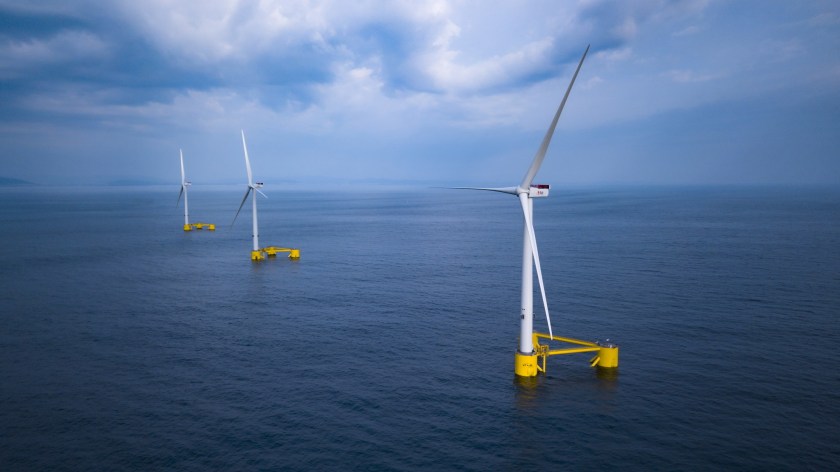
California has adopted a target of 25,000 MW of floating offshore wind generation capacity. Of course, the cost is never mentioned, so here is a rough estimate to get the ball rolling.

From CFACT

By David Wojick

California has adopted a target of 25,000 MW of floating offshore wind generation capacity. Of course, the cost is never mentioned, so here is a rough estimate to get the ball rolling.

The estimate begins with the huge Dominion Energy (DOM) fixed wind project currently under construction off of Virginia. Because the regulated utility DOM is its own developer, we get some public numbers, so here is a crude derivation. Big numbers are rounded for simplicity and ease of memory.

A. DOM says the 2,600 MW facility will cost $10 billion to build, which is about $4 billion/GW. But financing and profit bump that to $20 billion or $8 billion/GW, which is called the โ€œrevenue requirementโ€ or what rate payers will pay. We will use that number.

B. DOM brags that they are immune to the big cost spike that has swept the industry because their contracts predate it. The costs have increased an estimated 65% industry-wide. That pushes the fixed bottom cost to $6.6 billion/GW construction and $13.2 billion/GW total.

C. Floating wind is generally estimated to be three times fixed wind because that huge floater costs a huge amount more than the single monopile a fixed tower sits on, plus there is a lot of mooring to the sea floor. Off California, the water is around a half mile deep.

This gives a construction cost of roughly $20 billion/GW and a total of $40 billion/GW. It could be a lot more as it has never been done.

D. Thus, 25 GW of floating capacity comes to $500 billion for construction and an incredible trillion dollars with financing. Note this does not include 20 yearsโ€™ worth of expensive operation, maintenance, repair, replacement and decommissioning. That makes it well over a trillion.

This is Californiaโ€™s trillion-dollar floating wind fantasy.

Now, letโ€™s turn this into a possible power purchase agreement (PPA) price. A trillion dollars paid over 20 years is $50,000,000,000 a year. Assuming a 40% capacity factor, that works out to 57 cents a KWh. Given that the average wholesale price of electricity in California is just around 5 cents, this is incredibly expensive.

The floating wind startup price is almost 12 times the regular price of electricity. Floating wind is a crazy policy, even by Californiaโ€™s crazy standards.

Which brings us to something happening right now. The U.S. Energy Departmentโ€™s Grid Deployment Office is asking for information and comments on developing an offshore wind transmission plan for the West Coast. See https://www.energy.gov/gdo/west-coast-offshore-wind-transmission-planning

Here is the basic announcement: โ€œThe West Coast Offshore Wind Transmission effort includes a Request for Information to allow individuals and organizations to submit written input about transmission topics, including siting, technology, and policy considerations. The GDO team will consider this input as they prepare West Coast recommendations. Responses must be received by October 3, 2024, and can be sent by emailing OSWTransmission@hq.doe.gov.โ€

DOE says the West Coast plan will be similar to the massive โ€œACTION PLAN FOR OFFSHORE WIND TRANSMISSION DEVELOPMENT IN THE U.S. ATLANTIC REGIONโ€œ. This Action Plan is from the Energy Department and the Bureau of Ocean Energy Management (BOEM), which is actually building the offshore wind monsters. The plan creates a massive undersea grid along the entire Atlantic coast.

The Atlantic Action Plan shows specific offshore wind projects in ever-increasing numbers by five-year increments, from 30,000 MW in 2030 to 85,000 MW in 2050. Suppose the West Coast plan is just as big as the East Coast at 85,000 MW. That is a monstrous 3.4 trillion dollars worth of floating wind, a technology that does not even exist at commercial scale.

I encourage people to send in comments objecting to this monstrous floating wind development effort. America does not need trillions of dollars worth of unreliable electricity.

Renault CEO says sector could face billions in fines as EV salesย slow

Europe might not have a ZEV Mandate, but car makers still canโ€™t escape the clutches of the eco loons

From NOT A LOT OF PEOPLE KNOW THAT

By Paul Homewood

h/t Hugh Sharman

Europe might not have a ZEV Mandate, but car makers still canโ€™t escape the clutches of the eco loons:

PARIS, Sept 7 (Reuters) โ€“ Europeโ€™s autos industry could face fines of 15 billion euros ($17.4 billion) for carbon emissions due to slowing demand for electric vehicles, Renault CEO Luca de Meo said on Saturday.

Automakers face tougher EU CO2 targets in 2025 as the cap on average emissions from new vehicles sales falls to 94 grams/km from 116 g/km in 2024.

“If electric vehicles remain at todayโ€™s level, the European industry may have to pay 15 billion euros in fines or give up the production of more than 2.5 million vehicles,” de Meo told France Inter radio.

“The speed of the electric ramp-up is half of what we would need to achieve the objectives that would allow us not to pay fines,” de Meo, who is also president of the European Automobile Manufacturers Association (ACEA), said of the sector.

Exceeding CO2 limits can lead to fines amounting to 95 euros per excess CO2 g/km multiplied by the number of vehicles sold.

That could result in penalties of hundreds of millions of euros for large carmakers.

https://www.reuters.com/business/autos-transportation/renault-ceo-says-sector-could-face-billions-fines-ev-sales-slow-2024-09-07