


From CFACT
By Kevin Mooney
Whales migrating up and down the East Coast are getting at least a temporary reprieve from offshore wind. So are property owners, homeowners, business owners, tourists, and anyone with a stake in beach communities. The people of New Jersey, Virginia, and other states hope the Trump administration can end these expensive boondoggles once and for all.
Offshore Wind On Its Last Legs
In New Jersey, the Atlantic Shores South offshore wind energy project President Joe Biden’s Interior Department had approved last year has come to a halt. The application of fresh legal pressure in combination with a new executive order from President Donald Trump could prove to be the coup de grace for the project. In Virginia, opponents of Dominion Energy’s Coastal Virginia Offshore Wind (CVOW) project are asking the Trump administration to reverse the Biden administration’s approval for the project, which is already under way. The public utility’s executives insist the Virginia project will still move forward.
Both states have gubernatorial races this year where the specter of higher energy costs associated with taxpayer subsidized green energy initiatives will tip the scales in the campaigns. Trump’s executive order calls for the temporary withdrawal of new areas for offshore wind leasing and a halt on new project approvals pending a review of leasing and permitting practices.
Craig Rucker, the president and founder of the Committee for a Constructive Tomorrow, or CFACT, told Restoration News in an interview that Trump’s order creates new opportunities to press federal officials over violations of the Endangered Species Act. CFACT joined with the Heartland Institute and the National Legal and Policy Center to file suit against the Biden administration in March 2024. The coalition argues that the Bureau of Ocean Energy Management (BOEM), the National Marine Fisheries Service (NMFS), The Interior Department, and the Commerce Department violated the ESA when they approved the Dominion Energy Project. The suit also names Dominion Energy as a defendant.
Rucker would like to see Republican Lt. Gov. Winsome Earle-Sears come out forcefully against Dominion’s offshore wind project. Earle-Sears is running this year to succeed fellow Republican Glenn Youngkin as governor.
Test Cases for Team Trump?
In New Jersey, a grassroots citizen activist group known as Save Long Beach Island (LBI) filed a federal lawsuit in January against the Atlantic Shores project—on top of state-level suits the group has filed. The Jersey litigation could serve as “test cases” for how Interior Secretary Doug Burgum and Attorney General Pam Bondi “implement the results of their leasing and permitting reviews,” in the words of Bob Stern, an engineer and LBI resident, who heads up the group of citizen activists.
Stern, who previously served in the U.S. Department of Energy, and sees “strong justification” for the new Trump administration to cancel existing leases and rescind project approvals. New Jersey Gov. Phil Murphy, a term-limited Democrat who will leave office next January, has been a strong proponent of wind power and the Atlantic Shores project. The state’s Republicans, including the current field of gubernatorial candidates, have been largely united in their opposition to Murphy’s green energy plans including offshore wind.
Youngkin, who is limited to one term under Virginia law, leaves office in January. He has actively opposed his state’s participation in the Regional Greenhouse Gas Initiative (RGGI), a multistate climate agreement. He has also resisted implementation of Virginia Clean Economy Act (VCEA), a state-level version of the “Green New Deal.”
Rucker views both programs as “costly green energy schemes” that could present Earle-Sears with an electoral opportunity. CFACT’s president recommends that Earle-Sears “pick up the mantle from Youngkin” on energy policy.
Whales as a Migratory Species
Both the New Jersey suit and the Virginia suit cite a “Save the Whales” perspective—bringing in several studies showing how offshore wind power harms marine life. Save LBI has a section of its website devoted entirely to updated research highlighting “unprecedented spikes in whale deaths” that coincide with vessel surveys for the Atlantic Shores project.
CFACT has called attention to statistical evidence showing that offshore wind sonar surveys the National Oceanic and Atmospheric Administration (NOAA) first authorized in 2016 are responsible for whale deaths. After Joe Biden took control of NOAA, they did a 180, releasing an analysis concluding that there are “no known links between large whale deaths and ongoing offshore wind activities.”
The “biological opinion” the NMFS issues is flawed, Rucker argues, because it only looked at each wind project individually rather than taking “a more comprehensive approach” that accounted for the whales’ migratory pattern.
Rucker expressed dismay that some of the larger environmental groups such as the Sierra Club and the Natural Resources Defense Council have not come out against offshore wind plans that can damage natural habitats.
“There’s no way an environmental group should be in favor of offshore wind,” Rucker said. “They are always opposed to offshore oil drilling which involves only speculative harm. But here we actually see dead whales washing up on beaches in Virginia and other places along the East Coast and this is happening in increased numbers. But all we hear from the environmental groups is crickets.”
CFACT has successfully petitioned the Trump Justice Department to stay the case. This way defendants could adopt a more intensive review of the permits the Biden administration awarded to Dominion. CFACT and Trump’s Interior Department are expected to submit additional filings.
Rucker is particularly concerned about the North Atlantic right whale population, which is listed as endangered. Only 350 remain—with only about 70 females capable of producing new offspring, according to court records in the case.
“Whales are a migratory species meaning they are not just staying off the coast of Virginia,” Rucker explained. “The population will be impacted by projects up and down the East Coast whether it’s in New Jersey, Maryland, Rhode Island, Massachusetts or other states. That’s the problem with how the feds operated under Biden. They needed to look at the cumulative effect on the whale population up and down the coast.”
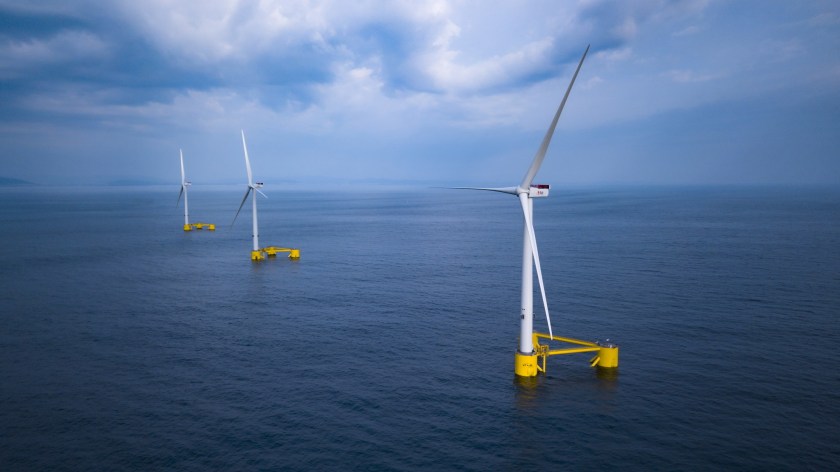
CFACT’s goal is to have Dominion cease construction of the Virginia Offshore Wind Project, which would consist of 176 wind turbines located 25 miles off the coast of Virginia Beach. Rucker points out that each wind tower will be taller than the Washington Monument with turbine blades longer than a football field.
A solution may be in order compliments of Save LBI. The New Jersey group plans to petition NOAA to designate a migration corridor for the right whale since it involves a critical habitat vital to the survival of the species. If NOAA complies, the order would exclude wind turbines would in this area.
The Atlantic Shores project envisioned 200 wind turbines positioned as close as 8.7 miles off the coast of LBI, Brigantine, and Atlantic City. Save LBI has visual displays showing that the proposed windmills, which could reach up to 1046 feet tall, would be taller than the Washington Monument, the Statute of Liberty, and rival the size of some skyscrapers.
While the litigation is focused on federal environmental laws, SAVE LBI and CFACT have also called attention to the anticipated economic fallout from offshore wind.
Higher Prices, Economic Losses—Who Wins with Wind?
Save LBI posted a study from Tourism Economics, attached to Oxford University, that estimates “reduced visitor spending” at the Jersey Shore would generate $668 million in economic losses throughout Ocean County, N.J. In similar fashion, CFACT has repeatedly warned Virginia residents about the high costs of wind energy.
Among the many action items Save LBI has recommended—a proposal to remove all the investment tax credits in Biden’s Inflation Reduction Act (IRA) so that green energy companies cannot profit at taxpayer expense.
Gubernatorial candidates in both states could be asked if they support this proposal. The IRA is loaded with multibillionaire grants such as the Greenhouse Gas Reduction Fund that have taxpayers on the hook. SAVE LBI’s proposal to remove investment tax credits from the IRA legislation is designed to prevent companies taking advantage of perverse incentives. As New Jersey and Virginia voters become more attuned to their elections, they become more likely to reject unsustainable green energy projects.
This article originally appeared at Restoration News

You must be logged in to post a comment.