โ€œSuddenly everybody hates themโ€. German leaders resign after crushing Greens election loss

Things just keep getting worse for the Greens in Germany. After two terrible performances in recent state elections the Party โ€œcrashed out of the state parliamentโ€ in the Brandenburg region of Germany (which surrounds Berlin). Results were so awful, theย two current leaders of the German Greens have jointly stepped down.

From JoNova

Jo Nova

The Greens have become the โ€œpunching bagโ€ of the Left and the Right

Things just keep getting worse for the Greens in Germany. After two terrible performances in recent state elections the Party โ€œcrashed out of the state parliamentโ€ in the Brandenburg region of Germany (which surrounds Berlin). Results were so awful, the two current leaders of the German Greens have jointly stepped down.

The Greens won a mere 4% of the vote in the region, not even reaching the minimum 5% required to win a parliamentary seat in the State election. About 70% of their voter base had abandoned them in the last five years. In Thuringia, the entire traffic light ruling coalition of three parties barely amassed 10% of the vote collectively.

The right-wing AfD (Alternative for Germany) party โ€œkeeps rising despite efforts to stop the partyโ€ says Nette Nรถstlinger at Politico, slightly baffled. The establishment used the nastiest names they could think of, and it didnโ€™t work:

The AfD keeps rising despite efforts to stop the party

Germanyโ€™s mainstream leaders have made a concerted effort to stop the rise of the AfD by warning voters of the partyโ€™s growing extremism, with some leaders even calling it a Nazi party. 

Weโ€™ve heard this before:

State-level domestic intelligence authorities have classified the local branches of the party in both Saxony and Thuringia as extremist organizations aiming to undermine German democracy.

The nasty names are backfiring, because no one is listening anymore:

That points to a core problem that wonโ€™t be easy for centrist parties to grapple with โ€” a growing mistrust of the centrists and the countryโ€™s institutions that has fomented anti-establishment fervor across a large swath of the country.

In other words, even as many centrist leaders and institutions in Germany warn of the AfDโ€™s extremism, many voters have simply stopped listening. In fact, the approach may be backfiring by alienating AfD voters.

When the TV commentators called the AfD โ€œextremistโ€ the leader in Thuringia said โ€œPlease stop stigmatizing meโ€. โ€œWe are the number one peopleโ€™s party in Thuringia. You donโ€™t want to classify one-third of Thuringian voters as right-wing extremists, do you?โ€ But of course, the TV commentariat probably did want to do exactly thatโ€ฆ

Bullying is brittle. When it fails, it crumbles into anti-matter, because there was nothing but nastiness to fall back on.

Even  The Guardian has noticed that the Greens have a crisis:

In the recent election campaigns, it [The Greens] often appeared to be the punchbag for parties across the spectrum. Accusations were rife that the party was trying to โ€œdictateโ€ the lives of ordinary Germans โ€“ from which type of heating system to use, to which car to drive โ€“ with the BSW and AfD going so far as to compare the Greens to the Communist regime of the former German Democratic Republic.

There is hope. Young voters are abandoning the party faster than any other age bracket:

The party has also lost a larger proportion of its younger voters at recent elections than any other party. In Sundayโ€™s Brandenburg poll, for instance, it saw its support in the 16-to-24 age bracket drop by 24 percentage points, a bigger fall than in any other age range. โ€”

Eugyppius says โ€” Something strange and unexpected is happening to the Greens โ€” โ€œEveryone hates themโ€.

The Crisis of the Greens and the Future of the Left

I have been thinking a lot about the Greens since their drubbing in the recent German elections. Something strange and unexpected is happening to them โ€“ something that even two years ago I wouldnโ€™t have predicted. They are bleeding support; they are on the defensive and suddenly everybody hates them. In East Germany you could even say that they are in outright collapse. The party of the future, the party of the youth, the party at the cutting edge of progressivism, is now withering on the vine. And I suspect that this is not just happening in Germany. It may be happening here faster than it is in other countries, but the Greens are an international phenomenon, and Green politics are in trouble in many places beyond the Federal Republic.

(Paywalled)

Votes for the Greens have been stolen from both sides

The collapse in popularity is about the climate, the heat-pumps, the cars, the energy prices โ€” but itโ€™s also about immigration and the war.  A new leftist force has appeared from nowhere in the  last few months, run by a former communist, but wanting to curb immigration:

In some ways, the biggest winner of the night was the populist-left Alliance Sahra Wagenknecht (BSW), which is led by a former member of East Germanyโ€™s communist party. The BSW finished third in both states, a notable result for a party that only formed several months ago.

The party, which merges traditional right-wing stances on immigration and other social issues, has repeatedly called for an end to German military aid for Ukraine and negotiations with Putin โ€” a view for which there is much sympathy in Germanyโ€™s formerly communist East. โ€” Politico

Itโ€™s part of the Great Realignment of politics. The new force on the left attacks the Greens for being arrogant and out of touch with the workers:

Is Germanyโ€™s rising superstar so far left sheโ€™s far right?

James Angelos, Politico, August 26th, 2024

Sahra Wagenknechtโ€™s brand of โ€œleft conservatismโ€ is upending German politics ahead of critical elections in the east.

Listening to Sahra Wagenknecht, Germanyโ€™s hard-left icon, you could be forgiven for coming away with the impression that the greatest threat to democracy is โ€œlifestyle leftistsโ€ nursing lattes in reusable cups while shopping for organic kale at a Berlin farmersโ€™ market.

Such well-off, eco-friendly urban bohemians hold what they deem to be โ€œmorally impeccableโ€ views about everything from Ukraine to climate change, she says, and then impose those beliefs over regular people with draconian zeal.

Sahra Wagenknechtโ€™s brand of โ€œleft conservatismโ€ is very tailored to East Germany, but some of it will translate widely. Uncontrolled immigration is a hot button everywhere. She attacks the influx of asylum seekers as a threat to the welfare state, which, she says, requires a โ€œcertain degree of homogenity to functionโ€. She attacks the gender bender transformations as something that benefits the big pharmaceutical companies. All of this will resonate across the political divide. At one point last year, the leader of the AfD in Thuringia was so impressed with her, he invited her to join the party in a speech.

The pure environmental Greens are a luxury bubble that no one can afford anymore. Those days are over.

h/t   John Connor II

Photos adapted from Image by Image by PayPal.me/FelixMittermeier from Pixabay and Presentsquare Presentsquare from Pixabay

While TATA Shut Port Talbotโ€™s Blast Furnace, They Have Commissioned One Twice The Size Inย India

Tata Steel today successfully commissioned Indiaโ€™s largest blast furnace at Kalinganagar, Odisha. With a total investment of Rs 27,000 crore, the Phase II expansion at Kalinganagar will take the total capacity at the site from 3 million tonnes per annum (MTPA) to 8 MTPA. The new facility was inaugurated by T. V. Narendran, CEO and Managing Director, Tata Steel, in the presence of senior leaders of the Company.

From NOT A LOT OF PEOPLE KNOW THAT

By Paul Homewood

Mumbai, September 20, 2024

~ Crude steel capacity at Kalinganagar to expand from 3 MTPA to 8 MTPA with an investment of Rs 27,000 crore ~

~ Odisha becomes Tata Steelโ€™s largest investment destination in India~

Tata Steel today successfully commissioned Indiaโ€™s largest blast furnace at Kalinganagar, Odisha. With a total investment of Rs 27,000 crore, the Phase II expansion at Kalinganagar will take the total capacity at the site from 3 million tonnes per annum (MTPA) to 8 MTPA. The new facility was inaugurated by T. V. Narendran, CEO and Managing Director, Tata Steel, in the presence of senior leaders of the Company.

The new blast furnace will significantly boost the plantโ€™s overall production capabilities, allowing Tata Steel to meet the growing demands of various industries, including automotive, infrastructure, power, shipbuilding, and defence. It will also provide advantages in specific areas like oil & gas, lifting & excavation, and construction.

With the Phase II expansion, Odisha has emerged as the largest investment destination in India for Tata Steel, with a total cumulated investment of over Rs 100,000 crore in the last 10 years.

On this occasion, T. V. Narendran, CEO and Managing Director, Tata Steel, said:”The commissioning of Indiaโ€™s largest blast furnace at Kalinganagar is a momentous occasion for the steel industry, setting new benchmarks in capacity, technology, and sustainability. A key enabler of socio-economic development in the region, the expansion not only strengthens Tata Steelโ€™s position as a leader in high-end, value-added steel segments but also showcases our advanced engineering prowess. It underscores our commitment to boosting private investment in India, aligning with the nationโ€™s vision for self-reliance and sustainable industrial growth. On behalf of Tata Steel, I thank the Government of Odisha for their unwavering support and applaud the collective efforts of our employees, suppliers & vendor partners, and all other stakeholders in enabling this significant milestone.โ€

The new blast furnace, with a volume of 5,870 m3, is equipped with state-of-the-art features for long campaign life and an eco-friendly design to optimise the steelmaking process. This blast furnace will utilise four top combustion stoves, a first in India, along with two preheating stoves for optimum specific fuel consumption in hot metal production. In a first for Tata Steel, a dry gas cleaning plant has been installed to maximise energy recovery from by-product gas. The worldโ€™s largest Top Gas Recovery Turbine (TRT) of 35 MW power generation capacity will help with the recovery of an additional 10% of energy. An evaporative cooling system is being employed for the first time in an Indian blast furnace, optimising space footprint while lowering specific water and power consumption by approximately 20% compared to conventional designs. The blast furnace will also have a zero-process water discharge plan with rainwater harvesting.

Key facilities in Phase II expansion at Kalinganagar also include a Pellet Plant, Coke Plant, and Cold Rolling Mill, each incorporating advanced technologies and sustainable practices. The new state-of-the-art steel plant incorporates modern technologies focused on value-added products, operational efficiency, and a significant reduction in carbon footprint.

The Kalinganagar plant is not just an industrial complex; it is a key contributor to the socio-economic development of the region. Tata Steel has invested significantly in community development programmes that focus on education, healthcare, and livelihood opportunities, positively impacting over 2 lakh people in the surrounding areas. The success of Tata Steel Kalinganagar is also deeply rooted in its workforce. Tata Steelโ€™s โ€˜Safety Firstโ€™ culture ensures that the highest safety standards are maintained, making Kalinganagar one of the safest steel plants in the country and the world.

Tata Steel Kalinganagar is the first Indian manufacturing plant to be named a Global Lighthouse by the World Economic Forum (WEF). In 2024, the Kalinganagar plant also received the prestigious ResponsibleSteelTM Certification, marking a significant milestone in its sustainability journey.

https://uk.search.yahoo.com/yhs/search?hspart=trp&hsimp=yhs-001&type=Y143_F163_201897_030421&p=tata+india+blast+furnace

It is TATA, of course, who have taken hundreds of millions from the UK government to demolish their blast furnaces at Port Talbot, and install electric arc furnaces instead, only capable of much smaller production and lower quality steel. All, of course, with the aim of saving the planet!

The switch will cost thousands of jobs. Port Talbot currently produces less than 3 million tonnes of steel a year. TATAโ€™s new blast furnace in India will increase output by 5 million tonnes.

It is a good bet some of that will find its way here.

Most climate policies are pointless but costly

In the first major study of its kind, researchers from several European institutions analyzedย 1,500ย climate policies implemented across 41 countries since the turn of the century. Only 63 were found to be effective.

From CFACT

By Kristen Walker

In the first major study of its kind, researchers from several European institutions analyzed 1,500 climate policies implemented across 41 countries since the turn of the century. Only 63 were found to be effective.

That means 1,437 policies (95.8%) were futile and failed. A meager 4.2% success rate would put most companies or organizations out of business or get someone fired. Such low rates of return are troublesome, but somehow, governments can get away with it.

Among the few strategies considered successful are โ€œprice-based instrumentsโ€โ€”carbon pricing, energy taxes, vehicle taxes, etc. Yet, the successful interventions only yielded total emission reductions between 0.6 billion and 1.8 billion metric tons of carbon dioxide. If the United Nations desires to cut the 40 billion tons of carbon emitted into the atmosphere each year by nearly half, the last two decades of climate policies have hardly made a dent.

Meanwhile, the majority of sweeping laws and regulations (the most popular being subsidies) enacted in the name of climate change have been inconsequential. Instead, they are inflicting harm, and consumers are paying the price.

The Inflation Reduction Act (IRA), a climate bill loaded with green energy handouts, is projected to cost American taxpayers at least $1.2 trillion over the next decade; some estimates put it closer to $2 or $3 trillion. The ballooning federal debt is already breaking the backs of middle- and lower-class Americans.

Plenty of states are snatching up the wind and solar subsidies offered in the IRA, obligating their regions to aggressively pursue renewable energy portfolios. Residents are seeing their utility bills skyrocket while at the same time being forced to endure the unreliability of renewable energy sources.

The North American Electric Reliability Corporation has repeatedly warned about risks to grid reliability. A sharp increase in renewables, coupled with a rapid scale back of fossil fuels, could lead to blackouts. This negatively impacts economic growth and puts lives at risk.

Gasoline prices have also spiked. A number of issues certainly factor into what motorists pay at the pump, but a leading cause has been the many actions taken in recent years severely restricting supply.

Nearly one in three households in the U.S. experiences energy poverty. It is even worse for certain minority communities: More than half of Black households, and close to half of Hispanics, struggle to pay their electric bill. One-third of Americans have foregone medicine or other necessities to keep their lights on.

High energy costs have fueled inflation. The prices of many goods and services have escalated quickly, leading to the highest inflationary rates in four decades. The cost of living continues to be a strain for most Americans.

Home prices are jumping, partially due to U.S. Department of Housing and Urban Development climate and environmental regulations which are adding up to $31,000 to the final price. Would-be homebuyers are seeing the dream of home ownership slip away.

Retrofitting new homes with environmentally strict appliances is adding as much as $9,100 to the final bill. At least 15 household appliances have been targeted by agencies, making them 34% more expensive than just 15 years ago.

Elected officials are pushing electric vehicles (EV), mandating that they comprise two-thirds of new car sales by 2035. Even with generous EV tax credits offered through the IRA, overall sales are lackluster; these cars are completely out of reach for most motorists. Riddled with issues, the transition to an electric fleet is proving to be very difficult. Auto manufacturers are losing money.

The struggle in America has been real, but we are not alone.

Countries throughout Europe, among the first to enact climate policies, are faring even worse. Dealing with shortages and skyrocketing prices, experts believe Germanyโ€™s contracting economy can be tied to its โ€œobsessionโ€ with renewable energy. Britainโ€™s aggressive pursuit of renewables has also inflicted economic pain through high costs, energy shortfalls, and low productivity.

Cutting emissions is intended to be a global effort, but requiring developing nations to be on board with net-zero policies condemns them to a life of poverty. Nigerian vice-president Yemi Osingajo correctly stated that โ€œno one in the world has yet been able to industrialize using renewable energy.โ€ Nearly half of Africaโ€™s 1.5 billion inhabitants lack access to electricity and desperately need the benefits of affordable and reliable energy.

The transition to so-called green energy also promises to yield a cleaner environment, but reality paints a different picture. The mining processes of critical minerals necessary for wind, solar, and EV batteries are destructive.

Certainly, crafting policies to dramatically alter the climate is a challenging task. In fact, it may not be possible. Several models claim that even if net zero emission targets were reached, only 0.13 degrees warming would be averted.

While the climate study has received its share of positive spin, the writing is on the wall. These climate policies have done more harm to the very individuals they claim to protect. Trillions of dollars in spending, with very little to show for it, except for economic hardship.

Society faces increasing energy demands; we would be better served by policies that foster energy abundance and affordability. The U.S. has already successfully reduced emissions through market-based solutions, such as increased vehicle efficiency, fracking, and LNG exports; we can continue to pioneer advancements without drastic government intervention.

Let innovation thrive. Drop the heavy-handed regulations, subsidies, and encroachment.

This article originally appeared at Real Clear Energy

Remember that โ€˜letโ€™s dump iron in the oceanโ€™ experiment? Nature is actually doing it.

We have in the pastย made fun of ideas to fertilize the ocean with ironย dumped by ships to reduce carbon dioxide. The last experimentย failed miserably. Meanwhile nature says, โ€œhold my beer.โ€ Fromย Frontiers in Marine Scienceย and Florida State University comes this press release.

From Watts Up With That?

By Anthony Watts

We have in the past made fun of ideas to fertilize the ocean with iron dumped by ships to reduce carbon dioxide. The last experiment failed miserably. Meanwhile nature says, โ€œhold my beer.โ€ From Frontiers in Marine Science and Florida State University comes this press release.


Oceanic life found to be thriving thanks to Saharan dust blown from thousands of kilometers away

The further dust-bound iron is blown from the Sahara, the more it becomes available for life through atmospheric reactions.

Iron is a micronutrient indispensable for life, enabling processes such as respiration, photosynthesis, and DNA synthesis. Iron availability is often a limiting resource in todayโ€™s oceans, which means that increasing the flow of iron into them can increase the amount of carbon fixed by phytoplankton, with consequences for the global climate.

Iron ends up in oceans and terrestrial ecosystems through rivers, melting glaciers, hydrothermal activity, and especially wind. But not all its chemical forms are โ€˜bioreactiveโ€™, that is, available for organisms to take up from their environment.

โ€œHere we show that iron bound to dust from the Sahara blown westward over the Atlantic has properties that change with the distance traveled: the greater this distance, the more bioreactive the iron,โ€ said Dr Jeremy Owens, an associate professor at Florida State University and a co-author on a new study in Frontiers in Marine Science.

โ€œThis relationship suggests that chemical processes in the atmosphere convert less bioreactive iron to more accessible forms.โ€

The core of the matter

Owens and colleagues measured the amounts of bioreactive and total iron in drill cores from the bottom of the Atlantic Ocean, collected by the International Ocean Discovery Program (IODP) and its earlier versions. IODP aims to improve our understanding of changing climate and oceanic conditions, geological processes, and the origin of life. The researchers selected four cores, based on their distance from the so-called Sahara-Sahel Dust Corridor. The latter ranges from Mauritania to Chad and is known to be an important source of dust-bound iron for downwind areas.

Figure 1. Locations of IODP sites 658, 659, 1062 and 1063 with Fe data. Base map shows estimates for dust deposition (g m-2 y-1) โ€” specifically transport of African dust across the surface ocean. Dust flux data are from Jickells et al. (2005), Mahowald et al. (1999), and Ginoux et al. (2001); all other data are from this study. Highly reactive Fe (FeHR) for each site is normalized to total Fe (FeT) to distinguish relative enrichments or deficiencies in the FeHR pool. Also shown are the Fe isotope compositions (ฮด56Fe) to constrain different sources of Fe.

The two cores closest to this corridor were collected approximately 200km and 500km west of northwestern Mauritania, a third in the mid-Atlantic, and the fourth approximately 500km to the east of Florida. The authors studied the upper 60 to 200 meters of these cores, reflecting deposits over to the last 120,000 years โ€“ the time since the previous interglacial.

They measured the total iron concentrations along these cores, as well as concentrations of iron isotopes with a plasma-mass spectrometer. These isotope data were consistent with dust from the Sahara.

They then used a suite of chemical reactions to reveal the fractions of total iron present in the sediments in the form of iron carbonate, goethite, hematite, magnetite, and pyrite. The iron in these minerals, while not bioreactive, likely formed from more bioreactive forms through geochemical processes on the seafloor.

โ€œRather than focusing on the total iron content as previous studies had done, we measured iron that can dissolve easily in the ocean, and which can be accessed by marine organisms for their metabolic pathways,โ€ said Owens.

โ€œOnly a fraction of total iron in sediment is bioavailable, but that fraction could change during transport of the iron away from its original source. We aimed to explore those relationships.โ€

Blowing in the wind

The results showed that the proportion of bioreactive iron was lower in the westernmost cores than in the easternmost ones. This implied that a correspondingly greater proportion of bioreactive iron had been lost from the dust and presumably been used by organisms in the water column, so that it had never reached the sediments at the bottom.   

โ€œOur results suggest that during long-distance atmospheric transport, the mineral properties of originally non-bioreactive dust-bound iron change, making it more bioreactive. This iron then gets taken up by phytoplankton, before it can reach the bottom,โ€ said Dr Timothy Lyons, a professor at the University of California at Riverside and the studyโ€™s final author.

โ€œWe conclude that dust that reaches regions like the Amazonian basin and the Bahamas may contain iron that is particularly soluble and available to life, thanks to the great distance from North Africa, and thus a longer exposure to atmospheric chemical processes,โ€ said Lyons.

โ€œThe transported iron seems to be stimulating biological processes much in the same way that iron fertilization can impact life in the oceans and on continents. This study is a proof of concept confirming that iron-bound dust can have a major impact on life at vast distances from its source.โ€

Arctic Ice Stillย There!

Another summer ends, and yet again the Arctic sea ice refuses to melt away!

From NOT A LOT OF PEOPLE KNOW THAT

By Paul Homewood

Another summer ends, and yet again the Arctic sea ice refuses to melt away!

The ice extent hit the minimum on 7th September, with NSIDC showing 4.213 million sq km:

Following the steady loss of ice between the 1990s and early 2000s, which culminated with a lot of ice loss through the Fram Strait in 2007, the ice extent has remained remarkably stable since.

I wonder when weโ€™ll get apologies from all of those who predicted it would all be gone years ago?

https://notalotofpeopleknowthat.wordpress.com/2022/09/26/what-happened-to-the-ice-free-arctic/

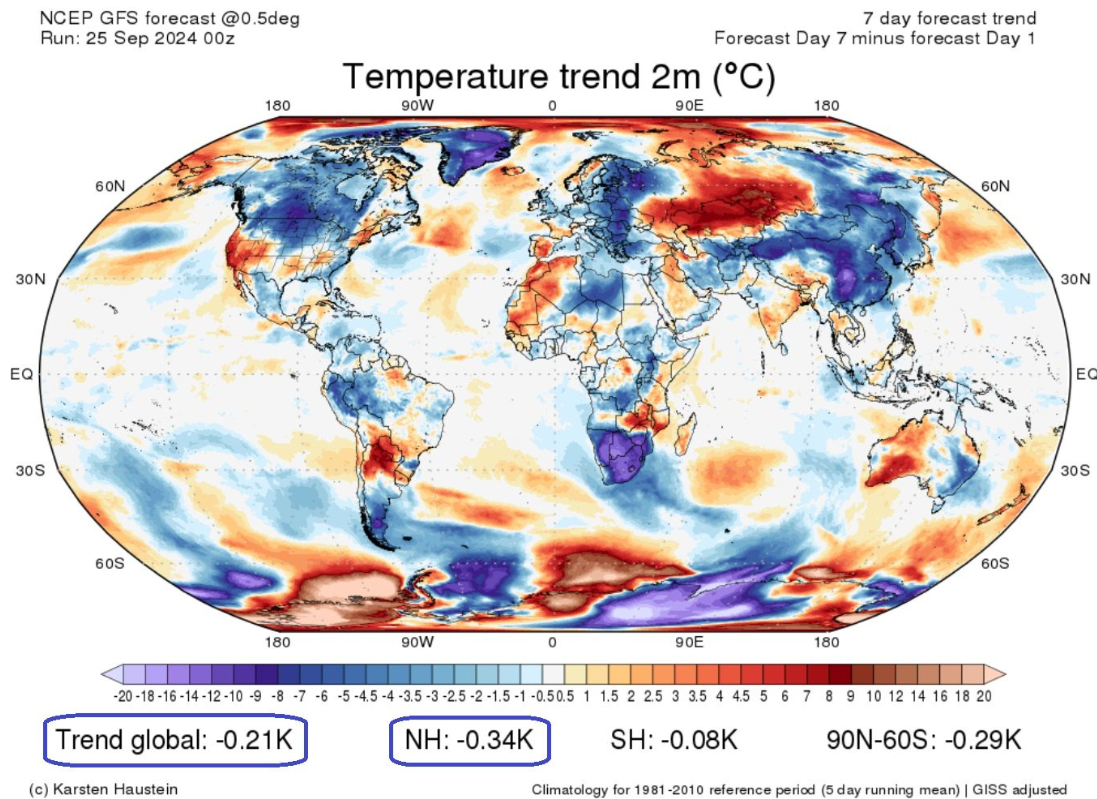
ย NCEP GFS 7-Day 2m Temperature Trend Run Sees 0.34ยฐC Fall

The GFS 7-day trend expects a strong cooling, especially in the northern hemisphere.

From NoTricksZone

Byย P Gosselin

The GFS 7-day trend expects a strong cooling, especially in the northern hemisphere.

Hat-tip: Snowfan here

The 2m temperatures in the northern hemisphere are expected to fall by -0.34ยฐC, which will also pull global temperatures down by -0.24ยฐC. Source: GFS 7-day trend T2m Global:

Source:ย GFS-7-Tage-Trend T2m Global,ย Karsten Haustein

The U.S.-Canada Energy Relationship Is Underappreciated โ€“ And May Now Be Under Threat

โ€œSenators, Calgary is a lot closer to Washington than Riyadh. And you donโ€™t need the U.S. Navyโ€™s Fifth Fleet to patrol the Great Lakes.โ€ So said then-Alberta Premier Jason Kenney at a U.S. Senate Energy and Natural Resources committee hearing in May of 2022, just a few months after Russiaโ€™s invasion of Ukraine thrust energy security back into the spotlight.

From Watts Up With That?

By Dan ByersMichael Gullo

September 18, 2024

โ€œSenators, Calgary is a lot closer to Washington than Riyadh. And you donโ€™t need the U.S. Navyโ€™s Fifth Fleet to patrol the Great Lakes.โ€   So said then-Alberta Premier Jason Kenney at a U.S. Senate Energy and Natural Resources committee hearing in May of 2022, just a few months after Russiaโ€™s invasion of Ukraine thrust energy security back into the spotlight.   

While global markets have calmed since the 2022 energy crisis, geopolitical tensions have worsened, there is war in Europe and the Middle East, and economic nationalism and protectionism are on the rise. Uncertainty reigns, which makes the North American energy alliance Premier Kenney championed all the more important. However, a sector-by-sector cap-and-trade system designed to meet Canadaโ€™s ambitious economy-wide 2030 greenhouse gas (GHG) goals is threatening this increasingly important partnership.   

While it should go without saying that U.S.-Canadian energy trade is critical to each countryโ€™s energy security and economic prosperity, Canadaโ€™s role in responding to U.S. demand with a safe and secure supply of affordable energy is often overlooked or poorly understood by policymakers.  

Even though the U.S. is the worldโ€™s largest oil and gas producer, it increasingly relies on its northern neighbor to supply refineries with much-needed heavy crude oil and keep power flowing to households and industry. In fact, growth in Canadian imports is an important factor driving Americaโ€™s reduced reliance on OPEC countries, as the country now accounts for more than 50% of U.S. petroleum imports. Meanwhile, virtually all natural gas coming into the U.S. comes from Canada, and it is also Americaโ€™s primary supplier of electricity and important minerals such as uranium. In total, two-way energy trade of oil, natural gas, electricity and uranium reached a record total in 2023 of $156 billion USD.   

This energy security partnership must not be taken for granted. Potential serious disruptions loom, especially if Canadaโ€™s intentions to impose a cap on the emissions produced by its upstream oil and gas sector go forward as envisioned.  While Canadaโ€™s emissions cap does not directly constrain energy production, it will do so as a practical matter, because the substantial costs and long lead times required to approve and deploy emissions-reducing technologies to power oil and gas operations (such as carbon capture and storage (CCS), waste heat recovery systems, and small modular reactors) leave industry with no other options.   

This could force Canadian producers to curtail operations as a compliance measure. Estimates suggest that curtailment could range from 626,000 to as much as 2,000,000 barrels per dayโ€”amounts equivalent to 16 โ€“ 52% of U.S. imports of Canadian crude oil.  Similarly, natural gas producers would need to reduce production by approximately 2.2 billion cubic feet per day, or roughly 76% of imports to the U.S. All this at a time when energy demand is rising, and power sector dependence on natural gas grows in response to coal retirements, transportation electrification, and data center expansion. 

Put simply, the de facto production caps under consideration by the Canadian government threaten to severely restrict cross-border energy trade in a way that harms our shared economic and security interests. They should not go forward as proposed, but that does not mean industry opposes ambitious action on emissions. To the contrary, energy companies on both sides of the border are investing billions of dollars on the transition to a cleaner energy future. Progress abounds  in both the U.S. and Canada, from investments in multi-billion dollar CCS projects and alternative fuels such as renewable natural gas to clean hydrogen production and world-leading actions to reduce methane throughout the oil and gas value chain. This commitment is unwavering, and promises to enhance North American energy security while meeting international demand for our (lower-GHG-footprint) exports.  

Policymakers should seek to strengthen cross-border collaboration on energy security, infrastructure, climate change policy, harmonized standards and development and deployment of key clean energy technologies. This coordination should recognize and protect the fundamental role each country plays in enhancing North American prosperity, meeting global demand and building resilient energy supply chains. Taking this broader view should also consider the increasingly important and integrated role both countries play in providing a safe, secure and clean supply of energy to overseas markets and NATO allies.  

Together, Canada and the U.S. have dominated global oil and growth in the past decade, creating an energy secure North America while driving billions into innovation and technologies designed to lower emissions. Policy actions that limit production and export capacity could reverse this progress, leaving us and our allies more vulnerable. We must instead leverage our deeply interconnected energy systems and rock-solid commercial relationships in support of a North American Energy Security framework that will deliver benefits for decades to come. Our organizations and collective membership stand ready to be a fully committed partner in this effort. 

Dan Byers is Vice President of Policy at the U.S. Chamber of Commerce Global Energy Institute.  

Michael Gullo is Vice President of Policy at the Business Council of Canada.  

This article was originally published by RealClearEnergy and made available via RealClearWire.

Media Confirms the Earth Is Not Abnormally Warm, Rather It Is in Its Coldest Period in 485 Million Years

Recently, many media outlets touted a new scientific study โ€œA 485-million-year history of Earthโ€™s surface temperatureโ€ as proof that the current modest rise in temperature over the last 150 years is going to be catastrophic. The data and the methodology used strongly suggest that such claims are false.

From ClimateRealism

By Anthony Watts

Recently, many media outlets touted a new scientific study โ€œA 485-million-year history of Earthโ€™s surface temperatureโ€ as proof that the current modest rise in temperature over the last 150 years is going to be catastrophic. The data and the methodology used strongly suggest that such claims are false.

For example, in their coverage, The Washington Post (WaPo) quoted one of the study authors, saying:

At no point in the nearly half-billion years that Judd and her colleagues analyzed did the Earth change as fast as it is changing now, she added:

โ€œIn the same way as a massive asteroid hitting the Earth, what weโ€™re doing now is unprecedented.โ€

How absurd. In no way is a world ending event from space anything at all like the gentle warming weโ€™ve seen over the past century.

Second, using the proxy data that their research was limited to, there is no way of determining whether the speed with which past temperature shifts occurred was faster, slower, or similar to what we are experiencing at present.

Bloomberg, in We Just Got a Wake-Up Call From the Time Before Dinosaurs, said this: โ€œEarth has been through periods of rapid climate change before. They all produced mass death.โ€ The implication is that we are on the same track as the dinosaurs, which ironically were ended by โ€œa massive asteroid hitting the Earth.โ€

Tech news had this foreboding headline: 500 Million Years of Climate History Tells Us of a Coming Catastrophe

All of these media outlets predict doom and gloom in our immediate future due to climate change, but in doing so, they completely ignore the bigger picture presented by the study. Most importantly, the study itself made no predictions of future doom due to climate change; such dire predictions are spun entirely by the media.

What is clearly evident in the graph provided by WaPo and the graph in the actual study (Figure 1 seen below), yet ignored by the media, is that fact that the present-day is the coolest Earth has been in 485 million years. Furthermore, the media completely ignored the fact that the wide swings in temperature recorded throughout history all naturally happened well before humans and the industrial revolution came on the scene.

Figure 1 -Phanerozoic temperature history. PhanDA reconstructed Global Mean Surface Temperatures for the past 485 million years. Black line shows the median, shading corresponds to the ensemble percentile. Blue rectangles show the maximum latitudinal ice extent , and orange dashed lines (fish symbols) show the timing of the five major mass extinctions of the Phanerozoic. The blue horizontal line, added by A. Watts shows that the present had the coolest global temperature in the entire 485 million year history. Source: Figure 2 from โ€œA 485-million-year history of Earthโ€™s surface temperatureโ€

Note the blue line in Figure 1 (added), denoting that according to their data, the present-day is the coolest in that 485-million-year history of temperature.

Yet somehow, this is lost on the media. WaPo focuses entirely on the small blip at the very end of the graph, with their own magnified version, seen below:

WaPo completely ignores the evidence presented research, such as the surface stations project conducted by The Heartland Institute, showing that the Urban Heat Island effect and the poor placement of temperature stations used to measure temperatures, from which long-term trend data is gathered, may account for as much as 50 percent of recent warming, with the remainder likely being partly or wholly natural.

Then WaPo sounds the obligatory alarm, saying:

The planet has been heating up for the past 20,000 years โ€“ but human-caused emissions in recent centuries have pushed the rate of warming into unprecedented territory.

Without rapid action to curb greenhouse gas emissions, scientists say, global temperatures could reach nearly 62.6 F (17 C) by the end of the century โ€” a level not seen in the timeline since the Miocene epoch, more than 5 million years ago.

That is false. We are not in โ€œunprecedented territory.โ€ The graph itself proves that as does other parts of the WaPo article, such as, โ€œAt its hottest, the study suggests, the Earthโ€™s average temperature reached 96.8 degrees Fahrenheit (36 degrees Celsius) โ€” far higher than the historic 58.96 F (14.98 C) the planet hit last year.โ€

Of course, that 96.8ยฐF peak happened well before humans even existed, suggesting that the planet has, as a result of entirely natural factors, dramatically warmed and cooled in the past without any human contribution whatsoever. To be clear, WaPo cites no data or theory, and certainly nothing contained in the study suggests, that human CO2 emissions could lead to the highs reached in the past. A 1.5 or 2 degree Celsius is increase is not dangerous, and certainly doesnโ€™t get the world from its present 14.98โ„ƒ to the 36โ„ƒ figure WaPo is discussing to scare its readers.

This passage from the WaPo story does come to the honest conclusion that Earth tends to run warmer than today throughout its geological history:

The study also makes clear that the conditions humans are accustomed to are quite different from those that have dominated our planetโ€™s history. For most of the Phanerozoic, the research suggests, average temperatures have exceeded 71.6 F (22 C), with little or no ice at the poles. Coldhouse climates โ€” including our current one โ€” prevailed just 13 percent of the time.

Therefore, it is quite possible Earth will return to a โ€œhothouse climateโ€ without any help from humans at all.

It is clear that the media wanted to spin this scientific study, which makes no alarming claims at all, into a tool to bolster their erroneous viewpoint that the world presently faces a โ€œclimate crisisโ€ caused by humans. However, the data clearly show that the Earthโ€™s temperature and the climates of its varied regions, have shifted radically in the past, that present temperatures are much cooler than has been the norm for the majority of Earthโ€™s geological history, and that humans have lived through both cooler and warmer temperatures than we are currently experiencing at various points in history.

It is a shame, but not unexpected, that the mainstream media spins reports such as these into something frightening. Such behavior is not only dishonest, but reprehensible.

The boiler tax is just the start of Labourโ€™s energyย catastrophe

We already know that there will be a steep rise in capital gains tax in the horror Budget that is planned for next month.

xr:d:DAF1u6IOMqo:33,j:4189885705292852563,t:23121309

From NOT A LOT OF PEOPLE KNOW THAT

By Paul Homewood

We already know that there will be a steep rise in capital gains tax in the horror Budget that is planned for next month.

We may well see fresh levies on landlords, increases in inheritance taxes, a raid on pension funds and perhaps an increase in the employerโ€™s rate of National Insurance. And yet, on top of all that, the Government has another charge in store for us that it conveniently forgot to mention during the election campaign.

The boiler tax is back.

Not only is it idiotic to revive a policy that was scrapped because it didnโ€™t work, it is just a foretaste of what is to come over the next five years. The Government is planning an ideologically driven energy policy that will plunge the economy into crisis.

It will be the unlikeliest return since the Spice Girls said they were getting back together. Most of us probably assumed that the boiler tax was dead and buried when, in a rare moment of common sense, the Sunak government decided to scrap it.

The scheme set a strict quota for a percentage of all new heating systems that had to be powered by heat pumps instead of conventional boilers, with fines for any installers who didnโ€™t meet the target.

Given that no one was buying expensive and unreliable pumps โ€“ surprise, surprise โ€“ installers were left with no choice but to pay the fine and pass on the cost in the form of a surcharge on any customer who needed a new piece of kit.

It was, in effect, a boiler tax. And now Ed Miliband, the Energy Secretary, has decided to reimpose it from next year. If your heating packs up over the winter, prepare to pay extra to get it fixed. And pensioners already worried about losing the winter fuel allowance will have even more reason to fear freezing over January and February.

The trouble is, there are two big problems with bringing the boiler tax back.

First, it was scrapped for a very simple reason. It was completely bonkers. No one was buying heat pumps because they are poorly suited for the UKโ€™s elderly housing stock, and it is not fair to punish the installers for not selling enough of a product that people donโ€™t want.

Even if you did want to impose a levy on traditional heating systems, then it hardly made any sense to impose it only on people who purchase a new one, not least because it encourages people to keep running old, inefficient systems for as long as possible (we will have a similar issue with quotas for electric cars, in the unlikely event anyone in government cares about rational arguments).

It would be better to simply impose an extra charge on all heating systems. The decision to reimpose it tells us something about the green commissars now in charge of the UKโ€™s energy policy. They donโ€™t care about practicalities, or what works. They only care about the target.

Next, and more importantly, it is a terrifying glimpse into how energy policy will develop over the next five years.

The Government is pressing ahead with forcing everyone to install a smart meter despite complaints from the consumer champion Martin Lewis last week that 19pc of them donโ€™t work. A failure rate that would be unacceptable in a toaster or a washing machine, and lethal in a car, is somehow completely fine because it is a โ€œgreenโ€ product.

Billions are about to be spent on GB Energy, even though no one seems to have the faintest idea what it will actually do apart from hiring the inevitable diversity officers. The oil and gas industry in the North Sea is being killed off, by windfall taxes, by refusing to fight legal actions by green activists, and by refusing any more development licences.

The countryside is about to be carpeted with windmills even if there is not enough storage capacity to make them effective, and there is precious little sign of either the large or small nuclear reactors that might actually make a difference getting built.

To cap it all, we will soon have waiting lists for the sale of new cars and vans, because there are quotas and fines for manufacturers to force us all to buy electric vehicles. The list goes on and on. We are only three months into the Starmer administration, and already energy policy has abandoned any contact with reality.

And yet the blunt truth is this: no economy can prosper without reliable, cheap power. According to a report from Sam Bowman and Ben Southwood only last week, British industrial energy costs are 74pc higher than in the United States, and 32pc higher than in France.

Much the same is true in the heavily regulated consumer market. We are placing a crippling burden on companies that makes it impossible for them to compete in global markets even compared to our European neighbours. And we are placing huge extra costs on households at precisely the same time as they are getting hammered by rising taxes and wages are stagnating once again.

Everyone agrees โ€“ well, almost everyone โ€“ that transitioning to a low-carbon economy is an important policy goal, and one that should be achievable as technology advances so long as we donโ€™t try and set a global example.

But the boiler tax was a bad policy, poorly designed, and has already been shown not to work. It was quite rightly scrapped. By reviving it, Miliband and the team around him have demonstrated that they will be driven by a series of bizarre, ideologically inspired targets that donโ€™t make any sense to anyone.

The boiler tax is just the start โ€“ it will get far, far worse over the next five years.

America First, Energy First (AFPI on energy)

โ€œAn America First energy agenda โ€ฆ focuses on creating a transparent and fair regulatory environment that creates a level playing field for all energy sources to compete, eliminating harmful regulations and barriers to growth across industries, allowing for investment in crucial infrastructure and jobs, reducing dependence on unstable foreign energy sources, and protecting the environment.โ€

From Master Resource

By Robert Bradley Jr.

โ€œAn America First energy agenda โ€ฆ focuses on creating a transparent and fair regulatory environment that creates a level playing field for all energy sources to compete, eliminating harmful regulations and barriers to growth across industries, allowing for investment in crucial infrastructure and jobs, reducing dependence on unstable foreign energy sources, and protecting the environment.โ€

Previous posts at MasterResource have examined the energy positions of the Jill Stein/Green Party, Kamala Harris, GOP Platform, American Petroleum Institute, and Heritage Foundation/Agenda 25. This post reproduces the energy positions of America First Policy Institute (AFPI), a think tank in the Trump fold.

Pillar VII of AFPIโ€™s โ€œMake American Energy Independentโ€ begins:

Our American energy sector achieved something else as well: in attaining new heights of innovation and development, the U.S. now provides the world with opportunity and security through its energy and energy technology exports. A policy environment that fosters American industry and innovation is the critical foundation to powering a cleaner, more prosperous future for the U.S. and the world.

Unfortunately, Americans producers and innovators face mounting policy barriers that make it harder for them to provide the resources needed. We must act to safeguard a legacy of prosperity and security for future generations, not a legacy of stagnation, uncertainty, and crippling energy inflation.

An America First approach that elevates energy independence to the center of American policy is essential to achieving these goals. An America First energy agenda is grounded in sound principles of free-market economics and transparent governance. This approach focuses on creating a transparent and fair regulatory environment that creates a level playing field for all energy sources to compete, eliminating harmful regulations and barriers to growth across industries, allowing for investment in crucial infrastructure and jobs, reducing dependence on unstable foreign energy sources, and protecting the environment.

America First policies will reduce our reliance on foreign fuel and strengthen our position on the world stage, lower consumer energy and fuel costs, advance environmental protection, and promote and power a growing and prosperous economy for all Americans.

After stressing the importance of domestic energy in a political world, the energy agenda continues:

Unfortunately, this new era of energy independence is under threat from the anti-energy agenda and regulatory overreach of our government today. The current administrationโ€™s decision to halt federal leasing and deprive industry access to critical resources on federal lands undermines market certainty, leading to underdeveloped resources. This decision and others demonstrate its failure to recognize that the U.S. has the resources to safeguard energy independence.

America First policies emphasize securing energy independence across a broad range of energy sources.
Such an approach recognizes the importance of diversification and having redundancies in Americaโ€™s
energy ecosystem, especially in light of the unpredictability of future economic and geopolitical conditions.

While fossil fuels will remain a core part of Americaโ€™s energy backbone, our Nationโ€™s ability to secure 21st century energy independence through world- leading technological innovation depends on several factors. These include having the industrial capacity to mine, extract, refine, and transport natural resources such as fossil fuels, critical minerals, rare earth elements, and uranium.

In contrast to the Leftโ€™s vision of putting all of Americaโ€™s energy eggs into one government-centric greenโ€ energy basketโ€”exposing our Nation to dangerous levels of foreign dependenceโ€”the America First approach relies on removing undue regulatory constraints. These constraints hamstring the private sectorโ€™s ability to take the lead in making critical investments that ensure Americaโ€™s energy independence regardless of which technologies end up prevailing in the energy marketplace. To facilitate such a robust marketplace, policymakers should also enhance access to federal lands for responsible resource development.

Just a few years ago, America defied the doubters by becoming energy independent for the first time in more than half a century. With sound policy, America can once again achieve this milestone and take energy security into its own hands, ensuring that it will never again be dependent on untrustworthy foreign governments for its energy needs.

Comment

The primacy of energy, as well as the dominant position of the U.S. in consumer-chosen, taxpayer-neutral energy, is evident in the above statements. The key is โ€œsound principles of free-market economics and โ€ฆ transparent and fair regulatory environment that creates a level playing field,โ€ which comports with AFPIโ€™s โ€œguiding principlesโ€ of โ€œliberty, free enterprise, national greatness, American military superiority, foreign-policy engagement in the American interest, and the primacy of American workers, families, and communities in all we do.โ€

Yes, oil, gas, and coal should not be penalized as under the current regime. But neither should fossil fuels or any form of energy be subsidized by special tax treatment or government grants. The same goes for wind, solar, biomass, and civilian nuclear. Electricity, too, should be a a free-market sector unlike today.

Finally (but not least!), tariffs on imported goods, a Trump campaign promise, should be energy-neutral as a โ€œsecond bestโ€ policy within a policy. Trump tariffs should not play into โ€œborder adjustmentโ€ policy (or PROVE IT Act policy) as part of a domestic CO2 (โ€œcarbonโ€) tax program. Better yet, it should not be implemented as a protectionist (vs. revenue) program for reasons explained by economic Donald Boudreaux.

The economic objection to tariffs โ€“ the economic case for free trade โ€“ is rooted exclusively in the recognition that artificially raising the prices of imported goods and services does not, contrary to protectionist myth, improve the living standards of people in the home country. Tariffs meant for revenue purposes are a categorically different animal. Revenue tariffs, quite unlike protective tariffs, achieve their goal only insofar as they do not obstruct imports.