Global warming, climate change, all these things are just a dream come true for politicians. I deal with evidence and not with frightening computer models because the seeker after truth does not put his faith in any consensus. The road to the truth is long and hard, but this is the road we must follow. People who describe the unprecedented comfort and ease of modern life as a climate disaster, in my opinion have no idea what a real problem is.
Offsetting has been hailed as a fix for runaway emissions and climate change—but the market’s largest firm sold millions of credits for carbon reductions that weren’t real.
One evening in November, 2021, a group of men assembled at sundown on the terrace of the Ruckomechi Camp, a safari resort on the Zambezi River. Since arriving by private plane, they had gone out lion-spotting, boated down the river, and landed a giant tiger fish; now they were clinking gin-and-tonics. Hippos wallowed in the water below.
The party was led by Renat Heuberger, a forty-four-year-old Swiss entrepreneur with narrow eyes and a cropped copper beard. Heuberger was the chief executive of South Pole, the world’s largest carbon-offsetting firm, and he had come to Zimbabwe to fight off an urgent threat to his company.
A decade earlier, South Pole had signed a deal to sell carbon offsets from an effort to protect a vast swath of forest on the banks of Lake Kariba, upriver from the camp. The Kariba project, spanning an area ten times the size of New York City, was among the world’s first “avoided deforestation” programs; by deterring local people from chopping down trees, it promised to prevent the release of tens of millions of tons of greenhouse gas. Leading corporations, including Volkswagen, Gucci, Nestlé, Porsche, and Delta Air Lines, paid South Pole nearly a hundred million dollars for Kariba credits, allowing them to market goods or services as “carbon neutral.”
South Pole thus pioneered a model of carbon offsetting that has been counted among our best hopes for staving off climate catastrophe: a mechanism that diverts funds from polluters in wealthy countries to protect crucial ecosystems in the Global South. Heuberger, a kinetic, grandiloquent man, speaks expansively about his mission. “We’re here to save the climate,” he told me.
As a child, Heuberger spent his spare time gluing protest flyers to car windows, and he considered himself an activist. But, as he built his company, he had developed a consumer-friendly brand of climate optimism. “It’s not true that to save the climate we will all need to go into perpetual lockdown or stop having fun,” he said, promoting Porsche’s offsetting program. “In fact, it’s the opposite”—drivers should enjoy their vehicles, knowing that “every ton of CO2 they compensate for is backed by a verified emission reduction.”
This perspective was enthusiastically received: Heuberger had regular speaking engagements at Davos and a spot in the World Economic Forum’s network of experts. As brands scrambled for inexpensive ways to reduce emissions, the market for offsets surged, quadrupling in 2021 alone. That year, South Pole was approaching a billion-dollar valuation, which would make it the world’s first “carbon unicorn.”
But alarming news had reached the company’s headquarters, in Zurich: it was at risk of losing its most lucrative project. By the terms of the Kariba deal, the company purchased carbon credits from a developer who oversaw the area’s forestland, and sold them for a twenty-five-per-cent commission. Now a competitor had offered the developer a substantial payment to take over the project. To help devise a response, Heuberger turned to an old friend from college, Dirk Muench, who had recently joined South Pole. Muench had left Wall Street to support climate action in the world’s poorest places. He was a self-confessed stickler, and could be too fastidious for Heuberger’s taste—but he was a skilled dealmaker.
“Yes, I was a little late again, but it isn’t like I have any control over the traffic or how many daily puzzles keep coming out!” Cartoon by Teresa Burns Parkhurst
Pennsylvania regulators are forcing truck drivers to buy trucks outside Pennsylvania. The crazy part: they didn’t even make the rules; they were made by California.
“We have no say, we can’t do anything about it,” says Brian Wanner the owner of Peter Brothers Trucking, “I don’t want to be anything like California.”
But that’s too bad, because Pennsylvania’s Environmental Quality Board decided to automatically copy rules from California.
The newest rules will raise the cost of new trucks by more than $50,000.
The regulators say these rules are important to stop pollution.
That’s dumb, says Wanner, “In 1980, 1 truck produced as much as 60 trucks today.”
“So, we want people to buy new trucks,” I ask?
“You want people to buy new trucks,” responds Wanner. “But if you put these costs on us that we cannot afford, we’re going to just run the older trucks.”
That’s something the regulators don’t think about.
In fact, there’s a lot they don’t think about. Their decision hurts truck sellers, won’t stop pollution, could be unconstitutional, and will only get more expensive when California mandates “all electric.”
The fact that water vapor is the dominant absorber in the Earth’s greenhouse effect can lead to a flawed narrative that anthropogenic carbon dioxide (CO2) is not important nor a significant driver of climate warming.
There is nothing mysterious about it unless you are totally blind to the natural forcing that supplies the reason. It should at least raise questions.
Water Vapor (WV) is by far a more important “heat-trapping ” gas than CO2. While we take great delight in measuring CO2 increase, no one on the other side of the issue says boo about water vapor. They adapt the Casablanca Louis Renault attitude ( they probably don’t know who that is). “I’m shocked, shocked to find that gambling is going on in here!”
I stated long ago this warming was their San Jacinto, that it was the trap set to destroy the phony climate war missive. And now they are trying to scramble by saying it is “mysterious”.
So, I will review it again.
CO2 has been on a steady rise since 1950.
The deceptive and despicable practice of making PARTS PER MILLION equal axis to years makes one think this is going through the roof. Imagine if the years were on a scale of millions, not decades. You would not even see it.
That realization alone should make one stop to think about the agenda.
They simply ignore Le Chetilier’s principle in this matter.
If CO2 was doing this, why was there no appreciable change in Sea Surface Temperature (SST) from 1950 to 1990? ( SST being the prime source of water vapor and hence the input). As for “heat-trapping gas, CO2 is too tiny to do that. Both have radiative properties, but CO2’s bands are saturated. So the argument that 1.8 ppm/yr of CO2 is “trapping” heat is non-provable. Water vapor would be a more likely candidate. But there is no real quantification. All we get is the temperature and CO2. That should make anyone suspicious.
But no change in SST.
But when increased input from underwater sources started,
the increase in SST was almost a perfect match since oceans tend to lag a bit, and the increases PRECEDED THE RISE.
There is a cumulative build-up of heat in the oceans and then the air-forced responses. The increase in WV warmed the planet disproportionately, leading to a La Nina base state in the actual reaction as seen in the Multivariate ENSO index (MEI), a far more accurate measurement of the ENSO and its reaction in the atmosphere. Another largely ignored metric. Since the Super Nino of 97-98, the La Nina has dominated. This is due to increased easterlies in the tropical Pacific. The only place water will cool is in the eastern Pacific off South America due to upwelling from the change in the Global Wind Oscillation. Do you see what I am doing here? UNLESS YOU HAVE A BOTTOM LINE WHERE YOU FORECAST GLOBALLY AND DO IT WITH THE RISK OF GETTING PAID, WHY WOULD YOU EVEN LOOK AT THIS? In fact, if it countered your missive, it was threatening your belief and economic system, and you would try to hide it.
I have written on this a bunch of times. It’s discouraging that many meteorologists are all agog at the El Nino without understanding the environment around it may not be having the same effect as others. How can we tell? By this time in 1997 and 2015, the MEI was already at almost record-high levels. This year, it is barely to an El Nino. The weaker MEIs are the colder winters. So that is a hint as to what kind of winter we are likely to have, which we actually have been showing since last winter ended on Weatherbell.com.
However, the Oceanic Nino index does indicate Water Vapor input is stronger. Again, the hypothesis is that the build-up of warmth in the oceans supplies a steady state increase in WV, but when reactionary Oceanic Nino El Ninos go off, the input OF WV IS HIGHER. Hence, the step-up function of warming.
Now, what happens when you have a warmed ocean all over and then a strong warming in the ENSO areas takes place?
Look at that difference from last year! There has to be a marked increase in WV, and another step-up function starts.
So why is it not showing up in the MEI?
Well, look at the difference in the warmth in the western and northern Pacific vs the last time the Oceanic Nino Index was this strong.
There is much more cool in the western Pacific, and so the reactions are different. By being warm all over, the reaction is different in the Atmosphere. Again crucial to winter forecasting. Also, the nature of these El Ninos is they don’t last more than a year. Consequently, a flip to the La Nina comes right back next year, and the result is likely to be a hurricane season from hell. But all this has nothing to do with CO2.
Finally, the great volcanic eruption last year, which was underwater-based, actually should wake people up to what is going on that they can not see. We saw this one, and unlike the great above-water eruptions, this sent immense amounts of water vapor into the air. So we had the perfect storm of cumulative buildup, El Nino response, and then the reaction of excess water vapor.
Joe Bastardi is a pioneer in extreme weather and long-range forecasting.
He is the author of “The Climate Chronicles: Inconvenient Revelations You Won’t Hear From Al Gore — and Others” which you can purchase at the CFACT bookstore.
His new book The Weaponization of Weather in the Phony Climate war can be found here. phonyclimatewar.com
Climate change is the catastrophe to end all other catastrophes
By Fatima Bhutto October 16, 2023 at 6:30 a.m. EDT
Fatima Bhutto is a Pakistani writer and novelist. Her latest book is “New Kings of the World.”
This past summer, the primordial elements conspired to ravage Greece, the birthplace of Western civilization. The Mediterranean’s many islands were swept by water, air and especially fire, leaving a trail of wreckage. Helios, the sun god, whose statue in Rhodes was among the Seven Wonders of the ancient world, brought scorching temperatures to that island, sparking hundreds of wildfires. In coastal Alexandroupolis, pine forests were “reduced to blackened, skeletal bark,” according to Reuters, while fires in the Dadia forest, home to a magnificent nature sanctuary, torched 281 square miles — an area roughly the size of New York City.
Across Greece, tens of thousands of people, locals and tourists both, had to be evacuated, …
In September, scant weeks after the fires, came the deluge. Storms buffeted Bulgaria, Turkey and Greece, precipitating massive floods. Regions logged record rainfall — a season’s worth in a day, according to one estimate. The crescendo — for now — was the inundation of Derna on Libya’s Mediterranean coast. Whole neighborhoods were swept out to sea after rains overwhelmed the city’s aging dams. The death toll there stands at 11,300, with 10,000 people still unaccounted for.
This barrage in and around Greece could not help but remind me of my country, Pakistan, and the so-called super flood it endured one year earlier. As more adventurous tourists will be aware, the reaches of northern Pakistan are home to Earth’s largest collection of glaciers outside the polar regions — surrounded by the three highest mountain ranges in the world: the Himalayas, the Karakoram and the Hindu Kush. The landscape is surreally beautiful: lunar visions of ice and rock, encircled by jagged peaks. But as global temperatures rise, glacial melt has led to the formation of more than 3,000 new lakes, posing flood risks to the 7 million people downstream.
This is the nonsense climate believers want you to accept as a climate emergency.
None of this is historically unusual. Greece suffers large fires from time to time. If they want less destructive fires, they should try some forest management.
Libya suffered large casualties because not enough people evacuated. Libya is a political mess, large scale consequences to natural disasters are an inevitable consequence of nations suffering political chaos.
Building wind turbines won’t help people who have suffered recent devastation. What would help them is fossil fuel modernity and better government – just as a modern, high energy lifestyle and better government has helped most of us.
Big sun eruption – Elements of this image furnished by NASA
The largest known solar storm struck Earth more than 14,000 years ago, according to a new study of the growth rings in ancient trees. Why it matters: The discovery illustrates the immense power of solar storms — and underscores the danger they pose today.
Tree rings of a buried subfossil tree in the Drouzet River in the Southern French Alps. Photo Credit: Cécile Miramont
An international team of scientists have discovered a huge spike in radiocarbon levels 14,300 years ago by analysing ancient tree-rings found in the French Alps.
The radiocarbon spike was caused by a massive solar storm, the biggest ever identified.
A similar solar storm today would be catastrophic for modern technological society – potentially wiping out telecommunications and satellite systems, causing massive electricity grid blackouts, and costing us billions of pounds.
The academics are warning of the importance of understanding such storms to protect our global communications and energy infrastructure for the future.
The collaborative research, which was carried out by an international team of scientists, is published today (Oct 9) in The Royal Society’s Philosophical Transactions A: Mathematical, Physical and Engineering Sciences and reveals new insights into the Sun’s extreme behaviour and the risks it poses to Earth.
Such massive solar storms, are known as Myake Events and were unknown to science before 2012. As many as eight additional such solar storms have been identified over the past 15,000 years. The 14.3 kya event would be the most powerful yet identified.
The discovery of the 774 CE spike fostered new 14C measurement programmes on tree ring series from the Holocene at annual resolution. This is an enormous task since, before this discovery, tree-ring calibration had mainly been based on 14C ages measured on decadal wood sections. So far, four SEP spikes have been evidenced with multiple cosmogenic isotopes, 774 CE (1176 Cal BP), 993 CE (957 Cal BP), 2610 Cal BP, 9125 Cal BP) and a few others have been proposed based solely on 14C, 1052 CE (898 Cal BP), 1279 CE (672 Cal BP), 7210 Cal BP, 7360 Cal BP [17].Bard et al., 2023
The 1859 Carrington Event
The largest, directly-observed, solar storm occurred in 1859 and is known as the Carrington Event. It caused massive disruption on Earth – destroying telegraph machines and creating a night-time aurora so bright that birds began to sing, believing the Sun had begun to rise. However, the Miyake Events (including the newly discovered 14,300-yr-old storm) would have been a staggering entire order-of-magnitude greater in size. Eureka Alert
As disruptive as the Carrington Event was, Myake Events are an order of magnitude larger than the 1859 Carrington Event.
Greenhouse Gas Emissions vs Solar Storms
A repeat of the Carrington Event would be truly catastrophic to our modern, technology-dependent, society. A Myake Event might actually be an existential threat to life as we know it…. Yet…
Bard, a climate scientist at Collège de France and CEREGE, said learning about the sun’s past behavior is important for forecasting future solar storms, but also for understanding the sun’s impact on Earth’s climate. The sun’s effect on Earth’s climate is not as large as warming from greenhouse gas emissions, but it is a factor to consider in climate models.The Washington Post
Myake Events were only first identified in 2012.
As many as nine have been identified over the past decade.
The timing appears to be random, with an average interval of ~1,200 years.
Scientists have no idea if or how they affected the Late Pleistocene to Holocene climates.
The cause is unknown.
The frequency is unknown.
The Carrington Event, an order of magnitude weaker, would wreak havoc on modern society.
Yet… The “scientists” know that greenhouse gas emissions are more important to Earth’s climate than the Sun. The greenhouse effect depends on the Sun. Greenhouse gasses can’t “trap” heat that never reaches the surface of the Earth.
Myake Events and Neoglaciation?
Five Myake Events occurred during the Mid-Holocene Neoglaciation, with four clustered around the maximum glacial advance.
McKay et al., 2020 CPS with historical climate periods and Neoglaciation (Grosjean et al., 2007), with Myake Events.
Bard did note the 14.3 kya appears to have been followed by a 14 kya grand solar minimum that was coincident with the Older Dryas cooling between the Bølling and Allerød interstadials. Maybe, the Myake Event cluster was related to Neoglaciation?
Green New Deal = Anthropogenic Myake Event?
Let’s assume arguendo that “business as usual” will lead to an additional 1 °C of warming and 11 inches of sea level rise over the next 80 years. Most people won’t notice, because they didn’t notice the previous 1 °C of warming and 11 inches of sea level rise. Time is a serious low-pass filter.
This would leave a mark:
A Carrington class storm (see below) could inflict damage and disruption estimated at between $0.6-$2.6 trillion in the United States alone — 20 times the cost of Hurricane Katrina! Major transformer damage/failure and permanent loss of generator step ups nationwide would take 4-10 years to recover from. The loss of electricity would ripple across the social infrastructure with water distribution affected within several hours, perishable foods and medications lost in 12-24 hours, loss of heating/air conditioning, sewage disposal, phone service, fuel re-supply and so on. At this point, that sounds apocalyptic, but one would be mistaken to assume that this is a rare occurrence.ELFIN UCLA
Costs trillions and destroys our energy infrastructure? Sounds a lot like the Green New Deal. The Green New Deal might even be an anthropogenic version of a Myake Event. The main differences are that a Carrington/Myake Event would happen over a matter of days, and that the Green New Deal can be prevented.
The Flip Side
Hat tip to Yooper for this Daily Caller article:
Stunning New Discovery Is Going To Make Progressives Hate Science, And Should Terrify Conservatives
BLOG
KAY SMYTHE NEWS AND COMMENTARY WRITER October 12, 2023
A study published Monday detailed how a horrifying solar storm bombarded the Earth right around the end of our last major ice age.
[…]
So, why will progressives hate this research? Well, it’s complicated. But the simplest way to explain it is the data contributes to a much larger body of research that is starting to dispel the origin narrative on climate change, and may mean we’ve spent the last thirty years trying to fight the wrong battle. (RELATED: Dear Kay: I Watched ‘Ancient Apocalypse’ And Now I’m Scared We’re Going To Die Before 2025)
Some of you may have been forced to watch former Vice President Al Gore’s documentary “An Inconvenient Truth” back in the early part of this millennium. The premise of the film was this idea that roughly 12,900 to 11,600 years ago, a mini ice age occurred. And it’ll happen again because of man-made climate change.
What Gore failed to explain was the planet was in the thick of an ice age some 2.6 million years prior. For some unknown reason, around 14,000 years ago, ice sheets started to disappear in some parts of the world, as discussed by the Oak Ridge National Laboratory.
If The Largest Asteroid Near Earth Hit Us, Here’s What It Would Look Like | @DailyCaller
Then, around 12,900 to 11,600 years ago, things got really cold again. This time period is called the Younger Dryas. And just as suddenly as it showed up, the Younger Dryas disappeared, likely because of an asteroid impact.
[…]
And conservatives: be scared. These same people have convinced you that climate change is not a threat. But it is. Just not in the way you’ve been told. We are now threatened by our ignorance toward the power of our cosmos, and the only thing that can change that is you.Daily Caller
D’Oh!
“That’s all I have to say about that.”
That unsaid, the “Dear Kay” link was worse, citing Graham Hancock as a scientific source. Although, I do agree with her advice for weathering a Carrington-style event:
Under this type of cataclysm, all of the technology on Earth will fail within about an hour. We won’t be thrown back to the dark ages, but all of our electrical infrastructure might be. We’d be back to subsistence living, dependent on Mother Nature while societal chaos erupts… until it eases. You can easily prepare for such a calamity by working hard, buying land, working that land, storing water, growing essential medicines and foods.
Bard Edouard, Miramont Cécile, Capano Manuela, Guibal Frédéric, Marschal Christian, Rostek Frauke, Tuna Thibaut, Fagault Yoann and Heaton Timothy J. 2023. A radiocarbon spike at 14 300 cal yr BP in subfossil trees provides the impulse response function of the global carbon cycle during the Late Glacial. Phil. Trans. R. Soc. A.3812022020620220206. http://doi.org/10.1098/rsta.2022.0206
Grosjean, Martin, Suter, Peter, Trachsel, Mathias & Wanner, Heinz. (2007). “Ice‐borne prehistoric finds in the Swiss Alps reflect Holocene glacier fluctuations”. Journal of Quaternary Science. 22. 203 – 207. 10.1002/jqs.1111.
Kaufman, D., McKay, N., Routson, C. et al. Holocene global mean surface temperature, a multi-method reconstruction approach. Sci Data7, 201 (2020). https://doi.org/10.1038/s41597-020-0530-7
Do we really wanna live in a world without crude oil and 6000 products for living. Do we really wanna live for a green pipe dream in a world without transportation, electronics, hospitals or toilets?
Over the last 200 years, after the discovery of crude oil, the world populated from 1 to 8 billion. Today, all the electricity generation options available, such as wind turbines, solar panels, nuclear, hydro, coal, and natural gas, are all dependent on the products and components manufactured from crude oil to be able to generate electricity.
Looking back, the history of the petroleum industry illustrated that crude oil was virtually useless unless it could be manufactured (refineries) into oil derivatives that are now the basis of chemical products, such as plastics, solvents, and medications, that are essential for supporting modern lifestyles. The more than 6,000 products being used for humanity’s needs and the generation of electricity did not exist a few short centuries ago.
Today, we have more than 50,000 merchant ships, more than 20,000 commercial aircraft, and more than 50,000 military aircraft that use the fuels manufactured from crude oil. The fuels to move the heavy-weight and long-range needs of jets moving people and products and the merchant ships for global trade flows; the military and space programs, are also dependent on what can be manufactured from crude oil.
For the aircraft and ships, just like that for the various options for the generation of electricity, they all utilize parts and components made from the oil derivatives manufactured from raw crude oil.
Mankind in the pre-1800s set the stage for the fantastic growth after the mankind’s discovery of crude oil:
Life longevity was around forty years of age, and people seldom travelled more than one hundred miles from where they were born.
A world population of about one billion people.
No electricity, as all generation of electricity is only possible with the parts made from the oil derivatives manufactured from crude oil for wind turbines, solar panels, and coal, natural gas, nuclear, and hydropower plants.
The following infrastructures were not around a few short centuries ago, because they all need components and parts that were NOT available in the pre-1800s.
Transportation
Hospitals
Medical equipment
Appliances
Electronics
Telecommunications
Communications systems
Space programs
Heating and ventilating
Military
Today, a few centuries after the discovery of crude oil:
Everything that needs electricity and every infrastructure is made from oil derivatives manufactured from crude oil, from the light bulb to the iPhone, defibrillator, and all the parts of EVs, toilets, and spacecraft.
Weather-related fatalities have virtually disappeared with all the products and medications available today that were not available a few centuries ago.
Globally, as most of the world leaders in the few wealthy countries continue to focus on ceasing oil production and shuttering the refining of crude oil, the future does not bode well, as 20 percent of the almost 700 worldwide refineries are expected to close in the next 5 years, i.e., 140 closures. Further inflation and shortages in perpetuity are guaranteed, as those refineries are manufacturing the oil derivatives for all the products in society, and the fuels for the jets moving people and products, and the merchant ships for global trade flows and the military and space programs.
While the few wealthy countries are pursuing the elimination of crude oil, China has no intentions of abandoning its economic, military, or strategic ambitions – all of which rely on crude oil. Asia is the region with the greatest number of future petroleum refineries. As of 2021, there were 88 new facilities in planning or under construction in Asia.
Policymakers in the few wealthy countries are not cognizant enough to understand that there has yet to be identified a replacement for crude oil that now provides the products and fuels that have been manufactured from crude oil during the last few centuries, that are the basis on every infrastructure segment supporting the 8 billion on this planet!
The elephant in the room that no one wants to discuss is that crude oil is the foundation of our materialistic society, as it is the basis of all products and fuels demanded by the 8 billion on this planet.
Ridding the world of raw crude oil before we have a replacement to produce the oil derivatives currently manufactured from crude oil, we’re back to the 1800s.
The greatest threat to the world’s populations could be the future for billions to exist and prosper without those oil derivatives that are currently supporting more than 6,000 products for society.
Shockingly, very few parents, teachers, students, politicians, and those in the media have any clues or understanding about the basis of the products in our daily lives from crude oil! Energy Literacy at its best!!!
The proverb “you can’t have your cake and eat it too” tells us that:
You can’t rid the world of crude oil and
Continue to enjoy the products and fuels that are currently made with the oil derivatives manufactured from crude oil.
Without a replacement for the crude oil that’s been providing the products supporting today’s humanity for the last couple of centuries, policymakers seem to be focused on jumping out of an airplane without a parachute!
Here are a few suggested subjects for those energy literacy discussions at the dinner table:
Everything that needs electricity is made from the oil derivatives manufactured from crude oil, from the light bulb to the iPhone, defibrillator, and all the parts of EVs, toilets, and spacecraft.
All generation of electricity is only possible with the parts made from the oil derivatives manufactured from crude oil for wind turbines, solar panels, and the coal, natural gas, nuclear, and hydropower plants.
Ronald Stein is an engineer, senior policy advisor on energy literacy for CFACT, and co-author of the Pulitzer Prize nominated book “Clean Energy Exploitations.”
Small modular reactors offer a lower initial capital investment, greater scalability, and siting flexibility for locations unable to accommodate more traditional larger reactors. They also have the potential for enhanced safety and security compared to earlier designs. Deployment of advanced SMRs can help drive economic growth.
Ed. note: Nuclear Power is a much talked about technology in the current climate debate. Electricity veteran Ken Maize of Quad Report provides an update on three current nuclear issues: a new, mysterious NuScale power agreement; Plant Vogtle legal restitution; and the recommissioned 805-MW Palisades plant in Michigan.
NuScale’s Mystery Deal
NuScale Power has landed a deal with privately-owned blockchain data center developer Standard Power to provide two planned data centers in Pennsylvania and Ohio, 924-MW each, with electricity from arrays of NuScale’s 77-MW VOYGR small modular reactors, 12 for each data center. NuScale’s partner ENTRA1 Energy has the exclusive rights to develop, manage, own and operate energy production plants powered by NuScale’s SMRs.
NuScale and ENTRA1 created an exclusive global partnership in 2022 to commercialize NuScale’s SMRs. Standard Power describes itself as providing “blockchain miners focused on Bitcoin and other Proof of Work algorithm cryptocurrency mining an industrial scale infrastructure as a Service platform. The company provides infrastructure as a service with industrial-grade electrical and data center designs, as well as site selection based on low power costs and low environmental impact.” The company’s only identified site is 125 acres in Coshocton, Ohio, about equidistant between Columbus and Pittsburgh, Pa.
The announcement of the nascent deal produced a substantial bump in NuScale’s stock, which has been hammered for many months. The company’s 52-week high was $12.36/share. In 2022, NuScale used a “special purpose acquisition company” (SPAC) to divorce itself from Fluor Corp. NuScale’s shares (symbol: SMR) opened on the New York Stock Exchange on Friday at $4.96, up marginally from its 52-week low of $4.91. It closed on Friday at $5.76, a 23% jump.
NuScale’s press release is filled with lots of business rhetoric and standard industry buzz words: clean power, proven technology, innovative design, and so forth. But there is little detail and considerable obfuscation. The Motley Fool investment website commented, “This contract is probably worth a lot to NuScale — but how much it’s worth remains a mystery.”
No financial details are provided in the press release, nor in the company’s Oct. 6 8K filings at the Securities and Exchange Commission. Nor are there any timelines for the deal. The Motley Fool observed, “This being the case, it’s hard to say precisely what effect the contract will have on NuScale’s bottom line — or how long it will take to show up on that bottom line.” To date, NuScale has no significant earnings.
Also, NuScale has no track record. Its other deal, with Utah Associated Municipal Power Systems (UAMPS), is long delayed and losing steam. The multiple-reactor project was originally planned to be in service in 2009.
Finally, the press releases state that NuScale’s technology is the only SMR that has Nuclear Regulatory Commission design approval. True but misleading: NuScale’s 50-MW design had NRC approval. In 2020, NuScale upped its reactor design to 77 MW. In March, the NRC announced a review of the changed design, stalling the prior approval. NuScale and ENTRA1 can’t apply for a license to build and operate the reactors until that review allows.
Vogtle #3/#4 Reparations
Southern Co.’s Georgia Power will pay public power system Oglethorpe Power Corp. $413 million to settle a lawsuit over cost escalation at the $35 billion, two-unit new Vogtle nuclear power expansion. Oglethorpe, a generation and transmission cooperative, owns 30% of the 2,000-MW Vogtle project.
As part of its ownership agreement, Georgia Power agreed to limit Oglethorpe’s exposure to cost overruns for the construction of the two 1,000-MW Westinghouse AP1000 pressurized water reactors. The costs of the project ballooned, more than doubling from the initial estimate of $15 billion for the two units.
Georgia Power and Oglethorpe disagreed on how much the investor-owned utility owed in refunds to the public power system. Oglethorpe sued in July 2022, seeking $695 million. The settlement last week (Oct. 6) will award Oglethorpe $308 million for already incurred cost overruns and and $105 million for estimated future costs. According to the Associated Press, Southern Co. says it will write off a $152 million loss as a result of the settlement. The settlement provides that Georgia Power will pick up two-thirds of additional costs beyond the current estimate, according to Morningstar.
Construction on Vogle 3/4 is running seven years behind schedule and is still not complete. Unit 3 went into service July 31. At the same time of the settlement, Georgia Power announced another significant delay in finishing Unit 4. In a Securities and Exchange Commission filing, the utility said it has identified a “motor fault in one of four reactor coolant pumps” and will have to replace the pump. The company said it has a spare on hand and the failure is “an isolated event.” As a result, the plant will not be able to start up this year, as Georgia Power had planned, and will be delayed into “the first quarter of 2024.”
Palisades Recommissioning
Holtec International has formally applied to the Nuclear Regulatory Commission (NRC) for permission to end its decommissioning of the elderly, mothballed 805-MW Palisades nuclear plant in Michigan and near Lake Michigan and restart it. If the NRC approves restating the plant’s operating license and Holtec can line up financing, it would mark the first time a retired plant undergoing decommissioning would go back into service.
Restarting the Combustion Engineering pressurized water reactor requires the NRC to formally waive portions of its order terminating the plant’s operating license. The license “prohibits the company from operating, placing fuel into or retaining fuel in the reactor.”
Holtec acquired the plant from Entergy in June 2022 for access to the decommissioning fund. In September 2022, Holtec applied to the Department of Energy’s Civil Nuclear Credit Program for funds to restart the plant, with support from Michigan Democratic Gov. Gretchen Whitmer. DOE denied the request in November.
Michigan is providing $150 million for the restart. Early this year, Holtec applied to DOE’s Loan Programs Office for funding. Holtec in September won a long-term power purchase agreement with rural electric power cooperative Wolverine Power Cooperative.
CMS Energy of Jackson, Mich., built Palisades between 1967 and 1970 at a cost of about $1.2 billion in 2023 dollars. It went into limited service in 1971 and got a full operating license in 1973. CMS sold the plant to Entergy in 2007 for $308 million (it cost $630 million to build in 2007 dollars), along with a power purchase agreement to buy the plant’s output. In 2007, the NRC approved a license extension to 2031.
In 2018, Entergy announced it would close the plant in 2022. Whitmer in May of 2022 asked DOE for funds to keep the plant open, a move that failed. Entergy closed Palisades in May and sold it to Holtec in June.
Last December, researchers vigorously promoted a possible 27% decline in Western Hudson Bay (WH) polar bear abundance but kept hidden the fact that adjacent Southern Hudson Bay (SH) numbers increased by 30% over the same period.
And surprise, surprise: the bombshell SH results call into question everything the ‘experts’ have been saying about polar bears in Hudson Bay for years.
I finally got a copy of the 2021 WH survey report from the Nunavut government, which was reported on by the media around the world in December 2022. The Nunavut government also sent along a copy of the 2021 SH report (helpfully asking, “would you also like the SH report?”), published at virtually the same time. The existence of a SH report was never mentioned by any of the media articles in December, even though it was referenced several times in the WH report, which suggests reporters never actually saw the WH report but were simply given a press release with approved talking points.
WH Report
The WH 2011 population estimate was 949 (range 618-1280), the 2016 estimate was 842 (range 562-1121), and 2021 estimate was 618 (range 385-852). The media must have been given the 27% figure representing the drop between 2016 and 2021 in a press release, because that figure isn’t mentioned in the WH report.
According to Andrew Derocher, of the University of Alberta, regarding the WH population, “The actual decline is a lot larger than I would have expected.” [CBC News, 23 December 2022]
I’ll say. However, the apparent decline from 2016 to 2021 was not statistically significant and neither was the decline between 2011 and 2021: the authors state this explicitly on pg. 29 of the WH report.
The WH report authors state that abundance of adult male bears remained unchanged over the three sampling periods but that a decline in abundance of adult females and subadult bears (especially in the area around Churchill) seems to have driven an apparent decline in overall numbers. A suggestion was made that perhaps some Churchill-area females and subadults had simply relocated a bit north or south but the authors shot that notion down.
Although, the estimated abundance of adult female and subadult bears in Area 2 [i.e. around Churchill] decreased significantly between the 2011 and 2021 surveys, concurrent increases of these types of bears in Areas 1 (Cape Tatnum) [to the south] or 3 (Nunavut) [to the north] of WH were not found (Table 13). [WH report, Atkinson et al. 2022, pg. 32]
So, the missing females and subadults didn’t move a bit north or south, but did they perhaps move further south, into Southern Hudson Bay?
Notably, between 2016 and 2021, the estimated abundance of SH increased by 223 bears while that of WH decreased by 224 (Northrup et al. 2022). Changes in both subpopulations, at least between 2016 and 2021, could therefore be accounted for by movement of WH bears into SH. [WH report, Atkinson et al. 2022, pg. 24, my bold]
However, the WH report reveals that results of an unpublished SH biopsy study led by graduate student David McGeachy found 22% of bears formerly sampled in WH were found in SH in 2021 but these were predominantly adult males, not the “missing” adult females from WH. This means that a large movement of WH females and subadults into SH in 2021 cannot explain the simultaneous abundance decline in WH and increase in SH.
Our findings that adult female and subadult abundance has declined while adult male abundance has remained unchanged are thus inconsistent with a range-shift hypothesis.[WH report, Atkinson et al. 2022, pg. 33, my bold]
The authors suggest the apparent WH population decline was “consistent” with predictions of adverse effect of climate change on polar bear health and survival, yet provided no sea ice data for the relevant period. However, observations by others (including the authors of the SH report) indicate the decline couldn’t have been caused by poor sea ice conditions over the last five years because WH ice from 2017-2020 was better than it had been for decades.
In short, the authors of the WH report were unable to explain why there was an apparent decline in abundance between 2011 and 2021, except that several hundred adult females and subadults seemed to have disappeared from the central WH area around Churchill. The authors seemed unsure that an actual decline had taken place at all, given the uncharacteristically tenuous language used to describe their results:
Estimates derived for the WH subpopulation indicated a possible decline in total bear abundance between 2011 and 2021. [WH report, Atkinson et al. 2022, pg. 29, my bold]
SH Report
SH numbers went from 943 bears in 2012 (range 658-1350) to 780 in 2016 (range 590-1029) to up to a whopping 1119 in 2021 (range 860-1454), an increase of 30% over five years (see pgs. 29 and 42). Oddly, the authors don’t mention if this is a statistically significant increase or not, but it seems likely it is.
The report authors initially claim that it is “highly implausible” that an increase of this magnitude could be due to natural increases in birth rate or reduced mortality alone over such a short time period (pg. 29). However, their data also indicated that 35% of all SH bears they counted were yearlings or cubs-of-the-year (more than found in WH in 2021) and the authors finally concluded that a natural increase in numbers did happen in conjunction with good sea ice conditions from 2017 to 2020 (pg. 31), perhaps in conjunction with immigration of some bears from another subpopulation that they couldn’t verify.
Reconciling the Reports
The authors of both reports were left sputtering to explain their results. A loss of hundreds of WH adult females and subadults between 2016 and 2021 is not consistent with the prevailing hypothesis that lack of sea ice drives long-term declines in polar bear abundance in WH because sea ice conditions from 2017 to 2020 were better than they had been in decades (only 2021 was not as good). And besides, SH had similar sea ice conditions over the same period and polar bear numbers there increased, as shown in a copy of Figure 22 from the WH report, below.
Questions remain. Such as, if 22% of bears sampled with biopsy darts in SH in 2021 were males from WH, why didn’t the WH survey register this as a loss of adult males? That’s a real conundrum.
More importantly, what did happen to the hundreds of adult females and subadults between 2016 and 2021? Did they die of starvation for some unknown reason unrelated to summer sea ice conditions or did they go somewhere else? Is it possible for a population to grow by 30% in only five years? Are the population estimates the researchers have generated simply way off? The scientists can’t say.
Although at least one of the media articles from December 2022 suggested that a nebulous lack of ringed seals might be responsible for the apparent decline of WH bears, the WH report contains no mention of a possible dearth of ringed seals as a causal factor.
Oddly, there is also no mention of Foxe Basin (FB) to the north as a possible destination for the missing WH females and subadults. Foxe Basin bears haven’t be been surveyed since 2010 but at that time were doing very well with an estimated population size of 2580 (Stapleton et al. 2012). Who knows what’s happened since but FB bears mix with WH and SH bears on the ice of Hudson Bay over the winter and sea ice generally persists in Foxe Basin well into August, which means Foxe Basin might be a suitable refuge area for WH females and young bears looking for more predictable sea ice conditions, just as Franz Josef Land is for some Svalbard area bears.
Overall, the results of these two studies reveal that polar bear specialists have no idea what’s actually going on with Hudson Bay bears. Without sea ice to blame, they’ve got nothing. They simply can’t explain their results.
Polar bears may be dying for unknown reasons unrelated to summer sea ice in one region and reproducing like crazy next door, or they’re moving undetected between subpopulation boundaries. And if polar bears are indeed moving between Hudson Bay subpopulation boundaries, they are not acting like the discrete units required for management decision-making and reputable scientific research, and that’s a big problem for everyone.
No wonder polar bear specialists didn’t want the press to get wind of the SH report.
References
Atkinson, S.N., Boulanger, J., Campbell, M., Trim, V. Ware, J., and Roberto-Charron, A. 2022. 2021 Aerial survey of the Western Hudson Bay polar bear subpopulation. Final report to the Government of Nunavut, 16 November 2022. pdf here.
Northrup, J.M., Howe, E., Lunn, N., Middel, K., Obbard, M.E., Ross, T., Szor, G., Walton, L., and Ware, J. 2022. Southern Hudson Bay polar bear subpopulation aerial survey report. Final report to Ontario Ministry of Natural Resources, 29 November 2022, pdf here.
Stapleton, S., Peacock, E., Garshelis, D., and Atkinson, S. 2012. Foxe Basin polar bear aerial survey, 2009 and 2010, final report. Nunavut Wildlife Research Trust, Government of Nunavut, Igloolik. Available online, Pdf here.
Where Aspirations Meet Realities…Well, COP28 President-Designate Dr Sultan Al Jaber is also chief executive of ADNOC, the national oil and gas company of Abu Dhabi.
In a recent article by Tilak Doshi on Forbes, the convoluted saga of climate negotiations is meticulously unraveled, shedding light on the dichotomy between rhetoric and reality as the world gears up for COP28 in Dubai. Doshi’s article, rich in analytical insights, serves as a beacon of clarity amidst the fog of climate alarmism that often shrouds such global congregations.
Doshi begins by questioning the tangible outcomes of nearly three decades of COP negotiations, a pertinent inquiry that echoes the sentiments of many who seek objective assessments over alarmist narratives. He states,
Another year will soon pass, another ‘Conference of the Parties’ to the United Nations Framework Convention on Climate Change (“COP”) will convene. This time the 28th COP will meet in Dubai in the United Arab Emirates during 30 November – 12 December. Doubtless, the legacy media will soon be inundating us with wall-to-wall coverage of yet another attempt at the UN concert of nations to ‘save the planet’. Now that we are three years short of three decades of COP negotiations to handle an asserted “climate emergency” allegedly caused by human-driven greenhouse gas (GHG) emissions, what progress have we made?https://www.forbes.com/sites/tilakdoshi/2023/10/16/cop28-in-dubai-climate-negotiations-at-a-crossroads/?sh=1a84ad00562b
The article delves into the intricacies of the “settled science” narrative propagated by the UN’s Intergovernmental Panel on Climate Change (IPCC), highlighting the demonization of fossil fuels and the oil and gas industry that has been a recurring theme in previous COP meetings. Doshi meticulously outlines the palpable rhetoric against fossil fuels, citing instances such as the exclusion of oil and gas industry executives from climate talks and the vilification of the industry by climate activists and certain sections of the media.
Since the first COP was convened in 1995 in Berlin (and held annually since, except for 2020), the rhetoric against fossil fuels has ramped up. The demonization of the oil and gas industry at COP26 held in Glasgow in 2021 was palpable. Oil and gas industry executives were ‘not invited’ (coal, of course, being beyond the pale). Royal Dutch Shell’s CEO stated that the company would be absent from the climate talks after being told it would not be welcome. Teenage climate icon Greta Thunberg, whose tirades always go viral on social media, tweeted “I don’t know about you, but I sure am not comfortable with having some of the world’s biggest villains influencing & dictating the fate of the world.”
In a striking revelation of the complexities and contradictions that characterize climate negotiations, Doshi highlights the leadership role of Dr. Sultan Al Jaber, the COP28 President-Designate, who is also the chief executive of ADNOC, the national oil and gas company of Abu Dhabi. This, he notes, has elicited criticism and expressions of concern from various quarters, underscoring the contentious nature of the discourse surrounding the involvement of fossil fuel industry stakeholders in climate negotiations.
In August 2022, the UN Secretary-General António Guterres slammed the “grotesque greed” of oil and gas companies and their financial backers. “It is immoral for oil and gas companies to be making record profits from this energy crisis on the backs of the poorest people and communities, at a massive cost to the climate.” And again, last month, Mr. Guterres – no stranger to hyperbolic rants, from “code red for humanity” to “an era of global boiling” — warned that humanity had ‘opened gates to hell’ by letting the ‘climate crisis’ worsen. In a ‘lacerating attack’, he blamed “the naked greed of entrenched interests raking in billions from fossil fuels” which are “embarked upon a ‘shameful’ attempt to stymie the [energy] transition.”
What could go wrong? Well, COP28 President-Designate Dr Sultan Al Jaber is also chief executive of ADNOC, the national oil and gas company of Abu Dhabi. In a long article published last week on Dr. Al Jaber’s appointment to lead COP28, Fiona Harvey of The Guardian asks how can the man — an oil and gas guy, and hence the root cause of the problem — even attempt to deliver humanity’s salvation from the climate crisis? Furthermore, Dr. Al Jaber’s company, the world’s 11th largest oil and gas producer, announced late last year that it plans to invest $150 billion through 2027 to expand the emirate’s oil and gas production capacity.
Doshi’s article also brings to the fore the evolving political landscapes in various countries, noting shifts in political alignments and policy stances that reflect a recalibration of priorities and approaches towards climate policies and fossil fuel use. He observes,
As COP28 gets underway next month, much has changed within the political establishments in the West that have been leading the charge on the “decarbonization” and “net zero by 2050” imperatives at the UN COP negotiations. Political cracks have begun appearing across ‘environmental left’ governments in Europe and the UK, and “peak green” is much in evidence.
Over a third of the EU’s member states have witnessed “right wing” political forces gaining influence, hewing towards a common agenda against uncontrolled mass immigration and “putting the brakes on those pesky EU laws that demand radical changes in lifestyle to achieve net-zero greenhouse gas emissions by 2050” as put by Alessandra Scotto Di Santolo of UK’s Daily ExpressEXPR+1.8%. Among the countries where the environmental left has lost political advantage are Sweden, Italy, Finland, Germany, the Netherlands and Spain. Just this past week, the populist backlash against green-left policies played a role in the fall of incumbent governments in Luxembourg and New Zealand.
In conclusion, Tilak Doshi’s article serves as a profound exploration of the crossroads at which climate negotiations find themselves, marked by a confluence of rhetoric, reality, political dynamics, and the enduring question of the tangible impacts of decades-long deliberations and declarations. It invites a discerning evaluation of the narratives, actors, and agendas that shape the global climate discourse.
According to the UAE government, COP28 in Dubai will welcome “over 140 heads of state, senior government leaders, over 70,000 participants and more than 5,000 media professionals.” One can imagine the carbon footprint of the international travel of the delegates involved, although Britain’s UCL has made available a handy calculator for this. Will the grand jamboree prove to be a farce, as many of the delegates from the West now report to new governments that are backpedaling from their own previous net zero commitments?
With what conviction can the chief German representative at the conference instruct his counterparts from around the world to pursue “net zero” policies as his or her own government approved earlier this month putting lignite-fired power plants back online for German households to keep warm this winter? Will the Netherlands and New Zealand delegates be holding up their anti-agriculture climate policies for emulation by the world’s nations, now that such policies have likely been consigned to the dung-heap of history by their own citizens?
The economist John Kenneth Galbraith once remarked, “meetings are indispensable when you don’t want to do anything.” It is likely that apart from grand-sounding communiques, more breast-beating by the climate NGOs and alarmist headlines by the legacy media, nothing much of practical significance will come out of the 28th Conference of the Parties in Dubai. And Dr Sultan Al Jaber, President Designate of COP28 and CEO of ADNOC, will do just fine.
So the warming in recent decades may be natural. The CO₂ increases resulting from the natural warming may be substantially natural too. And these results are observationally supportable.
Carbon dioxide readings at the Mauna Loa Observatory in Hawaii have reached what atmospheric scientist Ralph Keeling calls a “psychological threshold” of 400 parts per million. The amount of carbon dioxide in the atmosphere has been steadily increasing since near-constant measurements began at the observatory in 1958.
Per a new study, atmospheric CO2 levels rose to 383 ppm in the 1940s mostly as a consequence of soil respiration processes and sea surface temperature warming. Any anthropogenic contribution to this CO2 peak “can be largely excluded.”
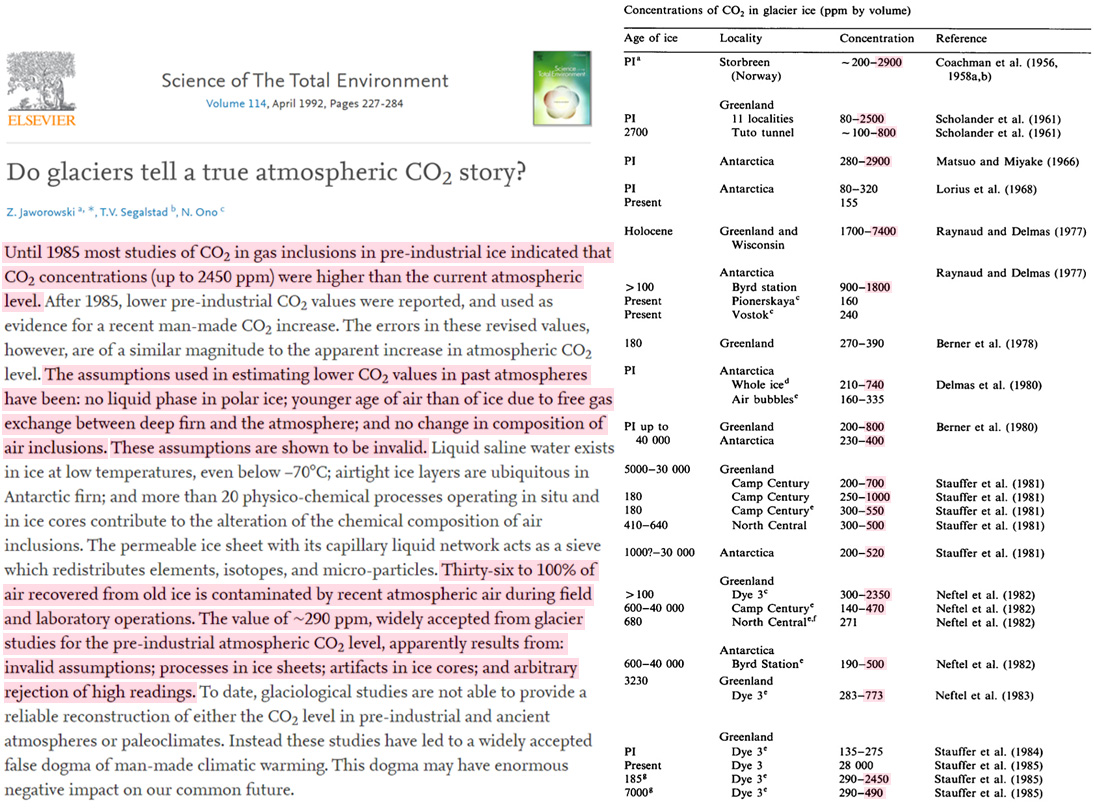
When assessing the historical atmospheric CO2 concentration, direct measurements of chemically analyzed air samples are at least 10 times more accurate than data derived from the commonly-accepted proxy records from ice cores (Harde, 2023).
The proxy data are subject to a great deal of selection bias, and thus the claim modern CO2 levels are uniquely due to human activity can seemingly be supported by using preferred data selection.
The late Dr. Ernst-Georg Beck spent years compiling an exhaustive chemical database of the CO2 levels measured in air samples from across the globe. Analyzing 979 technical papers reporting from 1,901 air sample measurement stations, Beck’s CO2 measurement data was published in a scientific paper entitled “Reconstruction of Atmospheric CO2Background Levels since 1826 from Direct Measurements near Ground” after his death in 2022.
The CO2 variability in the measured data profoundly deviate from the far-less-accurate proxy data derived from one single continent’s (Antarctica) ice samples. The 60,000 global-scale chemical measurements compiled between 1930 and 1950 using data from 25 authors and locations assessed that between 1939 and 1943 global atmospheric CO2 rose to 383 ppm – the same concentration again achieved in 2007. After the early 1940s, the chemical measurements indicate CO2 plummeted to 310 ppm by the late 1940s.
These fluctuations are consistent with variations in sea surface temperatures (warmer water releases more CO2, cooler less) and temperature-dependent soil respiration (with mixing ratios ranging between 500 and 20,000 ppm) processes, suggesting that temperature is the driver, and CO2 variations are the effect. This T→CO2 directionality found in measured CO2 air sample data from 19th to mid-20th century is also evident for the satellite era.
Furthermore, the analysis reveals that of the 90 ppm rise in CO2 since 1958 (the Mauna Loa era), not more than 12 ppm could be said to have derived from fossil fuel emissions. And when the CO2 rose to 383 ppm in the early 1940s, the impact from anthropogenic emissions “can be largely excluded.”


 John Stossel





You must be logged in to post a comment.