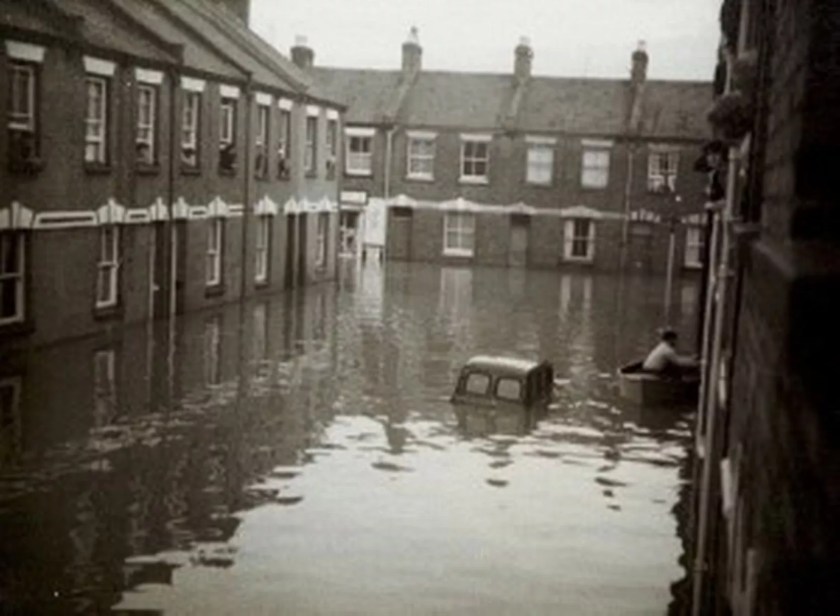
Do The Met Office Know What Extreme Weather Really Looksย Like?

From NOT A LOT OF PEOPLE KNOW THAT

By Paul Homewood

I have a prediction!

At the end of the year, the Met Officeโ€™s State of the Climate report will declare 2023 as a โ€œYear of Extremesโ€.

It will highlight September as a particularly extreme month, with a heatwave (which peaked at temperatures several degrees lower than in 1906 and 1911); a monthly temperature no higher than in September 2006; and Storm Agnes.

I doubt whether anybody with any experience would find anything extreme about the weather last month. On the contrary, they will all be able to recall genuinely extreme autumn weather in the past.

For example, let;s look back to the 1960s, courtesy of Weatherweb:

Autumn 1960:

East Devon FLOODS, after repetitive HEAVY RAINFALL. Using data up to 2013, this was the third WETTEST autumn in the EWP data-set, with only 1852 and 2000 significantly wetter. July and August were also WET, as was the previous winter (see above). The combination of events led to FLOODS reported from many parts of the country come the autumn.

This actually barely begins to tell the story of just how catastrophic the floods were that autumn, particularly in Devon, which were some of the worst of the 20thC.

Devon Live has a very good account:

https://www.devonlive.com/news/devon-news/remembering-1960-floods-devastated-thousands-3137954

September 1961

Residual elements of the Atlantic hurricane โ€˜Debbieโ€™ (presumably wrapped-up within a โ€˜standardโ€™ mid-latitude cyclone) led to severe gales affecting โ€˜Atlanticโ€™ Ireland, much of Scotland and the northern Isles. In the most intense phase on the 16th new records for strongest GUSTS occurred in Ireland, notably 93 knots at Shannon airport & 98 kn at Malin Head. Later in the day & early on the 17th, Lerwick Observatory (southern tip of Shetland) recorded a mean hourly WIND speed of 53 knots / 98 km/h, and a GUST of 77 knots / 142 km/hr, which at the time was the highest recorded since the Observatory opened in 1921. Severe dislocation of transport & electrical supplies in Ireland, with significant loss of woodland. Also, the deaths of at least 16 people. (GBWFF, HS/23)

Note the 93 kts (107 mph) recorded at Shannon Airport. Storm Agnes only got into the 30 mph range at low land sites.

November 1962

From the 8th, as winds came more from a continental (easterly) direction, TEMPERATURES fell steadily, then abruptly on the 11th as Russian/arctic air spread west. The following weekend (16th/17th) was one of the STORMIEST/MOST SNOWY on record for November. GALES were widespread, GUSTS of 75 knots being recorded on the Isles of Scilly on both the 16th and 17th, and SLEET/SNOW fell practically everywhere. Level SNOW was 7 inches (circa 17cm) deep in parts of Scotland, with DRIFTS of 3 feet (circa 1 metre), and roads were BLOCKED, traffic dislocated as far south as Devon, Cornwall & Somerset. COLD, northerly winds persisted for several days, with widespread FROST.

November 1965

Three (out of 8) cooling towers at the Ferrybridge power station near Doncaster (South Yorkshire) collapsed in very strong winds, and the five remaining towers were all damaged significantly. The nearest anemometer recording (about 12km / 7.5 miles away) produced a highest (60-minute) mean wind speed of around 40 kt / 45mph, and gusts were thought to be of the order 74 kt / 85 mph at the base of the towers. These values are not of themselves excessive either generally, or for the particular location, and the problem was not so much the wind strength, but that air was forced between one group of badly-sited towers in an enhanced way to the second (leeward of the first group), causing the collapse. Pre-construction tests (using a wind tunnel) had only considered an isolated tower, not the grouping planned; neither had gusts and local eddying (particularly possible lee-wave enhancement) been allowed for. It is now considered that the gust values at the tops of the towers were some 90 kt / just over 100mph.

While the winds were not exceptional we can  note that sustained wind speeds were recorded locally at 45 mph. more than double lowland measurements for Agnes.

October 1966

After weeks of persistent and often heavy rain, a spoil tip behind the village school in Aberfan, south Wales collapsed, burying the school under a torrent of slurry with the deaths of 144 people, 116 of the dead were school-children. After the โ€˜East Coastโ€™ floods of 1953 (q.v.), this is now regarded as the second-worst natural disaster to affect the UK (in terms of deaths) since the Second World War.

September 1968

Prolonged HEAVY RAIN (enhanced by some long-lived THUNDERSTORMS forming in the vicinity of an occlusion across SE England, which in turn was associated with a slow-moving depression over northern France) on the 14th, 15th and 16th in 1968 caused WIDESPREAD & SEVERE FLOODING in the south east of England with 215mm falling at Northchapel (West Sussex) within 24 hours and 57mm in 42 minutes at Purleigh (Surrey). East Molesey in SW London .. near Hampton Court Palace was particularly badly affected. More generally, much of Essex, Surrey, Kent, and London recorded 150mm (locally 200mm) over these 2 to 3 days. Tilbury, Essex recorded 201 mm in two days โ€“ more than one-third of the normal annual fall. From mid-afternoon on the 15th, FLOODING over streams and rivers built up rapidly in Surrey, causing disruption to traffic and damage to property. One person was KILLED (a man died of a heart attack as he was swept away by flood-water). The widespread FLOODING took many days to subside โ€“ the impact was primarily due to the rapid/long-lasting nature of the intense RAINFALL (convective cells) โ€“ but was perhaps most unusual in that it affected such a large area of SE England. Newspapers of the time in Kent (e.g. โ€˜Kent Messengerโ€™) stated that it was “the worst FLOODING since 1814”.  The considerable / widespread FLOODING took many days to subside.

The late Philip Eden described them as โ€œthe most severe inland flood to hit the Home Counties in the last 100 yearsโ€

October 1969

And yes, there were even heatwaves!

One of the five DRIEST Octobers (17 mm) over England & Wales in the entire EWP series, and the 2nd DRIEST (after 1978) in the 20th century. Also, the equal 3rd WARMEST (equal with 2006, behind 2001 & 2005) October in the entire CET record.

Nothing To Sea Here Folks

CDN

In this “Fact Check” video from the Climate Discussion Nexus, Dr. John Robson expands on our Sea Level Check series to rebut claims of dangerous, accelerating, man-made sea level rise by examining the actual history and current state of melting land ice, changes in the land and other complex factors that contribute to this non-crisis.

Biden Treasury Dept Report claims โ€˜climate changeโ€™ could impose โ€˜substantial financial costsโ€™ on U.S. household finances โ€“ But it is Bidenโ€™s climate POLICIES that are already imposing substantial costs

From ClimateDepot.com

CNBC: Climate change is expected to impose โ€œsubstantial financial costsโ€ on U.S. households in the coming years, according to a new report by the U.S. Department of the Treasury. … 
Flooding and wildfires can damage businesses, forcing employers to furlough or lay off staff, the Treasury Department found. …

Recurring hazards such as wildfires or heat waves could reduce the available jobs in certain sectors, leading to long periods of unemployment for people. … 

The financial threat is secondary to a more existential risk given the dire climate conditions anticipated. … 

Climate change-caused disruptions to supply chains could lead to soaring prices on certain products, the Treasury Department finds. … 

Droughts, floods and extreme temperatures will likely create food shortages and make prices at the supermarket increase. …

Households may see their energy bills rise too as climate change worsens.

#

Climate Depot’s Morano: “The Treasury Dept report is complete nonsense. The report claims that ‘climate change’ will have ‘substantial financial costs,’ create unemployment, food shortages, inflation, and make energy bills rise. The Treasury report has it completely backward: it is the Biden administration’s climate & energy policies that are already having ‘substantial financial costs,’ creating unemployment, food shortages, inflation, and making energy bills rise.”

Scientific Reality Check: 2023: Definitive Guide to Extreme Weather: No trends or declining trends in hurricanes, floods, tornadoes, droughts, heat waves, disaster losses, wildfires โ€“ All peer-reviewed & official sources โ€“ By Dr. Roger Pielke Jr.

2021: โ€˜A lie is bornโ€™: Extreme weather expert Dr. Roger Pielke Jr. rips mediaโ€™s false claim that โ€˜1 in 3 Americans experienced a weather disaster this summerโ€™ โ€“ Pielke slams โ€˜spectacularโ€ฆquality control problems in climate journalismโ€™

Byย Marc Morano

https://www.cnbc.com/2023/10/02/climate-change-could-devastate-household-finances-us-treasury-warns.html

By Annie Nova โ€“ CNBC

  • Climate change is expected to impose โ€œsubstantial financial costsโ€ on U.S. households in the coming years.
  • In a new Treasury Department report, government officials warn of rising prices and disruptions to income due to climate disasters and the warming planet.

Climate change is expected to impose โ€œsubstantial financial costsโ€ on U.S. households in the coming years, according to a new report by the U.S. Department of the Treasury.

Between 2018 and 2022, weather and climate disasters cost more than $617 billion, it found โ€” a record. Within the last year, 13% of Americans reported economic hardship due to severe weather events and disasters.

โ€œSevere flooding, wildfires and extreme heat are imposing significant financial burdens on households across the country,โ€ Graham Steele, assistant secretary for financial institutions at the Treasury Department, said in a statement.

The government report flags the biggest financial risks from a warming planet. Here are some of them.

Pay and benefit disruptions

Flooding and wildfires can damage businesses, forcing employers to furlough or lay off staff, the Treasury Department found. This could lead workers to lose their pay for a period, and potentially their workplace benefits, including health insurance or retirement plan support.

Recurring hazards such as wildfires or heat waves could reduce the available jobs in certain sectors, leading to long periods of unemployment for people. Workers in the fields of agriculture, construction, manufacturing and tourism may be especially hard hit.

Meanwhile, โ€œoutdoor workers,โ€ as the report describes those who spend more than two-thirds of their workday outside, comprise about a fifth of the civilian workforce and are among the most likely to see their hours and pay disrupted.

At times in the Treasuryโ€™s report, the financial threat is secondary to a more existential risk given the dire climate conditions anticipated.

For example, it warns that prolonged exposure to extreme heat may impair workersโ€™ physical and cognitive abilities, โ€œwhich can lower their overall productivity and, consequently, result in a decline in their earnings.โ€

Property destruction

Climate disasters impacted 1 in 10 houses in the U.S. in 2021, and led to damages exceeding $56 billion, according to one recent study by CoreLogic, a global property information firm.

Families unable to quickly pay for repairs in the wake of climate disasters may see their property values decline or vanish, the Treasury Department says. It points out that Hurricane Katrina damaged about 70% of all Louisiana properties. Nearly a fifth of those properties remained unrepaired five years later, and 8% were uninhabitable.

Many families could have to relocate due to climate change, incurring relocation expenses.

Higher prices for consumer products, energy

Climate change-caused disruptions to supply chains could lead to soaring prices on certain products, the Treasury Department finds.

Droughts, floods and extreme temperatures will likely create food shortages and make prices at the supermarket increase. Transportation of food and goods may also be hit by climate events, leading to more delays and shortages on store shelves.

โ€œWhen climate hazards increase food prices, this may cause additional households to experience food insecurity,โ€ the report says. โ€œFood insecurity disproportionately impacts lower-income households, families led by single mothers, families with children, and households in Southern states.โ€

Households may see their energy bills rise too as climate change worsens. Heat waves, for example, will lead many families to use their air conditioners more frequently. Climate events can also lead to increased medical expenses. The Treasury report notes that in one analysis from 2012, 10 climate events led to a total of $10 billion in health-related costs.

Andrew Rumbach, a senior fellow at the Urban Institute, said he was glad to see the government focusing on climate changeโ€™s financial impacts on households. Usually that discussion is centered on societal expenses, he said.

But, โ€œat the end of the day, it is individuals and families that will carry a lot of these costs,โ€ he added.

#

CNBC: Climate change is expected to impose โ€œsubstantial financial costsโ€ on U.S. households in the coming years, according to a new report by the U.S. Department of the Treasury. โ€ฆ 

Flooding and wildfires can damage businesses, forcing employers to furlough or lay off staff, the Treasury Department found. โ€ฆ

Recurring hazards such as wildfires or heat waves could reduce the available jobs in certain sectors, leading to long periods of unemployment for people. โ€ฆ 

The financial threat is secondary to a more existential risk given the dire climate conditions anticipated. โ€ฆ 

Climate change-caused disruptions to supply chains could lead to soaring prices on certain products, the Treasury Department finds. โ€ฆ 

Droughts, floods and extreme temperatures will likely create food shortages and make prices at the supermarket increase. โ€ฆ

Households may see their energy bills rise too as climate change worsens.

#

Climate Depotโ€™s Morano: โ€œThe Treasury Dept report is complete nonsense. The report claims that โ€˜climate changeโ€™ will have โ€˜substantial financial costs,โ€™ create unemployment, food shortages, inflation, and make energy bills rise. The Treasury report has it completely backward: it is the Biden administrationโ€™s climate & energy policies that are already having โ€˜substantial financial costs,โ€™ create unemployment, food shortages, inflation, and make energy bills rise.โ€

Scientific Reality Check: 2023: Definitive Guide to Extreme Weather: No trends or declining trends in hurricanes, floods, tornadoes, droughts, heat waves, disaster losses, wildfires โ€“ All peer-reviewed & official sources โ€“ By Dr. Roger Pielke Jr.

2021: โ€˜A lie is bornโ€™: Extreme weather expert Dr. Roger Pielke Jr. rips mediaโ€™s false claim that โ€˜1 in 3 Americans experienced a weather disaster this summerโ€™ โ€“ Pielke slams โ€˜spectacularโ€ฆquality control problems in climate journalismโ€™

Batteries Will Not Solve Renewable Energy Storage Problem, Says Royal Society

Tesla Megapack battery in Victoria catches fire while testing

From The Daily Sceptic

BYย CHRIS MORRISON

The penny is finally starting to drop. Current batteries cannot possibly store more than a fraction of the energy needed to keep the lights on when the wind stops blowing and the sun doesnโ€™t shine. The learned U.K. Royal Society has recently analysed 37 years of wind patterns across Britain and concluded there is a serious underestimate of the amount of storage required. Around 50 academics and specialists led by Professor Sir Chris Llewellyn Smith of Oxford University state clearly that batteries are not the answer to the vast storage required. But like many learned people, wedded to the idea that it is possible to remove the fossil fuel source supplying 80% of the world needs in less than 30 years, they fall down at the practical level. Having lost batteries, the study goes for hydrogen, an idea only slightly less dumb than digging up the planet to produce vast quantities of limited-life batteries.

The Royal Society report envisages dissolving huge salt caverns capable of storing โ€˜greenโ€™ hydrogen. To keep the electricity grid functioning when renewables go off line, around two to three million tons of hydrogen would need to be stored for decades at a time. Wind not only stops for days during periods of intense cold in winter, but the Royal Society found recent periods when speeds were low for a number of years. Salt caverns are only available in a limited number of places in Britain, so a huge network of specialist pipelines would be needed to move the gas to turbines on constant standby. Over a period of time, hydrogen would leak from porous salt caverns.

The report, lacking a practical answer to wind and solar intermittency, seems to have been ignored by mainstream media. The news that batteries cannot play any significant part in the collectivist Net Zero project is unwelcome to those who have been betting the ranch on this solution for many years. Francis Menton of the Manhattan Contrarian sees the report as an โ€œenormous improvementโ€ on every other effort on the subject of large scale energy storage systems. But in the end, the authorsโ€™ โ€œquasi-religious commitmentโ€ to a fossil-free future leads them to minimise and divert attention away from critical cost and feasibility issues. โ€œAs a result, the report, despite containing much valuable information, is actually useless for any public policy purpose,โ€ he concludes.

What are the problems with hydrogen? Where to start. It is a highly explosive and flammable gas that needs careful handing. Its molecules are small and it has a low density. This means it escapes easily, while three times the volume of hydrogen is required to produce the same energy as natural gas. Kathryn Porter is an energy consultant and an associate member  of the All-Party Parliamentary Group. She recently wrote an article in the Daily Telegraph about the gas and its possible role in Net Zero.

Hydrogen is also hard to move around. To get the gas to move through pipes, it has to be compressed and pushed along using compressors. This process requires energy: the losses in moving hydrogen through pipes are ten times greater for hydrogen than for methane; up to 30%. In other words you need to use up almost a third of your gas just moving it from A to B. โ€ฆ

The infrastructure for hydrogen does not exist, neither for the most part do the production facilities and they will cost billions to build. Then the underlying cost of storing hydrogen is probably at least four times that of storing methane. Huge amounts of energy are lost in each stage of the process due to the fundamental properties of hydrogen.

As a solution to storing renewable power, Porter is of the view that โ€œhydrogen is one of the worst substances you could choose for this purposeโ€. But, she adds, because you can burn it in air without creating carbon dioxide, โ€œit has been hailed as the answer to Net Zero dreamsโ€. Both carbon capture and hydrogen are โ€œsquare pegsโ€ which people are desperately trying to force into round holes. It might be noted, in the light of this last comment from Porter, that the Royal Society traces its roots back to 1660, and published Sir Isaac Newtonโ€™s Principia Mathematica. Its politicised track record on Net Zero has yet to live up to the highlights of its glorious past.

Lead author Sir Chris Llewellyn Smith notes that the need for long-term energy storage in a renewable electricity system has been seriously underestimated, and work on constructing storage caverns needs to be started immediately if the Government is to have any chance of meeting its Net Zero targets. Construction of a large green hydrogen production and storage facility would appear to be a โ€œno-regretsโ€ option, he claims.

Someone regretting the option might be the consumer. Francis Menton observes that the Royal Societyโ€™s hydrogen plans suggest a cost โ€œto the gridโ€ of around ยฃ120 per MWh, a figure described as high but not stratospheric. But this is the wholesale cost, not the one charged to the consumer. In addition, Menton wants to know how much a nationwide set of new pipes will cost, plus the entire new fleet of standby turbines capable of burning 100% hydrogen and providing all the power to the grid when renewables stop working. In addition, Menton notes a โ€œlowโ€ rate of interest for capital costs of 5%.

โ€œThe whole thing just cries out for a demonstration project to prove feasibility and cost. Iโ€™m betting that will never occur before the whole Net Zero thing falls apart from the disastrous skyrocketing electricity prices,โ€ concludes Menton.

Menton sees some honesty in the Royal Society report. But as regular readers will probably agree, the top award for an honest Net Zero commentary goes to the U.K. Government-funded U.K. FIRES project. In looking at a 2050 Net Zero world, this group of academics ignore as speculative all non-scalable suggestions around carbon capture and hydrogen, along with all the green inventions yet to be made. They point to a future with barely a quarter of our current energy supply. There is nothing more honest than telling people that this will entail no flying or shipping, drastic cuts in home heating, limited transport, no meat, few modern building materials and houses made of โ€œimpactedโ€ earth. Worryingly, though, thereโ€™s no indication the authors see this as a reason not to go full steam ahead.

Chris Morrison is the Daily Scepticโ€™s Environment Editor.

Foisting green levies onto gas bills will cause public health crisis, Sunak warned

Green blob

From Net Zero Watch

Green Conservative minister is undermining Sunakโ€™s attempts to come clean with the public over Net Zero

Campaign group Net Zero Watch has condemned Government plans to move renewables levies onto gas users. Speaking at the Conservative Party conference in Manchester, energy minister Lord Callanan announceda consultation on what he euphemistically called โ€˜rebalancingโ€™, forcing gas users to pay part of the cost of the UKโ€™s grossly inefficient renewables. The Government hopes that this will make heat pumps and other electric technologies more viable.

Net Zero Watch director Andrew Montford said:

Trying to force up gas bills at a time when people are already struggling to heat their homes is shameful. It will cause a public health crisis. Callanan is utterly callous, but climate extremists only care about their targets, and not whether Granny is going to freeze to death in winterโ€.

Mr Montford says that it is not clear that moving the levies, running at around ยฃ7 billion per year, will be enough to make heat pumps viable, and secondly because if it is, it can only temporarily hide the costs: if gas boilers become a thing of the past, the cost of the levies will have to return to electricity users. Net Zero Watch energy director Dr John Constable said:

Using heat pumps in a wind and solar powered grid is going to be expensive; putting a surcharge on gas to deny people a cheaper and reasonably clean alternative is cruel.โ€

And Mr Montford warned:

Rishi Sunak has said that successive Governments have deceived people over the cost of Net Zero, but here is the Green Blob in his own party โ€“ one of his own ministers no less โ€“ launching a shameless confidence trick on the public at large. How can the Prime Minister let them get away with it?โ€

Notes for editors

  • The plan has been on the agenda since Boris Johnsonโ€™s time in Number 10. Net Zero Watch warned of the impact of moving green levies to gas bills at the time.
  • Deaths from cold in winter far outnumber deaths from heat in summer, and fuel poverty is a significant contributory factor. Moving green levies to gas bills will therefore exacerbate a problem that is already serious.

To study atmosphere, NASA rockets will fly into October eclipse’s shadow

From Phys.org

By Miles Hatfield,ย NASA

This map details the path the Moonโ€™s shadow will take as it crosses the contiguous U.S. during theย annular solar eclipse on Oct. 14, 2023, andย total solar eclipse on April 8, 2024. Credit: NASA/Scientific Visualization Studio/Michala Garrison; eclipse calculations by Ernie Wright

A NASA sounding rocket mission will launch three rockets during the 2023 annular eclipse in October to study how the sudden drop in sunlight affects our upper atmosphere.

On Oct. 14, 2023, viewers of an annularย solarย eclipse in the Americas will experience the sun dimming to 10% its normal brightness, leaving only a bright “ring of fire” of sunlight as the moon eclipses the sun. Those in the vicinity of the White Sands Missile Range in New Mexico, however, might also notice sudden bright streaks across the sky: trails of scientific rockets, hurtling toward the eclipse’s shadow.

A NASA sounding rocket mission will launch three rockets to study how the sudden drop in sunlight affects our upper atmosphere. The mission, known as Atmospheric Perturbations around the Eclipse Path or APEP, is led by Aroh Barjatya, a professor of engineering physics at Embry-Riddle Aeronautical University in Daytona Beach, Florida, where he directs the Space and Atmospheric Instrumentation Lab.

Some 50 miles up and beyond, the air itself becomes electric. Scientists call this atmospheric layer the ionosphere because it is where the UV component of sunlight can pry electrons away from atoms to form a sea of high-flying ions and electrons. The sun’s constant energy keeps these mutually attracted particles separated throughout the day. But as the sun dips below the horizon, many recombine into neutral atoms for the night, only to part ways again at sunrise.

During a solar eclipse, the sunlight vanishes and reappears over a small part of the landscape almost at once. In a flash, ionospheric temperature and density drop, then rise again, sending waves rippling through the ionosphere.

“If you think of the ionosphere as a pond with some gentle ripples on it, the eclipse is like a motorboat that suddenly rips through the water,” Barjatya said. “It creates a wake immediately underneath and behind it, and then the water level momentarily goes up as it rushes back in.”

During theย 2017 total solar eclipseย visible across North America, instruments many hundreds of miles outside the eclipse’s path detected atmospheric changes. So did critical infrastructure like GPS andย communications satellitesย that we rely on every day.

“All satellite communications go through the ionosphere before they reach Earth,” Barjatya said. “As we become more dependent on space-based assets, we need to understand and model all perturbations in the ionosphere.”

To this end, Barjatya designed the APEP mission, choosing the acronym because it is also the name of the serpent deity from ancient Egyptian mythology, nemesis of the sun deity Ra. It was said that Apep pursued Ra and every so often nearly consumed him, resulting in an eclipse.

The APEP team plans to launch three rockets in successionโ€”one about 35 minutes before local peak eclipse, one during peak eclipse, and one 35 minutes after. They will fly just outside the path of annularity, where the moon passes directly in front of the sun. Each rocket will deploy four small scientific instruments that will measure changes in electric and magnetic fields, density, and temperature. If they are successful, these will be the first simultaneous measurements taken from multiple locations in the ionosphere during a solar eclipse.

Barjatya chose sounding rockets to answer the team’s science questions because they can pinpoint and measure specific regions of space with high fidelity. They can also measure changes that happen at different altitudes as the suborbital rocket ascends and falls back to Earth. The APEP rockets will take measurements between 45 and 200 miles (70 to 325 kilometers) above the ground along their trajectory.

“Rockets are the best way to look at the vertical dimension at the smallest possible spatial scales,” said Barjatya. “They can wait to launch at just the right moment and explore the lower altitudes where satellites can’t fly.”

While the in-situ rocket instruments are all being built by Embry-Riddle and Dartmouth College in New Hampshire, a host of ground-based observations will also support the mission. Co-investigators from the Air Force Research Laboratory at Kirtland Air Force Base in Albuquerque, New Mexico, will collect ionospheric density and neutral wind measurements.

Co-investigators from the Massachusetts Institute of Technology’s Haystack Observatory in Westford, Massachusetts, will run their radar to measure ionospheric perturbations farther away from the eclipse path. Finally, a team of students from Embry-Riddle will deploy high-altitude balloons (reaching 100,000 feet) every 20 minutes to measure weather changes as the eclipse passes by. All of these measurements will aid ionosphere modeling efforts led by scientists at the University of Colorado Boulder and Embry-Riddle.

This won’t be the only APEP launch. The APEP rockets launched in New Mexico will be recovered and then relaunched from NASA’s Wallops Flight Facility in Virginia, on April 8, 2024, when a total solar eclipse will cross the U.S. from Texas to Maine. The April launches are farther from the eclipse path than for the October annular eclipse, but will present an opportunity to measure just how widespread the effects of an eclipse are.

After these two eclipses, the next total solar eclipse over the contiguous U.S. is not until 2044, and the next annular eclipse is not until 2046. “We have to make hay while the sun shines โ€ฆ or, I suppose for eclipse science, while it doesn’t,” Barjatya joked. “In all seriousness though, this data set will reveal the widespread effects that eclipses have on the ionosphere at the smallest spatial scales.”

Provided by NASA 


Explore further

The impact of solar eclipses on the structure and dynamics of Earth’s upper atmosphere

‘Climate Rage’ protest: Far-left activists address car culture and more in Montreal

Rebel News

Far-left activists participated in destructive actions, targeting cars and SUVs on the streets of Montreal during the ‘Climate Rage’ protest.

The Climate Rage Week included an event on the night of September 28, known as the ‘Crush Car Culture’ protest.

This protest, led by far-left activists, was prominently featured on theirย Facebook event page, where they emphasized the government’s investments in roads at the expense of public transport.

Throughout the protest, multiple cars were vandalized, with windshields smashed, tires deflated, and paint used. Some SUV owners received fake “infraction” notices accusing them of emitting excessive CO2 and endangering human, animal, and plant life.

http://RebelFieldReports.com | Far-left activists participated in destructive actions, targeting cars and SUVs on the streets of Montreal during the ‘Climate Rage’ protest.

Grand Enviro-Scandal: Wind Industry Delivers (Dead) Whale Watching Tourismย Bonanza

From STOP THESE THINGS

Thanks to the offshore wind industry, itโ€™s never been easier to get up close and personal with rare and endangered whales. Never before has the general public been able to walk along the shoreline and find their favourite beach routinely littered with a steady stream of cetacean carcasses. Call it โ€˜eco-tourismโ€™, with a twist.

Some might cringe at the carnage, but the wind industry hasnโ€™t a care in the world โ€“ long before they began spearing these things into the ocean, they sought and were granted government-backed licenses to (quite lawfully) kill an unlimited number of whales, porpoises and dolphins โ€“ aka the โ€˜Incidental Harassment Authorizationโ€™.

Under the witless Chris Bowen, Australiaโ€™s wind and solar obsessed Federal government is hell-bent on plugging thousands of these monstrosities off Australiaโ€™s coasts, notwithstanding the wholesale whale slaughter playing out along Americaโ€™s Atlantic coast.

With that in mind, itโ€™s timely to tap into the work of Michael Shellenberger, who has recently produced a half-hour documentary, Thrown To The Wind โ€“ that exposes the corrupt relationship between government and the wind industry โ€“ desperately designed to cover up the true cause of one the greatest environmental scandals, of all time.

Weโ€™ll start first with Shellenbergerโ€™s interview on Sky News, and leave you with the video of Thrown To The Wind.

Government offshore renewable projects at risk of killing marine life
Sky News
Outsiders
24 September 2023

Environmental policy expert Michael Shellenberger says offshore renewable projects are โ€œvery environmentally degrading technologyโ€ that is affecting marine life.

โ€œWindmills are very old, these are hundreds of years old technologies; the wind itself has low energy density meaning you have to spread wind turbines over huge areas, that; โ€˜s why they keep building them so big,โ€ Mr Shellenberger told Sky News host Rowan Dean.

โ€œThe preparation, the mapping of the ocean floor with sonar is so loud itโ€™s actually in violation of the regulations by the US government the separations the mothers from their calfโ€™s, it sent the whales into boat traffic.

โ€œThese impacts can be seen around the world; the east coast is very sensitive because itโ€™s actually a very shallow waters on the offshore.

โ€œI think you can expect to see very significant impacts in Australia and everywhere in the world, I think people donโ€™t realise that the oceans are full of life and I think we sometimes miss the fact that itโ€™s a really biodiverse important part of our planetary ecosystem.โ€

Transcript

Rohan Dean: The Albanese governmentโ€™s green dream is in strife. Things are not going to plan. Residents near the proposed five gigawatt Hunter offshore wind farm zone are furious. Not only is it outrageously expensive, but it will kill our whales. Our next guest has delved deeply into this sad phenomenon in his documentary, Thrown to the Wind. Take a look.

Thrown to the wind:
โ€œI saw another whale had washed up and itโ€™s becoming a pattern.โ€
โ€œIt sounds like someone pile driving!โ€
โ€œWhat the United States is looking at is thousands of wind turbines in an area that our whales, our dolphins, our marine lifeโ€ฆโ€
โ€œSo those red dots are whale deaths?โ€
โ€œPrecisely.โ€
โ€œWhat a scandal.โ€

Rohan Dean: Joining us now is the producer of that video, a great friend of Outsiders, Michael Shellenberger, author, journalist, and founder of the group, Environmental Progress. Michael, itโ€™s always great to see you. Thanks for coming on Outsiders. The documentary about killing whales, it has landed at the right point in time here in Australia. We are embarking on a massive offshore wind program across some of our most beautiful Australian ocean sides. What do you make of it?

Michael Shellenberger: Well, itโ€™s good to be with you, Rohan. And yeah, I mean, itโ€™s a very environmentally degrading technology because you have to remember, windmills are very old. These are hundreds of years old technologies. The wind itself has low energy density, meaning you have to spread wind turbines over huge areas. Thatโ€™s why they keep building them so big, as tall as the Eiffel Tower. What we have documented is just simply the preparation, the mapping of the ocean floor with sonar is so loud. Itโ€™s actually in violation of the regulations by the US government that separates the mothers from their calves. It sends the whales into boat traffic and also the wind industry is expanding boat traffic into areas where there wasnโ€™t traffic. Thatโ€™s whatโ€™s behind the deaths of these whales off the East Coast of the United States. Also, dolphins, all cetaceans. And these impacts can be seen around the world.

The East Coast is very sensitive because itโ€™s actually very shallow waters on the offshore and thereโ€™s only 340 of these magnificent whales left. Itโ€™s the North Atlantic right whales. But I think you can expect to see very significant impacts in Australia and everywhere in the world. I think people donโ€™t realise that the oceans are full of life, and I think we sometimes miss the fact that itโ€™s a really biodiverse important part of our planetary ecosystem, and I think thereโ€™s also just a lot of mythology. I think people think that because itโ€™s wind, itโ€™s somehow more natural or better for the environment, but what the science shows is something very different. Massive ecological impacts from industrial wind turbines. And as I pointed out last week, weโ€™re now seeing the impacts of wind turbines on pumas in Brazil, critically endangered, but also on eagles, other raptor species, including raptors in Australia, and bat species. These are huge, loud degrading devices, and so I would just say you really have to make sure because weโ€™ve discovered that the government hasnโ€™t done the research that it claimed it was doing in order to monitor and protect the whales.

Rohan Dean: James.

James Morrow: And Michael, you go further than that, and this is a great concern in Australia because we also have right whales that migrate up and down the East Coast every year. You can watch them from the cliffs at Bondi. You can see them go up the coast. You say that the government knew about these effects and has covered this up. Tell us about that and what does that tell us that we should be watching out for when the government here in Australia says, โ€œThis is clean, this is green, this has no impact. This is what we need. If weโ€™re going to march on to net zero, whales be damned.โ€

Michael Shellenberger: Well, I think the first thing you have to remember is that environmental conservation organisations have been pointing out the impacts of sonar on whales for many decades. This is a very well-studied phenomenon. Two years ago, the big conservation organisations wrote an open letter warning of this particular project on this whale species. Last year, a top government scientists wrote a very unusual letter warning of extinction on the species. We have now sent multiple letters to the government pointing out that the applications for the permits to engage in this industrial activity themselves show that theyโ€™re in violation of the law. So itโ€™s big money, huge taxpayer subsidies. Somewhere on the order of one third to two thirds of the cost of wind energy is subsidised by rate payers. The industry then funnels that money to the politicians who then put pressure on the regulators to not enforce these environmental laws.

They have this cover, this story that says that this is good for the environment. Itโ€™s bad for the environment. This is greenwashing like Iโ€™ve never seen before. Iโ€™ve said it before, Iโ€™ll say it again. This is the biggest environmental scandal Iโ€™ve ever seen or been involved with, and Iโ€™ve been involved in environmental causes for over 30 years. This is a critically endangered species that could go extinct because of this project, but I think that people in Australia also need to look closely at the documents. People can be in touch with me, by the way. Weโ€™ve now gotten pretty good at the science and also at helping to work with the independent scientists, so many of whom have been sold out and the conservation groups have sold out.

We also documented industry funding for news organisations, aquarium, Woods Hole. I mean, itโ€™s shocking how much money is being spent basically to repress the best available science showing the imminent threat to these magnificent animals, spiritual animals, I should say. Thereโ€™s a reason we care about whales, the songs, the love of the mothers for their calves, the ways in which theyโ€™re a communal species. All of the reasons that weโ€™ve loved and protected whales for decades stand today. Itโ€™s more desperate than ever, particularly for the right whales.

Rohan Dean: And Michael, Iโ€™ll just point out to viewers, you were of course Time Magazineโ€™s, Young Environmentalist of the Year several years ago, so you know exactly what youโ€™re talking about when you talk about caring for the environment. Liz.

Liz Storer: Well, I was going to ask Michael, how you account for the fact that the government is blindly forging ahead despite all the research done by yourselves and others in this space, and how do you account for that? Youโ€™ve kind of already answered that by saying follow the money. Do you ascribe to the idea that thatโ€™s really all there is behind the veil of this green dream zero emissions. And what do you make, would you agree with Dr. Jordan Petersonโ€™s assessment that this is an extremely anti-human species agenda that weโ€™re seeing rollout?

Michael Shellenberger: Yeah, absolutely. I think the thing you have to remember is that the reason that wind energy is so expensive is the same reason itโ€™s so bad for the environment, which is that itโ€™s just really inefficient. Wind is very energy dilute. You have to spread the collection of energy over huge amounts of areas. You have to build these machines to be very tall, to have huge environmental impacts. At bottom, it is a kind of mania like a religion, climatism, which says that climate change is the only environmental problem. It is an environmental problem. Itโ€™s not the biggest environmental problem and what is more tragic than actually killing an entire species of whale out of, because people are in the grip of this religion. We have shut down more nuclear energy on the East Coast of the United States, closed more nuclear plants that produced more energy than all of the wind turbines will produce if they got them up and running.

So the big hope here is that the finances of these projects are absolutely awful. Even with one to two third subsidy, the wind industry is asking for more money for rate payers. So weโ€™re at just high corruption at this point. I mean, itโ€™s just a money grab by greedy politicians, by frankly greedy journalists, scientists, conservation groups. Many of them have really sold out. Itโ€™s been a small group of us that are independent scientists, researchers, advocates, and others that have been fighting this. But I think that Australians also have a really important role to play here. The projects that proposing Australia would be absolutely devastating. Weโ€™re here to be in solidarity. If folks in Australia want to reach out, michaelshellenberger@gmail.com, happy to give our assistance because this industry is an absolute nightmare for marine life, marine mammals, and for whales in particular. Thereโ€™s a reason we care so much about these particular animals.

Rohan Dean: Michael Shellenberger, well said, you will be inundated. Iโ€™ll repeat that, michaelshellenberger@gmail.com. We know what a great job Michael has done on so many fronts. Weโ€™ll talk to you again soon in a couple of months because the nuclear debate is heating up here. Michael, you were out here in Australia talking to Australians about the need for nuclear to get to net zero. The liberal party is finallyโ€ฆ looks like adopting that as their major policy going to the next election. So weโ€™ll be chatting a lot more about that, but thatโ€™s yet another example, Michael, of the great work you have done for us here in Australia. Get ready for those emails on the whales. Thanks, Michael.
Sky News

Hereโ€™s Michaelโ€™s documentary on the offshore wind industryโ€™s utterly pointless and unnecessary marine mammal slaughter.

Thrown to the Wind
YouTube
Public News Video
14 September 2023

YouTube

ERCOT Readies โ€˜Retiredโ€™ Gas Generation for the 2023/24 Winter Peak

texas-blackout

From ย Master Resource

By Ed Ireland

โ€œMuch of the generation named by ERCOT as qualified under their latest RFP is generation units that were recently retired, many because they could not compete with the artificially low prices that heavily subsidized wind and solar can offer, so they are still operational.โ€

The Electric Reliability Council of Texas (ERCOT), the planning agency for 90% of the stateโ€™s grid, has a wind/solar tiger by the tail. As the agency does not exchange power with its out-of-state neighbors to avoid federal (FERC) jurisdiction, it is looking at home for able, firm generation that wind and solar unfairly (via government intervention) put out of operation.

Background

ERCOT is (in)famous because its grid almost collapsed during Winter Storm Uri in February 2021. The Texas electricity grid had lost so many generators due to the storm that it was only 4 minutes and 37 seconds from collapsing, which would have required a restart from a โ€œblack start.โ€ That would have left the Lone Star State without electricity for eight days or longer. ERCOT instituted emergency measures, including rolling blackouts, that saved the grid and its integrity.

As it was, hundreds of cold-related deaths and ruined lives and property otherwise represented the worst electricity (and energy) debacle in American history. Tens of billions of dollars of disputed power payments are working their way through the courts.

The state of Texas and ERCOT never want to be in that situation again.

The summer of 2023 pushed the ERCOT grid close to rolling blackouts on many evenings around 8 PM in July and August as the sun set and the wind stopped blowing, resulting in no solar power and little or no wind power. These situations occurred on many evenings during July, August, and Septemberโ€”with September 6, 2023, pushing the grid to a Level 2 emergency, which gave ERCOT additional resources to stabilize the grid.

Winter Preparations

To avoid more emergencies, ERCOT issued a Request for Proposal (RFP) to secure backup generation for the 2023-2024 winter. The RFP for โ€œFirm Fuel Supply Serviceโ€ would be for on-demand power generation from November 15, 2023, to March 15, 2024 with a due date of September 1.

ERCOT received proposals from five Qualified Scheduling Entities. QSEs are pre-qualified power wholesalers who buy and sell electricity on the wholesale market and act as intermediaries between individual independent generators.

The five QSEs that responded offered 32 different generating stations that could provide guaranteed backup power whenever ERCOT calls for it:

  • All 32 Generation Resources were entirely natural gas-fired power generation facilities and were awarded $9,000/MW (the cap established by the Public Utility Commission of Texas).
  • 31 of the 32 Generation Resources will be backed up by fuel if natural gas is not available.
  • One โ€œGeneration Resourceโ€ offered natural gas storage to guarantee their ability to maintain their natural gas supply
  • A total of 3,319 MW of FFSR was procured with a projected total cost of procurement of $29.9 million.

By comparison, the first Firm Fuel Supply Service ERCOT obtained (November 15, 2022, through March 15, 2023) was 43% for 13% less capacity.

Since the off-peak daily clearing prices for natural gas generation averages $20 per MW, $9,000 per MW is high. However, these generators provide standby generation and guarantee it will be available whenever ERCOT calls for it.

โ€”โ€”โ€”โ€”โ€”โ€”โ€”โ€”-

In addition to โ€œFirm Fuel Supply Serviceโ€ above, ERCOT issued another call on October 2, 2023, for additional winter generation, titled โ€œRequest for Proposals for Capacity,โ€ even though ERCOT considers their grid an energy-only market. Proposals are due this November 6.

ERCOT specifically highlighted that grid reliability problems had been caused by (1) load growth, (2) recent and proposed retirements of โ€œdispatchable Generation Resourcesโ€ (which means natural gas-fired generators), and (3) the possibility that recent winter weather events could be repeated:

ERCOT has determined that if the ERCOT Region experienced a winter storm during the 2023-24 winter Peak Load Season comparable to Winter Storm Elliott in December 2022, the risk of entering into an Energy Emergency Alert (EEA) during the highest-risk hour (Hour Ending 8 a.m.) would be approximately 19.9%. 

This would exceed the 10% probability level that constitutes an โ€œelevatedโ€ risk under the standard ERCOT has employed for purposes of its studies conducted in support of NERCโ€™s winter resource adequacy assessments.  While ERCOT is not projecting that EEA conditions are likely to occur, ERCOT nevertheless finds this elevated risk of EEA unacceptable.  ERCOT has determined that approximately 3,000 MW of additional capacity would be needed to reduce the probability of EEA below this 10% elevated-risk threshold. 

Based on the risk identified in ERCOTโ€™s analysis, ERCOT intends to issue a request for proposals (RFP) to procure up to 3,000 MW of generation or Demand response capacity for the winter 2023-24 Peak Load Season (December 2023 through February 2024).

ERCOT identified by name the mothballed generation that qualify to respond to its RFP:

  • Ten named โ€œMothballed Dispatchable Generation Resources (as of December 1, 2023)โ€
  • Four named โ€œSeasonally Mothballed Dispatchable Generation Resources (as of December 1, 2023)โ€
  • Seven named โ€œDispatchable Generation Resources that have decommissioned since December 1, 2020โ€.

Final Comments

ERCOT is serious about avoiding any repeats of the grid problems encountered in winter storms Uri and Elliott. Every available tool is being used to secure the necessary backup generation. Much of the generation named by ERCOT as qualified under their latest RFP is generation units that were recently retired, many because they could not compete with the artificially low prices that heavily subsidized wind and solar can offer, so they are still operational.

A better approach to the complex and expensive efforts ERCOT is going through would be for wind and solar generators to provide their own backup, enabling them to bid fairly with natural gas-fired generation. This approach would increase the value of wind and solar generation and reduce the burden placed on ERCOT to accommodate their unreliability. It would also reveal the actual levelized cost of wind and solar as being one of the most expensive forms of power generation. This approach would take the cost and operational burden off ERCOT and transfer it back to the generators where it belongs.

The Energy Transition is Social Vandalism

From Watts Up With That?

By Dr. Euan Mearns

What is reported daily as an energy transition bears none of the hallmarks of previous shifts in the energy system that is a fundamental driver of global economies.

In the early 19th century, many homes were heated with wood, and transport was by horse, sailing ship or shankโ€™s pony. Industry was powered by water wheels, and agriculture by horses. Whale oil, candles or gas lamps provided light after sunset. The majority of people lived in grinding poverty, and in 1820 the life expectancy of the global population was about 26 years.

By end of the century and the close of the Victorian era, society was well into an energy transformation. Coal heated many homes. The first electric street lighting had been installed along with coal-fired power generation and a rudimentary power grid in the industrializing world. Coal-powered railways were everywhere. Steam engines fueled with coal powered mighty steel-hulled ships and industrial plants. In 1900, global life expectancy had risen to around 31 years.

This transition paralleled the Industrial Revolution launched by the introduction of coal, which has double the energy density of wood, and the 18th century invention of the steam engine.

Accelerating the transformation was Edwin Drakeโ€™s 1859 discovery of a small quantity of โ€œrock oilโ€ in Pennsylvania. And then in 1901, the Spindletop gusher was drilled in Texas, marking the true beginning of the oil age.  Refined rock oil (kerosene) could be used in oil lamps. The replacement of whale oil with kerosene for light, effectively saved a leviathan from early extinction just as the move to coal for heating preserved many forests.

The mid 19th century also saw the development of early internal combustion engines, although at that time there was insufficient fuel for a motor industry. The Spindletop gusher and subsequent discoveries changed all that. The world was now awash with oil without any real market. Then in 1908, Henry Ford rolled out his Model T to begin the age of the car and mass transit. The Wright brothersโ€™ first powered flight in 1908 led quickly to commercial air travel and eventually to the jet age.

Unparalleled development came with the 20th century and the introduction of nuclear power plants whose uranium fuel contains more than 16,000 times the energy content of coal, oil and natural gas. At the same time, hydroelectric power rapidly expanded and natural gas (the most energy dense of the fossil fuels by mass) became more available for electricity generation and home heating and cooking.

The introduction of gas-fired central heating enhanced the well-being of populations. Whole homes would be heated by hot-water radiators, and no longer would families have to huddle round a dirty coal fire. By 2000, life expectancy in world population had risen to 66 years, 78 years in the now developed countries.

There are lessons to be learned from this short history.

As new energy sources were added over the centuries, the rough sequence has been wood, human slaves, draft animals, water wheels, windmills, coal, oil, natural gas, hydroelectric power and nuclear power.

These additions have been driven by the advantages of new energy sources over the old in terms of power, energy density, efficiency and cost. Populations embraced the new because it enhanced living standards.

An important thing to grasp is that, at the global scale, this is an additive process happening gradually through the endeavours of many individuals throughout society in many places. Wood and draft animals, and, tragically, human slaves are still widely used.

At no point in human history has a political decision been made by a relatively few elite to replace cheap, efficient forms of energy like fossil fuels with inferior and more expensive technologies like solar and wind. You cannot run public services on an energy source that is consuming taxes instead of paying them.

However, the current so-called transition is being forced upon the masses by politicians and through diktats and vast handouts (of our money). Taxes are being squandered, special interests enriched and citizens saddled with expensive and unreliable energy supplies and diminished living standards.

Virtually everything we have โ€“ roads, buildings, cars, TVs, clothes, computers, aircraft, agriculture, education systems, healthcare systems, military capabilities โ€“ exist thanks to fossil fuels. Their continued use and nuclear powerโ€™s further development promise to improve the lives of billions. Yet, the long, upward climb of humankind โ€” propelled through natural incentives and governed by economics and physical laws โ€” is being horrifyingly short-circuited by the misguided and self-interested.

Dismantling our current energy-supply system may go down as one of the greatest acts of economic, environmental and social vandalism in human history. The motives of those standing behind it must be questioned.

This commentary was first published at Biz Pac Review October 3, 2023.

Euan Mearnsย provided analytical services to the global oil industry for more than 20 years. He has edited a book on nuclear energy and co-authored another on The Great Tangshan Earthquake and a paper on Swiss net-zero energy policy, A proud member of theย CO2 Coalition, Arlington, Virginia, he has a B.S. in geology and a Ph.D. in isotope geochemistry, both from the University of Aberdeen, Scotland.