Can extreme heat make parts of the Earth too hot for humans?

PNAS is another absurdity study.

From Watts Up With That?

By Andy May

In another “How the hell did this paper pass peer-review?” incident we find yet another PNAS absurdity by Daniel Vecellio and colleagues (Link), that is described by a truly awful summary in Science Daily here. The paper tells us, correctly, that any wet-bulb temperature above 35°C is dangerous for humans. This particular temperature is dangerous because that is when our bodies lose their ability to cool themselves. The wet bulb temperature is the lowest temperature that air can be cooled to by the evaporation of water. Consider it our external body temperature, in direct sunlight, while sweating.

The table in figure 1 shows how this temperature relates to relative humidity and air temperature in the shade. Danger is reached around 36°C (97°F) at 55% relative humidity. Fortunately, while this situation can occur, it will not occur for long or over a wide area because deep convection will start spontaneously. Deep convection is a steep updraft, caused by warm, humid air (humid air has a lower density than dry air), rising rapidly and forming clouds. This process is nearly perpetual in the ITCZ or the intertropical convergence zone, which is where the Sun is directly overhead at noon, or the climatic equator. This zone encircles the Earth.

Figure 1. A chart showing wet bulb temperatures, as a function of relative humidity (vertical axis) and air temperature in the shade, horizontal.

The values in black are dangerous for work or play outside in direct sunlight. For those who prefer Fahrenheit temperatures, 35°C is about 95°F, 37°C is about 98.6°F, and 32°C is about 90°F. For some perspective, I regularly play golf, in the summer, when the wet bulb temperature is 32°C. When I was younger, I even walked the golf course at those temperatures. Now I use an electric cart and have immediate access to shade. A little wind while driving the cart really helps. I should also note that, while I’m relatively healthy, I am 71 years old. Thus, Vecellio, et al.’s claim that a more realistic upper threshold is 30.6°C for “young, healthy subjects” is belied on every Houston area golf course (we have more than 80) every July and August.

As both articles note, time of exposure to high wet bulb temperatures is important, but clearly a four-hour golf game is OK, with lots of water and frequent breaks in the shade with a light breeze. The Science Daily article quotes the lead author of the paper (Vecellio) as saying: “Heat is already the weather phenomenon that kills the most people in the United States.” This is clearly not true, cold-related deaths far exceed heat-related deaths in the U.S. This CDC study confirms it.

So much for the awful Science Daily article, we return to the peer reviewed PNAS paper. The first problem we notice is that the authors conflate local warming, mainly in the tropics, with the consensus goal to limit global warming to 1.5-2°C. Tropical temperatures don’t change much even over very long geological periods of time, because they are limited by deep convection to less than 30°C, except for short periods and over land where humidity is generally lower.

This is explained well by Sud, et al. (Sud, Walker, & Lau, 1999), Newell and Dopplick (Newell & Dopplick, 1979), Willis Eschenbach (Eschenbach, 2021), and Rick Willoughby (Willoughby, 2021). As Sud, et al. explain, a sea surface temperature of about 28°C is sufficient to drive the surface air to cloud level. This process also occurs over land, but generally requires high relative humidity and higher temperatures. It is well known that average tropical sea surface temperatures over large areas are capped at 30°C (86°F) and that essentially all global warming happens in the higher latitudes, thus the idea in the paper that global warming somehow will push tropical temperatures to dangerous levels is unfounded and physically impossible as long as our oceans and lakes exist.

Our distant ancestors, the first primates, evolved about 56 million years ago during one of the warmest times in the Cenozoic Era. This was the Paleocene-Eocene Thermal Maximum (PETM), when the global average temperature may have been ten degrees warmer than today. Primates not only evolved then, but they also thrived. They spread rapidly around the world according to the fossil record, that we exist today is a testament to their success. Mammal fossils, perhaps even primate fossils, can be found in the Polecat Bench section in Wyoming and in PETM sections in Europe. Clearly, during the PETM, the tropical temperatures could not have been much different than today.

To find another easily falsifiable PNAS paper, so soon after the Leah Stokes’ paper shows something is clearly wrong at PNAS.

The featured image is a photo of the PETM section in Polecat, Wyoming. It was taken by Mark Fisher.

Works Cited

Eschenbach, W. (2021, January 21). A Chain of Effects. Retrieved from Wattsupwiththat.com: https://wattsupwiththat.com/2021/01/21/a-chain-of-effects/

Newell, R., & Dopplick, T. (1979). Questions Concerning the Possible Influence of Anthropogenic CO2 on Atmospheric Temperature. J. Applied Meterology, 18, 822-825. doi:10.1175/1520-0450(1979)018<0822:QCTPIO>2.0.CO;2

Sud, Y. C., Walker, G. K., & Lau, K. M. (1999). Mechanisms Regulating Sea-Surface Temperatures and Deep Convection in the Tropics. Geophysical Research Letters, 26(8). Retrieved from https://agupubs.onlinelibrary.wiley.com/doi/pdf/10.1029/1999GL900197

Willoughby, R. (2021, May 23). Ocean Surface Temperature Limit-Part 1. Retrieved from Wattsupwiththat: https://wattsupwiththat.com/2021/05/23/ocean-surface-temperature-limit-part-1/

Green Groups That Have Backed Palestinians Offer Justifications, Silence After Hamas Attacks

In 1948 when Israel was re-established, there were 700,000 so-called “Palestinians.” Now there are 7 million.

From The Daily Caller News Foundation

NICK POPE

CONTRIBUTOR

Several environmentalist groups that have advocated for the Palestinian cause have had little to say about the massive terror attacks launched by Hamas over the weekend.

The Sunrise Movement, Fridays for Future and 350.org have variously supported the Palestinian cause and “decolonization” movements in the recent past, but have not yet released their own statements regarding the massive Hamas terrorist attack against Israel over the weekend. Some environmentalist groups view climate change and “decolonization” as inextricably linked because, in their view, the colonial era established unjust and exploitative economic systems that have subsequently evolved to drive climate change, according to The Club of Rome, an international policy think tank.

The Sunrise Movement, an environmental and social advocacy organization, has reposted a statement from an organization called IfNotNow, which says that “we cannot and will not say today’s actions by Palestinian militants are unprovoked” and that “every day under Israel’s system of apartheid is a provocation.” Hamas’ Saturday surprise attack has resulted in at least 700 deaths and numerous abductions, according to Axios, with Americans among the dead, prompting Israel to declare war against Hamas in response as reports of atrocities surface. (RELATED: ‘Squad’ Dems Weigh In After Terrorists Murder Hundreds In Israel)

In May 2021, when Israel last fought Hamas for an extended period of time, the Sunrise Movement posted a video comparing Palestinians to Black Lives Matter protesters in Ferguson, Missouri, and to environmentalist protesters in Standing Rock, North Dakota. “We must fight for collective liberation for us all, or we will never be truly free,” the video’s caption reads.

Fridays for Future, another prominent youth eco-activism organization inspired by Greta Thunberg, has made several statements in favor of the Palestinian cause in the past 12 months. “As an international anti-colonial, climate-justice movement, we stand in solidarity with the Palestinian liberation,” the group stated in November 2022.

The group has also called to “free Palestine from the River to the Sea,” a common refrain of Palestinian activists that calls for the establishment of a Palestinian state spanning from the Jordan River to the Mediterranean Sea. This slogan is also popular among violent Palestinian groups, as it implies the erasure of the Jewish state and, in some cases, the Jewish people inhabiting the area, according to the American Jewish Committee.

350.org, an international climate advocacy group, stated during the May 2021 conflagration between Israel and violent Palestinian groups that “now needs to be a time of solidarity & community across borders. From Palestine to Colombia to Myanmar and beyond, people are working for their liberation.” 350.org has not yet issued a statement disavowing the Hamas attacks, but it has tweeted about “migrant justice” and the work of a Brazilian graffiti artist in the days since Hamas murdered hundreds of Israelis.

The Sunrise Movement, Fridays for Future and 350.org all did not respond immediately to requests for comment.

Why COPs Should Have No Teeth

COP 28 in Dubai United Arab Emirates world cloud

The 28th session of the Conference of the Parties (COP 28) to the United Nations Framework Convention on Climate Change (UNFCCC) will convene from 30 November to 12 December 2023 in the United Arab Emirates.

From Watts Up With That?

Ivor Williams

One definition of insanity is ‘doing the same thing over and over again and expecting a different result.’ (Supposedly an Einstein quote.)

A good example is the forthcoming 28th session (COP28) of the Conference of the Parties to the United Nations Framework Convention on Climate Change (UNFCCC). This will convene from 30 November to 12 December in the United Arab Emirates. The ‘Parties’ are UN member states plus some observers. The last one, COP27 at Sharm el Sheik in Egypt, had 12,000 delegates from over 200 countries.

There has been one every year since except for 2020. All the 27 so far have warned about the increasingly noxious state of the atmosphere and declaring that something must be done about it before it’s too late.

It all began with the May 1992 UNFCCC Convention. This comprehensive document was supposed to lay the foundation for all subsequent action to deal with climate change. In essence it said: ‘human activities have been substantially increasing the atmospheric concentration of greenhouse gases … the global nature of climate change calls for the widest possible cooperation by all countries and their participation in an effective and appropriate international response.’

Nothing much happened so the UN planned a series of Conferences of the Parties to the Convention. The first (COP1) in 1995 declared: ‘The Parties should protect the climate system for the benefit of present and future generations of humankind … the developed country Parties should take the lead in combating climate change.’

Ten years and ten Conferences later produced the Paris Agreement at COP21 in December 2015, ‘a legally binding international treaty on climate change.’ The 196 Parties attending agreed ‘to limit global warming to 1.5°C … greenhouse gas emissions must peak before 2025 at the latest and decline 43% by 2030 … the Agreement is a landmark in the multilateral climate change process because, for the first time, a binding agreement brings all nations together to combat climate change and adapt to its effects.’

The scale of inaction now clearly bears traces of insanity. Seven years and seven Conferences after the Paris ‘landmark’ COP27(2022) announced: ‘Parties have established their resolve to limit the global average temperature increase to 1.5°C in order to avoid the worst impacts of climate change … with cascading crises facing governments and citizens alike, global efforts risk backsliding against the scale and speed of action required … stakeholders must ensure they deliver on their promises.’

The CO2 content of the atmosphere has been measured since 1957 and has risen steadily every year. The twenty-seven Conferences have had no effect on total global emissions. Nations have realised their people’s need for electricity had to come first. The cheapest and quickest way to provide that is by way of fossil-fuelled power stations.

Leaders of nations may also have wondered at the increasingly manic shouts of: ‘global boiling’; ‘July the warmest in human civilisation’s history’; ‘oceans growing hotter … triggering global weather disasters … heat searing  enough to knock out mobile phones’; ‘daily temperatures hitting a 100,000 year high’; ‘the September data shows … the planet’s temperature reached its warmest level in modern records and probably in thousands of years.’

Advisers to leaders of nations may have pointed out that we have only been measuring daily world-wide temperatures for about 140 years. NASA makes it quite clear that ‘before 1880 there just wasn’t enough data to make accurate calculations.’ The last ice age ended about 10,000 years ago; the advisors may have advised that it would therefore seem reasonable to expect that records will be broken, will continue to be broken, and may or may not have anything to do with global warming.

There has curiously been very little comment about the willingness of the UN to go on having Conferences calling for actions that don’t happen. Occasional remarks have appeared, in March 2019 for instance: ‘After 25 years of failure, we should abandon the UNFCCC … Emissions are at record levels and the international treaty designed to rein them in cannot drive action, it is time for new ideas to be explored.’

Dominic Raab, then the UK Foreign Secretary, was quoted in the Daily Telegraph for 24 October 2020: ‘We want to see a reformed UN, a UN that is ready … to address the global challenges that lie ahead.’ After the COP27 climate conference closed in Egypt, Simon Stiell, head of the UNFCCC, said he intended to review the COP process ‘to make it as effective as possible.’

Pope Francis, in his recent Laudate Deum Exhortation sums up the problem, declaring that (section 4.52): ‘the accords [of the UNFCCC] have been poorly implemented, due to lack of suitable mechanisms for oversight, periodic review and penalties in cases of noncompliance … international negotiations cannot make significant progress due to positions taken by countries which place their national interests above the global common good.’

But is it a problem? If the UN had had unlimited power and authority, would the industrialised nations have been ordered to give up their coal, oil and gas, send much of their ill-gotten treasure south and east as compensation to Africa and Asia, and shoved back a century as punishment for taking the world down the wrong path?

Perhaps we should be thankful that where climate is concerned the UN can only talk, not act.

This New Film Challenges the Climate Orthodoxy

A Climate Conversation cuts through the rhetoric and propaganda to ask the simple questions that many times go unanswered.

The Heartland Institute

Newsmax will soon air a prime time documentary titled “A Climate Conversation,” produced with the help of The Heartland Institute. Scheduled for Sunday, October 15th at 8 PM Central Time, this documentary cuts through the alarmist rhetoric and propaganda to address straightforward scientific questions. The film serves as a vital tool for reaching individuals who are skeptical of the climate alarmist narrative but have not yet heard the counter argument. While it is persuasive, it remains neither confrontational nor exaggerated. The data is enough.

Narrated by Colorado radio personality Kim Monson, the documentary adopts a balanced and scientific approach challenging the man-made climate change and its perceived implications for life on Earth. Within, viewers will recognize familiar faces, as well as long-time Heartland advisers and collaborators.

In episode 83 of “Climate Change Roundtable,” we will review the film with the producers and narrator. Our regular panel, consisting of Sterling Burnett, Linnea Lueken, and host Anthony Watts, will also join in the discussion.

Tune in LIVE to “Climate Change Roundtable” at Noon CT/1 PM ET this Friday for an insightful film review. We encourage viewers to submit their questions, which may be addressed live during the broadcast. Join us to share your opinions and partake in the conversation!

NOAA U.S. Contiguous USCRN Temperature Anomaly September 2023 Data Shows No “Climate Emergency”

The USCRN data result does not support alarmist propaganda claims of a “climate emergency”.

From Watts Up With That?

Guest essay by Larry Hamlin

NOAA has released its September 2023 Contiguous U.S. USCRN temperature anomaly data shown below with the years 2015, 2019, 2021 and 2022 recorded USCRN September temperature anomaly data exceeding the year 2023 September 1.93 F value. This data is from the state-of-the-art U.S. Climate Reference Network which has all of their stations properly sited away from heat sources/biases by design.

NOAA’s September 2023 contiguous U.S. temperature anomaly USCRN data result does not support alarmist propaganda claims of a “climate emergency”.

Additionally, NOAA’s National Time Series 3-month maximum temperatures for the contiguous U.S. between July and September 2023 do not support climate alarmist media propaganda claims of “record high summer temperatures in 2023” based on this latest September 2023 NOAA data shown below.

NOTE: You can see the USCRN data on the WUWT sidebar. There is an explanatory page to go with it here.

Climate Fact Check: September 2023

Was September 2023 the warmest month on record? Based on NASA satellite data, September 2023
had the highest temperature anomaly (i.e., difference from average) on record. It was 0.9C warmer than
the 1991-2020 average.

From JunkScience.com

By Steve Milloy

10 bogus climate claims from September 2023 debunked here.

New Study Upends Modeling, Finds Earth’s Rocks Are A Net Source Of CO2 Rivaling Volcanic Emissions

New research has overturned the traditional view that natural rock weathering acts as a CO2 sink that removes CO2 from the atmosphere.

From NoTricksZone

By Kenneth Richard on 12. October 2023

For decades rock weathering has been thought to be a net sink in carbon budget models. New research finds rock emissions are a large net source of CO2 to the atmosphere.

A few years ago Buesseler et al., 2020 discovered that all of the climate modelers’ previous estimates of global ocean carbon uptake are substantially wrong because they were measuring from the fixed “canonical fixed 150-m depth.” The alleged new-and-improved way to assess carbon uptake is from much shallower depths: the euphotic zone (Ez). This is the section of the upper ocean layer that sunlight is able to penetrate, and it can “vary from less than 20 m to almost 200 m” in depth.

When the variable Ez depth is used to estimate carbon absorption versus export, the absorption estimate changes by more than a factor of 2, from 2.8 petagrams of carbon (PgC) per year to 5.7.

Image Source: Buesseler et al., 2020 and press release

Now, new research reverses the decades-long assumption that rocks exposed to the air absorb CO2 from the atmosphere. Instead, weather-exposed rocks “act as a large CO2 source,” as they release “as much carbon dioxide as the world’s volcanoes.” Rock weathering as a net source of CO2 is thus “not captured in climate models.”

Image Source: AAAS

About 5 years ago it was discovered that modeled estimates of CO2 emissions from volcanoes are 10 times smaller than actual measurements indicate (Illyinskaya et al., 2018).

Image Source: Illyinskaya et al., 2018

Another 2018 study (Gray et al., with a Physics Today press release) estimated the carbon uptake for the Southern Ocean. But instead of using the traditional ship-based measurement, the authors utilized biochemical floats. The results upended decades of modeling.

Instead of absorbing close to 1 petagram of carbon (PgC) per year, the Southern Ocean is barely even a carbon sink at all – just 0.08 PgC of yearly absorption (with a ~14 times larger uncertainty range, ±0.55 PgC/year). Large regions of the Southern Ocean near Antarctica are now considered a net source of CO2 to the atmosphere.

In other words, when estimates are float-based rather than ship-based, one estimate can be more than 10 times different than another.

Image Source: Physics Today

These wildly varying results and consequent large uncertainties underscore just how guess-based carbon budget modeled estimates are.

—————————————————————————————————————————————–

Investors are starting to abandon clean green energy as they realize it’s never going to be cheap

Investing in a green transition will lower electricity prices, free funding from entrenched fossil fuel subsidies and create new jobs all over the world is a myth.

From JoNova

By Jo Nova

Image by ThankYouFantasyPictures from Pixabay

Kathryn Porter in The Telegraph, has compiled quite the list of failures as offshore wind projects get frozen around the world.  Decisions are being delayed, contracts abandoned, auctions left without bidders and almost no new projects started. The awful truth of inflation, the maintenance cost shocks and cable failures is all too much. Then there was the problem of needing a 100 years of copper, nickel and lithium production before Christmas.

It’s all been kept quiet. Who knew there were no offshore wind investments in the EU last year, apart from a few floating projects?

After years of subsidies, wind power was meant to get cheap enough to be profitable and competitive all by itself, instead, 25 years later, it just needs bigger subsidies. When the great oil and coal price crunch came, wind power was supposed to rise through the ashes, instead we discovered that wind turbine and battery factories needed cheap coal and oil like the rest of the economy.

Right now Australia has no offshore wind turbines and is about to jump onto a burning ship:

The myth of affordable green energy is over

Kathryn Porter in The Telegraph,

Progress is stalled around the world as nobody wants to admit the real costs

Turbine manufacturers have been losing money hand over fist in recent years. Collectively over the past five years the top four turbine producers outside China have lost almost US$ 7 billion – and over US$ 5 billion in 2022 alone.

But the losses have also been driven by pricing structures designed to win market share, and aggressive windfarm developers who have refused to pay up, often while pocketing billions in subsidies. The market has started to look, if not like a Ponzi scheme, then like a house of cards built on the shakiest of foundations.

Offshore wind projects have been drying up around the world. During the whole of 2022 there were no offshore wind investments in the EU other than a handful of small floating schemes. Several projects had been expected to reach financial close last year, but final investment decisions were delayed due to inflation, market interventions, and uncertainty about future revenues. Overall, the EU saw only 9 gigawatts worth of new turbine orders in 2022, a 47 percent drop on 2021.

Over in the United States, despite the massive support offered by the Inflation Reduction Act, windfarm projects are also struggling. Orsted, the global leader in offshore wind, has indicated it may write off more than US$2 billion in costs tied to three US-based projects – Ocean Wind 2 off New Jersey, Revolution Wind off Connecticut and Rhode Island, and Sunrise Wind off New York – that have not yet begun construction, saying it may withdraw from all three if it can’t find a way to make them economically viable.

Meanwhile, projects off New York are asking for an average 48 percent increase in guaranteed prices that could add US$ 880 billion per year to electricity prices in the state.

Investors are starting to run

The S&P Global Clean Energy Index is down by 30% this year and most of that is in the last three months:

S&P Global Clean Energy Index

The S&P Global Clean Energy Index, comprised of major solar and wind power companies and other renewables-related businesses, has lost 30 per cent in 2023, with nearly all of the decline since July.

By contrast, the oil and gas-heavy S&P 500 Energy Index is up slightly this year.

In the last three years the real S&P energy sector is up 287% (white line below), but the clean energy sector (the green line) is down 32%.

Energy Sector Index growth (white) compared to the Global Clean Energy Sector (green) in the last three years.

“The energy sector has been the best-performing market segment so far this month, with oil prices surging 30% over the past three months.” — Globe and Mail

Yahoo Finance graphs the extraordinary growth of the S&P 500 Energy Index since 1994.

Thanks to NetZeroWatch

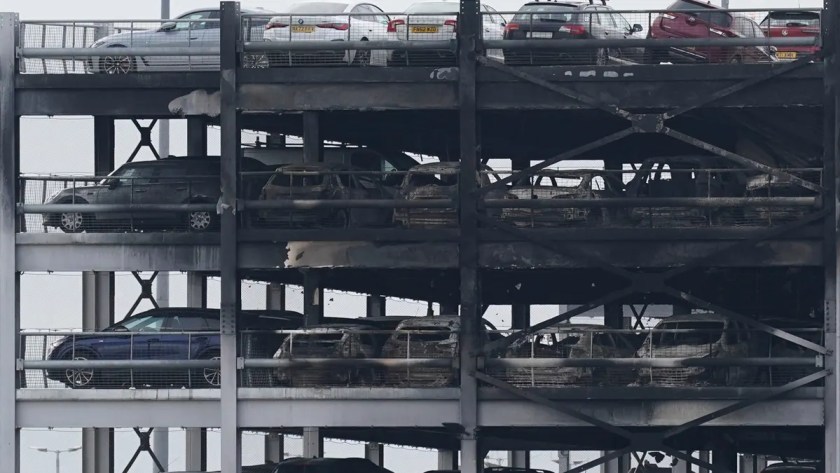
Car Park Fires

The aftermath of a large parking garage fire at Luton Airport is photographed, Luton, England, Wednesday Oct. 11, 2023. (Jacob King/PA via AP)

London’s Luton Airport reopened on Wednesday after a vehicle fire spread through a newly built car park, partially collapsing the building and causing major disruptions to tens of thousands of passengers.

From NOT A LOT OF PEOPLE KNOW THAT

By Paul Homewood

h/t Caffe Anvils

I am told that there was another major carpark fire, in December 2017 in Liverpool.

It was evidently a major event, as Merseyside Fire Service published a report a few months later.

It is interesting to compare it with Luton.

First of all, the timeline:

In the Kings Dock fire, it took two hours from the 999 calls for the fire to have become so dangerous that firefighters were withdrawn.

At Luton, the local fire chief, Andy Hopkinson, maintains that when his crews arrived within ten minutes of the 999 calls, they were faced with “a rapidly developing and escalating fire, involving a large number of vehicles spread across a number of floors”.

Secondly the Liverpool fire was spread by running fuel fires – in other words, fuel escaped from burning cars, which caught fire, thus spreading the fire to the next car in line. Fires spread to the floor below, as the burning fuel descended the drainage system.

There is a third issue as well. The Liverpool fire report noted that the first hour only saw two rows of cars affected. This implies that the fire could only spread to the next car close to it, consistent with running fuel. Footage of Luton shows that the fire spread quickly over large distances by explosion.

Clearly the Liverpool fire had little in common with Luton, where the fire spread much more rapidly, and where the there is footage of one of the floors actually collapsing, bringing the burning vehicles from above with it.

The only possible explanation is that the Luton fire involved one, and most probably more, EVs, which turned a slow developing fire into the catastrophic event we have all seen,

One final comment.

The Merseyside report noted the absence of sprinkler systems, and it appears that Luton’s car park also did not have any sprinklers working.

While these would clearly be invaluable in an ordinary car fire, they would be worse than useless in a lithium battery fire.

I can only repeat – if a fire occurred in an underground car park full EVs below a block of flats, it would be a disaster.