Who, Us? Fewer Than 50% of Americans Think Humans Are the Main Cause of Climate Change

When it comes to climate change, Americans are increasingly pointing the finger at nature itself as the cause, finds a new survey by The Associated Press-NORC Center for Public Affairs Research and the Energy Policy Institute at the University of Chicago.

When it comes to climate change, Americans are increasingly pointing the finger at nature itself as the cause, epic.uchicago.edu/ has the story.

According to the results of new survey, thereโ€™s been a sizeable shift in just the last five years in the percentage of Americans who believe humans are the primary driver of climate change as opposed to natural changes in the environment.

Though three-quarters of Americans believe climate change is happening, only 49% say itโ€™s mostly or entirely precipitated by human activity โ€” an 11% drop since 2018.

Digging into the demographics, the falloff was most pronounced among Democrats and independents. In 2018, 72% of Democrats said climate change is mostly or entirely a result of human activities; in 2023, that figure fell to 60%. For independents, the decline was even steeper: from 61% in 2018 to 42% in 2023.

Creeping doubt about humansโ€™ impact on climate could be affecting the choices people are making, or not making, to reduce their carbon footprint.

The survey showed 89% of Americans routinely turn off lights when not needed and 68% use energy efficient appliances. But far fewer people have taken more significant steps: Only 11% have lived in a home with solar panels, and just 12% have driven a hybrid or electric vehicle.

Other interesting results of the survey:

โ€” Americans have mixed feelings about the high-voltage power lines needed to transport renewable energy: 56% support beefing up the nationโ€™s power grid, but that number dips to 48% if the power lines would be built in their neighborhood.

โ€” People who live in the Southwest and on the West Coast are more likely than other Americans to say theyโ€™d consider moving to avoid extreme weather impacts. People in the Northeast are standing pat.

The survey was conducted by The Associated Press-NORC Center for Public Affairs Research, with funding from the Energy Policy Institute at the University of Chicago. Additional results areย available online.

97,404 Direct CO2 Measurements From 1826-2008 Indicate Humans Do Not Drive CO2 Change

Mauna Loa Observatory

So the warming in recent decades may be natural. The COโ‚‚ increases resulting from the natural warming may be substantially natural too. And these results are observationally supportable.

Mauna Loa

From NoTricksZone

Byย Kenneth Richardย onย 17. October 2023

Carbon dioxide readings at the Mauna Loa Observatory in Hawaii have reached what atmospheric scientist Ralph Keeling calls a “psychological threshold” of 400 parts per million. The amount of carbon dioxide in the atmosphere has been steadily increasing since near-constant measurements began at the observatory in 1958.

Per a new study, atmospheric CO2 levels rose to 383 ppm in the 1940s mostly as a consequence of soil respiration processes and sea surface temperature warming. Any anthropogenic contribution to this CO2 peak โ€œcan be largely excluded.โ€

When assessing the historical atmospheric CO2 concentration, direct measurements of chemically analyzed air samples are at least 10 times more accurate than data derived from the commonly-accepted proxy records from ice cores (Harde, 2023).

Image Source:ย Harde, 2023

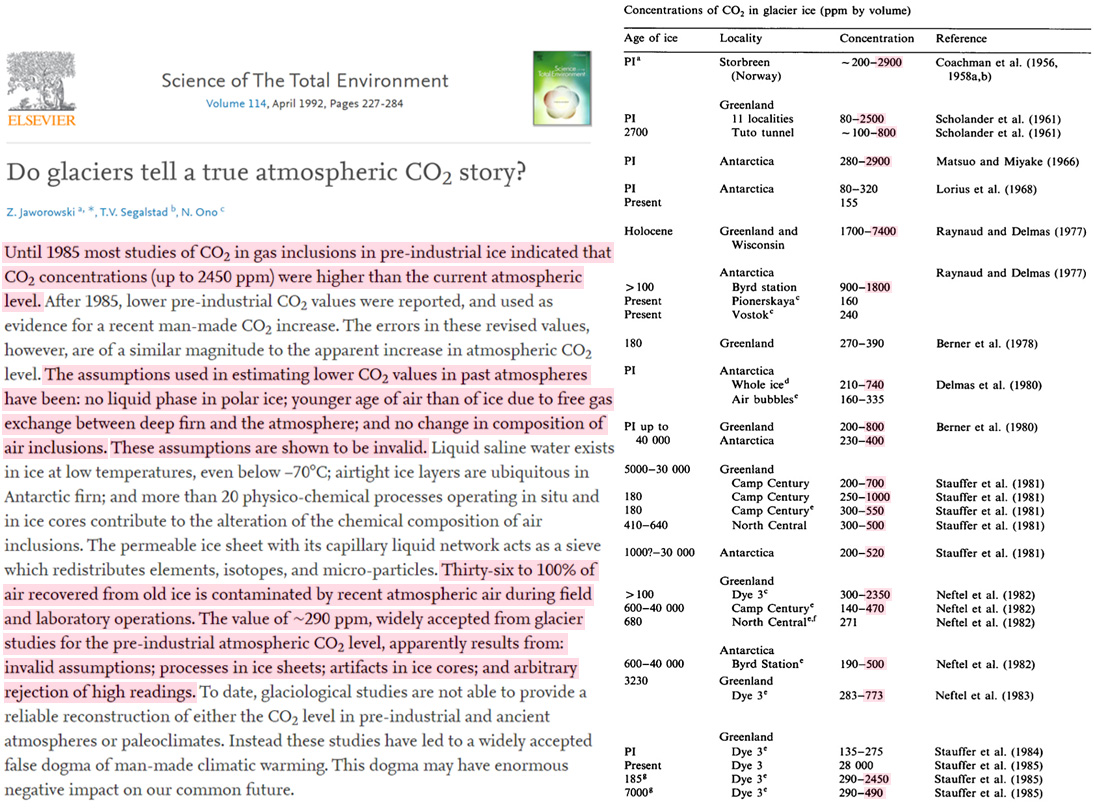
The proxy data are subject to a great deal of selection bias, and thus the claim modern CO2 levels are uniquely due to human activity can seemingly be supported by using preferred data selection.

The late Dr. Ernst-Georg Beck spent years compiling an exhaustive chemical database of the CO2 levels measured in air samples from across the globe. Analyzing 979 technical papers reporting from 1,901 air sample measurement stations, Beckโ€™s CO2 measurement data was published in a scientific paper entitled โ€œReconstruction of Atmospheric CO2 Background Levels since 1826 from Direct Measurements near Groundโ€ after his death in 2022.

The CO2 variability in the measured data profoundly deviate from the far-less-accurate proxy data derived from one single continentโ€™s (Antarctica) ice samples. The 60,000 global-scale chemical measurements compiled between 1930 and 1950 using data from 25 authors and locations assessed that between 1939 and 1943 global atmospheric CO2 rose to 383 ppm โ€“ the same concentration again achieved in 2007. After the early 1940s, the chemical measurements indicate CO2 plummeted  to 310 ppm by the late 1940s.

These fluctuations are consistent with variations in sea surface temperatures (warmer water releases more CO2, cooler less) and temperature-dependent soil respiration (with mixing ratios ranging between 500 and 20,000 ppm) processes, suggesting that temperature is the driver, and CO2 variations are the effect. This Tโ†’CO2 directionality found in measured CO2 air sample data from 19th to mid-20th century is also evident for the satellite era.

Furthermore, the analysis reveals that of the 90 ppm rise in CO2 since 1958 (the Mauna Loa era), not more than 12 ppm could be said to have derived from fossil fuel emissions. And when the CO2 rose to 383 ppm in the early 1940s, the impact from anthropogenic emissions โ€œcan be largely excluded.โ€

mauna loa