Al Gore’s “Inconvenient Truth” Decrepit at Age 20

Twenty years ago, “An Inconvenient Truth” received a standing ovation at the
Sundance Film Festival. Though it was full of predictions that never
came to pass, it was a key catalyst of the climate activist movement.

A man in a suit appears shocked, standing in front of icebergs against a sunset backdrop, with bold text overlay reading 'The Arctic will be Ice Free 2013'.

From The Science Matters

By Ron Clutz

A crowded cinema audience watching a movie, with a bright white screen illuminated in front of them.

Kevin Killough describes the decay of Gore’s signature movie in his Just the News article Al Gore’s ‘Inconvenient Truth’ turns 20, and critics say biggest disaster is its failed predictions.  Excerpts in italics with my bolds and added images.

Twenty years ago, “An Inconvenient Truth” received a standing ovation at the
Sundance Film Festival. Though it was full of predictions that never
came to pass, it was a key catalyst of the climate activist movement.

Twenty years ago, Monday, former Vice-President Al Gore’s documentary on global warming, “An Inconvenient Truth,” premiered at the Sundance Film Festival and received a standing ovation. The 2006 documentary was released to theaters the following May and went on to gross over $25 million worldwide.

Gore’s film was a primary catalyst for the climate activist movement, and it generated a lot of concern about global warming following its release. The movie left audiences with the impression that the human race was hurtling toward a dystopian future on a planet baking in unbearable temperatures where extreme weather caused frequent disasters.

A woman holding a sign that reads 'PREPARE FOR THE END OF THIS WORLD' in a crowded harbor setting.

Almost 13 years to the day after its release, Rep. Alexandria Ocasio-Cortez, D-N.Y., was telling people the world would end in 12 years – presumably five years from now – because of the burning of fossil fuels.

Matt Wielicki, who writes about climate and energy on his “Irrational Fear” Substack, was once an assistant professor in the Department of Geological Sciences at the University of Alabama. In the early part of his academic career, he taught at a local college.

A speaker presenting on stage with a graph displayed behind him, discussing climate data in front of an audience.
Al Gore with a version of the Hockey Stick graph in the 2006 movie An Inconvenient Truth

He told Just the News that he showed “An Inconvenient Truth” to his students. Over time, he began to question the “gloom and doom” narratives Gore presents in his film, he said.

“People took that as a starting point, and they just kept running further and further with it,” Wielicki said.

Gore’s film, however, was full of numerous predictions that turned out to be wrong, and it’s likely that the world will not end in 2031, as Ocasio-Cortez predicted. 

A political cartoon depicting a man with a smirk holding a 'Nobel Prize' award, surrounded by a list of claims that a British judge has ruled as scientific errors in Al Gore's film 'An Inconvenient Truth.'
Stubborn ice

Among the predictions Gore made in the documentary is that Africa’s Mt. Kilimanjaro would have no more snow on it by 2016. In 2020, The Times reported that the snow on the 19,000-foot mountain remained, despite Gore’s predictions. But the documentary had caused some to rush to climb the mountain before the snow disappeared. Instead, the tourists are surprised to find glaciers still clinging to it.

Gore also predicted that Glacier National Park would be “the park formerly known as Glacier” after all the ice melted away in the blazing hot temperatures that were to descend upon the human race. The claim made a big mark, and federal agencies began looking closely at glaciers.

Three polar bears in snowy surroundings with text overlay discussing their decreasing population.

The U.S. Geological Survey predicted all the glaciers in the park would be gone by 2020. Signs were placed throughout the park warning visitors of the impending end of glaciers, which never happened. Instead, CNN reported, the signs had to be removed in 2020 when it was clear the glaciers remained.

Gore also connected Hurricane Katrina to global warming – later renamed climate change – and he predicted that these storms would become more frequent. The reality of human contributions to hurricane activity is far more nuanced and uncertain than Gore discusses in the documentary.

Line and bar graph showing Annual ISAAC data from 1900 to 2010, with black bars representing annual values, an orange line indicating the 10-year centered average, and a blue line depicting CO2 levels in ppm.
Integrated Storm Activity Annually over the Continental U.S. (ISAAC). Value is the Accumulated Cyclone Energy from all storms over land.

The National Oceanic and Atmospheric Administration has a section on its website dedicated to the topic. The page reads.

“In summary, it is premature to conclude with high confidence that human-caused increases in greenhouse gases have caused a change in past Atlantic basin hurricane activity that is outside the range of natural variability, although greenhouse gases are strongly linked to global warming,”

A man named Mr. Martz is seated at a hearing table, prepared to speak, with papers in hand. The audience behind him includes individuals with varied expressions, some looking attentively at him.
Uncertainty and nuance

Meteorologist Chris Martz said that climate science is full of the kind of uncertainty and nuance you see on the NOAA website, which “An Inconvenient Truth” dismisses entirely. 

A cartoon depicting a long line of people outside a theater showing two films: 'Inconvenient Sequel' and 'Climate Hustle.'

Since Gore’s film was released – which was given a sequel in 2017 – Gore has continued to make false predictions, the meteorologist said. In 2009, Gore stated that the Arctic would be ice-free in summer within five to seven years. As of today, the Arctic still has ice in summer.

“We look at the Arctic ice now and yes; it’s declined since 1979 when satellite records began … But over the last 18 to 20 years, there’s really been no trend. And this caught scientists off guard. The models never predicted this,” Martz told Just the News.

A glacier landscape with a person appearing concerned, featuring speech bubbles discussing climate predictions about ice disappearance.

He also said there’s been multiple studies on Arctic ice, and while some predicted an ice-free Arctic, others find the ice extent in the region recedes or grows as a result of natural variability. 

Predictions of cataclysm stemming from climate change regularly get reported in the media, but there’s little reporting when the predictions fail. In 2022, NBC News was one of many outlets reporting that California and the American West were in the midst of a “megadrought,” which was the worst the region had seen in over 1,000 years.

Earlier this month, NBC reported that California is drought free for the first time in 25 years. The article makes no mention of the previously predicted “megadrought,” nor does it mention climate change.

Graph showing U.S. percentage areas of Very Wet (green) and Very Dry (orange) conditions over time, with a blue line indicating CO2 levels in ppm from January 1895 to December 2022.

Martz said that many of his critics respond to these failed predictions by arguing they weren’t made by scientists in peer-reviewed articles published in journals. Instead, they’re made by politicians or scientists in interviews. But most people don’t get their information from scientific journals. They get it from the media, Martz said.

A humorous infographic titled 'Climate Change: A Timeline (of Failed Predictions)' illustrating various exaggerated predictions about climate change from the 1960s to the 2010s, featuring cartoon-style graphics and annotations.

“That communication is what’s more important in terms of public perception of what science is,” he said.

Listening to the experts

Though it had no scientific basis, there was a widespread belief that global warming could cause the human race to go extinct. 

A 2017 survey found that 40% of Americans believed there is a 50% chance of that happening. In fact, the number of people killed by natural disasters has never been lower, a fact largely ignored by the media.

Line graph comparing average annual deaths per decade from climate-related causes (blue) and non-climate-related causes (red) from 1920 to 2020. The graph shows a significant decline in climate-related deaths and a stable trend for non-climate-related deaths.
My Mind is Made Up, Don’t Confuse Me with the Facts. H/T Bjorn Lomborg, WUWT

People appear more likely to be influenced by Congresswoman Ocasio-Cortez than the scientific data on deaths from climate-related natural disasters.

A cartoon depicting two men standing on a bridge. One man is confusedly asking the other why his seventh-grade class would jump off a bridge, to which the other replies he has no idea. In the background, a sign is held up stating 'EARTH WILL be UN-INHABITABLE in 0 YEARS!' with various protest signs about climate change.

Her statement that the world would end in 12 years was actually a misreading of a special report by the Intergovernmental Panel on Climate Change, which predicted that the world would need to cut its carbon dioxide emissions by 40-50% by 2030 and eliminate them entirely by 2050 to keep temperatures from rising more than 1.5 degrees Celsius above levels they were at before humans began burning a lot of fossil fuels.

Infographic illustrating emission pathways towards the Paris Agreement, showing historical CO2 emissions, projected scenarios for limiting global warming to 1.5 °C and 2.0 °C, and targets for achieving carbon neutrality by 2050 and 2070.

There’s nothing in the report that predicts disaster after crossing that threshold, and some experts are estimating that we have already done so. The report estimates that under the worst-case scenario, the global GDP loses about 2.6%, but it would still be about 10 times larger than it is today. But people didn’t read the report. They just heard Ocasio-Cortez warning of end times.

The report, or at least Ocasio-Cortez’s understanding of it, led her to introduce the ambitious Green New Deal plan, a suite of progressive policies justified as presenting global disaster. It failed to get a single vote when it was brought to the Senate floor for a procedural vote, which would mean, according to Ocasio-Cortez, the world has five years until it ends.

A satirical political cartoon depicting a map of the United States labeled 'The Socialist States of the Green New Deal'. It features exaggerated illustrations of a person with outstretched arms, various signs indicating restrictions like 'No Fly Zone', 'No Gas-Powered Cars', and 'No Farting Cows', along with icons representing government programs, taxes, and a navy, highlighting the perceived implications of the Green New Deal.

Larry Behrens, communications director for Power the Future, told Just the News that AOC likely spent the seven-year anniversary of her prediction doing exactly what she does any other day.

“Because she knows it was nonsense when she said it, and it’s nonsense now,” he said.

“Make no mistake, she’ll join the rest of the eco-left in their convenient climate silence, hoping voters forget their green crusade delivered record energy prices and crushing inflation. On this anniversary, ‘climate’ is the last word AOC, and her allies want to utter because midterms are coming, and voters remember exactly who made life more expensive.”

A cartoon depicting a worker in a hard hat sitting on a structure labeled 'OIL & GAS INDUSTRY' while a character resembling a donkey operates a boat labeled '2020 DEMS,' making a sound effect 'BRRR-AP-AP-AP-AP.'

California’s Climate Lawsuit soaring electricity costs

Attorney General Rob Bonta’s lawsuit against major oil companies like ExxonMobil, Shell, BP, ConocoPhillips, Chevron, and the American Petroleum Institute- focuses on alleged deception and public nuisance related to climate change misinformation rather than addressing practical energy challenges in the state.

A man in a suit passionately speaking at a podium outdoors, with the text 'No gas and oil' overlayed.

Attorney General Rob Bonta’s lawsuit against major oil companies like ExxonMobil, Shell, BP, ConocoPhillips, Chevron, and the American Petroleum Institute- focuses on alleged deception and public nuisance related to climate change misinformation rather than addressing practical energy challenges in the state.

This view aligns with broader conservative critiques of climate litigation against oil companies, which often portray such suits as attempts to regulate energy policy through courts rather than legislatures, potentially ignoring global energy realities.

_________________________________________________________________________________________________________

A graph titled 'Soaring Power Costs' displays increasing power prices from 2010 to 2020, alongside images of power lines and wildfires. A group of people in formal attire is seated in a meeting room, viewing the presentation.

California’s lawsuit is about control and reflects a governing mindset that favors lawsuits and executive orders over collaboration and accountability

Anyone who has paid a California electric bill lately knows how bad things have gotten. Costs are soaring, the grid is strained, and policymakers in Sacramento seem more focused on courtroom sound bites than keeping the lights on. The California Globe has the story.

To that end, California’s latest climate lawsuit against American energy producers may grab headlines, but it will not lower emissions, modernize infrastructure, or make life more affordable for families already struggling to keep up.

Attorney General Rob Bonta’s 2023 lawsuit accuses energy producers of misleading the public about climate change. But it conveniently ignores the fact that California’s energy policies have long relied on traditional fuels to fund state programs and meet consumer demand, even as leaders claimed to be phasing them out.

In fact, California’s Public Resources Code even explicitly directs state supervisors to “encourage the wise development of oil and gas resources to best meet oil and gas needs in this state.”

Yet instead of addressing these deep credibility issues and admitting the failures of their unrealistic green energy proposals, state officials now want the courts to rewrite history and send the bill to energy consumers.

The problems California faces are not due to a lack of ambition, but execution.

California has set some of the most aggressive climate targets in the world, but the infrastructure needed to reach them is years behind schedule.

Transmission upgrades, renewable-energy projects, and grid storage remain mired in permitting delays and bureaucratic review. Each new regulation or lawsuit adds yet another layer of uncertainty for investors and developers, driving up costs and pushing projects elsewhere.

Meanwhile, residents of the Golden State are paying the price. California families face electricity rates nearly double the national average and some of the highest gasoline prices in the country.

For low- and middle-income households, these monthly realities make it harder to live, work, and commute. Suing American energy producers does nothing to solve these problems. If anything, it risks making them worse by discouraging investment in the systems that keep California running.

If our leaders truly wanted to bring relief to California families while working towards their climate targets, they would start by reforming the permitting and funding structures that delay new energy projects for years.

They would invest in grid modernization, advanced storage, and cleaner domestic production of oil and natural gas rather than depending on more carbon-intensive imported fuels and foreign supply chains.

They would also empower local communities to shape their own energy priorities instead of dictating one-size-fits-all mandates from Sacramento.

Read the full story here.

A group of executives seated at a conference table discussing rising electricity costs, with a presentation showing a graph of electricity price increases on a screen behind them.

All of the above, please

Wind and solar industry lobbyists are appealing to conservatives in a last-ditch effort to promote wind and solar power as a reliable energy source.

A young boy holding a metal bowl while speaking, with a backdrop of the Eiffel Tower and a table set with glasses and plates of food.

From American Thinker

Wind and solar industry lobbyists are appealing to conservatives in a last-ditch effort to promote wind and solar power as a reliable energy source.

By Bill Ponton

Wind and solar industry lobbyists are appealing to conservatives in a last-ditch effort to promote wind and solar power as a reliable energy source. They are rallying around the slogan, “all of the above”. By that, they mean that we should avail ourselves of all sources of electricity. The Western Way, a non-profit that seeks pro-market solutions to energy and environmental challenges, issued a recent report touting the reliability of power grids with a wide range of energy sources. It concludes with the following passage:

This whitepaper has sought to clear up this confusion. Phasing out tax subsidies for certain energy sources at the federal level does not mean phasing out the energy sources themselves at the local, state and regional level.

Make no mistake: The U.S. needs every economically viable energy source to maintain a stable power grid, win the global AI race and restore the nation’s manufacturing might. Not only that, but all those different energy sources will also need to work together as efficiently as possible, and therefore solutions will look different from state to state and region to region based on their unique circumstances.

In fact, relying too much on a small number of sources only increases the likelihood of grid failures, especially during unexpected events like equipment failures or severe weather. For grid operators, the risk of blackouts is much lower when they have more options in the generation stack – not fewer options – to choose from.

The author is incorrect in stating that “… the risk of blackouts is much lower when they have more options in the generation stack – not fewer options – to choose from.” As I discussed in a recent article entitled, “Not all gigawatts are the same”, intermittent power sources (wind and solar) do not come with the same level of reliability as firm power sources (coal, gas, oil, nuclear). Intermittent sources add nothing to the reliability of a grid. For a grid to be reliable, firm capacity must exceed peak demand.

The only role that intermittent sources play is to reduce fuel usage, but that comes at a price, and it’s not one that I would call economically viable. Depending on the region, operators are paying between 1.5 to 2.8 times more in terms of USD/kWh (see table below). My calculations are here.

Table comparing energy costs (USD/kWh) for wind, solar, and dispatchable thermal sources in Spain, UK, Texas, California, and Germany.
Image created by author.

I assume that the author wishes to preserve remaining state mandates for renewable energy as federal tax subsidies get phased out, and he hopes to achieve it by muddying the waters. To that end, he might have success.

Many conservative politicians in western states are beholden to the wind and solar power industry that provides livelihoods to their constituents.

One need only look back at the past economic folly with ethanol mandates that have enriched farmers in the Midwest for almost five decades. Ronald Reagan summed it up best when he said, “Government programs, once launched, never disappear. A government bureau is the nearest thing to eternal life we’ll ever see on this earth.”

A young boy holds out an empty bowl, looking hopeful and saying, 'All of the above, please.' In the background, several other children and an older man are seated at a wooden table.
Image generated by ChatGPT.

False, Everyday States, Prices Show Renewables Aren’t ‘Cheaper Than Fossil Fuels’

Everyday States published an article claiming wind and solar power, but especially solar power, provide cheaper electric power than fossil fuels in various states. Media outlets have repeatedly made similar claims over the past decade, but as with those previous stories, data on power prices and trends in those states show the claim to be false.

Aerial view of a solar panel farm with numerous blue solar panels and wind turbines in a desert landscape.

From The Climate Realism

By H. Sterling Burnett

A house roof covered with solar panels against a cloudy blue sky.

Everyday States published an article claiming wind and solar power, but especially solar power, provide cheaper electric power than fossil fuels in various states. Media outlets have repeatedly made similar claims over the past decade, but as with those previous stories, data on power prices and trends in those states show the claim to be false. Wind and solar power remain considerably more expensive than more reliable electric power generated by natural gas, coal, and nuclear power. Academic studies prove this, as do electric power rates and trends in the states highlighted in the Everyday States post.

In the story, “The States Where Renewable Energy Is Now Cheaper Than Fossil Fuels,” the author, Lean Thomas, writes under the first sub-head, “The Solar Revolution Transforms America’s Energy Landscape:”

Picture this: just 15 years ago, solar energy cost four times more than the cheapest fossil fuel option. Today, solar is less than half as expensive as the lowest-cost fossil alternative, marking one of the most dramatic cost reversals in industrial history. The transformation is nothing short of remarkable, with solar PV’s levelized cost of electricity (LCOE) being 56% less than the weighted average fossil fuel-fired alternatives in 2023.

Renewables have transformed the energy landscape, but not for the better, unless one likes blackouts and high costs.

One problem for Thomas’ claims is that the LCOE leaves out a lot of the costs inherent to wind and solar: costs in terms of direct subsidies, tax credits, and costs related to back up and transmission that is socialized across ratepayers rather than paid for by wind and solar developers.

A peer reviewed study in the journal Energy attempted to account for all the up front and hidden costs of competing power generation sources, allowing for an apples-to-apples comparison of affordability, producing a Levelized Full System Costs of Electricity (LFCOE) of competing grid power sources. After accounting for subsidies, production tax credits, additional transmission lines, backup power, and other state and federal programs incentivizing renewables, the study found that solar energy is 10 times more expensive than natural gas and more than four times more expensive than coal. Wind, well it’s cheaper than solar but still comes in at nearly six times more expensive than natural gas, and more than three times more expensive than coal.

In wind and solar friendly Texas, for example, the LCFOE for new natural gas is $40.00 per megawatt hour (Mwh) and coal is $90.00 Mwh, compared to $291.00 Mwh for wind and $413.00 Mwh, for solar.

Interestingly, Thomas specifically mentions Texas as an example of a state where solar is now cheaper than fossil fuel generated electricity, yet the Texas experience is this: 20 years ago, Texas had among the lowest electric power rates in the nation and ratepayer prices were declining under competition. Texas has abundant coal and natural gas, which was reflected in the state’s rates.

State and federal government help in the form of stricter regulations on coal power plants has caused premature closures. Since 2005, more than 7,000 Mw of coal power was taken offline to be replaced by 38,000 Mw of wind and 35,000 Mw of solar. Texas ratepayers now experience more outages, energy emergencies, and calls for conservation than ever in the state’s history, including during the winter, historically the state’s time of lowest demand.

Meanwhile, electric power rates have skyrocketed. In 2005, Texas had the cheapest electric power rates in the region. Since then, as ever more wind and solar was added to the grid, Texans’ electricity prices rose significantly and steeply. Texas now has the most expensive power in the region and has been among the fastest rising electric power costs in the nation.

The other state specifically mentioned in the Everyday States story is California, where the story is even worse for the bucolic narrative about abundant and affordable renewable power that Thomas is trying to spin.

California’s power grid is under constant strain, with outages a regular feature, especially during the summer, in large part due to its smothering climate regulations that ended coal use in the state, restrained natural gas, and mandated wind and solar.

Concerning costs, California’s residential electric power rates are the highest and its commercial power rates are the second highest in the continental United States. California’s residential rates are nearly double the national average.

Despite the fact that Californians use less energy per capita in the nation, their power prices keep rising, in large part due to climate regulations and the forced displacement of fossil fuels and nuclear by wind and solar power via mandates and special pricing. California’s electric power rates have more than doubled since 2005.

Everyday States should not mislead its readers with fairy tales of cheap electricity from solar and wind. Data from the Energy Information Administration is clear and easy to access and it shows that states that remain largely dependent upon coal or hydropower have among the lowest residential, commercial, and industrial electric power rates in the nation. By contrast, states with rising renewable energy mandates and subsidies are among the highest and fastest rising energy costs. Contrary to Thomas’ fantastical assertions, the “cheaper” wind and solar are added to a state’s grid, the higher (and faster rising) the energy costs, and the less reliable is its power system as a whole.

A split image contrasting pollution from industrial activities on the left, with dark smoke, oil extraction, and heavy machinery, and a clean, green landscape on the right featuring wind turbines, solar panels, and a bright sun, symbolizing renewable energy and environmental sustainability.

Al Gore Wants to Pay Farmers to Grow Less Food to Fight Climate Change

Former Vice President Al Gore said on Wednesday that government policy should promote “regenerative agriculture” during a discussion at the World Economic Forum (WEF).

A man in a suit passionately speaking at the World Economic Forum, with a woman in the background expressing surprise.

From The Daily Caller

From THE DAILY CALLER

Daily Caller News Foundation

Harold Hutchison
Media Reporter

Former Vice President Al Gore said on Wednesday that government policy should promote “regenerative agriculture” during a discussion at the World Economic Forum (WEF).

The WEF is in Davos, Switzerland, for its annual meeting, with panels and speeches from world leaders, philanthropists, business leaders and A-list Hollywood actors, according to the program on the forum’s website. Gore made his comments during a panel discussion titled “How Can We Avert a Climate Recession?”

 (RELATED: ‘Patrick Bateman Meets Sparkle Beach Ken’: Scott Bessent Delivers Sassy Retort To Gavin Newsom)

“But the role of policy which we’re discussing here is crucial in agriculture as well. In the US, the largest source of government subsidies to farmers is in a program called crop insurance,”

Gore, who won the Nobel Peace Prize for his documentary “An Inconvenient Truth,” claimed.

“The title is a bit misleading… in order to qualify for these subsidies, farmers basically have to assure the government that they are not going to engage in regenerative agriculture because the incentives have been to produce as much as possible as quickly as possible, fence row to fence row instead of taking care of the productivity of the soil and not depleting its vitality.”

WATCH:

“So, we need policies that in recognition of the fact that governments around the world typically do subsidize farming, but don’t subsidize them in ways that incentivize them to go in the wrong direction, but incentivize them to go in the right direction,”

Gore continued.

Environmentalists have targeted agriculture, particularly meat production, claiming that it contributes to climate change. The Dutch government forcibly shut down 3,000 farms to meet European Union environmental policies in 2022, leading to a backlash as a pro-farmer party won 15 of the 75 seats in the European country’s legislature the following year.

During the 2023 WEF meeting, one speaker called for an end to eating meat.

“If a billion people stop eating meat, I tell you, it has a big impact. Not only does it have a big impact on the current food system, but it will also inspire innovation of food systems,” 

Jim Hagemann Snabe, chairman of the Germany-based conglomerate Siemens AG, said during a panel called

“Mobilizing for Climate.”

“I predict that we will have proteins not coming from meat in the future, they will probably taste even better. So why are we trying to mimic meat if we can have a better taste? They will be zero carbon and much healthier than the kind of food that we eat today,” 

Snabe added.

A man passionately speaking and gesturing with raised hands during a panel discussion at the World Economic Forum.

Winter Storm Wrecks Power Lines as Hundreds of Thousands are Still Without Power

A major winter storm has swept across much of the United States in late January 2026, bringing heavy snow, freezing rain, and ice that have caused widespread damage, particularly to power infrastructure.

The storm’s freezing rain coated trees, branches, and power lines with thick ice, leading to snapped limbs, downed lines, and collapsed poles.

A snow-covered road obstructed by a fallen tree, with snow-laden branches on either side.

A major winter storm has swept across much of the United States in late January 2026, bringing heavy snow, freezing rain, and ice that have caused widespread damage, particularly to power infrastructure.

The storm’s freezing rain coated trees, branches, and power lines with thick ice, leading to snapped limbs, downed lines, and collapsed poles.

This has resulted in massive power outages, primarily in the South- hardest hit regions include Tennessee (especially around Nashville and Middle Tennessee), Mississippi, Louisiana, and parts of Texas and Kentucky.

_________________________________________________________________________________________________________

A person wearing a thick, snow-covered jacket and hat, with frost around their face, looks directly at the camera. The image is overlaid with the text 'GLOBAL WARMING' in large, bold letters.

From The Institute for Energy Research

By IER

Electricity outages across the United States reached nearly a million customers early Sunday afternoon, but by 10:30 p.m. Sunday, utility crews had reduced the number of outages to fewer than 805,000, mostly in the South, according to poweroutage.com.

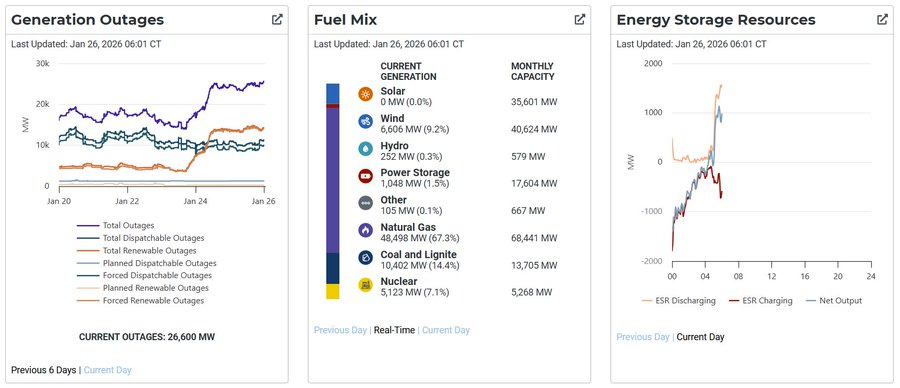
Utility generators had to rely on natural gas, coal, and nuclear power to keep the lights on as the lack of sun wiped out solar power and limited wind and/or freezing equipment reduced wind power output.

In the Northeast, oil and wood saved the day as the lack of sufficient pipeline infrastructure limited additional gas-generated power. In the Northeast and Midwest, where more people get heat from natural gas, less of the fuel is available for power plants.

More outages would have been the result if President Trump and Energy Secretary Wright had not kept coal plants from retiring.

Record-breaking temperatures are expected to last for much of the week with more than 85 million people placed under an extreme cold warning.

As the temperatures dip further, demand for power is expected to rise, raising the possibility that more outages could occur. It is estimated that storm damage could result in up to $115 billion in losses, according to AccuWeather. 

As natural gas is in high demand and freezing conditions restrict gas output, natural gas prices have risen to above $6.20 per million British thermal units as of Monday morning, the highest since December 2022.

The fuel of choice for data centers, natural gas output dropped as icy conditions forced drillers in regions such as the Permian shale basin in Texas and New Mexico to curb output due to “freeze-offs,” when water and other liquids in the gas stream freeze.

The Department of Energy ordered the manager of the Texas power grid to begin using backup generation resources at data centers and other facilities that consume large amounts of energy to help prevent blackouts.

According to the agency, the order would aid the Electric Reliability Council of Texas, ERCOT, in maintaining grid operations through the “extreme temperatures and storm destruction” left by the weekend’s powerful weather event.

In its 2025–2026 Winter Reliability Assessment, the North American Electric Reliability Corporation (NERC) found that the ERCOT assessment area was at elevated risk. According to NERC, above-normal winter peak and outage conditions could result in the need for operating mitigations and Energy Emergency Alerts.

According to the Wall Street Journal, the Energy Department also waived emissions rules so fossil-fuel plants could run at maximum capacity. Early Sunday morning, coal accounted for some 40% of power in the Midwest’s MISO grid, 24% in the eastern PJM Interconnection, and 18% in Texas, with most of the rest coming from natural gas and nuclear.

Power plants in New England burned oil, which accounted for 40% of electricity at peak demand, and the region generated more power from burning wood and trash than from wind power.

Back-up batteries for wind and solar did little as they can discharge power only for a few hours at a time and had no excess sun or wind power to recharge them.

While Texas did have some outages, the results were far better than during Winter Storm Uri in February 2021 due to changes the state made post-Uri.

As of early Monday morning, the state was generating 89% of its power from reliable baseload fuels — 67% from natural gas, 14% from coal, and 7% from nuclear, with just 9% coming from wind, none from solar, and 1.5% coming from batteries.

Analysis

Winter Storm Fern has further revealed the importance of connecting reliable generation resources to the grid, without which numerous lives and dollars would be lost.

State-level policies forcing the retirement of coal plants and preventing the construction of natural gas and nuclear plants have led to the current situation facing the grid, where power plants are burning oil, wood, and trash, as the Wall Street Journal reports.

Reducing carbon emissions by increasing renewable generation may sound good in theory, but the fact that solar and wind can’t provide the same capacity during poor conditions makes their inclusion on the grid duplicative and expensive.

As the Journal’s Editorial Board asks, “Is the goal to reduce carbon emissions by making Americans freeze?”

For inquiries, please contact wrampe@ierdc.org.

Chinese Professor Demands Politicians Shut Down Rich Country High Carbon Industries

Developing countries like China get a free pass because they “are forced to emit”. But rich country politicians “must understand that addressing climate change can be a decisive factor in their political success or failure”.

A propaganda poster featuring a smiling figure of Mao Zedong with an outstretched hand, surrounded by a crowd of supporters holding up placards, set against a background of red and yellow rays.

From Watts Up With That?

Essay by Eric Worrall

Portrait of Professor Hu Yong, a faculty member at the School of Journalism and Communication, Peking University, along with his title as Founding Director of the Communications Association of China.

“… If industries resist, strict regulations may be required to enforce change or even force noncompliant companies to shut shop. …”

Time to fix responsibility for climate change

By Hu Yong | CHINA DAILY | Updated: 2026-01-26 06:43

MA XUEJING/CHINA DAILY 

Global warming is one of the biggest challenges faced by humanity today. As emissions continue to rise, global temperatures keep breaking records and the world’s poorest nations bear the brunt of a crisis they did little to create.

However, public discourse on climate responsibility remains mired in individualism. Citizens are told to recycle, go vegan and shrink their “carbon footprints” while systemic sources of emissions- from industrial production to state- backed fossil fuel subsidies- remain largely untouched. It is time the global conversation shifts from personal virtue to structural accountability, from lifestyle tweaks to large-scale political and economic reform.

Carbon emissions are linked to economic activity. Data show that 63 percent of emissions come from poor or developing countries, countries where the people are not rich, but are trying to achieve a middle-class lifestyle. In order to become middle or upper-class, lower income countries are forced to emit. Urging a developing country to cut back is an attempt to constrain its development, especially when today’s rich countries emitted freely on their way to prosperity.

Politicians must understand that addressing climate change can be a decisive factor in their political success or failure. They need to tackle climate change substantively- not through symbolic actions like banning plastic straws, but by addressing the largest sources of emissions, such as coal and oil. Policy measures, including support to green technologies and investing heavily in innovations, would help. If industries resist, strict regulations may be required to enforce change or even force noncompliant companies to shut shop. With adequate funding, this strategy could disrupt the existing cycle and help lower prices.

…Read more: https://www.chinadaily.com.cn/a/202601/26/WS69769cb4a310d6866eb359f5.html

Developing countries like China get a free pass because they “are forced to emit”. But rich country politicians “must understand that addressing climate change can be a decisive factor in their political success or failure”.

The absurdity of this thinking is if CO2 was a problem, it wouldn’t matter whether the CO2 was emitted by rich countries or poor countries. It’s like Professor Hu Yong is demanding a free pass for developing countries to wreck the planet, while developed countries cut back to give them space. If the world truly had exhausted its carbon budget, everyone would have to cut back on emissions, developed or not.

Thankfully CO2 is not a problem. By every reasonable measure the global climate is improving, thanks to CO2 fertilisation. The world is becoming more benign for plant life, more able to sustain food production and create prosperity for Earth’s billions of people.

Even better, vast tracts of land which were too cold to farm are becoming arable, with far more to come if warming continues.

Global warming is no threat to survival.

We should be emitting as much CO2 as possible, building a buffer against the ongoing Late Cenzoic Ice Age which still has the world in its grip, not panicking over every ounce of emitted CO2.

Global cooling is what we should fear.

Bjørn Lomborg is Wrong to Say Climate Change is a Problem to be Solved

In a commentary article in the Financial Post on Tuesday, Bjørn Lomborg argues that Net Zero is “on its way out”, as politicians across the world face up to the high cost and tiny climate returns of raising energy prices. With voters “weary of soaring energy bills and annoyed by increasingly hysteric and patronising climate rhetoric”, governments from the US to UK, Germany to Australia are waking up to the “simple truth”: “aggressive Net Zero mandates are delivering economic pain for unmeasurable and far-off climate gain”. Lomborg senses “a new pragmatism” entering the climate debate.

A serene landscape featuring a winding river surrounded by lush greenery, tall pine trees, and vibrant wildflowers, with majestic snow-capped mountains in the background under a clear blue sky.

CO2 Coalition

By Tilak Doshi

A tranquil alpine lake reflecting snow-capped mountains under a clear blue sky.

In a commentary article in the Financial Post on Tuesday, Bjørn Lomborg argues that Net Zero is “on its way out”, as politicians across the world face up to the high cost and tiny climate returns of raising energy prices. With voters “weary of soaring energy bills and annoyed by increasingly hysteric and patronising climate rhetoric”, governments from the US to UK, Germany to Australia are waking up to the “simple truth”: “aggressive Net Zero mandates are delivering economic pain for unmeasurable and far-off climate gain”. Lomborg senses “a new pragmatism” entering the climate debate.

Lomborg takes the example of United Kingdom, whose Net Zero law enacted in 2019 committed it to zero emissions by 2050. “Hailed as bold leadership, its reality has been economic sabotage” as the UK’s industrial electricity prices surged at four times the increase in the US- leaving the UK with the highest power rates in the Western world.

While Prime Minister Keir Starmer is reportedly preparing to delay or dilute key green commitments to curb “voter revolt”, Reform UK, leading the national polls by far, promises to end Net Zero targets when the party comes to power. Kemi Badenoch, leader of the Conservatives, pledged in 2025 to repeal the Climate Change Act. Lomborg notes the retreat from penurious green policies in the EU, Germany, Australia, Japan and even in Democrat states in the US.

So how does the Western painful dalliance with Net Zero end, according to Lomborg? He finds promise in the about-turn declared by philanthropist Bill Gates who seems to have had an epiphany about the costs of Net Zero. Lomborg is on the same page as Gates. In his long memo ahead of the COP30 climate summit, Gates called for attending states to face up to “three tough truths”: climate change is serious but “will not lead to humanity’s demise”, temperature is not the best measure of progress, and our best defences against climate change are better health and increased prosperity.

What can governments – made more “pragmatic” in the face of voter revolts – do in response to all the money wasted on futile Net Zero policies which cost far more than their presumed (and speculative) long-term ‘benefits’? Lomborg, like Gates, is a techno-optimist, and he sees hope in government-funded research “to achieve breakthroughs in nuclear, carbon capture, geo-engineering and far more efficient green-energy generation and storage”.

The Lomborg Conundrum
Bjørn Lomborg occupies a curious and increasingly uncomfortable position in the climate wars. To climate activists, he is a dangerous heretic who undermines the urgency of ‘The Science’ by questioning the costs of Net Zero. To many skeptics, he is a frustrating near-ally who dismantles the climate policy edifice brick by brick — only to stop short of questioning its foundations.

Lomborg insists that climate change is real, that CO2- driven warming is a problem and that humanity must ultimately ‘solve’ it. Yet he also argues, persuasively, that the costs of current climate policies vastly exceed their benefits, and that trillions are being squandered on symbolic decarbonisation while far more urgent human needs go unmet.

This intellectual tension- between scepticism about policy and faith in the premise defines Lomborg’s conundrum. He rightly rejects Net Zero as economically ruinous but still accepts the moral framing that elevates man-made CO2 to a civilisational threat in the first place. He denounces coercive regulation and carbon taxes but places hope in large-scale, government-funded research and development to deliver future technological salvation. In doing so, Lomborg offers a critique that is incisive but incomplete — and ultimately justifying the very climate orthodoxy he seeks to reform.

Lomborg’s most valuable contribution has been to puncture the illusion that climate mitigation is a ‘free lunch’ or ‘win-win’. He draws on the work of William Nordhaus, the Nobel prize winning economist who is well known for “integrating climate change into long-run macroeconomic analysis”. Lomborg treats climate change as a long-term economic externality whose damages, while real, are modest relative to the benefits of growth. The central error of Net Zero policies, he argues, is not that they fail to reduce emissions but that they impose crushing costs today for vanishingly small benefits decades hence.

Events have vindicated Lomborg, at least as far as the costs are concerned. The green consensus is unravelling across Europe under the weight of high energy prices, deindustrialisation and voter revolt. Britain’s political class, once united in climate sanctimony, now speaks openly of delaying or diluting Net Zero commitments. Australia’s centre-Right Liberal party and Japan’s new PM Sanae Takaichi are retreating from official Net Zero targets. Even the Tony Blair Institute has urged suspending carbon taxes on gas in the name of cheaper power.

What was sold as ‘green growth’ has now revealed itself as no growth.

Lomborg has been clear-eyed about this retreat, describing it not as moral failure but as political reality. He notes that governments are discovering that climate virtue cannot be eaten, worn or used to heat homes. The lived experience of voters has finally punctured the abstractions of climate modelling. On this terrain, Lomborg, the sceptical environmentalist has done more than most to restore economic realism to a debate long dominated by moral theatrics.

Yet for Lomborg this retreat from Net Zero seems merely tactical. The destination- deep decarbonisation- remains appropriate, only the route is wrong. This insistence is where his analysis begins to raise questions among others who also call themselves sceptics.

Techno-Optimism and the Mirage of State-Led Innovation
If Lomborg’s critique of Net Zero is grounded in economics, his proposed alternative rests on faith in the powers of planners. He repeatedly returns to the same solution: massive public investment in research and development to deliver breakthroughs in clean energy.

Advanced nuclear, carbon capture and storage, better batteries, green hydrogen, even geoengineering- all are invoked by Lomborg as future tools that will make decarbonisation cheap, painless and politically palatable. Lomborg has consistently advocated government investments in green R&D. He even cites studies that purport to show that “every dollar invested in green R&D could prevent $11 in long-term climate damages, making it arguably the most effective global climate policy available”.

Lomborg aligns closely with Bill Gates whose own climate evangelism has undergone a tactical rebranding in recent years. Gates, like Lomborg, rejects degrowth and hair-shirt austerity. He promises instead that innovation — funded and guided by governments — will square the circle between climate goals and prosperity. The link between Gates, who holds himself out as a private philanthropist, and the Lomborg solution of private-public funding of large-scale environmental R&D came under stress as the Trump administration’s DOGE initiatives began to bite.

With the end of USAID and its folding into the State Department, Gates went on record to blame the end of USAID, saying: “The things USAID fund – I fund.” Bill Gates isn’t happy about DOGE cutting funding to projects he’s also involved in. This, some would say, should tell you all you need to know.

But this shared techno-optimism is precisely where Lomborg’s brand of environmental scepticism deserts him. The history of state-directed innovation is not one of elegant breakthroughs and timely miracles. It is a history of misallocated capital, political capture, crony capitalism and technological white elephants. Governments do not ‘pick winners’; they subsidise incumbents, entrench failures and reward those best able to navigate bureaucracies rather than markets. More often than not, it is losers who pick governments.

Take the example of the Ivanpah solar power project, one of the most expensive green energy projects ever undertaken in American history, costing $2.2 billion to build. Benjamin Zycher of the American Enterprise Institute put the promise of the solar power project in California’s Mojave Desert this way:

It was the future. It would demonstrate how to save the planet. It would produce electricity clean and cheap and immune to the vagaries of international shifts in prices, interest rates, currency exchange values and the caprice of foreign governments. It was a demonstration of the massive achievements possible from public-private ‘partnerships’, that is, central planning American style.

After failing to meet its targets, it is set to shut down in 2026 “after eating up massive amounts of taxpayer dollars and killing thousands of birds”.

Britain’s disastrous carbon capture and storage (CCS) project offers another case in point. After decades and billions in subsidies, the technology remains commercially marginal, energy-hungry and dependent on permanent public support. Grid-scale batteries face material constraints that no amount of funding can wish away, as the example of Massachusetts shows. GM, Ford, and other big car makers are “waving white flags” after huge losses and layoffs from their electric vehicle ventures.

These are not failures of imagination or underfunding. They are constraints imposed by the very nature of public sector funding. Lomborg understands these realities when he criticises climate policy mandates. Yet he suspends disbelief when the same political systems are recast as benevolent patrons of innovation.

The Premise Lomborg Will Not Abandon
This is the heart of Lomborg’s conundrum. He accepts that climate change is “a problem”, even as he shows repeatedly that it is dwarfed by other challenges and grossly inflated by policy responses. He argues that adaptation is cheaper than mitigation, that growth saves lives and that energy poverty kills far more people than climate variability.

Yet he stops short of asking the obvious question: if the man-made CO2 problem is small, distant and manageable, why must it remain central at all?

Across the Atlantic, under Donald Trump, the United States has answered that question bluntly. Climate alarmism has been labelled a hoax, international climate institutions such as the IPCC and the UNFCC defunded, Paris-style multilateralism abandoned. Whatever one thinks of Trump’s rhetoric, the underlying shift reflects a broader reassessment: climate policy has delivered higher costs, lower resilience and no measurable climatic benefit.

Lomborg watches this reversal with a mixture of admiration and unease. He welcomes the rejection of Net Zero but not the rejection of climate exceptionalism itself. He wants climate policy to be cheaper, smarter- but still morally privileged.

A more thoroughgoing realism, as put across by President Trump in his speech to the UN, would go further. It would recognise that modest warming (whatever its cause) is not an existential threat. It would abandon global temperature targets as technocratic fantasies. It would prioritise energy abundance, resilience and adaptation over decarbonisation. And it would treat climate as one variable among many in the complex equation of human welfare.

Lomborg has performed a valuable service in exposing the economic wreckage of Net Zero and the hollowness of green utopianism. But by clinging to the premise that climate change must ultimately be “solved” through policy-directed and publicly funded innovation, he gives credence to the very worldview he criticises. His halfway house reassures moderates, comforts elites, and irritates activists- while leaving untouched the deeper error that made Net Zero plausible in the first place.

Until that premise is confronted, Lomborg will remain an ambiguous figure – demonised by climate ideologues, praised by pragmatists, yet tethered to an idea whose time seems to have quietly passed.

Originally published in Daily Sceptic on January 27, 2026.

Dr Tilak K. Doshi is the Daily Sceptic‘s Energy Editor. He is an economist, a member of the CO2 Coalition and a former contributor to Forbes. Follow him on Substack and X.

What’s New!

The CO2 Coalition has released its new episode of the Climate Debrief Podcast featuring Dick Storm (Part 2). Watch the full video here!

British Intelligence Goes Full Guardian Promoting Untestable Computer-Generated Scares of Eco-System Collapse

Conspiracy nuts have had a field day over the delayed release of work compiled by the British Intelligence Services warning of possible eco-collapse, mass extinctions, food shortages, conflicts and mass migration. In fact, the flimsy 14-page report is little more than a cutting job from the Guardian. Twenty-six mostly usual suspect sources are named, and highlights of the most extreme scenarios are cherry-picked in yet another Net Zero Blob effort to create population panic

A close-up of a man in a tuxedo with a bow tie, standing in front of ancient Egyptian hieroglyphs, looking serious.

From The Daily Sceptic

By Chris Morrison

Conspiracy nuts have had a field day over the delayed release of work compiled by the British Intelligence Services warning of possible eco-collapse, mass extinctions, food shortages, conflicts and mass migration. In fact, the flimsy 14-page report is little more than a cutting job from the Guardian. Twenty-six mostly usual suspect sources are named, and highlights of the most extreme scenarios are cherry-picked in yet another Net Zero Blob effort to create population panic. Who knows how much taxpayer money was wasted on this compilation – AI could have done the job in under a minute. The obvious reason for the delay in publication was that someone intelligent in the Intelligence Services said something along the lines: ‘We can’t publish this BS, we will look complete idiots.’

The claim is that the original report was blocked at the top of the British government for being too negative. This is obvious nonsense. No claim of eco-system collapse and devastating climate change would ever be considered too extreme by almost the entire British political class, at least if past evidence is anything to go on. It appears that the report was compiled by the Joint Intelligence Committee, which coordinates the work of MI5 and MI6. It only saw the light of day with publication by the Government’s environment department following a Freedom of Information request from the Times newspaper. Green author and activist Rupert Read was suitably affronted by what was seen as a cover up.

Tweet by Rupert Read discussing the importance of nature-based climate adaptation and referencing a suppressed climate report warning of mass migration and nuclear war.

The report is strewn with fake scares that have been widely debunked over the years. The surprise is to see some of them still being published by bodies with reputations to lose. It would be interesting hear Rupert Read debate some of these contentious matters, but, alas, along with Caroline Lucas, George Monbiot and Clive Lewis MP, he signed a 2018 letter to the Guardian stating that he would no longer lend his “credibility” by talking to those who question the opinions around human-caused climate change.

It is claimed in the report that the rate of extinction is tens to hundreds of times higher than the average over the past 10 million years, and this is said to “suggest a sixth mass extinction may be underway”. These types of claims require copious computer modelled estimates and assumptions, but they have a problem in connecting with observed reality. In a paper recently published by the Royal Society, it was found that extinction rates for animals and plants have “generally declined in the last 100 years”. Past extinctions are said to “strongly suggest” that climate change is not an important threat to biodiversity. The paper’s conclusions about extinctions are not new, and there is not a scintilla of scientific proof that the planet is in, or facing, a sixth mass extinction of animal and plant life.

All eco systems are said to be degrading around the world and population sizes of monitored vertebrate species are claimed to have fallen by an average of 68% since 1970. This is an old scare and arises from the bi-annual activist WWF ‘Living Planet’ report. Needless to say, this highly improbable figure has been effectively debunked. In 2020, a group of Canadian biologists examined a previous decline figure of 69% and showed that it was a statistical freak. They revealed that the estimate was driven by 2.4% of wildlife populations, adding, “if these extremely declining populations are excluded, the global trend switches to an increase”. Put simply, population of wildlife species often dramatically wax and wane – it’s called nature.

Collectors of laughable cherry-picking would have been delighted with a ‘case study’ that claimed falling coffee harvests are driving migration from central America to the USA. Not any more they are not, thanks, of course, to President Trump. Disease in 2012-2015 and what is characterised as “highly erratic weather” in 2018 led to particularly bad harvests. It happens, might be the realistic explanation. Although yields have recovered in recent years, production in this part of the world is hampered by primitive farming methods and small holdings. Central America is a world outlier. Elsewhere, coffee growing is booming with global production doubling over the last 30 years. Higher productivity farms in neighbouring Brazil and Columbia can often achieve double the hectare yields recorded in central America.

The report highlights biodiversity loss that it says will cause crop failures and intensify natural disasters and infectious disease outbreaks. If only there was substantial evidence to back all this up. Nowhere in this silly report is it mentioned that crops yields are soaring almost everywhere you look due to the enormous boost recently supplied by hydrocarbon-produced fertiliser. If you want half the world to starve, stop drilling for oil and gas. As is common in activists’ agitprop, there is no mention either of the recent 14% ‘greening’ of the Earth caused by higher levels of carbon dioxide. A good case can be made that natural famine has been eliminated globally for the first time in human history.

A number of desert areas are reducing in size and some marginal areas sustaining a better quality of life. Trees around the world, including those in the Amazon, have been putting on bulk in CO2 party time. The millions, make that billions, of climate refugees on the move exist only in the fevered imaginations of Guardian readers. Meanwhile, natural disasters show no sign of intensifying, while the number of global human fatalities caused by them has dropped 99% over the last 100 years.

The report relies heavily on the computer modelled fantasy world of ‘tipping points’. By 2030 there is said to be a “realistic possibility” that the boreal forests will start to collapse. Of course, the actual evidence suggests otherwise. In recent years, boreal forests in the northern hemisphere have become greener and more productive, helped by gentle climate warming and increased CO2 feeding levels. There has even been some measurable northwards expansion. The FOA Global Forest Resources Assessment indicates that boreal forests have shown relatively little net change in total area over recent decades.

This ridiculous scare alone gives us an idea about what is going on here. Humans affect the environment they live in, as do all species, but political extremists are given free rein to magnify to truly absurd levels the dangers of exploitation. Their solution is a neo-Malthusian command-and-control Net Zero takeover that would inevitably cause societal and economic collapse. When people are starving and destitute, biodiversity will be torn to shreds. Cobbling together 14 pages of reheated sandwich board-scares that have been doing the rounds for decades is an absurd waste of time for security professionals with presumably better things to do.

Chris Morrison is the Daily Sceptic’s Environment Editor. Follow him on X.