Texas Windpower: Will Negative Pricing Blow Out the Lights? (PTC vs. reliable new capacity)

The federal Production Tax Credit (PTC), which currently provides a $0.022/kWh subsidy to qualifying renewables, is set to expire at year-end. Just the prospect of expiration has dramatically slowed new construction of industrial wind capacity, despite a raft of other subsidies to politically correct energy.

From The Master Resource

By Josiah Neeley

Ed. note: This post by Josiah Neeley, originally published at MasterResource in November 2012, predicted the decline of reliable (dispatchable) power a decade before Storm Uri, the subject of yesterday’s post. Meanwhile, climate/renewable activists such as Chris Tomlinson (Houston Chronicle) was calling out the ‘fossil fuel-supporting Chicken Littles‘. Tomlinson (et al.) misinterpreted the event by focusing on the physical ‘why’ instead of the economic ‘why behind the why’ (here, here, and here).

“It is well known that Texas is undergoing a major challenge in maintaining resource adequacy due to improper price signals; less well known is that a significant portion of the problem can be laid directly on the doorstep of subsidies for wind generation.”

The federal Production Tax Credit (PTC), which currently provides a $0.022/kWh subsidy to qualifying renewables, is set to expire at year-end. Just the prospect of expiration has dramatically slowed new construction of industrial wind capacity, despite a raft of other subsidies to politically correct energy. [1]

The Texas Public Policy Foundation has released a new paper looking at the effect of the production tax credit both on taxpayers and consumers. Bill Peacock and I found that PTC continuance puts the Texas electricity market at increased risk of price spikes and blackout by discouraging the construction of new reliable, on-peak generating capacity.

Texans are not only paying for the PTC’s direct annual cost of $622 million; they could pay billions of dollars more from forgone capacity given negative pricing where wind producers generate unneeded electricity just to pocket tax credits.

Background

It is well known that Texas is undergoing a major challenge in maintaining resource adequacy due to improper price signals; less well known is that a significant portion of the problem can be laid directly on the doorstep of subsidies for wind generation.

When wind is bid into the market at a negative price, superior forms of generation must match that price or risk getting knocked off the grid. This decreases the profitability of non-wind generation and makes companies less likely to invest in new capacity. This has already degraded Texas’s resource adequacy, and it could get worse before it gets better. This increases the risk of blackouts if unusual events reduce capacity and/or increase demand.

Donna Nelson, chairman of the Public Utility Commission of Texas (PUC) explains this well:

Federal incentives for renewable energy… have distorted the competitive wholesale market in ERCOT. Wind has been supported by a federal production tax credit that provides $22 per MWh of energy generated by a wind resource. With this substantial incentive, wind resources can actually bid negative prices into the market and still make a profit.

We’ve seen a number of days with a negative clearing price in the west zone of ERCOT where most of the wind resources are installed…. The market distortions caused by renewable energy incentives are one of the primary causes I believe of our current resource adequacy issue… [T]his distortion makes it difficult for other generation types to recover their cost and discourages investment in new generation.

The Northbridge Group recently published a study confirming the distortions in the market caused by the PTC. Northbridge found that the five-fold increase in wind generation since 2006 parallels the increase in negative pricing. In ERCOT, negative pricing occurred between 8 percent and 13 percent of the time from 2008 to 2011.

Percentage of Hours with Negative Real-Time Electric Energy Prices in ERCOT, 2006-11

Source: The Northbridge Group

The disruption of the Texas electrical market by negative wind prices is only going to get worse as more renewable-specific transmission lines are built, and as the frequency of negative pricing in new parts of the state comes to resemble the West Zone.

As another recent report by the Brattle Group noted:

Wind generation puts downward pressure on energy prices in all parts of ERCOT whenever the wind blows. However, the effect is greatest in the West Zone, where more than 70% of ERCOT’s wind capacity is located…

The CREZ project is primarily designed to move electricity generated by wind and other renewable resources from remote parts of Texas (i.e., West Texas and the Texas Panhandle) to the more heavily- populated areas of Texas (e.g., Austin, Dallas-Fort Worth, and San Antonio). This transmission expansion will also increase Texas’s ability to build more wind generation but may in the future erode non-wind generator economics more by depressing energy prices in the other three zones.

The Real Cost of Wind

It is difficult to quantify the cost of the PTC’s distortions on the market, though the Foundation will address this issue more fully in an upcoming paper. But one method of doing so would be of looking at the cost of solving Texas’ resource adequacy challenges.

PUC Commissioner Ken Anderson recently did some “back of the envelope” calculations of the cost of imposing a PJM-style capacity market on ERCOT. He came up with a cost of over $3.6 billion per year. The portion of this cost that can be attributed to renewable energy subsidies is debatable, but these costs could easily exceed the costs of the direct subsidies, more than doubling the costs on consumers.

At a bare minimum, renewables energy subsidies in Texas are costing more than half a billion a year. Because of the PTC’s per megawatt hour subsidy, it causes substantially more distortion to the market than other renewable subsidies.

A credible case could be made that the PTC is more responsible than any other factor in causing ERCOT’s resource adequacy challenges and thus driving Texas toward some kind of forward capacity market.

Conclusion

Competition is working in the Texas electricity market. It is government interference with the market—led by the PTC—that is causing the current reliability challenges.

Texas need not abandon wholesale competition and move toward a capacity market. But this will be difficult to avoid as long as the PTC is in place. Congress should allow the PTC to expire; if not, we may see the end of Texas’ world-class energy-only electricity market.

—————-

[1] The PTC is only one of the subsidies available to renewable energy producers in Texas. Others available in Texas include Renewable Energy Credits (RECs) under the state’s Renewable Portfolio Standard, federal grants under the 2009 stimulus bill, and access to transmission through the Competitive Renewable Energy Zone (CREZ) program. Altogether, renewable energy subsidies in Texas, including PTC, will cost taxpayers and consumers about $12.9 billion over the same period. [The PTC, set to expire at year-end 2012, has been extended six (6) times since this post.]

———-

Josiah Neeley is a policy analyst for the Armstrong Center for Energy & the Environment at the Texas Public Policy Foundation, a non-profit, free-market research institute based in Austin. Bill Peacock, coauthor of this post, is the Vice President for Research and Director for the Center for Economic Freedom at the TPPF. [Update: Mr. Neeley is Senior Fellow and Energy Director, Texas at R-Street]

Winter Storm Wrecks Power Lines as Hundreds of Thousands are Still Without Power

A major winter storm has swept across much of the United States in late January 2026, bringing heavy snow, freezing rain, and ice that have caused widespread damage, particularly to power infrastructure.

The storm’s freezing rain coated trees, branches, and power lines with thick ice, leading to snapped limbs, downed lines, and collapsed poles.

A snow-covered road obstructed by a fallen tree, with snow-laden branches on either side.

A major winter storm has swept across much of the United States in late January 2026, bringing heavy snow, freezing rain, and ice that have caused widespread damage, particularly to power infrastructure.

The storm’s freezing rain coated trees, branches, and power lines with thick ice, leading to snapped limbs, downed lines, and collapsed poles.

This has resulted in massive power outages, primarily in the South- hardest hit regions include Tennessee (especially around Nashville and Middle Tennessee), Mississippi, Louisiana, and parts of Texas and Kentucky.

_________________________________________________________________________________________________________

A person wearing a thick, snow-covered jacket and hat, with frost around their face, looks directly at the camera. The image is overlaid with the text 'GLOBAL WARMING' in large, bold letters.

From The Institute for Energy Research

By IER

Electricity outages across the United States reached nearly a million customers early Sunday afternoon, but by 10:30 p.m. Sunday, utility crews had reduced the number of outages to fewer than 805,000, mostly in the South, according to poweroutage.com.

Utility generators had to rely on natural gas, coal, and nuclear power to keep the lights on as the lack of sun wiped out solar power and limited wind and/or freezing equipment reduced wind power output.

In the Northeast, oil and wood saved the day as the lack of sufficient pipeline infrastructure limited additional gas-generated power. In the Northeast and Midwest, where more people get heat from natural gas, less of the fuel is available for power plants.

More outages would have been the result if President Trump and Energy Secretary Wright had not kept coal plants from retiring.

Record-breaking temperatures are expected to last for much of the week with more than 85 million people placed under an extreme cold warning.

As the temperatures dip further, demand for power is expected to rise, raising the possibility that more outages could occur. It is estimated that storm damage could result in up to $115 billion in losses, according to AccuWeather. 

As natural gas is in high demand and freezing conditions restrict gas output, natural gas prices have risen to above $6.20 per million British thermal units as of Monday morning, the highest since December 2022.

The fuel of choice for data centers, natural gas output dropped as icy conditions forced drillers in regions such as the Permian shale basin in Texas and New Mexico to curb output due to “freeze-offs,” when water and other liquids in the gas stream freeze.

The Department of Energy ordered the manager of the Texas power grid to begin using backup generation resources at data centers and other facilities that consume large amounts of energy to help prevent blackouts.

According to the agency, the order would aid the Electric Reliability Council of Texas, ERCOT, in maintaining grid operations through the “extreme temperatures and storm destruction” left by the weekend’s powerful weather event.

In its 2025–2026 Winter Reliability Assessment, the North American Electric Reliability Corporation (NERC) found that the ERCOT assessment area was at elevated risk. According to NERC, above-normal winter peak and outage conditions could result in the need for operating mitigations and Energy Emergency Alerts.

According to the Wall Street Journal, the Energy Department also waived emissions rules so fossil-fuel plants could run at maximum capacity. Early Sunday morning, coal accounted for some 40% of power in the Midwest’s MISO grid, 24% in the eastern PJM Interconnection, and 18% in Texas, with most of the rest coming from natural gas and nuclear.

Power plants in New England burned oil, which accounted for 40% of electricity at peak demand, and the region generated more power from burning wood and trash than from wind power.

Back-up batteries for wind and solar did little as they can discharge power only for a few hours at a time and had no excess sun or wind power to recharge them.

While Texas did have some outages, the results were far better than during Winter Storm Uri in February 2021 due to changes the state made post-Uri.

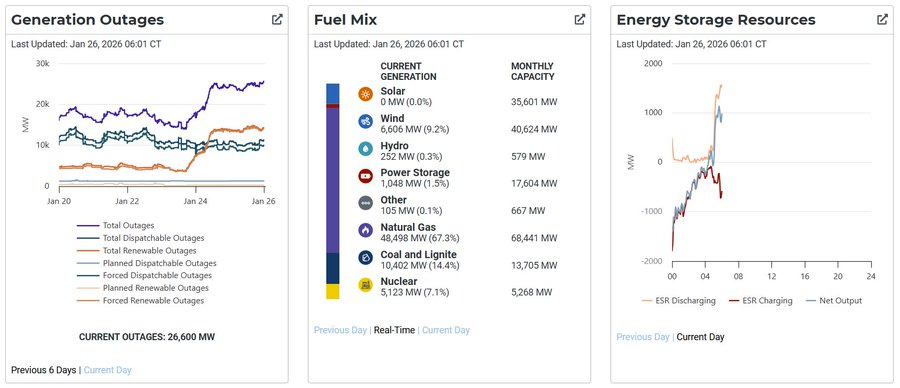
As of early Monday morning, the state was generating 89% of its power from reliable baseload fuels — 67% from natural gas, 14% from coal, and 7% from nuclear, with just 9% coming from wind, none from solar, and 1.5% coming from batteries.

Analysis

Winter Storm Fern has further revealed the importance of connecting reliable generation resources to the grid, without which numerous lives and dollars would be lost.

State-level policies forcing the retirement of coal plants and preventing the construction of natural gas and nuclear plants have led to the current situation facing the grid, where power plants are burning oil, wood, and trash, as the Wall Street Journal reports.

Reducing carbon emissions by increasing renewable generation may sound good in theory, but the fact that solar and wind can’t provide the same capacity during poor conditions makes their inclusion on the grid duplicative and expensive.

As the Journal’s Editorial Board asks, “Is the goal to reduce carbon emissions by making Americans freeze?”

For inquiries, please contact wrampe@ierdc.org.

Coal Is the New Bridge Fuel

Once again, the consensus of government and private weather forecasters is that this coming summer will witness above-average temperatures in most parts of the United States. Already, warnings have been sounded that America’s power grids will be under great stress—as has been the case for a number of years—with a strong probability of blackouts and brownouts in some parts of the country. 

From Watts Up With That?

By Bernard L. Weinstein

Once again, the consensus of government and private weather forecasters is that this coming summer will witness above-average temperatures in most parts of the United States. Already, warnings have been sounded that America’s power grids will be under great stress—as has been the case for a number of years—with a strong probability of blackouts and brownouts in some parts of the country.  For example, the North American Electric Reliability Corporation’s (NERC) summer reliability assessment published on May 18 cited the 15-state Midcontinent Independent System Operator (MISO) as the regional grid most likely to see a meltdown this summer.

NERC’s warning proved to be prescient. On May 25, more than 100,000 customers in and around New Orleans lost power for most of the day when electricity demand exceeded supply, despite an emergency order from the Department of Energy several days earlier to keep a 1,560 megawatt coal plant in Michigan on-line that was slated for closure by the end of May. ERCOT, the Texas grid operator, has also warned of possible outages this summer due to potential low solar and wind energy availability during peak demand.   

The strains on America’s power grids are easy to explain. After remaining relatively flat for a decade, electricity demand is now projected to jump 50% over the next 10 years. Investments in server farms, artificial intelligence, crypto-mining, and a revival of manufacturing activity account for most of this growth. For example, a recent study by the Berkeley National Laboratory found that data centers consumed 4% of total U.S. electricity in 2023 but will account for 12% of power demand by 2028.    

At the same time, construction of new base-load power plants—natural gas, nuclear, and coal—has plummeted. Driven by federal, state, and local tax incentives, wind and solar have accounted for the lion’s share of new installed generation in recent years. The problem, of course, is that these power sources are intermittent, which is why New Orleans lost electricity in May and why the Iberian Peninsula suffered a blackout in April.

Although several states—most notably Texas—have adopted programs to encourage new construction of natural gas plants, for the near term it’s critical to keep the nation’s remaining coal plants online.

Since 2010, 300 “always on” coal-fired power plants have been closed, reducing its share of generation from 45% to 16% nationwide. Only about 200 remain on the regional grids today.

The Trump administration has taken several steps to enhance power grid reliability and resiliency by keeping these coal plants on-line, including a series of executive orders signed by the President in early April. One of these orders allows a number of aging coal plants slated for closure to continue producing power. 

Not surprisingly, these actions have energized environmentalists who remain committed to shuttering the remaining coal fleet and banning the construction of any new fossil fuel power plants. But the renewables-or-nothing approach they favor is crashing into a new energy reality. Not only is power demand poised to surge but building and connecting wind and solar plants, as well as the infrastructure needed to integrate them into the grid, is proving increasingly costly and challenging. Coupled with higher interest rates and supply chain challenges, local opposition to wind and solar farms, as well as new transmission lines, is having a significant impact on the speed and scale at which new generation is entering service.

The era of tearing down existing, well-operating power plants before reliable replacement capacity is built and connected to the grid is over. The on-demand power plants already in service are more valuable than ever. While coal’s long-term future remains in question, its near-term importance is clear. Our existing fleet of coal plants can help us manage the transition to a more reliable and resilient energy future as we build the next generation of base-load resources.

Bernard L. Weinstein is retired associate director of the Maguire Energy Institute at Southern Methodist University, professor emeritus of applied economics at the University of North Texas, and a fellow of Goodenough College, London. 

This article was originally published by RealClearEnergy and made available via RealClearWire.

The Politicized Texas Grid: Sheridan Calls for Transparency (and Mea Culpas)

Texas is turning to government-aided natural gas to fix its broken political grid. Yes, wind and solar did that in one of the natural gas meccas of the world.

From Master Resource

By Robert Bradley Jr.

“Our affection for Texas runs deep, but so does our concern over its grid. It’s time for a candid conversation about the state’s energy policies—one that acknowledges the true costs and challenges of a blindly pro-renewables approach and seeks solutions that ensure the resilience of the grid and the well-being of Texans.” (Doug Sheridan, below)

Texas is turning to government-aided natural gas to fix its broken political grid. Yes, wind and solar did that in one of the natural gas meccas of the world.

Doug Sheridan, a reliable voice on social media, posted this at LinkedIn:

It was big news last week that the Texas PUC received 125 applications for 56 GW of new gas-fired generation. The legislation behind the initiative—which appropriates $5B in state grants and loan guarantees to the plants—was intended to spur 10 GW of new gas-fired capacity on ERCOT.

We’ve seen commentary about what the supposedly massive “oversubscription” means, with plenty of energy industry insiders hailing it as a rebuttal to the massive buildup of renewables on the state’s increasingly shaky grid. We’re not so sure.

The subsidized fund for gas-fired generation is far from a solution to the grid’s large and growing problems. More likely it’s a political fig-leaf to cover up poor grid management by state leaders—that is, a way to say, “Don’t blame us, we tried to fix it” should the system suffer catastrophic failure due to the non-performance of renewables.

The truth is many of the same state politicians who championed this particular law have actually enabled the very situation on the grid they now supposedly decry. We say supposedly because, to be clear, there’s absolutely no *mea culpa* here—from anyone. We don’t get those anymore.

We suspect analysis of political contributions from renewable energy interests to Texas politicians would show there’s too much in the way of donations flowing to the political class to expect they’d ever disallow more damaging renewables on the system. Again, we may be wrong on this point, but we doubt it. In time, we hope to do that analysis.

Leaders in Austin seem determined to tempt fate in other ways as well. As reported by David Blackmon, Lt. Gov Dan Patrick is now referring to a “Texas Miracle”… presumably of economic growth and prosperity. Careful Sir, there are too many problems lurking on the Texas grid to be claiming miracles at this point.

When it comes to the 125 applications for new gas-fired capacity, many questions remain. Certainly more honest and complete math needs to be done. Our sense is that honest analysis would show that Texas rate- and tax-payers are now effectively financing the kind of inefficient duplicate backup generation capacity critics of renewables have been warning about for years.

The lack of public understanding of what’s going on as it relates to the Texas grid is also a concern. That’s because it limits the public’s ability to act as a governor in real time to politicians… and their policy makers and moneyed interests. Unable to punish politicians at the polls in advance of breaking our grid, it leaves only the regrettable option of punishing them after the fact.

Our affection for Texas runs deep, but so does our concern over its grid. It’s time for a candid conversation about the state’s energy policies—one that acknowledges the true costs and challenges of a blindly pro-renewables approach and seeks solutions that ensure the resilience of the grid and the well-being of Texans.

Final Comment

Hear, hear. The wind/solar/battery experiment in Texas has wounded a once reliable grid by replacing consumer-driven, taxpayer-neutral, economic, reliable energies with inferiors. And where has anyone calculated what the benefits are in terms of avoided “climate change”? Instead, the wilds of Texas are being industrialized, a not-so-green outcome that Big Green does not want to contemplate. Kudos to the Doug Sheridans for speaking truth to political power to such wind/solar/battery apologists such as Doug Lewin on the Texas electricity ‘market’.

Tomlinson on the Texas Grid Three Years Ago (prediction fail!)

With the 3rd anniversary of the Great Texas Blackout (February 2021) this week, it is worth revisiting an (egregious?) forecasting error of Houston Chronicle business editorialist Chris Tomlinson.

From Master Resource

By Robert Bradley Jr.

Ed. Note: With the 3rd anniversary of the Great Texas Blackout (February 2021) this week, it is worth revisiting an (egregious?) forecasting error of Houston Chronicle business editorialist Chris Tomlinson. The conflicted journalist (married to a multi-millionaire renewables developer) has continued to posit the false narrative that natural gas failed, not wind, solar, and central planning in the state. This post was originally published at MasterResource.

“Fossil fuel-supporting Chicken Littles have done their best to spread fear of renewable energy, warning that relying on wind, solar and storage would lead to blackouts and economic devastation.” ( – C. Tomlinson)

Three years ago this month, Houston Chronicle business editorialist Chris Tomlinson wrote that no iceberg was ahead for the Texas grid–and concerns about the wind/solar takeover was special-interest drudge. True, the warnings from the free-market community were long in coming–but they turned out true for the right reasons.

Josiah Neeley, then with the Texas Public Policy Foundation, wrote back in 2012:

“It is well known that Texas is undergoing a major challenge in maintaining resource adequacy due to improper price signals; less well known is that a significant portion of the problem can be laid directly on the doorstep of subsidies for wind generation…. Congress should allow the PTC to expire; if not, we may see the end Texas’ world-class energy-only electricity market.

Tomlinson’s three-year-old editorial, “Evolving Texas grid marks beginning of the end for fossil fuel electricity” (December 25, 2020) follows.

Fossil fuel-supporting Chicken Littles have done their best to spread fear of renewable energy, warning that relying on wind, solar and storage would lead to blackouts and economic devastation.

For years, I have denounced the propaganda promulgated by lobbyists financed by the oil and gas industry. Now, the latest data proves that the New Year will mark the end of the beginning for clean energy, and the beginning of the end of our reliance on coal and natural gas for electricity.

The tipping point was revealed in the latest capacity report from the Electric Reliability Council of Texas, or ERCOT, the grid operator that delivers power to most of the state. After several years of thinning reserve generation capacity due to coal-fired plant retirements, solar facilities are adding cushion.

ERCOT runs one of the world’s leading competitive wholesale markets for electricity. Rather than dictate what kind of power plant an energy provider should build, generators compete to sell the lowest-cost electricity. In Texas, demand sets the price, not a political appointee.

Utilities have been shutting down old, expensive coal-fired and natural gas-fueled power plants, while others have constructed wind and solar facilities subsidized with tax credits. Texas’s electricity reserve margins dropped below target levels in 2018 and 2019, stirring a lot of debate about reliability and higher prices.

“These business cycles of retirements and new investments are expected in the ERCOT market, and it is ERCOT’s job to maintain reliable electric service through the various changing conditions,” ERCOT CEO Bill Magness said in a statement. Most of the new investments are paying off.

ERCOT expects to add 3,039 megawatts of utility-scale solar resources, 1,765 megawatts of wind and 816 megawatts of natural gas-fired generation next year. The grid will have 86,842 megawatts of capacity to serve an expected peak demand of 77,244 megawatts in 2021, the council said.

In addition, ERCOT is working on adding large batteries that will provide even more capacity during the hour or so every August when demand peaks. The reserve capacity in 2021 will be 15.5 percent, well above the target of 13 percent, and will rise to 27 percent in 2022, ERCOT said.

Solar and wind power’s predominance in new generation is typical across the country, where major corporations and consumers want more of their electricity from sources that do not contribute to climate change.

No new coal-powered plants are planned for the United States. New nuclear power technologies are a decade away from deployment. New natural gas plants struggle to compete on price with solar and wind, even after renewables lose the federal tax subsidies that are phasing out over the next few years.

President-elect Joe Biden also wants to make the U.S. power grid carbon neutral by 2035 to fight climate change. While there are still plenty of fossil fuel Chicken Littles declaring that goal impossible, innovators are describing plenty of pathways to achieving net-zero greenhouse emissions.

“For an industry that has focused heavily on solar and wind, supportive federal actions could help progress timelines for further expansion into new technologies, including advanced batteries and other forms of storage, offshore wind, and green hydrogen technology,” the consulting firm Deloitte explains in its new Renewable Energy Outlook.

Batteries and green hydrogen, both of which I’ve written about recently, offer novel and affordable ways to store energy when proverbially, the wind does not blow, and the sun does not shine. Carbon capture technology can also offset carbon emissions for those times when natural gas is needed.

Federal investment in these new technologies will be critical to meet the 2035 net-zero goal for electricity generation and even more important to make the entire economy net-zero by 2050. Both targets are essential to prevent warming to levels that imperil human life.

Making those investments will also generate economic returns. Federal incentives could trigger $1 trillion in private capital investment and create 1 million new clean energy jobs, according to a report from energy consulting firm Wood Mackenzie and the American Clean Power Association.

“Transforming the U.S. power grid is technically and commercially feasible, with appropriate policy support. This activity would unlock a tremendous economic development opportunity for infrastructure investment and associated jobs,” said Aaron Barr, principal consultant in Wood Mackenzie’s Energy Transition Practice.

Every week another organization shares a new plan for reaching net-zero emissions by 2035, and every technological innovation and cost reduction makes fossil fuel generation less attractive. The transition is well underway.

Those who make their living off fossil fuels can keep claiming the sky is falling, but the trajectory is clear. The energy powering the future will not come out of the ground.

And here we are three years later. Texas’s wounded grid has summer and winter problems that have required duplicating the grid with expensive storage (not needed with fossil-fueled generation) and ERCOT monies for thermal reserve incentives. Nationally and internationally, government-drilled energy transformation is causing higher prices, ballooning federal budget deficits, and consumer angst. The environment is suffering too from renewable blight and sprawl.

Will Chris Tomlinson make any mid-course correction. Does he have any incentive to do so?

Electricity Expert/Planner ‘Shaken’ (Texas debacle shocks worldview)

With the 3rd anniversary of the Great Texas Blackout of February 2021, it is worth remembering the second thoughts that architects of the centrally planned state grid (ISO/ERCOT) had at the time. But have the guilty feelings resulted in a fundamental rethink of government electricity?

From Master Resource

By Robert Bradley Jr.

Ed. Note: With the 3rd anniversary of the Great Texas Blackout of February 2021, it is worth remembering the second thoughts that architects of the centrally planned state grid (ISO/ERCOT) had at the time. But have the guilty feelings resulted in a fundamental rethink of government electricity? This post is reprinted from MasterResource (May 20, 2021)

“I have to admit, the ERCOT blackouts have shaken me. The amount of physical damage and human suffering they caused is astounding. Obviously, the ‘market’ failed to provide the service reliability that customers expected and deserved.”

– Robert L. Borlick, Independent energy consultant, here

It is tough when your belief system gets rattled by reality. Very few people can handle that well. The best prevention strategy is to keep an open mind, and understand other views about as well as your own. Be polite, and stay modest (‘the higher you fly, the harder you fall’).

One longtime electricity planner, Robert L. Borlick, is angry. His ideal regulatory/planning system, the Electric Reliability Council of Texas, overseen by the Public Utility Commission of Texas (PUCT/ERCOT), crashed. He is in denial, having claimed:

  • The February Texas experience was akin to earlier experienced blackouts (“To be sure, the ERCOT blackout was bad but nowhere as widespread as the Northeast blackouts. Not even close.”)
  • Wind and solar power have not compromised the grid (“wind and solar had virtually no role in causing the Texas blackout.”)
  • Natural gas was the Blackout culprit, and criminally so (“The CEOs of those gas companies should be criminally charged.”)
  • PUCT/ERCOT planning is not regulation but the free market (“In ERCOT the free market determines reliability.”)
  • More regulation is needed, not less. (“Unintended consequences of government intervention?’ Are you f***in’ kidding me? What just happened is a direct consequence of insufficient government intervention!”)
  • There is no free market alternative to central planning . (“The grid would go dark very quickly in the absence of a system operator (like ERCOT) to direct the traffic.”)
  • As his critic, I am untrustworthy and serious participant. (“Rob, why are you shilling for the natural gas industry?”)

Like other central planners, Borlick wants more government (coercion) to address the problems of earlier planning failures:

Cost benefit analysis (whether pure or impure) will reach the optimal solution if it is done right and includes all of the social costs and benefits. For example, the customers that were interrupted deserve to be paid $9 for each kWh they would have consumed if they had remained connected…. The Texas legislature should mandate that all REP contracts contain clauses requiring such compensation.

His worldview at risk, Borlick stubbornly believes that lost renewables during the Texas freeze was “a fly on the ass of an elephant.” (Evidently, renewables can be excused from their disappearing act because we know and expect it.) But every thousand megawatts of capacity counts, particularly at the peak. But perhaps more importantly, the government-forced renewables binge has prematurely retired reliable generation from gas and coal, and new capacity, chiefly powered by natural gas, has been shelved .

And low margins from wind’s negative pricing (which Borlick admitted: “I agree; negative prices are dysfunctional. I have never supported the production tax credit’) naturally leads to postponed or foregone expenses, such as weatherization.

But that’s no excuse. Economist not, Borlick states:

Obviously, the “market” failed to provide the service reliability that customers expected and deserved. It’s cold comfort that the major generation owners, NRG and Vistra lost about $1 billion – each. Their failure to weatherize assets cost consumers many multiples of $2 billion. This is also true regarding the unweatherized natural gas assets.

The market flaw appears to be that market participants optimized their positions based on the costs and profits they expected to incur while ignoring the costs and benefits of the retail customers. Today this is obvious. The question is how to fix this market flaw?

Not enough mandates. And who is to blame for the debacle?

Presumably, Efficient market behavior will result if property rights require the party that harms another to fully compensate the harmed party. Going forward, should generators be required to compensate the customers that lost service? Lastly, does anyone have the obligation to serve? The REPs?

So, government intervention distorts incentives, and dis-incited market participants get punished? And what does the ‘obligation to serve’ mean when reliability is outsourced to government rather than being the role of entrepreneurs in a free market?

Welcome to the road to serfdom.

Borlick’s insults sometimes catch up to him. On one occasion (not involving me) he got melancholy:

I apologize for the condescending tone of my reply. Not knowing all of the facts doesn’t mean someone is unworthy of respect.

I have to admit, the ERCOT blackouts have shaken me. The amount of physical damage and human suffering they caused is astounding. Obviously, the “market” failed to provide the service reliability that customers expected and deserved.

A little more humility and deep thinking about the direct and indirect role of renewables might just allow any troubled, “shaken” power expert/planner to sleep better at night. [And I forgive any harsh treatment of my (different) views in the heat of battle. Egos are behind intellectual for all of us….]

Texans Left Scrambling For Power As Wind Turbines Take Another Summer Vacation

Texas is littered with solar panels and wind turbines, but don’t expect them to deliver power as and when you need it. As happens most years, wind turbines across Texas have been on their annual summer vacation, for weeks now.

Wind turbines in the Papalote Creek Wind Farm near Taft, TX. Monday, Oct. 28, 2013.

From STOP THESE THINGS

Texas is littered with solar panels and wind turbines, but don’t expect them to deliver power as and when you need it. As happens most years, wind turbines across Texas have been on their annual summer vacation, for weeks now.

In their absence, solar is able to pitch in for a while, but sunset has this remarkable and dramatic effect on output. Which means that, by the time householders turn on their air conditioners and settle down for an ice cold beer in the evening, almost all of their electricity needs are being covered by gas, coal and nuclear, in that order.

Yet again, a calm and balmy Texan summer has shown the part-time power producers to be utterly meaningless, as Ed Ireland explains below.

The Texas Dunkelflaute
Thoughts About Energy and Economics
Ed Ireland
9 September 2023

Texas’ blackout left millions powerless.

The hot Texas wind has been dropping off in the summer afternoons of 2023, sending Texas wind turbines on summer vacation. Solar power has faired pretty well on most days, but when the sun sets every evening, solar power goes to zero. The German word for weather conditions that result in no wind or solar generation is “Dunkelflaute.” The Texas version of Dunkelflaute has occurred many evenings this summer, with some pushing the Texas grid to near collapse.

The operator of the Texas electricity grid, ERCOT, declared an Emergency Level 2 on September 6, 2023, because reserve generation capacity had dropped to less than 1,750 megawatts. The emergency notice said: “ERCOT expects tight grid conditions, requests conservation today from 5 PM to 9 PM CT.” It goes on to explain the reasons underlying the emergency:

  • Heat. Continued statewide high temperatures.
  • Demand. Texas is seeing high demand due to the heat.
  • Solar. Solar generation starts to decline earlier in the afternoon hours towards the end of summer before completely going offline at sunset.
  • Wind. Wind generation is forecasted to be low this afternoon and into the evening hours during peak demand time.

In a nutshell, ERCOT said it is hot this summer, the wind is falling off, and Texans are using a lot of air conditioning just as the sun sets. Nothing new to native and long-time Texans.

Unfortunately, typical summers in Texas now also mean that the tens of thousands of acres of wind turbines and solar panels are going offline early as the days get shorter in late summer, and the wind stops blowing during the hot summer afternoons. This starts as people are getting home and cranking down the air conditioning, starting at about 4 PM and lasting until about 8 PM, which is half an hour after sunset, and solar generation is zero.

Another factor is that the fleet of natural gas-fired generators that always fill the gaps in electrical power when the wind stops and the sun sets has been running all out for months and foregoing regular maintenance. Eventually, maintenance became necessary, and in the case of this emergency declaration, an estimated 10 MW of natural gas generation was offline for maintenance.

When the wind died down, and the sun was setting on September 6, 2023, natural gas came to the rescue, providing two-thirds of the power on the grid (thanks to David Blackmon for this screenshot taken shortly after ERCOT issued the emergency order):

Natural gas generation combined with coal and nuclear provided a whopping 90.6% of total generation on the Texas grid. Without those three dependable workhorses, rolling blackouts would have ensued. Statements that wind power and batteries saved the day are not factual.

The Texas version of a full Dunkelflaute, when the wind isn’t blowing and the sun isn’t shining, is coming next month when a solar eclipse will likely shut down solar power during the day. The 2023 Annual Eclipse on October 14, 2023, will cross North, Central, and South America. Its path will go directly over the prime solar generation country in West Texas, blocking 90% of the sun, according to NASA:

According to NASA, the solar eclipse begins in Oregon at 9:13 AM and ends in Texas at 12:03 CDT so Texas solar power generation will be reduced most of that morning. Of course, a solar eclipse does not occur often, but it will highlight the problems solar power generation faces when cloudy weather reduces solar output.

While rolling blackouts were avoided on September 6, the intermittency of wind and solar highlighted that they depend on the weather. My friend, Robert Bryce, expressed his thoughts to me on this subject:

If we are facing more extreme weather due to climate change, it would be insane to make our most-critical infrastructure dependent on the weather. We need energy and power systems that are weather resilient, not weather dependent.

Truer words were never spoken.

While Texas has the largest installed capacity of intermittent wind and solar power of any state in the U.S., the underlying strength of the Texas power market is that it is deregulated, dating back to 2002 when the Texas legislature fully implemented deregulation, giving consumers the “power to choose” their electricity provider. The basic premise of the ERCOT system was that market-determined prices would encourage power generators to provide the electricity demanded by consumers at the lowest possible price.

That system worked well until heavily subsidized wind and solar generation emerged in the early 2000s. The problem that has now been exposed is that the subsidies for wind and solar result in artificially low prices. As a result, wind and solar operators can sell their electricity at zero or even below zero. That means wind and solar are always first in the queue because they are the low bidders but can drop off at any time due to the weather, as happened on September 6, 2023.

Natural gas generators are expected to provide backup power when wind and solar are unavailable and are occasionally rewarded with peak prices of up to the cap of $5,000 per megawatt, but that occurs only occasionally and briefly. Most of the time, natural gas generators have to take a price below what is needed to maintain existing generation and encourage the development of new power generation. This has resulted in a declining fleet of natural gas-fired electricity generators in Texas.

Add to this the uncertainties of pending federal legislation, such as the EPA “New Source Performance Standards,” which threaten to shut down natural gas generation by 2040. That EPA rule would be devastating to the reliability of U.S. power grids, which was highlighted by pleas from 21 states and all power grids to halt that rule.

The State of Texas wrestled with this problem in the legislative session that ended on May 31, 2023. The state passed legislation to help provide up to 10 gigawatts of new dispatchable thermal generating capacity, most likely powered by natural gas. While that will help avoid rolling blackouts, it will not stop the ongoing problem of near-failures in the Texas power grid caused by intermittent and weather-dependent wind and solar generation.

These situations can be avoided if ERCOT develops new innovative approaches to encourage sufficient natural gas-fired power generation, both base load and peaking. The system that ERCOT proposed in the last legislative session, the “performance credit mechanism,” was rejected by the Texas legislature, but other innovative ideas must be pursued in order to stabilize the Texas grid.
Thoughts About Energy and Economics

The Wounded Texas Grid: Who’s On First?

The Texas Electric Utility Restructuring Act of 1999 is approaching a quarter-century. And what a mess has resulted from the misnomer “electricity deregulation.”

From Master Resource

By Robert Bradley Jr.

“It is time to do now what was not done in 1999 in Texas. First, deregulate the electricity market, do not re-regulate it under a new regime. That means removing public utility regulation of rates and other terms of service, as well as end the franchise protection over geographical territory.”

The Texas Electric Utility Restructuring Act of 1999 is approaching a quarter-century. And what a mess has resulted from the misnomer “electricity deregulation.” A monopoly wholesale market under mandatory open-access rules is central planning pure and simple. The idea that a ‘competitive’ retail market rescues the wholesale market from the knowledge problem and politicization (per Lynne Kiesling, Michael Giberson, etc.) has been turned upside down in Texas and elsewhere.

I was reminded of this upon reading a 500-word commentary from Doug Sheridan on LinkedIn. It is worth reproducing in its entirety.

Imagine you’re in charge of the electric grid that services the vast majority of America’s second largest state. You have a problem—demand for power is soaring, and supply is increasingly erratic… even shrinking.

You’re faced with the fact that the wind turbines and solar panels that make up a large chunk of your capacity are often barely producing. And that your underappreciated, overtaxed and undercompensated thermal plants that are supposed to fill the gap are struggling to keep up.

You know you have to do something, but you also know you have to answer to a lot of people who don’t want you to do anything—mostly because they don’t want you drawing attention to the problems on your system, lest their role in creating or enabling those problems makes the front page.

Sheridan continues by identifying culprits.

You have a governor, who has vowed to keep Texas free from a green energy takeover, but seems weirdly happy to help facilitate just that. You have a confused legislature, who’s slashed your budget and oversight after the last blackout fiasco, which was largely enabled by persons of their own ilk.

You have a public utility commission of questionable competence, who appointed your bosses and can fire you at any time. You also have a media who are unabashed cheerleaders for overhyped wind and solar generation. They are also ready to pounce on any hint of mismanagement or corruption.

Finally, you have a demanding public, who are used to cheap and reliable power and who won’t tolerate interruptions.

So what to do? Sheridan ends:

You try to avoid making any hard decisions. You try to squeeze every last megawatt out of the generators on your system, even if it means risking damage or breakdowns. You try to delay any orders to cut power to customers, even if it means risking instability or collapse.

You also position yourself to shift the blame for these circumstances to others than yourself, your organization and your bosses, even if it means ignoring the root cause of your problem—the growing reliance on intermittent and unreliable sources of energy that are incompatible with your grid and its mission.

You hope that somehow, some way, you can get through this crisis without anyone noticing how close things are to the edge. You hope that no one will ask you why you didn’t better plan ahead, why you failed to act with greater urgency, why you didn’t invest in more reliable and resilient infrastructure, why you didn’t stick to reliable, dispatchable, and affordable forms of energy.

You pray that no one will question your competence, your integrity, or your loyalty. Most of all, you hope no one will realize you’re in charge of a massive and growing house of cards—increasingly pressing your luck and that of the state with each passing day.

To Sum It Up: Say hello to Pablo Vegas, president and CEO of ERCOT and the most on-the-spot person in Texas. And wish him luck… he needs every bit he can get.

Commentary

It is time to do now what was not done in 1999 in Texas. First, deregulate the electricity market, do not re-regulate it under a new regime. That means removing public utility regulation of rates and other terms of service, as well as end the franchise protection over geographical territory.

Second, the owners of transmission and distribution assets have the right to use their property as they want without state or federal mandates involving other parties.

Third, intermittent generation (wind, solar, batteries) or related transmission will not be advantaged by taxpayers or under regulated rate designs. Private contracting will settle the exact terms in a truly free market. The what, when, where of electricity in the home or business or otherwise.

This will require new laws to repeal old ones. Ideas have consequences–let the debate broaden.

Wind Output Plaguing Texas (ERCOT weathers on)

Wind and solar are not reliable enough to maintain grid stability and therefore require dispatchable power sources such as coal, nuclear, and natural gas-powered generation to stabilize the grid. Until sufficient utility-scale battery storage is available, which is unlikely anytime soon due to the cost of current technologies, the ERCOT power grid and all others will require substantial natural gas generation capacity to maintain grid stability.

Wind turbines in the Papalote Creek Wind Farm near Taft, TX. Monday, Oct. 28, 2013.

From  Master Resource

By Ed Ireland

“Failures of wind and solar during severe weather events are a problem, but a larger problem is that failures are not confined to severe winter storms. In fact, these failures occur on a daily and even hourly basis. During the summer months, wind tends to die down in the afternoons, causing large drops in wind-generated electricity. Later afternoon rain storms can reduce solar generation significantly.”

Texas is blessed with mineral and natural resources. Texas is the largest crude oil and natural gas producer in the US. It would be the world’s 4th largest producer if Texas were a country.

For reasons of politics and government intervention over a quarter-century, Texas is the largest wind power producer and second-largest solar producer in the U.S. and will likely surpass California, the leading solar power state, within a year.

We long have been told that wind and solar can replace coal, oil, and natural gas for power generation, but nothing could be farther from the truth. Wind and solar are dilute, intermittent sources that depend on the weather. If the wind is blowing and the sun is shining, they may work to some extent, but the weather changes constantly, and so does their ability to produce electricity.

An epic failure of wind and solar in Texas was during Winter Storm Uri in February 2021. While there were failures in all types of generation, including coal, nuclear, and natural gas, due to the sub-freezing and even sub-zero temperatures, wind turbine freeze-ups were a major problem for the ERCOT system. (Ruined margins for the reliables from wind/solar had a major negative effect too in setting up the failure, a separate story.)

Less than two years later, in December of 2022, wind and solar failed again during Winter Storm Elliot, but the State had learned some lessons from Uri and was prepared with sufficient natural gas, coal, and nuclear-generated electricity.

Failures of wind and solar during severe weather events are a problem, but a larger problem is that failures are not confined to severe winter storms. In fact, these failures occur on a daily and even hourly basis. During the summer months, wind tends to die down in the afternoons, causing large drops in wind-generated electricity. Later afternoon rain storms can reduce solar generation significantly.

Peak Demand, Unreliable Supply

The summer of 2023 has been a very hot one as a result of two weather overlapping events: El Nino and the eruption of the Hunga Tonga–Hunga Ha’apai volcano eruption, with El Nino bringing in hot air from the west and the HTHH forming a heat cap, resulting from the extremely large volume of water vapor accompanying the eruption.

The enhanced greenhouse effect? Not so much because the GHG ‘signal’ has a winter, night, high latitude character–not Texas summer afternoons. Abruptness (Spring was relatively normal) fits nature, not the human influence.

The resulting summer heat has stressed many power grids due to higher-than-normal cooling demand. The combination of these two weather events has produced very hot summer conditions in the US and other parts of the world and added another layer of stress to power grids.

In Texas, the higher-than-normal air conditioning loads coupled with its high installed capacity of wind and solar have been challenging for the load management on the ERCOT power grid for two reasons: (1) the wind tends to subside on hot afternoons, and (2) solar panels lose capacity due to the high temperatures. This leads to a double whammy for the Texas power grid of losing electric generating capacity from both wind and solar.

These losses are documented on the ERCOT “Dashboards” as shown below for Thursday, August 17, 2023:

Note that the Maximum Capacity for solar is 21,162 megawatts (MW), while its summer capacity is only 12,636 MW. The “Maximum Capacity” for wind is 38,695 MW, while its Summer Capacity is only 10,427 MW. The low summer capacity for wind is due to the fact that winds die down in hot afternoons, so wind turbines fail to produce anywhere near their capacities. Solar panels are less efficient in converting sunlight to electricity at warmer temperatures. Note that the solar panels in this example were performing near their “Summer Capacity” earlier that day on August 16, 2023, but this screenshot was taken at 8:30 PM when the sun was setting, and the temperature had declined.

With Coal and Nuclear operating at their maximum levels (coal is actually producing over its Summer Capacity), the power grid is dependent on natural gas to keep the lights on and the air conditioning running, and it did its job, producing 60% of the power being produced on the grid.

Nevertheless, the ERCOT power grid dropped below its acceptable minimum level of 3 MW, as shown in the graphic below, which is an automatic voluntary conservation notice.

This low level of operating reserves is reflected in the “System-wide Prices” graph shown below, which shows that spot prices for natural gas reached $5,000 per megawatt for a few minutes, which is the maximum price allowed on the ERCOT system.

Price spikes are a predictable consequences of faulty supply-side energy reliance.

Conclusion

Wind and solar are not reliable enough to maintain grid stability and therefore require dispatchable power sources such as coal, nuclear, and natural gas-powered generation to stabilize the grid. Until sufficient utility-scale battery storage is available, which is unlikely anytime soon due to the cost of current technologies, the ERCOT power grid and all others will require substantial natural gas generation capacity to maintain grid stability.

The Texas legislature understood this requirement and passed several bills with appropriate spending to keep the ERCOT power grid running with enough dispatchable power to maintain its reliability. ERCOT is doing a commendable job managing the Texas power grid this hot summer–even with the largest wind and second-largest solar portfolio in the US–thanks to Texas being the largest natural gas producer in the country.