Global warming, climate change, all these things are just a dream come true for politicians. I deal with evidence and not with frightening computer models because the seeker after truth does not put his faith in any consensus. The road to the truth is long and hard, but this is the road we must follow. People who describe the unprecedented comfort and ease of modern life as a climate disaster, in my opinion have no idea what a real problem is.
Dr. Ryan Maue has warned that if the winter of 1962-1963 occurred with today’s European energy system, Germany would not be able to make it. The country is currently facing “exceptional energy shortfalls” and the weather models are indicating severe winter conditions across Europe for early January.
Dr. Ryan Maue has warned that if the winter of 1962-1963 occurred with today’s European energy system, Germany would not be able to make it. The country is currently facing “exceptional energy shortfalls” and the weather models are indicating severe winter conditions across Europe for early January.
Meteorologist Dr. Ryan Maue warns at X that if the winter of 1962-1963 happened again with today’s European energy system, then “Germany won’t make it”. The country has “exceptional energy shortfalls.”
Image genrated by Grok AI
And, suddenly, the weather models are hinting at severe winter conditions across Europe for early January.
Maue’s claim leans on a paper titled: “On the Link Between Weather Regimes and Energy Shortfall During Winter for 28 European Countries,” published in Meteorological Applications (2025) by Emmanuel Rouges, Marlene Kretschmer, and Theodore G. Shepherd. The authors examine how specific atmospheric patterns affect the balance between energy demand and renewable energy production across Europe.
The study focuses on energy shortfall, defined as periods when electricity demand significantly exceeds renewable energy production (specifically wind and solar). It analyzes 28 European countries using a “fixed electricity system” model (based on current infrastructure) and historical weather data (reanalysis) to see how past weather would affect today’s grid.
The researchers found that the primary driver of shortfall varies by region. In cold-climate, low-windd capacity countries, a shortfall is primarily demand-driven (e.g., increased heating needs during cold snaps).
In warm climate, high wind capacity countries, a shortfall is primarily production-driven (e.g., periods of low wind speed or “Dunkelflaute”).
The study categorized winter weather into six specific “regimes.” Only a subset of these—primarily those involving atmospheric blocking (which brings cold, still air)—are responsible for the majority of high-shortfall days. These critical weather regimes often affect large portions of the continent simultaneously, meaning many European countries experience energy stress at the same time.
There is a high level of spatial correlation in energy shortfalls. If one country is experiencing a shortfall, its neighbors are highly likely to be in the same situation. This highlights a potential challenge for “sharing” energy across borders during extreme weather events, as many potential exporters might also be facing deficits.
The authors simulated what would happen if the 1962/1963 winter (the coldest of the 20th century in Europe) occurred with today’s energy system. They concluded that the persistent blocking conditions of that winter would lead to extreme and prolonged energy shortfalls across almost all of Europe, far exceeding the stress seen in more recent decades.
The paper emphasizes that as Europe transitions to renewable energy, understanding the meteorological drivers of shortfall is critical. It suggests that energy planners must account for the fact that extreme weather events can cause simultaneous, continent-wide energy crises that current interconnected grids may struggle to mitigate through simple cross-border trading.
Climate scientists embracing their inner eco-fascist?
‘Carrots’ can’t save the climate – we need a big ‘stick’
Publicly released: Mon 22 Dec 2025 at 2100 AEDT | Mon 22 Dec 2025 at 2300 NZDT
Subsidies for green technologies (‘carrots’) may help in the short-term, but punishment policies like charging for carbon emissions (‘sticks’) are likely needed as well to greatly reduce CO2 emissions by 2050, according to a US study. Researchers used a computer model of the US that included factors like socioeconomics, energy systems and consumer demands to look at the effects of ‘carrot-first’ policies, in which the ‘stick’ was introduced in 2035 or in 2045. They found that the size of the ‘stick’ (i.e. the price of carbon) would have to be just as big, or even bigger, than if only a ‘stick’ policy was used, without any ‘carrots’ to sweeten the deal. The researchers said that although ‘carrot’ policies are more appealing to governments to appease big industries and voters, leaders need to start hitting out with ‘sticks’ to make sure CO2 emissions dramatically decrease by 2050.
Many political jurisdictions have embraced climate policy strategies that emphasize large subsidies to deploy green technologies (‘carrots’) with the anticipation that more punitive policies (‘sticks’) may follow. However, little is known about how such policy sequencing affects future policies, emission reductions and costs. Using a multisector model for the USA, we examine carrot-first policies which mimic the increasingly popular interest in industrial policy and offer a way to model these real-world policy choices in energy-system models. We find that a carrot-first policy strategy still requires later use of similar-sized sticks when compared with a policy strategy that begins with sticks and achieves the same levels of long-term decarbonization. Policy carrots alone do not dramatically reduce future emissions. Only with policy sticks are there unambiguous signals to substantially shrink the size of incumbent fossil fuel industries.
Sticks are only required in the context of energy policy if the energy policy doesn’t make sense.
When the world transitioned from whale oil to kerosene between 1860 to 1870, it was pretty much all over by 1870. No government subsidies or coercion were required, because the energy transition made sense. Whale oil was expensive and smelly, and kerosene was cheap and had a less offensive odour.
In addition, sticks can lead to bad outcomes. Whether it be sky high energy prices in green states like California or New York’s unheated school bus horror WUWT recently reported, driving energy use change with coercion forces people into bad situations they wouldn’t choose of their own free will.
The silver lining to this nastiness is this is the demand for coercion is tantamount to an admission the renewable transition has failed, that green technology is not ready to replace fossil fuel. Ordinary people are rejecting the renewable energy transition on a scale which makes Net Zero goals impossible without the use of coercion and force. Otherwise, desperate greens wouldn’t be advocating depriving people of liberty to make their own choices.
Energy analyst Robert Bryce maintains a database showing that, as of November 2025, local communities have rejected or restricted 595 wind, 475 solar and (more recently) 72 large-scale battery projects.
Energy analyst Robert Bryce maintains a database showing that, as of November 2025, local communities have rejected or restricted 595 wind, 475 solar and (more recently) 72 large-scale battery projects.
Many don’t want the installations blanketing wildlife habitats, scenic vistas, croplands or their backyard viewsheds; especially when the unreliable electricity is exported to faraway, power-hungry, virtue-signaling cities; and particularly when they are expected to help pay for installations and transmission lines that serve another state: North Dakota ratepayers to help Minneapolis, for example.
Many people also get riled up over the real costs of “green” energy – the total actual costs … versus deliberately lowballed costs that advocates emphasize.
This opposition is not only an American phenomenon. French and other European towns are also raising concerns, as are others around the world.
A recurrent sales pitch is that wind and solar power costs are declining and are now lower than coal, gas or nuclear electricity, ensuring lower prices for consumers. The claims leave out important but studiously unmentioned costs – economic, environmental and human.
“Save with renewable energy” promotions typically look only at initial costs associated with installing wind turbines and solar panels – which often come from China and are manufactured with cheap labor, using materials extracted with child labor, in mines and facilities with minimal or no workplace safety or environmental safeguards, with every phase fueled by oil, natural gas or coal.
Promoters also ignore sneaky subsidies paid via taxes and hidden charges on electric bills. They ignore payments to companies for not producing electricity when they must shut down because of high winds or when generation exceeds supply or grid capacity.
They don’t mention the costs of constructing, maintaining and operating duplicative backup systems: coal- or gas-fired power plants that must operate full-time at low throttle and go full-bore whenever wind and sunshine are inadequate. Or the mining and pollution involved in manufacturing all these technologies.
Offshore oceanic wind turbines must be replaced frequently, due to salt spray and storms. Hailstorms can destroy entire solar panel installations. The trillions of dollars keep adding up.
High-voltage transmission lines, often hundreds of miles long, cost $1-8 million per mile – for concrete, power lines, transformers, towers 50-200 feet tall, and warehouses of other equipment.
No wonder states and countries obsessed over climate cataclysms, net zero, and wind and solar have outrageous electricity rates. Germany now has the developed world’s highest domestic electricity prices; Britan has its highest industrial rates. Average prices for Europe’s heavy industries are double those in the United States. US states heavily reliant on wind and solar likewise pay exorbitant prices.
When families cannot afford electricity or gas, their homes are frigid, and thousands die every winter from illnesses they would survive if they had proper heat.
Even France – which generates two-thirds of its electricity with nuclear power and leads Europe and the world in this regard – is betting big on solar, plus some wind. President Emmanuel Macron’s government intends to install millions of solar panels on “wastelands” and along freeways, and still “protect the beauty of our landscapes.”
The French Parliament has mandated that parking lots larger than 1,500 square meters (16,145 square feet; 80 vehicles) be 50% covered with solar panels. The government claims this electricity will equal the output of ten nuclear power plants producing a total of 10 Gigawatts on about 13 square miles of land.
It’s a fantastical assertion.
A 1-GW solar installation requires 4,000-5000 acres (6-8 sq. mi.), so ten will cover roughly 70 square miles. That’s nearly twice the land area of Paris, if entire parking lots are covered by panels. Can there possibly be that many appropriately sized outdoor lots in France?
Moreover, actually generating Gigawatts with photovoltaic solar requires – sunlight! France averages about 2,000 hours a year (23% of total annual hours). So, legislators will have to conjure up many more parking lots covered in solar panels. Or compel the sun to shine longer and brighter.
Unless France builds more coal and gas power plants, it will also have to spend tens of billions of euros to install hundreds of thousands of grid-scale batteries, to store much of that electricity for nighttime and cloudy-day needs, diverting electricity from homes to batteries.
Perhaps the Macron government recognizes these obstacles. It’s blanketing, not just roadsides, “wastelands” and parking lots, but farmlands, meadows and forests all over France.
But when national governments make “climate stabilization” and “saving the planet” their top priority, destroying villages, scenery, croplands and habitats becomes a minor inconvenience. So does the fact that much of the pseudo-sustainable electricity will likely be exported to Belgium, Switzerland and CERN – or to Spain during its next massive blackout.
The German government even bulldozes ancient villages to mine dirty, low-quality lignite coal, because it opposes nuclear power plants … and refuses to frack for natural gas for backup power.
This craziness could be coming to your neighborhood, as governments commit varying degrees of environmental vandalism and economic suicide in pursuit of solutions to the imaginary “climate crisis.”
Sometimes a wildly “green” state or provincial government preempts local zoning laws that could otherwise be used to reject wind, solar, battery and transmission line projects, so that “70% green energy by 2030” goals can be met by building in rural areas to serve high-voter urban areas.
Climate-obsessed national governments often act to control local voices and choices in pursuit of “decarbonization” even without being bound by international treaties. However, nations frequently trample on both state and local needs and concerns by signing onto Kyoto and Paris climate agreements that impose “tyranny by treaty” and thereby let unelected, unaccountable international politicians and bureaucrats rule in contravention of national laws and even constitutions.
President Trump took America out of the Paris climate pact, President Biden put it back in, and Trump 47 removed the US again in 2025. The cycle could repeat at the national or state level, as elections install new governments. Virginia is already finding that out, as its Clean Economy Act gets a “progressive” political power boost, though Trump just suspended its offshore wind project.
Voters and ratepayers need to wake up to these realities – and vote ideologues out of power before they destroy the planet in misguided attempts to save it.
Paul Driessen is senior policy analyst for the Committee For A Constructive Tomorrow (www.CFACT.org) and author of books and articles on energy, climate change and human rights. Special thanks to researcher T.H. Platt, author of The Dark Side of Hunger Mountain, for assisting with this article.
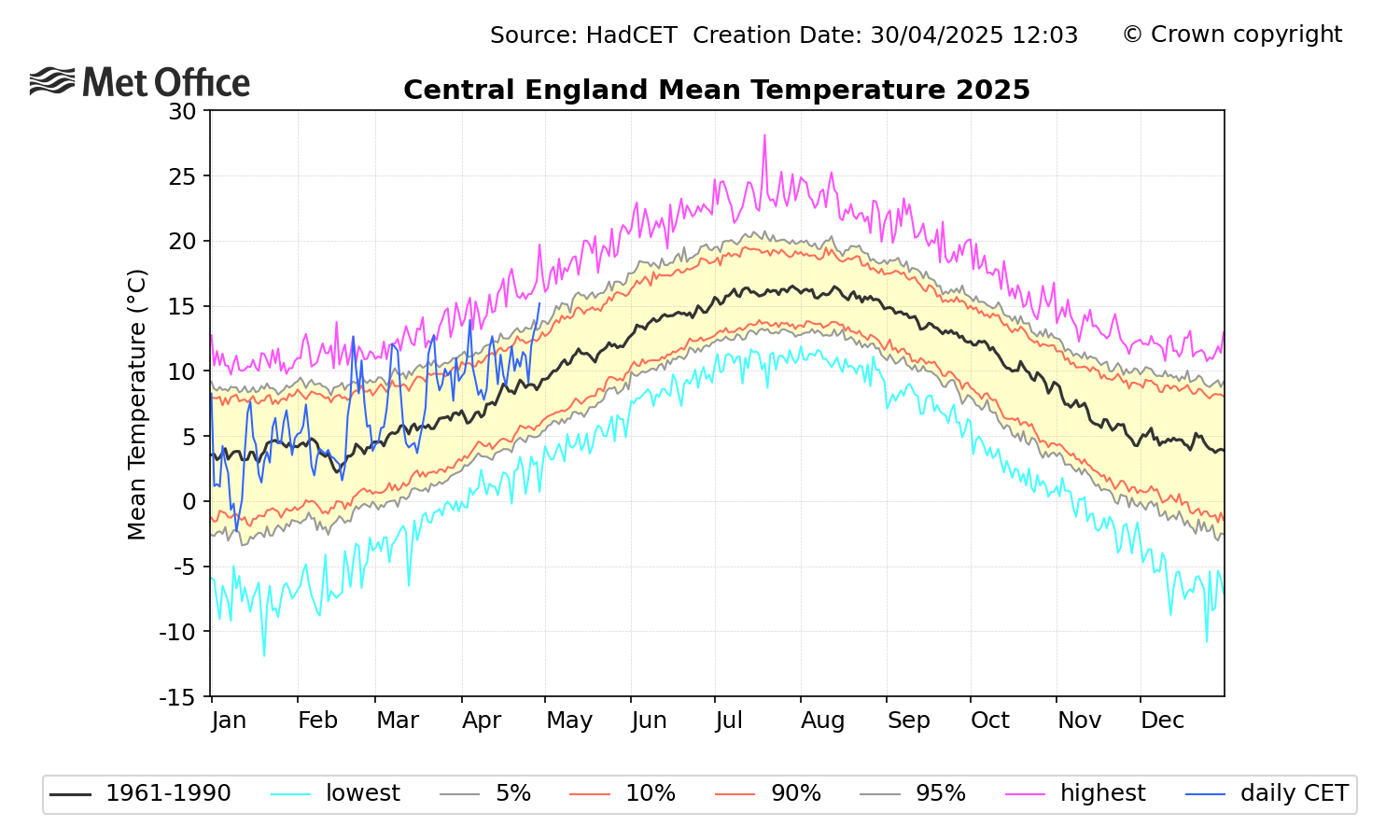
As we approach year end, 2025 is on track to be one of the UK’s warmest years on record, joining 2022 and 2023 in the top three warmest years.
Currently the mean temperature value for the year so far (up to Sunday 21 December) is tracking well ahead of the previous highest year set in 2022. However, a forecast colder spell from Christmas and extending into 2026 makes it too close to call definitively.
Mike Kendon is a senior scientist in the Met Office’s climate information team. He said: “If confirmed at year end this will be the second annual UK temperature record for the UK this decade with the previous being in 2022. This should come as no surprise. Over the last four decades we have seen the UK’s annual temperature rise by around 1.0°C. We will have to wait for the year end before confirming 2025’s final number, but at this stage it looks more likely than not that 2025 will be confirmed as the warmest year on record for the UK.
“However, it will not be long until this record is broken again. Since the start of the 21st Century a new record has been set for UK annual mean temperature no less than six times – in 2002, 2003, 2006, 2014, 2022 and now 2025 (if confirmed) – each record progressively warmer than the last. In terms of our climate, we are living in extraordinary times. The changes we are seeing are unprecedented in observational records back to the 19th Century.”
Very sorry, but anybody who claims they know the UK annual temperature to two hundredths of a degree is a charlatan. Indeed, with 80% of their data coming from junk stations, which are so badly sited that they could be overestimating temperatures by as much as 5C, they cannot seriously claim accuracy to within one degree.
And Mike Kendon needs to understand the difference between WEATHER and CLIMATE.
British weather has always been unpredictable, ranging from mild winters to cold ones and hot summers to wet, miserable ones. This year, it is the warmer weather that has dominated throughout the year.
We had a lot of sunny weather in the spring and summer. Guess what? When it’s sunny, it’s hot. And during the winter, it has been mild, wet weather from the Atlantic which has dominated.
But at no time during the year have we had temperatures that were unprecedented for the time of year. Most days had above average temperatures, but they were no higher than we have often had in the past.
In short, higher than average temperatures have been the direct consequence of weather patterns, not climate change.
We know the Met Office is getting ever more desperate to bang their climate alarm drum, as both this country and the rest of the world increasingly loses. But unless Mike Kendon can explain how emissions of CO2 lead to sunny summers or Atlantic weather in winter, his claims about “rising temperatures” are no more than political rhetoric.
As for his “unprecedented changes”, there is no evidence at all for this. Our weather has not changed at all since the 19thC; the only thing that has changed this year is the mix.
The central empirical claim of modern climate science is that the Earth system is gaining energy, and that this gain is sufficiently well measured to justify strong conclusions about long-term warming.
[note: this was published behind the paywall last week to premium users, but it’s time for complete public release]
An Epistemological Problem at the Heart of Ocean Heat Content
The central empirical claim of modern climate science is that the Earth system is gaining energy, and that this gain is sufficiently well measured to justify strong conclusions about long-term warming.
This claim does not fail because of greenhouse physics, radiative transfer, or conservation laws. It fails—or at least becomes far less certain—because of a category error about measurement.
That error becomes obvious once one confronts the scale, dominance, and uncertainty of the ocean’s energy content.
The Ocean Dominates the Climate Energy System
More than 90% of the energy attributed to recent climate change is claimed to reside in the oceans. The atmosphere, land surface, and cryosphere together account for only a small residual fraction.
This is not controversial. It is foundational.
As a result, any claim about whether the Earth’s climate system is warming, cooling, or remaining stable is, in practice, a claim about ocean heat content.
If we do not know the ocean’s energy state with sufficient epistemic confidence, then we do not know the system’s energy state—no matter how well radiative forcing is understood.
Step 1: The Absolute Energy Scale of the Ocean
Let us begin with a physically honest question:
How much energy does the global ocean contain?
To answer this, we compute the sensible enthalpy of the ocean referenced to absolute zero, including the energy required to warm ice and melt it. This is not how oceanographers usually frame the problem—but it is how thermal energy is actually defined.
Ocean mass
The mass of Earth’s oceans is approximately:
Energy components
To bring the ocean from 0 K to its present mean temperature (~3.5 °C), three energy terms are required:
1. Warming ice from 0 K to 0 °C
Because the heat capacity of ice drops sharply toward zero at low temperature, this term cannot be calculated with a constant. A physically reasonable range yield:
This term alone carries substantial uncertainty.
2. Melting ice at 0 °C (latent heat of fusion)
This term is comparatively well constrained.
3. Warming liquid seawater from 0 °C to ~3.5 °C
This is small compared to the first two terms.
Total ocean sensible enthalpy
Summing these components:
A reasonable central estimate is:
Step 2: The Uncertainty in That Quantity
The uncertainty in absolute ocean sensible enthalpy is dominated by:
Low-temperature heat capacity of ice,
Reference-state assumptions,
Simplifications required to compute a planetary-scale integral.
A conservative estimate is:
This is not a statistical error bar—it is a structural uncertainty.
Step 3: The Claimed Signal
Now compare this with the quantity that underpins modern climate attribution:
Estimated ocean heat uptake over the last ~50 years:
This is the signal.
Step 4: Putting the Scales Side-by-Side
Here is the comparison that is almost never made explicitly:
Quantity
Order of Magnitude (J)
Absolute ocean sensible enthalpy
~1027
Uncertainty in absolute enthalpy
~1026
Claimed 50-year ocean heat uptake
~1023
The ratio is unavoidable:
The uncertainty in the ocean’s sensible heat content exceeds the reported signal by roughly three orders of magnitude.
This is not a matter of better statistics. It is a matter of scale.
“But We Measure Changes, Not Absolutes”
At this point, the standard rebuttal appears:
We do not need to know the absolute heat content. We measure changes.
That sounds reasonable—until one asks what must be true for that to work.
The Wall-Mark Allegory (and Why It Fails)
Imagine measuring the growth of a child without a ruler.
Instead, you make marks on a wall as the child grows taller. Over time, the marks move upward, and you infer growth.
This works only if two conditions hold:
You know where the floor is.
The floor is not moving.
In climate science, the ocean is the wall—and the observing system is the floor.
Condition 1: Knowing where the floor is
Ocean temperature measurements over the last 50–70 years come from a sequence of fundamentally different systems:
Ship-based mechanical instruments,
Expendable probes with known, evolving biases,
Sparse deep measurements,
A modern Argo float network with different calibration regimes.
Each transition introduces offsets that must be corrected after the fact, using models.
That means the baseline is not observed. It is inferred.
Condition 2: The floor is not moving
The floor has been moving continuously:
Instrument types changed,
Sampling depth changed,
Spatial coverage changed,
Correction methods changed.
The reference frame itself has drifted.
You are no longer measuring marks on a fixed wall—you are measuring marks while the floor shifts and tilts, and then reconstructing where the floor must have been.
A Second Moving Floor: Heat Entering from Below
The epistemological problem deepens further once the bottom boundary of the ocean is acknowledged.
The ocean is not heated only from above.
Seafloor heat flux
Earth’s internal heat flow to the surface is commonly estimated at roughly:
Integrated over 50 years:
This is not negligible relative to claimed multidecadal ocean heat uptake.
Why uncertainty matters more than the mean
The critical issue is not the global mean flux—it is where and how the heat enters the ocean:
Mid-ocean ridges with intense hydrothermal circulation,
Ridge flanks with poorly constrained low-temperature heat transfer,
Seamounts and submarine volcanoes,
Vast plate interiors filled in by models due to sparse measurements.
The spatial and temporal structure of this heat input is uncertain, heterogeneous, and partially modeled rather than observed.
Epistemologically, this means the “floor” is not merely unstable—it is actively injecting heat, unevenly, through pathways that are not well constrained at climate-trend resolution.
Tightening the Comparison One Last Time
Put all relevant energy terms together:
Quantity
Energy over ~50 years
Claimed ocean heat uptake
~(3–5)×10²³ J
Seafloor heat input (order)
~7×10²² J
Uncertainty in absolute ocean enthalpy
~2×10²⁶ J
This is the full context.
The Epistemological Error
Here is the core issue, stated plainly:
Climate science treats a reconstructed differential signal as if it were a directly observed quantity, even though the signal is orders of magnitude smaller than the uncertainty of the dominant energy reservoir and comparable to poorly constrained boundary fluxes.
This is a category error.
In experimental physics or metrology, such a situation would immediately trigger questions about traceability, reference stability, and error dominance. In climate science, it is largely bypassed by redefining the problem in anomaly space and assuming stability.
That assumption is not a law of nature. It is a methodological choice.
What This Does—and Does Not—Imply
This argument does not show that the Earth is not warming. It does not show that greenhouse forcing is irrelevant. It does not show that climate models are useless.
What it does show is this:
From a strict epistemological standpoint, we do not know—at high confidence—whether the total energy of the Earth’s climate system is increasing, decreasing, or remaining approximately constant.
The dominant reservoir cannot be measured with uncertainty smaller than the claimed change, and one of its boundaries injects heat in ways that are incompletely observed.
That matters.
Conclusion
You can measure growth without a ruler—by making marks on a wall—but only if you know where the floor is, and only if the floor is not moving.
In climate science, the floor has moved, the wall has changed, and heat is entering from below through pathways that are not well constrained.
Until those epistemological limits are acknowledged explicitly, claims about the Earth’s energy trajectory remain inferences, not measurements.
The U.S. automotive market is experiencing a significant shift as companies like Ford, GM, and Stellantis adjust their strategies in response to changing consumer demands and regulatory environments. With electric vehicle (EV) sales slowing down, these manufacturers are scaling back EV production and redirecting investments toward hybrids and gas vehicles
The U.S. automotive market is experiencing a significant shift as companies like Ford, GM, and Stellantis adjust their strategies in response to changing consumer demands and regulatory environments. With electric vehicle (EV) sales slowing down, these manufacturers are scaling back EV production and redirecting investments toward hybrids and gas vehicles.
General Motors (GM) and Ford Motor are cutting billions in fixed costs, including laying off thousands of workers, and Chrysler parent Stellantis is taking even more drastic measures to reduce spending. According to Reuters, Ford Motor is taking a $19.5 billion write-down and is removing several electric-vehicle (EV) models from its line-up, as the auto industry retreats from battery-powered models in response to weakened EV demand and the Trump administration’s policies. GM and Stellantis have already shifted more of their production to combustion engine vehicles, also taking financial hits. GM wrote down $1.6 billion in EV assets and indicated that more write-downs are expected. Due to the push for electric vehicles by Western governments, automakers overestimated their demand and are now making a detour to correct the costly error.
Sales of new electric vehicles in the United States, especially more expensive models, have slowed since the beginning of 2024. The Trump administration rolled back financial incentives for consumers to buy electric vehicles in the One Big Beautiful Bill Act by removing tax credits at the end of the fiscal year, further depressing sales. The administration is also modifying automobile efficiency standards from those approved by the Biden administration to eliminate the requirement forcing EV purchases.
Companies Will Continue with EV Production at a Reduced Level
According to Reuters, Ford will switch production at a new factory in Tennessee to gas-powered pickup truck models from electric models, cancel an electric commercial van model, remake the F-150 Lightning vehicle into a hybrid from a pure electric vehicle; and convert its Kentucky EV-battery factory into a battery-storage business for utilities, wind- and solar-power developers, and data centers that train artificial intelligence. It is also planning to build a medium electric truck with a $30,000 price target by 2027 to be competitive with Chinese automakers. That was the first in a line of low-cost electric vehicles. CBS News reports that, by 2030, Ford expects about half its global volume to consist of hybrids, extended-range vehicles, and electric vehicles, up from 17% this year. Hybrids are believed to be more affordable and practical to consumers who are wary of pure electric vehicles due to their high sticker prices, worries over battery range, and access to charging stations.
Western vehicle makers are aware of the competitive threat posed by Chinese EV automakers, whose models are popular at home and abroad. U.S. automakers see Americans want smaller, affordable EV models like those made by Chinese automakers and sold outside the United States. Currently, Chinese vehicles are banned from U.S. markets because of tariffs. Ford’s changes are expected to put it on a better footing to compete with Chinese automakers.
Besides the $19.5 billion write-down Ford is taking, its EV losses since 2023 have totaled $13 billion, according to the Wall Street Journal, making its total EV junket at least a $32.5 billion mistake. American automobile buyers were charged more for their gas and diesel vehicle purchases to help pay for the misguidance of automakers producing electric vehicles, with overall vehicle prices hitting new heights. Many Americans felt vehicles were becoming unaffordable.
Via Electrek, GM is halting production of its electric vehicles due to slower EV industry growth and customer demand. Production of the Cadillac Lyriq and larger Vistiq, both of which are built at a Spring Hill, Tennessee facility, will be reduced during the first five months of 2026. GM plans to suspend one of its two shifts at the facility, resulting in layoffs for workers on the second shift. GM is also delaying the start of a second shift at its Fairfax assembly plant outside of Kansas City “indefinitely,” where the new Chevy Bolt EV was scheduled to enter production this year. GM also plans to slow production of the GMC Hummer EV and Cadillac Escalade IQ at its Factory Zero plant in Detroit.
Automakers Turn to Producing Energy Storage Batteries
According to the Wall Street Journal, automakers and battery manufacturers are repurposing electric-vehicle battery plants to serve the fast-growing data-center and utility markets, as slowing EV demand pushes companies to seek alternative revenue streams. General Motors, South Korean conglomerate LG, and Chrysler parent Stellantis have shifted toward producing batteries for energy-storage systems to help offset the downturn in electric-vehicle sales.
Tesla has already built a sizable business in the segment, generating billions of dollars in sales from energy-storage batteries. Revenue from its energy-generation and storage division, which also includes solar panels, rose 67% last year to $4 billion, partially cushioning a $6 billion decline in EV revenue.
GM is also exploring a partnership to supply energy-storage batteries to Redwood Materials, a battery-recycling startup. Under the proposed arrangement, GM would provide Redwood with a mix of new and used batteries for large-scale storage projects. Meanwhile, a Chinese-owned battery manufacturer that had planned to supply Mercedes-Benz is now considering pivoting to energy-storage products in an effort to revive a stalled factory project in Kentucky.
U.S. electricity demand is growing again due to demand from artificial intelligence data centers, manufacturing, and increased electrification, which was pushed by the Biden administration and continues to be pushed in blue states. These factors make energy storage a growing business.
Europe Waters Down Its Ban on New Gas-Powered Vehicles
As reported by the BBC, the European Union has watered down its ban on new gas-powered vehicles, easing rules approved two years ago that required all new vehicles sold from 2035 onward to have zero carbon emissions, which would have effectively barred the sale of hybrid vehicles as well as traditional internal combustion engines. Instead, it is using a strict emissions cap that leaves room for gas and hybrid models. Instead of a 100% tailpipe carbon dioxide reduction target in 2035, it has a 90% fleet reduction. The change still forces automakers to sell mostly zero-emission vehicles, but it opens a path for a small number of plug-in hybrids and highly efficient combustion cars, particularly those that can run on certified carbon dioxide-neutral e-fuels or advanced biofuels.
Analysis
The so-called EV revolution is beginning to stall as automakers repurpose their EV production capacity in favor of gas-powered vehicles and batteries for energy storage. Slowing EV sales and the removal of subsidies and mandates by the Trump administration and congressional Republicans have signaled to these manufacturers that their efforts are better served by meeting consumer demand rather than government incentives. Even in Europe, politicians are starting to realize that forcing automakers to sell only EVs would raise prices and force consumers to drive cars that can’t travel as far.
Politicizing America’s energy resources by subsidizing “alternatives” and crafting laws that prioritize wind and solar over hydrocarbons leads to more expensive and less reliable electricity generation.
This article was originally published at The Empowerment Alliance and is re-published here with permission.
Politicizing America’s energy resources by subsidizing “alternatives” and crafting laws that prioritize wind and solar over hydrocarbons leads to more expensive and less reliable electricity generation.
When governments choose winners and losers, proven and efficient methods and industries take a back seat. Productivity falls off. Innovation and risk-taking are disincentivized. Competition is discouraged. Consumer choices are reduced. At the same time, quality suffers, tax dollars are wasted and investor confidence in markets and institutions is shaken.
The real-world financial realities of government decision-making based on far-left political agendas are becoming increasingly evident, with whole communities paying the consequences. Case in point: Oakland, California.
As the New York Times recently reported, “A decade ago, when environmental protesters banded together and convinced (Oakland) to renege on a contract allowing coal shipments from an Oakland terminal, it set off a chain of events that undermined a Kentucky coal company and left the city potentially liable for hundreds of millions of dollars. Since then, judges have ruled multiple times against Oakland, which is already plagued by serious financial problems.”
The article explained that in 2013 “the city gave permission to a local developer, Phil Tagami, to build a $250 million shipping terminal on that land. He then signed a lease with a company that planned to ship as many as 12 million tons of coal per year, according to court documents. It was set to become the largest coal export facility on the West Coast, opening up Asian markets as demand dipped domestically.”
But when news of the deal broke, activists lobbied Oakland City Council to prohibit coal from entering the city, arguing that even though the coal wasn’t slated to be burned there, “toxic dust” could pollute the air. Additionally, “environmentalists were adamantly opposed to Oakland contributing to the use of more fossil fuels,” supposedly worsening climate change.
Caving to pressure, city council unanimously passed an ordinance in 2016 banning large imports of coal. Tagami, the developer who had made the coal deal, sued twice and won each time. But that wasn’t the end of Oakland’s problems.
This past October, a bankruptcy judge ruled that the city’s actions unjustly harmed the Kentucky company supplying the coal, forcing it into bankruptcy. The judge suggested hundreds of millions of dollars in damages. One legal expert told the Times that if forced to pay, the city’s options included raising taxes or issuing bonds, and added, “The specter of bankruptcy for Oakland is not off the table.”
True to form, some environmentalists interviewed by the Times still defended the decision to oppose the coal shipments despite the financial implications to the city and its residents.
While Oakland’s dispute involves coal, it’s not hard to imagine similar battles involving other hydrocarbons like natural gas, or other effective energy sources like nuclear. It’s frightening to contemplate the fact that the controversy in Oakland wasn’t even about an energy source being used there, but intended to be shipped overseas.
Will activists rise up next to stop the shipment of gas or other hydrocarbons from one country to another? No need to wonder – they’re already doing so in ports around the world.
To prevent local officials from caving to the politically driven energy constraints demanded by far-left activists, federal legislation must be passed defining America’s energy position and protecting our most affordable and effective resources, both for domestic use and for exporting. The Affordable, Reliable Clean Energy Security Act (ARC-ES) currently pending in Congress would guarantee America’s energy security and codify into law the United States’ commitment to cost-effective and dependable energy resources.
When our nation declared its independence, Thomas Jefferson, with input from others, crafted one of the most famous statements of principle in human history: “We hold these truths to be self-evident, that all men are created equal, that they are endowed by their Creator with certain unalienable Rights, that among these are Life, Liberty and the pursuit of Happiness.”
Generating accessible and affordable electricity – essential for modern-day life, liberty and the pursuit of happiness – depends on our most accessible and affordable resources. To insulate state and local officials from radical-left pressure that would endanger Americans’ rights to energy security, Congress must pass ARC-ES.
More and more people around the world are recognizing that access to affordable and reliable electricity is not just an essential part of daily life, but a God-given right. The Washington Post recently reported that Iranian demonstrators, protesting government mismanagement and corruption, chanted, “Water, electricity, life is our inherent right.”
If the citizens of an oppressive regime such as Iran’s can insist on such rights, should Americans be any less bold?
Gary Abernathy is a longtime newspaper editor, reporter and columnist. He was a contributing columnist for the Washington Post from 2017-2023 and a frequent guest analyst across numerous media platforms. He is a contributing columnist for The Empowerment Alliance, which advocates for realistic approaches to energy consumption and environmental conservation.
This article was originally published by RealClearEnergy and made available via RealClearWire.
Biomass energy — electricity made by burning or gasifying trees —
is an expensive, dirty relic that relies on industry misinformation and taxpayer money.
California’s most expensive electricity source is finally poised to lose a government handout that props up its high costs and harmful pollution. In an era of clean, cheap solar and wind energy, policymakers are rightly beginning to treat biomass energy like the boondoggle it is.
Biomass energy — electricity made by burning or gasifying trees — is an expensive, dirty relic that relies on industry misinformation and taxpayer money.
In a vote later this month, the California Public Utilities Commission is expected to end the BioMAT subsidy program, which requires electric utilities to buy biomass power at exorbitant costs— four times the average. Californians get hit with those extra costs in our power bills, along with pollution that harms our health and climate.
Utilities and environmental groups support ending this costly subsidy. But the biomass industry is fighting back with misleading claims that its projects are made clean by “new” technology or that they’re needed for wildfire safety. Don’t be fooled.
Biomass energy releases toxic air pollutants that endanger health, increasing the risk of premature death and illnesses like asthma. The facilities often are located in low-income communities and communities of color that have long fought to shut them down.
It is telling that the biomass industry is rebranding. It claims it will use “clean” methods to gasify trees instead of burning them. But gasification — which also involves heating organic material — releases large amounts of climate-harming air pollution.
State regulators in May denied a costly biomass gasification project that couldn’t show it would reduce emissions as promised.
The industry also promotes carbon capture and storage, claiming this technology will suck up carbon dioxide from biomass smokestacks and store it underground forever. But carbon capture and storage is a costly, decades-old technology with a long history of failure and serious health and safety risks.
Finally, the industry claims biomass energy projects will help pay for forest thinning, which it says will protect communities during wildfires. That means cutting trees, often large trees, whichthreatens wildlife and depletes forests, which naturally store carbon and fight climate change.
Thinning isn’t a good way to keep communities safe. Most of the community destruction is caused by wind-driven fires during extreme fire weather, made worse by climate change. The fastest-moving 3% of wind-driven fires is responsible for 88% of the damage to homes. [Note: no proof wildfires are worse now than in the past]
No amount of forest thinning can stop that. In fact, thinning makes cool, moist forests hotter, drier and more wind-prone, which can make fires burn faster and more intensely.
Instead, the best investment for protecting communities during wildfires is hardening homes, so they’re less likely to catch fire, and stopping new development in fire-prone areas. Yet the state has earmarked only 1% of its wildfire funding for home hardening. Most goes to thinning.
Where thinning occurs, it’s most cost-effective to scatter the wood in the forest to create wildlife habitat, retain vital nutrients, and enhance natural carbon storage. If wood must be removed, it can be turned into mulch and shavings. The worst choice is subsidizing biomass companies to make dirty energy.
Any way you look at it, biomass energy is a polluting money pit that won’t solve our climate or wildfire safety problems.
A recent study by the Potsdam Institute for Climate Impact Research (PIK) has shed light on the devastating economic consequences of climate change. In fact, the study was retracted due to concerns over data issues, highlighting the complexities and challenges of climate research.
A recent study by the Potsdam Institute for Climate Impact Research (PIK) has shed light on the devastating economic consequences of climate change. In fact, the study was retracted due to concerns over data issues, highlighting the complexities and challenges of climate research.
We recently reported on this unfortunate PIK study on the economic consequences of the climate. It had to be withdrawn (after some outcry in the economic world) – unfortunately much too late. The reasons: heavily falsified data in the direction of alarms and far too little assumed uncertainties.
“Isn’t this proven mistake a nice occasion to put other forecasts and climate allocations of PIK to the test?” is a logical conclusion.
Has the certainty of “serious consequences” been exaggerated in such a way for other aspects of the climate? You then inevitably end up with the developments of the jet stream due to climate change.
This strong wind band in the upper troposphere, which blows from west to east at an altitude of 8-12 km, indeed influences the weather here very much. In our latitudes, the pressure structures on the ground follow the course of the jet stream and this is highly variable.
In January 2025, we had once again provided detailed information about some wild hypotheses about the “already visible” changes. “At some point, PIK itself must come to the conclusion that an institute should by definition take care of science and therefore not interpret a “climate impact” into every weather,” one would think.
Far from it! Last summer was quite rainy and that was the reason for an interview with the RBB radio station “Radio eins” on July 21, 2025, with PIK representative Fred Hattermann. From min 1:20 there comes quickly “the old lyre”: “The jet stream is getting weaker because the North Pole is getting warmer with less ice and that leads to extremes with us”. This time, Hattermann referred to the summer rains in Germany. Was it a coincidence that the interview appointment was also the rainiest day (9 mm of rain in the area average of Germany) of the whole summer? Hard to believe!
Was the rain in 2025 unusual overall? A look at data, showing the precipitation in mm/day:
Is there a trend (dashed) from 1980 onwards for heavy precipitation on a single day? On how many summer days did it rain more than on this July 21, 2025?
By no means a real trend! The 2.5mm/day in the area average is completely inconspicuous in the context of summers back to 1950, as is the maximum daily amount. A real trend from 1980 (onset of modern climate change) is also not discernible, between 2000 and 2010 it became a bit wetter, and the average is now, after a dip until 2021, about where it was in the 80s. So, what’s the truth in the jet stream story, since Arctic sea ice didn’t shrink until after 2000, but no longer after 2011?
To make a long story short: Nothing at all! In our January article linked above, we also showed why this is so: At the height of the jet stream, the tropics warm up more than the Arctic with climate change. This should lead to a stronger jet stream, not a weaker one, as is often claimed. The PIK representative probably sticks to the “jet weakness fairy tale” against his better knowledge (he should know the current literature on the topic he is talking about!). The years of announcing this erroneous thesis are even reflected in Google AI summaries in searches. If you type in “jet stream change”, it jumps out at you:
“The jet stream is changing due to climate change: the warming of the Arctic (Arctic amplification) reduces the temperature difference with the equator, which tends to make the jet stream weaker …”
A very recent meta-study on the jet stream (published at the end of November 2025) explains the “summer jet stream changes”:
“In summer, Arctic amplification and Rossby wave propagation are both weaker and the stratospheric polar vortex is absent, making these less important among other previously mentioned drivers. … but the agreement across models on the polewards shift suggests that tropical upper-level warming is a major driver in that season.”
There is a very slight northward shift of the jet stream and it becomes somewhat stronger due to the tropical warming caused by climate change.
That is the state of science. However, especially around the jet stream and its development with climate change, there are also huge question marks, including the question of whether the models used are even able to say anything valid about it in our country:
… which raises concerns about the ability of models to capture the North Atlantic jet response to drivers. This discrepancy could have implications for how well models capture the magnitude of the jet response to greenhouse gas forcing…
Apparently, however, the steep and unscientific claims have been hammered into a collective memory with equally unscientific certainty so successfully that “artificial intelligence” has also adopted it. A reminder to focus more on “Human Intelligence” than on “Artificial”!
The question remains why the “jet stream fairy tale” was brought into the world. The answer is obvious: This means that pretty much any weather can be attributed to climate influences. If it rains little: “Climate impact!”, it rains a lot: “Climate impact!” Only attention is always the goal, hardly science.
The fairy tale is, so to speak, the Swiss Army knife for all would-be climate impact explainers.
As long as they are always able to place their stories offensively in the media, the widespread superstition will somehow live on. In truth, the climate impact explainers from Potsdam are probably interested in this, not primarily in responsible science, as it should be.
But then the “I” for “institute” in the name PIK would be an oxymoron, a contradiction in terms. But who can remember an acronym like “PKM” for “Potsdamer Klima Märchen” (Potsdam Climate Fairy Tale)?



You must be logged in to post a comment.