Global warming, climate change, all these things are just a dream come true for politicians. I deal with evidence and not with frightening computer models because the seeker after truth does not put his faith in any consensus. The road to the truth is long and hard, but this is the road we must follow. People who describe the unprecedented comfort and ease of modern life as a climate disaster, in my opinion have no idea what a real problem is.
Make no mistake about it, the One Big Beautiful Bill Act (OBBBA) signed into law on Friday by President Donald Trump falls neatly in line with the Trump energy and climate agenda. Despite complaints by critics of the deal that Majority Leader John Thune struck with Alaska Sen. Lisa Murkowski to soften the bill’s effort to end wind and solar subsidies from the Orwellian 2022 Inflation Reduction Act, the OBBBA continues – indeed, accelerates – the Trumpian energy revolution.
David Blackmon David Blackmon is an energy writer and consultant based in Texas. He spent 40 years in the oil and gas business, where he specialized in public policy and communications.
Make no mistake about it, the One Big Beautiful Bill Act (OBBBA) signed into law on Friday by President Donald Trump falls neatly in line with the Trump energy and climate agenda. Despite complaints by critics of the deal that Majority Leader John Thune struck with Alaska Sen. Lisa Murkowski to soften the bill’s effort to end wind and solar subsidies from the Orwellian 2022 Inflation Reduction Act, the OBBBA continues – indeed, accelerates – the Trumpian energy revolution.
Leaders in the oil and gas industry, hamstrung at every opportunity by the Biden presidency, hailed the bill as a chance to move back into some semblance of boom times. Tim Stewart, President of the U.S. Oil and Gas Association, told his members in a memo that, “For the oil and gas industry, the bill…signals a transformative opportunity to enhance domestic production.”
API CEO Mike Sommers also praised the OBBBA as a positive step for his members: “This historic legislation will help usher in a new era of energy dominance by unlocking opportunities for investment, opening lease sales and expanding access to oil and natural gas development. (RELATED: Why Oil Market Held Firm In Face Of Another Middle East War)
While leaders of organizations like those must curb their enthusiasm to some extent in their public statements, they and their peers must be somewhat amazed at how much real substantive change the thin GOP majorities shepherded by Thune and House Speaker Mike Johnson managed to stuff into this bill. This industry, historically an easily demonized bogeyman for Democrats and too often ignored by previous Republican presidents, does not experience days as encouraging as July 3 was in the nation’s capital.
Even so, many Republicans, especially in the House, remained unsatisfied by amendments the Senate made to the bill related to IRA subsidy rollbacks. To help Speaker Johnson hold the party’s narrow House majority together, President Trump committed the executive branch to strict enforcement of the new limitations, and promised the White House will work with congressional allies to move a major deregulation package ahead of the 2026 midterm elections.
But the OBBBA as passed is chock full of energy and environment-related provisions. FTI Consulting, a business consultancy with a major presence in Washington, DC, published a quick analysis Thursday that projects natural gas and nuclear as the biggest winners as the OBBBA’s impacts begin to take hold across the United States. Interestingly, the analysis also projects battery storage to expand more rapidly over the next five years even as wind and solar suffer from the phasing-out of their IRA subsidies.
The side deal struck by Thune and Murkowski is likely to result in significant new investment into wind and solar facilities as developers strive to get as many projects on the books as possible to meet the “commenced construction” requirement by the July 4, 2026 deadline. The bill’s previous language would have required projects to be placed into service by that time. But even that softer requirement will almost certainly cause a flow of capital investment out of wind and solar once that deadline passes, given the reality that many of their projects are not sustainable without constant flows of government subsidies.
What it all means is that the OBBBA, combined with all the administration’s prior moves to radically shift the direction of federal energy and climate policy away from intermittent energy and electric vehicles back to traditional forms of power generation and internal combustion cars, effectively reset the policy playing field back to 2019, prior to the COVID pandemic. That was a time when America had become as energy independent as it had been in well over half a century and was approaching the “Energy Dominance” position so dear to President Trump’s heart.
Trump’s signing of the OBBBA gives the oil and gas, nuclear, and even the coal industry a chance at a do over. It is an opportunity that comes with great pressure, both from government and the public, to perform. That means rapid expansion in gas power generation unseen in 20 years, rapid development of next generation nuclear, and even a probable chance to permit and build new coal capacity in the near future.
Second chances like this do not come around often. If these great industries fail to grab this brass ring and run with it, it may never come around again. Let’s go, folks.
David Blackmon is an energy writer and consultant based in Texas. He spent 40 years in the oil and gas business, where he specialized in public policy and communications.
The views and opinions expressed in this commentary are those of the author and do not reflect the official position of the Daily Caller News Foundation.
All content created by the Daily Caller News Foundation, an independent and nonpartisan newswire service, is available without charge to any legitimate news publisher that can provide a large audience. All republished articles must include our logo, our reporter’s byline and their DCNF affiliation. For any questions about our guidelines or partnering with us, please contact licensing@dailycallernewsfoundation.org.
There is perhaps no scholar more qualified to dissect the world’s energy systems on a macro scale – from food and agriculture to electricity and fuel – than Vaclav Smil. The 81-year-old Distinguished Professor Emeritus in the Faculty of Environment at the University of Manitoba has been researching how humanity has developed, transformed, and used energy for over a half-century. And to our collective benefit, he doesn’t keep what he’s learned to himself. Smil has written fifty books. (His latest was just released in April.)
There is perhaps no scholar more qualified to dissect the world’s energy systems on a macro scale – from food and agriculture to electricity and fuel – than Vaclav Smil. The 81-year-old Distinguished Professor Emeritus in the Faculty of Environment at the University of Manitoba has been researching how humanity has developed, transformed, and used energy for over a half-century. And to our collective benefit, he doesn’t keep what he’s learned to himself. Smil has written fifty books. (His latest was just released in April.)
Smil’s up-to-date and encyclopedic knowledge on humanity’s energy use, coupled with his longevity in the field, make him uniquely positioned to render learned prognostications on the future of Earth’s ever-changing energy, material, and environmental systems. He graciously took the time to answer a few questions for RealClearScience on topics ranging from small nuclear reactors, to climate adaptation, to humanity’s much-debated fertility “crisis.”
RP: Market valuations for small modular reactor companies such as Oklo and Nuscale have ballooned over the past year to roughly $10 billion for each despite the fact that these firms have never built a commercial nuclear reactor. Do you think hype has gotten ahead of reality here? How likely do you think it is that small modular reactors will be deployed in the next decade? What are some open challenges?
VS: This is just the latest (and perhaps the craziest) chapter in an old tale. I heard first about small nuclear reactors more than 40 years ago from Alvin Weinberg (a Manhattan project participant, co-inventor of pressurized water reactor and a director of the Oak Ridge National Laboratory (ORNL)). When Congress ended the funding of a liquid metal fast breeder reactor in 1983 (in the wake of the Three Mile Island accident and huge cost overruns for large nuclear plants), ORNL began to promote the idea of small, inherently safe reactors now known as SMRs (small modular reactors).
When asked about their future I have had a simple answer ever since the 1980s. First, I used to say, “give me a call,” then I changed that to “send me an e-mail” once you see such wonders built on schedule, on budget, and in aggregate capacities large enough to make a real difference to a country’s electricity supply (say at least 10% of the total).
US installed power capacity is now about 1.3 TW. Ten percent of that is 130 GW. Hence, even if SMRs were to average 100 MW, the US would need 1,300 of them to matter. If they averaged just 50 MW, then the country would need 2,600 of them. And that’s before we even consider rising electricity use.
Then think of dealing 1,300 or 3,000+ times with public acceptance, siting selections, NIMBY controversies and lawsuits, regulatory requirements, constructions schedules and major cost overruns (all major projects are notoriously prone to that fate). Obviously, that e-mail announcing SMRs making discernible difference, nationally or globally, is not coming during this decade . . . or the next one.
RP: Transitioning power generation to renewables garners most of the attention when it comes to addressing climate change, but you’ve pointed out that there are other major processes besides power generation that are extremely important and even more difficult to decarbonize. What are a few of these?
VS:Decarbonizing electricity generation is technically straightforward, with known conversions (now dominated by wind turbines and PV cells) and system arrangements (substantial storage and transmission). And there are other effective choices: the world still has a huge untapped hydro capacity, and a new generation of fission reactors could supply base demand. In contrast, decarbonizing what I have called the four pillars of modern civilization -– ammonia, steel, cement, and plastics -– is hard as there are no readily available technical fixes combining the needed output scale with affordability. Basic calculations reveal the extent of these global challenges.
Without Haber-Bosch synthesis of ammonia we could not, even with assiduous recycling of organic wastes, feed more than about half of humanity. This synthesis is now responsible for less than 2% of global CO₂ emissions, mostly from the production of hydrogen by natural gas reforming. Steel and cement are the two largest, indispensable infrastructural materials. Primary steel production is responsible for 7-9% of global CO₂ emissions, above all from blast furnaces fuelled by metallurgical coke. Cement production (calcination process) generates 7-8% of global CO₂ emissions. And now ubiquitous plastics add 4-6% of global CO₂ emissions from the energy-intensive production of petrochemicals used as feedstocks and energy sources. Together, these industries contribute 20-25% of total global CO₂ emissions. And then there are non-energy uses of fossil fuels as feedstocks required for plastics production as feedstocks and for lubricants (5-6% of total global primary energy use).
Synthesis of ammonia as well as the smelting of iron can rely on green hydrogengenerated by electrolysis of water energized by renewably generated electricity. If you do your own stoichiometric calculations of hydrogen mass needed to produce annually about 180 million tons of ammonia and 1.35 billion tons of primary steel (by the reduction of iron oxides) you will end up with some 32 million tons of green hydrogen for ammonia and 75 million tons of green hydrogen for steel, 107 million tons in total.
In 2025, the global production of green ammonia will not surpass 5 million tons, less than 5% of today’s replacement demand -– but by 2050 that demand for rising ammonia and steel production might surpass 150 million tons of green hydrogen a year, requiring about 30-fold increase of electrolysis capacity in 25 years. This is technically doable but enormously challenging with total costs (most notably, building entirely new iron pellet reduction plants because the existing blast furnaces cannot work by burning green hydrogen instead of metallurgical coke) that remain to be determined. Meanwhile, 75 new blast furnaces began to work (mostly in China and India) since 2020 and dozens more are under development. Once lit, new furnaces produce hot metal in uninterrupted campaigns lasting 15-20 years. Moreover, in 2024 Nature Energy found a huge gap between the promise and the reality of new green hydrogen capacities: after tracking 190 projects over three years, they found only 7% of announced projects finished on schedule.
RP: Humanity, at this time, appears to be largely fixed within its current systems and resistant to the large-scale change and immense spending – estimated to be comparable to WWII yearly expenditures – that would be required to complete a global energy transition by 2050. Do you foresee anything steering humanity off of its current planet-heating course?
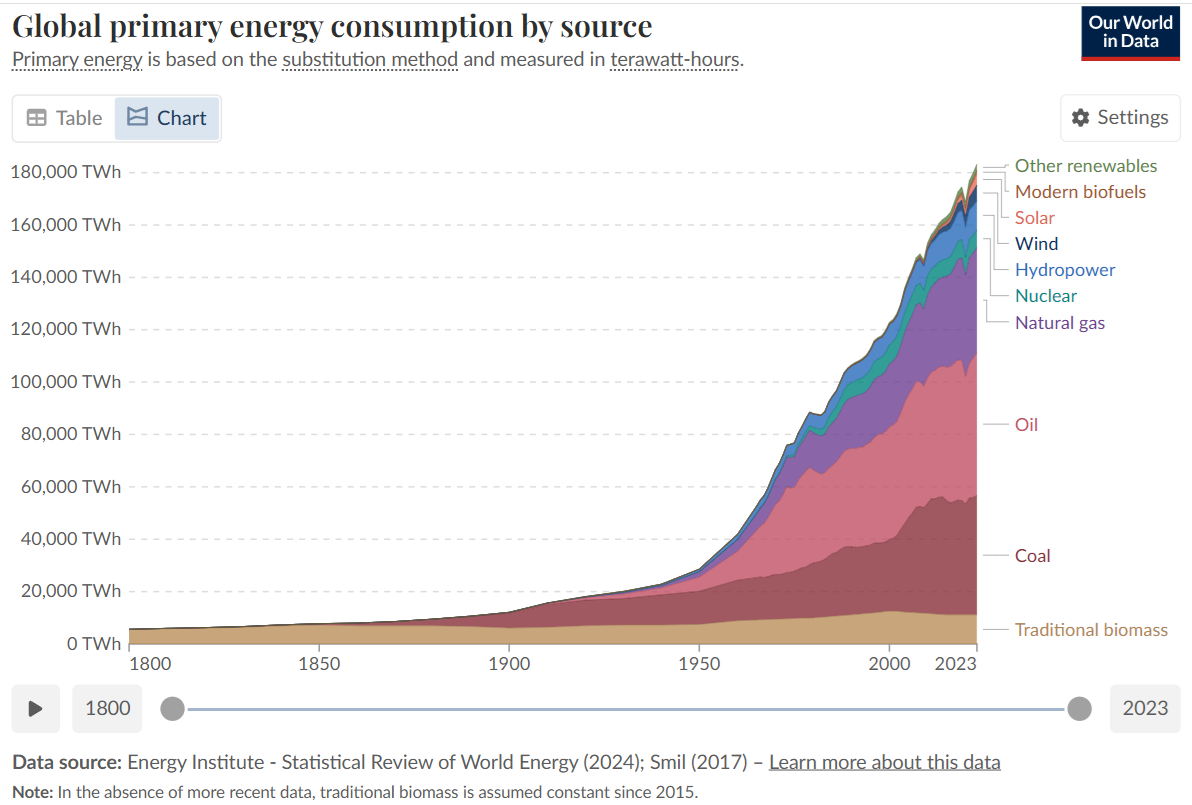
VS: Contrary to common impressions, there has been no absolute worldwide decarbonization. In fact, the very opposite is the case. The world has become much more reliant on fossil carbon. Global fossil fuel consumption rose by 62% between 1997 and 2025 while the share of fossil fuels in global energy consumption has decreased only marginally and it remains above 80 percent. Moreover, the first global energy transition, from traditional biomass fuels to fossil fuels, which started more than two centuries ago, remains incomplete, as about two billion people still rely on traditional biomass energies – mostly on fuelwood and crop residues in the countryside but also on inefficiently and destructively produced charcoal in cities. Replacing these energies will require even greater increases of renewably generated electricity.
In large-scale affairs, scale always rules. Wishful thinking may set the dates (usually years ending in zero or five) for specific national, regional or global decarbonizations (EU: no new internal combustion engines in 2035; world: net zero in 2050) but after increasing our reliance on fossil fuels by more than 60% during the past quarter century the chances of completely eliminating this dependence during the next 25 years appear extraordinarily unlikely.
RP: Is there a point that climate adaptation becomes a wiser strategy than climate mitigation?
VS: Let us stick to facts. Since the year 2000 more than 20 countries have reduced their CO2 or even their overall (CO2, CH4, N2O) emissions. But global emissions –- the only metric that matters because it is the total mass of greenhouses gases resident in the Earth’s atmosphere that determines the degree of warming — keep on rising. CO2 emissions from energy uses are the most reliably quantifiable flows. In 2024 they set yet another record, 1.3% above 2023 and they now approach 41 billion tons of CO2 equivalent a year, nearly 9% higher than a decade ago. Clearly, there has not been any mitigation (“the act of reducing a severity”) on the global level.
As for adaptation, wide-body jetliners bring record numbers of people to places already choked with other people. As you read this, cargo flights are bringing fresh blueberries from Peru to New York and just-caught tuna from the Indian Ocean around the Maldives to Tokyo. Go ahead and calculate the carbon costs and benefit ratios of such ventures (blueberries are 85% water and not even high in vitamin C). There is no “wiser strategy” –- there is no strategy (“a plan to achieve a major gain”). The greatest global success has been the rising share of renewably generated electricity (about 13% of the total in 2025) -– but the world now also generates more electricity from coal and natural gas than ever and hence the carbon emissions from this sector also keep on rising.
RP: You’ve previously touted efficiencyas an unheralded yet highly effective method of reducing our impact on Earth’s systems, noting leaky water distribution, inefficient indoor heating, and nitrogen waste from fertilizers as problems ripe for innovation. Why don’t you think there’s been more of a widespread effort to boost efficiency in these arenas?
VS: Eventually, efficiencies always make the greatest difference. Here are just two prominent examples. The first gas turbine(1939) generated electricity with 17% efficiency,now Siemens will sell you one that is 64% efficient.Boeing 787 uses 69% less jet fuel per revenue passenger kilometer than did the first commercial Boeing 707 in 1958. But these gains are usually incremental, spanning decades. Light emitting diodes (LEDs) have been a notable exception.
Energy losses taking place in hundreds of millions of homes (heated in winter and air conditioned in summer), at billions of sites (leaking pipes), or over enormous areas (as denitrification bacteria in soils convert fertilizer nitrates into nitrogen gas) are an entirely different challenge to manage. Still, none of this can excuse the modern preference of throwing away billions on quests for dubious breakthroughs over-hyped by instant (and often instantly forgettable) start-ups rather than spending millions on good sensors to avoid excessive fertilizer applications and to seal leaking pipes or restrict excessive heating.
RP: Elon Musk and others have sounded the alarm about a looming fertility crisis resulting from humanity’s gradually declining fertility rate, which has fallen from almost five children per woman in 1965 to just over two today. What do you think about the declining fertility rate? Is it a “crisis”, something to be celebrated, or neither?
VS:Who is the arbiter of this global total? Who defines what is “desirable?” Who decides what constitutes a “crisis?” Elon Musk? In 1950, when I was a young boy, the global population was about 3 billion. Then the panic about endless growth set in and in 1960 Science (!) published a paper claiming that on Friday, 13 November, A.D. 2026 the Earth will have an infinite population! No wonder, by the late 1960s there were apocalyptic fears of massive famines. Yet then the death rates declined, life expectancies rose, mass famines ended, and today we have about 8.3 billion people. Who is omniscient to say that 9 or 6 or 3 billion is the right number for the human future. Elon Musk?
Over the past decade, China has steadily increased its engagement across North Africa, with Libya emerging as a centerpiece of Beijing’s expanding geopolitical and economic ambitions. As part of its global Belt and Road Initiative (BRI), China is accelerating multi-sectoral investments in energy, infrastructure, and logistics in eastern Libya.
Over the past decade, China has steadily increased its engagement across North Africa, with Libya emerging as a centerpiece of Beijing’s expanding geopolitical and economic ambitions. As part of its global Belt and Road Initiative (BRI), China is accelerating multi-sectoral investments in energy, infrastructure, and logistics in eastern Libya. These developments reflect a broader effort by China to reshape trade routes, supply chains, and political alignments in the Mediterranean and sub-Saharan Africa. Libya’s east, under the control of Field Marshal Khalifa Haftar’s Libyan National Army (LNA), has become a focal point for negotiations that could transform the region into a critical hub for Sino-African and Sino-European trade.
Strategic Location and Investment Potential
Tobruk, a port city on Libya’s eastern coast, is at the center of Chinese plans. Its strategic location—less than 400 kilometers from Crete and southern Europe—offers a rare combination of geographic proximity and maritime potential. Historically, Tobruk has served as a strategic military and trading post since the Roman era, and later as the site of a pivotal World War II battle. Now, the city is poised to regain international importance, this time as a commercial and energy transit node.
Unlike many southern European ports, such as Genoa, Piraeus, and Barcelona, which lack the draft depth to accommodate ultra-large container vessels, Tobruk’s natural deep-water port positions it as a gateway to Europe. According to our sources inside Libya, Chinese strategists have identified Tobruk as a linchpin for addressing Europe’s port capacity constraints. A multi-phase Chinese investment plan envisions Tobruk as a logistics mega hub. At its core is a proposed $10 billion oil refinery capable of processing 500,000 barrels per day. The refined products would be exported to European markets, securing an alternative and stable energy source for the continent. If Haftar’s approval is secured, Chinese stakeholders are prepared to invest even more extensively, potentially surpassing $50 billion in total commitments across Libya in the near- to medium-term.
This refinery project is not standalone. Our sources suggest that China envisions Tobruk as an integrated logistics platform that includes fuel storage facilities, transshipment terminals, and supply depots for both maritime and overland transport. The city’s unique geographic location gives it direct access to the Suez Canal, the eastern Mediterranean, and central Africa, creating a web of interlocking trade and supply chains.
Port, Airport, and Logistics Expansion
Alongside the refinery, Chinese companies plan to expand and modernize Tobruk’s port, transforming it into a transshipment hub. Large vessels would dock and offload goods, which would then be transferred to smaller ships for distribution to European destinations—offering a strategic workaround for European port limitations. The port upgrade would include container terminals, bunkering facilities, and customs infrastructure to facilitate seamless trade flows.
China has also proposed upgrading Al-Adem Airport, located adjacent to the Tobruk port. Once the largest British Royal Air Force base globally and now controlled by Haftar’s forces and used by Russian military personnel, Al-Adem is slated to become a critical logistics hub. The airport would integrate with sea and land transport systems, serving as both a civilian cargo and refueling station and a potential dual-use facility with strategic implications. Fuel produced at the Tobruk refinery could be stored and distributed via this air hub, bolstering China’s aviation and military logistics.
These combined port and airport projects would create a modern, multi-modal logistics hub in Tobruk, from which China could control the flow of goods and energy into southern Europe. Strategically, it would give Beijing an unparalleled foothold on NATO’s southern flank.
While Haftar has not yet formally approved the projects, our sources suggest Chinese officials are offering generous terms and may request Russian mediation to overcome U.S. concerns. Haftar’s hesitancy underscores Libya’s fragile geopolitical balance but also highlights the stakes of deeper Chinese engagement.
Rail, Roads, and Cross-Regional Linkages
China’s ambitions extend far beyond Libya’s Mediterranean coast. As Egypt constructs a 2,000-kilometer high-speed rail network connecting Ain Sokhna on the Red Sea to Marsa Matruh on the Mediterranean, Chinese-backed plans to extend this corridor into eastern Libya would effectively link Tobruk and Benghazi to the Red Sea. This east-west transnational rail connection would create a seamless land bridge from Libya’s key eastern ports through Egypt to Asia-facing shipping routes. The China Railway International Group (CRIG), supported by the Singapore-based BFI Management Consortium and in partnership with Siemens, has signed a memorandum of understanding with Libyan Railroads to explore building this railway from Benghazi to Marsa Matruh via the Musaid border crossing. With an estimated cost of up to $20 billion, the project reflects the scale of ambition, and the complexity of terrain, engineering, and cross-border coordination required.
BFI Management Consortium plays a pivotal role in advancing China’s infrastructure ambitions in Libya. Acting as CRIG’s exclusive partner, BFI has facilitated high-profile agreements across both eastern and western Libya, including planned rail and metro systems in Benghazi and Tripoli. Formed as a special-purpose vehicle for Libyan development, BFI brings together global engineering firms such as Arup and Siemens, providing both technical expertise and political risk insulation. Its involvement underscores the strategic coordination between Chinese state-owned enterprises and international partners, and its operations serve as a critical conduit for Beijing’s expanding logistical and commercial presence in North Africa.
These rail lines are not just about transit—they represent a new spine of connectivity through North Africa. Designed to streamline the movement of goods and people between Asia, Africa, and Europe, these projects are also aimed at opening up future corridors south into Chad and Sudan. In doing so, China seeks to build a vertically integrated trade route that bypasses traditional maritime chokepoints and strengthens its position in emerging African markets, all while using Libya as a continental gateway.
Energy Finance and Institutional Frameworks
To facilitate these complex infrastructure and energy investments, eastern Libya has approved the establishment of the Libyan Bank for Energy and Mining. Its director, Juma Jaballah, has disclosed plans to bring in substantial Chinese capital and is currently awaiting Central Bank of Libya approval for a SWIFT code to begin international transactions.
This development underscores China’s preference for building institutional foundations alongside infrastructure. The bank would serve as the financial conduit for refinery construction, port upgrades, and associated service contracts. It is expected to play a pivotal role in easing capital flows and ensuring compliance with international norms, even as Libya remains politically divided.
Kerui Petroleum, a major Chinese oil services firm, has already begun preliminary studies for the Tobruk refinery under contract from Benghazi’s Ministry of Investment. This underscores the operational readiness of Chinese firms to move forward with detailed planning, even as geopolitical approvals remain pending.
In support of this growing partnership, a high-level Libyan delegation—led by one of Field Marshal Haftar’s sons and representing the Fund for the Development and Reconstruction of Libya—recently traveled to China to advance multiple avenues of cooperation. The delegation held meetings with leading Chinese companies, including Huawei and the China Energy Engineering Corporation (CEEC), to discuss a wide array of projects spanning telecommunications, energy infrastructure, and logistics. Notably, according to our sources inside Libya, Huawei is already leading the rollout of a dedicated telecom network in eastern Libya through a joint venture with local authorities, with the system currently in the testing stage. These developments highlight China’s deepening multi-sector engagement in Libya’s east.
Link to Africa: Roads to Chad and Sudan
China’s vision for Libya transcends national borders. With Africa’s population set to double by 2050, Beijing aims to deepen trade routes that bypass maritime chokepoints like the Suez Canal. Tobruk’s transformation includes plans to extend highway and logistics corridors southward into Chad and Sudan. These overland routes would allow Chinese-manufactured goods to reach African interior markets quickly and cost-effectively.
In return, China would gain access to African raw materials—oil, rare earth elements, and agricultural goods—transported north to Tobruk for processing and export. This multimodal corridor strategy mirrors similar Chinese projects in East Africa, such as the Mombasa-Nairobi-Addis Ababa corridor.
Historical and Geopolitical Context
China’s interest in North Africa is not new. Since the 1960s, Beijing has maintained a presence in Africa, supporting liberation movements and later pivoting to infrastructure and trade. Libya, once marginalized due to internal conflict, is now reemerging as a candidate for strategic partnership. China’s non-interference policy and track record of dealing with non-Western regimes appeal to Haftar’s administration, which remains internationally unrecognized.
Importantly, the eastern region of Libya—historically known as Cyrenaica—played a pivotal role in the Allied campaign during World War II, serving as a key staging ground in the fight against Nazi Germany and Fascist Italy. The region’s legacy as a frontline in the defense of liberal democracy underscores the strategic importance of its alignment today. In the context of growing Chinese and Russian activity, many Western analysts argue that restoring Libyan unity under a government aligned with Western institutions is not only a matter of regional stability but a vital component of broader transatlantic security.
Meanwhile, Libya’s fractured governance deters Western investment and engagement. The United States has prioritized counterterrorism and migration control over state-building in Libya, while the EU remains divided over the best approach. The absence of cohesive Western policy has opened the door to alternative actors—including Russia, Turkey, and increasingly, China.
Implications for European Energy Security
The implications of this Chinese pivot toward Libya for European energy security are profound. Europe’s ongoing energy diversification efforts, especially since the Russia-Ukraine war, have made the continent more reliant on alternative sources from the Middle East and North Africa. If Beijing gains control over a large-scale refinery in Tobruk and the associated port infrastructure, it will possess significant influence over supply chains feeding Europe.
This is not just about access to oil. With the ability to refine, store, and transport energy products directly from North Africa to Europe, China could dictate pricing, volume, and prioritization in times of crisis. Such leverage would challenge Europe’s energy autonomy and increase its dependency on Beijing at a time when the transatlantic alliance is already under strain.
Additionally, China’s control over container logistics through Tobruk would provide Beijing with leverage over not just energy, but manufactured goods and critical technologies. The dual-use airport, coupled with surveillance and digital infrastructure, could also serve intelligence and military interests.
Strategic Consequences and Outlook
Should Haftar approve the Chinese proposals, Libya would become the western anchor of a vast, China-led logistical and energy network spanning the Indian Ocean, the Red Sea, and the Mediterranean. The Tobruk refinery and associated infrastructure would give Beijing new leverage over European energy markets, especially as the EU seeks to diversify away from Russian gas.
Moreover, the dual-use nature of Tobruk’s upgraded airport and port could extend Chinese naval or intelligence capabilities into the Mediterranean. This possibility has already raised concerns in some NATO circles, although no formal opposition has been articulated.
If successful, China’s Libya strategy would reshape Eurasian supply chains and trade flows. It would also signal a shift in the balance of soft power and strategic influence in North Africa, with potentially profound implications for Europe’s energy security and geopolitical autonomy.
Libya may appear a fragile and fractured state, but to Chinese planners, it represents a gateway—one with the potential to tie Africa, Europe, and Asia together under a new global trade architecture led by Beijing.
The big, beautiful new tax law creates a not-so pretty loophole that untold billions of dollars’ worth of renewable projects are going to try to squeeze through. Anytime you screw with the market, you get screwy results, and this is titanic screwing. Watching it could be great fun.
The big, beautiful new tax law creates a not-so pretty loophole that untold billions of dollars’ worth of renewable projects are going to try to squeeze through. Anytime you screw with the market, you get screwy results, and this is titanic screwing. Watching it could be great fun.
The specifics are simple enough. The massive federal subsidies for wind and solar will end soon, with one big exception. Any project that can get under construction in less than a year from now and come online by 2030 still gets all the goodies.
Given that the queue of proposed wind and solar projects tops a trillion dollars, there will be many billions worth that try to make the short-term construction deadline. That many of these likely will fail makes it especially interesting. It is a prescription for financial chaos.
Of course the huge immediate question is, what does it take to be under construction? The subsidies are in the form of investment and production tax credits so the IRS makes the rules. Happily, a similar but much smaller version of this issue occurred in 2013.
The IRS has a little rule book titled “Beginning of Construction for Purposes of the Renewable Electricity Production Tax Credit and Energy Investment Tax Credit” here:
The rules are only for wind projects, but the application to solar looks simple, at least for big projects. Rooftop solar might be much more complicated and something to watch.
The simplest way to do it is called a “safe harbor” by the IRS. The developer just has to invest 5% of the project cost up front in actual development and then add “continuously” to that over time.
The 5% need not include any site development, so this works for projects that do not yet have a site which might be a lot of them. The developer just has to fund binding contracts for the stuff that will go into the site once actual construction begins.
Where this gets tricky is that the wind and solar components production capacity probably does not exist to supply all the stuff needed for everybody to meet the 5% requirement in less than a year from now. This could create a seller’s market with prices quickly rising to what the highest bidders will pay. There could be a lot of losers.
It is possible that promissory contracts to make the stuff will eventually be okay. as long as they are funded and binding. But then, the second requirement of continuous development becomes a problem. Development with what?
So a mad scramble to try and quickly spend a lot of money in less than a year seems likely. Whether it can be done remains to be seen.
It is also worth noting that in the long run renewables may not live or die in this scramble. The idea that renewables require subsidies may be incorrect to a considerable degree. This is because most states have energy transition mandates that, in effect, require buying more and more renewables output.
To begin with, 28 states have “renewable portfolio standards” that specifically require ever-increasing use of renewables. Others, like Virginia, have net-zero emission reduction laws that, for practical purposes, have the same result.
But how this works out without massive federal subsidies remains to be seen. Tax credit subsidies are invisible, never showing up on someone’s bill. Absent these subsidies, the cost of the mandates hits the ratepayers in a highly visible way.
Increasing electricity rates are already becoming a political issue. The long-term effect of ending the subsidies well might be ending the mandates once their true cost becomes clear.
It looks like the U.S. renewables industry is going to be scrambling financially. This is certain for the next twelve months and maybe long after that. Watching the mad scramble could be both enlightening and entertaining.
As I have previously reported, President Donald Trump’s Environmental Protection Agency (EPA) has been busy reversing all the climate cultist policies that harm this nation’s ability to serve and support its citizens.
After six months of watching Trump and various members of his team suspend and terminate federal employees, end the progressive pork distribution agency formerly known as USAID, and otherwise upend the Deep State approach to ruling over American citizens, one might think that federal employees who valued regular paychecks and good benefits would realize “Resistance 2.0” would be a failure.
However, a group of EPA employees clearly weren’t paying attention. The agency has placed 144 staffers on paid leave and launched an inquiry into their participation in signing a letter that accused the Trump administration of politicizing the agency.
The agency said its actions were warranted because the employees had signed the letter using their official titles and because the letter had denigrated the agency’s leadership.
“The Environmental Protection Agency has a zero-tolerance policy for career bureaucrats unlawfully undermining, sabotaging and undercutting the administration’s agenda as voted for by the great people of this country last November,” the E.P.A. press secretary, Brigit Hirsch, wrote in an email.
The 144 employees received emails on Thursday saying they had been placed on leave for the next two weeks “pending an administrative investigation,” according to a copy of the email reviewed by The New York Times.
“You are required to provide a current email address and phone number so that we can contact you as part of our investigation,” the email said, adding that the staff members would continue to collect paychecks while on leave.
NEWS: EPA places 144 employees on administrative leave pending further investigation, EPA official confirms to @NRO. Zeldin says a "small fraction" of EPA staffers used official work titles to sign onto public letter (linked below) that was "was riddled with misinformation" pic.twitter.com/eRf0vhB3Oq
Trump campaigned on refocusing the EPA on its original mission and putting an end to the climate-driven excesses the agency had embraced, (especially during the Biden administration). And he won the election. If these individual were truly “brave,” they should have quit (and perhaps taken Trump up on his offer to accept a payout for early retirement) during the administration’s first phase of reducing the size of government.
The letter outlined five key concerns, including that the Trump administration was dismantling the EPA office of research and development, canceling environmental justice programs and grants, making employees fearful, undermining the trust of the public, and “ignoring scientific consensus to protect polluters.”
“These actions directly undermine EPA’s capacity to fulfill its mission,” the letter said.
The employees placed on administrative leave are planning to sue.
More than 170 EPA employees put their names to the document, with about 100 more signing anonymously out of fear of retaliation, according to Jeremy Berg, a former editor-in-chief of Science magazine who is not an EPA employee but was among non-EPA scientists or academics to also sign.
At least 31 workers were escorted out of the Chicago office. A union leader told ABC7 Chicago they will sue the administration for violating their right to freedom of speech.
As Behind the Black‘s Robert Zimmerman notes, Team Trump’s swift removal of potentially toxic bureaucrats is certainly the right move to make.
The best part of this story is two fold. First, these individuals have done a good job of self-identif[ying] themselves as fifth columnists inside the Trump administration, making it easier to get rid of them. Second, the swift response by the Trump administration to remove them illustrates the difference between Trump 45 and Trump 47. In his first term Trump was more willing to tolerate this foolish and undemocratic behavior, and thus that first term was largely ineffective. In his second term Trump ain’t fooling around. From day one he has moved hard to clean house, and this story illustrates this difference most starkly.
Back in March, when the heatwave hysteria was just a gleam in the BBC’s eye, I showed some statistics on the UK’s Consumption Emissions (capitalised Donald Trump style here to show that it is a variable as well as a name).
Still chasing the wrong number, but still pointless chasing the right number.
Back in March, when the heatwave hysteria was just a gleam in the BBC’s eye, I showed some statistics on the UK’s Consumption Emissions (capitalised Donald Trump style here to show that it is a variable as well as a name).
If you remember, Imported Emissions are difficult to calculate, so the ONS produces them at a three-year lag. Thus, in March, all I could show was data up to 2021. Today, I decided to go back to the ONS today to see whether the statistics had been updated for 2022.
Well, they had.
OK, so now we just add another row to the spreadsheet for 2022 and…
Hold on a minute, the numbers for 2021 don’t match.
OK, maybe the previous year has been revised. Let’s just check the numbers for the first year in the series – 1996.
They don’t match, either.
Rather bizarrely, the UK’s emissions for almost every year in the series have been revised, mostly up. I say “appear” there because I don’t have a pristine version of the 1996-2021 spreadsheet. I edited it by adding columns of data to the right. There is a finite chance that I did something bad to the raw data somehow. Knowing me, I think this is highly unlikely. But I note it anyway as a possibility. In terms of Consumption Emissions, there is considerable recent variation with the new update; 2016’s value has been revised up by 14%. [The Territorial Emissions for that year have been revised downwards slightly.]
The problem here is that we can’t really discuss emissions figures to any purpose if they are going to be subject to revisions of the order of 10% some years after the event.
That said, I’m going to show the new dataset now, but caveat emptor, or cave canem, or cave next year’s revision.
So, without further ado, here are the UK’s Consumption Emissions and our Territorial Emissions Before Exports, including the wholesale changes in the 2022 update:
The story is essentially the same as before, with a somewhat rapidly-declining Net Zero-relevant metric (orange line) and a Consumption Emissions metric (i.e our actual emissions) that is hardly declining at all. The gap between the two is inevitably widening. If you put a line (ordinary least squares) through the two datasets, you will predict that we’ll hit Net Zero in 2050, but that our Consumption Emissions in that year will still be 557 Mt CO2e. Those emissions would be entirely imported, by definition. [In 2022, Imported Emissions are already well over half of our Consumption Emissions.]
What this means is that we will hit our Net Zero target on time, but still be emitting more CO2 in 2050 than many people think we are emitting today. We’ll say we’re on 0, but we’ll be on 557 Mt.
In fact, somewhat spookily, the orange line reaches Y = 0 when the year = 2050.2. On the present data we hit Net Zero exactly in 2050. Coincidence? [We wouldn’t hit Y = 0 on Consumption Emissions until 2130, on a wild extrapolation of this data.]
This figure shows our Net Emission Imports (i.e. Imported – Exported) as far as the latest update. The only way is up.
Conclusion: all the blather about how necessary Net Zero is to save the planet is incoherent for several reasons. Top is that, if the UK reaches Net Zero, the grand total of the world’s emissions will hardly notice. A close second comes the observation that we are just displacing our emissions to other countries, making our triumphant parade to Net Zero a mere accounting trick.
It’s as if we had pledged to give up keeping slaves, and when we reached the target of Zero Slaves, we all jumped around, slammed trebles, and popped party popping things, etc. Most of the public in that halcyon day would be blissfully unaware that we were still vicariously keeping slaves by importing goods from – shall we say – less scrupulous countries.
My suggestion would be that we need to impress upon our leaders that they are chasing the wrong number in Territorial Emissions Before Exports. But there’s no point pursuing the Consumption Emissions down to Net Zero, either, because success on that metric would result in the destruction of the UK as a functioning country. [I don’t exaggerate.] There’s no way that anyone could pretend otherwise, meaning that recognising Consumption Emissions as the appropriate target for our self-sacrifice would necessitate its abandonment as insane.
Or that’s what happens in a version of reality that I’d like to live in.
Every so often, the climate media machine spits out a headline so breathless you’d think the laws of physics had just been accidentally repealed by a badly-worded executive order. Case in point: bne IntelliNews in Germany recently told us that a “major ocean current in the Southern Hemisphere has reversed direction for the first time in recorded history,” and that climatologists are calling it a “catastrophic” tipping point. It also quotes a climatologist as saying “The stunning reversal of ocean circulation in the Southern Hemisphere confirms the global climate system has entered a catastrophic phase.”
Every so often, the climate media machine spits out a headline so breathless you’d think the laws of physics had just been accidentally repealed by a badly-worded executive order. Case in point: bne IntelliNews in Germany recently told us that a “major ocean current in the Southern Hemisphere has reversed direction for the first time in recorded history,” and that climatologists are calling it a “catastrophic” tipping point. It also quotes a climatologist as saying “The stunning reversal of ocean circulation in the Southern Hemisphere confirms the global climate system has entered a catastrophic phase.”
The implication: pack your bags, the climate apocalypse is here, and don’t forget your floaties.
But as is so often the case, the devil isn’t just in the details—it’s in the words they didn’t mention. The article, like a magician with something up both sleeves, never links to the actual scientific study.
To start with, here’s the Southern Ocean Overturning Circulation (SMOC) that they are claiming has “reversed”.
Figure 1. Ocean currents around Antarctica. The Bottom Water descends from the edge of the continent and runs towards the Equator along the ocean floor. Above that, the Deep Water flows towards Antarctica, rises to the surface, and moves back toward the Equator. When it hits the Circumpolar Current it splits into the Intermediate Water and Mode Water. Not sure what a “reversal” of that would look like.
And when I got to the study, what do you know? The study doesn’t mention “tipping point,” “collapse,” “current reversal,” “Southern Ocean current” or even “overturning circulation.” The only “reversal” in the paper refers to satellites detecting a reversal in surface salinity trends from decreasing to increasing, not a reversal in the the direction of the Southern ocean’s most complex circulation shown above.
So what did the study actually say? Here’s the paper’s abstract:
“For decades, the surface of the polar Southern Ocean (south of 50°S) has been freshening—an expected response to a warming climate. This freshening enhanced upper-ocean stratification, reducing the upward transport of subsurface heat and possibly contributing to sea ice expansion. It also limited the formation of open-ocean polynyas. Using satellite observations, we reveal a marked increase in surface salinity across the circumpolar Southern Ocean since 2015. This shift has weakened upper-ocean stratification, coinciding with a dramatic decline in Antarctic sea ice coverage. Additionally, rising salinity facilitated the reemergence of the Maud Rise polynya in the Weddell Sea, a phenomenon last observed in the mid-1970s. Crucially, we demonstrate that satellites can now monitor these changes in real time, providing essential evidence of the Southern Ocean’s potential transition toward persistently reduced sea ice coverage.”
I love how in the very first line, the earlier freshening (decreased salinity) of the polar Southern Ocean is described as “an expected response to a warming climate”. This is to demonstrate how well they understand what happens as the Earth warms, they knew it was going to freshen …
… but then they failed to mention that the increase in salinity post-2015 is an unexpected change that was unforeseen by either climate numerologists or computer haruspicy. But to be sure, they’ll gladly tell us what the climate will be like in 2100 AD.
In any case, let’s translate the actual science: For decades, the surface of the polar Southern Ocean (south of 50°S) was getting fresher—a little less salty—thanks to melting ice and increased precipitation, which the climate modelers assured us was exactly what a warming world would do. But then, around 2015, the trend did a U-turn. Suddenly, the surface started getting saltier, not fresher, and sea ice coverage dropped like a rock. The study’s main points? Satellites are now good enough to watch these swings in real time, and the ocean’s surface salinity is a lot more jumpy than either the models or the scientists predicted.
The media, meanwhile, went straight from “salinity trend reversal” to “ocean current reversal” to “climate system collapse.” It’s like watching a game of telephone played by people who skipped science class and majored in panic. But don’t worry, we’re assured it’s legit because bne IntelliNews said the study “was confirmed by Spanish marine scientists at El Institut de Ciències del Mar (ICM-CSIC) in Barcelona”.
Discouragingly, it’s not just the media. Even the scientists at the aforementioned Spanish Ocean Sciences Institute managed to headline their press release “Major reversal in ocean circulation detected,”despite the fact that the study didn’t detect any such thing. Antonio Turiel, ICM-CSIC researcher and co-author of the study, even said:
“We are witnessing a true reversal of ocean circulation in the Southern Hemisphere—something we’ve never seen before. While the world is debating the potential collapse of the AMOC [Atlantic Meridional Overturning Circulation] in the North Atlantic, we’re seeing that the SMOC [Southern Meridional Overturning Circulation] is not just weakening, but has reversed. This could have unprecedented global climate impacts.”
YIKES! EVERYONE PANIC!
Want to know the kicker? I mean, other than the fact that neither “reversal” nor “SMOC” are even mentioned in the study?
This isn’t even the first time it’s happened. Check out the Abstract again. The study itself notes that the Maud Rise polynya—a big seasonal hole in the sea ice—was visible in the 1970s under similar conditions, and is currently visible again. But you wouldn’t know that from the headlines, which prefer to treat every wiggle in the data as a sign of imminent doom.
“You can believe half of what you read, a quarter of what you hear …
… and an eighth of what you say.”
Although for popular reports of climate science, you might want to divide by sixteen. The next time you see “catastrophic tipping point” in the news, do yourself a favor—find the actual study, read the abstract, and remember that in climate science, as in life, reality is usually a lot less dramatic than the press release.
My warmest wishes to everyone for crisp mountain mornings, or warm summer evenings, or sunlight far-reaching on the sea, the best of whatever you dream to you all,
w.
Yep. I’ll say it again: When you comment, please quote the exact words you are discussing. I can defend my words. I can’t defend your unclear claims as to what I said.
On Friday morning, heavy rains led to catastrophic flooding along the Guadalupe River in central Texas.
Tragically, it appears that at least fifty people lost their lives.
But what is particularly disturbing is that the National Weather Service (NWS) provided excellent warnings and forecasts before the event that clearly predicted a substantial threat.
And yet, no attempt at evacuation was made.
Furthermore, weather model forecasts indicated the potential for a major precipitation event over this historically flood-prone region during the prior days.
The Event
The flooding occurred around 4 AM on July 4.
A heavy precipitation event was forecast for the region during the previous days. For example, the NOAA/NWS HRRR forecast from 8 PM July 3 (the evening before) predicted a band of heavy rain over central Texas.
THE DAY BEFORE, the NWS Forecast Office in San Antonia put out a flood watch for central Texas Hill Country, which included the site of the tragedy.
During the subsequent hours, the National Weather Service communicated increasingly strong warnings, including flash flood warnings. A children’s camp on a floodplain should have been evacuated.
Here is the warning by the local NWS office several hours before the flood.
Also consider the warning by the National Weather Service Weather Prediction Center (WPC) before the event:
As the event got closer, with National Weather Service radar showing the event unfolding, the San Antonia office made the threat explicit, noting a very dangerous flash event.
Any media or other organization suggesting that the National Weather Service was not on top of this event is not only not telling the truth, but doing a deep disservice to the highly professional and skillful folks in that organization.
Some folks are making such suggestions for patently political reasons. Extraordinarily unethical and wrong.
Areas along the Guadalupe River have flooded catastrophically many times in the past, and not evacuating low-lying areas with such warnings verges on criminal neglect. The local county (Kerr) does not even have a flood warning system in place.
The Texas flooding is another example of large numbers of deaths, even when weather forecasts are excellent, with all too many other examples, including the Maui wildfires, the LA wildfires, and flooding from Hurricane Helene.
But if you really want to experience media and advocacy group loss of moral compass, consider those claiming this event is the result of global warming.
For example, this connection was suggested by the New York Times:
There is NO EVIDENCE that the central Texas floods are the result of climate change.
For example, the Environmental Protection Agency has noted that flooding is DECLINING over time in that region (see below)
I examined this issue myself. Below is a plot of the extreme daily precipitation in July for nearby San Antonio from the 1940s to today.
There is NO upward trend, which suggests that climate change is not a factor in this event.
If climate change was significant, there WOULD be an upward trend.
In summary, society needs to learn how to effectively use the greatly improved prediction and observational capabilities that now exist.
Most weather-related deaths can be prevented if society makes use of this valuable information.
Those using disasters to support their political and social change agendas are not only hurting those they wish to help but acting in a morally and ethically indefensible way.


You must be logged in to post a comment.