Toward A New Climate Paradigm

What got me into investigating climate science a quarter-century ago? The astounding stability of the Earth’s global surface mean temperature (GMST). For example, since the year 1900, a century and a quarter, the Earth’s temperature has gone up by 0.46 ± 0.07 percent.

From Watts Up With That?

Guest Post by Willis Eschenbach

What got me into investigating climate science a quarter-century ago? The astounding stability of the Earth’s global surface mean temperature (GMST). For example, since the year 1900, a century and a quarter, the Earth’s temperature has gone up by 0.46 ± 0.07 percent.

I’ll say it again. In a century and a quarter the Earth has warmed by less than half a percent

The Earth’s climate system is a curious thing. It is a giant solar-driven heat engine. A heat engine is a device that turns heat into mechanical motion. In the case of the climate, the mechanical motion is the endless, ceaseless motion of the ocean and the atmosphere. Like all heat engines, the climate heat engine is heated at the hot end, and then the heat is transferred to the cold end and leaves the engine.

So I started out to discover why the temperature is so stable. Yes, I know that from our tiny human perspective it seems unstable, but for a heat engine, the temperature varying by less than half a percent over a century and a quarter is very stable. And here’s what I found out.

Like all flow systems far from equilibrium, the climate is ruled by the Constructal Law, one of the most under-appreciated discoveries of modern thermodynamics. The Constructal Law governs the evolution of flow systems.

And as the Constructal Law requires, the climate heat engine is constantly evolving to maximize the flow. The Constructal Law is a sort of Ten Commandments for anything that flows—rivers, blood, traffic, and, yes, the climate itself. The basic idea?

Everything that moves is constantly evolving and morphing to make movement easier. Life, it turns out, is just one big game of “How can I get from here to there with the least amount of fuss?” The Constructal Law is why river deltas look like the branches of a tree, which in turn look like the alveoli in our lungs. They are all controlled by the Constructal Law.

From a Constructal Law point of view, the climate is not a fragile, teetering system on the verge of collapse, but a gigantic, heat-hauling Rube Goldberg machine.

The sun pours energy onto the tropics, the poles are the cold end of the heat engine, and the atmosphere and oceans get busy shuttling all that heat from the equator towards the poles, where it escapes to space far more easily than at the tropics. Here’s a map of what areas lose or gain energy by this flow.

Figure 1. Average of flow of heat which is constantly being exported from the tropics to the poles, March 2000 to February 2024.

According to Bejan, the climate doesn’t maximize temperature, or CO₂, or even the number of climate conferences in Paris.

No, what it’s really maximizing—relentlessly, remorselessly, every minute of every day—is the flow of heat from where it’s hot to where it’s not.

Picture the earth as a planetary HVAC system, always rearranging its ductwork to get the job done faster. The Hadley cells, the jet streams, the ocean currents—none of these are accidents or the result of a committee meeting. They’re the system’s way of morphing itself to maximize that poleward heat flow. The boundaries between the warm and cold zones, the size of the tropical belt, the speed of the trade winds—Bejan’s math predicts them all and the numbers line up with the real world.

And here’s the kicker: when you let the system optimize for maximum heat transport, a bunch of other things fall into place. The average surface temperature, the temperature difference between the equator and the poles, the total amount of heat getting shunted north and south—Bejan’s model nails them all, without the need for fudge factors, hand-waving, or appeals to the climate gods.

How do I know that? I know because I created and ran what I believe is the first actual real-world based exemplar of Bejan’s theoretical climate model on my computer and saw how successful it was. The whole process is described in the post below.

So what’s the grand takeaway?

The climate isn’t a delicate flower, always on the verge of wilting. It’s a brawny, self-organizing, heat-moving machine, always rearranging its own plumbing to maximize the flow from hot to cold. It doesn’t care about our politics, our models, or our carbon taxes. It just wants to get the job done, and it’ll keep morphing until it does.

In short: if you want to understand the climate, stop thinking about balance, and start thinking about flow in a constructally-ruled world. The Earth’s climate is a heat engine with a mission, and it’s not going to let a little thing like equilibrium get in its way.

My best wishes to all,

w.

Of Course … when you comment, I politely ask that you quote the exact words you are discussing. Makes things clear.

China caught funding eco-lawfare suits in the USA to sabotage American energy dominance

The West’s ridiculously bloated legal system sits there like a radioactive duck. For a pittance, the Chinese Communist Party can sponsor climate lawsuits that cost US companies big money, tie them up in court, slow them down, and sometimes bankrupt them, and that’s for cases they don’t win.

From JoNova

By Jo Nova

It didn’t start that way, but it’s almost like Climate Change is just a Chinese trick…

The West’s ridiculously bloated legal system sits there like a radioactive duck. For a pittance, the Chinese Communist Party can sponsor climate lawsuits that cost US companies big money, tie them up in court, slow them down, and sometimes bankrupt them, and that’s for cases they don’t win.

For the other cases, left wing non-profits are running training programs for judges to indoctrinate them with climate ideology. (If we think some judges are crazy, perhaps they had help to get there?)

Senate Hearing Exposes China’s Role In Backing Climate Lawsuits Against U.S. Energy

By Olivia Rondeau, ClimateChangeDispatch

The Chinese Communist Party (CCP) is financially backing left-wing climate lawfare in the United States, and Sen. Ted Cruz (R-TX), Kansas Attorney General Kris Kobach, and dark money expert Scott Walter revealed the shady details while testifying before a Senate subcommittee on Wednesday.

According to Cruz, this campaign is a “three-pronged” approach.

“First, foreign money from entities tied to the Chinese Communist Party flows into the United States to bankroll climate advocacy groups who litigate against American energy,” the senator said in his opening remarks.

“Second, activist lawyers flood our courts with lawsuits designed not to win policy debates, but to bankrupt energy producers and to dismantle energy infrastructure through sheer attrition.”

“And third, the judiciary itself is being quietly captured and brainwashed as left-wing nonprofits host closed-door trainings that indoctrinate judges to adopt the ideological goals of the climate welfare machine,” he explained.

“The CCP plainly has a strategy of driving the United States away from domestic energy sources and increasing U.S. dependence on sources that rely on a Chinese supply of solar panels, electric vehicle batteries, and other technologies.”

If the CCP do this in the US, why wouldn’t they do it in Australia? (Perhaps they don’t need to, they could hardly hope to sabotage the mining industry in Australia better than Tanya Plibersek has.) But if they did, who would investigate? The ABC?

Of course, the Chinese Communist Party is just worried about carbon emissions

It’s what a good global citizen does — help everyone else cut emissions, especially stupid nations:

OWID

It’s a bit like the way the CCP is suddenly so worried Australia might waste money on military expenses. Xiao Qian, China’s Ambassador to Australia, doesn’t mind us spending billions on Chinese made solar panels and wind-mills, but he’s concerned about our heavy fiscal burden for defense and our livelihoods. It’s all so touching…

Don’t fall for NATO’s hyped-up rhetoric on defence spending

By Xiao Qian, in The Australian

By playing up international and regional tensions and slandering China’s normal military build-up, these countries are merely seeking nothing but excuses to drastically grow their military spending…

Dramatically increasing military spending places a heavy fiscal burden on the countries involved, undermining their efforts to boost economies and improve livelihoods, and further straining a global economy already struggling with weak recovery.

On a blog we might call this a concern troll.

If the CCP were so worried about us wasting money on defense they didn’t have to conduct live firing exercises off Sydney…

Image: Green paint for Chairman Mao. …by Daderot 

2025 Update: Fossil Fuels ≠ Global Warming

Previous posts addressed the claim that fossil fuels are driving global warming. This post updates that analysis with the latest (2024) numbers from Energy Institute and compares World Fossil Fuel Consumption (WFFC) with three estimates of Global Mean Temperature (GMT). More on both these variables below. Note: Previously these same statistics were hosted by BP.

From Science Matters

By Ron Clutz

Previous posts addressed the claim that fossil fuels are driving global warming. This post updates that analysis with the latest (2024) numbers from Energy Institute and compares World Fossil Fuel Consumption (WFFC) with three estimates of Global Mean Temperature (GMT). More on both these variables below. Note: Previously these same statistics were hosted by BP.

WFFC

2024 statistics are now available from Energy Institute for international consumption of Primary Energy sources. Statistical Review of World Energy. 

The reporting categories are:
Oil
Natural Gas
Coal
Nuclear
Hydro
Renewables (other than hydro)

Note:  Energy Institute began in 2023 to use Exajoules to replace MToe (Million Tonnes of oil equivalents.) It is logical to use an energy metric which is independent of the fuel source. OTOH renewable advocates have no doubt pressured EI to stop using oil as the baseline since their dream is a world without fossil fuel energy.

From BP conversion table 1 exajoule (EJ) = 1 quintillion joules (1 x 10^18). Oil products vary from 41.6 to 49.4 tonnes per gigajoule (10^9 joules).  Comparing this annual report with previous years shows that global Primary Energy (PE) in MToe is roughly 24 times the same amount in Exajoules.  The conversion factor at the macro level varies from year to year depending on the fuel mix. The graphs below use the new metric.

This analysis combines the first three, Oil, Gas, and Coal for total fossil fuel consumption world wide (WFFC).  The chart below shows the patterns for WFFC compared to world consumption of Primary Energy from 1965 through 2024.

The graph shows that global Primary Energy (PE) consumption from all sources has grown continuously over nearly 6 decades. Since 1965  oil, gas and coal (FF, sometimes termed “Thermal”) averaged 88% of PE consumed, ranging from 93% in 1965 to 81% in 2024.  Note that in 2020, PE dropped 21 EJ (4%) below 2019 consumption, then increased 31 EJ in 2021.  WFFC for 2020 dropped 24 EJ (5%), then in 2021 gained back 26 EJ to slightly exceed 2019 WFFC consumption. For the 60 year period, all net changes were increases from previous years and were:

Oil207%
Gas555%
Coal183%
WFFC252%
PE308%
Global Mean Temperatures

Everyone acknowledges that GMT is a fiction since temperature is an intrinsic property of objects, and varies dramatically over time and over the surface of the earth. No place on earth determines “average” temperature for the globe. Yet for the purpose of detecting change in temperature, major climate data sets estimate GMT and report anomalies from it.

UAH record consists of satellite era global temperature estimates for the lower troposphere, a layer of air from 0 to 4km above the surface. HadSST estimates sea surface temperatures from oceans covering 71% of the planet. HadCRUT combines HadSST estimates with records from land stations whose elevations range up to 6km above sea level.

Both GISS LOTI (land and ocean) and HadCRUT4 (land and ocean) use 14.0 Celsius as the climate normal, so I will add that number back into the anomalies. This is done not claiming any validity other than to achieve a reasonable measure of magnitude regarding the observed fluctuations.[Note: HadCRUT4 was discontinued after 2021 in favor of HadCRUT5.]

No doubt global sea surface temperatures are typically higher than 14C, more like 17 or 18C, and of course warmer in the tropics and colder at higher latitudes. Likewise, the lapse rate in the atmosphere means that air temperatures both from satellites and elevated land stations will range colder than 14C. Still, that climate normal is a generally accepted indicator of GMT.

Correlations of GMT and WFFC

The next graph compares WFFC to GMT estimates over the decades from 1965 to 2024 from HadCRUT5, which includes HadSST4.

Since 1965 the increase in fossil fuel consumption is dramatic and monotonic, steadily increasing by 252% from 146 to 513 exajoules.  Meanwhile the GMT record from Hadcrut shows multiple ups and downs with an accumulated rise of 1.4C over 60 years, 10% of the starting value.

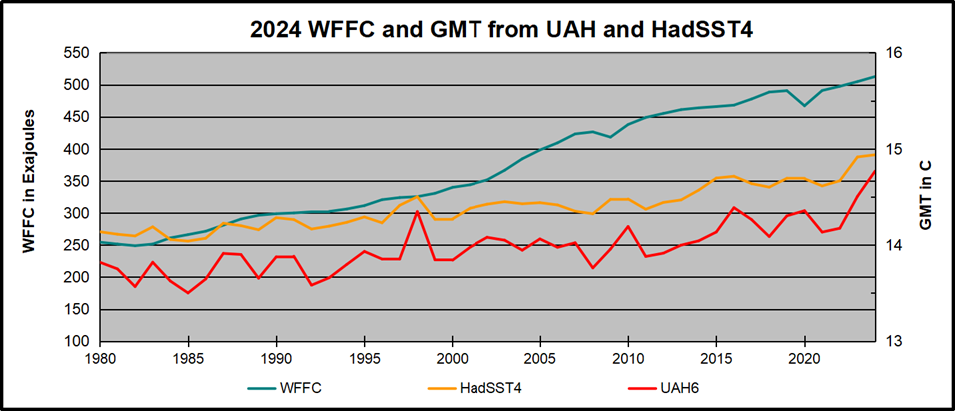
The graph below compares WFFC to GMT estimates from UAH6, and HadSST4 for the satellite era from 1980 to 2024 a period of 45 years.

In the satellite era WFFC has increased at a compounded rate of 1.5% per year, for a total increase of 99% since 1980. At the same time, SST warming amounted to 0.8C, or 5.6% of the starting value.  UAH warming was 1.1C, or 8% up from 1979.  The temperature compounded rate of change is 0.1% per year for HadSST4, and 0.2% per year for UAH, an order of magnitude less than WFFC.  Even more obvious is the 1998 El Nino peak and flat GMT until 2023-24.

Summary

The climate alarmist/activist claim is straight forward: Burning fossil fuels makes measured temperatures warmer. The Paris Accord further asserts that by reducing human use of fossil fuels, further warming can be prevented.  Those claims do not bear up under scrutiny.

It is enough for simple minds to see that two time series are both rising and to think that one must be causing the other. But both scientific and legal methods assert causation only when the two variables are both strongly and consistently aligned. The above shows a weak and inconsistent linkage between WFFC and GMT.

Going further back in history shows even weaker correlation between fossil fuels consumption and global temperature estimates:

Figure 5.1. Comparative dynamics of the World Fuel Consumption (WFC) and Global Surface Air Temperature Anomaly (ΔT), 1861-2000. The thin dashed line represents annual ΔT, the bold line—its 13-year smoothing, and the line constructed from rectangles—WFC (in millions of tons of nominal fuel) (Klyashtorin and Lyubushin, 2003). Source: Frolov et al. 2009

In legal terms, as long as there is another equally or more likely explanation for the set of facts, the claimed causation is unproven. The more likely explanation is that global temperatures vary due to oceanic and solar cycles. The proof is clearly and thoroughly set forward in the post Quantifying Natural Climate Change.

Footnote: CO2 Concentrations Compared to WFFC

Contrary to claims that rising atmospheric CO2 consists of fossil fuel emissions, consider the Mauna Loa CO2 observations in recent years.

Despite the drop in 2020 WFFC, atmospheric CO2 continued to rise steadily, demonstrating that natural sources and sinks drive the amount of CO2 in the air.

See also: Nature Erases Pulses of Human CO2 Emissions

02/2025 Update–Temperature Changes, CO2 Follows

Monday Mirthiness: The Bob Ward Teller of Forecast Fortunes

Back in May, our laughable punk rock alien reared his shiny high albedo head again…

From Watts Up With That?

By Anthony Watts

Back in May, our laughable punk rock alien reared his shiny high albedo head again…

Bob cites this as “proof they were right.” 

A 25% chance of a dry spring, but a 1.3x chance over the normal chance? It reminded me of something a fortune teller might issue – vague, but defendable in any outcome. Of course, he’d hear nothing of any rebuttals, because facts don’t generate additional grants for his employer, The Grantham Institute.

Bob is always good for a laugh. While I was writing this, he posted this:

Stay frosty Bob, your job may be next.

Last month, I had commissioned our resident cartoonist, Josh, to make a new Bob Ward cartoon…citing his “green alien” persona we’ve given him here done in the spirit of an iconic Fortune Teller Machine known as Zoltar, which has about the same accuracy as Met Office forecasts. But, because Bob is such a comical low value annoyance, it took a while for Josh to get it done, and even longer for me to post it. So, without further delay, here it is.

If you like Josh’s work, buy him a pint here. I guarantee you’ll get more enjoyment per dollar (or pound) than all the money given to The Grantham Institute.

Solar Tax Credits: 1978–2025 (never enough)

Aaron Nichols on LinkedIn provided a history of federal solar tax subsidies, beginning with Jimmy Carter. His point was to show that the numerous extensions (15 by my count) were bipartisan. My point, instead, is that on-grid solar is inherently noncompetitive against free market energies.

From Master Resource

By Robert Bradley Jr.

Aaron Nichols on LinkedIn provided a history of federal solar tax subsidies, beginning with Jimmy Carter. His point was to show that the numerous extensions (15 by my count) were bipartisan. My point, instead, is that on-grid solar is inherently noncompetitive against free market energies. [Note: AN blocked me]

Solar tax credits were not “created by the Inflation Reduction Act” or “invented by the Biden Administration,” Nichols begins. He continues:

The first solar energy incentives were created in 1978 by Jimmy Carter’s Administration. They’ve even enjoyed bipartisan support and been renewed by Republican administrations! Here’s a high-level history of solar tax credits:

1978: The Energy Tax Act of 1978 set the first federal solar ITC at 10% of project costs. ​Congress extended and modified this credit through the early 1980s, eventually making a 10% solar ITC permanent in 1992​.

1992: The Energy Policy Act of 1992 established the PTC for renewable electricity. Originally aimed mainly at wind power, it provided 1.5¢ per kWh for the first 10 years of a project’s operation.
Solar was not initially eligible for the PTC, but this law reaffirmed the permanent 10% ITC for solar.

2005: President George W. Bush signed the Energy Policy Act of 2005, a landmark energy bill establishing a 30% ITC for solar investments​. This included a new 30% residential solar credit. The 30% rate was initially temporary but was later extended by the Obama administration.
.
2008: The Emergency Economic Stabilization Act of 2008 (enacted under President Bush and continued by President Obama) extended the 30% ITC for eight more years and removed the $2,000 cap on the residential credit​.

2009: In response to the financial crisis, the American Recovery and Reinvestment Act of 2009 (Obama administration) introduced a cash grant option (the Section 1603 Treasury Grant Program) in lieu of the ITC​.

2015: The Consolidated Appropriations Act of 2016 (enacted Dec 2015 under President Obama) provided a long-term extension with a phase-down for the solar ITC​. It maintained the 30% ITC for projects commencing through 2019, then scheduled step-downs: 26% for 2020, 22% for 2021, and thereafter dropping to 10% for commercial and 0% for residential in 2022​.

2020: In late 2020, under President Trump, Congress extended the phase-out schedule for solar credits by two years​. COVID-19 relief legislation (Dec 2020) kept the ITC at 26% for projects begun in 2021 and 2022 (instead of dropping further), with 22% for those begun in 2023​. There was speculation that President Trump might veto this extension, but he ultimately signed it into law​.

2022: The Inflation Reduction Act (IRA) of 2022, passed under President Biden, not only renewed and increased these clean energy tax credits but also redesigned them. It restored the ITC to 30% and guaranteed it for at least a decade, revived the PTC for solar and other renewables, and introduced bonus credits and elective pay.

Comment

“Clean energy doesn’t have to be Red vs. Blue (and historically hasn’t been),” Aaron Nichols ended. “Investment in solar energy infrastructure benefits us all.”

Really? Tell that to Sunnova clients and investors. Tell that to beleaguered taxpayers. One wonders how long Mr. Nichols will still have employment, his job description being

I’m a NABCEP-certified PV professional who’s worked in solar sales, installation, and marketing. I’ve researched and written on federal clean energy policies and have served as a source on the U.S. solar market for several major publications, including Business Insider, USA Today, and NerdWallet. My writing has appeared in Solar Today, PV Tech, and Solar Power World.

One hopes his skill set can be redeployed to non-political profit centers. The private sector needs him more than a dying industry does. (And he should unblock me at part of his changeover.)

Appendix: My ITC Summary

In Wind and Solar Power: Old, Uneconomic, Government Dependent, I provided this similar summary of the Investment Tax Credit (ITC)

Fast forward to the 1970s when U.S. price controls on natural gas and oil led to shortages and fears of Peak Oil and Peak Gas. Solar became the political energy of choice for President Carter, beginning with a 10 percent Investment Tax Credit in 1978. Extensions followed in 1980, 1986, 1988, 1989, 1990, and 1991.

The Energy Policy Act of 1992, increasing the ITC to 30 percent of invested capital, was extended in 2006, 2008, 2009, 2016, 2018, 2019, and 2022, the most recent being in Biden’s Inflation Reduction Act. In all, solar has received 15 extensions of its “temporary” program to date.

Not good, and time for change.

Throwing Away A Third Of Our Electricity

To have enough renewable power to run the country in winter, there will inevitably be far too much at times in the rest of the year.

From NOT A LOT OF PEOPLE KNOW THAT

By Paul Homewood

More on that excess of wind and solar power:

To have enough renewable power to run the country in winter, there will inevitably be far too much at times in the rest of the year.

In reality, we know that there won’t be enough power in winter when the wind stops blowing, but that’s another topic.

But based on Labour’s Clean Power 2030 Plan of Clean Power 2030 Plan and doubling onshore, NESO have conveniently provided the hourly data for a typical week in summer – Sheer CP12 on the link provided above.

Running their numbers through, the week averages out with generation of 45.3GW. Demand in summer is around 30GW. Although demand is expected to increase, much of this will charging EVs at night and powering heat pumps in winter, so it is unlikely we will see much effect during the day in summer.

What NESO figures tell us is that a third of daily generation will have to be constrained. At an average price of £100/MWh, that works out at a cost of £3.3 billion, just for summer alone.

The actual constraint payments could be much higher, because mostly it will be offshore wind affected. It is likely that the AR7 strike prices will be over £100/MWh, and offshore wind farms already operating are being paid considerably more. If you have a contract for £150/MWh, you are not going to accept £100 to switch off.

‘Outright Massacre’: Senate GOP Takes Sledgehammer To Biden’s Green Energy Subsidies

The Senate dealt a series of blows to solar and wind energy in the latest version of President Donald Trump’s “big, beautiful” bill — taking a page out of House Republicans’ playbook to crack down on green energy tax credits enacted under former President Joe Biden.

From Watts Up With That?

THE DAILY CALLER

Daily Caller News Foundation

Adam Pack
Congressional Reporter

The Senate dealt a series of blows to solar and wind energy in the latest version of President Donald Trump’s “big, beautiful” bill — taking a page out of House Republicans’ playbook to crack down on green energy tax credits enacted under former President Joe Biden.

The Senate’s new proposal would move up the deadline for solar and wind projects hoping to qualify for production and investment tax credits by requiring them to produce electricity by the end of 2027. The additional cuts to green energy tax credits follows the president’s public broadside against the upper chamber’s initial proposal, which delayed the termination of solar and wind subsidies. (RELATED: Trump Calls On Waffling Congress To Crush Biden’s Green ‘SCAM’)

“Windmills, and the rest of this ‘JUNK,’ are the most expensive and inefficient energy in the world, is destroying the beauty of the environment, and is 10 times more costly than any other energy,” Trump wrote in a post to Truth Social on June 21. “It is time to break away, finally, from this craziness!!!”

The upper chamber’s revised bill would also create a new tax on wind and solar projects whose components are sourced from foreign entities of concern, such as China.

Senate Democrats referred to the creation of a new excise tax penalizing the renewable industry’s reliance on Chinese materials as “economic self-sabotage” and an “outright massacre” for the solar and wind industry.

Republican Utah Sen. Mike Lee was one of several GOP senators pushing the upper chamber to aggressively crack down on solar and wind tax credits in the president’s landmark bill. The Utah Republican favors a wholesale repeal of green energy subsidies, though Congress is likely to stop short of that given opposition from moderate Republicans.

Republican North Carolina Sen. Thom Tillis told reporters Saturday that the Senate finance panel’s decision to accelerate the termination of solar and wind subsidies by the end of 2027 was “disappointing.” He also suggested that failure to maintain the green energy tax breaks would have negative economic consequences for his state.

Tillis is one of several GOP senators that has pledged to vote against the president’s landmark tax and immigration bill, citing the legislation’s reforms to Medicaid.

Elon Musk, the world’s richest man and former Department of Government Efficiency (DOGE) lead, blasted Senate Republicans for rolling back green energy subsidies within their proposal, accusing GOP senators of putting “millions of jobs” on the chopping block.

“The latest Senate draft bill will destroy millions of jobs in America and cause immense strategic harm to our country!” Musk, the founder of the electric vehicle manufacturer, Tesla, wrote on his social media platform, X. “Utterly insane and destructive. It gives handouts to industries of the past while severely damaging industries of the future.”

Proponents of terminating green energy subsidies argued that the green energy industry’s messaging revealed its dependency on government funds in order to be profitable.

“If, as supporters of the IRA [Inflation Reduction Act] are complaining, repealing these subsidies will ‘kill’ their industry, then maybe it shouldn’t exist in the first place,” American Energy Alliance president Tom Pyle said in a statement Saturday. “Extending green giveaways on the backs of American taxpayers is shortsighted and neglectful.”

The conservative House Freedom Caucus (HFC) has also urged the Senate to adopt the House-passed language that put solar and wind tax credits on a faster route to termination.

Several HFC members, including Republican Reps. Chip Roy of Texas and Ralph Norman of South Carolina, suggested they would not vote for the Senate’s proposal if it failed to adhere to the House language accelerating the termination of green energy subsidies.

“That’s got to go,” Norman told the DCNF in an interview Thursday. “The President wants it to go. He wants to abolish all of them. We agree with that.”

All content created by the Daily Caller News Foundation, an independent and nonpartisan newswire service, is available without charge to any legitimate news publisher that can provide a large audience. All republished articles must include our logo, our reporter’s byline and their DCNF affiliation. For any questions about our guidelines or partnering with us, please contact licensing@dailycallernewsfoundation.org.

Will Fewer Balloon Weather Observations Mean Reduced Forecast Skill?

Due to retirements and hiring suspensions, the number of launches of balloon-launched weather balloons (called radiosondes) has been reduced by about 10% in the U.S. 

From The Cliff Mass Weather Blog

Due to retirements and hiring suspensions, the number of launches of balloon-launched weather balloons (called radiosondes) has been reduced by about 10% in the U.S.  

Specifically, of the 92 U.S. radiosonde locations, about ten have reduced launches either totally or partially.

Several media sources have suggested this reduction could seriously degrade U.S. weather prediction (see samples below).   

But is this true?   As discussed below, there are several reasons to expect that the impacts will be very small, not the least because balloon-launched weather observations now play a much, much smaller role in the modern observing network.

Why upper air data matters

The atmosphere is fully three-dimensional, and predicting the weather requires understanding the 3D distribution of temperature, wind, and humidity.

Such three-dimensional data is the starting point of the key technology of weather forecasting: numerical weather prediction (NWP), in which meteorologists simulate the evolution of the atmosphere by solving the equations describing atmospheric physics on the largest computers available.

Such forecasts start with a three-dimensional description of the atmosphere, called the initialization.

During the early years of NWP (1950-1970), radiosondes were the only source of weather information above the surface.  Absolutely critical.

The number of radiosondes has declined modestly over the years, with the current global network shown below.  

Lots over the U.S., Europe, and Southeast Asia.  You will notice a major issue with the radiosonde distribution:  there are few over the oceans and the polar regions, which encompass about 70% of the planet!

The current U.S. radiosonde network is displayed below, with red circles indicating radiosonde sites that are either suspended or only launched once per day.  Keep in mind that at most sites, these observations are only made twice per day.

Is there any objective evidence that forecasts have declined with fewer U.S. radiosonde observations?

As far as I can tell, the answer is no.  

I have gone through all the objective verification scores and could not find any degradation in National Weather Service forecast skill.  For example, the 5-day precipitation scores over the U.S. in March 2025 are better than March 2024.

I could show you a dozen more like this.  

But we have to be careful here.  Perhaps 2025 was an easier year to forecast.  

To do this right, we need to do OSSEs…observing system simulation experiments… in which we run identical periods we different amounts of radiosonde data.

However, there are powerful arguments about why the radiosondes are no longer as important to weather prediction, and particularly whether the temporary loss of a few of them would make much of a difference.

Today, three-dimensional satellite observations are dominant–in fact, approximately 99% of the weather data used today in numerical weather prediction is from satellites.    For example, we can determine the winds by tracking features in the infrared part of the spectrum.

Or we can use satellites to measure how humidity varies with height.

Other satellites measure temperature and humidity with height by noting how GPS signals are bent by the Earth’s atmosphere.

I have hardly warmed up.  There are dozens of other examples of how satellites provide detailed, three-dimensional weather data over the entire planet…over most of which there are no radiosondes.

But there is more.   Many aircraft take continuous observations in flight and provide vertical profiles of the atmosphere (called soundings) are they take off and land at airports (see below).   Such soundings are very much like the radiosonde data but are taken at more locations and at more times.

The bottom line of all this is that balloon-launched weather instruments (radiosondes) are now only a very, very small proportion of the atmospheric weather data used by meteorologists for weather prediction.   

As a result, a loss of a few observations over a portion of one country probably has very little impact.

Thus, the headlines of gloom and doom are probably wrong.    

Let me be clear…. I think we should restore the U.S. radiosonde network and then complete careful experiments to determine how many of them are really needed for calibrating the satellite data and other uses.  From what I have learned, restoration of the missing radiosondes will occur over the next few months, with the National Weather Service now hiring again.

Too Much Sun

Saturday, the 28th of June, was, you may recall, both sunny and windy.

Solar power peaked at 10.9GW at 1.00pm, while wind power was running at 12.4GW. Total electricity at that time was 32.3GW, including 2.51 GW, 0.90GW and 4.79GW from gas, bio and nuclear respectively.

From NOT A LOT OF PEOPLE KNOW THAT

By Paul Homewood

https://www.solar.sheffield.ac.uk/pvlive/#

Saturday, the 28th of June, was, you may recall, both sunny and windy.

Solar power peaked at 10.9GW at 1.00pm, while wind power was running at 12.4GW. Total electricity at that time was 32.3GW, including 2.51 GW, 0.90GW and 4.79GW from gas, bio and nuclear respectively.

All well and good, you might say!

But here is the rub. Ed Miliband is planning to triple offshore wind, double onshore wind and double onshore wind capacity by 2030.

On a similarly sunny and windy day in June 2030 then, we can expect to see solar power hitting 33GW, and wind around 31GW. Even allowing for a small increase in demand, we will have twice the amount of electricity we need. Moreover, our nuclear plants will have to be switched off.

Currently NESO pay a handful of remote wind farms to switch off when bottlenecks in the grid cannot cope. But in 2030, this will be a nationwide problem.

A particular problem is that all of this solar power and much of the onshore wind will be embedded in the regional distribution network. It will, in technical terms, be invisible to NESO, simply showing up as reduced demand. NESO will not have the ability to constrain these generators.

Interconnectors might take away a small part of this surplus, but Europe will be in the same boat, with excess solar power of their own. Meanwhile using the surplus to charge batteries might help for an hour or two, but the surplus will be building up for hours. Batteries are also likely to be already fully charged on days like this.

NESO admit that many days will feature 100% wind and solar – indeed even during autumn and spring as well. Their chart below has no y-axis, but their database shows weather dependent generation hitting nearly 60GW plus “Firm” capacity on most days.

Nowhere does their plan state how they will deal with these surpluses in practice.

Seeing Oil Barons in Every Closet: The Climate Movement’s Desperate Cry

Here comes the latest act in the grand theatre of climate melodrama: a chorus of self-appointed guardians, convinced they are on the losing side of the argument, now clutching at every conspiracy theory that drifts across their newsfeeds. They thunder about “dark money” behind every dissenting tweet, accuse shadowy forces of “virulent disinformation,” and summon fossil-fuel lobbyists into every room—sometimes even under the bed—to explain why anyone dares question their sacred models. The real punchline?

From Watts Up With That?

By Charles Rotter

Here comes the latest act in the grand theatre of climate melodrama: a chorus of self-appointed guardians, convinced they are on the losing side of the argument, now clutching at every conspiracy theory that drifts across their newsfeeds. They thunder about “dark money” behind every dissenting tweet, accuse shadowy forces of “virulent disinformation,” and summon fossil-fuel lobbyists into every room—sometimes even under the bed—to explain why anyone dares question their sacred models. The real punchline? Their kneejerk conspiratorial caterwauling betrays one thing above all: that the debate of ideas is slipping through their fingers, and they have no rational reply save to imagine enemies in every closet.

This is not just a difference of political opinion or healthy debate. It is a coordinated, well-funded campaign to delay action, erode trust and protect the profits of the fossil fuel industry, which profits most from the status quo. These narratives find fertile ground on social media, where algorithms prioritise outrage over facts. They also thrive in moments of crisis and confusion, playing on existing frustrations among communities who don’t feel their voices are heard by those in charge.

https://www.theguardian.com/commentisfree/2025/jun/23/london-paris-vicious-backlash-climate-action-sadiq-khan-anne-hidalgo

The mayors of London and Paris bemoan “a surge in climate deniers and delayers spreading virulent disinformation,” as if any skeptical question automatically signals a secret cabal . Their choice of words betrays the familiar tactic: paint every critic as a hireling of Big Oil, then claim moral victory because nobody would dare question “consensus” in the heat of such righteous indignation. When reason fails, conspiracy theories rear their heads.

They trumpet the ultra-low emission zone (Ulez) in London as “a policy proven to cut pollution and save lives,” invoking it like a holy relic against all who would dare drive a slightly older SUV. Yet a closer look at the studies behind these “proven” benefits reveals activist-friendly assumptions, shifting baselines and model runs that treat correlation as causation. If a handful of months with marginally lower particulate readings equals hundreds of “lives saved,” then by their logic every cloudy day should cure cancer.

In London, the expansion of the ultra-low emission zone (Ulez), a policy proven to cut pollution and save lives, was relentlessly targeted by disinformation campaigns. These messages were seeded by anonymous accounts, supercharged by bots and then repeated across partisan media. The campaigns combined existing fears about the cost of living with more sinister and racially motivated tropes, leading to a surge in attacks online against politicians and supporters, abuse of TfL staff doing their jobs installing Ulez cameras, and eventually dangerous and destructive acts of vandalism.

https://www.theguardian.com/commentisfree/2025/jun/23/london-paris-vicious-backlash-climate-action-sadiq-khan-anne-hidalgo

Next comes the grand claim of improved health and longevity. One reads headlines declaring tens of thousands of lives spared by Paris’s pedestrianised riverbanks or urban cycling campaigns. But those figures emerge from computer simulations—pseudo-science dressed in activist lab coats—rather than controlled trials or real-world data. Linearity is assumed, confounders are ignored, and error bars vanish in a puff of promotional rhetoric. It’s the sort of number-crunching that would make any real statistician weep, right before reaching for the smelling salts.

Meanwhile, the myth of fossil-fuel lobbyists hiding in every corner grows. Why accept that millions of citizens simply tire of rationed energy, higher taxes and glamorous e-bikes? It’s easier to imagine “dark money,” to cast doubt on honest debate, and to accuse ordinary drivers of being pawns in some evil grand design. If they could bottle that level of paranoia, they’d corner the market on dystopian novels.

Then there’s the solemn warning that “disinformation flourishes when trust breaks down. Ultimately, fighting disinformation is not only a matter of public relations, but also about public leadership”. In other words, when a policy proves unpopular, simply call it “disinformation.” When polling shows the public edging away from Net Zero zealotry, rebrand dissenters as villains. Trust isn’t rebuilt by transparent debate, it seems, but by hammering critics with ever more dire labels.

At the core of these theatrics lies an unspoken admission: the climate models are shaky. Estimates of climate sensitivity to CO2 remain all over the map, confidence intervals are enormous, and feedback loops are stuffed into parameter boxes no one can open. Yet rather than confront these unknowns, the narrative insists on celebrity proclamations and grand summits, as though chanting “Net Zero” can substitute for hard science.

Net Zero policies double down on that technocratic impulse. They transport entire industries onto the shoulders of distant bureaucrats, force-feed markets with renewable mandates and treat citizens like lab rats in an energy experiment. The result? Sky-high electricity costs, supply-chain bottlenecks, and looming shortages of critical minerals. Not exactly the health-and-longevity bonanza the activists promised.

One might expect that, faced with these mounting failures, the architects of Net Zero would pause, revisit their assumptions and engage in open debate. Instead, they accuse anyone daring to point out the elephant in the room of being in league with Big Oil. It’s a classic fallback: when the evidence doesn’t support the policy, show the messenger the door.

All the while, individual liberty and consumer choice get trampled beneath the march of grand plans. Ulez zones encroach, carbon taxes climb, and mandates dictate how one heats a home or what kind of car one can drive. Public sentiment? Irrelevant. Expert opinion? Unassailable. Reasoned discourse? Discouraged, lest someone notice that complex systems rarely tolerate one-size-fits-all interventions.

The real debate—about uncertainties in models, trade-offs in policy, and the proper role of government—has become the hostage of conspiracy-fuelled rhetoric. Critics aren’t invited to the table; they’re cast as saboteurs. Meanwhile, the truth of individual responsibility and local solutions goes begging, sacrificed on the altar of centralized control.

If the climate movement truly believed in its science, it would welcome rigorous scrutiny and healthy skepticism. Instead, it panders to fear, scapegoats dissenters, and resorts to high-volume caterwauling about nonexistent lobbyists under the bed. Like any dogmatic creed, it treats questions as heresy and uses conspiracy to mask the cracks in its foundation.

At its best, skepticism means holding judgment in suspension, demanding evidence, and remaining open to revision. At its worst, the current climate crusade has weaponised skepticism into a cudgel against honest inquiry. When every challenge is labelled a lie, the true dishonesty lies in refusing to acknowledge uncertainty.

The public is waking up. People notice higher energy bills, less reliable power and an endless parade of doomsday forecasts that never materialize. They’re not puppets of Big Oil; they’re citizens who prefer transparent debate over hushed conspiracies. If the climate lobby had confidence in its case, it wouldn’t be scrambling to paint critics as mind-controlled villains.

The next time a mayor or activist declares that only a “surge” of bureaucratic zeal can save us from imaginary marauders, remember: the real threat isn’t fossil fuels or oil executives. It’s a movement that abandons reason, wraps itself in conspiracy, and mistakes conspiracy for conviction. That drama belongs in a pulpy thriller novel, not in the serious debate of public policy.