Global warming, climate change, all these things are just a dream come true for politicians. I deal with evidence and not with frightening computer models because the seeker after truth does not put his faith in any consensus. The road to the truth is long and hard, but this is the road we must follow. People who describe the unprecedented comfort and ease of modern life as a climate disaster, in my opinion have no idea what a real problem is.
“[T]he increase in absorbed solar radiation is primarily due to natural variations in cloudiness and surface albedo, which have served as the main forcing factors of the flux above the atmosphere over the last 2 decades.” – Diodato et al., 2025
“[T]he increase in absorbed solar radiation is primarily due to natural variations in cloudiness and surface albedo, which have served as the main forcing factors of the flux above the atmosphere over the last 2 decades.” – Diodato et al., 2025
And now, in two new studies (Diodato et al., 2024 and Diodato et al., 2025), scientists have begun formulating reconstructions of cloud cover over the Mediterranean region that can be dated all the way back to the Medieval Warm Period, or 970 CE.
The authors suggest their reconstructions of cloud cover may be representative of more than just this region, as it is a product of large scale processes that may “transcend geographical boundaries.” In other words, what happens in the Mediterranean region may well have global implications.
Their reconstructions indicate the modern declining cloud cover trend may not only have been occurring since 2000, but, except for a brief increasing period from about 1945 to 1980 (that coincided with a global cooling trend), it has been ongoing for over 200 years. The “turning point” years were 1815-1818, following the eruption of Mount Tambora. From that point on there has been a precipitous decline in cloud cover that departs from multi-decadal variability.
The authors suggest the “dominant” factors linked to the post-1800s warming trend include solar forcing, volcanic forcing, and the Atlantic Multi-decadal Oscillation (Diodato et al., 2024).
In other words, the modern warming as well as the past climate changes may be “primarily due to natural variations in cloudiness and surface albedo, which have served as the main forcing factors” (Diodato et al., 2025).
The Labour-run London Borough of Camden (LBC) has been forced to scrap a hugely controversial Low Traffic Neighbourhood (LTN) scheme centred on Dartmouth Park on the eastern edge of Hampstead Heath – home to Ed Miliband, Benedict Cumberbatch and numerous other Labour luvvies. The plan had been to impose an 18-month ‘trial period’ with the least possible public consultation.
The Labour-run London Borough of Camden (LBC) has been forced to scrap a hugely controversial Low Traffic Neighbourhood (LTN) scheme centred on Dartmouth Park on the eastern edge of Hampstead Heath – home to Ed Miliband, Benedict Cumberbatch and numerous other Labour luvvies. The plan had been to impose an 18-month ‘trial period’ with the least possible public consultation.
Attempting to put the best spin on it, LBC calls this a “pause”, but the scheme – a pet project of cycle-fanatic Cllr Adam Harrison, “Cabinet Member for Planning and a Sustainable Camden” and CBC’s Deputy Leader – was always unworkable. Uproar among locals, who discovered Camden’s brief ‘nonsultation’ was to be held during last summer’s holidays, was led by the Highgate Society which commissioned expert analysis of LBC’s dodgy metrics.
Locals packed protest meetings and deluged their council with complaints, not least about the scheme’s obvious potential for raising money by fines. With vehicle access from the north, east and south denied to thousands of homes in the LTN, voters demanded to know how ambulances, deliveries and visitors could reach them, or how anyone less than 100% fit would be able to get the shopping home?
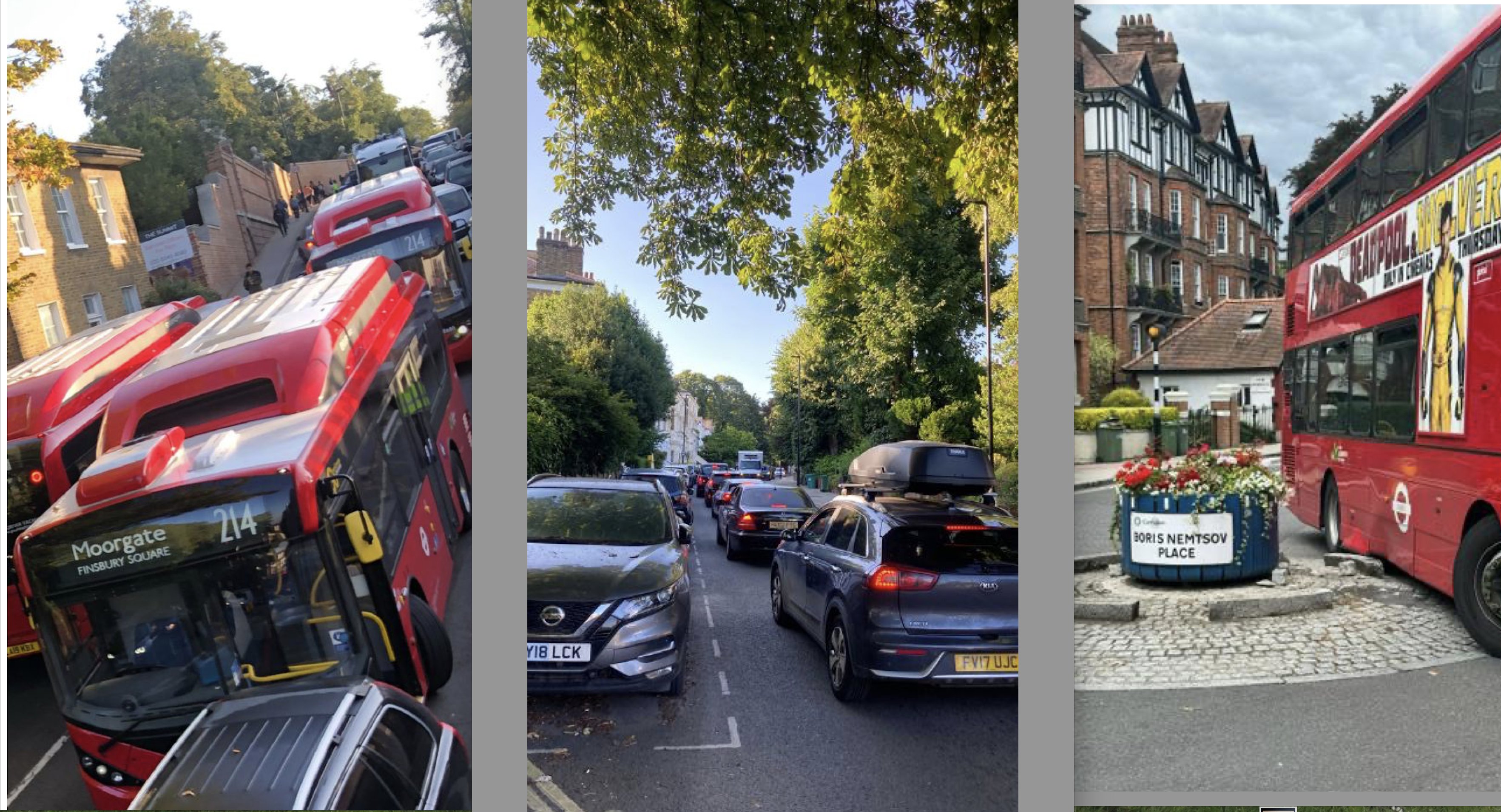
Among many issues they highlighted were inevitable gridlock on Highgate Road, Highgate West Hill and other bus routes on the proposed LTN’s boundary, and increased air pollution on children’s walking routes to the area’s schools – ironically the same good schools which attract so many upwardly-mobile Labour supporters to leafy Dartmouth Park’s expensive homes.
Highgate West Hill is frequently disrupted by emergency repairs to water mains and flooding caused by natural springs (photo: dphnjointaction.com)
Having wasted vast amounts of TfL’s money on consultants while plotting Dartmouth Park’s LTN in secret, Camden’s Labour regime has been handed an expensive lesson in not annoying one’s diehard voters. Its problems include a private company called Commonplace, and an unusually articulate local population.
Commonplace Digital Ltd is a privately-owned “citizen engagement platform” which claims to “inspire thriving places, powered by data and collaboration”. On its touchy-feely website rows of smiley, young and casually-dressed “customer success managers” and “business development managers” promote the platform.
What Commonplace actually does is to sell machine-readable online surveys to councils and developers – relieving them of the trudge of asking local people what they think and reading the responses properly, while still getting the result they first wanted via an ostensibly democratic process.
The snag, as we in Bedfordshire know to our cost, is in the questions asked and the boxes you’re allowed to tick. Our council’s Commonplace survey on local cycling and walking issues produced 826 responses, of which over 100 tried to explain – only possible in the “other comments” box – that by far our worst problem is how to get across the A1 safely into Biggleswade without using a car: a walk/cycle underpass is needed, obviously.
Chancing the A1 at Biggleswade (photo: Mike Wells)Waiting to cross the A1 at Biggleswade (photo: Mike Wells)
But in its published LCWIP plan, based on this “engagement”, Central Beds Council felt able to ignore the lethal risks run by locals trotting or wheeling their children across the A1 carriageways, because the online Commonplace survey had asked no machine-readable question about it. The metrics didn’t prove a need, which happily allowed CBC and National Highways to carry on ignoring the danger.
People are increasingly suspicious of the skewed questions asked in Commonplace surveys, and in the case of Camden’s proposed Dartmouth Park LTN, many refused to participate. Instead, 773 locals emailed their council direct, as well as emailing individual councillors. Here in Beds our ward councillor just leafleted over 800 locals about our Biggleswade problem, asking what they need to get onto town safely, and the scores of replies were a revelation.
Ask people what they really think, without leading questions or tick-boxes, and what you get is ‘quote gold’. Many said roughly what was anticipated, though in their own inimitable words; others made important points that hadn’t even occurred to campaigners. Analysing genuine replies like these – as opposed to machine-readable surveys – takes time and thought, and Camden is now having to go back to the drawing board and read its hundreds of non-Commonplace responses, acutely aware that having wound up the Highgate Society and Dartmouth Park’s vigilant locals, its cunningly-worded online “consultation” cannot alone justify imposing a disastrous LTN.
Somewhere, probably in a temperature-controlled office lit by taxpayer-funded fluorescent lights, a gang of climate hysterics decided it was time to sound the next false alarm: global warming is coming for your dreams. That’s right. If the planet warms by a couple degrees, you won’t just sweat a little more—you’ll sleep less. And if you sleep less, according to these clowns, you might die. Cue the dramatic music and the UN PowerPoint.
Somewhere, probably in a temperature-controlled office lit by taxpayer-funded fluorescent lights, a gang of climate hysterics decided it was time to sound the next false alarm: global warming is coming for your dreams. That’s right. If the planet warms by a couple degrees, you won’t just sweat a little more—you’ll sleep less. And if you sleep less, according to these clowns, you might die. Cue the dramatic music and the UN PowerPoint.
The impact of rising ambient temperatures on sleep and its phases under climate change is becoming increasingly concerning but remains underexplored. Sleep, consisting of non-rapid eye movement and rapid eye movement phases, is crucial for health, and insufficient sleep in either phase could have significant implications. Based on sleep monitoring data of 23 million days from 214,445 participants across mainland China, we investigated how daily average temperature affected sleep. For each 10 °C increase in ambient temperature, the odds of sleep insufficiency increased by 20.1%, while total sleep duration decreased by 9.67 minutes, with deep sleep declining the most (by 2.82%). Projections under the unrestricted (SSP5-8.5) greenhouse gas emission scenario suggest that by the end of the century, sleep insufficiency could rise by 10.50%, with an annual loss of 33.28 hours of sleep per person. These findings highlight the potential of climate warming to exacerbate sleep deprivation and degrade sleep quality, especially for the elderly, women, individuals with obesity, and regions of South, Centre and East.
This deeply unserious study out of China—blessed, of course, by Nature Communications (a publication that has long since traded rigorous science for progressive catechism)—makes the mind-numbing claim that rising temperatures are causing people to lose sleep. The culprit? Not noisy neighbors, too much screen time, or China’s brutal urban density. Nope. It’s “climate change,” the all-purpose demon invoked every time someone stubs a toe or misplaces their AirPods.
The study boasts about analyzing 23 million sleep records from over 214,000 people in China using Huawei smart devices. Because when it comes to objective medical data, nothing says “trustworthy” like consumer gadgets from a surveillance state.
The researchers conclude—with a straight face—that a 10°C increase in average temperature leads to a 20.1% increase in sleep insufficiency and a devastating (hold onto your pillow) loss of 9.67 minutes of sleep per night. Deep sleep is reduced by 3.58 minutes. Oh, the humanity.
If you’re laughing, you’re not alone.
You’d think a minor drop in deep sleep could be chalked up to a new mattress or your neighbor’s karaoke addiction. But no. These authors go full apocalyptic, projecting that under the IPCC’s most extreme emissions scenario (the infamous SSP5-8.5, aka the Mad Max fantasy lane of climate predictions), people could lose—wait for it—33.28 hours of sleep per year by 2099.
That’s right. In 75 years, if we don’t abandon airplanes and steak, Chinese adults might lose 30 hours of snoozing. That’s about two bad weekends of sleep. And this, apparently, is an argument for global emissions restrictions, carbon taxes, and presumably a government-subsidized pillow redistribution program.
But let’s not gloss over the real comedy here. The whole thing is based on correlation. The authors themselves acknowledge they didn’t measure indoor temperature, air conditioning usage, or even basic confounders like income or occupation. Their sleep data? Sourced from voluntary Huawei smartwatch users who had to opt in. You know, the exact kind of scientific randomness you’d expect from a TikTok challenge.
And the projections? Modeled using Shared Socioeconomic Pathways—that is, computer-generated crystal ball gazing that makes astrology look positively rigorous. Remember SSP5-8.5? The “unrestricted emissions” scenario even the IPCC admits is wildly implausible? These authors not only used it—they based their conclusions on it.
The punchline is in their own words:
“Our findings highlight the importance of mitigating greenhouse gas (GHG) emission and implementing tailored adaptive measures for vulnerable regions and subgroups to alleviate the sleep deprivation and degraded sleep quality associated with climate warming.”
Translation: Let’s throw trillions of dollars at net-zero policies because your smartwatch said you tossed and turned last night.
Here’s the truth: this isn’t science. It’s ideological performance art dressed up in spreadsheets. The climate priesthood isn’t content with claiming climate change will flood cities and kill polar bears—they now insist it’s responsible for insomnia, bad moods, and your toddler’s tantrum. If a leaf falls off a tree, it’s because you didn’t buy carbon credits.
There’s something deeply grotesque about using speculative future sleep loss to push present-day climate policies that will definitely destroy jobs, raise energy costs, and wreck the economies of the very people these “researchers” pretend to protect.
Enough. If your sleep is bad, try turning off your phone and using blackout curtains. But don’t let the climate cult tuck you in with fear-porn masquerading as science.
The only thing truly losing sleep should be this junk paper’s credibility.
From the University of Michigan and the Eye-rolling Climate Science Department, because asking your doctor about severe weather is the dumbest thing you can possibly do. And for the zillionth time, WEATHER IS NOT CLIMATE!
From the University of Michigan and the Eye-rolling Climate Science Department, because asking your doctor about severe weather is the dumbest thing you can possibly do.And for the zillionth time, WEATHER IS NOT CLIMATE!
Weather emergencies affect older adults’ views on climate and health
People over 50 who recently experienced an extreme weather event are far more likely to express concern about the effects of climate change on their health
Nearly 3 out of every 4 older Americans have experienced at least one extreme weather event in the last two years, a new University of Michigan poll finds. And living through such an event appears to make a big difference in how they view the potential impact of climate change on their health.
The new findings from the National Poll on Healthy Aging show that 59% of people aged 50 and over are concerned about how climate change could affect their health.
The percentage expressing concern was even higher among those who had recently lived through a weather emergency such as a wildfire, extreme heat, severe storm or power outage lasting more than a day. In all, 70% of those who had experienced at least one such event in the past two years expressed concern about climate change and their health, compared with 26% of those who had not lived through such an event.
Other groups of older adults were also more likely to say they are concerned about the effects of climate change on their health, including women, those reporting fair or poor mental health, and those who live in urban areas.
Only 6% of people over 50, though, had talked with a health care provider about how extreme weather might affect their health and how they could prepare or protect themselves.
This finding suggests more opportunity for older adults to ask their doctors and other health care providers about things like how to protect their lungs from wildfire smoke, how to prepare for prolonged disruptions to their supply of medications or the electricity that powers their medical equipment, or how to know where to find cooling centers, warming centers and emergency shelters in their community.
“Our findings suggest a need to help more older adults understand and take steps to prepare for the impacts of wildfires, hurricanes, tornadoes, extreme heat waves, winter storms and more, especially when it comes to the medications, medical supplies, electricity and access to care that these emergencies can disrupt,” says Sue Anne Bell, Ph.D., FNP-BC, a nurse practitioner and associate professor at the U-M School of Nursing who worked with the poll team. Bell specializes in studying the impacts of disasters and public health emergencies among older adults.
In addition to the national poll report, the team compiled data for Michigan adults aged 50 and older compared with those in other states; an interactive data visualization is available at https://michmed.org/MDKQ2.
The poll was conducted in August 2024, before some of the most extreme climate-related emergencies of the past year, such as September’s Hurricane Helene – the deadliest hurricane to strike the U.S. since Hurricane Katrina in 2005 – and the wildfires in the Los Angeles area in January of 2025.
In addition to concern for their own health, 74% of people aged 50 and over say they are concerned about the potential impact of climate change on the health of future generations. That includes 43% who say they are very concerned, and 31% who are somewhat concerned.
Those older adults who had lived through a weather emergency in the past two years were more likely to express concern about future generations, with 83% of them saying they’re concerned, compared with 45% of those who had not experienced a weather emergency.
Extreme heat was the most common extreme weather event experienced by poll respondents, with 63% saying they had experienced at least one major heat wave in the past two years. Poor air quality due to wildfire smoke was next most common, at 35%, and 31% had been in the path of a severe storm. Prolonged power outages (lasting more than one day) were next most common, at 13%; power outages may be due to factors other than extreme weather.
The poll also asked older adults which potential future effects of climate change concerned them most. The most-cited potential future effect was more extreme heat events (70%), followed closely by air pollution and poor air quality (69%), loss of basic infrastructure like power and water (68%), more frequent severe storms (68%), and changes in infectious diseases (66%).
“These kinds of events can affect an older adult’s health directly – for instance, people with asthma and other lung diseases can have trouble breathing due to wildfire smoke, home medical equipment can be affected by power outages, and older adults can be more vulnerable to extreme heat and cold,” says poll director Jeffrey Kullgren, M.D., M.P.H., M.S., a primary care physician at the VA Ann Arbor Healthcare System and associate professor of internal medicine at U-M.
“But there are also indirect effects, including mental stress, lack of access to medications and medical care, and in extreme cases, lack of ability to evacuate safely or find shelter,” he added.
Bell notes, “Planning and preparing for emergencies is especially important for those with complex health conditions and disabilities, who should ask their regular health care provider for advice as well as seek information from their local and state emergency preparedness authorities.”
Poll respondents reporting a health problem or disability that limits their daily activities were slightly more likely than other older adults to say they had spoken with a health care provider about how to prepare for a climate-related emergency, at 8% vs. 5%. Among all older adults who had had such discussions, 64% had taken at least one action to prepare.
The U.S. government’s Ready.gov website offers information about how to prepare for and cope with extreme weather events and other emergencies.
Bell previously worked with the poll team to explore what older adults have done to prepare for emergencies; read the report here.
The poll findings come from a nationally representative survey conducted by NORC at the University of Chicago for IHPI and administered online and via phone in August 2024 among 3,486 adults ages 50 to 94 across the U.S. The sample was subsequently weighted to reflect the U.S. population. Read past National Poll on Healthy Aging reports and about the poll methodology.
If the Labor government said it was going to make us pay a $10,000 fee on a fossil fuel car so it could give $10,000 to our rich neighbor to buy an EV, there would be mayhem and outrage in the streets. So instead they’ve come up with* a tricky scheme to force car manufacturers to do something like that, and they hope the complexity will fool the people. The new car tax and forced subsidy payments are called the “New Vehicle Efficiency Standard” (NVES) which makes it sound nicer and less Soviet, but really, the scheme is pure politburo management.
New “emission” rules for cars started in January, but EV sales are falling and manufacturers are starting to panic
If the Labor government said it was going to make us pay a $10,000 fee on a fossil fuel car so it could give $10,000 to our rich neighbor to buy an EV, there would be mayhem and outrage in the streets. So instead they’ve come up with* a tricky scheme to force car manufacturers to do something like that, and they hope the complexity will fool the people. The new car tax and forced subsidy payments are called the “New Vehicle Efficiency Standard” (NVES) which makes it sound nicer and less Soviet, but really, the scheme is pure politburo management.
The Soviets were infamous for making 800 million pairs of shoes of the wrong sort . Somehow the Russian people had to stand for hours in queues to get one pair that they wanted, and so it is that Commissar Albanese has decreed the kinds of cars Australians will want, whether they like it or not. Like the Russians, we too will pay extra or wait for years to get what we want.
As of, 2025, the government now is forcing manufacturers to sell “a balanced fleet” that meets the average emissions target the government set. In effect, they have turned the manufacturers into tax managers. The government tells Australians “You can buy whatever car you want” — but since the car companies can’t sell whatever car they want, it means customers have to change what they want. This is not a free market.
Obviously, companies selling too many “bad” high emission cars are going to have raise prices on those cars to slow down the sales, and they’ll have to drop the prices of the unpopular low emissions cars to boost them. Perhaps they’ll have to give them away to meet the targets? It might be cheaper than paying the fines.
In the end, it means only the rich will be able to afford the fossil fuel cars that most people want. The poor will have to settle for a subsidized EV, or they will have to pay more for the car they want and subsidize the rich man buying the EV as a second car.
The car manufacturers face big fines if they can’t sell enough EV’s
The targets are delusional magic wand edicts — thou shalt reduce carbon emissions of new cars by 60% in five years! And the fines are savage. The new rule has only been in place for 3 months and already manufacturers can see at this rate, they may end up paying $2.7 billion in fines. Insufferable:
In a new front in the growing industry push for Anthony Albanese to revamp his climate and energy policy, Mitsubishi Motors Australia chief executive Shaun Westcott said the government needed to rethink the aggressiveness of its targets aimed at lowering the carbon footprint of new cars by 60 per cent by 2030.
The sector is anticipating the New Vehicle Efficiency Standard, which came into effect in January, would lead to car suppliers paying $2.7bn in fines by the end of the decade for missing carbon-emission requirements.
EV sales fell from 9.6% of the market a year ago, down to 5.9% last month:
After a very slow start to EV sales in January 2025, the Australian EV market has shown another month of stagnant sales, with electric vehicles making up just 5.9 per cent of the country’s total new car market, which was also subdued.
The latest data from the Federal Chamber of Automotive Industries (FCAI) (released on Wednesday) and the Electric Vehicle Council (EVC – released on Tuesday) shows that a total of 5,684 full battery electric vehicles were sold in Australia in February, compared to 10,111 in the same month last year, when Tesla dominated and accounted for 5,665 units.
A total of 96,710 new vehicles were sold in Australia during the month, itself a fall of nearly 10 per cent from the same month a year ago.
Faced with these numbers Shaun Westcott said: “There is nothing we can do to force them to buy those vehicles.”
With typical gaslighting style, the “government spokeswoman said the NVES was providing Australians with “choices”.” While they take away the one choice Australians really want which is cheap large fossil fuel comfortable cars.
On the lowest population density country on Earth, with extreme heat, and no transmission lines in most of the country, let alone chargers, this is a dumb place to demand EV’s.
When Australians figure out this communist witchcraft, they are going to be livid.
____________
*Australian Labor didn’t come up with the idea, they stole it from the Democrats in the US who set up this up long ago.
A recent article at The Washington Post, “In the Australian outback, climate change widens the racial divide,” blames both racism and climate change for Australian Aboriginal people living in a hot Australian outback town. This is nonsense. Poverty is the main cause of their suffering, and part of the cause is high energy prices and poor infrastructure.
Lodo27 from Moscow, Russia, CC BY-SA 3.0, via Wikimedia Commons
A recent article at The Washington Post, “In the Australian outback, climate change widens the racial divide,” blames both racism and climate change for Australian Aboriginal people living in a hot Australian outback town. This is nonsense. Poverty is the main cause of their suffering, and part of the cause is high energy prices and poor infrastructure.
The Washington Post (WaPo) claims that extreme heat is “surging around the world” because of climate change, and points to the plight of Aboriginal people in one South Australia town as an example.
Before getting into the specifics of the story, it is important to note that extreme heat is not surging. While global average temperatures seem to have risen modestly over the past hundred-plus years, this does not translate to higher temperatures everywhere. Natural heatwave-producing events like El Niño have a much stronger impact on regional temperature spikes than the 1 degree of warming over the past century.
WaPo writes that the town of Coober Pedy’s “mostly white residents” live below ground in “dugouts” repurposed and expanded from old opal mines. The Aboriginal people live on the hot surface.
The article says that the Aboriginal people are 17 percent of the town’s population, and only sixty percent of the town’s residents live in underground homes, meaning it is impossible that it is even mostly Aboriginal people living on the hot surface, while all the white people are living comfortably underground. This makes for shoddy reporting on WaPo’s part, perhaps to minimize the white sufferers in order to make the story fit the racism narrative. Certainly, WaPo could have used a fact check here. In any case, the surface-dwellers “swelter without air conditioning or rack up enormous electricity bills.”
This sweltering is due, according to WaPo, to South Australia’s increase in average temperature of 3 degrees over the past century, “and predicted to rise up to four degrees more by 2050.”
It’s inconvenient that, according to Australian Bureau of Meteorology (BOM), the record high temperature for Coober Pedy was set in 1979, at a station that was shut down in the late 90s. More recent data from the Coober Pedy airport, which is artificially hotter because of the urban heat island effect, as explored by meteorologist Anthony Watts in his U.S. temperature station audit, doesn’t come close to the 44.2°C record of 1979.
Another issue with WaPo’s assertions is that the predicted rise of 4 degrees Celsius comes from projections using a climate model scenario called RCP8.5; a model pathway that has been widely abandoned by climate scientists for being outrageously inaccurate, and impossible to achieve, as discussed in Climate Realismhere.
The real issue with the heat in Coober Pedy isn’t that it is getting so much hotter there, but rather that they have unreliable and extremely expensive electricity, which WaPo admits. WaPo explains that as is common with extremely remote towns in the outback, “Coober Pedy is not connected to the national energy grid,” and “it buys power from a privately owned solar-wind-diesel plant before selling it to residents.”
The Coober Pedy hybrid plant relies primarily on wind and solar, the majority share of energy generation comes from those sources while being backed up by diesel generators. It is heavily subsidized, but even that has not lowered prices for residents. It was unpopular right away as people realized that the cost would end up being more than double that of other alternatives considered.
So, the poorest in the town are often unable to pay their bills. This has nothing to do with climate change itself, but rather is a result of the government pushing wind and solar power to the exclusion of reliable coal generated electricity as part of its efforts to fight climate change. It has everything to do with the economics of living in an off-grid town in a naturally hostile environment, and the hidden costs of renewables.
WaPo’s attempt to imply racism is to blame for Aborigines’ suffering from heat is shameful. The causes of the suffering, if suffering there is, are the fact that Coober Pedy is located in the arid, desert like region northern South Australia, historically known for its extreme heat and low rainfall, and the high poverty rate in the town. Both of these issues are exacerbated by the country’s green energy policies that are restricting domestic coal use and relying instead on intermittent, expensive wind and solar. Those are the factors responsible for any suffering there. WaPo should be ashamed of itself for falsely raising the specter of racism to advance its failing climate disaster narrative.
The Environmental Protection Agency’s (EPA) Office of the Inspector General (OIG) is opening an audit into a $7 billion Biden-era solar deployment program, the OIG said in a Wednesday letter.
BALDWIN, NEW YORK – JUNE 28: NY GOP Candidate for Governor Rep. Lee Zeldin (R-NY) speaks during his election night party at the Coral House on June 28, 2022 in Baldwin, New York. Front runner Rep. Zeldin won the GOP Primary for NY Governor over his three primary challengers. Zeldin is one of 139 House Republicans to object to the certification of the 2020 presidential election results after the insurrection at the Capitol Jan. 6, 2021. (Photo by Michael M. Santiago/Getty Images)
The Environmental Protection Agency’s (EPA) Office of the Inspector General (OIG) is opening an audit into a $7 billion Biden-era solar deployment program, the OIG said in a Wednesday letter.
The OIG is auditing the Solar For All program, which is part of the $27 billion Greenhouse Gas Reduction Fund (GGRF) created by the Inflation Reduction Act (IRA). The Biden EPA used the program to route massive checks to sixty recipients — primarily state governments —around the country so that awardees could finance solar panel deployment in low-income areas. The Trump EPA is now following up on the program’s funding.
Gloria Taylor-Upshaw, an audit official for the EPA OIG, sent the letter to Julie Zavala, a deputy director of the EPA office responsible for implementing the GGRF.
Some of the states that received massive checks from the Solar for All program happen to be among the least-sunny states in the U.S.
For instance, the Executive Office of the State of New Hampshire received approximately $43.5 million from the program, and the Vermont Department of Public Service reaped nearly $62.5 million while the Maine Governor’s Energy Office raked in $62.1 from the Solar for All program. The National Renewable Energy Laboratory’s National Solar Radiation Database Physical Solar Model indicates that New Hampshire, Vermont and Maine are among the least-sunny states in the U.S.
One big winner of the Solar for All program was the Texas Southern University’s Bullard Center for Environmental and Climate Justice, which took home $156 million from the Solar for All program. Robert Bullard, the director of the center that bears his name, served as a member of the Biden White House Environmental Justice Advisory Council at the time the funding was awarded, The Washington Free Beacon reported in July 2024.
The Trump administration’s audit of this program comes as it faces a legal battle to terminate billions of dollars doled out by other GGRF programs. They allege that those funds were rushed out the door to politically connected nonprofits in a fraudulent manner.
All content created by the Daily Caller News Foundation, an independent and nonpartisan newswire service, is available without charge to any legitimate news publisher that can provide a large audience. All republished articles must include our logo, our reporter’s byline and their DCNF affiliation. For any questions about our guidelines or partnering with us, please contact licensing@dailycallernewsfoundation.org.
President Trump’s Day one Executive Order (EO) on wind power is a clear threat to the offshore wind projects that are under construction, but they seem to be ignoring this threat. I find no evidence that they are disclosing this threat to the public or their stockholders.
President Trump’s Day one Executive Order (EO) on wind power is a clear threat to the offshore wind projects that are under construction, but they seem to be ignoring this threat. I find no evidence that they are disclosing this threat to the public or their stockholders.
The EO is quite clear in initiating an investigation into terminating these leases. Here is the text:
“With respect to such existing leases, the Secretary of the Interior, in consultation with the Attorney General as needed, shall conduct a comprehensive review of the ecological, economic, and environmental necessity of terminating or amending any existing wind energy leases, identifying any legal bases for such removal, and submit a report with recommendations to the President, through the Assistant to the President for Economic Policy.”
Here are the five OSW projects under construction listed by owner, with the most relevant statements that I could find on this threat:
1. Dominion Energy’s Coastal Virginia Offshore Wind project
“Trump warned axing largest US offshore wind farm would be ‘most inflationary action’”
“Dominion Energy CEO Bob Blue doesn’t foresee impacts from President Donald Trump’s halting offshore wind leasing and permitting to its mammoth 2.6GW Coastal Virginia Offshore Wind (CVOW) project currently in at-sea construction.”
2. Orsted’s Revolution Wind and Sunrise Wind projects
“Orsted’s Sunrise Wind and Revolution wind projects that are under construction offshore New York and New England respectively should not be impacted by Trump’s order, CEO Rasmus Errboe told investors the company’s company’s Feb. 6 earnings call. Future developments, however, may be at risk.
“We are fully committed to moving them forward and deliver on our commitments,” Errboe said. “We do not expect that the executive order will have any implications on assets under construction, but of course for assets under development, it’s potentially a different situation.”“
“But the international companies behind Empire Wind and Sunrise Wind say they are committed to protecting their investments and completing the projects amid the uncertainty as the “best way to create and protect shareholder value,” as Equinor’s CFO put it in a recent earnings call.”
Vineyard Wind itself is understandably silent as they are already in a warm Federal embrace thanks to the debris laden failure of a 70 ton wind tower blade. They were allowed to resume construction just before Trump took office and issued his EO.
Overall it looks like the offshore wind construction projects are simply ignoring the Federal investigation into their legitimacy. Even under Biden the federal leasing agency made it clear that a lease is not a right to build, just a right to make a proposal. The leases themselves contain language allowing the Feds to change them with no limit to how big these changes might be.
Statements by offshore wind developers that their federal leases are not subject to the Presidents Executive Order are simply incorrect. The investigation into terminating these leases in underway.
Stay tuned to CFACT to see how this multi-billion-dollar story plays out.
“Since its 2009 formation under Obama, ARPA-E within the U.S. Department of Energy has awarded about $4.2 billion to some 1,700 energy projects. The latest nuclear revival continues a long string of starts-and-stops for a technology that has been more promise than performance.”
“Since its 2009 formation under Obama, ARPA-E within the U.S. Department of Energy has awarded about $4.2 billion to some 1,700 energy projects. The latest nuclear revival continues a long string of starts-and-stops for a technology that has been more promise than performance.”
Energy Secretary Chris Wright and the White House appear to be headed for a clash on major DOE spending programs, including the agency’s Loan Programs Office and the main research arm, Advanced Research Projects Agency-Energy (ARPA-Energy).
Last week, DOE earmarked another $57.8 billion in federal money to the Palisades nuclear plant resurrection in Michigan, part of a $1.52 DOE billion loan to Holtec International for the project.
Since DOE’s Loan Programs Office approved the deal last September, the agency has doled out almost $96 million for the restart of the 805-MW reactor that shut down in 2022, starting with $38 million this January.
The Biden administration and two Democratic Michigan governors, Gretchen Whitmer and her predecessor, Jennifer Granholm, who was also Biden’s energy secretary, were important parts of the impetus behind the Palisades subsidy. Despite this prehistory, Wright said: “Today’s action is yet another step toward advancing President Trump’s commitment to increase domestic energy production, bolster our security and lower costs for the American people.”
As keynote speaker at ARPA-E’s annual “summit” meeting at a Maryland resort, Wright touted the technology (modeled on the DOD’s Defense Advanced Research Projects Agency) as essential in the AI race in terms of U.S. national defense and medical science.
The only way we can get there is if we grow our energy system faster and faster, and that’s why you are all here. There is a huge, life-changing opportunity for innovation there.
Since its 2009 formation under Obama, ARPA-E has awarded about $4.2 billion to some 1,700 energy projects. The latest nuclear revival continues a long string of starts-and-stops for a technology that has been more promise than performance, from “too cheap to meter” in 1954 to George W. Bush’s Energy Policy Act of 2005 allocating $2 billion for up to six new reactor projects.
Fiscal Prudency?
On January 28, the White House’s Office of Management and budget produced a 52-page spreadsheet (obtained by Bloomberg) listing targets for a spending axe or Elon Musk’s chain saw. Among the myriad targets: DOE’s Loan Program Office and ARPA-E. The next day, a federal judge issued a temporary hold on those program cuts, which expired in February. No cuts have been made to date.
The DOE press release on the Palisades funds characterized the financing as a “loan guarantee,” a term the federal government and Congress stole in 2005 to imply that Uncle Sam was simply backstopping private sector money. The aim was to free up money for the construction of new nuclear plants after the first generation had fizzled out. But the solons didn’t want it to look like they were risking taxpayer dollars, which they were.
That didn’t work – as the outrageously expensive new Vogtle units in Georgia and the failed V.C. Summer project in South Carolina demonstrated.
A conventional loan guarantee, as defined by Investopedia, is “a type of loan in which a third party agrees to pay if the borrower should default.” DOE’s “loan guarantees” are loans, much like car loans. The borrower provides a down payment of 20% and DOE picks up the rest. The loans are approved by the Treasury Department and disbursed by Treasury’s Federal Financing Bank, which also collects loan payments.
According to the Code of Federal Regulations, “The full faith and credit of the United States is pledged to the payment of principal and interest.” If a borrower defaults on principal or interest payments, and “such default has not been cured within the applicable grace period, the (Treasury) Secretary shall notify the Attorney General.”
A 2012 monograph from the Nonproliferation Policy Education Center – Pure Risk: Federal Clean Energy Loan Guarantees – offered a series of critiques of the loan guarantees, especially for nuclear plants. NPEC Executive Director Henry Sokolski wrote in a foreword:
This volume spotlights the costs and risks associated with federal clean energy loan guarantees….They point to the half billion dollars Solyndra has already cost U.S. taxpayers.
In 2017, Rep. Randy Weber (R-Texas) and four other hard-right House conservatives – Mark Meadows of North Carolina, Pete Sessions of Texas, Gary Palmer of Alabama, and Jim Jordan of Ohio – introduced legislation to “amend the Energy Policy Act of 2005 to repeal certain loan guarantee programs of the Department of Energy, and for other purposes.” It went nowhere.
The Heritage Foundation’s 2023 book Mandate for Leadership Project 2025 – which Trump disdained during the campaign and has frequently attempted to implement once in office – says the “DOE Loan Program should be eliminated or reformed,” along with a list of other DOE subsidy programs including the “DOE Office of Clean Energy Demonstrations (OCED); Office of State and Community Energy Programs; ARPA-E; Office of Grid Deployment (OGD).”
Euthanizing of those DOE programs would require congressional action, which is unlikely.
False Promises Perennial Hopes
Vaclav Smil [Energy Myths and Realities (AEI Press, 2010)] has described nuclear fission as a “successful failure.” On the positive side: ““Nuclear fission is a reliable, high-capacity, high load mode of electricity generation, which makes it an ideal complement to various renewable conservation modes that still have mostly low-capacity, moderate-load, and unpredictably intermittent operations.” But instead of meeting expectations, he adds, “nuclear power has fulfilled only a fraction of its original promise.” [1]
Trump 47’s DOE needs to think through nuclear policy from the ground up.
[1] Vaclav Smil, Energy Myths and Realities (Washington, DC: AEI Press, 2010), pp, 42, 40, 32.
———————-
This is a slightly revised version of what was originally posted at The Quad Report, the blog site of electricity expert Kennedy Maize. Other posts by Maize at MasterResource are here.




You must be logged in to post a comment.