The Psychology of Climate Doom: How Narrative Outpaces Nuance

Spend enough time watching the public discussion around climate, and a pattern emerges that has less to do with radiative physics and more to do with how people process information under uncertainty. The persistence of “climate doom” narratives isn’t mysterious—it follows recognizable psychological and social patterns.

From Watts Up With That?

By Anthony Watts

Spend enough time watching the public discussion around climate, and a pattern emerges that has less to do with radiative physics and more to do with how people process information under uncertainty. The persistence of “climate doom” narratives isn’t mysterious—it follows recognizable psychological and social patterns.

Before digging into the details, here’s the short list of what drives it:

  • Humans are wired to prioritize alarming information over neutral data
  • Media coverage amplifies extreme events while downplaying context
  • “Consensus” messaging substitutes for deeper understanding
  • Scientific uncertainty gets compressed into false precision
  • Moral framing turns disagreement into a social risk
  • Worst-case scenarios are treated as baseline expectations

Keep those in mind—they show up repeatedly.

Start with a basic feature of cognition: humans are highly sensitive to perceived threats. Psychologists call this negativity bias, and it ensures that alarming language—“catastrophic,” “irreversible,” “tipping points”—carries more weight than measured descriptions of gradual change with uncertainty ranges. That bias interacts with the availability heuristic, where people judge reality based on what they can easily recall. If media coverage repeatedly highlights wildfires, hurricanes, or heatwaves and links them to climate change, those events become intuitive proof, even when long-term datasets show more complexity or variability. Vivid imagery tends to override statistical context.

Most people don’t engage directly with technical literature, so they rely on institutional signals. Phrases like “scientific consensus” act as shortcuts, conveying that the issue is settled and discouraging further scrutiny. While there is broad agreement on some fundamentals, that agreement often gets extended in the public mind to areas where uncertainty remains—such as climate sensitivity, feedback mechanisms, and long-term projections. The complexity of climate modeling adds to this disconnect. Models depend on assumptions about emissions, cloud dynamics, and ocean behavior, and the literature routinely acknowledges uncertainty: “Climate projections are subject to uncertainties arising from internal variability, model structure, and future emissions scenarios.” Yet in public communication, those uncertainties are frequently compressed into precise-sounding forecasts, where ranges become single numbers and scenarios are treated as expectations.

At the same time, climate has increasingly been framed in moral terms—“saving the planet,” “protecting future generations”—which shifts the discussion from technical analysis into ethical territory. Once that shift occurs, disagreement carries social consequences. Skepticism can be interpreted as irresponsibility, and nuance can be viewed as obstruction. Media ecosystems reinforce this dynamic by amplifying emotionally engaging content, often favoring the most dramatic interpretations. Over time, users encounter a narrower range of perspectives, creating a perception of unanimity and reinforcing confidence in more extreme conclusions.

Another important factor is the treatment of scenarios. In scientific work, a range of possibilities is explored, including worst-case outcomes. These are useful for testing models, but in public discourse they often become the default narrative. High-end emissions pathways or upper-bound sensitivity estimates are presented as likely futures rather than conditional ones, anchoring perception around extreme outcomes. There’s also a broader psychological appeal here—large-scale crisis narratives provide structure, clarity, and a sense of purpose in a complex world, making them particularly compelling.

None of this means there is no signal in the data. Temperatures have risen, and atmospheric CO₂ has increased. The complexity lies in interpretation: how sensitive the system is, how reliable long-term projections are, and how specific events should be attributed. Those questions remain open to varying degrees, even if public messaging often implies otherwise. Where this becomes consequential is in policy. Decisions based on high-confidence, worst-case framing can prioritize urgency over reliability, with real implications for energy systems, economic stability, and access to resources.

Skepticism plays a necessary role in keeping those assumptions in check. It involves testing models against observations, questioning inputs, and maintaining visibility of uncertainty. When that process is sidelined, the feedback loop that refines scientific understanding weakens.

Bottom Line

The persistence of climate doom narratives follows a predictable pattern:

  • Human cognition amplifies threats
  • Media systems favor dramatic framing
  • Social dynamics reinforce consensus signals
  • Scientific uncertainty gets compressed or omitted

By the time the message reaches the public, it reflects more than the data—it reflects the filters it passed through.

Understanding those filters doesn’t resolve every question in climate science. It does make it easier to see why the conversation so often leans toward certainty and urgency, even when the underlying evidence remains probabilistic and open to interpretation.

The data center energy threat is way overblown

David Wojick nails a key distinction that’s often lost in the data-center panic: most of the scary headlines rely on “fantasy” proposal numbers rather than what’s actually getting built. He calls the whole “threat” an offshoot of AI hype that’s warping power policy debates, and his three little numbers make the case concisely.

David Wojick nails a key distinction that’s often lost in the data-center panic: most of the scary headlines rely on “fantasy” proposal numbers rather than what’s actually getting built.

He calls the whole “threat” an offshoot of AI hype that’s warping power policy debates, and his three little numbers make the case concisely.

Relative to the grid?

PJM peaks ~150 GW, ERCOT >80 GW, national peak >750 GW. Adding ~6 GW over several years is “tiny” and “too small and growing too slowly to be a threat.”

No correlation with recent regional price spikes, either.

It’s a timely, data-driven corrective to the flood-of-data-centers narrative.

The ~6 GW pipeline vs. 280 GW “planned” gap exposes how hype gets ahead of hardware.

Data centers aren’t about to fry the national grid tomorrow.

_____________________________________________________________________________________

From CFACT

By David Wojick

False fears of a flood of data centers are warping the electric power policy debate. Here are three little numbers that tell the story. Well, actually, it is two little real numbers and one huge fantasy number (which is the problem).

My first source is “North America Data Center Trends H2 2025” by the real estate tracker CBRE.

This quote provides the two little numbers, which are MW of data centers under construction:

“The total amount of new capacity under construction in primary markets declined for the first time since 2020. There were 5,994.4 MW under construction at the end of 2025, down from 6,350.1 MW in 2024. Many planned projects remain delayed due to ongoing permitting, zoning, and power procurement hurdles, underscoring the complexities of scaling infrastructure.”

So, there is only about 6,000 MW of new data centers in the construction pipeline for the entire U.S. That is a tiny number when it comes to the national grid. PJM alone peaks around 150,000 MW, Texas over 80,000, and so on. Combined American peak is over 750,000 MW.

Moreover, installed data center capacity is just around 17,000 MW. While adding 6,000 MW will be a big percentage increase, it will still be an extremely small amount. Note that this is not 6,000 MW a year, because it takes several years to build a data center.

For the huge fantasy number, we go to “Data Centers in the United States” by Clearview.

They have a nifty map showing all the existing and proposed data center clusters.

Here is the big number quote:

“As of April 2026, the U.S. has 602 operating data centers with 16,914 MW of capacity and 889 planned projects that would add 278,842 MW of additional capacity, according to Cleanview’s project tracker.”

Adding 280,000 MW of new power demand would certainly fry the grid, but this is just a fantasy number. These are not “planned projects,” just proposed or merely mentioned by some bigwig.

Unfortunately, it is variations of this fantasy number that are driving the data center panic. Many press articles read as though we are already being swamped with data centers, when the reality is new construction is barely noticeable. CBRE has a nice listing of the latest year-on-year additions for each region. Almost all are tiny.

Note, too, that the tiny amount of demand growth in existing data centers cannot possibly account for the regional surges in electric power prices. This is why there is no correlation between data center growth and power price increases.

It is helpful to see the long-standing parallel fantasy on the power generation side. The queue of applications for wind and solar projects to connect to the grid is over two million MW, when our total generating capacity is just over one million. Almost none of this proposed generating capacity is going to be built, and neither is the fantasy list of proposed data centers.

The data center threat is way overblown, if it exists at all. This supposed threat is just an unfortunate offshoot from the massive AI hype. Untold billions of investor dollars are flowing into the hot AI bubble, so there is tremendous incentive to develop AI data center proposals.

It is possible that over the next 10 to 20 years there will be significant growth in data center capacity. Some states, regions, and localities are already vying for this development. But it will be constrained by available power — in fact, it already is. New dispatchable generation would be good for restoring reliability, and if the data centers want to help pay for that, fine by me.

On the other hand, if the AI bubble bursts there might be relatively little growth. Investment capital can disappear very quickly.

But in no case is there a data center threat to the grid. Data centers are too small and growing too slowly to be a threat.

Conference Rattles Climate Activists – The Climate Realism Show #198

The Heartland Institute’s Anthony Watts, Linnea Lueken, Sterling Burnett, and Jim Lakely will also cover the Crazy Climate News of the Week, including a pilot who quit his job because he was climate change was giving him sleepless nights, environmentalists who want to put kids to sleep with a new video game called the “Great Green Neighborhood Showdown,” how the Obama administration faked the Endangerment Finding, and is the US going to force the World Bank to abandon its “green targets”?

The Heartland Institute

Last week, the 16th International Conference on Climate Change made international news. It also disheartened the environmental left and the media because it was clear from that two-day event that Climate Realism is Rising. We will go over some of the highlights of the conference — including a protest during our panel of “climate realist youth” — with Angela Wheeler of the CO2 Coalition, a co-host of that great event.

The Heartland Institute’s Anthony Watts, Linnea Lueken, Sterling Burnett, and Jim Lakely will also cover the Crazy Climate News of the Week, including a pilot who quit his job because he was climate change was giving him sleepless nights, environmentalists who want to put kids to sleep with a new video game called the “Great Green Neighborhood Showdown,” how the Obama administration faked the Endangerment Finding, and is the US going to force the World Bank to abandon its “green targets”?

We will be LIVE at 1 p.m. ET on YouTube, Rumble, X, and Facebook. Participate in the show by leaving your comments and questions in the chat.

Visit our sponsor, Advisor Metals: https://climaterealismshow.com/metals

Does Low Snowpack Increase the Chances of Washington State Wildfires?

You hear this all the time in the media and by climate advocacy groups:

A below-normal snowpack means enhanced wildfire danger in Washington State.

From Cliff Mass Weather Blog

By CliffMass

You hear this all the time in the media and by climate advocacy groups:

A below-normal snowpack means enhanced wildfire danger in Washington State.

Some samples are shown below:

_________________________________________________________

__________________________________________________________________

The truth is that such claims are not true.   Snowpack variability has very little correlation with the area of local wildfires.

Other meteorological conditions are FAR more important than snowpack regarding wildfire acreage and the large wildfires in our region.

The facts are very clear.   To demonstrate the lack of relationship between snowpack and wildfire area, below is a plot of April 1 snowpack (the standard measure)–shown by the blue line– and the annual acreage of burned area–red line– for Washington State for 2002 to 2025.

You will notice very little correlation between the two lines.  Snowpack has ups and downs, perhaps a slight downward trend.  Wildfire acreage has wild excursions that generally are not associated with changes in snowpack.

Of the 24 years shown, only ONE (2015) had a combination of low snowpack and large wildfire area.  But it was NOT because of snowpack.

The year was unusual for other reasons, with a crazy, persistent summer ridge of high pressure over the region, that produced very anomalous high temperatures–something shown below, and lack of summer precipitation.  2015 was the hottest summer on record in our region.

he facts are very clear. 

Snowpack has very little to do with regional wildfires.   High temperature during the summer is a major contributor, since it contributes to drying of surface fuels.   High winds are a contributor to some of the biggest fires, since winds can fan and spread the flames, and can contribute to fire ignition (e.g, from wildfires).  Low summer relative humidity is a contributor.  Low summer precipitation can contribute since that leads to low fuel moisture.

Snowpack has little to do with our local wildfires.  During a normal year, the snowpack has generally melted by early summer over the lower to middle elevations where most wildfires occur. Remember, most of wildfire are in mid-summer to early fall.   Interestingly, above-normal snowfall can contribute to MORE wildfires if it provides moisture for more vegetative growth.  Vegetation that later dries and becomes flammable.

Why is the Seattle Times and others providing obviously false information to the public about snowpack and wildfire?  Even Google’s AI knows better:

Media ring the climate alarm but 2025 was the year of Record-Low Extreme Weather Deaths

The claim that 2025 saw the fewest deaths from extreme weather ever is partially accurate but requires context. Preliminary data from reliable sources indicate 2025 had one of the lowest recorded annual totals and rates of deaths from weather-related disasters, though final figures may adjust slightly as reporting completes.

A dramatic depiction of extreme weather, featuring swirling storm clouds, lightning, and a turbulent landscape with trees and rocky formations, illustrating the power of nature.

The claim that 2025 saw the fewest deaths from extreme weather ever is partially accurate but requires context.

Preliminary data from reliable sources indicate 2025 had one of the lowest recorded annual totals and rates of deaths from weather-related disasters, though final figures may adjust slightly as reporting completes.

Data from the International Disaster Database (EM-DAT, maintained by CRED at UCLouvain and visualized on Our World in Data) show approximately 4,500 weather-related deaths through October 2025, with late-year events (e.g., cyclones and floods in South/Southeast Asia causing ~1,600–1,750 deaths) pushing the provisional total to around 6,000–7,000.

This yields a death rate of less than 0.8 per 100,000 people — the lowest on record, comparable only to years like 2015 and 2018.

A polar bear stands on a small ice floe in a turbulent ocean environment, surrounded by melting ice, floating newspapers discussing climate change, and a fiery background illustrating extreme weather events.

_____________________________________________________________________________________________

Media continues to ring climate alarm, but 2025 saw the fewest deaths from extreme weather ever

A dramatic composite image showcasing extreme weather phenomena, including lightning strikes, ice, fire, a tornado, and dark storm clouds.

As 2025 came to a close, the legacy media was topping off its coverage of climate in the preceding 12 months. CBS News reported the year was so hot, “it pushed Earth past the critical climate change mark.” 

ABC News had a “year in review” article recounting stories about wildfires, floods and extreme heat, and The Guardian reported on a study tallying the costliest disasters of 2025.  Just The News has the story.

“Cyclones and floods in south-east Asia this autumn killed more than 1,750 people and caused more than $25bn (£19bn) in damage, while the death toll from California wildfires topped 400 people,” The Guardian article states in the opening paragraph. 

One story The Guardian and other outlets aren’t reporting is that extreme weather in 2025 claimed the fewest lives in recorded history. 

Less than 1 per 100,000

Dr. Roger Pielke, Jr., senior fellow at the American Enterprise Institute, spent 30 years researching the impacts of climate change while he was a professor of environmental science at the University of Colorado-Boulder. 

On his “The Honest Broker” Substack, Pielke estimates that there were 0.8 deaths per 100,000 people across the globe in 2025. Despite media reports that climate change is bringing death and destruction at every turn, deaths from extreme weather per 100,000 people have been falling rapidly for decades. 

There were more than 320 deaths per 100,000 in 1960, and approximately 1.3 deaths per 100,000 in 1990. There have been six years since 2000, Pielke notes, in which deaths per 100,000 population were less than 1, and they all have happened since 2014. 

Selling extremes aligned with funding sources

David Blackmon, author of the “Energy Absurdities” Substack and an analyst with more than 40 years of experience in the oil and gas industry, told Just the News that the drive to generate audiences plays a role in why the legacy media ignore good news when it comes to climate. 

“Catastrophe sells better than calm weather,” Blackmon said. 

Beyond those incentives, to which all media businesses are susceptible, is the funding directly and indirectly flowing into the legacy media from anti-fossil fuel activist groups, Blackmon said. Inside Climate News, for example, is funded by numerous climate advocacy groups, including the Rockefeller Family Fund, the Rockefeller Brothers Fund and the Leonardo DiCaprio Foundation. 

To promote news favorable to its political goals, Inside Climate News has regularly partnered with broadcast networks and newspapers, including NBC News, the Dallas Morning News, and the San Francisco Chronicle. Last year, CBS News teamed up with the activist publication for an article that was critical of efforts to recycle plastics. 

The Associated Press received $8 million from climate advocacy groups in 2022 directly in support of its climate and energy reporting. These political advocacy groups include the William and Flora Hewlett Foundation, Quadrivium and the Rockefeller Foundation, which has pledged over $1 billion between 2023 and 2028 to eliminate the use of fossil fuels. 

The Associated Press discloses this funding at the bottom of articles on climate and energy issues. However, it refers to the groups simply as “philanthropies” without any mention of their pro-green energy agendas.

“Many of these outlets take money from billionaires and their charitable foundations who have created these phony media operations like Inside Climate News to run negative stories about the climate and to try to hide the climate emergency that doesn’t exist. And so, there’s no financial incentive for these platforms taking all that money to report any of this good news,” Blackmon said. 

Media climate alchemy

The CBS article reporting that 2025 was the “hottest year ever” cites an analysis by the World Weather Attribution, which helped develop the field of “attribution science” for the purpose of environmental litigation. The field produces studies immediately following extreme weather events that purport to find that global warming is making the event many times more likely. 

The World Weather Attribution was founded to help climate activists win lawsuits against fossil fuel companies. Its co-founder, climatologist Friederike Otto, told Politico in 2019, “Unlike every other branch of climate science or science in general, event attribution was actually originally suggested with the courts in mind.” 

Otto explained in a Concordia University interview last year that this field of science is part of a legal strategy to arm plaintiffs in lawsuits against oil companies with a scientific basis for their complaints. Pielke has criticized its methods and compared its conclusions to the ancient pseudo-scientific practice of alchemy. The organization’s research gets extensive media coverage, but rarely do the reports include critics of its conclusions. 

Read the full story here.

A busy street scene in London featuring pedestrians walking past the iconic Big Ben and the Houses of Parliament on a sunny day.

DOE Climate Working Group RIP

We rarely break news here at THB, but we are today. The Department of Energy’s Climate Working Group (CWG) was disbanded on September 3 and its work under DOE will not continue in any manner. Presumably its work product(s) and submitted public comments will all be withdrawn. This will be formally announced shortly.

A gravestone in a cemetery, inscribed with 'RIP DOE CWG 2025-2025,' surrounded by greenery and wildflowers.

We rarely break news here at THB, but we are today. The Department of Energy’s Climate Working Group (CWG) was disbanded on September 3 and its work under DOE will not continue in any manner. Presumably its work product(s) and submitted public comments will all be withdrawn. This will be formally announced shortly. The Honest Brocker- Roger Pielke Jr. has the story.

When I first read the lawsuit, I expected that it would be dismissed — Surely, I thought, DOE had taken steps to ensure that the five members of the CWG were either employed by DOE or otherwise detailed to the agency, such that they would not fall under the provisions of FACA.1

Apparently, one of the members of the CWG did not file the paperwork necessary to be considered internal to DOE, thus legitimizing the UCS/EDF lawsuit. Given this, on the merits, UCS/EDF were correct and would likely have prevailed. With the stakes so high, DOE was sloppy in not ensuring that the CWG was procedurally air tight.

The disbanding of the CWG says nothing about the substance of the CWG report — which, as THB readers know, made several important critiques relying heavily on my work and that of colleagues — notably related to scenarios, When I first read the lawsuit, I expected that it would be dismissed — Surely, I thought, DOE had taken steps to ensure that the five members of the CWG were either employed by DOE or otherwise detailed to the agency, such that they would not fall under the provisions of FACA.1

Apparently, one of the members of the CWG did not file the paperwork necessary to be considered internal to DOE, thus legitimizing the UCS/EDF lawsuit. Given this, on the merits, UCS/EDF were correct and would likely have prevailed. With the stakes so high, DOE was sloppy in not ensuring that the CWG was procedurally air tight.

The disbanding of the CWG says nothing about the substance of the CWG report — which, as THB readers know, made several important critiques relying heavily on my work and that of colleagues — notably related to scenarios, extreme weather, “billion-dollar disasters,” and extreme event attribution. Of course, in areas outside my expertise the report has seen other critiques that I have not discussed.

The most important accomplishment of the short-lived working group was to reveal the censorious and politicized response of many in the media and climate science community to the very idea that other accomplished and credentialed experts might have views that deviate in small or large degree from an acceptable orthodoxy — all in the context of climate politics.

Responses to the CWG were often expressed with expletives, in personal terms, and focused on the alleged political and financial motivations of the members of the CWG.

The responses of climate scientists to the CWG report also included multiple false claims — such as in defenses of RCP8.5, sowing confusion about time of emergence and detection/attribution, on the integrity of “billion-dollar disasters,” contradicting IPCC on extreme weather and more. None of the critiques chose to take on any of our research cited in the CWG report. It’s as if they dismissed more contentious claims of CWG in order to avoid having to take on those that were obviously correct., “billion-dollar disasters,” and extreme event attribution. Of course, in areas outside my expertise the report has seen other critiques that I have not discussed.

The most important accomplishment of the short-lived working group was to reveal the censorious and politicized response of many in the media and climate science community to the very idea that other accomplished and credentialed experts might have views that deviate in small or large degree from an acceptable orthodoxy — all in the context of climate politics.

Responses to the CWG were often expressed with expletives, in personal terms, and focused on the alleged political and financial motivations of the members of the CWG.

The responses of climate scientists to the CWG report also included multiple false claims — such as in defenses of RCP8.5, sowing confusion about time of emergence and detection/attribution, on the integrity of “billion-dollar disasters,” contradicting IPCC on extreme weather and more. None of the critiques chose to take on any of our research cited in the CWG report. It’s as if they dismissed more contentious claims of CWG in order to avoid having to take on those that were obviously correct.

Read the full story here.

The Hurricane Hoax: Exposing The Data the IPCC Ignores

For the media and the climate-industrial complex, every low-pressure system is an opportunity to push a fear-driven narrative: that hurricanes are getting stronger, more frequent, and more deadly due to human-caused climate change.

A dramatic and swirling storm cloud formation over the ocean, with a striking ray of light shining through the clouds and lightning visible, accompanied by a solitary tree in the foreground.

A Storm Surge of Misinformation

June 1st has arrived, marking the official start of hurricane season… and, like clockwork, the beginning of another season of climate propaganda.

For the media and the climate-industrial complex, every low-pressure system is an opportunity to push a fear-driven narrative: that hurricanes are getting stronger, more frequent, and more deadly due to human-caused climate change. Irrational Fear.substack.com has the story.

But here’s the problem: warming itself is not especially dangerous. On its own, a gradual increase in global average temperature doesn’t inspire panic… it doesn’t justify emergency declarations or trillion-dollar policies. That’s why the IPCC and its media allies must link warming to disasters. It’s not the thermometer that scares people… It’s the hurricane footage.

This connection between climate change and bad weather isn’t just casual… It’s strategic. The climate crisis, as we know it, depends on linking human emissions to catastrophic events, even when the data doesn’t support it. And nowhere is this more obvious than in how hurricanes are presented to the public.

Case in point: 2025 has kicked off with a conspicuous lull in storm activity. According to a recent FOX Weather article, the Atlantic basin remained uncharacteristically quiet for a fourth year in a row, a trend never predicted by IPCC models.

Where are the early-season superstorms we were told to expect?

The models said they’d increase… but they haven’t. If the narrative were based on actual data, we might be rethinking the entire premise of “climate-fueled hurricanes.” Instead, the silence is ignored.

Headline announcing the start of the 2025 Atlantic hurricane season, highlighting the absence of named storms for the fourth consecutive year.
https://www.foxweather.com/weather-news/tropical-weather-outlook-forecast

It doesn’t matter that the data says otherwise… It doesn’t matter that the scientific literature is filled with caveats, uncertainty, and counter-evidence… All that matters are the climate crisis headlines.

The IPCC has long predicted a rise in both the frequency and severity of tropical cyclones, offering convenient fodder for media outlets looking to dramatize every storm.

But these claims have not been borne out by observations. In fact, quite the opposite: there is growing evidence that hurricanes are not increasing in frequency, are not becoming more destructive, and that some of the most recent seasons—like the one we’re entering now—begin with historic lulls, not record-breaking activity.

The disconnect between what’s predicted and what’s happening isn’t just a minor detail… It’s the central flaw in the climate hurricane narrative.

If the IPCC’s models and assumptions can’t even account for a basic feature like seasonality or storm frequency, why should we trust them on matters of long-term risk, funding, or global policy?

Read the full story here.

Line graph showing the number of major hurricanes in the Atlantic from 1851 to 2020, with a red trend line representing the 10-year running average.
Bar graph depicting the number of major landfalling hurricanes in the US from 1900 to 2020, highlighting trends over the years with a red dotted line showing the average frequency.

About That Annoying DOE Climate Review

When it comes to the recent DOE Climate Review, legacy media coverage is lop-sided and limited to declarations of disgust and dismissal from climate insiders.  Andrew Bolt in Australia is an exception, interested as he is in why climatists find the study so annoying.  So, his interview with one of the authors explores the controversy and why the media is averting their attention.

A dramatic comic-style illustration showing a group of six men exclaiming in panic while holding a sign that reads 'The end is nigh!' The background features a dystopian cityscape with lightning, fire, and flooding, creating a sense of chaos and urgency.

From Science Matters

By Ron Clutz

A cartoon depicting a wedding ceremony where the officiant asks the groom and bride if they believe in climate change, with humorous responses from the guests.

When it comes to the recent DOE Climate Review, legacy media coverage is lop-sided and limited to declarations of disgust and dismissal from climate insiders.  Andrew Bolt in Australia is an exception, interested as he is in why climatists find the study so annoying.  So, his interview with one of the authors explores the controversy and why the media is averting their attention.

For those preferring to read, below is a transcript from the closed captions in italics wtih my bolds and added images. AB refers to Bolt and SK to Koonin

AB: I’m amazed how little attention the media has given to a new report on global warming I mentioned last week. I’m not that surprised to be honest. I mean, I’ve seen how the media ignores proof that the warming scare is grossly exaggerated, but I think you deserve to know more about this report.

An illustration depicting two men, one looking worried and the other inflating a large pink balloon labeled 'Climate Alarm', symbolizing concerns about climate change.

In the United States, Chris Wright is the brilliant gas tycoon who now leads the US Department of Energy. He hired five very prominent climate experts to report back to the government on what the climate was really doing and whether we could trust predictions by the most popular climate models that we’re facing dangerous warming of at least 3 degrees this century and we’re already copying all sorts of climate disasters.

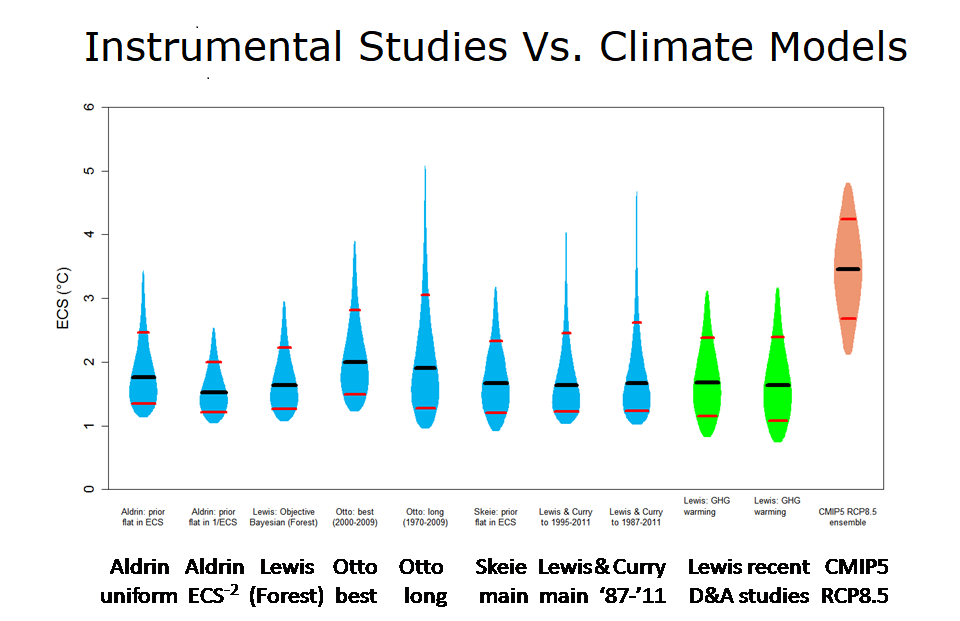
Well, the authors’ conclusion was that the climate models are actually unreliable. They’re all over the shop. They predict probably one degree more warming than is likely and we aren’t getting many of the predicted climate disasters. Plus, global warming also has benefits that are often ignored, especially a big increase in trees and crops that we’ve been seeing, a greening of the planet.

And in this report, the authors sum it all up like this. models, the climate models and experience suggests that carbon dioxide induced warming may be less damaging economically than commonly believed and excessively aggressive mitigation policies, you might include our own net zero schemes, could prove more detrimental than beneficial.  [See DOE Climate Team: Twelve Keys in Assessing Climate Change]

A cartoon depicting a pope character stating that scientists believe in anthropogenic global warming, while a doctor replies with a belief that there is no God.

So, you can understand why the authors have since been absolutely trashed for daring to doubt the climate scare and upsetting the climate industry. They’ve been called all sorts of names painted as fools, frauds, Donald Trump Toadies, even Stalinists, would you believe? But don’t be fooled by the abuse because the five authors are in fact very prominent experts. Professor emeritus Judith Curry has published 192 peer-reviewed papers on the climate. Dr. Roy Spencer, NASA senior scientist runs probably the most accurate measure of world temperature. Professor Ross McKitrick is an expert reviewer of the last three reports of the IPCC (intergovernmental panel on climate change). And distinguished professor John Christie, is a former lead author of an IPCC report. I mean, these are very serious people.

Plus Steven Koonin. He’s a physicist and former under secretary of science for President Barack Obama, a Democrat. And I am joined by Steven, Steve thank you so much for your time. Why did you and the other four experts behind this report actually agree to do it when you must have known the climate industry and the media would really go after you?

SK: Indeed. But you know, all five of us scientists have long felt that the science was misrepresented to the public and the decision makers, and we wanted to do our best to set the record straight.

Quote from Steven Koonin discussing the treatment of the Developing World and the fear instilled in younger generations, with a green geometric background.

AB: Well, on many points your report agrees with what I’ll call the consensus, the alarmist position, perhaps the position of the United Nations Intergovernmental Panel on Climate Change. You say, “Yes, global warming is real. Yes, it’s a problem. Yes, it’s caused in part by humans.” Now, tell us where you disagree with this consensus.

SK: Well, you know, people have said 95% of our report agrees with or is taken right out of the IPCC. It’s just that there are aspects of what the consensus says that do not find their way to the public. For example:

♦ There are no detectable trends in the great majority of extreme weather types.

♦ The models that we use to project climates into the future are demonstrably deficient. They’re in many ways all over the place in terms of their projections. And,

♦ The projected impacts of future climate change, even using those deficient models, are minimal.

These are very important central points that are there in the report
but do not make their way into the public discussion.

AB: You actually point out that the models tend to run hot, as in predict more warming than we’ve had. They’re unreliable. A number of basing false assumptions of how much emissions we’re going to get. You actually predict almost one degree less warming over the century than the IPCC model consensus. How important is that?

A bar chart comparing estimates of climate sensitivity from various instrumental studies and climate models, titled 'Instrumental Studies Vs. Climate Models'.

SK: Well, to be clear, we don’t predict. We simply cite and assess the work of others. But certainly, if the warming is a degree less than what the IPCC consensus says, that’s a big deal.

AB: And what about the climate disasters? I mean, every time like we’ve got it right now, you know, we’ve got some algae blooming off the South Australian coast. Global warming. We get heavy rain, global warming. We get a drought, global warming. How much influence has man-made warming really had from the work that you’ve done in this report? How much has it really influenced the natural disasters we tend to see?

A cartoon depicting a news anchor in a suit gesturing at a weather map showing a hurricane formation, with a caption stating, "Despite this being the first major hurricane to hit the U.S. since 2005, there's a 100% chance it will be blamed on climate change."

SK: Yeah, you know, people have a very short memory for weather disasters. There’s a lovely example that turned up at the beginning of July, having to do with the floods in Texas that we that were a terrible tragedy. But if you look back in the records, you can find the same kind of event happening in the same place in 1900. And of course, human influences on the climate were much smaller in 1900. And so, you have a very hard time to logically attributing the recent disaster to carbon dioxide.

The same is true for many other severe weather phenomena.
They happened in the past. They’re just relatively rare. And so
we get surprised when we see them happen in the present day.

AB: Yeah. I noticed for instance in your report you say the number of heat waves in America actually peaked nearly 100 years ago.

A political cartoon showing a worried man in a suit holding a paper bag, thinking, 'Another Heat Wave!' with 'MAINSTREAM MEDIA' labeled on the bag.

SK: The number of heat waves that were striking America at the time, and what we see now is much less, you know. The damning thing about the heat waves is that we really don’t understand why the 30s were so much warmer than it has been in many subsequent decades. And that speaks to our rather poor understanding of the ways in which the climate varies.

Graph showing no trend in U.S. heat wave frequency or magnitude over time, with data points from 1900 to 2020.

AB: I think the real thing about your report that’s annoying so many people in the climate industry is this. You say the warming will be less than what most people are claiming. You say the disasters from the warming we’ve seen are basically exaggerated.  They’re not that many that you can point to. And the the attempts we make to stop all this are very expensive. And well, do they really work? Isn’ it the takeaway here, that it might not actually be worth trying to stop what isn’t the the climate disaster that many claim.

SK: Absolutely. You know, in deciding what to do, we have to balance the hazards, the certainties and uncertainties in the changing climate against other considerations. Like the world needs more and more energy, and in deciding what to do you have to look at the costs. Are they going to be effective? What about equity between generations, between countries, and so on. It’s not simply that, oh my god, we’ve broken the climate, and we’ve got to fix it. And I do think some people get annoyed when we start to expose those nuances of the situation.

A cartoon depicting a conversation between two individuals, one asking if the other is a believer, followed by a question about climate or religion. The scene includes cartoonish characters in a crowd.

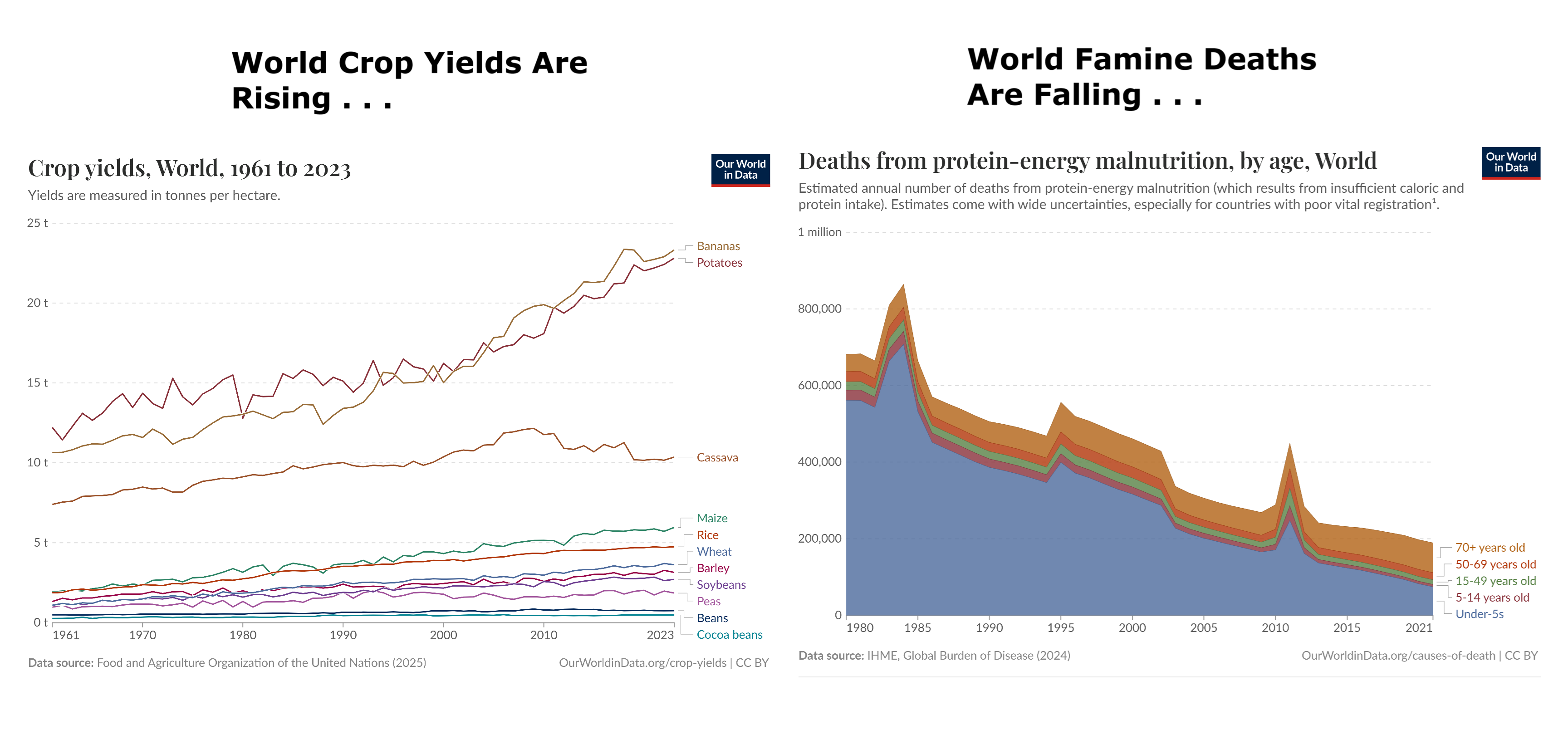
AB: Oh yes. So, you’ve really offended in the church of climate. And of course you also stress what’s undeniably true. The greening of the planet is actually a benefit of extra carbon dioxide in the atmosphere. More trees, more plants, more food.

Line graph showing global crop yields from 1961 to 2023, indicating rising trends for various crops.

SK: Agricultural yields have in fact doubled over the last 60 years or so. And a good fraction of that, NASA says 75% is attributable to higher carbon dioxide levels. You know, if you look inside a hot house, we put the carbon dioxide levels typically up to about 1,200 parts per million, which is just about three times what you find in the atmosphere even now.

AB: Now, you’ve come under massive attack, of course, Steve Koonin. I mean, environmental groups are even suing to censor the report. You’ve got media outlets of the left demonizing you, running so-called fact checks. I’ve had a look at a few, and they’re not persuasive. Some climate scientists are abusing you, claiming, you know, the group of you are just handpicked skeptics, even though you used to be with the Obama administration.  Have there been any criticisms of your report that you think, “Yep, that’s fairenough. we’ve goofed here or we haven’t taken this into consideration. Any criticism you think you can you should take on the chin?

SK: Well, we’ve seen one already that we basically made a a typographical error in one of the footnotes. We have acknowledged that to the person who pointed it out and of course we will fix it. But you know, we’re refraining right now from looking in detail at the criticisms till they come in over the next couple weeks through the public portal. Then as we have promised, we will deal with every serious criticism seriously and like good scientists we will modify the report as might be warranted from those criticisms.

AB: Steve Koonin, you’ve been fighting the alarmism for some time now. I think this is your your weightiest blow against the scaremongering. So congratulations and thank you so much for your time.

A cartoon depicting a hot air balloon labeled 'Catastrophic Global Warming Predictions' ascending, while two characters discuss various criticisms of climate models and predictions, including statements about temperature trends and inaccuracies.

Turns Out Major Climate Study Peddled By Media Relied On Bunk Data

A 2024 climate change study amplified by the corporate press projecting up to $38 trillion in global climate damages by 2050 relied on inaccurate data, The Washington Post reported Wednesday.

A group of six anxious people gathered around an old radio, listening intently. The background features a scenic landscape with mountains and a setting sun.

From Watts Up With That?

THE DAILY CALLER

Daily Caller News Foundation

Audrey Streb
DCNF Energy Reporter

A 2024 climate change study amplified by the corporate press projecting up to $38 trillion in global climate damages by 2050 relied on inaccurate data, The Washington Post reported Wednesday.

The study’s inclusion of Uzbekistan’s faulty GDP figures skewed its results and cast doubt on its conclusion that global GDP could be roughly 62% lower by 2100 due to climate change than it otherwise would be, according to the Post. Numerous prominent media outlets touted the study upon its release as proof of climate change’s imminent economic threat, but a new analysis and experts who spoke to the Post argue the paper is undermined by Uzbekistan’s “data anomalies.”

The original study was the second-most cited paper across media in 2024, according to the U.K.-based climate outlet Carbon Brief.

“The only GDP that is set to plummet is the GDP of fraudulent self-promoting climate activists who are about to finally and appropriately get their funding cut by the Trump administration,” President of the Heartland Institute James Taylor told the Daily Caller News Foundation. “Common sense and actual peer-reviewed studies show that warmer weather saves lives, with nearly 20 times more people dying from cold than heat, that warmer temperatures and more atmospheric CO2 are stimulating a blooming of greenery throughout the planet, and crop production sets records nearly every year with longer growing seasons and more atmospheric CO2.” (RELATED: Trump Admin’s New Report Blows Massive Hole In The Left’s Climate Catastrophe Narrative)

The U.S. government has even cited the study, with one December 2024 Congressional Budget Office (CBO) report referencing it to illustrate the risks climate change poses to the American economy.

Once Uzbekistan was removed from the dataset, projected GDP losses dropped sharply, from 62% to 23% by 2100, and from 19% to 6% by 2050, Hsiang told the Post. Hsiang and his two co-authors, graduate students Tom Bearpark and Dylan Hogan, reportedly uncovered the error after erasing one nation at a time from the data collection and observing that Uzbekistan’s absence drastically shifted the results, according to the Post. The authors found that Uzbekistan’s GDP records showed wild oscillations incongruent with purportedly more reliable World Bank data, which reflected less intense fluctuations, according to the outlet.

“Everybody who works with data has some responsibility to look at the data and make sure it’s fit for purpose,” Global Policy Laboratory Director at Stanford University Solomon Hsiang, who helped point out the error, told the Post. “When you have a lot of data points, the idea that a small country could be so influential is not intuitive.”

Nature editor Karl Ziemelis wrote to the Post that his publication is reviewing the study and that “appropriate editorial action would be taken once the matter was resolved.” The report’s original authors told the outlet that the Uzbekistan data flub was a processing error that was corrected in an updated analysis, though they believe the report still holds up.

“We are grateful, and I think it’s a good part of the scientific process that they’ve pointed out these issues,” Leonie Wenz, professor of environmental economics at the Technical University of Berlin and one author of the initial study, told the Post. “But importantly, the main conclusions of the paper hold, and there are only slight changes to the estimates.”

The massive GDP loss scale was flagged during the peer review process, one review noting that “I find all of this well explained and fairly convincing, yet, purely subjectively, I have a hard time in believing the results, which seem unintuitively large given damages aren’t perfectly persistent.”

Nature, Wenz, his coauthors Maximilian Kotz and Anders Levermann, Hsiang, Bearpark and Hogan did not respond to the DCNF’s requests for comment.

All content created by the Daily Caller News Foundation, an independent and nonpartisan newswire service, is available without charge to any legitimate news publisher that can provide a large audience. All republished articles must include our logo, our reporter’s byline and their DCNF affiliation. For any questions about our guidelines or partnering with us, please contact licensing@dailycallernewsfoundation.org.

CNN Analyst Shocked Americans Aren’t Afraid of Media-Created ‘Climate Crisis’

Meanwhile, the press intends to double down on its climate hysteria.

From Watts Up With That?

Legal Insurrection

Meanwhile, the press intends to double down on its climate hysteria.

Posted by Leslie Eastman 

CNN Analyst Shocked Americans Aren’t Afraid of Media-Created ‘Climate Crisis’

Meanwhile, the press intends to double down on its climate hysteria.

Posted by Leslie Eastman

I have noted on a few occasions that Americans’ trust in scientists has eroded. One reason for this is related to high-profile claims about weather and climate that have not materialized as predicted.

For example, there have been warnings of snowless winters, rapidly vanishing glaciers, and an ice-free Arctic.

Additionally, the monsoon rains of the American Southwest are now being repackaged as yet another reason to attack fossil fuels in the name of man-made global warming — despite the fact that the region’s monsoon season has long been officially recognized as occurring between mid-June and late-September.

However, the mainstream media’s constant doom-and-gloom reporting is not having the desired effect. CNN’s chief data analyst, Harry Enten, recently reported on a poll showing that Americans remain largely unmoved by the histrionics surrounding climate change.

Polling from Gallup found that 40% of Americans are “greatly worried about climate change” currently, which has decreased by six percentage points from 2020. These new numbers emerged as many liberals, including Democrat members of Congress, have attempted to blame climate change and President Donald Trump for the devastating flood in Central Texas.

“Are Americans concerned of climate change, and the answer is, Americans aren’t afraid of climate change,” Enten said. “Climate activists have not successfully made the case to the American people. I want you to take a look here. ‘Greatly worried about climate change.’

We have data going all the way back since 1989, and look at it then, it was 39%. In 2000, it was 40%. 2020, 46%. In 2025, 40%, which is the exact same percentage as in 2000, despite all of these horrible weather events. The percentage of Americans that are greatly worried about climate change has stayed pretty gosh darned consistent.”

The press is a little unhappy that its fearmongering isn’t working, so it’s clearly going to double down. For example, a piece published by NBC News pushes the narrative that people aren’t afraid enough of “extreme weather events” — as evidenced by an Associated Press article quoting preferred “experts” on the subject.

Climate change is making extreme weather events more frequent and intense, according to climate scientists and government data. But people and governments are generally living in the past and haven’t embraced that extreme weather is now the norm, to say nothing about preparing for the nastier future that’s in store, experts in meteorology, disasters and health told The Associated Press.

“What happens with climate change is that what used to be extreme becomes average, typical, and what used to never occur in a human lifetime or maybe even in a thousand years becomes the new extreme,” Princeton University climate scientist Michael Oppenheimer said. “We start to experience things that just basically never happened before.”

Meteorologist Chris Mertz points out what the “extreme weather event” narrative is in a recent interview.

Life expectancy has more than doubled since the mid-19th century. The number of deaths from weather-related natural disasters has decreased by over 96% since the 1920s. Also, if you look at the number of hurricanes, they are not increasing on a global scale. The number of tornadoes has remained about steady in the United States since real-time data collection began in 1954. Similarly, the number of floods and droughts is not increasing globally, and wildfires have gone down.

The media minions constantly conflating severe weather with a climate apocalypse at the behest of climate cultists with policy agendas will continue to lose audience as those with more sensible and realistic perspectives, who are no longer silenced, are proven to be scientifically correct.

I am very grateful Americans recognize climate hysteria for what it is.