444,000 semi-loads of food? Just another day on planet earth

A friend of mine, always with a keen eye on interesting things, passed on an interesting quote from the CERA Week energy conference the other week. The head of the International Energy Forum mentioned a surprising statistic, asย quotedย by Javier Blas on Twitter: โ€œHeathrow airport in London uses more energy than the whole African nation of Sierra Leone [population ~8.5 million].โ€ Yikes!

From The BOE Report

ย Terry Etam

A friend of mine, always with a keen eye on interesting things, passed on an interesting quote from the CERA Week energy conference the other week. The head of the International Energy Forum mentioned a surprising statistic, as quoted by Javier Blas on Twitter: โ€œHeathrow airport in London uses more energy than the whole African nation of Sierra Leone [population ~8.5 million].โ€ Yikes!

Hereโ€™s another one that turned up randomly in the feed by a credible source: โ€œIf we keep growing our energy usage (2.9% CAGR last 350 years) we will use more energy in the next 25 years than in all prior human history. 3x in 39 years and 9x by the end of the century.โ€

Energy is an amazing topic, both sources and uses. The sheer scale of what we require for our present lifestyle is mind-blowing when placed in concrete contexts like above. In the abstract, the numbers donโ€™t mean anything. The world consumes over 100 million barrels of oil per day. So what? Is that a lot? Sure itโ€™s a big number but so is 8 billion people. Either stat is hard to wrap oneโ€™s head around.

Consider the following with respect to oil consumption/production: ExxonMobil made waves recently for a large oil discovery offshore Guyana, in an era when there arenโ€™t that many discoveries being made (the flip side of the demand for oil/gas companies to return money to shareholders means exploration generally takes a back seat). Reuters picked up the story: ExxonMobil announced a new discovery, one of 30 since 2015, in a 6.6 million acre area that to date has been found to hold 11 billion barrels of recoverable oil, which also equals the countryโ€™s total. The results are significant, moving Guyana up to 17th on the worldโ€™s petroleum reserve rankings, similar to Norway, Brazil, or Algeria.

Now compare that number to consumption. At 100 million b/d, the world consumes a billion barrels of oil every ten days. Eleven billion barrels of recoverable reserves will meet the worldโ€™s needs for about 110 days, or just under four months. And global demand continues to grow.

The scope of this discussion goes far beyond oil demand. It is imperative that people understand energy demand, and particularly so on a global scale.

Look at this history of global energy consumption chart fromย Our World in Data:

Itโ€™s nuts. But it coincides very well with the rising standard of living attained by humanity, particularly in the west, an increase the rest of the world wants to emulate.

Consider the following statistics if you think that trajectory is going to slow down or reverse any time soon.

Africa has about 1.2 billion people, or roughly 15 percent of the earthโ€™s population. Yet Africa accounts for 2 percent of global air traffic. By contrast, Europe has a population of about 740 million, and accounts for 31 percent of global air traffic.

What if Africans decide they want to live like Europeans, air-travel-wise, which is not just justified on moral grounds but actually more functionally logical, because Europe covers only 1/3 of Africaโ€™s size of 30 million square kilometres?

What if the rest of the world wants to enjoy air conditioning to the extent the US does (and why on earth wouldnโ€™t they)? According to the US Energy Information Agency, nearly 90 percent of US households use air conditioning, and virtually every office building does as well. The US has about 130 million households for 330 million people, or about 2.5 people per household. If Africa had a similar ratio, they would have 480,000 households, and if a similar proportion had AC there would be 430,000 households with AC. Itโ€™s safe to say that today in Africa the number of households with AC is far closer to zero than 90 percent. (Even communists/hardcore socialists support near-universal air conditioning, though they call it a โ€˜rightโ€™ by way of that fuzzy but firm โ€˜gimme thatโ€™ appropriation way of theirs.)29dk2902lhttps://boereport.com/29dk2902l.html

Now add in India, with another 1.4 billion people, and do the same math. A billion air conditioners worth of global demand is not a ridiculous estimate, not when considering Pakistan, Bangladesh, Indonesia, parts of South Americaโ€ฆ in addition to Africa, Indiaโ€ฆ

Consider even food, and the logistical magnum opus required to keep countries food-riot-free. A typical western website says that the average person consumes 3-4 pounds of food per day. Letโ€™s say the rest of the world isnโ€™t so lucky, and weโ€™ll call it 2.5 pounds per day for a global average (each new cruise ship drags the world average up considerably). There are 8 billion of us schlepping around planet earth. A semi trailer can carry about 45,000 pounds of cargo. So every day, the equivalent of about 444,000 semis full of food are forklifted out of trucks and down the gullets of 8 billion upturned mouths. Every freaking day, without a break.

And thatโ€™s just food. What about IKEA. And Costco. And Home Depot. And Walmart. And all the other stuff in our world.

And billions more people are striving to fill up the SUV (yes, everywhere you go, SUV) at their local Costco/Home Depot/Walmart, as soon as one arrives in their community.

Ah hell, I give up. The scale of all this stuff is unfathomable. And yet it all gets where it needs to go, every day, as long as thereโ€™s energy.

Any singular household staple must be there, in abundance, or all hell breaks loose. Remember Covid > toilet paper? What happens as soon as there is even a rumour of a shortage? Social deviants, which are harder to eradicate than (and just as useful as) STDs, get into gear and begin hoarding in order to resell at a profit. It just happens, one of the unfortunate costs of living in a free society. (Iโ€™m not suggesting that those people should be found and beaten with a tire iron, but then again Iโ€™m not suggesting that they shouldnโ€™t.)

When we think of energy consumption, we tend to think of our hilariously comfortable lives in western nations, where supermarkets are perpetually full, where gasoline and heating fuels are available 24/7/365 at reasonable prices, where flying wherever and whenever we want, with minimal hassle, is one step away from being viewed as a human right. We are correct in that our energy consumption per capita in the west is very high. But on an outright total consumption basis, individual country statistics are pretty wild. And saddening, in some ways.

First the wild part: You would expect (or I did anyway) the US to be either at the top of the consumption pile or close; it is and has been an economic juggernaut for a century. But not even close: in 2022, the US consumed about 96 exajoules of energy, which is a lot โ€“ that number equals the consumption of India, Russia, Japan and Canada combined. But way out in front is China, with 2022 consumption of 159 exajoules. No one should be surprised China leads the world in renewables installation and coal fired power plant construction. They need it all.

Where it gets sad is to wander further down the list to the lowest consumers. The site linked above shows a graphic of the world, with each country colour-coded for total energy consumption. The lowest on the colour scale is a pale yellow representing 20 exajoules per year. The scale rises up through blues and towards a dark navy which represents China at the top of the heap.

Most African countries, and some South American ones, do not even warrant a definition in the legend at all, and are simply greyed out. They have so little energy consumption they hardly even make it onto the raw data table. Hundreds of millions of people live like that. But only as long as they have to.

It is very sobering to see how much of the world lives, and how very far they are from the Westโ€™s standard of living. The Westโ€™s leaders push the concept of โ€˜electrify everythingโ€™, a concept that only makes sense if one is looking no further than their backyard and has zero feel for the true global situation. In much of the world, they would just as happily get behind the slogan โ€˜electrify anythingโ€™.

It is hard to imagine this energy consumption trajectory falling; weโ€™d be very lucky if it stayed flat. But that seems like an unrealistic hope. The developing world clearly has every incentive and right to advance towards the Westโ€™s standard of living, and if they get close global energy consumption will head off further into the stratosphere. Here in the West, we play cute little games like a forced switch to EVs, while ignoring almost totally any common sense commentary on the subject (For example, Toyotaโ€™s 1:6:90 rule which states that for the same amount of raw materials to manufacture one EV, Toyota can make six plug-in hybrids or 90 hybrids, and in doing so would achieve 37 times the emissions reduction of a single EV. Yet Toyota is scorned for such logic on the grounds that โ€œToyotaโ€™s reluctance to fully embrace EVs can hinder innovation in the EV industry.โ€ Note that there is no challenge to the facts themselves, just a bruising of the ego of the think tanks.)

Anyone that provides energy of any kind should roll up their sleeves, thereโ€™s a lot of work to be done, and those who wish to hunt for energy villains will get run over, in due course.

Energy conversations should be positive, grounded in reality, and as funny as possible. Life depends on it, both the energy and the humour. Find out more in โ€œThe End of Fossil Fuel Insanityโ€ at Amazon.ca, Indigo.ca, or Amazon.com. Thanks!

Read more insightful analysis from Terry Etam here, or email Terry here.

Stop Fearmongering, The Hill, Climate Change Is Not Harming Homeowners

A recent article from The Hill, titled โ€œHomeowners in these U.S. cities face the greatest threat from climate change,โ€ cites a new report from the First Street Foundation claiming homeowners in certain cities face large and increasing climate riskโ€”claiming that more than 44.8 percent of homes face โ€œclimateโ€ risk. This story is misleading. What they are actually reporting is weather risk, not risk related to climate change, because none of weather conditions discussed in the report are getting worse.

From ClimateRealism

By Linnea Lueken

A recent article from The Hill, titled โ€œHomeowners in these U.S. cities face the greatest threat from climate change,โ€ cites a new report from the First Street Foundation claiming homeowners in certain cities face large and increasing climate riskโ€”claiming that more than 44.8 percent of homes face โ€œclimateโ€ risk. This story is misleading. What they are actually reporting is weather risk, not risk related to climate change, because none of weather conditions discussed in the report are getting worse. Each of the cities discussed have been threatened by the types of extreme weather events cited in the story throughout their histories.

It is important to note that the First Street Foundation is the source of this report. That organization is a climate alarmist group that has been a wellspring of false reports that Climate Realism has repeatedly refuted previously, here, here, and here, for example. Based on the organizationโ€™s history of publishing blatantly misleading reports, The Hill should have known better than to uncritically parrot the false claims made in this First Street Foundation report.

The same errors from those previous claims are made here again in this Hill post.

The Hill reports that a recent โ€œRealtor.com Housing and Climate Risk Report found that more than 44.8% of the countryโ€™s homes face at least one kind of โ€œsevere or extreme climate riskโ€ from either flood, wind, wildfire, heat or air quality.โ€

The First Street Foundation data used were forecasts about the likelihood of given weather disasters striking selected cities over the next 30 years.

More than twenty cities are listed in the article. For the sake of brevity only a few have been selected for debunking here.

The Hill says โ€œ[w]hen it comes to the total value of homes at risk of flooding, the greater Miami area ranks first, with a total value of $323.9 B[illion].โ€

Flooding has been common throughout Miamiโ€™s history. Recent floods in Miami have often been attributed to climate change induced sea level rise. To begin, Miami is a low-lying coastal city, making flooding a constant threat. Data does not show thatย sea levelย rise is advancing at a speed in Miami that threatens it. As shown in a previousย post, data from a nearby National Oceanic and Atmospheric Administration (NOAA) tide gauge station show that sea level is rising off Miami at a rate slower than even the global average, at about 1.2 inches per decade. (See figure below)

Like many coastal cities in the Eastern United States, Miami was built on swamp land. As a result, Miami suffers from land subsidence, a factor which contributes to flooding issues. Groundwater withdrawal and land compaction from development also contribute to flooding in Miami. This can be mitigated, however, with modernized infrastructure and maintenance of coastal ecosystems like estuaries and tidal marshes which reduce the impact of high tides and storm surge.

The Hill says that Los Angeles is one of the major metropolitan areas most affected by wildfires. This is true, but, again, climate change is not to blame for the risk.

Wildfires, contrary to popular media narratives, have not become more common or widespread, according to global satellite data. Recent upticks in parts of the United States correlate to changes in forest management practices, which after decades of poor policy, have built up much of the American West into a tinderbox.

Historically wildfire has been a normal and fairly regular of feature of the ecosystem where Los Angeles lies, and for arid California, as a whole, as a study in the journal Forest Ecology and Management shows. That research found that fires were much more common and larger in scale in the areaโ€™s ancient past. The studyโ€™s authors write, โ€œ[o]ur estimate of prehistoric annual area burned in California is 88% of the total annual wildfire area in the entire US during a decade (1994โ€“2004),โ€ and โ€œ[s]kies were likely smoky much of the summer and fall in California during the prehistoric period.โ€

Along with some Florida cities, Texas cities like Austin are listed by the Hill and the Realtor.com report as particularly susceptible to extreme heat. No one who has lived in those places would dispute that, but again, climate change is not the reason. Modest warming is happening, but there is no trend towards more extremely hot days in Texas, according to data from theย National Oceanic and Atmospheric Administration. Even with annual variation, the long-term temperature trend shows a decline in extremely hot days overall since 1900. (see the figure).

The final category discussed is air quality due to air pollution, for which San Francisco is listed as particularly susceptible. Again, it is true that San Francisco suffers from smog, but again, climate change is not responsible.

San Francisco is uniquely positioned on the California coast to suffer from smog due to the geography of the region. Temperature inversions, which aid in the creation of โ€œair pollution weatherโ€ have not been found to be increasing according to the Intergovernmental Panel on Climate Change. Further, NASA satellite data show that air pollution, including irritating components in smog like nitrogen dioxide, which forms ground level ozone, have substantially declined in recent years.

Every one of the weather conditions listed are just that โ€“ weather conditions. All have been common for the regions discussed for hundreds of years, long before the cities themselves existed, or climate change became a cause cรฉlรจbre. There is not a single part of the United States, or the world, that does not experience extreme weather of some kind. Some are more prone to particular types of extreme weather events than others. Anyone buying a home should be aware of the natural disaster threats that exist in the region so that they can prepare adequately. A study on regional weather patterns can be useful in this regard, unless it falsely points to factors having nothing to do with the weather problems, like climate change, that misdirect concern from the real sources of the problem, and result in diverting resources from real potential solutions to common local incidences of extreme weather.

Sadly, the latter is just what the First Street Foundationโ€™s report and the Hillโ€™s article promoting it are likely to do.

The Incredible Dumbness of Bidenโ€™s War on LNG

The Biden administration hasย pausedย new Department of Energy (DOE) approvals of proposed liquefied natural gas (LNG) export projects. This decision will not affect current export projects or those under construction.

From Watts Up With That?

Guest โ€œYou Canโ€™t Fix Stupid, Part Deuxโ€ by David Middleton

FYI

  • LNG: liquified natural gas
  • DOE: Department of Energy
  • FERC: Federal Energy Regulatory Commission
  • Bcf: billion cubic feet
  • mcf: thousand cubic feet
  • mmBTU: 1 million British thermal units (~1 mcf)

The Old News

Biden pauses LNG export approvals after pressure from climate activists

By Timothy Gardner

January 26, 2024

WASHINGTON, Jan 26 (Reuters) โ€“ U.S. President Joe Biden on Friday paused approvals for pending and future applications to export liquefied natural gas (LNG)from new projects, a move cheered by climate activists that could delay decisions on new plants until after the Nov. 5 election.

The Department of Energy (DOE) will conduct a review during the pause that will look at the economic and environmental impacts of projects seeking approval to export LNG to Europe and Asia where the fuel is in hot demand.

[โ€ฆ]

Biden said in a statement: โ€œDuring this period, we will take a hard look at the impacts of LNG exports on energy costs, Americaโ€™s energy security, and our environment.โ€

The pause โ€œsees the climate crisis for what it is: the existential threat of our time,โ€ said Biden, a Democrat.

Administration officials vowed that the pause would not hurt allies, as it has an exemption for national security should they need more LNG.

[โ€ฆ]Reuters

The Incredible Dumbness of Bidenโ€™s War on LNG

Bidenโ€™s pause of new LNG export approvals will have no effect on:

  • Bad weather (AKA climate change)
  • Short-term US energy prices
  • Global natural gas consumption

This has to be the most idiotic sentence in US presidential history:

My Administration is announcing today a temporary pause on pending decisions of Liquefied Natural Gas exports โ€“ with the exception of unanticipated and immediate national security emergencies.ย 

Letโ€™s Go Brandon!

They paused the permit approvals for new LNG facilities. It can take ten years to go from permitting, to construction to loading up the first LNG tanker. This โ€œpauseโ€ does not apply to currently operation LNG facilities or those under construction.

The Biden administration hasย pausedย new Department of Energy (DOE) approvals of proposed liquefied natural gas (LNG) export projects. This decision will not affect current export projects or those under construction.

Center for Strategic & International Studies

The Pause Violates the Natural Gas Act and Administrative Procedure Act


LNG 21 Mar 2024 | 23:01 UTC

Sixteen US states challenge White House โ€˜pauseโ€™ on LNG permits

Author Corey Paul
Editor Giselle Rodriguez
Commodity LNG

Louisiana, Texas and more than a dozen other Republican-led states sued the Biden administration March 21 seeking to overturn its suspension on issuing key new LNG export permits.

The lawsuit in a federal Louisiana court argued that the White House ran afoul of the Natural Gas Act and flouted the Administrative Procedure Act when it hit โ€œpauseโ€ on the permits in late January. The suit, filed in the US District Court for the Western District of Louisiana by sixteen state attorneys general, names President Joe Biden, the Department of Energy and agency officials as defendants.

[โ€ฆ]S&P Global

The Biden maladministration has lost nearly every oil & gas related lawsuit filed in Western District of Louisiana and the Fifth Circuit. The fact that the Natural Gas Act effectively requires the Department of Energy to approve LNG permits should make this one a piece of cake.

Under the Natural Gas Act, the DOEย is requiredย to approve such authorizations unless it finds that doing so would not be in the public interest.

Center for Strategic & International Studies

An American Industrial Success Story

APRIL 1, 2024

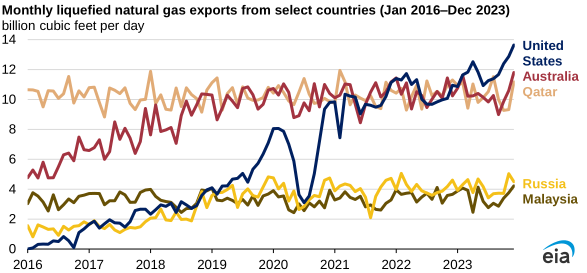
The United States was the worldโ€™s largest liquefied natural gas exporter in 2023

monthly liquefied natural gas exports from selected countries

Data source: U.S. Energy Information Administration, Natural Gas Monthly, Cedigaz


The United States exported more liquefied natural gas (LNG) than any other country in 2023. U.S. LNG exports averaged 11.9 billion cubic feet per day (Bcf/d)โ€”a 12% increase (1.3 Bcf/d) compared with 2022, according to data from our Natural Gas Monthly.

LNG exports from Australia and Qatarโ€”the worldโ€™s two other largest LNG exportersโ€”each ranged from 10.1 Bcf/d to 10.5 Bcf/d annually between 2020 and 2023, according to data from Cedigaz. Russia and Malaysia were the fourth- and fifth-highest LNG exporters globally over the last five years (2019โ€“23). In 2023, LNG exports from Russia averaged 4.2 Bcf/d, and exports from Malaysia average 3.5 Bcf/d.

U.S. LNG exports increased in the first half of 2023 after Freeport LNG returned to service in February and ramped up to full production by April. Relatively strong demand for LNG in Europe amid high international natural gas prices supported increased U.S. LNG exports during the year. U.S. LNG exports set monthly records late last year: 12.9 Bcf/d in November, followed by 13.6 Bcf/d in December. We estimate that utilization of U.S. LNG export capacity averaged 104% of nominal capacity and 86% of peak capacity across the seven U.S. LNG terminals operating in 2023.

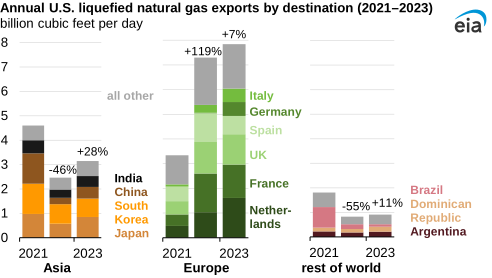
Similar to 2022, Europe (including Tรผrkiye) remained the primary destination for U.S. LNG exports in 2023, accounting for 66% (7.8 Bcf/d) of U.S. exports, followed by Asia at 26% (3.1 Bcf/d) and Latin America and the Middle East with a combined 8% (0.9 Bcf/d).

In 2023, Europe (EU-27 and the UK) continued to import LNG to compensate for the loss of natural gas previously supplied by pipeline from Russia. Europeโ€™s LNG imports capacity continued to expand, and we expect it will increase by more than one-third between 2021 and 2024.

The countries that imported the most U.S. LNG were the Netherlands, France, and the UK, with a combined 35% (4.2 Bcf/d) of all U.S. LNG exports. LNG imports increased in the Netherlands after the Gate LNG regasification terminal was expanded and two new floating storage and regasification units (FSRUs) were commissioned. Germany began importing LNG in 2023 when three new FSRUs were commissioned. We expect another four terminals (three of which are FSRUs) to come online between 2024 and 2027.

In Asia, Japan and South Korea each received 0.8 Bcf/d of LNG exports from the United States, the fourth- and fifth-highest U.S. LNG export volumes by country in 2023. Japan, China, and India increased LNG imports from the United States by a combined 0.6 Bcf/d compared with 2022. The Philippines and Vietnam started importing LNG in 2023; the Philippines imported LNG cargoes from the United States only in October and November.

In Latin America, U.S. LNG exports to Brazil continued to decline last year as Brazil continued to primarily use hydropower for electricity generation. U.S. LNG exports to Brazil peaked in 2021, when the country experienced its worst drought in more than 90 years.annual U.S. liquefied natural gas exports by destination

Data source: U.S. Energy Information Administration, Natural Gas Monthly
Note: Percentages shown denote year-on-year change in U.S. export volumes. Europe includes Tรผrkiye.


Principal contributor: Victoria Zaretskaya

Tags: natural gas, international, exports/imports, United States, liquid fuels, Australia, LNG (liquefied natural gas), Qatar, RussiaUS Energy Information Administration

Let this sink in: The United States oil & gas industry went from zero-point-zero LNG exports in 2016 to becoming the โ€œworld leaderโ€ in LNG exports (~14 Bcf/d) in 2023. This is akin to the New York Mets going from cellar dwellers from 1962โ€“1968 to World Series champions in 1969โ€ฆ Or NASA going from JFKโ€™s 1961 goal โ€œof landing a man on the moon and returning him safely to the earthโ€ before 1970, to Neil Armstrongโ€™s โ€œone giant leapโ€ 84 days prior to the Metsโ€™ World Series victory.

New York Mets? Moon landing? LNG exports???

Former Mets manager Casey Stengel had such low expectations for the still-fledgling Mets that he once said man would walk on the moon before the Mets win a championship. As Steven Marcus of Newsday aptly points out, Stengel was correct, but by only three months.Metsmerized

โ€œWhen those astronauts landed on the moon,โ€ said Mets relief pitcher Tug McGraw, โ€œI knew we had a chance. Anything was possible.โ€Throneberry Fields Forever

The Amazing (or Miracle) Mets and Apollo 11 were examples of incredible achievementsโ€ฆ Essentially going from startups to world champions in less than a decade. In less than eight years, the US oil & gas industry went from net importers of to the world champions of LNG exports. Putting the brakes on LNG exports would be as dumb as cancelling the Apollo program after its most successful mission, Apollo 17, or the New York Mets trading away a young Nolan Ryan for a washed up infielder in 1971.

Increased U.S. Natural Gas Exportsโ€ โ‰  Higher U.S. Prices

We are able to export natural gas because we produce more than we consume. If natural gas exports were prohibited, we wouldnโ€™t have excess natural gas production.

Natural gas explained: Natural gas imports and exports

We did all this while actually driving prices down.

https://www.eia.gov/dnav/ng/hist/n9070us2A.htmย https://www.eia.gov/dnav/ng/hist/n9140us2a.htmย https://www.eia.gov/dnav/ng/hist/rngwhhdA.htm

While short-term disruptions in supply and demand can trigger short-term upward and downward spikes in prices, as in 2022, prices were far higher when the US was a net importer, rather than exporter, of natural gas.

What would happen if the Biden maladministration did actually halt LNG exports? The US market would suddenly be oversupplied by almost 12 Bcf/d of production. This would cause natural gas prices to collapse, shale gas producers would slash production and oil producers would ramp up flaring of associated gas. The largest Marcellus producer recently announced production cuts due to natural gas falling below $2/mcf.

EQT Announces Strategic Production Curtailment

EQT Logo (June 2020) (PRNewsfoto/EQT Corporation)

NEWS PROVIDED BY EQT Corporation (EQT-IR) 

04 Mar, 2024, 05:00 ET

PITTSBURGH, March 4, 2024 /PRNewswire/ โ€” EQT Corporation (NYSE: EQT) (โ€œEQTโ€ or the โ€œCompanyโ€) today announced it made the strategic decision to curtail approximately 1 Bcf per day of gross production beginning in late February in response to the current low natural gas price environment resulting from warm winter weather and consequent elevated storage inventories. The Company expects to maintain this curtailment through the month of March and will reassess market conditions thereafter. Curtailments are expected to total approximately 30 to 40 Bcf of net production during the first quarter.    

[โ€ฆ]PR Newswire

Other Marcellus and Haynesville operators have also recently announced production cuts.

Making Russia Great Again

API on LNG Permit Pause: A โ€˜Win for Russiaโ€™ and โ€˜Broken Promise to U.S. Alliesโ€™

WASHINGTON, January 26, 2024 โ€“ The American Petroleum Institute (API) today released the following statement from President and CEO Mike Sommers on the Biden administrationโ€™s announcement to pause approvals of new LNG export facilities, unnecessarily increasing project wait times at a time of geopolitical turmoil and rising coal use around the world. 

โ€œThis is a win for Russia and a loss for American allies, U.S. jobs and global climate progress. There is no review needed to understand the clear benefits of U.S. LNG for stabilizing global energy markets, supporting thousands of American jobs and reducing emissions around the world by transitioning countries toward cleaner fuels. This is nothing more than a broken promise to U.S. allies, and itโ€™s time for the administration to stop playing politics with global energy security.โ€ 

The announcement undercuts President Bidenโ€™s own pledge to send increased U.S. LNG supplies to our allies overseas to help end dependence on Russian gas. The pledge also committed the United States to โ€œmaintaining an enabling regulatory environmentโ€ for LNG.

[โ€ฆ]American Petroleum Institute

Breaking News!

Energy Environment LNG Gas Energy

White House open to ending LNG export pause in push for Ukraine aid, sources say

By Jarrett Renshaw, Patricia Zengerle and Timothy Gardner

April 2, 2024

WASHINGTON, April 2 (Reuters) โ€“ U.S. officials are open to ending President Joe Bidenโ€™s pause on approvals of liquefied natural gas exports to get a Ukraine aide package passed in Congress but want to wait to see the entire proposal before making any decisions, two White House sources said on Tuesday.

Biden, a Democrat, in late January had paused approvals for pending and future applications to export the supercooled fuel after protests about the booming industry from activists concerned about its impact on climate change.

[โ€ฆ]Reuters

I tend to think that the โ€œsourcesโ€ were just floating a trial balloon. This tradeoff doesnโ€™t seem to make sense for anyone.

Conclusion

I stand corrected. This is actually the most idiotic sentence in US presidential history:

This pause on new LNG approvals sees the climate crisis for what it is: the existential threat of our time.Letโ€™s Go Brandon!

If the response to โ€œthe existential threat of our timeโ€ is to transfer future (beyond 2030) LNG sales from US companies to Russia, Qatar, etcโ€ฆ And they might be willing to trade the pause for another $95 billion for Ukraineโ€ฆ It just might not be very โ€œexistential.โ€

Debunking the Myth CO2 infrared Heats the Ocean!

Absorbed solar heat creates a temperature gradient where conduction moves heat from the diurnal warm layer up towards the cooler skin surface and out to the atmosphere. 98% of the time the ocean heats the atmosphere. The atmosphere does not heat the ocean.

From Jim Steele

Scientists pushing CO2 warming, dishonestly push the myth that CO2 warms the ocean.

First understand, CO2 infrared only penetrates a few microns depth compared to solar heating that warms the sub-surface to several meters depth, creating the diurnal warm layer (graphic B)

Second, the oceanโ€™s skin layer is the only layer where heat can ventilate from the ocean. Absorbed solar heat creates a temperature gradient where conduction moves heat from the diurnal warm layer up towards the cooler skin surface and out to the atmosphere. 98% of the time the ocean heats the atmosphere. The atmosphere does not heat the ocean.

The skin surface is always the coolest layer because as soon as any downward infrared from greenhouse gases heats the micron thick skin surface, the skin surface radiates that heat away, as the laws of physics dictate! Furthermore, any heating of the skin surface increases evaporation and promotes evaporative cooling. And finally skin surface heat is also conducted away by the atmosphere. Thus even at night after most solar heat has been ventilated, the skin surface is cooler than subsurface layers. (graphic A)

Measurements show the skin surface radiates away infrared from the combined inputs of solar heating that rises to the skin surface and infrared heating absorbed by the skin surface (bottom graph). The skin surface cannot trap heat. However subsurface layers trap heat because of the time delay for that heat to reach the skin surface to ventilate. Furthermore, heat is trapped in the ocean subsurface where ever solar heated subsurface layers are overlain by fresher water that suppresses convection.

To better understand this dynamic watch or read: Science of Solar Ponds Challenges the Climate Crisis

UN Climate Advisor & Time Magโ€™s โ€˜Woman Of The Yearโ€™ declares โ€˜the climate crisisโ€™ is โ€˜not just manmade, itโ€™s white manmadeโ€™ โ€“ โ€˜A result of capitalism, years of colonialism, years of racial oppressionโ€™

UN climate advisor Ayisha Siddiqa (also Time Mag’s 2023 Woman of the Year): “The climate crisis is manmade. And it’s not just manmade, it’s white manmade. (applause) It is a result of capitalism, years of colonialism, years of racial oppression. And so if you want to get involved, the way that we save our planet is when we protect the most vulnerable communities among us. And this includes black trans women. This includes indigenous people. This is why it includes children and young people, because when we protect them, we can protect everybody else.”

From Climate Depot

UN climate advisor Ayisha Siddiqa (also Time Mag’s 2023 Woman of the Year): “The climate crisis is manmade. And it’s not just manmade, it’s white manmade. (applause) It is a result of capitalism, years of colonialism, years of racial oppression. And so if you want to get involved, the way that we save our planet is when we protect the most vulnerable communities among us. And this includes black trans women. This includes indigenous people. This is why it includes children and young people, because when we protect them, we can protect everybody else.”

Byย Marc Morano

Time Mag: Ayisha Siddiqa Is Making the World Think Differently About Climate Action

Ayisha Siddiqa (@ayisha_sid) โ€ข Instagram photos and videos

UN touts Aysisha Siddiqa as Time Magโ€™s โ€˜Woman of the Yearโ€™ for 2023: The Secretary-Generalโ€™s Youth Advisory Group on Climate Change provides him with practical and outcome-focused advice, diverse youth perspectives and concrete recommendations, with a clear focus on accelerating the implementation of his climate action agenda.

UN secretary-general youth climate adviser calls for Whites to be stripped of power in โ€˜revolutionary fightsโ€™ย โ€“ โ€˜Racial harmony is a fallacy,โ€™ said United Nations climate adviser Ayisha Siddiqa

Ayisha Siddiqa (@ayisha_sid) โ€ข Instagram photos and videos

UN climate advisor Ayisha Siddiqa (also Time Magโ€™s 2023 Woman of the Year): โ€œThe climate crisis is manmade. And itโ€™s not just manmade, itโ€™s white manmade. (applause) It is a result of capitalism, years of colonialism, years of racial oppression. And so if you want to get involved, the way that we save our planet is when we protect the most vulnerable communities among us. And this includes black trans women. This includes indigenous people. This is why it includes children and young people because when we protect them we can protect everybody else.โ€

Time to save the Right Whale from the Green-Left

Back in the sixties and seventies โ€œSave the Whalesโ€ was the exclusive domain of the political left.

As Bob Dylan might say, โ€œthe times they are a changin.โ€

From CFACT

By Craig Rucker

Back in the sixties and seventies โ€œSave the Whalesโ€ was the exclusive domain of the political left.

As Bob Dylan might say, โ€œthe times they are a changin.โ€

Three major โ€œconservativeโ€ organizations โ€“ the National Legal Policy Center, Heartland Institute, and my organization, the Committee For A Constructive Tomorrow โ€“ recently filed a major lawsuit in a Washington, D.C. federal court to save the Right Whale from facing potential oblivion.

Why arenโ€™t the larger Green groups, unlike the grassroots ones, rallying around the efforts of these organizations to save Right whales?  Good question.  Perhaps itโ€™s because the threat to the remaining 350 of them doesnโ€™t come from Russian, Norwegian, or Japanese whaling vessels, as it did back in the 70โ€™s.  Rather, it is from so-called โ€œGreen energyโ€ in the form of offshore wind.  Right whales are being threatened by the Biden Administrationโ€™s fast-track plans to hurriedly place 30,000 MW of wind power generation off the Eastern coast, and doing so without the proper sort of environmental impact assessment they might otherwise perform for, say, offshore oil.

The collective decision by our outfits to take the issue of whale protection to Court came after two years of futile attempts to get the Biden Administration to listen. Offshore wind development threatens the nearly extinct North Atlantic Right Whale in various ways, and the government refuses to investigate.

The two agencies which share responsibility for making sure wind development does not harm whales include the Interior Departmentโ€™s Bureau of Ocean Energy Management (BOEM), which oversees building wind facilities, and the Commerce Departmentโ€™s National Marine Fisheries Service (NMFS or NOAA Fisheries), which enforces the various laws to protect whales. Neither seems intent on doing their job.

In issuing its โ€œbiological opinionโ€ last September, for instance, NMFS only examined the impact that each of these projects individually and in isolation would have on the North Atlantic right whale. The agency did not, as it should have, issue a comprehensive and cumulative analysis examining the combined harm which all the projects, together, would inflict on the whales during their annual migration path.

If it had done so, it would have uncovered that dangerous noises generated from several projects combine to create much louder and more dangerous circumstances for marine mammals than noises coming from just a single project. In fact, impacts can combine over time as well, such as when migrating Right Whales are repeatedly forced to go around a dozen wind facilities into heavily trafficked shipping lanes. The risk of being struck by a ship then becomes ten times greater than for a single project.

Itโ€™s likely for such reasons the Endangered Species Act specifically calls for assessment of cumulative impacts such as these, but the Biden Administration has ignored this requirement.

BOEM and NMFS say there is no evidence of a threat to whales. But this is just a coverup. The Right Whale population began its rapid decline in 2017, the year offshore wind development began in earnest. The Humpback Whale death rate tripled that very year and has remained abnormally high.

NMFS actually provides some of the strongest evidence. For every wind project they estimate the number of marine mammals by species that will be adversely affected by construction noise, something which they call โ€œLevel B Harassmentโ€. For Right Whales the cumulative total of predicted Level B Harassments the government projects, and allows for, is already roughly twice the total population of the mammal โ€ฆ and growing.

Why is this a big deal?  Because such harassment can easily lead to a whale death. This can happen, for example, when the noise level of an operating turbine disrupts the navigation of a marine mammal, driving it into heavy ship traffic or fishing nets. BOEM and NMFS have refused to consider this deadly possibility, even for a single project like Dominion Energyโ€™s windfarm off Virginia Beach, much less cumulatively. Meanwhile more and more whales are dying from ship strikes and fishing net entanglements as offshore wind development recklessly accelerates.

Harassment-caused death is merely one of many potentially deadly threats that BOEM and NMFS refuse to assess.  There are others we have cited, including loss of habitat, reduced food supply, and concentrated ship traffic.  This is why we are asking the Court to require that the government undertake such an investigation, as they are required to do so under the ESA, on all offshore wind projects cumulatively.

โ€œSave the whalesโ€ is more than a slogan. It should be a directive our federal agencies are eager to carry out.  But if they wonโ€™t do it, then they shouldnโ€™t be surprised to see lawsuits headed their way from every corner of the public interest โ€“ including from those of us on the right.

This article originally appeared atย Real Clear Policy.

Tokyo Says โ€œSayonaraโ€ To Warmer Wintersโ€ฆ40-Year JMA Trend Shows COOLING!

Tokyo winters have in fact cooled (slightly) over the past 4 decadesโ€ฆ

From NoTricksZone

Byย P Gosselin

Tokyo winters have in fact cooled (slightly) over the past 4 decadesโ€ฆ

Charts by Kirye

The December 1 to February 29 meteorological winter ended and the latest data for the mean winter temperature are available for Tokyo and its island Hachijล-jima.

Looking at the mean DJF winter temperature trend for Tokyo going back 39 yearsย using the untampered dataย from the Japan Meteorological Agency (JMA), we see a surprising trend: NO WARMING!

Data source:ย JMA.ย 

Moreover, the average of the last 10 years have been colder than the two preceding ten-year periods.

Rural Pacific island Hachijล-jima: no warming in 75 years!

Next we look at the latest mean winter temperature trend of the rural Tokyo island ofย Hachijล-jima, located in the Pacific โ€“ some 287 kilometers south of Tokyo โ€“ where there is relatively little temperature data corruptive concrete and asphalt like we have in Tokyo:

Data source:ย JMA.ย 

Winter mean temperatures on this Pacific island havenโ€™t risen in over 75 years, this according to the meticulously collected and tabulated data from the JMA.

We can suspect the news is also similar at other locations across the northern hemisphere, if you donโ€™t look at data thatโ€™s been tampered with by NASA.

Of course, few argue that the surface of the globe as a whole hasnโ€™t warmed over the past decades, and that man hasnโ€™t played a role. One thing is 99.99% certain: there is no โ€œclimate crisisโ€ โ€“ just lots of junk-grade, foul science behind the ridiculous claim.

The Entire Push To Halt New Natural Gas Exports Traces Back To One Ivy League Prof And His Shaky Study

A questionable study by a Cornell University climate scientist gave climate activists and the media ammunition to wage a pressure campaignย against the Biden administration to take action against liquefied natural gas (LNG) exports.

From The Daily Caller

NICK POPE

CONTRIBUTOR

A questionable study by a Cornell University climate scientist gave climate activists and the media ammunition to wage a pressure campaign against the Biden administration to take action against liquefied natural gas (LNG) exports.

Cornellโ€™s Robert Howarth authored the October 2023ย study, which purported to find that lifecycle emissions associated with LNG exports are far greater than those attributable to domestically-mined coal.ย Numerousย mediaย outlets, includingย The New York Times, amplified the study, and climate activists lobbying the Biden administration to kill LNG exports cited it as evidence to substantiate their position before the White Houseย announcedย the moratorium on LNG export terminal approvals on Jan. 26.

The study, titled โ€œThe Greenhouse Gas Footprint of Liquefied Natural Gas (LNG) Exported from the United States,โ€ found that โ€œgreenhouse gas emissions from LNG are also larger than those from domestically produced coal, ranging from 44% to more than 2-fold greater for the average cruise distance of an LNG tanker.โ€ Howarth, who openly opposes the use of fossil fuels, admitted to releasing his study before it was peer-reviewed in order to influence the LNG export debate.

โ€œAccording to the ethical guidelines from several of the professional societies to which I belong, scientists have a duty to provide information to the public and to decision-makers on important public issues when they have access to such information,โ€ Howarth told the DCNF.

Howarthย saidย environmental activist Bill McKibben was the one who convinced him to release the study before it underwent the months-long peer review process. McKibben himselfย wroteย about the study in The New Yorker in October 2023, touting it as evidence that the Biden administration should not expand LNG export capacity.

After McKibben published his piece for The New Yorker and Howarth released the study to the public, the duo joined a November 2023 press call alongside several climate activists and Democratic lawmakers โ€” including Oregon Sen. Jeff Merkley โ€” to talk about the issue of LNG exports, according to E&E News.

โ€œFrom what I am told by reporters and what I read in the press, yes, my paper has had some impact,โ€ Howarth said.

Indeed, The Wall Street Journalย reportedย Howarthโ€™s work influenced the Biden administrationโ€™s decision to pause approvals for new LNG export hubs.

Howarthโ€™s study โ€œclearly was a factor in the Biden administrationโ€™s decision to pause making the required determinations required for approval of new LNG export projects and launching a U.S. Department of Energy study of the climate impact of LNG exports,โ€ Steven Hamburg, the Environmental Defense Fundโ€™s chief scientist, told Bloomberg News.

The White House invariably felt pressure from left-wing lawmakers and environmental activists who regularly cited the study in their push to choke off U.S. natural gas exports.

Merkley cited the Howarth study as โ€œthe latest climate scienceโ€ in a November 2023ย letterย to Energy Secretary Jennifer Granholm. Sixty-four other lawmakers signed that letter, which called on Granholm to update her agencyโ€™s review process for LNG export facilities to include climate impacts.

Likewise, the Sierra Clubย promotedย a story that cited the study and referred to one of the affected LNG export hubs as a โ€œcarbon bomb.โ€ A disruptive outfit called Climate Defianceย promotedย the study on social media beforeย meetingย in December 2023 with Senior Advisor to the President John Podesta to lobby against the planned expansion of LNG export capacity.ย (RELATED: Biden Admin Leaned On Questionable And Misleading Science To Justify Halting Natural Gas Hub Approvals)

Scores of environmental groups cited Howarthโ€™s study in a letter sent to President Joe Biden applauding his Jan. 26 decision to pause new LNG export terminals. In their letter, eco-activists also demanded Biden โ€œ[stop] all LNG and related fossil fuel infrastructure permits across all U.S. federal agencies.โ€

โ€˜Widely Panned And Largely Dismissedโ€™

Howarthโ€˜s findings contradict plenty of existing research on the subject, including two Department of Energy (DOE) studies from 2014 and 2019, which concluded that American LNG exports to Asia and Europe do not create more lifecycle emissions than regionally-mined coal when used to generate power. The Cornell professorโ€™s study has drawn the ire of the oil and gas industry, which has pointed out that Howarthโ€˜s most recent findings are detached from a robust body of research on the subject.

โ€œDr. Robert Howarth openly admitted he prematurely released his not-yet-peer-reviewed study in order to influence politics and advance activist agendas against responsible oil and gas development,โ€ Jeff Eshelman, the president and CEO of the Independent Petroleum Association of America, told the DCNF. โ€œHis research โ€“ which has been widely panned and largely dismissed by the scientific community โ€“ ignores the environmental benefits of U.S. natural gas and LNG, including data by the Department of Energy.โ€

Howarth โ€” described by Politico as a โ€œlongtime sparring partner with the gas industryโ€ โ€” has come under fire for peddling shaky science about natural gas in the past. Back in 2012, he told a columnist for the New York Post that he was trying to make the anti-fracking movement more mainstream and trendy.

Howarth himself is closely tied to environmental activism. He is a board member for Food and Water Watch (FWW), a green nonprofit that has campaigned against natural gas development and exploration in New York state, though he denies this unpaid position influences his work.

His new paper was funded in part by the Park Foundation, a left-wing nonprofit with a stated goal of โ€œ[challenging] continued shale gas extraction and infrastructure expansionโ€ and a strong presence in New York state, where Howarthโ€™s university is located. Howarth told the DCNF the Park Foundationโ€™s โ€œmodestโ€ financial support of the study did not constitute a conflict of interest, and that the organization has no influence over his work.

The Park Foundationโ€™s environment committee โ€œrecognizes that a firm stance against further oil and gas development is a necessary component to future funding decisionsโ€ and is resolved to support initiatives that โ€œcommit to the โ€˜keep it in the groundโ€™ philosophyโ€ or otherwise resist oil and gas drilling and infrastructure expansion, according to the organizationโ€™s website.

The Park Foundation gave Cornell University more than $530,000 to support natural gas-related academic work between 2010 and 2021, according to a DCNF review of tax filings.

Howarthโ€™s study cites seven of his own previous papers, of which at least five were funded in part by the Park Foundation, a DCNF review of those studies found.

Howarth routinely slams Republicans on social media, castigating the โ€œparty of disinformation and misinformationโ€ as a โ€œcultโ€ whose members โ€œsimply do not care about truth.โ€ Heโ€™s also vocal in his opposition to the continued use of fossil fuels.

โ€œI definitely consider myself to be an objective scientist,โ€ Howarth said. โ€œI also am a citizen, and as such have an ethical obligation to participate in our society. So no, I am not apolitical. But I am confident that my political views do not affect my scientific research.โ€

โ€˜Not A Guarantee Of Quality Or Accuracyโ€™

Howarth arrived at his topline finding by calculating the emissions caused by natural gas exports at every stage โ€” from initial extraction to processing to final destination and end use โ€” and comparing those emissions to the amount generated by every step of domestic coal extraction and use.

But Howarth has revised his study several times since releasing his study to the public. The initial version asserted that the lifecycle emissions of LNG exports are greater than those of domestically-produced coal, with the difference ranging between 24% and 274%. The study was updated on Jan. 13 to reflect that โ€œtotal greenhouse gas emissions from LNG are larger than those from domestically produced coal, ranging from 27% to 2โ€fold greater for the average cruise distance of an LNG tanker.โ€

Howarth announced on March 13 that he had again revised his study โ€œusing this new estimate, 4.6% emissions (not including urban/surburban (sic) distribution systems) for the best studied major U.S. shale gas fields.โ€

After the March update, the study now asserts that LNG exports can have lifecycle emissions that are greater than those of domestic coal by between 44% and 200% or more.

These updates have come under considerable criticism from the oil and gas industry and scholars.

William Jordan โ€” general counsel for EQT, a natural gas company based in Pittsburgh, Pennsylvania โ€” suggested to the WSJ that Howarth cherry-picked data and leaned on flawed assumptions to pursue influence rather than understanding.

โ€œI received two anonymous reviews from the journal just before Christmas, as well as input from people who had read the original version online. I revised the manuscript based on these comments, and submitted it back to the journal on January 13,โ€ Howarth told the DCNF in defense of his updates.

โ€œThe version posted online now is the latest version,โ€ Howarth told the DCNF. โ€œIt is very much standard to revise in response to peer review comments. That is precisely what peer review is about!โ€ย (RELATED: Could Joe Bidenโ€™s Natural Gas Pause Cost Dems The Senate In November?)

Roger Pielke Jr., a former academic who has written extensively about politicized science, told the DCNF that while such practices are common, theyโ€™re less than ideal.

โ€œThe posting of pre-prints is now standard practice in many fields, and they are exactly that โ€” pre-prints,โ€ Pielke said. โ€œThat said, passive peer-review is not a guarantee of quality or accuracy, but in many cases a minimal check for quality. No one paper offers the last word, and these days, studies are often conducted with an outcome in mind.โ€

โ€œThat imposes a challenge on all of us, journalists especially, to be careful and critical consumers of the latest and greatest science,โ€ Pielke said. โ€œToo often published research is used to support favored and previously-held positions rather than considered on its merits.โ€

Howarthโ€™s study also heavily relies on a 20-year timeframe to assess the impacts of emissions from LNG exports. Typically, researchers adopt a 100-year outlook, a number which Howarth describes as โ€œarbitraryโ€ in his work.

โ€œUsing [the twenty-year timeframe], LNG always has a larger greenhouse gas footprint than coal,โ€ Howarth writes in the study.

โ€œWhat we see here is the standard climate activist and Biden administration formula at play,โ€ David Blackmon, a 40-year veteran of the oil and gas industry who now writes and consults on the energy sector, told the DCNF. โ€œFirst, you allege a problem exists without any scientific basis. Then, you identify a โ€˜studyโ€™ with findings you like that can be used to form a basis for policy advocacy, which you pass onto your former fellow activists who are now in the administration, and let them run with it.โ€

All content created by the Daily Caller News Foundation, an independent and nonpartisan newswire service, is available without charge to any legitimate news publisher that can provide a large audience. All republished articles must include our logo, our reporterโ€™s byline and their DCNF affiliation. For any questions about our guidelines or partnering with us, please contactย licensing@dailycallernewsfoundation.org.

Claim: Questioning Attribution Studies is the โ€œGateway Drugโ€ to Climate Denial

Christopher Warren implies advocacy of nuclear energy is an expression of industrial capitalist supporter ignorance, but real ignorance is denying that nuclear energy is a serious option. Nuclear works in france, which still generates around 70% of their electricity from affordable zero carbon nuclear. Are the French much smarter than everyone else on the planet? Or is copying the French nuclear success something any advanced nation could reasonably attempt to do?

But the idea that climate denial is motivated by irrational support for industrial capitalism is the crowning absurdity of Christopherโ€™s article.

From Watts Up With That?

Essay by Eric Worrall

Apparently โ€œโ€ฆ denialism is standing up for industrial capitalism. โ€ฆ poorly educated men (and to the regional communities built around them) โ€ฆโ€ are the drivers of modern climate denial.

Never mind the science, News Corp has strengthened its climate denialism machine

Climate crisis denial can come in many forms โ€” and Murdochโ€™s empire has all bases covered.
CHRISTOPHER WARREN
APR 02, 2024

The News Corp climate denial machine โ€” all those cogs in its opinion pages finely tuned to reverse Aesopโ€™s fable and repeatedly croak out: โ€œNo wolf here!โ€ โ€” has a problem. Extreme weather events have made it all but impossible to ignore the climate wolf threatening to blow our houses down.

โ€ฆ

Theyโ€™ve reengineered the underlying denialism, too. Sure, they say now, the climate may be changing, but itโ€™s not our fault. Itโ€™s not, as the cloistered academics would say, โ€œanthropogenicโ€. 

If global heating is not caused by humans burning fossil fuels, why would humans be able to do anything about it? (And, just in case, why not go, umm, nukular?)

โ€ฆ

โ€œAttributionโ€ has always been the weakest form of denialism, raising doubts rather than definitively rejecting. But as a recent US study found, its danger lies in being the gateway drug to a more full-blown repudiation of the science itself.

โ€ฆ

Why did climate denial suddenly become a touchstone for the global right?  โ€ฆ

โ€ฆ Itโ€™s been tagged โ€œthe anti-reflexivity thesisโ€œ, which is the argument that denialism is standing up for industrial capitalism.

It appeals to a certain old-style machismo โ€” the good olโ€™ days of physical, manual jobs that matter for poorly educated men (and to the regional communities built around them).

โ€ฆRead more: https://www.crikey.com.au/2024/04/02/news-corp-climate-change-denial-machine/

The person who wrote this vile outpouring of ignorance and contempt for rural people and people who work with their hands is a former president of the International Federation of Journalists โ€“ which in my opinion goes a long way towards explaining why large sectors of society donโ€™t trust establishment media.

Climate attribution studies are far from beyond question. They purport to explain how much climate change contributes to weather, but doubts have been raised about the methodology, including concerns about serious mathematical biases in the method used to tease the alleged climate impact from the data.

Christopher Warren implies advocacy of nuclear energy is an expression of industrial capitalist supporter ignorance, but real ignorance is denying that nuclear energy is a serious option. Nuclear works in france, which still generates around 70% of their electricity from affordable zero carbon nuclear. Are the French much smarter than everyone else on the planet? Or is copying the French nuclear success something any advanced nation could reasonably attempt to do?

But the idea that climate denial is motivated by irrational support for industrial capitalism is the crowning absurdity of Christopherโ€™s article. From a study referenced by the article;

Anti-Reflexivity and Climate Change Skepticism in the US General Public

Aaron M. McCright Lyman Briggs College and Department of Sociology Michigan State University, Michigan, United States

Abstract

The leading theoretical explanation for the mobilization of organized climate change denial is the Anti-Reflexivity Thesis, which characterizes the climate change denial countermovement as a collective force defending the industrial capitalist system. In this study, I demonstrate that the Anti-Reflexivity Thesis also provides theoretical purchase for explaining patterns of climate change skepticism among regular citizens. Analyzing nationally representative survey data from multiple waves of the University of Texas Energy Poll, I examine key predictors of climate change skepticism within the US general public. Identification with or trust in groups representing the industrial capitalist system increases the likelihood of climate change skepticism. Also, identification with or trust in groups representing forces of reflexivity (e.g., the environmental movement and scientific community) decreases the likelihood of such skepticism. Further, this study finds that climate change skeptics report policy preferences, voting intentions, and behavioral intentions generally supportive of the existing fossil fuelsโ€“based industrial capitalist system.Read more: https://search.informit.org/doi/epdf/10.3316/informit.324791340628136

The study above defines anti-reflexivity as โ€œโ€ฆ Reflexive Modernization Theory (e.g., Beck, 1992; Giddens, 1990; see also Rosa, Renn, & McCright, 2014) characterizes the current era of late modernity as a distinct stage of advanced industrial society where institutions suffer from legitimacy crises brought on by their inability to effectively solve the ecological and technological problems of modernization. โ€ฆโ€

The idea, the โ€œanti-reflexity thesisโ€œ, that opposition to climate policies comes from people who miss โ€œthe good old daysโ€, who have lost their jobs and way of life because of social and technological progress, this fiction runs deep in liberal circles. The idea has even made it into television series. The following is character Tom Kirkman from the seriesย โ€œDesignated Survivorโ€ย explaining why industrial jobs are disappearing from the USA and will never return.

But industrial employment didnโ€™t disappear, it was lost to China.

If the reason for job losses in the USA was automation and technological progress, manufacturing would all still all be happening in the USA. The real reason lots of industrial activity moved to China and other parts of Asia, is because China prioritises affordable energy over green fantasies โ€“ even their solar panel manufacturing industry is powered by coal.

Green policies are the real job killers, not technology and progress โ€“ and people who are most affected by green policies, farmers and industry workers whose profitability utterly depends on affordable energy, are naturally opponents of policies which are wrecking their livelihoods.

Perhaps none of this matters to comfortable establishment media journalists who have no hesitation heaping contempt and scorn on anyone who gets their hands dirty, or anyone who objects to whatever latest green lunacy they champion. Because who cares what happens to farmers and factory workers right? Everyone knows food comes from supermarkets, and most of the stuff they care about is imported.

Alaska Bad Bill 1: Clean Energy Standards (HB 368)

โ€œThe score for this bill in its present state is a -7 with -9 being the worst, 0 neutral, and +9 being the best for freedom and liberty.โ€

From Master Resource

Byย Kassie Andrews

โ€œThe score for this bill in its present state is a -7 with -9 being the worst, 0 neutral, and +9 being the best for freedom and liberty.โ€

HB 368 was introduced by Representative George Rauscher, chair of the Special House Energy Committee. Clean Energy Standards (CES) is the evil twin of the Renewable Portfolio Standard, Despite, the claim by this committee that there are no penalties for utilities to contend with, its just smoke-and-mirrors in terms of ratepayer welfare, energy reliability, and economic freedom from energy statism.

On March 22, 2024, the House Special Committee on Energy advanced the bill out of committee by a vote of 4-3 to establish a CES under HB 368.  The purpose of the bill is โ€œto establish a clean energy standard that requires certain electric utilities to derive increasing percentages of the utilityโ€™s net electricity sales from clean energy sources.โ€

The following individual recommendations were recorded: Do pass (2): Baker (R-Barrow), Rauscher (R-Sutton); Do not pass (2): Prax (R-North Pole), McKay (R-Anchorage); No recommendation (2): Armstrong (D-Anchorage), Wright (R-Anchorage); Amend (1): Schrage (NA-Anchorage)

This legislation, with the amendments approved in session, increase the tax credit, allows for Independent Power Producers (IPPs) to take advantage of the tax credit, and allows for a school district to apply for the tax credit.  There were no fiscal notes present at the time of review but were uploaded when the bill was transferred from the Special Committee on Energy to the Finance Committee.

There was unanimous public testimony in opposition to the bill.  The Republican majority continues to defend their position that the utilities are asking for this legislation and continue to state that this legislation doesnโ€™t create a mandate.  The fatal flaw in that argument is that every utility already has a published decarbonization plan where this is a key component needed for their stated outcome.  The costly and ineffective features as part of what defines clean energy in this bill aim to make wind and solar appear affordable.

This CES is bad but remember the goal is the transmission upgrades and fully integrated Railbelt Transmission System. If the upgrade required under this subsection is not completed before December 31, 2026,                                                                              

 (1)  35 percent of sales in the load-serving entityโ€™s portfolio must be from clean energy within 10 years after the upgrade is complete; and                                             

 (2)  60 percent of sales must be from clean energy within 25 years after the upgrade is complete, or when electric power transmission lines connect the interconnected electric energy transmission network in the Railbelt to the service area of the Copper Valley Electric Association, whichever is later.

This is a no-win situation when the utilities have the pieces in place to execute their plan, communicated their desire for wind and solar only, and got on board with having this legislation passed.  There were amendments that would have made this legislation useless, but they were pulled from discussion; why we will never know.  The green energy legislators have the Republicans right where they want them, chasing easy money and appeasing business interests over individual liberty.

In the end, the rate payer loses.  This is demonstrated in the detailed legislative scoring:

The score for this bill in its present state is a -7.  With -9 being the worst, 0 neutral and +9 being the best for freedom and liberty.

1.     Expand/Contract Government?

Does it create, expand or enlarge an agency, board or function/activity of government? Conversely, does it reduce the size/scope of government?

Score -1.  This bill increases the size of government.  The fiscal note at present is 1.7M through FY 2030 for a full time equivalent and consultant to setup the regulation changes.

2.     Govt Free-Market Interference?

Does it give the government any new/expanded power to prohibit, restrict or regulate the free market? Conversely, does it eliminate/reduce govt intervention in the free market?

Score -1.  This bill does give the government power to prohibit and restrict the free market.  The bill defines new โ€œstandardsโ€ that pigeonhole utilities into adoption of a defined set of energy sources, rather than the most economical and reliable.  Utilities may not bring on a large energy facility if it is detrimental to the clean energy standards as defined in the bill.

3.     Creates / Removes Barriers to Enter Market?

Does it increase barriers to entry into the market? Conversely, does it remove barriers to market entry?

Score -1.  The market for solar and wind is forced and fixed.  All this legislation does is lock things up so that we will never have a free market.  This is taking the open market and subjecting it to corrupt crony controls. 

4.     Increase Taxes, Fees, Etc.

Direct/Indirect increase of taxes, fees/assessments?  Conversely, does it reduce them?

Score -1.  This bill incentivizes the clean energy standard by use of a tax credit. In no way will this bill end with the reduction of taxes or fees.

5.     Increase Govt Spending?

Does it increase govt spending or debt? Conversely, does it reduce govt spending/debt?

Score -1.  This bill increases spending by adding more government to the Regulatory Commission of Alaska.  This bill provides for a 0.2 cent per kwh subsidy for clean energy standard generation.  Per an amendment offered by Representative Baker, this bill adds one cent per kwh for electric utilities that receives power cost equalization subsidies.  An amendment offered by Representative Rauscher to increase the tax credit from 0.2 cents to 2 cents was estimated to cost over half a billion dollars (655M) to the state in the next 20 years.  The only supporters of this amendment were Republican Representatives Baker, Wright and Rauscher.  Thankfully this amendment failed.

6.     Govt Growth/Displace Private Sector

Does it grow government by displacing the private sector in the market? Conversely, does it eliminate or return a function of government to the private sector?

Score 0.  Indirectly it will grow NGOs and ENGOs which are subsidized by the government.

7.     Govt Redistribution of Wealth Tax Policy Reward Special Interests

Does it increase govt. redistribution of wealth? Tax policy to reward special interests/businesses/govt. employees.  Conversely does it decrease govt. redistribution?

Score -1.  The major component of this bill is about subsidizing the behavior of our utilities through tax incentives.  The IPPs (Independent power producers) and the NGOs that support them are special interests that require massive subsidies (federal and now state) to claim affordability.  Additionally and in parallel, the requirement for us to build the infrastructure for the ability for IPPs to exist at all as shown in Curtis Thayerโ€™s testimony appealing to the state that we need over $200M in match funding to transform our grid to allow IPPs onto it.  Per this bill by an approved amendment offered by Representative Schrage, IPPs will get clean energy tax incentives as well.

8.     Restrict Public Access to Information?

Does it restrict public access to information related to govt. activity or reduce accountability? Conversely, does it increase government transparency/accountability?

Score 0.  Although this bill doesnโ€™t restrict public access related to government activity, this bill adds layers of complexity to an already complex energy system.  It reduces accountability to the utility and the utility boards that represents the rate payer when the state creates laws that affect the rate payer.  Laws to mandate how and when a utility derives their energy makeup skews the relationship between the utility provider and the end user, thus resulting in less clear information and reduced accountability.  Interestingly, non-governmental organizations have more access and influence than private citizens, they are writing legislation and invited in as expert testimony to support what they authored.  This rating could very well be -1.

9.     Violate U.S. Constitution or Alaska Constitution

Does it violate the spirit or the letter of either the U.S. Constitution or the Alaska Constitution? Conversely, does it uphold either of those constitutions?

Score -1.  Our forefathers never foresaw the problem we are having with the federal reserve and inflation โ€“ inflation is the mother of all taxes.  Taxation without representation.  This bill issues mandates for utilities to adopt prescript and expensive sources of energy.  This indirect tax, along with the energy tax credits are taxes to which the state is not responsible to the people for.  This legislation is also in conflict with the Alaska Constitution Article 8 โ€“ โ€œIt is the policy of the State to encourage the settlement of its land and the development of its resources by making them available for maximum use consistent with the public interest.โ€  This energy crisis is manufactured.  This bill ensures that our affordable sources of energy remain in the ground.

Total Score -7.

Energy Bill Scoring

This bill is now headed to the House Finance Committee where hearings have not yet been scheduled.


Prior posts of Kassie Andrews, a principle at MasterResource, can be foundย here.