Global warming, climate change, all these things are just a dream come true for politicians. I deal with evidence and not with frightening computer models because the seeker after truth does not put his faith in any consensus. The road to the truth is long and hard, but this is the road we must follow. People who describe the unprecedented comfort and ease of modern life as a climate disaster, in my opinion have no idea what a real problem is.
From the University of Sydney and the “this is what passes as peer-reviewed science these days” department come this load of rubbish. The paper argues that climate change erodes social connections, through heatwaves keeping people indoors, disasters displacing communities, and droughts reducing participation in rural community life. They further claim that this social isolation compounds mortality risk during climate events.
From the University of Sydney and the “this is what passes as peer-reviewed science these days” department come this load of rubbish. The paper argues that climate change erodes social connections, through heatwaves keeping people indoors, disasters displacing communities, and droughts reducing participation in rural community life. They further claim that this social isolation compounds mortality risk during climate events. They contend that disadvantaged populations bear a disproportionate burden, that weak social ties reduce collective willingness to act on climate change, and that governments should therefore treat “social connection” as essential climate infrastructure alongside housing and transport. The British Columbia Heat Dome is cited as evidence, noting that people with schizophrenia made up around 8% of heat deaths, which the authors attribute partly to social isolation.
But here are the obvious things they miss. Schizophrenic people have paranoia and distrust of institutions can make people less likely to seek help from emergency services or cooling centers. Their condition puts them more at risk, not climate change. But, wait! There’s more…
Overrepresentation in homeless and precariously housed populations increases exposure risk.
Sedative effects of some antipsychotics reduce general alertness and responsiveness to environmental threats.
– Anthony
Climate change costs lives by breaking down social connection Climate change is a social crisis, disrupting connection, community and belonging
Climate change is widely understood as an environmental and economic threat, but new research from the University of Sydney shows it is also a growing social crisis, weakening the relationships people rely on to survive.
Published in Nature Human Behaviour, the international study found climate change is eroding social connection at a time when those ties are most needed, creating a feedback loop where disruption to relationships reduces people’s ability to adapt and recover.
How climate change is breaking down social connection
The research draws together global evidence showing that climate pressures are reducing everyday opportunities to connect. Heatwaves and air pollution are pushing people indoors and away from shared public spaces, while interruptions to school and work make it harder to maintain relationships.
Evidence from China and Tuvalu shows these pressures can reduce social activity, increase depression, and in some cases lead people to withdraw from community life altogether.
When disasters like floods, cyclones and bushfires strike, the effects are more immediate, with displaced communities, damaged homes and public spaces, and disrupted daily routines. Case studies in the Dominican Republic and Japan show that even when relocation improves physical safety, it can leave many people more socially isolated and in poorer health.
Slower-moving impacts can have similar consequences over time. In rural Australia, prolonged drought has been linked to declining participation in community life and increasing isolation, while financial strain, food insecurity and misinformation create further barriers to connection and trust.
Climate change is widening the gap in who stays connected
The study finds these impacts are not shared equally. People already facing disadvantage, such as those on low incomes, in poor-quality housing, living with disability, or from marginalised communities, are more exposed to climate risks and less able to stay connected.
“Many face a double burden,” Dr Bower said. “They are more vulnerable to climate impacts because of where and how they live, and have fewer social and financial supports to draw on.”
As these pressures build, the researchers describe a widening “social health gap” between people who remain well connected and those who become increasingly isolated.
Social connection is critical for climate action
Experts say the strength of social ties shapes how communities respond to climate change, with higher trust linked to greater support for climate action and collective responses.
“When people feel disconnected, they are less likely to participate, cooperate or help each other,” Dr Bower said. “That limits our ability to respond to climate change in a meaningful way.”
The consequences are more visible during disasters, where people with weaker social ties are consistently more likely to die than those with strong support networks.
During the 2021 British Columbia Heat Dome, which caused more than 600 deaths, people with schizophrenia – a group more likely to experience social isolation – accounted for around eight percent of heat-related deaths, highlighting how social isolation can compound risks.
“If we ignore social health, we miss a major driver in who survives climate events and who doesn’t,” said Dr Bower.
Social connection must be treated as climate infrastructure
Despite its importance, social health remains largely absent from climate policy. The researchers highlight that while governments invest heavily in infrastructure and emergency response, far less attention is given to the social systems that determine who receives help.
With social disconnection already affecting up to one in four people globally and impacts on mortality comparable to smoking and obesity, the authors argue that social connection should be treated as essential climate infrastructure, embedded in housing, transport, urban design and public spaces.
“If we keep treating climate change as a scientific or technical problem, climate policy will fail,” said Dr Bower. “Social health allows communities to survive and recover.”
Evidence from Australia’s Black Summer bushfires shows people with strong community ties experienced lower distress and greater resilience long after the fires, provided those connections existed before disaster struck.
“There’s often a surge of togetherness immediately after an event, followed by exhaustion months later,” Dr Bower said. “The people who fare best are those who were connected beforehand.”
What the Southern Poverty Law Center has done to America’s racial and cultural cohesion is just the tip of the spear. Environmental groups and their enablers have inflicted equivalent damage.
“Progressive” politicians, activists and journalists have long extolled the SPLC as the epitome of virtue and justice, “a vigilant voice in civil society against radical white nationalist violence and extremism, neo-Nazism, and other forces.”
They’ve joined the SPLC in falsely accusing President Trump of seeking to “undermine civil society organizations” and “reduce our ability to defend ourselves against the virus of racial violence.” They’ve smeared other people and organizations with equally baseless and inflammatory allegations.
The Center’s shiny veneer has now been scraped off, revealing a wealthy, vicious, politicized, corrupt institution whose stock-in-trade is defamation and race-baiting. In 2019, it fired co-founder Morris Dees for his alleged complicity in racial discrimination, sexual harassment and a toxic workplace environment.
Now a Department of Justice investigation and 11-count grand jury indictment alleges that the SPLC has been engaging in fraud, conspiracy to commit money laundering, and other high crimes, misdemeanors and hateful actions.
It appears the Montgomery, Alabama-based Center was funding the very hatred it repeatedly denounced. According to the indictment and Acting US Attorney General Todd Blanche, the SPLC “secretly funneled more than $3 million in funds to white supremacist and extremist groups.” It even gave money to a former Grand Wizard of the Knights of the Ku Klux Klan, the DOJ says.
It created bank accounts in the names of “at least five completely fictitious organizations that had no bona fide employees or legitimate business purpose.” The money was passed from SPLC “to one sham account, to a second sham account, and then loaded onto prepaid cards to give to members of extremist groups,” including people who planned the infamous 2017 “Unite the Right” event in Charlottesville, VA.
In effect, the SPLC lit the racial fires, fanned the flames, and then arrived like a white knight to extinguish the inferno and Save the Republic. It then used the widely publicized incidents to persuade corporations, foundations and other donors to fund its “vital civil rights” work: Apple, JPMorgan Chase, George and Amal Clooney, $1 million each; Google, $250,000; little guys, $25-500 … right after Charlottesville.
Left-leaning investigative journalist Ken Silverstein revealed25 years ago that “the SPLC’s treasury bulges with $120 million, and it spends twice as much on fund-raising – $5.76 million last year – as it does on legal services for victims of civil rights abuses.”
Donors cannot say they weren’t forewarned about SPLC’s activities or the likely consequences.
A white supremacist used his car to kill a young woman in Charlottesville. After the SPLC labeled the Family Research Council a “hate group,” an actual hater tried to gun down FRC employees at its headquarters. A year after it added Turning Point, USA to its “hate group” list, next to the KKK and neo-Nazis, a “transgender activist” murdered Charlie Kirk at Utah Valley University.
Just as troubling, the defamatory accusations, destroyed reputations, sleazy fundraising, and endless media and political campaigns against perceived enemies are not limited to racial matters. The tactics and incidents are just as common in the climate and environmental arena.
Collude and plan with like-minded organizations and funders. Inflame impressionable students and adults with junk science, fearmongering and outright lies. Accuse companies and fossil fuels of climate change, species extinction, toxic pollution and planetary ecocide. Advance laws, regulations and verdicts that delay and bankrupt essential projects. Encourage and excuse disruptive and violent action against them. Raise billions of dollars. Avoid any accountability.
Retain tax-exempt status as an “educational” or “public interest” organization. Enjoy lavish media, political and Hollywood praise. Raise more money.
As of 2022, more than 77,000 U.S. environmental groups were registered with the Internal Revenue Service, according to the Urban Institute’s National Center for Charitable Statistics. Their cumulative assets were well north of $200 billion.
A vanishingly small amount of this came from membership dues and individual contributions. The financing comes largely from corporations, government agencies, lawsuit settlements and foreign governments, natural resources policy expert Greg Walcher reports.
But the vast bulk of the money comes from private foundations with familiar names: Pew Charitable Trusts, Rockefeller Brothers Fund, Hewlett Foundation, Packard Foundation, Walton Family Foundation – all of which, like the recipients, profit mightily from America’s generous tax code and tax dodges.
And ironically, Greg observes, much of that funding originated with successful industrialists and corporations – whose descendants now support organizations dedicated to destroying the very industries and free-market economic system that created their wealth.
The Gordon and Betty Moore Foundation (Intel computer chip money) gave $100 million to block Alaska’s Pebble Mine, which would have developed a worldclass deposit of six billion tons of copper, gold, molybdenum, silver, rhenium, palladium and other critical minerals essential for computer, defense, aviation, medical, communication and other technologies.
Environmental groups claimed development would have harmed local waters and fisheries. Of course, they oppose nearly every US mining project, but don’t care about child labor in African mines.
They are perpetually silent about the local, national and global impacts that their “renewable” energy “solution” to the climate “crisis” inflicts on lands, wildlife and people: from covering millions of acres with solar panels, bird-butchering wind turbines and transmission lines; from the mining, quarrying, processing and manufacturing needed to build those installations; from having to build backup power plants and grid-scale, fire-prone battery installations for windless, sunless periods; from heart and other human health problems due to infrasound from wind turbines; and countless other issues.
They ignore the often deadly consequences that result from their Net Zero policies and obsession with climate change, mostly as an excuse for near-criminal malfeasance and mismanagement: mostly elderly people dying because they can’t heat their homes properly in wintertime or cool them sufficiently during heat waves; families burned to death because they couldn’t escape raging infernos in overgrown forests; millions dying from poverty, malnutrition and disease in countries that still don’t have electricity.
The foundations, trial lawyers and foreign entities also fund climate lawfare and third-party litigation –hundreds of lawsuits against US energy companies, over climate change, pipelines and other specious issues, with the result, if not the goal, of destroying businesses, jobs, affordability and living standards.
About the only accountability we’ve seen thus far is Greenpeace being held liable for defamation and malicious destruction of property over the Dakota Access Pipeline – and ordered to pay Energy Partners $345 million in damages.
Congress, the Justice Department, and state legislatures and attorneys general should investigate these organizations, examine their financial dealings, and remove their phony science and civil rights materials from schools. Where appropriate, prosecute them under RICO and other laws. Above all, perhaps, revoke their nonprofit, tax-exempt status.
Injured parties should sue for defamation and damages. Be creative. A lot of juries are fed up with these destructive antics.
The HITRAN database of gaseous absorption spectra enables the absorption of earth radiation at its current temperature of 288K to be accurately determined for each individual atmospheric constituent and also for the combined absorption of the atmosphere as a whole.
Yellow dot is the present day ppm CO2 and the Green dot is double present ppm CO2. NASA estimates CO2 was 300 ppm in 1910 and 400 ppm in 2015. Exhibit from Coe et al. with added information.
Consensus climate science asserts as given a difference of 33°K between earth surface temperature average 288°K and top of the atmosphere temperature average 255°K. It further claims that IR active gases in the atmosphere (so-called “greenhouse gases”) cause the entire 33°K by their absorption of IR emitted from the earth. A recent peer-reviewed paper took without challenging that presumption and proceeded to attribute the warming effect to the various GHGs: H2O, CO2, CH4, and N2O. The researchers are expert with measures of atmospheric radiation activity and use of the HITRAN database. The paper is The Impact of CO2, H2O and Other “Greenhouse Gases” on Equilibrium Earth Temperatures by David Coe et al. Excerpts in italics with my bolds. H\T Paul Homewood
Abstract
It has long been accepted that the “greenhouse effect”, where the atmosphere readily transmits short wavelength incoming solar radiation but selectively absorbs long wavelength outgoing radiation emitted by the earth, is responsible for warming the earth from the 255K effective earth temperature, without atmospheric warming, to the current average temperature of 288K. It is also widely accepted that the two main atmospheric greenhouse gases are H2O and CO2.
What is surprising is the wide variation in the estimated warming potential of CO2, the gas held responsible for the modern concept of climate change. Estimates published by the IPCC for climate sensitivity to a doubling of CO2 concentration vary from 1.5 to 4.5°C based upon a plethora of scientific papers attempting to analyse the complexities of atmospheric thermodynamics to determine their results.
The aim of this paper is to simplify the method of achieving a figure for climate sensitivity not only for CO2, but also CH4 and N2O, which are also considered to be strong greenhouse gases, by determining just how atmospheric absorption has resulted in the current 33K warming and then extrapolating that result to calculate the expected warming due to future increases of greenhouse gas concentrations.
The HITRAN database of gaseous absorption spectra enables the absorption of earth radiation at its current temperature of 288K to be accurately determined for each individual atmospheric constituent and also for the combined absorption of the atmosphere as a whole. From this data it is concluded that H2O is responsible for 29.4K of the 33K warming, with CO2 contributing 3.3K and CH4 and N2O combined just 0.3K. Climate sensitivity to future increases in CO2 concentration is calculated to be 0.50K, including the positive feedback effects of H2O, while climate sensitivities to CH4 and N2O are almost undetectable at 0.06K and 0.08K respectively. This result strongly suggests that increasing levels of CO2 will not lead to significant changes in earth temperature and that increases in CH4 and N2O will have very little discernable impact.
Discussion
Unlike water vapour, the mean CO2 concentration will remain constant at all atmospheric levels, although its density will reduce as altitude increases and pressure and temperature decrease. CO2 concentration however will vary considerably with location and with seasons, as biospheric photosynthesis removes substantial seasonal amounts of CO2 from the atmosphere. A mean level of 400ppm has been assumed for the following calculations of atmospheric absorptivity. Similarly, CH4 and N2O concentrations will be considered to remain constant at current average levels of 1.8ppm and 0.32ppm respectively.
CH4 and N2O are indeed very powerful absorbers of infra-red radiation. Increasing the concentrations of each gas to 30ppm (a 16fold increase in the case of CH4 and an almost 100fold increase in N2O) would result in a combined absorption of 15%, close to the value of 18% for 400ppm of CO2. The combined absorptive impact in the presence of H2O and CO2 however reduces this absorption to less than 3% as can be seen in Figure 11 due to the overlap of the absorption bands of CO2 and H2O. It would thus take a huge increase in atmospheric concentrations of these gases to have any significant impact on total atmospheric infra-red absorption.
Figures 4, 5 and 6 show the transmission of the spectral radiation Eλ, through current atmospheric concentrations of CO2 and H2O and through the combination of the two gases. Absorptivities of both CO2 and H2O, as well as CH4 and N2O, have been determined over the range 3 to 100µm to a resolution of 0.1cm-1. It is clear that significant amounts of radiated energy are absorbed by both CO2 and H2O. It is also clear that there is considerable overlap of the absorption bands of CO2 and H2O with the H2O absorption being the dominant factor.
Coe et al. Figures 4, 5 and 6.
It is of some interest to calculate the increase in temperature that has occurred due to the increase in atmospheric CO2 levels from the 280ppm prior at the start of the industrial revolution to the current 420ppm registered at the Mona Loa Observatory. (K. W. Thoning et. al. 2019) [17]. The HITRAN calculations show that atmospheric absorptivity has increased from 0.727 to 0.730 due to the increase of 140ppm CO2, resulting in a temperature increase of 0.24Kelvin. This is, therefore, the full extent of anthropogenic global warming to date.
Conclusions
From this it follows that the 33Kelvin warming of the earth from 255Kelvin, widely accepted as the zero-atmosphere earth temperature, to the current average temperature of 288Kelvin, is a 29.4K increase attributed to H2O, 3.3K to CO2 and 0.3K to CH4 and N2O combined. H2O is by far the dominant greenhouse gas, and its atmospheric concentration is determined solely by atmospheric temperature. Furthermore, the strength of the H2O infra-red absorption bands is such that the radiation within those bands is quickly absorbed in the lower atmosphere resulting in further increases in H2O concentrations having little further effect upon atmospheric absorption and hence earth temperatures. An increase in average Relative Humidity of 1% will result in a temperature increase of 0.03Kelvin.
By comparison CO2 is a bit player. It however does possess strong spectral absorption bands which, like H2O, absorb most of the radiated energy, within those bands, in the lower atmosphere. It also suffers the big disadvantage that most of its absorption bands are overlapped by those of H2O thus reducing greatly its effectiveness. In fact, the climate sensitivity to a doubling of CO2 from 400ppm to 800ppm is calculated to be 0.45 Kelvin. This increases to 0.50 Kelvin when feedback effects are taken into account. This figure is significantly lower than the IPCC claims of 1.5 to 4.5 Kelvin.
The contribution of CH4 and N2O is miniscule. Not only have they contributed a mere 0.3Kelvin to current earth temperatures, their climate sensitivities to a doubling of their present atmospheric concentrations are 0.06 and 0.08 Kelvin respectively. As with CO2 their absorption spectra are largely overlapped by the H2O spectra again substantially reducing their impact.
It is often claimed that a major contributor to global warming is the positive feedback effect of H2O. As the atmosphere warms, the atmospheric concentration of H2O also increases, resulting in a further increase in temperature suggesting that a tipping point might eventually be reached where runaway temperatures are experienced. The calculations in this paper show that this is simply not the case. There is indeed a positive feedback effect due to the presence of H2O, but this is limited to a multiplying effect of 1.183 to any temperature increase. For example, it increases the CO2 climate sensitivity from 0.45K to 0.53K.
A further feedback, however, is caused by a reduction in atmospheric absorptivity as the spectral radiance of the earth’s emitted energy increases with temperature, with peak emissions moving slightly towards lower radiation wavelengths. This causes a negative feedback with a temperature multiplier of 0.9894. This results in a total feedback multiplier of 1.124, reducing the effective CO2 climate sensitivity from 0.53 to 0.50 Kelvin.
Feedback effects play a minor role in the warming of the earth. There is, and never can be, a tipping point. As the concentrations of greenhouse gases increase, the temperature sensitivity to those increases becomes smaller and smaller. The earth’s atmosphere is a near perfect example of a stable system. It is also possible to attribute the impact of the increase in CO2 concentrations from the pre-industrial levels of 280ppm to the current 420ppm to an increase in earth mean temperature of just 0.24Kelvin, a figure entirely consistent with the calculated climate sensitivity of 0.50 Kelvin.
The atmosphere, mainly due to the beneficial characteristics and impact of H2O absorption spectra, proves to be a highly stable moderator of global temperatures. There is no impending climate emergency and CO2 is not the control parameter of global temperatures, that accolade falls to H2O. CO2 is simply the supporter of life on this planet as a result of the miracle of photosynthesis.
Footnote:
Coe et al. confirm what Ångström showed experimentally a century ago. He stated in 1900: “Under no circumstances should carbon dioxide absorb more than 16 percent of terrestrial radiation, and the size of this absorption varies quantitatively very little, as long as there is not less than 20 percent of the existing value.” See Pick Your A-Team: Arrhenius or Ångström
Soil resistivity has an inverse relationship with corrosion rates in buried metallic pipelines, such as ductile iron pipes (DIP): lower resistivity generally leads to higher corrosion rates, while higher resistivity slows them down.
Soil resistivity is a key parameter for assessing the corrosivity of soil to buried metallic structures like ductile iron pipelines. It is typically measured in ohm-cm (or ohm-m) and indicates how easily electrical current flows through the soil moisture (the electrolyte). Lower resistivity generally means higher corrosion risk.
Wenner Four-Electrode (Four-Pin) Method — Most Common Field Method
This is the standard and most widely used technique for in-situ (field) soil resistivity measurements, especially for pipeline corrosion and cathodic protection (CP) design. It is defined in ASTM G57.
Schlumberger Method (or Schlumberger-Palmer)
A four-electrode variant often used as an alternative or complement to Wenner.
Laboratory Soil Box Methods
Used for disturbed soil samples brought back to the lab (or sometimes field portable boxes).
Soil resistivity has an inverse relationship with corrosion rates in buried metallic pipelines, such as ductile iron pipes (DIP): lower resistivity generally leads to higher corrosion rates, while higher resistivity slows them down.
Typical Classification and Corrosion Risk
Common industry guidelines classify soil corrosivity by resistivity (values can vary slightly by source/standard):
Soil Resistivity (ohm-cm)
Corrosivity Rating
Typical Corrosion Risk
< 1,000
Extremely corrosive
Very high
1,000–2,000 / 3,000
Very / Highly corrosive
High
2,000–5,000 / 10,000
Corrosive / Moderately
Moderate to high
5,000–10,000
Moderately corrosive
Moderate
10,000–20,000
Mildly corrosive
Low to moderate
> 20,000
Essentially non-corrosive
Very low
Resistivity is a strong indicator but not the only factor. Corrosion also depends on pH, oxygen availability, microbial activity, redox potential, and coating condition. Some studies note that while resistivity correlates well overall, other variables (like chlorides + moisture) can refine predictions in certain cases.
Measurement: Soil resistivity is typically measured in the field using the Wenner four-pin method or in labs with soil boxes. Tests are often done at saturation for conservative (worst-case) assessment.
Monash University researchers have developed and reviewed “smart soil” or specially engineered backfill materials to combat corrosion in Australia’s extensive network of underground water pipelines.
Australia has about 260,000 km of pipelines, with roughly 80% buried underground. Most are metallic (e.g., ductile iron) and vulnerable to corrosion. This issue costs up to $1 billion annually due to repairs, maintenance, water loss, and infrastructure replacement.
A recent review paper by Monash engineers (published in Geotechnical and Geological Engineering) integrates geotechnical engineering and corrosion science. It proposes treating backfill materials as an active part of the corrosion protection system, not just supportive fill.
Sustainable Backfill Design Strategies for Mitigating External Corrosion in Buried Ductile Iron Pipelines
Sustainable Backfill Design Strategies for Mitigating External Corrosion in Buried Ductile Iron Pipelines is a 2026 open-access review paper by Thisara Senarathna and colleagues (including Liuxin Chen, Ravin N. Deo, Sebastian Thomas, Edouard Asselin, and Jayantha Kodikara) from Monash University, published in Geotechnical and Geological Engineering (DOI: 10.1007/s10706-026-03692-8).
It synthesizes geotechnical engineering, corrosion science, and Australian industry survey data. The core thesis: Backfill should shift from a primarily mechanical/support role to an active, engineered component of the corrosion protection system.
Ductile iron pipes (DIP) offer high strength and are common in water/sewer systems, but external corrosion drives significant failures, especially where coatings are damaged. Australia manages ~260,000 km of pipelines (80% buried), with corrosion costing ~$1 billion annually through repairs, water loss, and replacements. Traditional focus on coatings and cathodic protection (CP) is insufficient alone, as their performance depends heavily on the surrounding soil/backfill environment.
Corrosion is mainly electrochemical (oxygen reduction at the metal-soil interface), governed by:
pH, ion concentrations (e.g., chlorides, sulfates)
Particle size distribution (PSD)/gradation
Compaction
Temperature and microbiologically influenced corrosion (MIC) in some cases
Backfill directly modulates these factors.
The paper advocates performance-based specifications that integrate structural (stiffness, compaction for load support) and electrochemical properties.
Target Backfill Properties for Corrosion Mitigation:
High electrical resistivity (ideally >5,000–10,000 ohm-cm; reduces current flow). Use resistivity tables to classify and select materials.
Optimized moisture regime — Good drainage to avoid prolonged saturation (limits electrolyte) while maintaining some equilibrium moisture (avoids overly dry conditions that might crack coatings). Use Soil Water Retention Curves (SWRC) for design.
Controlled oxygen access — Balance aeration to limit cathodic reaction without promoting excessive drying.
Favorable pH and chemistry — Neutral to alkaline to reduce aggressivity; low soluble salts/chlorides/sulfates.
Suitable gradation and compaction — Coarser, well-graded materials (sands/gravels) often preferred over fine clays for drainage and resistivity. Avoid excessive fines that retain moisture. Compaction must balance density (structural) with permeability.
Zonal Backfilling: Use high-performance, corrosion-resistant material in the “pipe zone” (immediate surround) and more economical fill above.
Engineered and Recycled Materials (Sustainability Focus):
Crushed glass or other processed wastes: Enhances hydraulic/electrical characteristics.
Clean sands/gravels in aggressive native soils.
Flowable fills (controlled low-strength materials) for uniform, stable, alkaline environments in specific cases.
These support circular economy goals, lower carbon footprints, and reduce virgin material use.
Industry Insights from Australian Survey
Professionals prioritize coatings/CP, inspection, and monitoring. Backfill is often treated mechanically/economically, with native soils commonly used. There is recognition of corrosion challenges but gaps in adopting engineered backfills due to standards, awareness, and short-term cost focus. The paper calls for updated guidelines, education, and performance specs (e.g., via WSAA, AWWA).
Pilot trials and monitoring (e.g., coupled sensors for moisture/resistivity/corrosion rate).
Lifecycle assessment (LCA) to quantify long-term savings and carbon benefits.
Benefits: Extended asset life (potentially decades), reduced maintenance frequency/costs, lower water loss, fewer replacements (carbon and economic wins), and passive/low-maintenance protection.
This review bridges disciplines and highlights a practical, scalable path toward “smart” buried infrastructure. It builds on Monash’s work in pipeline modelling and soil behaviour. For full details, access the open-access paper directly. Site-specific implementation should involve collaboration between geotechnical, corrosion, and utility engineers.
Published:Geotechnical and Geological Engineering (2026)
The long-term integrity of buried ductile iron pipelines is increasingly compromised by external corrosion, especially where protective coatings are damaged or direct soil contact occurs. While coatings and cathodic protection remain essential for corrosion control, their long-term performance is strongly governed by the surrounding soil environment. In highly corrosive or moisture-retentive backfills, these conventional systems can degrade rapidly, leading to reduced protection efficiency and frequent maintenance. However, backfill design in current practice is primarily driven by mechanical considerations, such as providing adequate stiffness rather than corrosion resistance. To maximise the effectiveness of both structural support and corrosion protection, backfill properties should be understood from an integrated geotechnical and materials perspective; a connection that remains poorly understood. This review synthesises existing knowledge in both fields to demonstrate how key soil parameters such as moisture content, resistivity, pH, ion concentration, gradation, and compaction collectively influence the corrosion kinetics. Complementing the literature review, industry survey data from Australia provide insight into practical challenges and maintenance strategies. Findings highlight the need for performance-based backfill design to extend pipeline service life, reduce maintenance frequency, and support carbon-reduction goals in civil infrastructure.
RCP8.5 had been widely used in media headlines, economic damage studies, and catastrophic climate projections long after many researchers questioned whether its assumptions — especially massive long-term coal expansion — matched real-world energy trends.
It has taken a few days for the climate headbangers to work out the best spin to counter the recent IPCC ruling that the RCP8.5 computer model pathway is “implausible”. Necessary work of course, since the shock ruling from the UN’s main climate science body about a set of impossible assumptions destroyed the validity of almost every mainstream Net Zero-supporting climate scare story published over the last 15 years. First out of the traps was Adam Vaughan of the Times, who said that the most apocalyptic worst-case scenario had been ruled out “thanks to the rapid rise in renewable energy”.
This is the feeble explanation given by the IPCC ‘s own ‘implausible’ authors but, alas, it is not borne out by the facts. In 2011 at the start of the RCP8.5 madness, wind and solar accounted for 0.8% of world energy production. According to the latest fully compiled figures for 2023 from The World in Data, the percentage rose to 4.5%. In other words, the percentage of total global wind and solar energy supply rose from negligible to almost negligible – this despite trillions of dollars being spent on an increasingly expensive source of unreliable and industry-destroying power.
Supporters were quick to run with this seemingly best explanation.
Negligible is a word that also springs to mind given that Vince’s Ecotricity UK onshore wind turbine operation contributes just 0.06 % of current UK electricity generation. Over the last 20 years, he has collected a far from negligible £145 million in subsidy paid by the British consumer. Electricity only accounts for 20% of all UK energy consumption, so Vince’s contribution to the overall total at 0.012% is not so much negligible as practically invisible. Calculations on how much global warming has been saved by all this expensive effort are sadly impossible to calculate.
In passing, Vince also notes a new high scenario figure of 3.5°C, down from 4.5°C. This figure is also mentioned by Adam Vaughan, and it arises from slightly different calculations. The rise of temperature established under RCP8.5 is generally held to be 3.9°C by 2100 from a 1850-1900 baseline. The science writer Roger Pielke Jr., who first drew public attention to the “implausible” finding, calculates that a newly proposed high scenario has an upper temperature rise of 3°C. Still ridiculous, of course, since this is the IPCC, a politically-funded body that gives scientific backing to the belief that almost all global warming in the industrial age is caused by a few trace gases in the atmosphere. Since pre-industrial times, and the lifting of the Little Ice Age, the Earth has warmed around 1°C. All is not lost it seems for clickbait scientists and their willing messengers flaming up bizarre claims in mainstream media. Now the high-end assumptions fed into computer models suggest a possible rise of about 2°C in just 74 years compared with 3°C. Come back Roger Hallam and Extinction Rebellion – all is forgiven.
To digress for a moment. It will be interesting to see if Dale Vince has changed his mind on jailing climate deniers in the light of RCP8.5’s demise. In July 2024, he posted on Twitter, now X, the following in support of five climate vandals who had brought the vital London M25 ring-road to a halt. One of the lunatic disrupters putting emergency services at grave risk was Roger Hallam, who was subsequently imprisoned for five years. The conspiracy was organised by Just Stop Oil, a group given £340,000 by Vince.
The “facing the end of the world” defence has more than a touch of RCP8.5 hysteria about it. Is Vince still in favour of jailing people who have questioned some of the ridiculous stories that have arisen from this now discredited set of assumptions? Are there any other parts of the inquiring scientific process where he thinks jail time is appropriate for those who question the ‘settled’ narrative? I think we should be told.
Alas, Vaughan’s article indicates that the Old Guard has not given up on Hallam-style warnings of the coming apocalypse. IPCC scenario lead author Detlef van Vuuren said that “uncertainties” in how sensitive Earth’s climate is to more greenhouse gases “mean that even under this slightly lower emissions pathway, warming could still end up exceeding 4°C”. Phrases like that of course give the green light to future scaremongering designed to prop up the fading hard-Left Net Zero fantasy. The “uncertainties” noted over carbon dioxide are unlikely to surround the lack of a conclusive temperature link over 600 million years, or a consideration that the Earth has thrived in the past with gas levels many times higher than today’s denuded levels. No chance. When you are deliberately stoking mass climate psychosis for population controlling aims, the uncertainty scare is all about slyly suggesting scenarios that even King Charles, Sir David Attenborough and the Swedish Doom Goblin might think a bit rich.
Chris Morrison is the Daily Sceptic’s Environment Editor. Follow him on X.
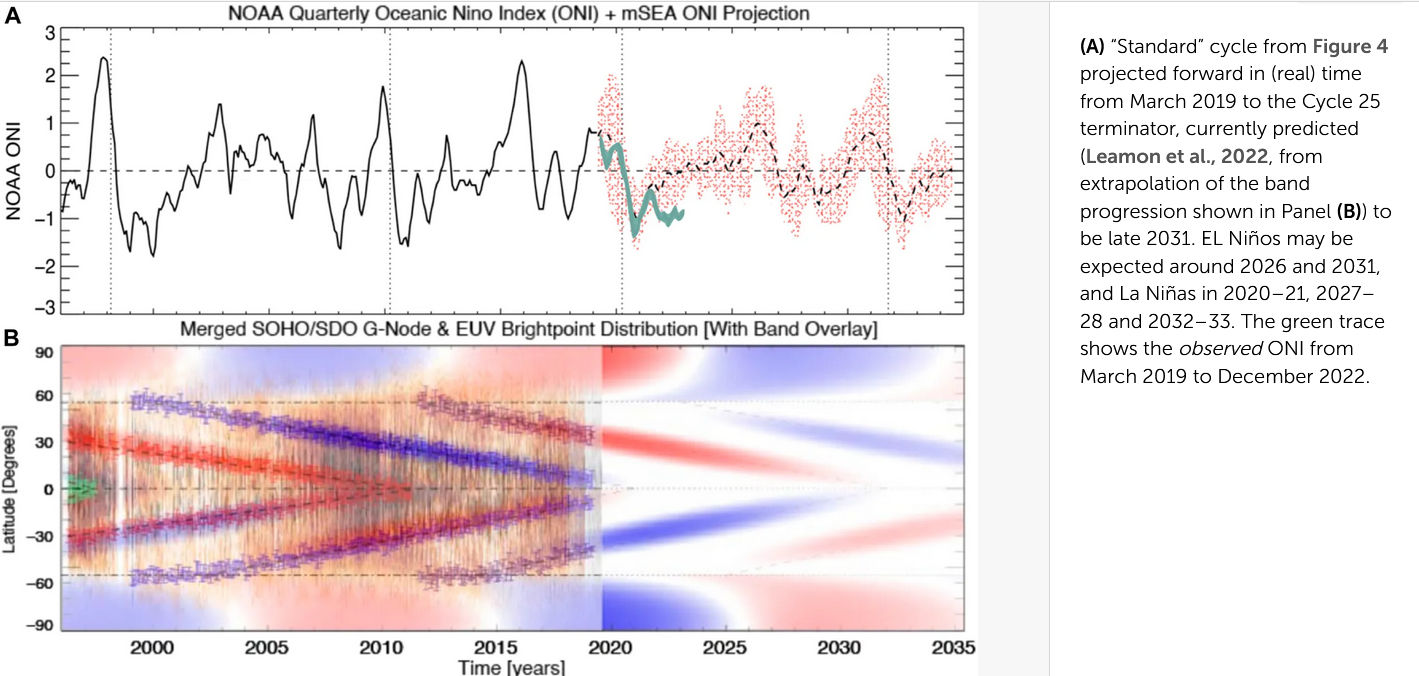
Robert Leamon of NASA and the University of Maryland (Baltimore County) published a 2023 paper predicting that the next El Niño would arrive in 2026. His forecast wasn’t based on ocean models or climate simulations. It was based on the sun.
Specifically, it was based on a solar phenomenon he and colleague Scott McIntosh call the “Terminator”: a magnetic event that marks the end of one solar cycle and the ignition of the next. By averaging the past five solar cycles into a composite “standard cycle” and projecting it forward, Leamon identified a recurring pattern. El Niños tend to follow Terminator events by roughly five years. The most recent Terminator occurred in December 2021. Do the math: that puts the next El Niño squarely in 2026. His model doesn’t speak to the strength of the event, but on timing, it appears to be spot-on.
Adapted by Dr. Tony Philps from Fig. 5 of Leamon (2023), this chart highlights two apparently successful predictions based on the Terminator
This isn’t the first time the Leamon-McIntosh framework has made a successful call. The pair previously demonstrated that every Terminator since the 1960s coincided with a flip from El Niño to La Niña conditions. That framework correctly predicted the onset of the triple-dip La Niña that began in 2020, and it revealed what may be a meaningful physical connection between solar variability and the ENSO (El Niño-Southern Oscillation) cycle.
What’s the mechanism?
That remains an open question, and an honest one. Most researchers working in this space favor “top-down” models, where solar activity modifies the upper atmosphere in ways that eventually propagate down to surface weather. But the specific physical pathway hasn’t been pinned down.
Leamon and McIntosh initially suspected (in their 2021 work) that galactic cosmic rays were the link. Cosmic ray flux varies with the solar cycle and affects atmospheric ionization. But by 2023, Leamon had reconsidered, as the timing didn’t fit well enough, and he now leans toward geomagnetic activity as a more plausible driver.
It’s worth noting that the search for a solar-ENSO connection is not new. Sir Gilbert Walker, who first identified the Southern Oscillation (the “SO” in ENSO) in the early 1900s, explicitly looked for a sunspot connection and came up empty. Researchers throughout the 20th century made similar attempts with similarly inconclusive results.
What’s different here is the Terminator concept itself, a relatively new framework that McIntosh and Leamon began developing about a decade ago. It offers a more precise solar marker than sunspot counts, and it appears to do a better job of both hindcasting solar cycles and anticipating ENSO transitions.
A possible geomagnetic-stratosphere-ENSO chain
The Terminator marks a rapid reorganization of the sun’s magnetic field at solar cycle boundaries. This reconfiguration produces a measurable shift in the solar wind and the interplanetary magnetic field, which in turn modulates Earth’s geomagnetic activity. That’s the entry point.
From there, geomagnetic disturbances are known to affect the distribution of electrical currents in the upper atmosphere. Those currents influence the stratospheric circulation, particularly the polar vortex and the quasi-biennial oscillation (QBO), both of which are established modulators of tropospheric weather patterns.
The tropical Pacific is particularly sensitive to stratospheric forcing because the deep convective systems there, the engines of ENSO, respond to even small changes in the temperature gradient between the equatorial stratosphere and the surrounding atmosphere. A Terminator-driven nudge to the stratospheric circulation could plausibly tip the balance between the trade wind patterns that sustain La Niña and the weakening that triggers El Niño onset.
Why the five-year lag?
This is where it gets interesting. The Terminator doesn’t flip a switch instantly. The post-Terminator solar cycle ramps up gradually, and the cumulative geomagnetic forcing takes time to work its way through the stratosphere and into the ocean-atmosphere coupling of the tropical Pacific. Five years is roughly consistent with the timescales of both stratospheric adjustment and the oceanic heat content buildup that precedes a major El Niño.
Caveats
This is a plausible chain, not a proven one. Each link, from solar magnetic reorganization to geomagnetic activity, to stratospheric circulation, to tropical convection, to ENSO, is individually uncertain, and the compounding of those uncertainties is substantial. The honest position is that this mechanism is testable in principle, which is exactly what makes the Leamon-McIntosh prediction record worth watching closely.
Bottom line
Two successful predictions, the 2020 La Niña onset and now apparently the 2026 El Niño, is not proof of a causal mechanism, but it is more than coincidence deserves to be called. Science advances on exactly this kind of pattern recognition followed by mechanism-hunting. The Terminator hypothesis is young, the mechanism is unknown, and confidence should remain appropriately provisional.
But the prediction was made. It’s on record. And the El Niño appears to be arriving right on schedule.
Yet, while the IPCC itself has finally abandoned the nonsense doomsday model it once promoted as the “baseline”, British Energy Secretary Ed Miliband, his fellow net-zero zealots in Whitehall, and his globalist colleagues in power in the EU, Canada and elsewhere press ahead with Net Zero undeterred. Indeed, ‘Mad Ed’ and gang is doubling down on the very policies built atop that now-discredited foundation. This is Intellectual Yet Idiot governance.
The international committee responsible for the UN Intergovernmental Panel on Climate Change’s official climate scenarios quietly delivered a bombshell last month: the notorious RCP8.5 “business-as-usual” pathway — the extreme emissions scenario that has underpinned virtually every climate alarm, every net-zero urgency claim, and every justification for Britain’s ruinous energy policy for the past fifteen years — has been declared officially “implausible” and eliminated from the next generation of models feeding into the IPCC’s Seventh Assessment Report. The “era of global boiling”speech of the UN Secretary General António Guterres in 2023 now sounds even more ludicrous than it already did then.
Roger Pielke Jr. – whose research has been heavily cited by the IPCC across all three Working Groups – analysed this stunning admission by the panel in his Substack The Honest Broker on 29th April. The high-emissions scenarios (RCP8.5, SSP5-8.5 and SSP3-7.0) that dominated research papers, government reports, and headlines are now recognised as describing futures that will not happen.
Yet while the IPCC itself has finally abandoned the nonsense doomsday model it once promoted as the “baseline”, British Energy Secretary Ed Miliband, his fellow net-zero zealots in Whitehall, and his globalist colleagues in power in the EU, Canada and elsewhere press ahead with Net Zero undeterred. Indeed, ‘Mad Ed’ and gang is doubling down on the very policies built atop that now-discredited foundation. This is Intellectual Yet Idiot governance.
The IYI Class and Miliband’s Credentials
In a 2016 essay, Nassim Nicholas Taleb coined the term “Intellectual Yet Idiot” to describe the credentialed class — policymakers, academics, journalists and think-tankers — who impose grand narratives on society while bearing none of the costs.
What we have been seeing worldwide, from India to the UK to the US, is the rebellion against the inner circle of no-skin-in-the-game policymaking “clerks” and journalists-insiders, that class of paternalistic semi-intellectual experts with some Ivy league, Oxford-Cambridge, or similar label-driven education who are telling the rest of us 1) what to do, 2) what to eat, 3) how to speak, 4) how to think… and 5) who to vote for.
They may ace exams, dominate elite discourse and signal virtue from the safety of their stately homes in the countryside or Oxbridge common rooms but lack practical judgment and “skin in the game.” As the essayist and blogger Marcus Stone observed in his analysis of intelligence without judgment, that there is a clear distinction among mere ignorance (the absence of knowledge), outright stupidity (reflecting the bell curve in the distribution of IQ, a fact of life), and the irredeemable learned idiocy of those who cling to narrative over reality.
Long before Taleb, George Orwell put across the point acidly: “There are some ideas so absurd that only an intellectual could believe them.” Thomas Sowell was another keen observer of the phenomenon: “There is usually only a limited amount of damage that can be done by dull or stupid people. For creating a truly monumental disaster, you need people with high IQs.”
Ed Miliband, Britain’s Energy Secretary and a PPE – which does not stand for Pernicious Political Elite – graduate of Oxford, embodies the IYI archetype with alarming precision. He even wants to ban tumble dryers to appease Goddess Gaia. His recent pronouncements on “breaking the link” between gas prices and electricity bills, his dismissal of North Sea oil and gas resources, and his relentless program of mandates and subsidies for unreliable intermittent renewables reveal not just policy error. Miliband exposes a profound economic illiteracy that threatens Britain’s prosperity and energy security. The Guardian-reading ideologues and comfortable Oxbridge academics repeatedly intone net zero mantras and incantations of “cheap” renewables while ordinary citizens pay the bills.
“Breaking the Link”: Misunderstanding Marginal Pricing
Miliband’s flagship idea — repeated by his civil-service wonks, favoured economists such as Professor Mariana Mazzucato of University College London, and dutifully echoed by the Guardian and even the increasingly gone-woke Economist — is that the UK must “break the link between gas price and power price.” Chancellor Rachel Reeves (“Rachel from Accounts”) backs Miliband on this quest.
The argument runs that it is unfair for renewables to be priced at the marginal cost set by “expensive” natural gas generation. This, we are told, makes “cheap” wind and solar artificially expensive. It is a claim so basic in its misunderstanding of markets that it would fail an A-level economics exam.
Every freely traded commodity or service — electricity, gas, oil, copper, wheat, pork bellies, haircuts — prices at the margin. The highest-cost supplier needed to meet demand sets the price paid to all suppliers in equilibrium where the supply and demand curves intersect. The same principle is illustrated by Adam Smith’s water-diamond paradox: water is cheap because it is abundant at the margin; diamonds are costly because the marginal unit is scarce.
To be sure, no one expects Miliband and his PPE buddies to have read Adam Smith’s Wealth of Nations at school:
The things which have the greatest value in use have frequently little or no value in exchange; and on the contrary, those which have the greatest value in exchange have frequently little or no value in use. Nothing is more useful than water: but it will purchase scarce anything; scarce anything can be had in exchange for it. A diamond, on the contrary, has scarce any value in use; but a very great quantity of other goods may frequently be had in exchange for it.
Miliband and his fellow IYIs appear never to have encountered the concept. They mistake the foundational principle of marginal pricing in economics for a policy failure that can be legislated away. As independent energy consultant Katherine Porter explained in her excellent recent Spiked interview, every market participant understands this; only the IYI class treats it as a quirk unique to British power markets that can be abolished by decree.
North Sea Oil and Gas: Domestic Benefits Ignored
The same learned idiocy, so well described by Marcus Stone, infects Miliband’s second favourite talking point: that developing North Sea oil and gas is pointless because “we cannot influence world prices.” Again, the narrative trumps reality. Natural gas has no single world price; it trades in regional markets — Europe’s TTF, Asia’s JKM, America’s Henry Hub — because pipelines and LNG liquefaction and shipping impose large transaction costs on fungibility.
Increased domestic production would displace the most expensive marginal supply (often imported LNG cargoes), lowering the clearing price for British consumers. Ms. Porter said that increasing North Sea gas output could displace LNG entirely in summer months, when imports are low, and reduce prices accordingly. The gas from a North Sea rig does not magically enter a global pool; it flows through pipes straight into the British grid. And, yes, it will be priced at the margin, at the point where the most expensive supplier of North Sea gas meets the utility-consumer with the highest willingness to pay.
Oil is much more fungible since it is far easier to store and transport and there are global reference prices such as West Texas Intermediate (“WTI”) and Brent. Other crude oils price against these reference prices once differences in the quality of the crude and its location are accounted for. But the principle holds: increased North Sea production of oil or gas adds to the nation’s GDP whether it is exported or supplied to the domestic market. It also creates jobs, skills development, shareholder returns and tax revenues.
Again, Miliband’s PPE does not seem to have covered (or it was unlearned soon after school finished) the simple accounting convention GDP = C + I + G + (X – M) which is the most famous identity in macroeconomics. Britain’s GDP is the total value of all goods and services finally produced in the country in a year. By the accounting identity, it is also the sum of expenditures in consumption, investment and government spending plus exports (money foreigners spend buying British goods and services) less imports (money British people spend buying foreign goods and services).
What is it that the policy wonks in Whitehall don’t get? How can it be fine for the UK to chase out further investments from its own jurisdictions of the North Sea while at the same time buying oil and gas from Norway in the face of this simple macroeconomic accounting? In a Robin Hood reversal, is Miliband’s aim to impoverish the country’s own citizens while enriching the already much richer Norwegians? This is all in the name of Britain’s “climate leadership” as Rupert Darwall has thoroughly dissected.
Under Miliband’s punitive windfall tax regime, it was reported last week that even BP is considering selling its North Sea assets for a full exit while Norway invests afresh. Norway’s government, unafflicted by Stone’s learned idiocy, issued 70 new drilling permits for oil and gas just last week.
Another garbled argument offered by UK’s Net Zero proponents in their quest to shut down new investments in the North Sea goes as follows: “Oil and gas are globally traded commodities. The UK is too small a producer to affect the world price. Therefore, more North Sea drilling will not materially reduce UK energy prices.”
At one level, this is trivially true. But anyone with a smattering of A-level economics would ask, “what has that got to do with anything?” Do countries produce stuff only if it reduces domestic prices? In what universe? Countries produce because it is profitable for them to do so (collectively speaking, since it is business firms that actually produce output). Increased production adds to the country’s GDP. The firm’s shareholders benefit as do those that gain employment and skills from the increased activity. And this does not include another elementary economic principle of the “multiplier effect”: the process by which an initial increase in spending, investment, production or income generates additional rounds of economic activity throughout the wider economy.
There is yet another version of idiot economics. An argument that circulates among Miliband allies, climate campaigners, net-zero commentators and mainstream media hacks runs roughly as follows: “North Sea oil is sold on international markets anyway, so it does not belong to Britain in any meaningful sense. Therefore drilling more does not improve British energy security or reduce bills.”
Yet again, one must summon much mental fortitude to grapple with the thoroughly befuddled logic. What happens to the UK’s balance of payments in all of this? Do not British exports improve the current account and strengthen the pound? Furthermore, how can increased output of North Sea oil and gas not enhance UK’s energy security, one asks incredulously. But in vain, for in the world of net zero zealotry, such views smack of right-wing Thatcherism.
IYI Economics vs. Real World
In the normal world, ordinarily, exports are good, production is good, profitable industries are good, trade surpluses are good, high-value industrial sectors are good. But in the leftist-globalist world of IYI governments and policy makers – where the Church of Climate rules supreme – fundamental laws of economics are legislated against, and hydrocarbons production is cast as morally suspect and economically irrelevant. When saving the world is at stake, these issues raised by level-headed economists are mere fripperies.
Profitability itself is suspect and attracts the charge of culpability. In a now deleted post on X, Mr Miliband accused BP of profiting from the Iran war crisis in arguing for retaining the windfall tax on North Sea investments. He considered it “morally economically wrong.” Of course, he did not try to understand why in times of extreme price volatility, commodity trading desks with sharp traders — as BP has — do exceptionally well. That is not, by any stretch of the imagination, war profiteering. Without the imprimatur of a PPE qualification, the double-barrelled adjective presented by Mr. Miliband is a bit of a poser. Back in the normal world, profits are good – since they pay for wages, rents, taxes and happy shareholders.
The British public has stirred. Britain’s stunning local election results delivered an unprecedented rout against both Labour and the Conservatives in favour of the relatively right-leaning Reform UK party which became electorally consequential only in the last year. It is a revolt by indigenous working- and middle-class voters against what David Starkey has called Britain’s long-standing ‘uniparty’ elite. It may mark the beginning of the end of the Westminster two-party system that has defined British politics since the late 17th century when the very concepts of the modern state first emerged.
To be sure, the revolt wasn’t just against Miliband’s punitive net zero mandates but against the entire package deal offered by the globalist uniparty elite which includes open borders, ever closer union with the EU despite Brexit, and the excesses of a politically correct welfare state that values immigrants over indigenes. The ballot box remains the only reliable mechanism for removing those who suffer no consequences for their luxury beliefs and idiot economics.
A sane energy policy — now that the IPCC itself has backed off from its implausible “end is nigh” scenarios — would start by recognising marginal pricing, not futilely trying to abolish it; allowing North Sea oil and gas output to rise so long as the private sector is willing to invest under competitive auctions; dropping the pointless carbon pricing on gas and indeed on all energy-intensive industry; putting a stop to the endless subsidies for renewables; ending the mandates for EVs that few want to buy; and cutting over-regulation of the nuclear power sector along, for example, proven South Korean timelines and costs rather than under Britain’s regulatory bloat.
Britain cannot afford another decade of IYI governance. Keeping the lights on, quite literally, depend on it.
German Chancellor Friedrich Merz has called the nuclear phaseout a “serious strategic mistake” that left Germany short of firm power that turned the Energiewende into the most expensive energy transition on the planet. This is an early marker for a developing worldwide retreat from policies that sidelined nuclear power and demonized coal, oil, and natural gas.
German Chancellor Friedrich Merz has called the nuclear phaseout a “serious strategic mistake” that left Germany short of firm power that turned the Energiewende into the most expensive energy transition on the planet. This is an early marker for a developing worldwide retreat from policies that sidelined nuclear power and demonized coal, oil, and natural gas.
German and Japanese Nuclear Embarrassment Germany stubbornly closed its last three functioning nuclear reactors in April 2023 right in the middle of a crippling energy crisis triggered by the war in Ukraine. As pragmatists predicted, German citizens now suffer under punishingly high electricity prices and remain heavily dependent on imported energy.
The green dream was sold as a route to “cheap” renewables, yet the reality for German households and factories has been record‑high electricity prices, complex subsidies for favored businesses and individuals who conform to the climate narrative, and a grid that struggles on windless days or under gray skies.
Japan made a remarkably similar error but is finally correcting course. After the Fukushima disaster, the government panicked and shut down all 54 of its nuclear reactors. Today, Japan is slowly restarting those idle units.
The pattern is plain to see. Countries abandon dependable power sources under political pressure, then spend years rebuilding what they had demonized and dismantled.
Regret Over Abandoning Fossil Fuels
This is why I anticipate a cascade of similar reversals by national leaders who participated in a destructive campaign that stripped grids of dependable, affordable, and abundant coal, oil, and natural gas.
Politicians are already quietly hitting the brakes on their aggressive fossil fuel phaseouts when reality bites. The massive Groningen gas field was scheduled for permanent closure due to localized earthquake risks. Yet in 2024, the Dutch Senate delayed the final shutdown vote when lawmakers demanded guarantees that abandoning the domestic resource would not jeopardize energy security.
Within a week of the German chancellor’s admission of a nuclear energy fiasco, the country’s energy minister lamented at an oil and gas conference the push of net zero policies, indirectly referencing the abandonment of fossil fuels.
In the United States, President Donald Trump took executive actions aimed at preventing some coal plants from closing, including orders that kept aging facilities like the J.H. Campbell plant in Michigan running to “avoid summer blackouts.”
South Africa’s Mineral Resources and Energy Minister Gwede Mantashe consistently fights international pressure to quickly abandon coal. “You don’t destroy what you have on the basis of hope that something better is coming,” he says. Mantashe rightly insists that protecting the ability of the state to supply energy must remain a priority.
India offers the most powerful example of this energy pragmatism. The country has signaled that coal will remain the backbone of the economy for decades, even as its diplomats make empty promises about reaching net-zero by 2070. Deputy Power Minister Shripad Naik recently revealed that India had added a massive 7.2 gigawatts of new coal capacity in the 2025–26 fiscal year alone and would add 307 gigawatts of total coal capacity by 2035.
A majority of Western countries, especially in Europe, utterly lack this basic foresight on energy security. Many countries have locked in policies that tear down coal, oil, gas, and nuclear plants before they have built credible alternatives. They chase targets for emissions reductions. They downplay the costs to their citizens.
Energy security has become more prominent in the news because of turmoil in the Middle East. Yet a war may not be needed to launch the next generation of energy crises. When the next prolonged cold spell, drought, or demand surge hits, the weakness of the anti-fossil fuel approach will show up in higher bills, rolling blackouts, and public anger.
Merz’s nuclear confession suggests that the political class cannot keep dodging reality forever.
Vijay Jayaraj is a Science and Research Associate at the CO2 Coalition, Fairfax, Virginia. He holds an M.S. in environmental sciences from the University of East Anglia and a postgraduate degree in energy management from Robert Gordon University, both in the U.K., and a bachelor’s in engineering from Anna University, India. He served as a research associate with the Changing Oceans Research Unit at University of British Columbia, Canada.


You must be logged in to post a comment.