Wrong, Guardian, Climate Change Hasn’t Taken New Orleans Beyond the ‘Point of No Return’

The Guardian claims in “‘Point of no return’: New Orleans relocation must start now due to sea level, study finds” that New Orleans has effectively entered a “terminal condition” and must begin an organized population retreat because sea-level rise will surround the city within decades. This is false. The article relies on speculative climate modeling, paleoclimate analogies, and worst-case sea-level projections that are nowhere near what actual tide gauge measurements of sea level show today.

From ClimateRealism

By Anthony Watts

The Guardian claims in “‘Point of no return’: New Orleans relocation must start now due to sea level, study finds” that New Orleans has effectively entered a “terminal condition” and must begin an organized population retreat because sea-level rise will surround the city within decades. This is false. The article relies on speculative climate modeling, paleoclimate analogies, and worst-case sea-level projections that are nowhere near what actual tide gauge measurements of sea level show today.

The story warns that southern Louisiana faces “3–7 meters of sea-level rise” and shoreline retreat of up to 100 kilometers inland. That claim is extrapolated from comparisons to a warm period 125,000 years ago when ice sheets were in a very different configuration, not based on observed current data trends. The result of computer model simulations of ancient paleoclimate conditions has no bearing on the present, nor is it in-line with actual sea-level trends.

Measured sea-level rise along the Gulf Coast is well documented by long-running tide gauges operated by the National Oceanic and Atmospheric Administration (NOAA). The observed rate in the region is on the order of millimeters per year, not meters per decade as seen in the sea level trend graphic from the National Atmospheric and Oceanic Administration (NOAA) below.

The New Canal Louisiana tide gauge is the station closest to New Orleans. Note that based on actual data, NOAA predicts about two feet of rise in 100 years. Even accounting for local subsidence, the data show gradual rise, not an exponential surge toward three to seven meters (9.8 to 23 feet) this century. There is no empirical evidence supporting the notion that New Orleans will be “surrounded by the Gulf of Mexico before the end of this century.”

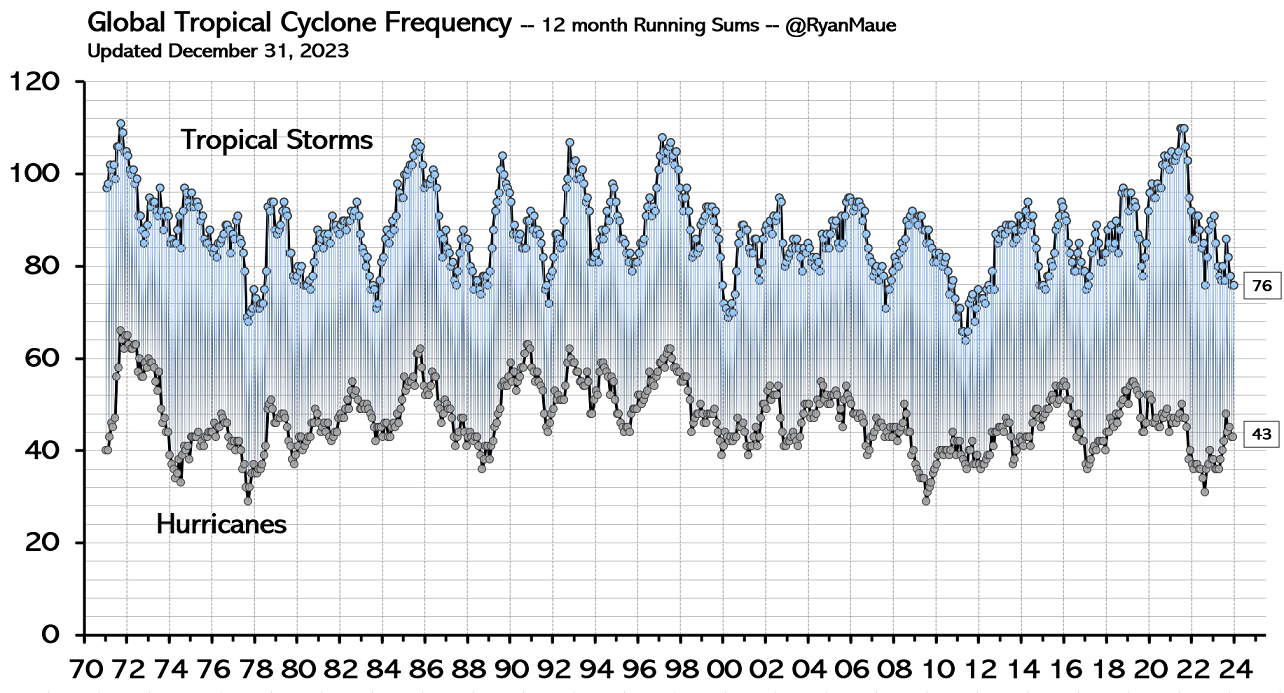
The Guardian also asserts that “strengthening hurricanes” are compounding the threat. Yet the Intergovernmental Panel on Climate Change (IPCC) Sixth Assessment Report (AR6) reports no increase in the number or severity of major hurricanes. Observational records for U.S. landfalling hurricanes show no significant upward trend over the past 50 years, as seen in the graphic below.

Source: Ryan N. Maue, “Global Tropical Cyclone Activity,” Climate Atlas, accessed May 6 2026, http://climatlas.com/tropical/frequency_12months.png

The most destructive hurricane to strike Louisiana, the 1900 Galveston storm and later the 1915 and 1965 storms, occurred long before modern carbon dioxide emissions were elevated. Hurricane activity in the Gulf of America has always fluctuated due to natural cycles such as the Atlantic Multidecadal Oscillation. Wind shear, sea-surface temperatures, and atmospheric dynamics drive storm intensity. There is no consistent data demonstrating a climate-driven escalation in Gulf Coast hurricane strength.

To the extent that “sea level rise” is greater on average in New Orleans and some other Gulf Coast areas than for the nation or world as a whole is due to a factor that the Guardian largely ignores, land subsidence. Southern Louisiana is sinking due to sediment compaction, groundwater withdrawal, oil and gas extraction, and the historical channelization of the Mississippi River. Much of the relative sea-level rise in the region is local land sinking, not accelerating global ocean expansion. Conflating subsidence with climate change induced sea level rise is grossly and dangerously misleading.

Even the study at the center of the article is an opinion piece, not a research paper, in a scientific journal projecting improbable future scenarios. It does not present new measurements showing imminent sinking or rapid sea level rise.

The map shown in the article depicts Louisiana under three meters of sea-level rise. That graphic is a model scenario based on SSP5-8.5, a high-emissions climate scenario combining fossil-fuel-intensive development with high level climate forcing by 2100. This worst-case scenario has no bearing in reality and is so bad that the IPCC recently removed it from all scientific consideration.

The rhetoric reads more like the trailer for a big-budget disaster film rather than an objective journalistic endeavor. “Terminal condition.” “Point of no return.” “Timebomb.” These alarming trigger words and phrases don’t reflect the reality on the ground in New Orleans, nor trends recorded by scientific instruments.

New Orleans has already invested billions of dollars in levees, pumps, and floodgates since Hurricane Katrina. Engineering solutions exist. The Dutch have defended land below sea level for centuries. To suggest that “there’s no amount of money” that can maintain protective infrastructure ignores modern coastal engineering reality.

Sea level is rising gradually. Wetlands are eroding due to river management and sediment starvation. Subsidence is measurable. These are real challenges. But they are not proof that relocation “must start now.”

Policy should be driven by measurements, not metaphors.

New Orleans faces engineering and land management challenges. It does not face a guaranteed watery extinction within decades based on current observed sea-level rise or hurricane trends. The Guardian’s doomsday story is not sober risk assessment, rather it is junk journalism at its worst.

New Paleo Research: Modern ‘Climate Change’ Has Had No Apparent Impact On Precipitation Patterns

Three new tree ring reconstructions (spanning 1320-2021, 1720-2014, and 1657-2020 CE) document the dominance of natural variability in the paleoclimate record.

From NoTrickZone

By Kenneth Richard 

Three new tree ring reconstructions (spanning 1320-2021, 1720-2014, and 1657-2020 CE) document the dominance of natural variability in the paleoclimate record.

In the last 300 to 700 years, no precipitation pattern has emerged in Scandinavia, Asia, or Central Greece which can be linked to anthropogenic impacts or post-1950 CO2 increases (Stridbeck et al., 2026, Cai et al., 2026, Sakalis and Kastridis, 2025).

Extreme precipitation deficits (droughts) were much more common and pronounced across sub-Arctic Sweden and the Tibetan Plateau (TP) before 1950 than since.

For example, there were three TP megadroughts from 1865-1950, whereas only one occurred from 1950-2014 (Cai et al., 2026). TP severe drought years were worse in 1735 and 1914 than in 2009.

Image Source: Stridbeck et al., 2026
Image Source: Cai et al., 2026
Image Source: Sakalis and Kastridis, 2025

Volkswagen Face $1.7 Billion Fine For Missing Emissions Targets

VW Group CFO Arno Antlitz summed it up by saying the company is essentially choosing between two losses: reduced margins from EV sales or penalties for exceeding emissions limits. Until EVs reach cost parity with ICE cars, this balancing act isn’t going away.

From NOT A LOT OF PEOPLE KNOW THAT

By Paul Homewood

AOL also cover the story:

Automakers are feeling the pressure to go electric, both to stay relevant and to avoid massive financial penalties. Governments, especially in Europe, are tightening emissions rules, forcing legacy brands to rethink how they build and sell cars. For giants like Volkswagen Group, the stakes are getting expensive.

Despite a strong push into electric vehicles, VW still isn’t moving fast enough to meet regulatory targets. That gap between ambition and reality could now cost the company up to $1.7 billion in fines. It’s a harsh reminder that the transition to electrification isn’t as smooth or as profitable as many expected.

At the core of the issue is a fundamental imbalance. Combustion-engine cars still bring in more profit, while EVs are essential for lowering fleet emissions. Trying to balance both without losing money has become one of the biggest challenges in the modern auto industry.

Volkswagen’s leadership has been surprisingly open about the situation. Instead of pretending everything is under control, executives admit they’re stuck choosing between losing money on EVs or paying fines. Either way, the bill is piling up.

Why VW Is Facing Huge Fines

The problem comes down to strict European Union emissions regulations. Automakers must meet fleet-wide CO₂ targets, meaning every gas-powered car sold has to be offset by lower-emission models like EVs or hybrids. If they miss those targets, financial penalties kick in.

For Volkswagen Group, that could mean fines totaling around €1.5 billion (roughly $1.7 billion) between 2025 and 2027. That’s not a one-time hit either, as it’s spread across multiple years, with hundreds of millions potentially lost annually. Even for a company of VW’s size, that’s a serious dent in profitability.

The EV Profitability Problem

Image Credit: Volkswagen.

On paper, the solution seems simple enough: just sell more electric cars. In reality, it’s far more complicated, as EVs are still less profitable than traditional combustion-engine vehicles, largely due to battery costs and development expenses.

VW Group CFO Arno Antlitz summed it up by saying the company is essentially choosing between two losses: reduced margins from EV sales or penalties for exceeding emissions limits. Until EVs reach cost parity with ICE cars, this balancing act isn’t going away.

Demand Isn’t Keeping Up With Regulations

Another issue is that consumer demand doesn’t always align with regulatory goals. While EV adoption is growing, it’s not happening fast enough to naturally meet emissions targets. That forces automakers to push electric models harder than the market might otherwise support.

In Europe, electric vehicles made up about 20% of new car sales in early 2026. That’s significant, but still not enough for companies like VW to comfortably hit their targets. As a result, they’re effectively selling more EVs than the market organically demands.

VW’s EV Push Is Still Gaining Ground

To be fair, Volkswagen isn’t standing still. The company has seen EV sales grow by over 11% compared to the previous year, with more than 176,000 electric vehicles delivered in the first quarter alone. That’s a solid increase, especially in a challenging market.

In Western Europe, roughly one in five VW vehicles sold is now fully electric. That’s a clear sign of progress, but it still doesn’t fully offset emissions from the rest of the lineup, so the math simply isn’t working in VW’s favor yet.

VW Group Faces $1.7 Billion Fine For Missing Emissions Target – AOL

EV sales in the EU are lagging UK sales – last year making up 17.4% of total sales.

Keystone XL Rebranded as “Keystone Light” in Trump’s Push for North American Energy Security

In late April/early May 2026, the Trump administration issued a presidential permit for the Bridger Pipeline Expansion (also called the Prairie Connector), a proposed ~647-mile crude oil pipeline from Alberta, Canada, into the U.S. (crossing into Montana and terminating in Wyoming). It’s widely nicknamed “Keystone Light” by media, supporters, and opponents due to its similarities to the original Keystone XL project.

From Watts Up With That?

From Legal Insurrection

This project is a leaner, faster, and more litigation-resistant project that reuses idle pipe, threads existing corridors, avoids reservation land, and is racing the clock to lock in steel-in-the-ground before the next Democratic administration can once again sacrifice North American energy security to green ideology.

Posted by Leslie Eastman

It’s been quite some time since we covered the Keystone XL Pipeline, a proposed extension of the existing Keystone Pipeline System designed to transport crude oil from Alberta, Canada, to Nebraska.

The project’s goal was to expand the pipeline system’s capacity by allowing the transport of up to 830,000 barrels of oil per day over a distance of approximately 1,210 miles. The aim was to provide a more direct route for Canadian oil, and provisions were included for adding American-produced oil from the Bakken formation in Montana and North Dakota.

The last time we reported on this Keystone XL, President Donald Trump was promising to revive the project “on day one.”

Last fall, Canadian Prime Minister Mark Carney raised the prospect of reviving the pipeline project during his recent White House visit with Trump.

The project has now moved another step toward starting.  Trump recently signed an order granting a cross-border permit to revive parts of the Keystone XL pipeline to transport Canadian oil to Guernsey, Wyoming.

The pipeline, proposed by Canadian pipeline company South Bow (SOBO.TO), opens new tab and its U.S. partner Bridger Pipeline, could increase Canada’s crude exports to the U.S. by more than 12% if it goes ahead. A presidential permit was required for ​the project to proceed.

The new proposal involves a different route through the U.S. than the previous Keystone XL project, which was canceled by ​former President Joe Biden in 2021 after years of Indigenous and environmental opposition.

“Slightly different than the last administration,” Trump said ⁠at a White House event, referring to his administration’s attitude towards crude oil infrastructure. “They wouldn’t sign a pipeline deal, and we have pipelines going up.”

But the project will use some of the previously built pipe on the Canadian side, where Keystone XL is already fully permitted. ​South Bow was spun off by former Keystone XL proponent TC Energy in 2024 to take over its oil pipeline business. Approximately 150 km (93 miles) of pipe has been built in Canada and sitting idle since Keystone XL’s cancellation.

Trump has approved the Keystone Light pipeline, clearing the way for construction to start in 2027. The Canada-U.S. project could move 550,000 barrels of crude per day, with completion targeted for late 2028 or early 2029.https://t.co/sfPgNiAUcO#energy #keystone #oilandgas

— Livingston Intl. (@livingston_intl) May 8, 2026

The footprint of this pipeline is a little different than that envisioned for the Keystone XL. It appears the goal of the firms involved in this project is to complete construction before Trump’s term ends.

Sometimes called “Keystone Light,” the Bridger Pipeline Expansion would not cross any Native American reservations. More than 70% would be built within existing pipeline corridors and 80% on private land, Bridger Pipeline LLC said in a statement.

The Casper, Wyoming-based company operates more than 3,700 miles (5,950 kilometers) of gathering and transmission oil pipelines in the Williston Basin of North Dakota and Montana and the Powder River Basin of Wyoming.

A subsidiary of True Companies, Bridger Pipeline could avoid a reversal by a future administration if it’s able to complete its project before Trump leaves office. It hopes to start construction in the fall of 2027 and finish it by late 2028 or early 2029, Bridger spokesperson Bill Salvin said.

It is being reported that oil companies have committed to move at least 400,000 barrels per day (bpd), or about 72 per cent of the pipeline’s initial capacity of 550,000 bpd.

Canadian oil producers are thrilled, as their ability to move product has been stifled by capacity constraints.

Rival pipeline operators are also looking to expand capacity on existing pipelines.

Last fall, Enbridge [ENB-T ]  approved expansions for its Mainline and Flanagan South pipelines, which will allow an additional 150,000 bpd of Canadian heavy oil to move to the U.S. Midwest and Gulf Coast.

That additional capacity is expected to come online in 2027, and the company is also gauging commercial interest in a second phase of its Mainline expansion, which it has said could be in service in 2028 and would add another 250,000 bpd of capacity.

The Trans Mountain pipeline, running from Alberta to Canada’s west coast for export to the U.S. West Coast and Asia, is also planning a series of enhancements that could increase its capacity by 360,000 bpd.

The bottom line: While Keystone XL’s original vision was killed off by Biden’s climate virtue-signaling, market realities, Canadian persistence, and Trump’s energy priorities have combined to resurrect its core purpose as “Keystone Light”.

Ultimately, this project is leaner, faster, and more litigation-resistant, reusing idle pipe, threading existing corridors, avoiding reservation land, and racing the clock to lock in steel-in-the-ground before the next Democratic administration can once again sacrifice North American energy security to green ideology.

Mantle Helium Reveals a New Tectonic Rift Awakening in Southern Africa

The East African Rift System (EARS or EAR) is one of the most significant active continental rift zones on Earth. It represents a divergent tectonic plate boundary where the African Plate is slowly splitting into the Nubian Plate (west) and the Somali Plate (east), with additional microplates involved (e.g., Victoria, Rovuma, and Lwandle).

The East African Rift System (EARS or EAR) is one of the most significant active continental rift zones on Earth. It represents a divergent tectonic plate boundary where the African Plate is slowly splitting into the Nubian Plate (west) and the Somali Plate (east), with additional microplates involved (e.g., Victoria, Rovuma, and Lwandle).

The system stretches roughly 3,000–6,400 km (depending on inclusion of northern extensions) from the Afar Triangle in Ethiopia/northern Ethiopia (connected to the Red Sea and Gulf of Aden) southward through Kenya, Tanzania, and into Mozambique. It averages 48–64 km wide.

It features two main branches:

Eastern Rift Valley (Gregory Rift): More volcanic, runs through Ethiopia (Main Ethiopian Rift), Kenya, and into northern Tanzania. Includes features like the Kenyan Dome.

Western Rift Valley: Less volcanic but more seismically active, arcs through Uganda, Rwanda, Burundi, Tanzania, etc., hosting many deep lakes.

The rift began developing around 22–25 million years ago (Miocene), with some influences from earlier events. It propagates generally from north to south.

The Nubian and Somali plates are separating at rates of about 6–9 mm per year on average (slower in some southern areas, up to ~4.7 mm/year in places like the Turkana Rift). The Victoria microplate rotates anti- clockwise.

Rifting involves normal faulting, half-graben basins (asymmetric), crustal thinning, and upwelling of mantle material. In advanced areas (e.g., Afar), it transitions toward oceanic crust formation. Recent studies (as of 2026) highlight “necking” (significant crustal thinning) in the Turkana Rift, indicating a more advanced stage than previously thought—this could lead to a new ocean basin in millions of years.

Recent insights (2025–2026): Seismic data shows the crust in Turkana has thinned critically. Mantle pulses and climate-tectonic interactions (e.g., lake level changes affecting fault activity) are also noted.

If rifting continues successfully, it could eventually form a new narrow ocean basin separating a “Horn of Africa” microcontinent from the rest of Africa over tens of millions of years (similar to how the Red Sea formed). Not all rifts succeed—some “fail” and become inactive.

The region is a hotspot for geothermal energy, mineral resources, and paleontology (cradle of humankind fossils preserved in rift sediments). It also poses hazards from earthquakes and volcanic eruptions.

This contrasts with the Southwest African Rift (e.g., Kafue in Zambia) mentioned previously, which represents another zone of potential African Plate deformation but is less developed and separate from the main EARS.

_____________________________________________________________________________________

The Southwestern Rift of Africa: isotopic evidence of early-stage continental rifting

The paper titled “The Southwestern Rift of Africa: isotopic evidence of early-stage continental rifting” (Karolytė et al., 2026, Frontiers in Earth Science, DOI: 10.3389/feart.2026.1799564) provides the first direct geochemical evidence of active mantle-crust interaction in the Kafue Rift of Zambia.

This is a concise, high-impact original research article (published 12 May 2026) led by Rūta Karolytė (University of Oxford), with co-authors including Michael C. Daly, Peter Vivian-Neal (Kalahari GeoEnergy), and experts like Chris Ballentine and Barbara Sherwood Lollar. It delivers the first direct geochemical proof of mantle-crust connectivity in the Kafue Rift, elevating the Southwestern Rift from a geophysical hypothesis to a geochemically supported active extensional zone.

Helium accumulation mechanisms in continental rifts, particularly early-stage systems like the Kafue Rift in Zambia’s Southwestern Rift, involve a combination of source, release, migration, concentration, and trapping processes. The recent Karolytė et al. (2026) paper highlights favorable conditions here.

Sources of Helium

Crustal (radiogenic ⁴He): Dominant source. Produced by alpha decay of uranium (U) and thorium (Th) in ancient Precambrian basement rocks (common in Zambia and southern Africa). Old, U/Th-rich cratonic or mobile belt crust generates helium over hundreds of millions to billions of years.

Mantle-derived (primordial ³He): Minor but diagnostic component. In the Kafue Rift, ³He/⁴He ratios of 0.14–0.17 R/Ra (8× crustal baseline) indicate mantle fluids rising through active faults, even without surface volcanism. This mixes with abundant crustal ⁴He.

Core Data and Results

Sampling: 6 samples from fault-related geothermal wells and springs inside the Kafue Rift (e.g., Bwengwa, Gwisho, Wells 15/18/20). 2 control samples from basement springs outside the rift boundary faults (~50 km SW and ~150 km NNW).

Helium isotopes:

  • Rift samples: ³He/⁴He = 0.14–0.17 R/Ra (corrected; consistently elevated ~8× above pure crustal production of ~0.02 R/Ra).
  • Basement controls: ~0.022 R/Ra (purely radiogenic crustal signature).
  • Very high ⁴He concentrations (0.4–2.3 mol% in rift samples) — among the highest in EARS hydrothermal fluids.
  • Negligible atmospheric contamination (⁴He/²⁰Ne ratios 856–3,240 vs. air ~0.032).

Carbon isotopes: One reliable δ¹³C(CO₂) = −3.9‰ (within/near mantle range of ~−7 to −4‰). CO₂ present in rift samples (1.5–15%) but absent in basement samples.

Major gases: Dominated by N₂ (84–98%), with crustal mobilization. No detectable CH₄. O₂ low to moderate.

Nitrogen isotopes: Trends toward enriched δ¹⁵N, consistent with crustal sources mixed with minor mantle input.

These values indicate mantle fluids (from partial melting at >60–70 km depth) ascending via active faults, while crustal gases (N₂, radiogenic ⁴He) are thermally mobilized. Low CO₂/³He ratios suggest CO₂ dissolution into groundwater — typical of low-magmatic-flux early rifting.

Figure insights (from paper): Rift samples plot similarly to early EARS segments (e.g., Northern Tanzanian Divergence Zone — NTDZ; Rukwa Rift Basin — RRB) on ³He/⁴He vs. ⁴He plots: moderate mantle He + high crustal He. Volcanically active EARS zones show higher ³He/⁴He and lower ⁴He.

Tectonic Significance

The Southwestern Rift (~2,500 km) runs from the Western EARS (via Rukwa) through Zambian rifts (Luangwa–Luano–Kafue) to Botswana’s Okavango and Namibia’s Eiseb. Prior evidence was indirect: subtle topography, fault scarps, gravity lows, heat flow >120 °C/km, and low seismicity.

This study confirms lithospheric-scale extension with mantle upwelling/degassing restricted to the rift zone. It supports partitioning of the Nubian Plate from a proposed San Plate (southern Africa). If mantle signatures appear along the full length, it strengthens the case for a nascent plate boundary potentially linking toward the Mid-Atlantic Ridge via Walvis Ridge.

Comparison to EARS: Mirrors the least magmatic, early-stage Western Branch segments (no surface volcanism, like much of the Kafue area). More advanced EARS sections (e.g., near volcanoes) show stronger mantle signatures and higher CO₂.

Mechanisms: Tectonic strain opens deep pathways for mantle fluids even without abundant magmatism (as seen globally in early rifts). Inherited crustal weaknesses and far-field stresses from mid-ocean ridges likely drive it.

Early rifting favors helium accumulation (high ⁴He, low dilution by volcanic gases) and geothermal potential (high heat flow + permeable faults). Groundwater acts as a CO₂ sink and trap for volatiles. Hydrogen is also mentioned as a possible target. One author’s industry affiliation (Kalahari GeoEnergy) notes access to sites, but the science stands independently.

This paper is a model of targeted, multi-isotope geochemistry resolving a big tectonic question. It advances understanding of how continents break up and highlights underexplored resource potential in central/southern Africa.

The full open-access article includes maps, figures, tables, and supplements for raw data. Highly recommended reading for anyone into tectonics or natural resources.

Published:  Frontiers in Earth Science

DOI: 10.3389/feart.2026.1799564

Authors: Rūta Karolytė, Michael C. Daly, Peter Vivian-Neal, Darren Hillegonds, Long Li, Barbara Sherwood Lollar, Chris J. Ballentine

Abstract

Helium and carbon isotope data (3He/4He = 0.14–0.17 R/Ra; δ13C(CO2) = −3.9‰) from hydrothermal springs within the Kafue Rift of Zambia provide the first geochemical characterization of thermal springs along a broad extensional zone connecting the African Rift System through central Africa to Namibia. These results reveal mantle-derived fluids at the surface, and associated mobilization of crustal N2 (84.4%–97.6%) with elevated 4He concentrations (0.4%–2.3%). Active hydrothermal groundwaters from outside of the Kafue Rift boundary faults show no isotopic evidence of mantle-derived helium or carbon dioxide. These geochemical compositions and spatial trends resemble those observed in other early rifts within the more thermally developed East African Rift System. The data is consistent with early stages of active lithospheric rifting, supported by previous geophysical observations globally. In addition to the regional tectonic importance of these data, these findings highlight the resource potential along central African active fault boundaries. The combination of a mantle fluid source, advective flow along crustal scale fault zones with low level seismicity, and groundwater serving as a sink for mantle CO2 with minimal crustal fluid dilution, indicate potentially favorable conditions for both geothermal energy development and the exploration of economically significant gases in crustal fluids, particularly helium and hydrogen.

Trump Administration Gets Strategic With Offshore Wind

The Trump administration has shifted from broad pauses and executive orders to targeted buyout agreements with offshore wind developers.

From The Manhattan Contrarian

By Francis Menton

Among all the crazy ways that humanity is supposed to “save the planet” by reducing emissions of carbon dioxide, offshore wind electricity generation has to be about the craziest. Between the expense of building and integrating the facilities and the intermittency of the output, the build-out of offshore wind infrastructure has threatened large and accelerating increases in consumer electricity bills.

Despite lack of any demonstration of feasibility or cost of running the grid on offshore wind, the Biden administration (with support from Congress) threw tens and hundreds of billions of taxpayer funds into the industry in the form of open-ended life-of-project tax credits.

The Trump administration came into office with a known hostility to offshore wind. However, its first efforts to shut down construction on these projects ran into a wall of judicial opposition. But rather than giving up, or embarking on years of appeals with uncertain outcomes, the administration has done some strategic thinking and come up with Plan B. This one looks to me like it will work.

But first there was Plan A. On December 22, 2025 the Interior Department announced that it was ordering a pause on all offshore wind projects under construction in the U.S. The stated ground was national security:

The Department of the Interior announced today that it is pausing—effective immediately—the leases for all large-scale offshore wind projects under construction in the United States due to national security risks identified by the Department of War in recently completed classified reports.

That Interior Department’s Order was immediately met with a barrage of litigation that, within a matter of a few weeks, had produced some five preliminary injunctions in favor of five separate projects. A February 2, 2026 article in the New York Times reported on the fifth of the injunctions:

A federal judge on Monday struck down the Interior Department’s order to halt work on a multibillion-dollar wind farm off the coast of New York State. . . . It was the fifth time in the past three weeks that a federal judge had rebuked the Trump administration’s crusade against the five wind farms under construction in federal waters along the East Coast. The previous four rulings allowed work to continue on Revolution Wind off Rhode Island, Empire Wind off New York, Coastal Virginia Offshore Wind off Virginia and Vineyard Wind off Massachusetts.

So it was all triumphalism at the Times back in February. But now that triumphalism has returned to the usual outrage as the administration has devised Plan B and started to implement it. The Times article from April 27 has the headline “Trump Administration Will Pay More Energy Firms to Cancel Wind Farms.”

Plan B appears to be that the administration is entering into legal settlements with the wind farm developers, whereby the government pays the developers substantial sums of money to walk away from the projects. Oh, and as a kicker, the settlements require the developers to reinvest the settlement funds in oil and gas projects in the U.S. The first such settlement was entered into with the French developer TotalEnergies in March, and then in late April the administration concluded two more such settlements with other developers. From the Times report on the April settlements:

The Trump administration will pay energy companies hundreds of millions of dollars to abandon their plans to build two wind farms off the U.S. coast, the Interior Department said Monday, in a repeat of a tactic the government used to cancel other offshore wind leases last month. The firms will forfeit their leases in federal waters for the two wind farms, one of which would have been built off New York and New Jersey and the other off California. The government will reimburse the companies a combined $885 million, the amount they paid for the leases under the Biden administration. In exchange, the companies have pledged to invest that money in oil and gas projects, including liquefied natural gas facilities along the Gulf Coast.

The usual outrage is palpable:

The agreements are extraordinary transfers of taxpayer dollars to private companies for the purposes of throttling offshore wind power, a source of clean energy that Mr. Trump has disparaged for decades. The president has claimed falsely that offshore wind turbines do not work and that they are killing whales.

Well, that’s their take. To me, these look like pretty good deals. According to the Times itself, the $885 million is just a refund of the amount that the companies had paid the government to acquire the leases in the first place. How much were these projects going to cost the taxpayers in tax credits over their lifetimes? There would have been an investment tax credit of 30% on the amount invested. At a reported investment amount of about $3 billion for Bluepoint Wind and as much as $20 billion for Golden State Wind, investment tax credits could have been as much as about $7 billion. Production tax credits at 2.6 cents per kWh could have been additional billions. And this for intermittent power that could not have replaced any of the existing dispatchable capacity.

The full terms of the settlements with the developers of Bluepoint Wind and Golden State Wind have not been disclosed. However, if these deals are structured as settlements of claims, they are likely to be much more insulated from judicial interference than mere administrative orders as had occurred under Plan A. Also, this structure makes it much more difficult for a subsequent administration to reverse course and get these projects back on track.

Volcano’s Stratospheric Plume Triggered Massive Methane Cleanup Scientists Never Expected

The January 2022 Hunga Tonga–Hunga Ha’apai underwater volcano eruption in Tonga was one of the most powerful in modern times. It injected huge amounts of water vapor, ash, sulfur dioxide, and other materials high into the stratosphere. While it had some warming effects from the water vapor (a greenhouse gas), a new study highlights an unexpected “self-cleaning” side effect involving methane.

The January 2022 Hunga Tonga–Hunga Ha’apai underwater volcano eruption in Tonga was one of the most powerful in modern times.

It injected huge amounts of water vapor, ash, sulfur dioxide, and other materials high into the stratosphere.

While it had some warming effects from the water vapor (a greenhouse gas), a new study highlights an unexpected “self-cleaning” side effect involving methane.

The eruption released significant methane (CH₄), a potent greenhouse gas, along with volcanic ash and seawater (rich in salts like chloride) and the plume mixed these materials high in the atmosphere.

Sunlight then drove chemical reactions: the salty aerosols and ash helped produce highly reactive chlorine species. These chlorine atoms reacted with methane, breaking it down into other compounds (with formaldehyde detected as a key byproduct/sign of this process).

In short, the volcano partially “cleaned up” some of its own methane emissions through this rare stratospheric chemistry. Researchers estimate it removed an amount of methane equivalent to the daily emissions of roughly two million cows.

Methane is mostly broken down in the troposphere by hydroxyl radicals (OH). This volcanic process created an additional, efficient destruction pathway in the stratosphere involving chlorine—something not previously observed or expected at this scale from a volcanic event.

Volcanoes were known to emit methane, but the idea that their ash and plume chemistry could actively remove some of it (acting like a natural scrubber) is new. The findings come from satellite observations tracking formaldehyde spikes and modeling the plume’s composition.

Context

Not a climate fix: This was a one-off event tied to the unique underwater nature of the eruption (seawater + ash + high injection). It doesn’t offset the eruption’s other climate impacts or broader human methane emissions.

Scientific interest: It demonstrates a natural methane sink mechanism that could inspire research into engineered ways to accelerate methane breakdown (e.g., for mitigating agricultural or fossil fuel emissions).

The study was recently published/ highlighted in outlets like Nature Communications or related reports, explaining the wave of headlines in May 2026.

This is a fascinating example of complex atmospheric chemistry—volcanoes can have both warming and cooling effects, plus these unexpected feedbacks. The Hunga Tonga event continues to yield new insights years later due to its scale and the quality of modern satellite monitoring.

_____________________________________________________________________________________

Satellite quantification of enhanced methane oxidation applied to the stratospheric plume following Hunga Tonga-Hunga Ha’apai eruption

This is a detailed, open-access study demonstrating a novel satellite-based method to quantify enhanced methane (CH₄) oxidation using formaldehyde (HCHO) as a proxy, applied as a proof-of-concept to the 2022 Hunga Tonga–Hunga Ha’apai (HTHH) stratospheric plume.

Core Methodology and Innovations

HCHO as tracer: Methane oxidation (primarily by OH, secondarily by Cl) produces ~1 HCHO molecule per CH₄ oxidized. HCHO is short-lived (hours in the stratosphere due to photolysis + reactions with radicals), making sustained enhancements strong evidence of ongoing production rather than direct volcanic injection.

TROPOMI strengths/limitations addressed: UV-based observations work over oceans (unlike IR CH₄ retrievals). Authors applied critical corrections for:

  • Stratospheric altitude (higher sensitivity → AMF correction factor ~4.85).
  • SO₂ spectral interference (up to +40% in one cloud initially, reduced later).
  • Aerosol/cloud effects (±20% uncertainty estimated).

Quantification combined direct integration (background subtraction) with correlations to co-emitted tracers (SO₂, sulfate aerosol from volcanic ash RGB, AOD). These agreed well, building confidence.

Key Quantitative Results

Peak HCHO: Up to ~12 ppb (±10%) at ~30 km in the plume (vs. typical stratospheric background <<0.1 ppb). Column enhancements up to 1.6 × 10¹⁵ molecules/cm².

Methane oxidation: 900 ± 220 Mg (metric tons) per day on Jan 16, with midday peaks ~75 ± 18 Mg/hour (60 ppb/day locally). Lower but detectable rates persisted (e.g., ~8 ppb/day on later days). Total suggests at least 330 Gg volcanic CH₄ injected into the stratosphere.

Chlorine requirement: To drive this, ongoing primary Cl production of 2–5 Gg Cl per day was needed — higher than prior model estimates for injected active Cl (~1.3 Gg total).

Persistence: Signal tracked for ≥10 days (up to Jan 25 in parts), consistent with Cl-driven chemistry tied to aerosols (not just initial injection). Correlated with ClO enhancements, O₃ depletion, and CO increases.

Proposed Mechanism

Photochemical Cl production from iron-chloride in sulfate-coated volcanic ash (enabled by submarine eruption: magma-seawater interaction provided salts + ash). Sunlight activates this even in the stratosphere, outside typical marine boundary layer contexts. This explains sustained HCHO without rapid decline. It also ties into low BrO observations.

Lead author note:

Maarten van Herpen (Acacia Impact Innovation BV) has a related patent on satellite quantification for engineered methane removal (distinct from this natural case). This is transparently declared.

This is rigorous atmospheric chemistry detective work leveraging an exceptional event. The full paper is freely available and includes extensive supplementary data/figures.

Natural methane (CH₄) sink processes remove most emitted methane from the atmosphere, maintaining a rough balance in pre-industrial times. Methane’s atmospheric lifetime is about 9–12 years, primarily due to these sinks.

Published: Nature Communications 

DOI: 10.1038/s41467-026-72191-4

Authors: Maarten M.J.W. van Herpen, 
Isabelle De Smedt, 
Daphne Meidan, 
Alfonso Saiz-Lopez, 
Matthew S. Johnson, 
Thomas Röckmann & 
Jos de Laat 

Abstract

Methane is a powerful greenhouse gas whose atmospheric sink remains uncertain, and emerging strategies to enhance its removal will require quantification and monitoring to verify any hypothetical future methane removal. Here we present satellite quantification of enhanced atmospheric methane oxidation, based on TROPOMI observations of a short-lived intermediate in methane oxidation, HCHO. We find a large HCHO enhancement of up to 12 ppb±10% at 30 km altitude, in the plume from the Hunga Tonga-Hunga Ha’apai eruption, persisting for ten days or more, and also explaining its low BrO levels. Total methane oxidation is 900 ± 220 Mg/day, suggesting at least 330 Gg of volcanic methane was injected into the stratosphere. The observed methane oxidation requires an estimated ongoing primary production of 2-5 Gg Cl per day that appears unexplained by known mechanisms. We show that chlorine production by iron-chloride photochemistry in sulfate-coated volcanic ash is a plausible mechanism, even outside the marine boundary layer. This method of measuring methane loss using formaldehyde can be sufficiently sensitive to quantify the impact of hypothetical future enhanced atmospheric methane oxidation approaches.

King Charles Still Playing Net Zero Politics With His Increasingly Bizarre Stuck-Record Climate Claims

You have to give it to King Charles; he does the Bertie Wooster meets Hugh Grant schtick very well. “By Jove”, he exclaimed at one point in his recent joint address to the US Congress, an exclamation that almost nobody has used in the UK since the passing of P.G. Woodhouse. But the fading Old World aristo charm only gets you so far in the New World.

From The Daily Sceptic

By Chris Morrison

You have to give it to King Charles; he does the Bertie Wooster meets Hugh Grant schtick very well. “By Jove”, he exclaimed at one point in his recent joint address to the US Congress, an exclamation that almost nobody has used in the UK since the passing of P.G. Woodhouse. But the fading Old World aristo charm only gets you so far in the New World. In all his unelected glory, Charles is a highly political Head of State as witnessed in his regular Net Zero promotion. Decades have been spent regaling his no-questions-allowed audiences with tales of impending doom. When he stepped up in 2009 to warn that Planet Earth had only 96 months to avert “irretrievable climate and ecosystem collapse”, he was talking, as he invariable does on his chosen subject, out of his Princely Posterior.

He has little in common with the thrusting capitalism that still drives many inhabitants in the United States. Let’s be honest – he would be telling Donald Trump to use the tradesman’s backdoor if he was not the US President. In 2009, he informed the British people that consumerism could no longer be afforded, and the “age of convenience” was over. Not, of course, for the pampered and indulged members of Britain’s Royal Family. Even his disgraced brother, Andrew Mountbatten Windsor, has all the high-born, inherited comforts. In his Sandringham estate exile, he is provided with a chef and a valet – perish the thought that the ending of the age of convenience should mean that the King’s younger sibling cooks and dresses himself.

Charles and the sinister Miliband seem as one in trying to ban convenience. By all accounts they get on well. One harking back “just the other day” to a pre-industrial time when cap-doffing peasants worked on the ‘sustainable’ landed estates and the other pushing a neo-Marxist dream where similar political control and heavily diminished expectations are imposed by state diktat. How Charles must have been impressed with Miliband’s recent suggestion to ban tumble dryers.

Our generation must decide how to address the collapse of critical natural systems, noted the King in Congress, a reference to his love of so-called ‘tipping points’. In his address to COP28 in 2023, the new King claimed that “we are seeing alarming tipping points being reached”. Alas, no specifics were given, understandably since there aren’t any. The US Climate Depot publication has tracked Charles’s regal ruminations for years, noting that he may be “the world’s wrongest man about climate change” – “may”, of course, being a necessary qualification since he is up against enormously strong competition.

In 2020, Charles said the world is “literally at the last hour” in the fight against climate change. At the time, Climate Depot noted that he had previously issued 10-year, 18-month, 100-month and 35-year tipping points. In true Davos Great Reset style, he went on to state: “We need a shift in our economic model that places nature and the world’s transition to Net Zero at the heart of how we operate”.

Over long decades of tedious claims of climate and nature collapses that failed to happen at the anointed hour, the Right Charlie has joined a select company of sandwich board know-all busybodies that also includes Al Gore and John Kerry. “Nobody is listening to me,” he nagged in 2016. “We are running out of time. How many times have I found myself saying this?” The uncharitable might note that constant repetition is the lot of the fool whose predictions never materialise.

So many ‘tipping points’, all of them inventions of garbage-in, garbage-out climate computer models, it is hard to keep up. And all the time, back in the real world, the climate seems to be improving with a little extra heat and carbon dioxide plant food causing massive ‘greening’ of the Earth. The Gulf Stream keeps streaming, the abundant coral reefs keep surviving as they have done for hundreds of millions of years while the polar bears are on the move across a thriving Arctic to avoid increasingly crowded neighbourhoods. Here’s a tip for His Majesty – stop sending children to bed crying with terrible predictions about their future by parroting invented, unfalsifiable pseudoscientific nonsense that you learnt from a small band of hand-picked, courtier Armageddonites.

His big claim in Congress noted the “disastrously melting ice caps of the Arctic”. Much of the Arctic is sea, where the ice waxes and wanes over the seasons. He was well advised to steer clear of the common claim that it will soon all be gone. Scientific data shows that the ice has been on a cyclical pause since around 2007. Presumably the King was thinking of the large Greenland ice cap, but again data shows that the rate of recent melting has declined. Over the last 20,000 inter-glacial years, ice up to 6 km deep has retreated from large areas of the northern hemisphere up to the Arctic. At current melt rates, the job in Greenland will finally be done in about 25,000 years’ time. It is easy to explain all these processes as natural variations, but that does not fit the political narrative of the Net Zero fantasy. But again, kids need to be sent to bed worried sick that any day soon a massive, unhinged ice sheet is about to crash into their houses, or at least inundate them with waters rising above their heads.

Stupid fear mongering, almost beyond belief.

And unbelievable nonsense stories are what the Intergovernmental Panel on Climate Change has finally cracked down on. Much of the climate information fed to high-profile influencers like King Charles is based on the clickbait product of computer models fed with RCP8.5 assumptions. The IPCC has bowed to the blindingly obvious and ruled that this notorious scenario is “implausible”. As we reported on May 6th, it is difficult to overestimate the importance of this finding since it renders most mainstream media scare stories over the last 15 years as junk.

Chris Morrison is the Daily Sceptic’s Environment Editor. Follow him on X.