Al Gore gives climate scare updateโ€”itโ€™s absurdly ironicโ€ฆ and makes a caseย againstย mass migration?

As we all know from that Gore is reliably unreliable, so of course, those โ€œfactsโ€ werenโ€™t even accurate. These climate doomsayers are โ€œdead rightโ€ despite a 100% fail-rate? Yeah, sure.

From American Thinker

Byย Olivia Murray

The village idiot was apparently ready to embarrass himself again, and he didย not disappoint; of course, Iโ€™m talking about the one and only Al Gore. During a televised segment yesterday on CNNโ€™s โ€œState of the Unionโ€ show, anchor Jake Tapper asked Gore what would happen if the world failed to โ€œreactโ€ to the impending climate doom-what sufficient โ€œreactionโ€ looks like is still unclear-and what the โ€œworst-case scenarioโ€ would be. Below is Goreโ€™s response, via a Breitbartย report:

Gore said, โ€˜The scientist who has warned us of these mega-storms and the floods and mudslides and droughts and the ice melting and the sea level rising and the storms getting stronger and the tropical diseases and climate and migrants crossing international borders in large numbers. They were dead right when they warned us about this, and so we need to pay more attention to them now.โ€™

He continued, โ€˜Here is one thing they say: if we donโ€™t take action, there could be as many as 1 billion climate refugees crossing international borders in the next several decades. Well, a few million have contributed to this wave of populist authoritarianism and dictatorships and so forth. What would a billion do? We canโ€™t do this. We could lose our capacity for self-governance.โ€™

As we all know from that Gore is reliably unreliable, so of course, those โ€œfactsโ€ werenโ€™t even accurate. These climate doomsayers are โ€œdead rightโ€ despite a 100% fail-rate? Yeah, sure. (Last year, the American Enterprise Institute published a โ€œ18 Spectacularly Wrong Predictionsโ€ piece, and itโ€™s worth a read.)

First of all, glaciers are actually growing, and all signs point to a coming era of extreme cold. Furthermore, cold temperatures have caused (and continue to do so) far more death than โ€œglobal warmingโ€ ever has; according to Bjorn Lomborg, a โ€œhigh-profile Danish figure known primarily for his internationally-renowned book, The Skeptical Environmentalistโ€:

Cold deaths vastly outweigh heat deaths. This is common knowledge in the academic literature and for instance the Lancet finds that each year, almost 600,000 people die globally from heat but 4.5 million from cold.

But Gore doesnโ€™t seem to grasp the true irony of his statement: although as I noted above that the sufficient โ€œreactionโ€ to temper the climate โ€œemergencyโ€ isnโ€™t really uniformly articulated (by the parasite class of leftist globalists pushing the agenda), we know it involves a complete and utter surrendering of personal liberties and national sovereignty to shadowy foreign bureaucracies.

What Gore is really saying is that to save โ€œself-governanceโ€ we have to give it up.

โ€œGive us your lives, your fortunes, and your liberty, and let amorphous unaccountable global agencies micromanage your existence from womb to tomb, OR YOU FORFEIT YOUR โ€˜CAPACITYโ€™ FOR SELF-GOVERNANCE AND DEMOCRACY IS DEAD!โ€

โ€œTheyโ€ tell us we canโ€™t fly. โ€œTheyโ€ took our light bulbs and our freon, while gas stoves, air conditioners, water heaters, and dishwashers, walk up the gallow steps. โ€œTheyโ€ demand we give up our gas-powered cars, for our own good and safety of course. โ€œTheyโ€ want social credit scores that include carbon output as a mitigating factor. โ€œTheyโ€ tell us to murder the most vulnerable and precious among us, for the sake of humanity and compassion. โ€œTheyโ€ are beyond demented and evil.

But, more absurdly, Gore noted that without mitigation, โ€œclimate refugeesโ€ will ultimately lead to the death of โ€œself-governanceโ€ because by his (il)logic, it will invite more โ€œpopulist authoritarianismโ€ and โ€œdictatorsโ€ (read, President Donald Trump and anyone else that fits his mold), into the Western nations fixing to be overwhelmed by third world hordes. Ergo, doesnโ€™t that make the Democrat case to curb the open borders policies theyโ€™ve championed for so long? If you donโ€™t want Trump, or anyone like him, then why create a melee in which you anticipate losing? Like I said, village idiot, with (heavy,ย heavy) emphasis on the โ€œidiot.โ€

โ€˜Climate Change Is Coming To Townโ€™: Hereโ€™s How A Disruptive Eco-Activist Group Spread Christmas Fear In DC

Hardline environmental activists sang climate change-themed carols outside of a Washington, D.C., holiday market ahead of the Christmas holiday.

From The Daily Caller

NICK POPE

CONTRIBUTOR

Hardline environmental activists sang climate change-themed carols outside of a Washington, D.C., holiday market ahead of the Christmas holiday.

Members of Extinction Rebellionโ€™s D.C. arm (XR-DC) congregated on the periphery of the downtown holiday market in the capitalโ€™s Gallery Place neighborhood, donning Santa hats and singing traditional Christmas carols with lyrics conveying the fear and angst climate change causes them. The carolers sang numbers like โ€œIโ€™m Dreaming of a Just Workplace,โ€ โ€œThe 12 Days of Crisisโ€ andย  โ€œClimate Change is Coming to Town,โ€ all spoofs of traditional Christmas songs that have marked the arrival of the holiday season in America for decades.

โ€œItโ€™s beginning to look a-poc-a-lyptic, science knows also. Take a look at the gap report, summer is pretty short, the data models, charts and graphs all show,โ€ the activists sang in their version of โ€œItโ€™s Beginning to Look A Lot Like Christmas,โ€ referencing the United Nationsโ€™ โ€œemissions gapโ€ report. โ€œItโ€™s beginning to look a-poc-a-lyptic, facts can be ignored, there are islands lost at sea, news cycles that should not be, but thereโ€™s more in store.โ€ย (RELATED: Climate Group Behind Headline-Grabbing Protests Is A โ€˜Cult,โ€™ Former Member Says)

The wider XR network is one of many confrontational eco-activist organizations that receive funding from the Climate Emergency Fund (CEF), a nonprofit which receives tax-deductible donations from many wealthy American liberals, such as Hollywood writer Adam McKay, โ€œSuccessionโ€ star Jeremy Strong and failed 2016 presidential candidate Hillary Clintonโ€™s Onward Together organization, according to CEFโ€™s 2022 annual report. Other notable groups that operate with the help of CEFโ€™s money include Just Stop Oil and Climate Defiance.

XR-DCโ€™s activists have staged numerous disruptive protests in recent years, including a 2019 protest outside the World Bank thatย haltedย traffic and dumpingย manureย outside of the White House in 2021 to make their views of President Joe Bidenโ€™s climate agenda known, for example. This style of protest is central to the groupโ€™s mission and strategy, which is to grab attention with their tactics and prompt discussions about climate change and societyโ€™s response to it in more direct fashion than conventional, less confrontational acts of protest,ย accordingย to XR-DCโ€™s website.

The holiday market featured numerous tents selling all sorts of wares, ranging from print maps and jewelry to dream-catchers and aromatic cheeses. Thousands of people visited the market on this particular Saturday afternoon, with intermittent gusts of wind bringing an occasional chill to an otherwise pleasant and sunny December day.

โ€œWe wish to avoid extinction, we wish to avoid extinction and live without fear,โ€ the group sang to the tune of โ€œWe Wish You a Merry Christmas,โ€ a favorite of carolers everywhere.

Most passers-by continued to their destinations, whether buried in their smartphones or accompanied by their children or shopping bags. Some, however, stopped to listen in to the XR-DC performance, held just beyond the marketโ€™s confines and far enough away from the band playing on the stage at the far end of the market so as to be heard.

After the five carolers had concluded their performance, which went smoothly despite their lack of practice sessions ahead of time, the Daily Caller News Foundation caught up with two of the activists to discuss their organizationโ€™s activities and their views on climate change.

โ€œCertainly, itโ€™s in our very name โ€ฆ we are rebelling against the status quo and the inaction by our elected officials and our business leaders. So, we do see ourselves as rebels, and cherish that we are trying to disrupt the status quo,โ€ said Charles, one of the XR-DC activists who gave the DCNF his first name. The group does not expect to receive coal in its stocking this year, he told the DCNF.

โ€œSanta doesnโ€™t want all of the ice at the North Pole to melt, so weโ€™re definitely on the nice list,โ€ Carol, another XR-DC caroler, told the DCNF.

โ€œIf we stay on track, by the end of the century, thereโ€™s going to be a billion people displaced from their homes due to climate change,โ€ Carol told the DCNF. โ€œPeople want to stay in their homes, and weโ€™re making it impossible for them to do so and live.โ€

โ€œI think we need immigration reform now in this country,โ€ Carol continued in reference to the discussion about climate refugees. โ€œThatโ€™s another conversation,โ€ she said when asked to clarify what that reform would look like.

Notably, illegal immigration has surged to unprecedented levels under the Biden administration; though it is impossible to know the true number of people that have entered the country illegally since the Biden administration took over in January 2o21, someย estimatesย put the figure at several million.

All content created by the Daily Caller News Foundation, an independent and nonpartisan newswire service, is available without charge to any legitimate news publisher that can provide a large audience. All republished articles must include our logo, our reporterโ€™s byline and their DCNF affiliation. For any questions about our guidelines or partnering with us, please contactย licensing@dailycallernewsfoundation.org.

VOICES OF CO2 DOOM DISHONESTLY ALARM UNTHINKING WORSHIPPERS WITH CORRELATIONS – WHILE DOWNPLAYING PROVEN CAUSATIONS

Climate scientists have been funded to find how rising atmospheric CO2 is affecting our climate and global ecosystems. As a result of their predisposed belief in โ€œdemon CO2โ€, simple correlations are misleadingly promoted as causation by both researchers and click-bait media.

By Jim Steele

Climate scientists have been funded to find how rising atmospheric CO2 is affecting our climate and global ecosystems. As a result of their predisposed belief in โ€œdemon CO2โ€, simple correlations are misleadingly promoted as causation by both researchers and click-bait media. For example, lowering of ocean surface pH is blamed on a correlation with rising CO2 (graphic #2). However, it is well established other factors also lower surface pH.

Climate alarmists use that correlation to scare the public, arguing that any continued burning of fossil fuels will cause pH to fall with catastrophic consequences for marine ecosystems. They simply assume surface pH will continue to fall as growing atmospheric CO2 pumps more CO2 into surface waters. But the data shows that has not always been the case.

Graphic #1 shows pH drops from ~8.2 at the surface falling to 7.6 by 300-meter depth where respiration and decay of organic matter dominates, releasing CO2 and lowering pH. Observations show wherever that low pH subsurface waters upwell to the surface, surface pH declines. The solid black curve shows surface pH was 8.2 in pre-industrial times but has fallen to 8.1 in modern times (dashed blue curve). However subsurface pH has remained steady throughout. Observed increases in upwelling since the Little Ice Age will have lowered todayโ€™s surface pH.

During the depth of the last Glacial Maximum, atmospheric CO2 dropped to 180 ppm as oceans accumulated 850 billion tons more CO2 than observed in todayโ€™s modern oceans (Anderson, R. F., et al. 2019). Yet despite more CO2 entering the ocean, surface pH was 8.3 (graphic 1a.). As ocean upwelling increased during the shift to the current interglacial, more CO2 was released back to the atmosphere and surface pH fell to 8.1 between 8,000 and 10,000 years ago and that contradicted theory. Assuming a surface ocean in equilibrium with atmospheric CO2, climate scientists expected a surface pH of 8.2 (Martinez-Boti 2015).

The upwelling of more ancient CO2 makes it impossible to accurately separate any effect of rising anthropogenic CO2. So, to minimize confounding upwelling effects, climate scientists have based their pH predictions on measurements taken from regions with low upwelling in the middle of subtropical gyres (#3), such as station Aloha (#2) in the Pacific, and in the North Atlantic gyre (BATS; not shown).

Still, gyre stations are not immune to the pH lowering effects from upwelling. Just as the separation of organic matter production by photosynthesis at the surface from the decay of organic matter at depth results in lower pH at 300 meters, similarly the separation of organic matter production in upwelling zones from the decay of the matter transported towards the center of those gyres, can also lower gyre pH.

Graphic #4 shows the winds along the American west coast cause upwelling of low pH water containing high minerals and high CO2 promotes abundant productivity. Those winds also create currents that transport that upwelled water and a portion of generated organic matter towards the gyreโ€™s center. Accordingly, Chavez (2017) has shown that upwelling along the Peruvian coast has greatly increased since the pre-industrial/Little Ice Age times, suggesting a trend of increasing upwelling that would lower the gyreโ€™s pH.

Likewise, trade winds cause upwelling which also transports organic matter towards the gyreโ€™s center (graphic #5). Research concludes average trade winds have also strengthened since the Little Ice Age. In addition, people who are informed about ocean circulation know upwelling of the low pH thousand-year-old water around Antarctica can also affect the pH of equatorial currents which in turn can affect gyre pH. Graphic #6 shows the pathway of the Ocean Conveyor Belt that brings water that initially sunk in the Arctic, eventually upwells around Antarctica, and then continues into the north Pacific.

Finally, reduced alkalinity also lowers pH. Ninety-five percent of the oceanโ€™s alkalinity consists of aqueous CO2derivatives: bicarbonate (HCO3-1) and carbonatenegative ions (CO3 -2) that can consume H+ ions and buffer changes in pH (red rectangle #7). In stark contrast to indefensible concerns that ocean acidification will hinder calcification by reducing carbonate ions, calcification reduces alkalinity that lowers pH.

No marine calcifying species use seawater carbonate ions. Instead, all species import the more abundant bicarbonate ions (blue rectangle #7) from which they generate carbonate ions internally by pumping H+ out into the seawater. The resulting calcium carbonate shells of planktonic coccolithophores (#9) will sink at a rate of 140 meters per day, carrying away alkalinitystored in their shells away from the surface to ocean depths. And again, this pH reducing dynamic has strengthened, as coccolithophore abundance has increased since 1990 (Krumhardt 2016).

Click-bait media has hyped a few laboratory studies suggesting ocean acidification decreased coccolithophore calcification. But responses to elevated CO2 by different species of coccolithophores vary greatly. Some increase calcification, some show no effect, and some show negative effects, making any extrapolation of laboratory results to natural populations extremely challenging.

If we follow all the science, the slight drop in ocean surface pH has many causes. Blaming burning fossil fuels, resulting in government bans on fossil fuel burning are unlikely to affect ocean pH. It is far more likely those bans will cause severe suffering for humanity that has been dependent on fossil fuels for winter warming, transportation, and all sorts of industrial operations!

Buick Dealers Fleeing the Net Zero EV Revolution

Dealers accepting the buyouts declined to invest hundreds of thousands of dollars to sell and service General Motorsโ€™ future electric vehicles.

From Watts Up With That?

Essay by Eric Worrall

h/t Breitbart; โ€œโ€ฆ weโ€™ve given dealers who are not aligned with Buickโ€™s future to exit voluntarily in a respectful and structured way โ€ฆโ€

GM buys out around half of its Buick dealers

Dealers accepting the buyouts declined to invest hundreds of thousands of dollars to sell and service General Motorsโ€™ future electric vehicles.

Published Dec. 21, 2023

  • General Motors has bought out around half of Buick dealers that declined to invest at least $300,000 to sell and service its future electric vehicles, a company spokesperson confirmed in an email.
  • Dealers accepting the buyout will no longer sell Buick vehicles, but they can continue to sell GMC and Chevrolet brand vehicles, according to the Wall Street Journal.
  • The buyouts come as GM significantly scaled back its EV rollout as the company deals with weak demand, manufacturing delays and low margins on EVs. Buick has no electric models on the market, but GM plans to transform the luxury brand into an EV-only brand by 2030.

Dive Insight:

The investment by dealers is intended to cover the costs of installing EV chargers, training staff to service EVs and other initiatives, according to the Wall Street Journal. Before the buyouts, GM had roughly 2,000 Buick dealers. However, a GM spokesperson told the WSJ that most Buick dealers have made the required upfront EV investments. As a result of the buyouts, GM said it will have around 1,000 Buick dealers left.

โ€ฆ

โ€œThis year weโ€™ve given dealers who are not aligned with Buickโ€™s future to exit voluntarily in a respectful and structured way; with the full support of our National Dealer Council,โ€ a GM spokesperson said in an email. 

โ€ฆRead more: https://www.automotivedive.com/news/gm-buys-out-around-half-buick-dealers-ev-electric-vehicles/703224/

As a small business owner I can imagine the anguish of dealers opting to give up businesses they have built over the years rather than follow GM into their high risk EV gamble. Running a business is more than a job, it is a labor of love โ€“ something you put your heart into, part of your identity as a person.

Iโ€™m guessing the dealers who accepted the buyouts felt they had no choice.

It is unlikely the $300,000 required investment to retool for EVs is the reason automobile dealers left the industry. There is big money in automobiles, a friend who runs a repair shop and towing service in a country town makes well north of $100,000 per month. The only reason I can think of for business owners bailing over a $300,000 mandatory investment is if the dealers thought they would lose a lot more than $300,000.

GM might have the political pull to demand and receive fat taxpayer bailouts when management incompetence drives the company into bankruptcy. Small independent automobile dealers not so much.


Merry (late) Christmas from Australia โ€“ I hope everyone had a day filled with love and loved ones.

Unprecedented Amazon Drought?

Another โ€œworse than everโ€ story!

From NOT A LOT OF PEOPLE KNOW THAT

By Paul Homewood

h/y Paul Kolk

Another โ€œworse than everโ€ story!

The Amazon rainforest experienced its worst drought on record in 2023. Many villages became unreachable by river, wildfires raged and wildlife died. Some scientists worry events like these are a sign that the worldโ€™s biggest forest is fast approaching a point of no return.

As the cracked and baking river bank towers up on either side of us, Oliveira Tikuna is starting to have doubts about this journey. Heโ€™s trying to get to his village, in a metal canoe built to navigate the smallest creeks of the Amazon.

Bom Jesus de Igapo Grande is a community of 40 families in the middle of the forest and has been badly affected by the worst drought recorded in the region.

There was no water to shower. Bananas, cassava, chestnuts and acai crops spoiled because they canโ€™t get to the city fast enough.

And the head of the village, Oliveiraโ€™s father, warned anyone elderly or unwell to move closer to town, because they are dangerously far from a hospital.

Oliveira wanted to show us what was happening. He warned it would be a long trip.

But as we turn from the broad Solimรตes river into the creek that winds towards his village, even he is taken aback. In parts itโ€™s reduced to a trickle no more than 1m (3.3ft) wide. Before long, the boat is lodged in the river bed. Itโ€™s time to get out and pull.

“Iโ€™m 49 years old, weโ€™ve never seen anything like this before,” Oliveira says. “Iโ€™ve never even heard of a drought as bad as this.”

After three hours of trudging up the drying stream, we give up and turn back.

“If it dries out any more than that, my family will be isolated there,” Oliveira says.

To get in or out theyโ€™ll have to walk across a lakebed on the other side of the village. But thatโ€™s dangerous โ€“ there are snakes and alligators there.

The rainy season in the Amazon should have started in October but it was still dry and hot until late November. This is an effect of the cyclical El Niรฑo weather pattern, amplified by climate change.

El Niรฑo causes water to warm in the Pacific Ocean, which pushes heated air over the Americas. This year the water in the North Atlantic has also been abnormally warm, and hot, dry air has enveloped the Amazon.

“When it was my first drought I thought, โ€˜Wow, this is awful. How can this happen to the rainforest?โ€™” says Flรกvia Costa, a plant ecologist at the National Institute for Amazonian Research, who has been living and working in the rainforest for 26 years.

“And then, year after year, it was record-breaking. Each drought was stronger than before.”

She says itโ€™s too soon to assess how much damage this yearโ€™s drought has done, but her team has found many plants “showing signs of being dead.

https://www.bbc.co.uk/news/world-latin-america-67751685

How often do we see these sort of claims by locals, that they have never โ€œseen anything like it beforeโ€? All amplified of course by the BBC, who fail to provide any actual data at all to support the claims.

In fact the data provided by the World Bank shows that the Amazon is actually getting wetter since 1960:

https://climateknowledgeportal.worldbank.org/country-profiles

There is always drought in the region during strong El Nino events. But there is no evidence that this yearโ€™s is any worse than before.

Emissions

As an addendum, the World Bank report also says this about Brazilโ€™s NDC submitted at Paris:

In reality emissions are still 28% higher than in 2005, and show little sign of coming down. A microcosm, I suspect of what is happening everywhere outside of the Western World:

BP Energy Review

BONNER COHEN: This Landmark Conservation Bill Has Been An Abject Failure For Fifty Years

December 23, 2023 marks the 50thย anniversary of the signing of the Endangered Species Act (ESA) by President Richard M. Nixon. The statute has put enormous power into the hands of bureaucrats at the two federal agencies that administer it โ€“ the Interior Departmentโ€™s U.S. Fish and Wildlife Service (USFWS) and the Commerce Departmentโ€™s National Marine Fisheries Service (NMFS).

From The Daily Caller

BONNER COHEN

AUTHOR, FIXING AMERICAโ€™S CRUMBLING UNDERGROUND INFRASTRUCTURE

December 23, 2023 marks the 50th anniversary of the signing of the Endangered Species Act (ESA) by President Richard M. Nixon. The statute has put enormous power into the hands of bureaucrats at the two federal agencies that administer it โ€“ the Interior Departmentโ€™s U.S. Fish and Wildlife Service (USFWS) and the Commerce Departmentโ€™s National Marine Fisheries Service (NMFS). It has also been adroitly used by environmental groups who have sued the federal government under the ESA to stop projects not of their liking through the broadest possible designation of a โ€œcritical habitatโ€ for a plant or animal said to be either threatened or endangered.

But on the ESAโ€™s stated goal of โ€œrecoveringโ€ species at risk, the law has been a spectacular failure, according to a new report from the Western Caucus Foundation. Theย report, โ€œThe Endangered Species Act at 50,โ€ was written by Robert Gordon. Active in environmental policy for over 30 years, Gordon has held many high-level positions, including senior advisor to the director of the U.S. Geological Survey, deputy assistant secretary of policy management at the Department of Interior, and senior advisor on endangered species for the U.S. House Committee on Natural Resources.

โ€œUnfortunately, at the half-century mark, with the listing of 1,667 species as threatened or endangered species, there are only 62 officially โ€˜recoveredโ€™ speciesโ€ Gordon points out. โ€œOf these, 36 โ€“ nearing 60% โ€“ are not real conservation โ€˜success stories.โ€™ These โ€˜recoveriesโ€™ are hollow, as they are inaccurate proclamations attributable to an erroneous original determination that the species was endangered or threatened. The ESAโ€™s poor showing is compounded by the fact that for some species that have been recovered, the recovery is not primarily or even substantially attributable to the ESA.โ€

โ€œScientific Integrity Problemโ€

Relying almost exclusively on the federal governmentโ€™s own data, the report uncovers widespread dishonesty about what the public is told about the ESA:

  • โ€œMore than half of the 62 โ€˜recoveriesโ€™ are not legitimate and owe their delisting primarily to the use of erroneous data or analysis to list the species.
  • Disguising species added to the list as โ€˜recoveriesโ€™ has been a long-standing practice.
  • The same deception has occurred with many species that are proposed for delisting or that have been downlisted and claimed as evidence of ESA effectiveness.
  • USFWS ceased reporting other measurements (in its biannual Report to Congress) that could have provided an additional yardstick for measuring progress and, instead, substituted bureaucratic fluff.
  • The listing standards, the process, or both, have led to more than twice as many wrongly listed species as recovered species.
  • Continuously mislabeling species as โ€˜recoveredโ€™ reveals a scientific integrity problem in the implementation of the ESA.โ€

โ€œThese errors are not without consequence,โ€ Gordon points out in the report. โ€œEach mistake consumes money and time through required bureaucratic actions. Many of these mistakes remained on the List for decades and resulted in regulatory burdens and economic costs. Not only does misreporting these species as โ€˜recovered,โ€™ hide the ESAโ€™s true conservation record, but it also obscures that waste of conservation resources, and the economic impacts and regulatory burdens on private property owners were imposed on the basis of bad data. Officially proclaiming these errors as recoveries resulted in more waste than would have occurred if the species had been properly delisted on the grounds of original data error. The deceptive record hinders Congressional oversight and misrepresents the program to the public.โ€

The report points out that the mislabeling of species as โ€œrecoveredโ€ has been going on for decades. โ€œAs far back as 1988, the Government Accounting Office reported this regarding three birds found on the islands of Palau. GAO reported, โ€œalthough officially designated as recovered, the [Palus owl, dove and flycatcher] owe their โ€˜recoveryโ€™ more to the discovery of additional birds than to successful recovery efforts.โ€

Gordon cites several recent cases in which FWS has been less than candid in its use of the term โ€œrecovery.โ€™ One egregious example is the tiny Monito gecko, whose numbers were put as low as 18 by one survey, earning it a spot on the Endangered Species List. That survey, however, was taken during the day. It was later learned that the Monito gecko is nocturnal, and its estimated population was raised to 7,661. In 2019, the gecko was declared โ€œrecoveredโ€ by the FWS. (RELATED: BONNER COHEN: Elites Have Come Up With Their Greatest Excuse Yet To Suppress The Rest Of Us)

When listing the running buffalo clover in 1987, FWS reported that it was โ€œone of the rarest members of the North American flora,โ€ with just four known individual plants existing in one county, in one state. โ€œBy the time it was delisted as a โ€˜recovered speciesโ€™ in 2021, 175 populations, in more than in more than 80 counties and in six states โ€“ with one population numbering more than 60,000 โ€“ had been found,โ€ the report notes.

โ€œDismal Recovery Recordโ€

The lessons to be drawn from the institutionalized deception practiced by ESA bureaucrats are clear.  

โ€œCongressional oversight committees should take a hard look at the data and the science used in listings and delistings,โ€ Gordon recommends. โ€œThis dismal recovery record further reinforces the need to modernize the Act so that it can be focused on effectively conserving legitimately threatened and endangered species.โ€

Bonner Russell Cohen, Ph. D., is a senior policy analyst with CFACT.

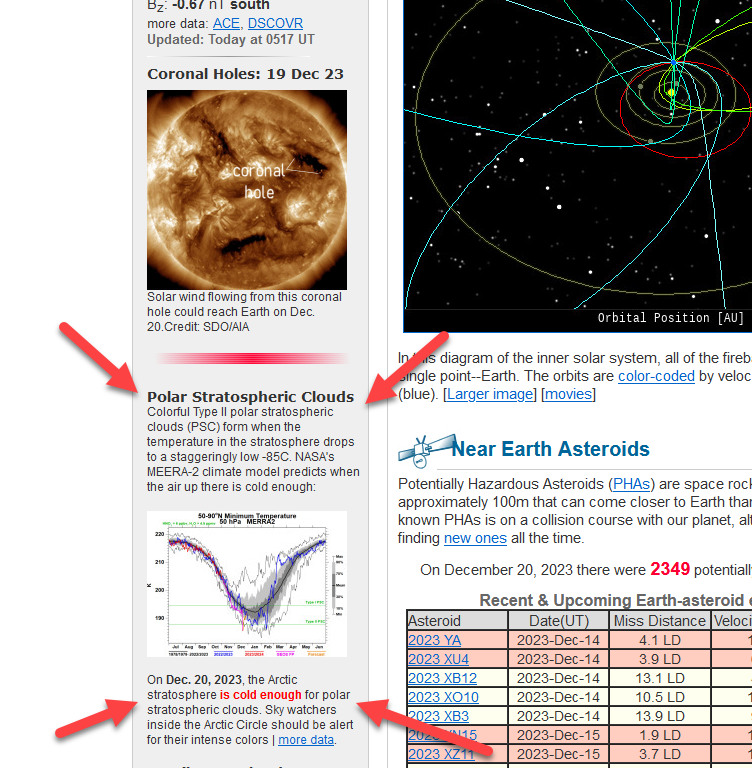
Record-Cold Weather in theย Stratosphere

Cold air in the stratosphere is exactly what PSCs require. Normally, the stratosphere has no clouds at all. But when the temperature drops to a staggeringly-low -85 C, widely-spaced water molecules coalesce into ice crystals and PSCs begin to form. Their aurora-like colors make them the most beautiful clouds on Earth.

From Spaceweather.com

By DR.TONY PHILLIPS

Dec. 24, 2023:ย (Spaceweather.com) Now we know why polar stratospheric clouds (PSCs) haveย suddenly exploded. According to NASAโ€™s MERRA-2 climate model, temperatures in the Arctic stratosphere just hit a 40-year record low for the month of December:

Cold air in the stratosphere is exactly what PSCs require. Normally, the stratosphere has no clouds at all. But when the temperature drops to a staggeringly-low -85 C, widely-spaced water molecules coalesce into ice crystals and PSCs begin to form. Their aurora-like colors make them the most beautiful clouds on Earth.

PSCs are normally confined to the Arctic where the stratosphere is coldest. During this weekโ€™s extreme cold wave, the clouds descended all the way to mid-latitudes. Here they are over Locarno, Switzerland (+46N):

โ€œI saw these clouds for the first time on Dec. 22nd,โ€ says photographer Branca Cristina. โ€œThe colors were amazing!โ€

At the same time, the clouds were sighted in Torun, Italy (+45N); the next morning they appeared again in Lausanne, Switzerland (+47N). These are extraordinary excursions from normal PSC habitat.

The season for PSCs usually starts in January. The current cold wave has given the season an early start, and could herald many more PSCs in the weeks ahead. To help sky watchers catch these rare clouds, we will henceforth publish daily predictions of temperatures in the Arctic stratosphere. When the air temperature drops below the โ€œType II PSCโ€ green line, itโ€™s time to look for PSCs.ย Check out the forecast here.

Hurricanes and Tropical Cyclones | Climate at a Glance

In the second of a new series based on The Heartland Institute’s Climate at a Glance for Teachers and Students, research fellow Linnea Lueken presents the facts about hurricanes.

The Heartland Institute

In the second of a new series based on The Heartland Institute’s Climate at a Glance for Teachers and Students, research fellow Linnea Lueken presents the facts about hurricanes.

Are they reaching historic levels of destruction, or is the media ignoring the data?

The answers you need can be found in Climate at a Glance!

โ€œA New Energy Blogโ€ (from 2008)

Oil, natural gas, and coal are middle class, working class energies. Wind and solar are for the rich.

By Robert Bradley Jr.

Ed. Note: The repost of the first post at MasterResource (from 12/26/2007) marks the 16th anniversary of the free market energy blog site. In this period, MR has posted more than 2,700 posts from more than 300 authors.

โ€œโ€ฆ our blog name is inspired by the late Julian Simon (1932โ€“1998). He labeled energy the master resource because it is the resource needed to bring other resources from a state of nature to one of human usefulness. Simon also used the term the ultimate resource to describe human ingenuity.โ€

We are just getting started here, but some of us veterans of the energy debate from a private property, free-market perspective have teamed together to offer our thoughts on late breaking energy items. When I read my newspapers each day, I have some thoughts that I wish I could share with folks from a historical, worldview perspective. I think we all have something to addโ€“and thus the inspiration for this endeavor.

We have a good core group of principal (and principled) bloggers, as well as a growing list of guest bloggers. We aim to post new material most every day. What we have to provide to the reader is frequent insight so that you visit us regularly.

There will be some trial and error, but this is the time to launch. President-elect Obama and his team have little concept of history in the energy debateโ€“what W.S. Jevons said about renewable energies in the 1860s or the perils of U.S. energy regulation learned from wartime planning and the 1970s. Some of us will dwell on this to add some unique perspective to the debate.

By the way, our blog name is inspired by the late Julian Simon (1932โ€“1998). He labeled energy โ€œthe master resourceโ€ because it is the resource needed to bring other resources from a state of nature to one of human usefulness. Simon also used the term โ€œthe ultimate resourceโ€ to describe human ingenuity. As the institutional economist Erich Zimmermann once said, resources come from the mind, not the ground.

Finally, I do hope mainstream journalists and many other open-minded individuals will come our way in the great energy and climate debates. The Obama march to energy statism needs a lot of debate. Big Government Democrats are not the cure to Big Government Republicanism. Oil, natural gas, and coal are middle class, working class energies. Wind and solar are for the rich. Windpower, in particular, as my friend Robert Bryce has put it, is the ethanol of electricity. Maybe, just maybe, these parasitic, inefficient energies will get the scrutiny they deserve from all sides of the political spectrum.

The post โ€œA New Energy Blogโ€ (from 2008) appeared first on Master Resource.