Global warming, climate change, all these things are just a dream come true for politicians. I deal with evidence and not with frightening computer models because the seeker after truth does not put his faith in any consensus. The road to the truth is long and hard, but this is the road we must follow. People who describe the unprecedented comfort and ease of modern life as a climate disaster, in my opinion have no idea what a real problem is.
For more than four decades, Americans have been subjected to a relentless drumbeat of environmental doom. They have been terrified by warnings of acid rain, the ozone hole, melting ice caps, drowned coastal cities, superstorms and mass extinctions. Then came Al Gore and increasingly apocalyptic warnings about global warming, which has since been rebranded as “climate change.”
Paul Ehrlich’s 1968 bestseller, “The Population Bomb,” promised mass starvation in the 1970s. Instead, Norman Borlaug’s Green Revolution fed a billion more people. Being wrong has never slowed down the doomsayers.
For more than four decades, Americans have been subjected to a relentless drumbeat of environmental doom. They have been terrified by warnings of acid rain, the ozone hole, melting ice caps, drowned coastal cities, superstorms and mass extinctions. Then came Al Gore and increasingly apocalyptic warnings about global warming, which has since been rebranded as “climate change.”
Today, we can see the consequences. Two generations of young people have been taught not to respect the environment, but rather to fear the future.
The numbers are disturbing. A Lancet Planetary Health survey of 15,793 Americans ages 16 to 25 found that 85 percent were at least moderately worried about climate change, including 58 percent who were very or extremely worried. More than half said climate change made them hesitant to have children.
Other research points the same way. A review of multiple studies found that stronger climate worry lines up with wanting fewer children or none at all.
Think about that. We have convinced millions of young people that the future is so bleak that they should reconsider having children.
Yet the picture of a dying planet bears little resemblance to the measurable world around us.
The Earth is getting greener. NASA reported that 25 to 50 percent of the world’s vegetated land greened significantly between 1982 and 2015 — an increase in leaf area roughly twice the size of the continental U.S. Researchers attributed about 70 percent of that greening to rising carbon dioxide.
So carbon dioxide is not merely an emission — it is plant food.
Agriculture tells the same story. The world now grows nearly three times as much grain on the same acre as it did in 1961. The cropland saved is close to the area of the U.S. and India combined. Credit better seeds, machinery, irrigation, modern farming, fossil fuel-derived fertilizer, and that carbon dioxide boost.
Our air is cleaner, too. EPA reports that emissions of the six main air pollutants fell 79 percent between 1970 and 2024, even as the economy grew 338 percent, Americans drove 195 percent more miles, and the population grew by two-thirds.
Prosperity has surged as well. The number of people living in extreme poverty worldwide fell from roughly 2.3 billion in 1990 to about 800 million today, even as the world population grew by nearly three billion. Life expectancy, literacy, and living standards are at record highs.
We have heard the doom and gloom predictions before. Paul Ehrlich’s 1968 bestseller, “The Population Bomb,” promised mass starvation in the 1970s. Instead, Norman Borlaug’s Green Revolution fed a billion more people. Being wrong has never slowed down the doomsayers.
None of this means environmental problems are imaginary. It means they are problems to solve and not reasons to surrender.
Previous generations built dams, cured diseases, split the atom, crossed oceans, and landed men on the Moon. They faced world wars, depressions, and nuclear standoffs, real existential dangers. Their answer was not to stop having children. It was to build a better world for them.
Even Elon Musk, who believes strongly that man-made carbon dioxide threatens the climate, preaches innovation and expansion — not retreat and despair. That is the mindset young people need.
So teach the real problems we can do something about — not false climate doom. Teach the triumphs, not just the panic. Teach how human ingenuity cleaned our air and rivers, tripled crop yields, cut extreme poverty by two-thirds, and greened a massive share of the planet.
Parents, this one is on us. Ask your school district what your children are being taught about climate, and what they are not. Ask to see the curriculum. Ask whether a single one of these numbers appears in it. Then say so out loud at the next school board meeting.
Two generations have been taught to fear the future. Let’s teach the next one to build it.
For years, Americans have been told that we face an existential climate emergency aka the so-called “climate-crisis.” That claim has reshaped public policy, transformed education, redirected enormous public and private investment, and justified sweeping government intervention into nearly every sector of the economy.
For years, Americans have been told that we face an existential climate emergency aka the so-called “climate-crisis.” That claim has reshaped public policy, transformed education, redirected enormous public and private investment, and justified sweeping government intervention into nearly every sector of the economy.
If the public was misled, whether intentionally or through reckless disregard for evidence, it is time to ask a difficult question: Who should be held accountable?
For nearly a decade, climate activists have pursued lawsuits against energy companies under the banner of #ExxonKnew, arguing that corporations should be financially liable for allegedly misleading the public about climate change. That raises an obvious question.
What if the same legal standard were applied to everyone?
If accountability is the standard, then it should apply equally to every institution that shaped public understanding of climate change.
If evidence exists that institutions knowingly exaggerated risks, relied on implausible scenarios while presenting them as likely outcomes, ignored contradictory observational data, or blurred the distinction between scientific inquiry and political advocacy, then they deserve the same scrutiny they demanded of others.
That scrutiny should extend to universities, researchers, advocacy groups, public education, renewable energy interests, politicians, and media organizations that blurred the line between reporting and advocacy.
But the greatest cost wasn’t measured in federal budgets. It was measured in classrooms.
An entire generation of children was taught that civilization was approaching collapse and that they might never enjoy a stable future because of climate change. Schools, documentaries, social media, and news coverage routinely presented Representative Concentration Pathway (RCP) 8.5’s most extreme projections as though they were the expected outcome rather than a worst-case modeling exercise. Even after leading researchers concluded the scenario no longer represented a plausible baseline, it remained embedded in textbooks, classrooms, government reports, and popular media.
Studies now document rising climate anxiety among young people, with many believing humanity is doomed or questioning whether they should have children. Presenting an increasingly implausible worst-case scenario as their expected future has consequences.
The financial consequences have also been enormous.
Since 2021 alone, Congress has enacted hundreds of billions of dollars in climate and clean energy spending through the Bipartisan Infrastructure Law and the Inflation Reduction Act, with the latter now projected to exceed $1 trillion over its lifetime. Utilities and consumers have absorbed billions more in costs associated with grid restructuring, renewable mandates, transmission expansion, and related policies.
Federal agencies also directed billions of dollars into climate research built around RCP8.5, even after many researchers concluded it was out of touch with reality and no longer represented a plausible “business as usual” future. Yet it continued to underpin government assessments, climate litigation, financial stress tests, educational materials, and thousands of scientific papers.
If the underlying scientific claims were exaggerated, if worst-case scenarios were repeatedly presented as the most likely outcomes, or if advocacy became indistinguishable from objective science, then accountability should follow.
That accountability should begin with congressional investigations and independent scientific reviews. It should include audits of federal grant programs, greater transparency in research funding, and a careful examination of how climate science has been communicated to policymakers, educators, journalists, and the public.
Where evidence supports it, civil litigation, including class action lawsuits, should also be on the table.
Discovery alone could prove invaluable. Internal emails, grant proposals, and communications among researchers, advocacy organizations, government agencies, philanthropic foundations, educators, and media organizations could reveal whether scientific uncertainty was honestly conveyed or deliberately minimized in pursuit of political, financial, or institutional objectives.
Climate activists established an important principle: those who knowingly mislead the public can be held legally accountable for the harm that follows.
If that principle has merit, it cannot apply only to fossil fuel companies. It must apply equally to every institution that shaped public understanding and influenced public policy.
Science advances by questioning assumptions and correcting mistakes. Continuing to promote claims after their weaknesses become clear, especially when those claims shape legislation, litigation, classrooms, and public opinion, deserves careful scrutiny.
If discovery in the #ExxonKnew lawsuits was intended to reveal who knew what and when they knew it, then the public deserves the same transparency from the institutions that built and promoted the climate emergency narrative. Internal communications, grant proposals, policy discussions, and media strategies should receive the same scrutiny that activists demanded of the energy industry.
Accountability should not depend on politics. It should depend on evidence.
If the legal standard is that knowingly misleading the public carries consequences, then it is time to ask not simply whether Exxon knew, but who else knew, what they knew, when they knew it, and why the public wasn’t told.
Only then can we begin to restore the public trust upon which both science and journalism depend, and ensure that climate science once again informs public policy rather than climate alarmism driving it.
This exchange in 2019 between Robert Bradley and climate scientist/activist Andrew Dessler regards adaptation as the key climate policy. It is reposted for its relevance in today’s debate over air conditioning (see yesterday’s post). “Climate mastery” via fossil fuels, as Alex Epstein has emphasized, is the natural, most rewarding public policy.
Ed. note: This exchange in 2019 between Robert Bradley and climate scientist/activist Andrew Dessler regards adaptation as the key climate policy. It is reposted for its relevance in today’s debate over air conditioning (see yesterday’s post). “Climate mastery” via fossil fuels, as Alex Epstein has emphasized, is the natural, most rewarding public policy. [1]
“With the very unique situation of CO2 (a global externality of positives and negatives), government mitigation is doomed to fail. Sooner or later, you will have to admit that politics failed, that fossil fuels were just too good given the alternatives of non-use, renewables, nuclear.” (Bradley to Dessler #1, August 3, 2019)
“We have not only market failure but also analytical failure (imperfect you, me, others) and government failure, which is magnified by 190 or so governments.” (Bradley to Dessler #2, August 3, 2019)
I have been critical of Texas A&M climatologist and Green New Dealer Andrew Dessler for some time now. He is far too certain about climate doom (“climate dystopia,” to use his term) and refuses to see the risks in climate policy, not only physical climate change. Most of all, he seems blind to human ingenuity regarding anticipating and adapting to weather extremes and climate change from any source, natural or anthropogenic.
Forwarding Professor Dessler a post from Marion Tupy of the Cato Institute, “The Cost of Air-Conditioning Fell by 97 Percent Since 1952,” I made a case for fossil fuels being the answer whether or not fossil fuels were the problem. My communication was inspired by the fact that Dessler was revising his Introduction to Modern Climate Change primer for Cambridge University Press, very timely given a need to rectify a number of important omissions (I listed 11 here).
Seeing Dessler’s Tweet (below) referring to me as a “free-market jihadist,” I am inspired to share our entire exchange and let the reader decide who is on the right track, realistically imagining how free, enabled humans can survive thrive in a warming world (again, natural or human-caused).
Dessler Tweet (August 7th)
Exchange: Bradley to Dessler (August 2, 2019)
Professor Dessler: You mentioned in a tweet that you are revising your science textbook, which hitherto has included a political economy section.
One point to inform your supporters and engage your critics. The debate over adaptation versus mitigation will only grow in importance because of the saturation effect of CO2 atmospheric concentrations on the one hand and the ongoing internalization of the costs of extreme weather (from whatever source) on the other (‘as if led by an invisible hand’).
The weakness in your political economy argument is the affordability and thus practicality of Adaptation in free societies governed by private property, voluntary exchange, and the rule of law. It should be a reason that you favor free markets even more than if the climate issue did not exist. We need free trade (not protectionism, including CO2 tariffs) to increase wealth. We need free migration where people vulnerable to weather can vote with their feet (but not overrun a welfare state).
We need the world to be air-conditioned inside and outside (see below). We need underground walking networks like in Houston to avoid heat, rain, whatever. We need bubbles over large recreation areas in certain places.
This is where the future is headed as our wealth increases to shape our world the way we like it.
More CO2 emissions from all this? More negative climate change? Remember the positives from the CO2 fertilization effect and from climate change—and note that the wealth from dense, reliable, carbon-based energy solves the ‘problem’ of climate change (or just extreme weather). And it has for a long time. Perhaps the most important statistic for the climate debate is the large reduction in climate-related deaths since measurements began. See Bjorn Lomborg here. If you dispute the statistics or have a different interpretation, do so in your books. (Don’t duck!)
Some wealth-is-health quotations:
“Climate is no longer a major cause of deaths, thanks in large part to fossil fuels.… Not only are we ignoring the big picture by making the fight against climate danger the fixation of our culture, we are ‘fighting’ climate change by opposing the weapon that has made it dozens of times less dangerous. The popular climate discussion has the issue backward. It looks at man as a destructive force for climate livability, one who makes the climate dangerous because we use fossil fuels. In fact, the truth is the exact opposite; we don’t take a safe climate and make it dangerous; we take a dangerous climate and make it safe. High-energy civilization, not climate, is the driver of climate livability.” (Alex Epstein, The Moral Case for Fossil Fuels, pp. 126-127.)
“If good and evil are measured by the standard of human well-being and human progress, we must conclude that the fossil fuel industry is not a necessary evil to be restricted but a superior good to be liberated.”
“We don’t need green energy–we need humanitarian energy.” (Alex Epstein, “At CERAWeek Fossil Fuel Leaders Should Make A Moral Case For Their Industry,” Forbes.com., February 18, 2016.)
Your books need to sharpen the discussion of energy density as a backdrop to the above debate (you do deal with intermittency). Vaclav Smil is the person you need to understand (he is Bill Gates’s favorite energy analyst).
I hope this will inspire more analysis of the issues. And please let me know of your counter-arguments if you feel I am missing some important analysis. I’m all ears and eyes.
Dessler’s Response (August 2, 2019)
“So your argument is that doing nothing about climate change and letting everyone take of themselves is better than the collective response of avoiding even the worst-case climate change scenario?”
Bradley to Dessler #2 (August 3, 2019)
Your formulation, which I know was a quickie, is not the way to characterize my position.
You stated: “So your argument is that doing nothing about climate change and letting everyone take of themselves is better than the collective response of avoiding even the worst-case climate change scenario?”
“Doing nothing” is a misrepresentation. I want to do a lot—but not use the power of government to override consumers/taxpayers by pricing CO2 emissions, etc. to artificially hurt fossil fuels in the energy mix.
I want climate scientists to keep getting us to a better understanding of what might be in the future (your 2.7C plus/minus is important in this regard). But a warning: false certainty in the high direction will oversell air conditioning, domes, spillways, etc. (Unintended consequence?)
Given realistic science (above), it becomes open knowledge to prepare and adapt to the future. Fossil fuels (see below) and wealth-is-health public policies are crucial in this regard. There is less margin for error than otherwise, right?
I want reform. I want to redirect public resources, private philanthropy, and individual effort away from wealth-compromising, potentially debilitating climate politics (Green New Deal) to climate/weather realism and resilience. I want public policy changes to empower self-help and societal improvement, which would include free migration, open trade, etc. The climate “problem” requires less government, not more.
So I want climate policy reform. And yes, there will be incremental CO2 emissions from an adaptation, free market approach.
In theory, “collective response” and “worst-case scenario” are unfair if you are assuming an effective “collective response” and a realistic “worst-case scenario”. In the real world, we cannot abstract from the ‘knowledge problem’ (Hayek) and perfect government (Public Choice economics vs. Nordhaus’s ‘environmental Pope’). We have not only market failure but also analytical failure (imperfect you, me, others) and government failure, which is magnified by 190 or so governments.
“Letting everyone take care of themselves” is not only the permission and incentive for individuals to ‘do the right thing’ and ‘do the best they can.’ It is also activating the very powerful third force of society beyond the individual and government—civil society. I think it would be far better climate policy to have the Rockefeller Brothers Fund and all the other activist climate organizations to spend their dollars on a variety of actions to help individuals and groups anticipate and adapt to change, not play the ‘alligator shoes’ game (Hansen) of climate politics.
Here is how I would rephrase your statement as my position:
So your argument is that government mitigation of anthropogenic GHG emissions wastes scarce resources and works against natural incentives to anticipate and adapt to a changing climate under a variety of modeled scenarios?
To which I would say “Yes,” and add:
But more than this, to the extent that there is a real physical change toward extreme temperature changes and other problematic weather events, we need to move the US and the world away from statism, collectivism, and cronyism to private ownership, voluntary exchange, and the rule of law—and toward liberalized immigration policy, free trade, balanced budgets, etc.
Here are other ways to understand my point:
The worse the climate problem, the more fossil fuels must be part of the preparation and response. The fundamental principle of energy density and intermittency, and the plain fact that electricity cannot lubricate, make plastics, and do many other things versus petroleum, is a physical reality at present.
The increasing wealth of a free society (and future generations given economic freedom!) can be expected to turn physically worse weather in the future into, practically speaking, more benign weather. (If just having a TV and the weather channel, for a simple example.)
This also explains why climate deaths have radically declined in the capitalist, fuel-fuel era. Wealth is health, to repeat myself.
By the way, I would have used the above argument a decade or two or three ago. And today, I would say, it is more compelling given the reality of energy (fossil-fuel boom) and politics (government waste, inaction, greenwashing). In other words, as we naturally adapt and the saturation effect increasingly kicks in, the case against mitigation and for wealth-is-health adaptation becomes more powerful.
This is my position. Just want you to personally understand it and, hopefully, professionally consider it. It is somewhat subtle but has a number of rich academic traditions behind it. I have actually read your books cover-to-cover, and skimmed your earlier editions to try to identify revisions. I am not afraid of ‘being wrong’ at this late stage of the game and welcome your critical feedback.
Dessler to Bradley #2 (August 3, 2019)
I hope you don’t mind me following up, but your response sounds like a lot of what I hear from the do-nothing crowd (“we need innovation!” “we need to make people richer!” “people need to prepare for climate change”) as a general principle, I agree with those goals.
But these are just goals — you need policies to achieve them. So when you say something like “I want reform. I want to redirect public resources, private philanthropy, and individual effort away from wealth-compromising, potentially debilitating climate politics”, how do you achieve that goal? What policies do you advocate for?
My hypothesis is that what you wrote is a lot of fancy window dressing that ultimately boils down to a policy of doing nothing, but I am ready to be proven wrong by a response from you containing a list of concrete policies that you’d like to see implemented.
Bradley to Dessler #3
Say the question was “what do we need to do to address poverty” … whether it was the goal in the US in the 1930s or a developing country today–and anything between.
Would you want to list specific welfare programs? Government this or that to tell citizens what to do? This is exactly wrong in my view.
To a classical liberal, this is called central planning or in theoretical terms, ‘scientism’ and ‘the fatal conceit’ — and it gets to the idea that government (190 nations in regard to CO2) has the knowledge to plan the right thing and that politics can implement the right thing…. And that private-sector entrepreneurs and hard working individuals cannot bring prosperity to themselves and to civil society to defeat poverty.
A classical liberal (there is a whole worldview here) believes in ‘simple rules for a complex world’ where you have the right institutions and incentives from private property rights, mutually beneficial (voluntary) exchange, the rule of law. Government does not plan but is neutral. Civil society is huge because government is small.
Entrepreneurship is all about anticipating and responding to change–business thrives on change for extraordinary profit (and loss). An accumulation of little things like what McIlhenny Company did with its 20-foot levee around its Tabasco plant on Avery Island off the Louisiana coast to insure against flooding.
So climate policy would be specifically to get the best science out there and let individuals, groups, philanthropies, and local government plan around it. NO mitigation of GHG’s as part of a “first do no harm, no regrets,” policy here.
Regarding “we need innovation,” you and others are right to conclude that this does not apply to wind, solar, and carbon capture and storage as far as being affordable and scalable. (Nuclear? Still quite uneconomic and risky and very subsidized by government.)
Innovation that is realistic is on the adaptation side, and we have countless examples of success is escaping bad weather or uncomfortable temperatures and the rest of it.
The most concrete climate policy, perhaps, is for the government to stop subsidizing beach living and the sort. Micro policies that work against self-help and adaptation. Also, immigration policies to allow folks to leave areas of ‘bad’ climate change for areas of ‘good’ climate change. Developing countries have another reason to reform toward free economies.
So, ZERO activist government mitigation policies that are a failure to date (you might agree) with little hope for reversal. The train has left the station and is gaining speed. (That is added to your books’ conclusion, right?)
With greater wealth from cheap, abundant mineral energies, adapt, adapt, adapt. (But don’t you scientists exaggerate the problem!). But even here, no central plan for adaptation. Let a million flowers bloom.
And for all the major capitalist-created foundations that are bankrolling climate alarmism and policy activism, redirect that money to real human needs rather than having to get philanthropists on the other side to hire people like me to try to cancel out the Joe Romms of the world. (Political solutions are wasteful all around.)
I wonder if the next editions of your books will increasingly focus on adaptation and the strategy of wealth-is-health as the only affordable climate policy in an energy-rich world.
Dessler to Bradley #3 (August 3, 2019)
The only policy action in your response was (maybe) getting rid of national flood insurance and (unspecified) immigration policies.
Otherwise, it still sounds to me like your preferred policy is to do nothing about climate change. If you think you have a set of coherent policy proposals, I just don’t see them. Perhaps you know that your policy is to do nothing, but you feel you can’t say it because you also know that’s a loser in a public debate — on that, we can agree.
Bradley to Dessler #4 (August 3, 2019)
Backing up, I advocate a public policy for CO2 that is about human betterment. Better quality of life and longer lives–and more people if that is what naturally emerges.
If your standard is not human betterment, we cannot agree. A deep ecologist has different premises and ends.
This said, I have a public policy with a clear rationale. You cannot accept my policy because it does not involve government, the one institution with a monopoly on force in a particular geographical area. I believe that under a wide range of scenarios, government forcing in the name of mitigating climate change fails under a human betterment standard. Lots of arguments in theory and, in practice, it is turning out just this way for understandable reasons (as you cover in your books).
Defining climate-conscious adaptation as “do nothing” policy because it is not macro-governmental (centrally planned) is a disservice to the debate. It is very robust–so much so that the other side really does not want to debate it. Present pain for distant benefits is a political loser, and it is a tough sell in a public debate too.
With the very unique situation of CO2 (a global externality of positives and negatives), government mitigation is doomed to fail. Sooner or later, you will have to admit that politics failed, that fossil fuels were just too good given the alternatives of non-use, renewables, nuclear.
I have provided many arguments for my position that you have jumped over. If I may return to an essential fact: fossil fuels must be the answer, whether or not they are the problem. I don’t see how you can deny this. The world reconfirms this every second 85 percent of the time, energy-wise. And humanity, by virtually all objective standards, is getting better despite statism at home and abroad.
Dessler to Bradley #4 (August 3, 2019)
OK, I think I understand your point. You think THE GOVERNMENT should do nothing to address climate change. As you probably suspect, I don’t view government action as the evil you do, and I think well-designed government regulations will lead to a more beneficial solution than free-market-only solutions. But thank you for detailing your points. I will of course consider this (and all other viewpoints) when I make decisions about what will and will not go into the 3ed of my textbook. Best wishes.
Bradley to Dessler #5
Yes, only decentralized government adaptation in the sense of planning infrastructure that it owns or manages.
What this exchange did for me is to formulate the term ‘climate-conscious adaptation’ in place of just adaptation. And what I sort of like about it is that it creates the right incentive for climate scientists to not exaggerate the problem because that would artificially spur CO2 emissions.
===
[1]“The popular climate discussion … looks at man as a destructive force for climate livability … because we use fossil fuels. In fact, the truth is the exact opposite; we don’t take a safe climate and make it dangerous; we take a dangerous climate and make it safe. High-energy civilization, not climate, is the driver of climate livability.”
– Alex Epstein, The Moral Case for Fossil Fuels, pp. 126–127.
The University of Copenhagen press release claiming that “over half of global coastal settlements are retreating inland due to intensifying climate risks” sounds like the sort of headline crafted to feed an increasingly popular narrative: coasts are becoming uninhabitable battlegrounds of climate doom, and people are fleeing for safety.
The University of Copenhagen press release claiming that “over half of global coastal settlements are retreating inland due to intensifying climate risks” sounds like the sort of headline crafted to feed an increasingly popular narrative: coasts are becoming uninhabitable battlegrounds of climate doom, and people are fleeing for safety.
Like many such claims, it rests on a selective look at data, a sweeping interpretation of human motives, and an assumption that climate hazards dominate decision-making for developers and residents. In reality, economics—not climate fear—drives coastal development, and has for centuries. The study’s reliance on nighttime light data as a proxy for population movement adds yet another layer of uncertainty—particularly in developing regions where electrification is uneven.
The study itself if paywalled at Nature Communications, and I’m not going to throw good money at bad science. Fortunately, the press release itself provides enough clues to see the cracks in the narrative.
(All quotations below come directly from the press release.)
1. Developers Don’t Use “Climate Risk Models” to Choose Where to Build — They Follow Money, Not Models
The press release repeatedly frames changes in settlement patterns as “responses to intensifying climate risks.” But nowhere does it present evidence that actual developers, property investors, or residents are citing climate risk as their primary rationale for new construction.
That is because, almost without exception:
Developers build where buyers want to buy. Buyers choose based on economic opportunity, amenities, and cost—not abstract climate projections.
A few points worth emphasizing:
Coastal real estate in the U.S., Europe, and Asia continues to command premium prices, rising faster than inland regions in many markets.
Major insurers still willingly underwrite billions in coastal property—usually at higher premiums, but still entirely viable.
Municipalities encourage coastal development because it boosts tax revenue.
New flood defenses, sea walls, and drainage upgrades are being built all over the world—not as signs of retreat, but evidence of investment in staying put.
In short: if a region truly believed climate risks were rendering their coasts unlivable, the cost of coastal land would collapse. It hasn’t.
The study authors assume causation: “retreat” must mean fear of climate hazards. But unless they interviewed developers, tracked planning documents, or reviewed permit applications (they did none of these), the causal claim is pure inference, not evidence.
2. The “Nightlights = Retreat” Assumption Is a Giant Leap — Especially Where Electrification Is Uneven
The entire study hinges on a questionable premise: that satellite-detected nighttime light intensity is a reliable indicator of population movement toward or away from the coast.
Even the authors admit the weaknesses:
“Night-time light data may not tell the whole story, as economic activity and settlements extent are not necessarily linked to luminous activity in regions with limited electrification.”
This applies not just to Africa but to large parts of Asia and South America as well. If electrification improves inland faster than along the coast—because of grid expansion, economic development, industrial siting, or government investment—the “retreat” the study claims to detect might simply be the movement of electricity, not people.
In wealthy regions, the situation is reversed: coastal areas often have higher light saturation due to tourism, port operations, and commercial zoning. A modest shift in where industrial lighting is concentrated could dramatically skew the appearance of “retreat” or “advance.”
Nightlights are a useful tool, but only when paired with direct measurements of actual population counts—census data, property tax rolls, verified construction records. The press release makes clear the study did not do this.
Without validating the light data against real-world settlement patterns, the resulting conclusions are, at best, speculative.
3. Coastal Population Trends Historically Show Growth, Not Retreat — Especially Relative to Inland Growth
To understand whether coastal communities are truly “retreating,” a simple question must be asked:
Are coastal populations shrinking relative to national population growth? Or are they growing, but at a slightly slower rate than in some inland regions?
There is a major difference between:
People abandoning the coast, and
Inland development simply growing faster (e.g., suburban sprawl, new industrial zones, tech corridors).
Historically, coastlines have grown faster than inland regions for centuries:
In the U.S., coastal county populations have increased steadily since at least 1900.
In Europe, major coastal cities—from Copenhagen to Rotterdam to Barcelona—continue expanding.
Southeast Asia, despite frequent typhoons, has seen explosive growth in coastal megacities.
The press release itself hints at the real driver:
“For centuries, coastlines have attracted dense human settlement and economic activity.”
That hasn’t changed. Economic opportunities still cluster along the sea.
Before claiming a “retreat,” the authors should demonstrate:
That actual population numbers in coastal zones have decreased, not just shifted slightly inland.
That growth inland is not simply outpacing coastal growth because of cheaper land or new infrastructure, not climate fear.
The press release presents no such evidence.
4. Middle-Income Regions “Retreating” May Simply Be Developing New Land — Not Fleeing Climate Risks
A key claim:
“Middle-income countries… possess enough institutional capacity and financial resources to support relocation.”
Or—more plausibly—they possess the resources to expand infrastructure inland:
New highways
New industrial parks
New housing blocks
New suburban developments
When you pave a new ring road 5–15 km inland, suddenly the lights there brighten, and the satellite interprets this as “retreat,” even if the coastal population remains stable or grows.
Economic development ≠ climate retreat.
Urban sprawl ≠ climate retreat.
Electrification ≠ climate retreat.
Unless the authors can show that coastal property is being abandoned—and not replaced by new development—the narrative of retreat is unsupported.
5. The Press Release Claims Retreat Is Driven by “Vulnerability” — But Vulnerability Is Itself a Social, Not Climatic, Metric
From the authors:
“Coastal retreat mostly happens in places where communities don’t have the means to protect themselves… not necessarily because of more hazards.”
This is a revealing admission.
If retreat occurs not because hazards are increasing, but because:
infrastructure is lacking,
governments are limited in capacity,
economies are weak,
…then the phenomenon is, by their own acknowledgment, a development issue, not a climate one.
In fact, this is exactly what historical settlement patterns show:
Wealthier nations invest in sea walls, surge barriers, and coastal defenses.
Poorer nations lack these resources and develop unevenly.
Some regions urbanize inland because it is simply cheaper and less congested.
None of this indicates an accelerating climate-driven retreat.
6. The Claim That “56% of Regions Retreated” Requires Context the Study Doesn’t Provide
The press release claims:
“56% of coastal regions have retreated from the coast from 1992 to 2019.”
This is statistically meaningless without answers to the following:
1. What is the magnitude of the retreat?
A shift of 200 meters inland shows up in satellite light data, but is irrelevant to real-world settlement patterns.
2. What is the baseline distance?
If a region’s bright zone expanded inland due to suburbanization, but coastal density remained stable, that is not retreat.
3. Were coastal lights dimming, or inland lights brightening?
Uneven electrification alone can explain large portions of the “retreat.”
4. Are coastal populations declining?
The press release provides no evidence of shrinking populations—just shifts in illumination.
Without these details, the 56% figure tells us nothing about actual human movement.
7. Copenhagen “Moving Toward the Coast” Undermines the Claim That Hazards Are Increasing
The press release unintentionally highlights a contradiction:
“Denmark… is amongst the minority of regions moving closer to the coast these past decades.”
Denmark—a country with allegedly “accelerating sea-level rise”—is building closer to the water. So are the Netherlands, Singapore, Dubai, Tokyo, Miami, and New York.
When wealthier nations with access to the best data refuse to retreat from the coast, it reveals something important:
Their actions contradict the narrative of imminent climate-driven coastal uninhabitability.
People vote with their feet—and their mortgages.
8. The Real Drivers of Settlement Patterns Are Economics and Infrastructure, Not Climate Fear
Let’s spell out the well-known, empirically supported factors that drive modern settlement shifts:
1. Suburban expansion
As cities globalize, growth typically moves outward, not inward.
2. Rising coastal land prices
As wealthy areas densify, lower-income residents move slightly inland.
3. New transportation corridors
Roads, railways, and airports often spur inland development.
4. Industrial relocation
Factories and logistics hubs often move inland to cheaper land.
5. Electrification and grid expansion
Satellite sensors detect light, not humans.
None of these are climate phenomena. All are consistent with ordinary economic development.
Until the authors can demonstrate that humans are abandoning coastal areas because of climate fears—and not simply developing new land inland—the claimed “climate retreat” remains an assumption.
Conclusion: The Study’s Narrative Outpaces Its Evidence
The press release frames global settlement shifts as a climate adaptation story, but the underlying evidence appears far too thin to support that narrative.
To summarize the core problems:
Developers don’t base decisions on climate risk—they base them on profit.
Nightlight data is an unreliable proxy for population movement, especially across countries with uneven electrification.
Historical population data shows long-term growth on coastlines.
Economic expansion inland is not the same as retreat from the coast.
The study itself admits that vulnerability—not hazard increase—is the key driver.
Wealthy nations continue to build aggressively on coastlines, contradicting claims of climate-driven retreat.
The real story appears to be one of development patterns, not climate exodus.
The press release presents an alarming climate-driven narrative, but the evidence it cites actually points to something else entirely:
People are not fleeing coasts—coasts are evolving, developing, and in many places, thriving.
And until studies like this validate their satellite interpretations with real-world population and development data, claims of global “retreat” should be viewed with healthy skepticism.
We hear it again and again: the melting ice in Greenland due to global warming will soon lead to a collapse of the Gulf Stream system, with the result that it would be difficult to restart. Then we would see great disasters like those depicted in Roland Emmerich’s dramatic climate movie “Day after Tomorrow”.
“Will dissuade people from climate doomism,” researcher hopes. Ice sheet runoff at the coast has much less impact on the AMOC than melting ice bergs out to sea do.
We hear it again and again: the melting ice in Greenland due to global warming will soon lead to a collapse of the Gulf Stream system, with the result that it would be difficult to restart. Then we would see great disasters like those depicted in Roland Emmerich’s dramatic climate movie “Day after Tomorrow”.
The seawater salinity in the north is critical because the salt-rich tropical water cools and sinks due to the higher salt content. This acts as the pump that makes circulation possible in the first place. This serves to transport very large amounts of heat into the North Atlantic, keeping Europe on the mild side in the wintertime. Scenarios have been published recently that calculate a drastic cooling of the large area (especially Europe) around it if the Gulf Stream system got “switched off”. But those scenarios are proving to be over-dramatic and alarmist.
Yuxin Zhou, a postdoctoral researcher in UC Santa Barbara’s Department of Earth Science, recently went back in history to study when the AMOC was severely weakened, from 68,000 to 16,000 years ago, when the Laurentide Ice Sheet existed, and thick ice covered northern North America and even New York City. Today that massive ice shelf of course no longer exists and thus there is no longer the potential of an ice melt and iceberg release of that scale.
Very different, less dramatic circumstances today
By analyzing sea sediment deposited by floating ice bergs out to sea in the North Atlantic, Zhou found that AMOC heat transferring oceanic current had been already moderately weakened back then before all the icebergs floated over the North Atlantic. Comparing the situation to today: “In contrast, the circulation is very vigorous right now, which suggests the melting of Greenland is not likely to plunge the North Atlantic into another deep freeze of the sort the alarmists fret about all the time.
Not all melting has the same effect on the Atlantic circulation. Freshwater released as icebergs has a much larger impact on the AMOC than runoff, which is released after melting on land. Icebergs can cool the surrounding seawater, causing it to freeze into sea ice. Ironically, this ice layer acts as a blanket, keeping the ocean surface warm and preventing it from plunging down to the depths and driving the Atlantic circulation. What’s more, icebergs travel much farther out to sea than runoff, delivering freshwater to the regions where this deepwater formation occurs.”
Today’s Greenland’s freshwater runoff won’t have the anywhere near same impact as the mass icebergs of the last age. Image: Yuxin Zhou et al.
Thus, should Greenland’s glaciers further recede inland, they would only melt on land and release freshwater at the coast rather than release icebergs far out to sea. This would mean a considerably smaller impact on the AMOC.
Stop the doomism
Zhou summarizes: ““We have a lot of anxiety about how fast climate change is happening and how dramatic the changes could be. But this is a piece of good climate news that hopefully will dissuade people from climate doomism, and give people hope, because we do need hope to fight the climate crisis.”
As we all know from that Gore is reliably unreliable, so of course, those “facts” weren’t even accurate. These climate doomsayers are “dead right” despite a 100% fail-rate? Yeah, sure.
The village idiot was apparently ready to embarrass himself again, and he did not disappoint; of course, I’m talking about the one and only Al Gore. During a televised segment yesterday on CNN’s “State of the Union” show, anchor Jake Tapper asked Gore what would happen if the world failed to “react” to the impending climate doom-what sufficient “reaction” looks like is still unclear-and what the “worst-case scenario” would be. Below is Gore’s response, via a Breitbart report:
Gore said, ‘The scientist who has warned us of these mega-storms and the floods and mudslides and droughts and the ice melting and the sea level rising and the storms getting stronger and the tropical diseases and climate and migrants crossing international borders in large numbers. They were dead right when they warned us about this, and so we need to pay more attention to them now.’
He continued, ‘Here is one thing they say: if we don’t take action, there could be as many as 1 billion climate refugees crossing international borders in the next several decades. Well, a few million have contributed to this wave of populist authoritarianism and dictatorships and so forth. What would a billion do? We can’t do this. We could lose our capacity for self-governance.’
As we all know from that Gore is reliably unreliable, so of course, those “facts” weren’t even accurate. These climate doomsayers are “dead right” despite a 100% fail-rate? Yeah, sure. (Last year, the American Enterprise Institute published a “18 Spectacularly Wrong Predictions” piece, and it’s worth a read.)
First of all, glaciers are actually growing, and all signs point to a coming era of extreme cold. Furthermore, cold temperatures have caused (and continue to do so) far more death than “global warming” ever has; according to Bjorn Lomborg, a “high-profile Danish figure known primarily for his internationally-renowned book, The Skeptical Environmentalist”:
Cold deaths vastly outweigh heat deaths. This is common knowledge in the academic literature and for instance the Lancet finds that each year, almost 600,000 people die globally from heat but 4.5 million from cold.
But Gore doesn’t seem to grasp the true irony of his statement: although as I noted above that the sufficient “reaction” to temper the climate “emergency” isn’t really uniformly articulated (by the parasite class of leftist globalists pushing the agenda), we know it involves a complete and utter surrendering of personal liberties and national sovereignty to shadowy foreign bureaucracies.
What Gore is really saying is that to save “self-governance” we have to give it up.
“Give us your lives, your fortunes, and your liberty, and let amorphous unaccountable global agencies micromanage your existence from womb to tomb, OR YOU FORFEIT YOUR ‘CAPACITY’ FOR SELF-GOVERNANCE AND DEMOCRACY IS DEAD!”
“They” tell us we can’t fly. “They” took our light bulbs and our freon, while gas stoves, air conditioners, water heaters, and dishwashers, walk up the gallow steps. “They” demand we give up our gas-powered cars, for our own good and safety of course. “They” want social credit scores that include carbon output as a mitigating factor. “They” tell us to murder the most vulnerable and precious among us, for the sake of humanity and compassion. “They” are beyond demented and evil.
But, more absurdly, Gore noted that without mitigation, “climate refugees” will ultimately lead to the death of “self-governance” because by his (il)logic, it will invite more “populist authoritarianism” and “dictators” (read, President Donald Trump and anyone else that fits his mold), into the Western nations fixing to be overwhelmed by third world hordes. Ergo, doesn’t that make the Democrat case to curb the open borders policies they’ve championed for so long? If you don’t want Trump, or anyone like him, then why create a melee in which you anticipate losing? Like I said, village idiot, with (heavy, heavy) emphasis on the “idiot.”
This is a key premise of Daniel Church’s Winter Games, which starts out with a surfer suffering from hypothermia and leads onto a protest that will hopefully turn the tide of climate doom.
At 59 degrees Fahrenheit ambient temperature, without warm clothing or movement, your body temperature will drop, keep dropping and you’ll die in less than a day. 59 degrees Fahrenheit is also what climate scientists claim to be the average temperature of our planet which, they also claim, is burning up. This is a key premise of Daniel Church’s Winter Games, which starts out with a surfer suffering from hypothermia and leads onto a protest that will hopefully turn the tide of climate doom.
I found this an enjoyable read most of the way through and it is indeed an easy read. To a certain extent it has the whiff of a docudrama about it, with its asides concerning the state of climate science – the way that data is distorted by dropping past temperatures to make it look like there has been a steady climb to present temperature, being just one example. This is all pretty old news to me, ever since I started reading into the science more deeply several decades ago.
My interest had been prompted by a doom-mongering article, which shrieked about a huge sea level rise, but, unusually, quoted some figures. It only took a few minutes with a calculator to discover that the awful fate that the article implied was just around the corner was 14,000 years in the future. Thereafter I read and watched the long catalogue of lies and data manipulation that have led us where we are today: Climategate, the Mann Hockey Stick (where he tried to lose the Little Ice Age and the Medieval Warm Period), Al Gore’s film (where he pointed out a correlation between CO2 rise and temperature rise in ice core data but neglected to mention CO2 rose an average of 800 years AFTER the temperature rise), and the exposure of the Urban Heat Island Effect, which should have led to the dismissal of the whole warming farrago, but instead, after the scientists ‘homogenized’ the figures, resulted in it being ‘worse than we thought!’
I would recommend this book to those who would like some of the arguments against climate doom in an easily digestible fictional form. It’s a bit of an antidote to the “burning earth as accepted knowledge” idea you’ll find in most of what’s out there. It illustrates the craziness of killing our energy systems to stop a fire that simply is not occurring. It brings to light the fact, so often ignored, that cold kills orders of magnitude more people than warmth. It shows us the pressure scientists are under to conform – how they can lose their livelihoods and even their lives if they do not. And it shows us how the media, as we are discovering nowadays, are hardly the arbiters of truth. However, it does have flaws.
In the last quarter characters were dropped in who should have been introduced earlier, including, to my mind, an unnecessary villain. I understand the quandary faced here, because I’ve faced the same in one of my recent books. It’s difficult to tell a satisfying story when the villain of the piece is not a singular character to be defeated. In Winter Games, the true villain of the story is a system, a conjunction of media looking for drama and scientists looking for fame and consequent pay cheques, the growth of a zeitgeist about climate practically transforming into a religion that cuts down heretics – in this case rational scientists who see through the bullshit. I also note that the writer wanted to bring about a happy ending, when this would have been brought to a close better on the death of someone who had chosen to die, and from there opening out into the dystopia we might well be facing.
Adults have the life experience to reject their politicised climate nonsense, or least be wary of their evidence free claims of climate doom. But climate doom packaged up as education is being inflicted on defenceless kids, who are at a stage in life where they are less skeptical about “information” provided by authority figures.
Full quote: “I tend to be very gentle and very careful or I’m very focused on hope.”
‘I tend to be very gentle’: how teachers are navigating climate change in the classroom
Published: August 30, 2023 6.12am AEST Kim Beasy Lecturer in Curriculum and Pedagogy, University of Tasmania Chloe Lucas Lecturer and Research Fellow, School of Geography, Planning, and Spatial Sciences, University of Tasmania Gretta Pecl Professor, ARC Future Fellow & Director of the Centre for Marine Socioecology, University of Tasmania
Climate change education is increasingly seen as an essential part of schooling.
The main international test of 15-year-olds’ progress (which Australia participates in) has just announced the next round of testing will include environmental knowledge alongside English, maths and science literacy.
Australia’s national curriculum (updated last year under the Morrison government) barely mentions climate change. But as a signatory to the United Nations Sustainable Development Goals and Paris Agreement, we have committed to develop climate change education policies.
In our new research, we interviewed nine primary and high school teachers about how they include climate change in their teaching.
We found teachers are becoming the bearers of bad news in the classroom as young people learn about the climate crisis, and they need better training and more support.
I tend to be very gentle and very careful or I’m very focused on hope.
If there’s one thing which truly upsets me about climate activists, it’s the way they try to indoctrinate kids with their point of view, to “prepare” the next generation for climate change.
Adults have the life experience to reject their politicised climate nonsense, or least be wary of their evidence free claims of climate doom. But climate doom packaged up as education is being inflicted on defenceless kids, who are at a stage in life where they are less skeptical about “information” provided by authority figures.
I also feel sorry for teachers trapped in this web of climate deceit, who are being forced to teach politicised scientific viewpoints they don’t support. Teachers in this situation have an impossible choice, if they stay they can try to minimise the harm, but still have to mislead their students to hang on to their jobs, but if they leave, they might be replaced by a climate fanatic.
There is evidence that such “climate” lessons are doing real harm;
In 2019, Dr. Alex Wodak, a high profile Australian expert on drug rehabilitation, named fear of climate change as one of the major problems driving young people into the kind of despair which leads to addiction to hard drugs, during his testimony to the NSW Government Ice Inquiry.
An excerpt of the transcript is below;
…
First, the threshold step is redefining drugs as primarily a health and social issue rather than primarily a law enforcement issue. Second, drug treatment has to be expanded and improved until it reaches the same level as other health services. Third, all penalties for personal drug use and possession have to be scrapped.
Fourth, as much of the drug market as possible has to be regulated while recognising that part of the drug market is already regulated, such a methadone treatment, needle and syringe programs, medically supervised injecting centres. It will, of course, never be possible to regulate the entire drug market. We have regulated parts of the drug market before. Edible opium was taxed and regulated in Australia until 1906 and in the United States Coca-Cola contained cocaine until 1903.
Fifth, efforts to reduce the demand for powerful psychoactive drugs in Australia have had limited benefit and require a new focus. Unless and until young Australians feel optimistic about their future, demand for drugs will remain strong. Young people, understandably, want more certainty about their future prospects, including climate, education, jobs and housing affordability. Change will be slow and incremental, like all social policy reform.
As Herb Stein, as adviser to President Nixon said: Things that cannot go on forever don’t.
Drug prohibition cannot go on forever and will be replaced by libertarian paternalism. Thank you.
If your child starts becoming distressed by climate lessons at school, you have to try something. If your child swallows the message of despair, and becomes convinced there is no hope, there is a real risk they will turn to hard drugs or other self destructive or high risk behaviour. You have to intervene before this happens.
Other than voting for different politicians, which I hope you are already doing, some pushback is possible.
The lessons cannot be eliminated from the curriculum of most jurisdictions except at the ballot box, but how they are taught can be modified. Even the most climate enthusiast teacher is sensitive to being accused of doing harm and causing distress, and likely actually cares about the kids – many of them, even the real climate enthusiasts, genuinely believe they are helping by providing necessary knowledge to prepare kids for the future. So if your kids become distressed, there is room to demand more sensitive handling of the subject matter.
Of course, the best intervention is to keep talking to your kids. So long as you have a good relationship with your kids, you are the ultimate authority figure in their lives, at least until they grow up, and can do a lot to mitigate any damage done by other authority figures.
We can’t strip the indoctrination from the curriculum until voters wake up and toss the fanatics out of office, but we can, through talking to our kids, do our best to mitigate the harm and shield our kids from green agents of despair.
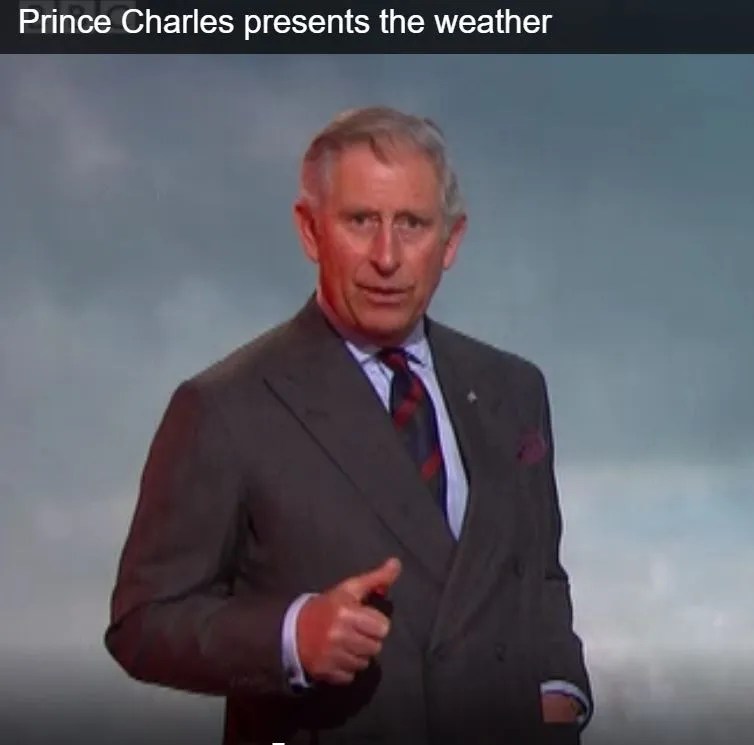
Climate alarmism with an end date is asking for trouble, to say the least. Gems such as this from 2008 — Prince Charles: Eighteen months to stop climate change disaster — spring to mind.
No previous constitutional monarch has expressed his political views so openly.
Unlike his mother and grandfather, whose opinions, if they had any, remained unknown to the general public, the king’s record-setting seventy years as heir apparent to the British throne saw him define himself as a deeply committed environmentalist.
. . . Father and son clashed on wind farms. In 2011, a wind farm developer reported that Prince Philip had told him that wind farms were “useless, completely reliant on subsidies, and an absolute disgrace.”
In his movie “Harmony—A new way of looking at the world,” Charles speaks of wind energy “working with nature’s freely-given forms” and the need to “end our dependence on fossil fuels.”
In the film’s opening sequence, showing a wind turbine in a meadow, Charles intones, “Time is running out.” . . . A 2021 paper on extreme climate forecasts tabulates 79 predictions of climate-caused catastrophe dating back to the first Earth Day in 1970.
Charles has the distinction of being the only individual to be featured three times, with separate predictions of climate apocalypse.
As the paper’s co-author David Rode of Carnegie Mellon University comments, alongside Stanford biologist Paul Ehrlich, Prince Charles has “warned repeatedly of ‘irretrievable ecosystem collapse’ if actions were not taken, repeated the prediction with a new definitive end date.
Their predictions have repeatedly been apocalyptic and highly certain . . . and so far, they’ve also been wrong.”
Here’s hoping that the reign of King Charles will be a happier affair than his failed forecasts of climate doom. Long live the King.
This Saturday’s coronation of King Charles III marks a significant moment in Britain’s history. No previous constitutional monarch has expressed his political views so openly. Unlike his mother and grandfather, whose opinions, if they had any, remained unknown to the general public, the king’s record-setting seventy years as heir apparent to the British throne saw him define himself as a deeply committed environmentalist.
In 2000, the BBC invited the then-Prince of Wales to give the last of the 2000 Millennium Reith lectures on sustainable development. Charles spoke of his belief in the “bounds of balance, order and harmony in the natural world which sets limits to our ambitions and define the parameters of sustainable development.” He name-checked the founders of the modern environmental movement—Rachel Carson and Fritz Schumacher, authors, respectively, of Silent Spring and Small is Beautiful. He embraced the precautionary principle, warning that the absence of hard scientific evidence of harmful consequences from genetically modified (GM) crops should not be taken as a green light to exceed nature’s limits.
Instead of looking to science for all the answers, mankind should work with the grain of nature, Charles argued. If a fraction of the investment going into GM technologies was devoted to improving traditional systems of agriculture, “the results would be remarkable,” he declared. He then praised fellow Reith lecturer Vandana Shiva, an environmental campaigner and director of the Research Foundation for Science, Technology and Ecology in New Delhi, for condemning large-scale commercial farming “so persuasively and so convincingly.”
Unfortunately for the people for Sri Lanka, Shiva also convinced the Sri Lankan government to ban GM crops and chemical fertilizers and switch to organic farming. The results were worse than remarkable; they were disastrous. According to Matt Ridley, within months of Sri Lanka going organic, “the volume of tea exports had halved, cutting foreign exchange earnings. Rice yields plummeted leading to an unprecedented requirement to import rice. With the government unable to service its debt, the currency collapsed.” Soon after, the government collapsed, too. Street protests forced President Gotabaya Rajapaksa to flee to the Maldives in an air force jet.
In a 2013 speech on protecting rainforests, the prince’s rhetoric became distinctly unroyal, accusing those who questioned the need to act as belonging to “the incorporated society of syndicated skeptics and the International Association of Corporate lobbyists.” This would have come as news to his father and sister. Asked in a 2020 interview whether she discussed farming with her brother, Princess Anne replied, “Yes … occasionally, but rather short,” adding “I don’t even go down the climate change route.”
According to the terms laid down by his son, Prince Philip would also be numbered among the syndicated skeptics and corporate lobbyists. In 2018, Philip wrote to Ian Plimer to congratulate him on his book The Climate Change Delusion. Prompted by Ridley’s 2016 Global Warming Policy Foundation lecture on how carbon dioxide emissions were greening the earth, Prince Philip had lunch in the House of Lords with Ridley and Nigel Lawson.
Father and son clashed on wind farms. In 2011, a wind farm developer reported that Prince Philip had told him that wind farms were “useless, completely reliant on subsidies, and an absolute disgrace.” In his movie “Harmony—A new way of looking at the world,” Charles speaks of wind energy “working with nature’s freely-given forms” and the need to “end our dependence on fossil fuels.” In the film’s opening sequence, showing a wind turbine in a meadow, Charles intones, “Time is running out.”
Indeed, time has run out for Charles’s forecasts of climate apocalypse. In March 2009, Charles warned that only 100 months remained to avert “irretrievable climate collapse.” That forecast expired in 2017, with no climate collapse. Subsequent dating of doom was pushed further out and became less precise. In 2015, the 100-month deadline was stretched to 35 years.
A 2021 paper on extreme climate forecasts tabulates 79 predictions of climate-caused catastrophe dating back to the first Earth Day in 1970. Charles has the distinction of being the only individual to be featured three times, with separate predictions of climate apocalypse. As the paper’s co-author David Rode of Carnegie Mellon University comments, alongside Stanford biologist Paul Ehrlich, Prince Charles has “warned repeatedly of ‘irretrievable ecosystem collapse’ if actions were not taken, repeated the prediction with a new definitive end date. Their predictions have repeatedly been apocalyptic and highly certain . . . and so far, they’ve also been wrong.”
Here’s hoping that the reign of King Charles will be a happier affair than his failed forecasts of climate doom. Long live the King.




You must be logged in to post a comment.