No, Smithsonian Magazine, Climate Change Is Not the Main Driver of Satellite Collision Risk—The Sun Is

A recent article from Smithsonian Magazine (SM) titled “Climate Change Might Increase Satellite Collisions, Limiting How Many Can Safely Orbit Earth, Study Finds” claims that human-induced climate change is causing the upper atmosphere to contract, reducing drag on satellites and space debris, which could lead to more collisions. This is misleading if not outright false. Multiple studies show the dominant factor influencing the density and temperature of the upper atmosphere—where some satellites orbit—is solar activity, not carbon dioxide emissions.

From ClimateRealism

By Anthony Watts

A recent article from Smithsonian Magazine (SM) titled “Climate Change Might Increase Satellite Collisions, Limiting How Many Can Safely Orbit Earth, Study Finds” claims that human-induced climate change is causing the upper atmosphere to contract, reducing drag on satellites and space debris, which could lead to more collisions. This is misleading if not outright false. Multiple studies show the dominant factor influencing the density and temperature of the upper atmosphere—where some satellites orbit—is solar activity, not carbon dioxide emissions. Data from decades of space research confirm that variations in solar radiation, particularly changes in ultraviolet (UV) output and solar wind, have far greater impacts on atmospheric density than any CO₂-driven effects.

The study, referenced by the SM article, is summarized as: “The thermosphere, which begins around 50 miles (80 kilometers) above Earth’s surface, is contracting. This is because as greenhouse gases like carbon dioxide and methane accumulate in the lower atmosphere, they radiate heat into space and cause the upper atmosphere to cool and shrink.” This claim exaggerates the role of human greenhouse gas emissions while ignoring the well-documented influence of solar variability.

The thermosphere, seen in the graphic from The Canadian Space Agency below, is primarily heated by the Sun’s intense ultraviolet radiation, and its temperature and density fluctuate significantly in response to the 11-year solar cycle. When solar activity is high, the thermosphere expands, increasing drag on satellites and space debris. Conversely, during solar minima, the thermosphere contracts. These natural solar-driven variations completely overshadow any potential effect from anthropogenic CO₂.

The Earth’s atmosphere has five primary layers: the troposphere, stratosphere, mesosphere, and the exosphere. Image: Canadian Space Agency

A study in the Journal of Space Research confirms that thermospheric temperature fluctuations are overwhelmingly linked to solar output, not greenhouse gases. Similarly, research in Space Weather Science demonstrates that solar activity is the primary driver of upper atmospheric density changes, affecting satellite drag far more than any CO₂-related cooling. In addition, a report in EOS shows that during a weaker-than-normal solar cycle, the thermosphere cooled and contracted more than expected. This aligns with long-term observations that solar variability dictates thermospheric behavior. NASA also credits the sun as driving the changes in the thermosphere.

While many satellites orbit Earth in the thermosphere, most Earth-orbiting satellites reside in the exosphere, such as geostationary satellites with orbits at 22,500 miles even higher than the exosphere, the outermost layer of the Earth’s atmosphere, where the atmosphere thins out and merges with outer space. So, the concerns about the thermosphere in the SM article are mostly moot, especially since many satellites that orbit in the thermosphere can boost with thrusters to a higher orbit if needed. Engineers plan for this.

The SM  article also fails to consider historical data. If CO₂ were truly the primary driver of thermospheric contraction, we would expect to see a steady, predictable decline in atmospheric density as CO2 emissions have increased. Instead, we observe clear cyclical patterns that correspond with the 11 year solar cycle, not industrial CO₂ emissions. During past solar minima, such as the Dalton Minimum (1790–1830) and the Maunder Minimum (1645–1715), similar thermospheric contractions occurred—long before human activity significantly increased CO₂ levels.

By pushing a climate change-driven explanation while ignoring the Sun’s dominant role, and ignoring where most satellites orbit Earth, Smithsonian Magazine is misrepresenting what science tells us about the atmosphere and what drives change in it. Space debris is a real issue that requires attention, but CO2 neither creates space debris nor is making collision with such debris more likely. Blaming CO₂ emissions for upper-atmospheric changes is a false narrative and distracts attention from the real problem of how to handle space debris.

No One Talks About It: Solar System “Climate Change”… Happening Beyond Planet Earth

Mysteriously, warming is happening across the solar system. The one common factor is at the center of it all: the sun.

From NoTricksZone

By P Gosselin on 12. September 2023

Mysteriously, warming is happening across the solar system. The one common factor is at the center of it all: the sun. 

Artist's Concept of Solar Storm Hitting Mars
The solar system’s powerful sun. Artist’s image of a solar storm hitting Mars, stripping ions from the planet’s upper atmosphere. Image: NASA, public domain. 

Because man is burning fossil fuels, our planet is allegedly becoming increasingly covered by a blanket of “heat-trapping” greenhouse gases, scientists like to make people believe. The recent global warming simply couldn’t have anything to do with the sun, they insist.

They’re likely way off the mark.

Today German prof. Stefan Homburg tweeted a summary of warming that’s happening at other places within our solar system, suggesting the sun is behind it.

“Global warming isn’t only happening on earth,” he tweets.

Triton has warmed 3°K

For example, warming is happening on Triton, Neptune’s moon. According to Germany’s wissenschaft.de: “Neptune’s giant moon Triton is the first body in the solar system where global warming could be detected.”

According to measurements, the atmospheric pressure doubled and the temperature rose 3 degrees Kelvin. “The cause is probably higher solar irradiation of the nitrogen ice cap at Triton’s south pole.”

Mars warmed 0.65°K since 1970s

German online news weekly Stern also reported in 2007: “The average temperature on Mars has risen by about 0.65 degrees Celsius since the 1970s,” citing American astronomers. Blamed here, though, are Martian dust storms. Why would dust storms on Mars be getting stronger? It’s likely linked to increased solar activity.

The Moon 3°C warmer, due to man!

Newly analyzed temperature data show the surface temperature of the moon raised by about three degrees Celsius, reported Germany’s Business Insider here in 2018. But NASA blames the astronauts!  “By walking around and poking at the lunar surface.”

“Climate change” on Pluto

According to www.wissenschaft.de here, Pluto’s atmosphere has warmed to being 40°K warmer than the temperature at the surface (-220°C). The reason for this temperature gradient is the “absorption of sunlight [by methane] reflected from Pluto’s surface into the atmosphere.”

Methane makes up only half a percent of Pluto’s  atmosphere. This small fraction heats the atmosphere in sunlight.

But not only Triton, Pluto and Mars are warming in our solar system, as Prof. Homburg suggests, other planets are warming as well. And there’s only one common denominator: The Sun. Global warming scientists do all they can to ignore this rampaging elephant in the room.

Jupiter’s “planetary heat wave”

Scientists last year found “an unexpected ‘heat wave’ of 700 degrees Celsius, extending 130,000 kilometers in Jupiter’s atmosphere.”

What’s behind it? Jupiter experiences variable intensity auroras around its poles as an effect of the solar wind.

Saturn heating

The surface of Saturn has been “slowly heating up” as well, reports Popular Science here. But NASA blames Saturn’s rings for the recent phenomenon.

“According to the paper, the most feasible explanation is that icy ring particles raining down onto Saturn’s atmosphere cause this heating. writes Popular Science. “A few things could be driving this shower of particles, including the impact of micrometeorites, bombardments with particles from solar wind, solar ultraviolet radiation, or electromagnetic forces picking up electrically charged dust. Additionally, Saturn’s gravitational field is pulling particles into the planet while this is all occurring.

Note how it’s never the sun’s solar activity and variability. It’s always some mysterious explanation.

Yet, there’s a reason why it’s called the “solar” system. It’s because the sun is at its center, and so its solar storms and variability impact all the bodies in it.

It’s Back: The Sodium Tail of Mercury

“Mercury is NOT a comet, but it sure looks like one,” says Voltmer. “Solar wind and micro-meteorites hitting the planet eject sodium atoms from Mercury’s surface. This creates a yellow-orange tail of sodium gas that is around 24 million kilometers long.”

Spaceweather.com

By DR.TONY PHILLIPS

April 12, 2023: Astronomy used to be so simple. Comets had tails, and planets did not. Mercury is making things complicated. When Dr. Sebastian Voltmer of Spicheren, France, photographed the planet this week, it exhibited a magnificent plume of gas flowing behind it:

“Mercury is NOT a comet, but it sure looks like one,” says Voltmer. “Solar wind and micro-meteorites hitting the planet eject sodium atoms from Mercury’s surface. This creates a yellow-orange tail of sodium gas that is around 24 million kilometers long.”

First predicted in the 1980s, Mercury’s tail was discovered in 2001. The gaseous plume is made of many elements from Mercury’s rocky surface, not only sodium. Sodium, however, dominates the scattering of sunlight and gives the tail its striking yellow hue.

People watching Mercury climb up the evening sky this month may be wondering “why didn’t I see a tail?” Answer: A special filter is required. “I used a 589 nanometer filter tuned to the yellow glow of sodium,” says Voltmer. “Without such a filter, Mercury’s tail is almost invisible to the naked eye.”

Mercury’s tail waxes and wanes in brightness as it orbits the sun. The predictable pattern is shown in this movie from NASA’s MESSENGER spacecraft, which spent years observing Mercury’s tail from close range:

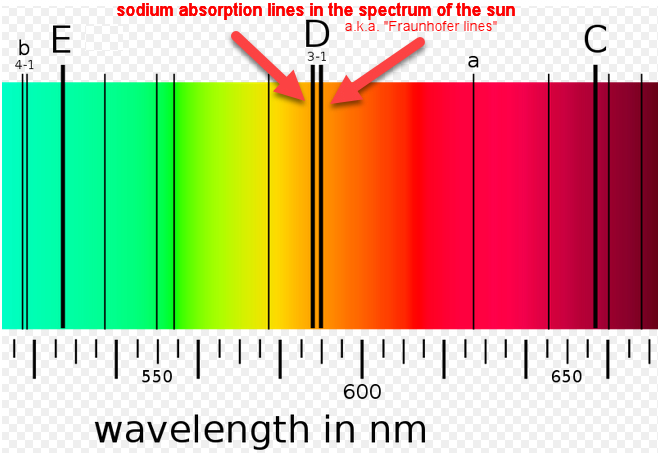
For reasons having to do with the Doppler shift of sodium absorption lines in the solar spectrum, Mercury’s tail is most luminous when the planet is ±16 days from perihelion (closest approach to the sun).

This means the tail’s maximum luminosity is only a few days away. Mercury will be 16 days past perihelion on Monday, April 17th, located in the sunset sky almost directly below Venus. If you have a sodium filter, take a look!

more images: from Nicolae-Adrian Corlaci of Bucharest, Romania; from Paul Robinson near Memphis, TN

This story was brought to you by Spaceweather.com