Philosopher Schopenhauer: Climate Science Certainty Stems from Stupidity, Ignorance

German philosopher Schopenhauer: Stupidity creates certainty while intelligence creates doubtโ€ฆWhy climate alarmists are, well, idiots.

A serious older man with white hair and a beard, wearing a black coat and holding glasses, poses against a neutral background.

From No Trick Zone

Byย P Gosselinย 

German philosopher Schopenhauer: Stupidity creates certainty while intelligence creates doubtโ€ฆWhy climate alarmists are, well, idiots.

Black and white portrait of an older man with disheveled hair and a stern expression, wearing a dark coat and white shirt collar.
German philosopher Arthur Schopenhauer

The video, Why โ€˜Idiotsโ€™ Think Theyโ€™re Intelligent โ€” Schopenhauer, reminds us a lot of all the idiots out there who are convinced of the AGW crisis and why they believe the absurdity, and lots of other nonsense.

Intelligence sees complexity

German philosopher Arthur Schopenhauer (1788โ€“1860) argued: Intelligence requires the ability to perceive complexity.

Conversely, if a person is too ignorant to see that complexity, everything appears simple and convincing, leading to a state of blissful confidence. Here we quiickly realize how this applies so perfectly to Climate Science, and many other fields.

Some examples of stupid, simplified claims:

  1. Climate Science: Climate is regulated by a single control knob, CO2! The higher the atmospheric CO2 level, the more violent our weather and climate become!
  2. COVID immunization: If you get vaccinated, you wonโ€™t get sick and spread the disease. (80% believed it and got the jab!)
  3. Public Health: Wear a mask, and the mask will catch your virus-carrying droplets and prevent others from getting infected!
  4. Biology: A fetus is just a clump of cells, the center of which is pulsing for some unimportant reason.
  5. Economics: Just print a lot of money and everyone will have enough!
  6. Nutrition: All calories are the same. And dietary fat is bad for you because it clogs your blood vessels.
  7. Neurology and Consciousness: Your brain produces your consiousness. When your body dies, you end!
  8. Economics: Permanent trade tariffs protect jobs and industries.
  9. Astronomy: The earth is flat and itโ€™s the center of the universe.

All the above are examples of extremely complex issues that get (got) grotesquely simplified to a level where the masses of idiots, media and much of academia think itโ€™s settled. For idiots, once you ignore all the complexity, it beomes simple, certain and unchallengeable.

Idiots can only comprehend simple things

And because these not-very-bright dimwits manage intellectually to finally grasp the absurd simplifications, they become convinced they know it. Just take a look at the audience of dummies watching Al Gore and his Inconvenient Truth presentation in his Oscar-winning propaganda movie. In the end, they all believed it was as simple as CO2 regulating the atmosphere.

Why are the skeptics intelligent?

Schopenhauer noted that stupidity creates certainty while intelligence creates doubt. Really iuntelligent people will always have doubt. Ask yourselves, who claims to be certain about climate science, and who sees that itโ€™s far more complex and uncertain?

If people admitted they didnโ€™t know everything about a topic, they would never have to fear admitting they were wrong later. When it comes to issues of great complexity, certainty always comes from ignorance.

INTERESTING: New Rogue Planet Discovered

The query refers to a recent astronomical discovery detailed in a scientific paper titled “A free-floating-planet microlensing event caused by a Saturn-mass object,” published in Science on January 1, 2026.

A detailed image of Saturn, showcasing its distinctive rings and surface features against a backdrop of stars.

The query refers to a recent astronomical discovery detailed in a scientific paper titled “A free-floating-planet microlensing event caused by a Saturn-mass object,” published in Science on January 1, 2026.

This event, designated as KMT-2024-BLG-0792 (from the Korea Microlensing Telescope Network) or OGLE-2024-BLG-0516 (from the Optical Gravitational Lensing Experiment), marks the first time astronomers have directly measured the mass of a free-floating (or rogue) planet using gravitational microlensing.

Gravitational microlensing occurs when a massive foreground object (like a planet or star) passes in front of a distant background star, bending and magnifying its light due to gravity, as predicted by Einstein’s general relativity.

For free-floating planetsโ€”objects not bound to any starโ€”this creates a brief, detectable brightening of the background star’s light without the influence of a host star’s glow.

A detailed image of Saturn surrounded by its rings, with a dark background filled with stars, showcasing the planet's unique colors and features.

_____________________________________________________________________________________________

Watts Up With That?

By Anthony Watts

A digital illustration depicting a free-floating planet in front of a spiral galaxy, illustrating the concept of gravitational microlensing.

From the AAS Editor: Gravitational microlensing causes the apparent brightness of a background star to vary when a foreground object passes across our line of sight. The mass and distance of the lensing object are usually degenerate parameters.

ย Dongย et al.ย have identified a microlensing event caused by a planetary-mass object with no associated host star. By combining observations from Earth and a distant spacecraft, the mass-distance degeneracy can be broken, allowing for measurement of the lensing objectโ€™s mass, which is similar to Saturnโ€™s. The researchers argue that this free-floating object did not form in isolation but was ejected from a host planetary system by dynamical interactions. โ€”Keith T. Smith


Simultaneous ground- and space-based observations of a newly discovered free-floating planet have enabled direct measurement of its mass and distance from Earth, according to a new study. The findings offer insights into the diverse and dynamic pathways by which planets can be cast adrift into interstellar space. Although studies to date have only revealed a handful of such free-floating planets, detections are expected to increase in the coming years, particularly with the NASA Nancy Grace Roman Space Telescope campaign that is scheduled for launch in 2027, notes Gavin Coleman in a related Perspective. โ€œSimultaneous space- and ground-based observations of microlensing events could be applied in the planning of future exploratory missions and could lead to a better understanding of how planets form across the Galaxy.โ€

Planets are most often found bound to one or more stars, yet a growing body of evidence shows that some wander the galaxy alone. These objects, called free-floating or rogue planets, lack any known stellar companion. And, since they donโ€™t emit very much light, they reveal themselves only through their subtle gravitational effects โ€“ a phenomenon called microlensing. One of the main limitations of this discovery method is that it cannot determine the distance to these planets, making independent measurement of their mass difficult. As a result, much about this elusive population of solitary worlds remains speculative.

Here, Subo Dong and colleagues report the discovery of a new free-floating planet detected via a fleeting microlensing event. However, unlike previous detections, Dong et al. uniquely observed this microlensing event simultaneously from both Earth and space, using several ground-based surveys alongside the Gaia space telescope. Tiny differences in the timing of the light reaching these distantly separated vantage points enabled measurement of the microlensing parallax, which, when combined with finite-source point-lens modeling, allowed the authors to determine the planetโ€™s mass and location. It is ~22% the mass of Jupiter and roughly 3,000 parsecs from the center of the Milky Way. Because this planetโ€™s mass is comparable to that of Saturn, Dong et al. argue that it likely formed within a planetary system, rather than in isolation like a small star or brown dwarf. Such low-mass rogue planets are thought to be born around stars and later expelled from their orbital confines through gravitational upheavals, such as interactions with neighboring planets or unstable stellar companions.

Journal: Science

DOI 10.1126/science.adv9266 

Itโ€™s Back: The Sodium Tail of Mercury

โ€œMercury is NOT a comet, but it sure looks like one,โ€ says Voltmer. โ€œSolar wind and micro-meteorites hitting the planet eject sodium atoms from Mercuryโ€™s surface. This creates a yellow-orange tail of sodium gas that is around 24 million kilometers long.โ€

Spaceweather.com

By DR.TONY PHILLIPS

April 12, 2023: Astronomy used to be so simple. Comets had tails, and planets did not. Mercury is making things complicated. When Dr. Sebastian Voltmer of Spicheren, France, photographed the planet this week, it exhibited a magnificent plume of gas flowing behind it:

โ€œMercury is NOT a comet, but it sure looks like one,โ€ says Voltmer. โ€œSolar wind and micro-meteorites hitting the planet eject sodium atoms from Mercuryโ€™s surface. This creates a yellow-orange tail of sodium gas that is around 24 million kilometers long.โ€

First predicted in the 1980s, Mercuryโ€™s tail was discovered in 2001. The gaseous plume is made of many elements from Mercuryโ€™s rocky surface, not only sodium. Sodium, however, dominates the scattering of sunlight and gives the tail its striking yellow hue.

People watching Mercury climb up the evening sky this month may be wondering โ€œwhy didnโ€™t I see a tail?โ€ Answer: A special filter is required. โ€œI used a 589 nanometer filter tuned to the yellow glow of sodium,โ€ says Voltmer. โ€œWithout such a filter, Mercuryโ€™s tail is almost invisible to the naked eye.โ€

Mercuryโ€™s tail waxes and wanes in brightness as it orbits the sun. The predictable pattern is shown in this movie from NASAโ€™s MESSENGER spacecraft, which spent years observing Mercuryโ€™s tail from close range:

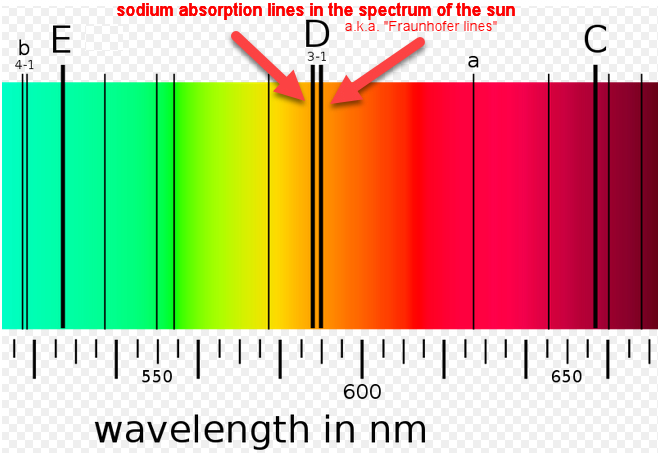
For reasons having to do with the Doppler shift of sodium absorption lines in the solar spectrum, Mercuryโ€™s tail is most luminous when the planet is ยฑ16 days from perihelion (closest approach to the sun).

This means the tailโ€™s maximum luminosity is only a few days away. Mercury will be 16 days past perihelion on Monday, April 17th, located in the sunset sky almost directly below Venus. If you have a sodium filter, take a look!

more images: from Nicolae-Adrian Corlaci of Bucharest, Romania; from Paul Robinson near Memphis, TN

This story was brought to you by Spaceweather.com