Global warming, climate change, all these things are just a dream come true for politicians. I deal with evidence and not with frightening computer models because the seeker after truth does not put his faith in any consensus. The road to the truth is long and hard, but this is the road we must follow. People who describe the unprecedented comfort and ease of modern life as a climate disaster, in my opinion have no idea what a real problem is.
In the global push for “climate action,” non-governmental organizations (NGOs) and philanthropic foundations position themselves as impartial guardians of the planet.
The result?
Policies that exacerbate energy poverty, hinder economic development, and promote anti-humanist doctrines like Net Zero, all while claiming the moral high ground.
Guest Post by Stephen Heins, originally posted at The Word Merchant.
In the global push for “climate action,” non- governmental organizations (NGOs) and philanthropic foundations position themselves as impartial guardians of the planet. Yet beneath this veneer lies a web of conflicts of interest that distorts energy policy and fuels destructive lawfare. These entities, often funded by billionaires, dark money networks, and even foreign governments, prioritize ideological agendas over human well-being.
The result? Policies that exacerbate energy poverty, hinder economic development, and promote anti-humanist doctrines like Net Zero, all while claiming the moral high ground.
The Machinery of Climate Lawfare
Consider the Rockefeller family’s long-standing involvement. For over a decade, Rockefeller-funded groups have spearheaded legal crusades against fossil fuel companies, launching subpoenas and lawsuits aimed at crippling the industry. This “climate lawfare”—using courts to enforce environmental policies—isn’t just activism; it’s a strategic assault on reliable energy sources.
In the U.S., state attorneys general and NGOs have pursued cases against oil giants, often backed by millions from anonymous donors and left-wing foundations like the Tides Foundation and George Soros-linked groups. Firms like Sher Edling have raked in tens of millions from such dark-money sources, orchestrating multi-state tort claims that impose immense financial burdens on traditional energy producers. Meanwhile, these same legal networks have expanded their scope to include broader product liability and chemical litigation, prioritizing systemic disruption over practical engineering solutions.
These conflicts extend globally. The European Climate Foundation (ECF) continues to funnel vast, anonymous donations to lobbying outfits and legal activist groups like ClientEarth, which challenge traditional energy and infrastructure projects under the guise of climate justice.
Simultaneously, ties to foreign influence and geopolitical maneuvering have repeatedly surfaced in Western anti-energy campaigns. Groups frequently evade stringent transparency requirements while pushing policies that undermine domestic energy independence. This isn’t environmentalism; it’s economic self-sabotage disguised as philanthropy.
Skewing Science and Suppressing Realities
The problems multiply when these NGOs influence energy policy. By shaming governments and funding alarmist research, they skew public discourse toward renewables at any cost. Studies examining institutional climate funding show how heavily financed NGO research overwhelmingly promotes catastrophic narratives while ignoring disclosure requirements and economic trade-offs. This bias correlates directly with advocacy ties, turning objective science into political activism.
Trustees at major conservation NGOs are routinely linked to elite financial institutions, from investment bank executives to billionaire spouses, seamlessly blending profit motives with green rhetoric.
At its core, this agenda embodies anti-humanism on a global scale. Climate alarmism and rigid Net Zero targets demand sacrifices that disproportionately burden the developing world. In Africa, where hundreds of millions still lack reliable electricity, NGOs routinely block fossil fuel and nuclear projects through legal pressure, treating the continent like a perpetual ward.
Women suffer most: indoor air pollution from biomass cooking kills millions annually, and without grid power, they endure grueling labor for basic survival needs. Yet, major philanthropic organizations continue to pour millions into anti-fossil campaigns, entirely ignoring these human tolls.
The Renewable Hypocrisy and Energy Sanity
Renewables exemplify the systemic hypocrisy. Touted as saviors, they rely on massive government subsidies to compete, yet their inherent intermittency demands backups from fossil fuels or nuclear power—which NGOs routinely oppose due to “climate arrogance.” Until wind and solar stand entirely on their own, unsubsidized and profitable, they are no panacea. Groups backed by tax-subsidized “charities” divide societies and stifle development. This isn’t cooperation; it’s exclusionary zealotry that prolongs energy poverty.
Actual progress demands energy humanism: a “Best of the Above” approach embracing all energy sources to end poverty. Advanced nuclear energy, including small modular reactors (SMRs), offers abundant, reliable power for modern demands—including the massive electrical loads required by AI data centers—without the pitfalls of weather-dependent renewables.
Principles of energy sanity—abundance, reliability, infrastructure expansion, economic growth, human health, and sound capital formation—must guide policy. Profits and managed debt, not endless mandates and subsidies, build sustainable futures.
The enormous problems we face stem from unaccountable power. Lawfare drains vital resources, threatening national security by weakening domestic production. To fix this, we must demand absolute transparency: complete donor disclosures and strict conflict-of-interest policies that go far beyond token gestures. We must end tax breaks for political advocacy disguised as charity.
We must prioritize human flourishing over alarmist dogma. Only then can we harness energy for all, not just the elite-funded few.
After the Paris Climate Agreement was signed in 2015, the World Bank declared a perilous “new course,” vowing to lead the way on green financing.
Today, it funnels 44% of its funds — $42.6 billion annually — into climate projects, siphoning resources from the world’s most desperate needs.
As its largest shareholder, the United States cannot continue to ignore this climate fixation.
At Monday’s World Bank Annual Meeting, Treasury Secretary Scott Bessent must demand that it explicitly scrap its wasteful climate targets — and redirect its attention to its true objective.
But as the climate-change narrative took hold, poverty was implausibly linked to 100-year temperature changes.
The World Bank, misrepresenting one of its own thoughtful reports, claimed in 2015 that without climate action more than 100 million additional people might be poor in 2030.
Ironically, that report found that a renewed focus on prosperity could lift almost a billion people out of poverty, but climate action would have virtually no impact by 2030.
As well-meaning as this may be, it is dangerous sophistry.
Tackling poverty through nutrition, health and education can quickly help hundreds of millions of people live better lives at low cost.
Tackling poverty through climate action will do next to nothing — yet climate policy costs easily run into the trillions, while harming the world’s poor by driving up costs of fertilizer and energy.
Rigorous research shows that dollar for dollar, core development investments — like improving maternal health, advancing e-learning or enhancing agricultural yields — deliver much greater and faster benefits than climate spending.
The World Bank’s own client surveys show people in poorer nations rank climate change near the bottom of their concerns.
Raiding development funds for climate initiatives isn’t just misguided but an affront to human suffering.
Developing nations today need cheap, reliable power to industrialize, create jobs and thrive — just as rich countries did a century ago, and China did over recent decades.
Most of Africa remains quite poor with little access to energy beyond wood and hydro power. The average poor African uses as much fossil fuel in a year as an American uses in less than 9 days.
The World Bank aims to connect 300 million more Africans to electricity by 2030 through its Mission 300 initiative — a worthy goal that’s being sabotaged by its fixation on renewables.
The bank’s energy access plans signed with 29 countries are “prioritizing” solar and wind, while tiptoeing around fossil fuels.
What’s more the Rockefeller Foundation, the bank’s Mission 300 partner, touts renewables as the “most cost-effective and rapid route to prosperity.”
This is fantasy: While solar and wind can be cheaper than fossil fuels when the sun is shining and the wind blowing, it is infinitely costly when there’s no sun and wind.
Reliable power requires extensive backup that drives costs up significantly.
That’s why rich countries, despite their green rhetoric, still get more than three-quarters of their energy from fossil fuels.
While African leaders will politely speak green to Rockefeller Foundation and the World Bank, their actions speak more loudly.
Last year, Africa added five kilowatt-hours of electricity for each person from solar and wind — but added almost five times more from fossil fuels, because they’re cheaper and more reliable.
Across all energy use (not just electricity), Africa increased its solar and wind consumption a bit, but increased its fossil fuel consumption 22 times more.
He is right to push reforms, including a tech-neutral energy policy that prioritizes affordability.
But the United States should go further and demonstrate bold leadership by insisting that the World Bank scrap its ring-fenced funds for climate.
Scarce funds should go toward tackling poverty head-on, not to trendy green goals.
Climate change demands action, but not at poverty’s expense.
Rich governments should invest in long-overdue R&D for breakthrough green technologies — affordable, reliable alternatives that everyone, rich and poor, will adopt.
The World Bank’s decade-long detour into climate activism is not saving the planet.
Instead, it’s abandoning the poor — and has influenced other development organizations to do the same.
It is high time for this giant to be pushed back on course.
Bjorn Lomborg is president of the Copenhagen Consensus, visiting fellow at Stanford University’s Hoover Institution, and author of “False Alarm” and “Best Things First.”
Over the last 2 decades, Germany has been at the centre of climate change activism and government policies like Energiewende that have had downside financial implications that might imply that the German philosophy had got it wrong.
Corruption has been in the news more and more in recent years.
Corruption is in politics, corruption is in medicine, corruption is in finances. corruption seems to be growing fast, but it is hard to measure and define it because many people consider it a bad thing that polite people should mention. So, let us have a look.
Here is one general definition of corruption:
“Corruption is the act and effect of giving or receiving something of value so that someone will either do or not do something, sidestepping a formal or implicit rule about what that person should do, to the benefit of the person giving the object of value or of a third party”.
“The popular narrative about climate change reflects a dangerous corruption of science that threatens the world’s economy and the well-being of billions of people. Misguided climate science has metastasized into massive shock-journalistic pseudoscience. In turn, the pseudoscience has become a scapegoat for a wide variety of other unrelated ills.”
‘In American laboratories and universities, the spirit of Trofim Lysenko has suddenly been woke.’
Source (3). July 12, 2020. Lawrence Krauss, Scientist and writer, in the Wall Street Journal.
‘When good science is suppressed by the medical-political complex, people die. Politicians and governments are suppressing science. They do so in the public interest, they say … the greatest deceptions are founded in a grain of truth. But the underlying behaviour is troubling”.
Source (4). November 13, 2020. An Editorial in the British Medical Journal discussed ‘Covid-19: politicisation, “corruption,” and suppression of science’.
“ … the very colleagues who propelled too high, too fast. In the article he comes across as somewhat non-plussed as though worrying about the quality of your data is not what stars do”.
Source (5). February 7, 2020. The corruption of scientists by fame and money. In Clothing the Emperor forum.
Overall, the scientists I have met do not like corruption, but few have done much to combat it.
Scientists like science free of corruption because corruption hinders advancements that help society as well as themselves. Some of these advancements involve new concepts, like the discovery of the chemical polymerase chain reaction PCR by Kary Mullis (6). Other advances can replace conventional wisdom in one stroke, like the discovery by Marshall and Warren that ulcers (7) are caused by bacteria, not by stress, so are treatable with antibiotics. Corruption of science slows such magnificent advances.
The LNT model and the Rockefeller Foundation.
There is a US corruption example (8) now becoming more public following decades of investigation by Professor Edward Calabrese (9) a toxicologist from Amherst University, Mass. This corruption started maybe around the 1950s. It is still with us. It has cost the world billions, maybe trillions of dollars by now.
This particular corruption starts with what seems a mild topic, the relation of the dose of a toxin to its harm. Continuing corruption has kept some questionable science in approved use, while alternative scientific studies have been suppressed by deliberate actions. (10).
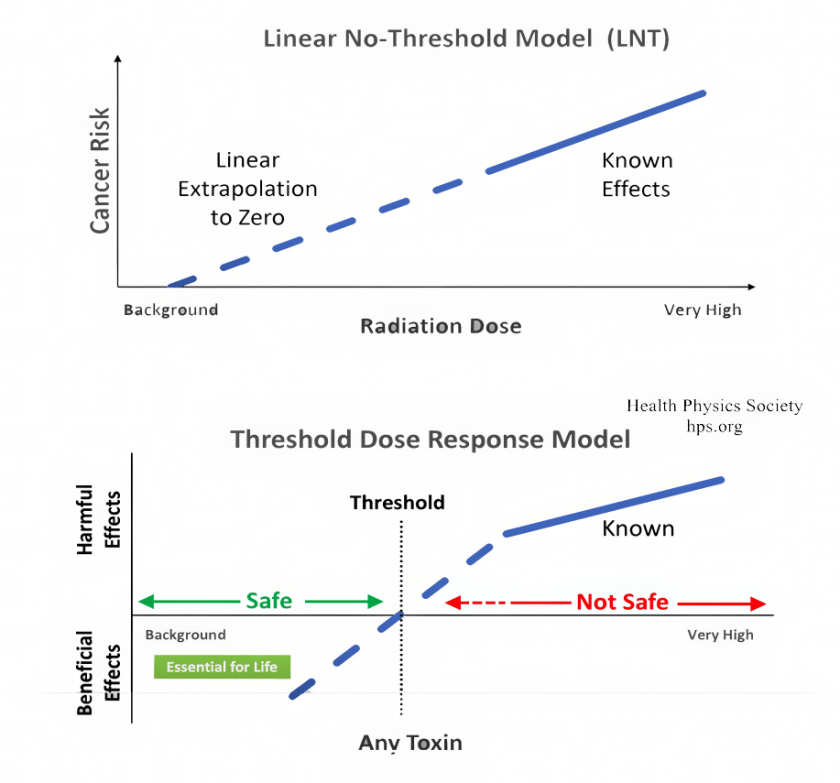
The example is about the questionable LNT model, for Linear No Threshold. It implies that there is no lower limit to a toxin dose because harm can be caused by all doses down to “zero” dose, whatever that is.
The alternative Threshold Dose Response models TDR allow for have a lower dose threshold beyond which no harm can be shown. TDR came first in time history. It was replaced by corrupt actions in the 1950s Cold War era.
These dose/harm models are important in science. There was a burst of study after WWII because more people might be exposed to nuclear bomb test radiation. Continued use of the questionable LNT model has affected peaceful uses of nuclear radiation such as electricity generation and how often a person has medical X-ray scans.
The LNT model is applied in many every-day matters. For pharmaceuticals, it is of fundamental importance to the safety of design of medical drugs. For environment protection, the LNT model has allowed regulatory bodies like the US Environmental Protection Agency EPA to exert control over many diverse products and methods. Dose/harm relations are involved with every new product on offer when we spontaneously ask “Is it safe?”
In this LNT case, the corruption began with a display of power and wealth at US Presidential level. This was done by the Rockefeller Foundation, here “The RF”.
Cut to the chase, in the 1950s The RF stacked the deck with its own people and money to get authorization from President Eisenhower for government-approved research into harm from nuclear radiation doses.
Here is a time series of some main events: Apart from Eisenhower, all people were linked to The RF
1949. Edward B Lewis, biologist, became a Fellow of The RF.
1950. Detlev Bronk from The RF was appointed President of US National Academy of Sciences, NAS.
1950. Dean Rusk became a trustee of The RF.
1951. Detlev Bronk joined Board of the Rockefeller Brothers Fund.
1952. Dean Rusk became President of The RF.
1953. Detlev Bronk became President of the Rockefeller University.
1953. The RF Board discussed the strategy of study of nuclear radiation doses on humans.
1954. Warren Weaver became Vice President for Natural and Medical Sciences of The RF.
1955. Detlev Bronk became President of National Academy of Sciences.
1955. Dean Rusk, The RF President, wrote to US President Eisenhower, to authorise the National Academy of Sciences to conduct The RF research proposal. (Link to letter below).
1955. US President authorised National Academy of Sciences to be involved, as requested.
1955. Creation of the main NAS Committee on Biological Effects of Ionizing Radiation, BEAR.
1955. Warren Weaver, The RF President for natural and Medical Sciences, appointed to head the BEAR Genetics Committee.
1955. BEAR program appointed six committees: genetics, pathology, meteorology, oceanography and fisheries, agriculture and food supplies, and disposal and dispersal of radioactive wastes.
1955. The BEAR Genetics committee was instructed by geneticist Tracy Sonneborn (earlier grantee of The RF) to dismiss alternatives to the preferred new LNT model.
1956. First BEAR report.
1956. The NAS arranged for Scientific American staff to write the Genetics Panel Public Report under Weaver’s guidance.
1957. E B Lewis (Fellow of The RF, 1949) published an influential paper in Science “Leukemia and Ionizing Radiation” describing harm from low doses, supporting LNT.
1960. Second BEAR report.
1961 Dean Rusk left The RF to be US Secretary of State under President Kennedy.
By these actions, The RF used power and money to capture the essence of the management of nuclear radiation risk, which is now excessive and costly. Power and money have been used to entrench the LNT model ever since. Its central role in regulation of industries and people has grown.
Incidentally, it is plausible that Australia’s post-1950s history of no nuclear electricity generation by law, is related to the LNT fearmongering by The RF and others. Elsewhere, the cost to build new nuclear power plants globally is now near an order of magnitude greater than the real cost.
The central importance of LNT is the enablement of regulators to intervene in every activity of people and industries that involves harm of one type or another.
This 2018 paper (14) by Cardarelli & Ulsh amplifies the theme. LNT has transformed from a scientific model to a tool of regulation. Proof of this comes from observing that those who promote LNT today are mostly in regulatory positions, while those objecting to LNT are mostly from industries with hands-on experience.
This split between researchers is also evident in publications about the reality and benefits of hormesis, a process described in many publications by Dr Calabrese.
The Rockefeller Foundation, “The RF” and Woke.
The RF began by philanthropic grants of money to advance science, especially in medicine. Its first big, successful project helped to eradicate the Hook Worm as a threat to human health and longevity. Today, scientific support by The RF seems to have metamorphosed like a beautiful butterfly turning into a caterpillar. The RF is now selling its soul to regulators as seen, for example, this extract supporting guesswork by EPA. (15).
“Nevertheless, unless compelling evidence for a practical threshold can be obtained, it must be acknowledged that there is likely to be a risk even at the lowest doses of ionizing radiation. Denials only fuel distrust. It is better to acknowledge that the science, so far, is consistent with a non-zero risk at low doses, even if direct verification is lacking”.
“We cannot escape the obligation, in this scientific age, to comprehend science; but in the supreme question which faces our generation, physics and chemistry and engineering have no answers for us.”
Today, The RF is not merely leading the woke inventory. It is a creator of woke ideas. Few people have yet studied and reported upon the woke movement – it is one that is savage in casting out those who criticise it. My personal preference for dealing with woke (17) aligns with descriptions in this March 2023 video by James Lindsay.
”Woke is supposed to advance equity … The definition of equity comes from the public administration literature – “an administered political economy in which shares are adjusted so that citizens are made equal”. They’re going to redistribute social and cultural capital in addition to economic and material capital. Woke is Maoism with American characteristics. Woke is Marxism.”
Recall that The RF started out in 1913 as a philanthropy to disburse money accumulated by John D Rockefeller (Snr.) from his business with Standard Oil and others. For a while, it stuck to its knitting as its Charter required. Today, much of its philanthropic funds is from investments in businesses. At the start, it did not pay income tax because there was no such tax. Today, it has tax benefits that to some might seem inconsistent with philanthropy. It is plausibly a scavenger of new ways to treat or to control Society. Some of the causes it is now funding are not in need of philanthropy. For example, it gives grants that promote the idea of climate change, which some regard as replete with corrupt science.
.“New York | June 20, 2023 ― Ahead of the New Financial Pact Summit, chaired by Emmanuel Macron, President of the French Republic, and Narendra Modi, Prime Minister of India, the Bill & Melinda Gates Foundation, Open Society Foundations, and The Rockefeller Foundation announced USD 2,781,783 in funding from the $5.25 million Multilateral Development Banks Challenge Fund (“the Fund”): Albert Ludwig University of Freiburg, Caribbean Development Bank, FSD Africa, IDB Invest, Risk Control Limited, and University of Leeds. The six grantees, which were selected to help increase efficiency and innovation in the world’s development finance system, advance the Fund’s overarching goal of accelerating investment for the United Nations’ Sustainable Development Goals (SDGs) and Paris Climate Agreement”.
“The following is a statement by funders and philanthropic organizations in response to the U.S. Supreme Court’s rulings in Students for Fair Admissions v. University of North Carolina and Students for Fair Admissions v. President and Fellows of Harvard College.
“A full list of signatories follows. The Supreme Court’s decision impedes colleges and universities from selecting their own student bodies and fully addressing systemic racial inequalities that persist. The ruling threatens to return this nation to a time when education and opportunity were reserved for a privileged class. It endangers sixty years of multiracial movements to challenge our nation to live up to the ideals enshrined in our founding documents. The decision erects new barriers to building a society in which everyone has the opportunity to improve their lives, communities, health, and education”.
One might ask if The Rockefeller Foundation, once a friend of science, society and industry, is now a powerful enemy.
Remediation.
(These remediations are purposely written in loose science language so that more people can understand.)
Suggestion 1.
For remediation, the regulatory industry should abandon unsupported loose science in favour of hard science.
Science is diverging into traditional “hard” science and newer “loose” science. Hard science is validated by measures to estimate, to display and to minimise uncertainty. Loose science tends to be silent about or pay lip service to uncertainty; belief tends to dominate over observation and measurement.
In financial circles, auditors used to be proud, even required, to account for the very last cent. Today, many people care little if a figure is in millions or billions of dollars. Despite the 3 orders of magnitude between them they are just large numbers that numb the mind.
The split between hard and loose science started in my lifetime. Nuclear radiation harm was a topic that I studied from 1972 at age 29 after we discovered the Ranger uranium deposits, for a while the largest and richest the world had known.
Suggestion 2.
Scientific publications should advise authors that their place of employment should not impact on their pre-publication scientific studies.
Hard science authors are now mainly from industry and research bodies within and close to industry. Loose science is more associated with those who regulate science. Many of the regulatory science authors are now expressing desperation, cutting corners in the “publish or perish” academic atmosphere, desperate for salary to fund the next sex-change operation on their children in accord with ideals of woke about what a modern parent should do.
Suggestion 3.
Try to advance science with impartial methods.
Traditional science has advanced through better science replacing poorer science. Objection to existing science is integral to the scientific advance. But, there has been an increase in the rate of disappearance of papers ready for publication and in the cancellation of papers already accepted. An example of such rejection happened recently when a medical science pre-print paper by Hulscher et al about autopsy results from Covid-19 vaccinated people was visible in The Lancet for only a few hours. (20).
Suggestion 4.
Scientific authors should learn more about the science of measurement uncertainty.
Proper estimates of the uncertainty of numbers used in publications is essential for their integrity. While some papers show excellent understanding of uncertainty, others publish works with naïve estimates that can mislead. The quality of treatment of uncertainty is a measure of the quality of the research. There are many examples from climate change science, where past temperature measurements are reported badly. An article that I wrote for Watt’s Up With That blog a year ago expresses some measurement uncertainty problems. (21).
Suggestion 5.
Be aware that the use of power and money continues to corrupt science; try to speak against this privilege.
Suggestion 6.
Study the actions of “philanthropic” bodies to discern if they are any different to a commercial organization that might not enjoy taxation advantages.
Bodies such as The RF, the United nations UN, the World Health Organization WHO, The Bill & Melinda Gates Foundation, to name just a few, comprise unelected people who at times are working against the directions of Governments and people. A recent example from medical sciences is explained in this video by a British MP in the House of Commons, Andrew Bridgen with Dr John Campbell about the WHO. (22).
Suggestion 7.
Smaller publishing companies from many countries could be more aggressive in earning market share for scientific publication.
Scientific journal ownership is complicated and under frequent change. Several of the major scientific publications like “Nature” and “Scientific American” are/were owned partly or mostly by German companies. (23).The leading journal “Science” is owned by the American Association for the Advancement of Science, AAAS. Over the last 2 decades, Germany has been at the centre of climate change activism and government policies like Energiewende that have had downside financial implications that might imply that the German philosophy had got it wrong. Scientific publications, if indeed affected this way, could improve with wider national diversity of ownership and direction. From Wikipedia:
“In 2013, prior to the merger with Springer and the creation of Springer Nature, Nature Publishing Group’s owner, Holtzbrinck Publishing Group, bought a controlling stake[3][4] in Frontiers.[5] Before Springer Nature was formed in 2015, Nature Research (as the Nature Publishing Group) was a part of Macmillan Science and Education, a fully owned subsidiary of Holtzbrinck Publishing Group.[6]”
Much of the quoted material in this article is Copyright 2003 by The RF. The author of this article has reproduced material under the US fair use doctrine, summarised as: Under the fair use doctrine of the U.S. copyright statute, it is permissible to use limited portions of a work including quotes, for purposes such as commentary, criticism, news reporting, and scholarly reports.


You must be logged in to post a comment.