Global warming, climate change, all these things are just a dream come true for politicians. I deal with evidence and not with frightening computer models because the seeker after truth does not put his faith in any consensus. The road to the truth is long and hard, but this is the road we must follow. People who describe the unprecedented comfort and ease of modern life as a climate disaster, in my opinion have no idea what a real problem is.
From streaming platform for half-baked reality dating shows to normalizing electric vehicles. When Netflix engages in shameless product placement, you can be sure it will at least be extra woke.
From streaming platform for half-baked reality dating shows to normalizing electric vehicles. When Netflix engages in shameless product placement, you can be sure it will at least be extra woke.
The left-wing steamer has entered a deal to feature General Motors’ electric vehicles in its original movies and TV series, providing the company with a new revenue stream while also burnishing its questionable credentials as a corporate climate crusader.
The campaign is also intended to serve as what one GM executive called a “blueprint” for Hollywood’s big push to normalize electric vehicles in the minds of consumers and to “accelerate the transition” away from gas-powered cars.
Netflix’s deal with GM will officially launch during the Super Bowl on February 12 with a commercial starring Will Ferrell who will reportedly drive a host of different GM electric vehicles through various Netflix shows, including Bridgerton, Squid Game, and Army of the Dead.
The streamer will place GM vehicles in its reality shows Love Is Blind and Queer Eye, as well as scripted shows, like the upcoming Rob Lowe comedy Unstable, according to a report from The Hollywood Reporter.
GM’s chief marketing officer Deborah Wahl said the goal is to normalize electric vehicles in an effort to “accelerate the transition” away from gas-powered vehicles.
“I think you can see with this we’re working together to create a blueprint for the whole entertainment industry in how to think about normalizing EVs and showcasing this all-electric future, because we all know it’s good for all of us if we accelerate that transition,” she told the trade magazine.
Electric vehicles have come under criticism for their dubious environmental qualities — mainly for relying on fossil fuel power grids for charging.
As Breitbart News noted, the left’s push for electric vehicles comes at a time of soaring electricity prices for households, making it more expensive to drive the average electric vehicle 100 miles than a gas-powered car for the same distance.
A recent story on NPR’s Morning Edition, titled “Climate change and a population boom could dry up the Great Salt Lake in 5 years,” bemoaned recent historically low levels of the Great Salt Lake (GSL), tying the lake’s decline to two factors: climate change and population growth. The writer, Kirk Siegler, was only half-right. Population growth is arguably the prime factor leading to the GSL’s decline. The recent drought is likely another factor in this year’s low levels, however, because the current drought is not historically unusual, and is not part of a long-term trend of increasing drought frequency or intensity, climate change cannot be blamed for the GSL’s recent decline.
Maybe one small bright spot in an otherwise grim story of a looming ecological disaster. The lake doesn’t really stink anymore because it’s drying … and dying.
Scientists point to climate change and rapid population growth — Utah is one of the fastest growing states and also one of the driest — as the culprits. A recent scientific report from Brigham Young University warned that if no action is taken, the Great Salt Lake could go completely dry in five years.
Over two decades of the western megadrought, water diversions from rivers that feed the lake have increased in order to support farms and thirsty, growing cities.
Without action to reduce water diversions and withdrawals from the rivers and streams feeding the GSL, it may, in fact, disappear. Salt Lake City, the surrounding cities and mountain states in the region, are among the fastest growing in the nation. This has increased the demands for water from the rivers and streams feeding the GSL. However, contrary to Siegler’s claims, neither Utah, nor the region is in the midst of a long-term megadrought.
Utah is a relatively arid state, receiving just 13.56 inches of precipitation on average annually, much of it delivered in the form of snow. Utah has received below average rainfall for the past couple of years, although with recent winter storms, the drought has lessened modestly. However, data from the U.S. Drought Monitor show the state received well above average precipitation as recently as 2019, with 99.7 percent of Utah being drought free in July 2019, and only 0.3 percent listed as being abnormally dry. Utah also received well above average precipitation in 2016 and 2015.
Indeed, records from the National Oceanic and Atmospheric Administration show that contrary to Utah being in a midst of a two-decade long megadrought; since 2000 Utah has experienced two years of approximately average rainfall, eight years of above average rainfall, and ten years of below average rainfall, meaning there is no evidence of a two decade long drought. In point of fact, Utah’s recent precipitation history resembles the state’s precipitation history since official record keeping began in 1895. (See the figure below)
This graph shows Utah precipitation levels from 1895 through 2020. The graph shows the many extremes in state levels every year. (Photo: NOAA National Centers for Environmental information)
As discussed in a prior Climate Realism, “No, Climate Change Isn’t Behind Great Salt Lake Decline,” because the GSL is a relatively shallow lake, modest declines in elevation or lake levels can amount to huge declines in area covered by water. During the present drought, the GSL did set a new record for low levels of 4190.2 feet in elevation in October 2021. However, that was only a foot lower than the prior record of 4,191.35 feet set in 1963. Tellingly, the previous record low elevation was set during a period when the earth was in the midst of a cooling trend and many scientists were warming of a pending ice age. It should also be noted that Utah’s precipitation in 1963, although slightly below average, was still more than 4 inches greater than Utah received in 2020.
Droughts come and go in Utah as they have throughout history and the data provides no support for the claim that climate change has made them more severe or frequent in the region. Indeed, as explained in Climate at a Glance: Drought, the current drought is a weather phenomenon of very recent vintage; not an indicator of long-term climate change. The U.N. IPCC reports with “high confidence” that precipitation has increased over mid-latitude land areas of the Northern Hemisphere (including the United States) during the past 70 years. Also, the National Oceanic and Atmospheric Administration reports the United States recently underwent its longest period in recorded history with fewer than 40 percent of the country experiencing “very dry” conditions. The United States recorded its lowest percentage of land area experiencing drought in recorded history in 2017 and 2019.
Since the GSL has undoubtedly declined, and climate change isn’t a factor, what is? This is where NPR got the story right. Utah is one of the fastest growing states in the United States and it has been so for some time. When the previous low elevation record for the GSL was set in 1963, Salt Lake City had a population of approximately 387,000 people and was growing at an estimated rate of 3.2 percent annually. Today, although the city’s annual population growth has slowed, at 0.92 percent annually, it is still increasing faster than most other cities across the country. The most recent estimate of Salt Lake City’s population is 1,203,000. In other words, Salt Lake City’s population increased by approximately 211 percent, between the GSL’s previous record low and the most recent record being set.
The record is clear; rainfall patterns in Utah haven’t changed. Yes, the state is currently experiencing a severe drought, but it is a recent phenomenon, not part of a long-term trend. What has changed for the GSL, the primary cause of the present conditions there, is the huge increase in water users. There have been huge increases in demand for water for the millions of urban and agricultural users added to Salt Lake City and the surrounding area. The growing populace is drawing from the streams and rivers which historically have fed and replenished the GSL. Water volumes and flows have decreased in those rivers and streams not because weather patterns have, they haven’t, but rather because of increased users.
Will the GSL survive another five years or more? If rain and snowfall increases it should, for a while, but if population continues growing and ways of managing water use to keep or return more water to the rivers are not discovered and implemented, then the GSL’s days as “Great” may be numbered regardless of climate change.
H. Sterling Burnett, Ph.D., is the Director of the Arthur B. Robinson Center on Climate and Environmental Policy and the managing editor of Environment & Climate News.
In addition to directing The Heartland Institute’s Arthur B. Robinson Center on Climate and Environmental Policy, Burett puts Environment & Climate News together, is the editor of Heartland’s Climate Change Weekly email, and the host of the Environment & Climate News Podcast.
This reprise has been prompted by a conversation with a colleague who’s only understanding of Climate Change or Global Warming has been gleaned from NPR/CNN/PBS and Main Stream Media.
NOTE: I wrote this original two-part series nearly five years ago now.
This reprise has been prompted by a conversation with a colleague who’s only understanding of Climate Change or Global Warming has been gleaned from NPR/CNN/PBS and Main Stream Media.
I thought to update this essay to see if I would have the same opinions today as I did five years ago. Updated text will be in this lighter blue color. Changed or added images will be clearly labelled.
I have often been asked “Why do you deny climate change?”
I am always stumped by the question. It is rather like being asked “Why do you torture innocent animals?”
The questioner is not merely asking for information, they are always making an accusation — an accusation that they consider very serious and a threat to themselves and others.
The reason it stumps me is that, as you have guessed already, I do not deny climate change (and I do not torture innocent animals — nor even guilty ones). And there is nothing about me or my behavior, present or past, that I am aware of, that would lead any reasonable person to think such a thing of me.
I am thoroughly guilty though of being very skeptical of what is generally referred to as the Climate Consensus — usually said to be represented by the latest reports and policy recommendations put out by the Intergovernmental Panel on Climate Change (IPCC) and its supporters; political, ideological and scientific. I suppose it is this that leads to the false accusation of “denying climate change”.
Note: My colleague had been indoctrinated to believe that the two sides of the issue consisted of only two positions: The IPCC Consensus team opposing those who think Global Warming is a hoax.
And there is the crux of the matter — it is something in the mind of the accuser, not any action of the accused, which leads to the false accusation.
MY DENIAL:
I deny that I am a Climate Denier, a Global Warming denier or any other kind of a “denialist”. And I do not think that Global Warming is a hoax.
WHY I DON’T DENY:
I do not deny either of the two primary claims of the Global Warming Movement:
1. Global Warming is happening
2. Human activity causes [some of] it.
Here’s why I don’t deny #1: Global Warming is happening.
There is no need to update this section very much as it is long-term historical data – though at end of section I will put in a current Global Temperature graphic for completeness.
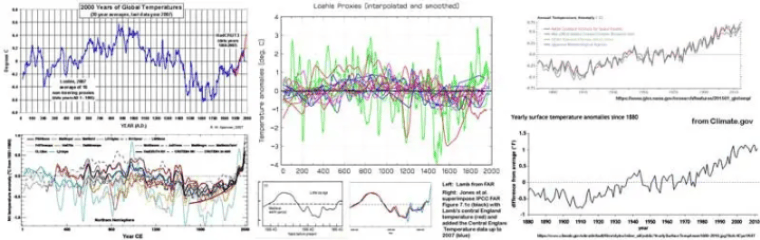
I am perfectly happy to accept that the “world” (the “global climate”) has warmed since the late 1800s. We know that the date of 1880/1890 is picked for the starting point of most of the contemporary consensus view plots — purportedly because it represents “the start of the modern industrial era”, this despite the fact that even the IPCC does not claim that “CO2 induced global warming” started at that date. Let’s take a closer look at Lamb and ”Lamb_modified_by_Jones”:
Note: This image cleaned up a bit. CET is Central England Temperature, which is used because the record is actual measurements continuous since mid-17th century.
We know that Lamb was showing a stylized “schematic” view of Central England temperatures — and Jones 2007 re-does the analysis with very slightly different results, then overlays (in blue) the measured Central England through 2007. This graph contains the seed of my certainty that “global warming is happening” — which, in un- politicized language would be something like: “The Earth’s general climate has warmed since a bit before 1700 CE — i.e., for the last 300+ years.” Here’s Spencer 2007:
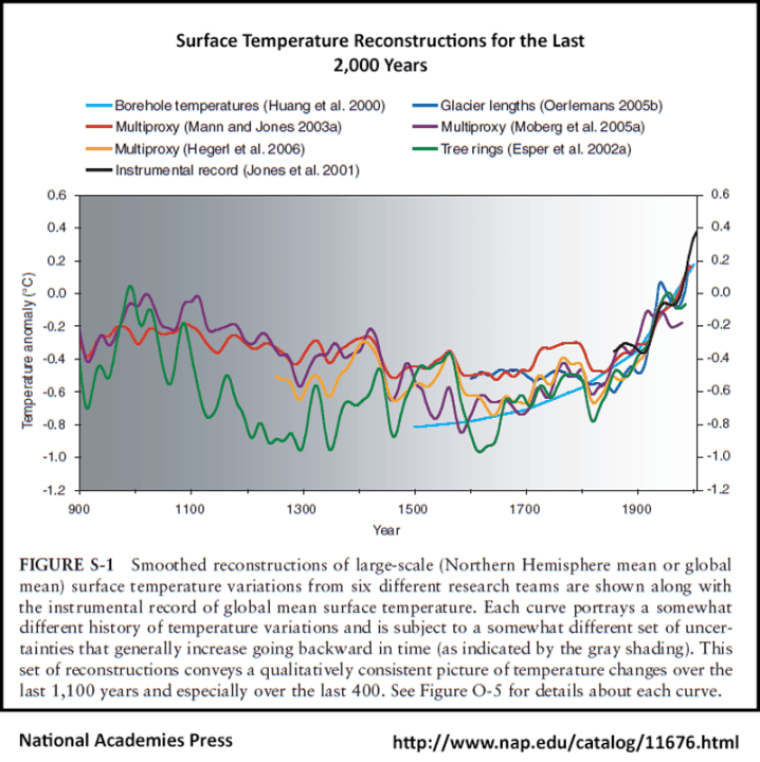
And if you prefer, here’s the NOAA version with comparisons of various reconstructions :
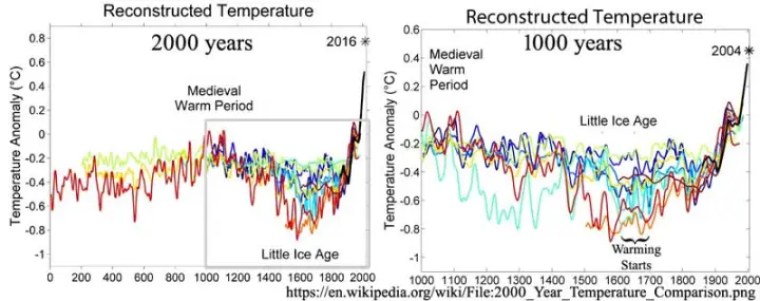
They all show cooling to approximately 1650 – 1700 and general warming since then.
From where does my skepticism arise then?
Well, there is no more — general warming started about 1650-1700, maybe a little earlier, and has been ongoing.
When warming doesn’t start is 1880/1890 — it starts one hundred and fifty to two hundred years earlier — earlier than the start of the increased CO2 output of the modern Industrial Revolution.
This makes me very skeptical indeed of the claim that the industrial revolution and modern warming are intrinsically entwined.
And I think that it is a good thing that it has warmed since 1700. The Little Ice Age years, up thru the 16 and 17 hundreds, were hard times for farmers (and thus whole populations) in North America and Europe, as attested to by contemporary accounts of crop failures and hard winters.
To my knowledge, this point is not controversial or even contested. In the Consensus Worldview, it is simply over-looked and not mentioned. Truthfully, since the facts don’t match the narrative — the narrative that global warming was caused by the start of the Industrial Revolution and its subsequent CO2 emissions — this fact seems to have been down-played or ignored.
Most current temperature graphics:
The above is Global Temperature Anomalies since 1880, with the vertical scale set to a spread of 5°C – the range recommended by U.S. OSHA for office temperature comfort.
What does the IPCC say?“Warming of the climate system is unequivocal.” — IPCC AR5 SPM 1.1
Well, I couldn’t agree more — moreover, it has been warming since about 1650-1700, two hundred years before the Industrial Revolution starts pouring out CO2.
What else does the IPCC say? “ … recent anthropogenic emissions of green-house gases are the highest in history.” — IPCC AR5 SPM 1
Again, I don’t disagree:
Without arguing about when “history” began, and looking at atmospheric CO2 concentrations rather than emissions, we can stipulate that the graph the European Geophysical Union gives us is an “accurate enough” picture of CO2 concentrations over the last thousand years.
CO2 remains a shaky 275-290 ppm for 800 years and then begins to show a rise around 1850, finally breaking into new territory circa 1880-1890 — the start of the modern Industrial Era.
The Wiki offers us the following, again confirming that CO2 does not begin to rise until 1890-1900, long after temperatures begin to rise.
It is simply a fact that atmospheric CO2 concentration has been rising since 1880-1890-1900 (close enough for my purpose today) and that it is now higher than it has been in a long time.
Atmospheric CO2 has been rising — but is there doubt about this? — “ … recent anthropogenic emissions of green-house gases are the highest in history.” ?
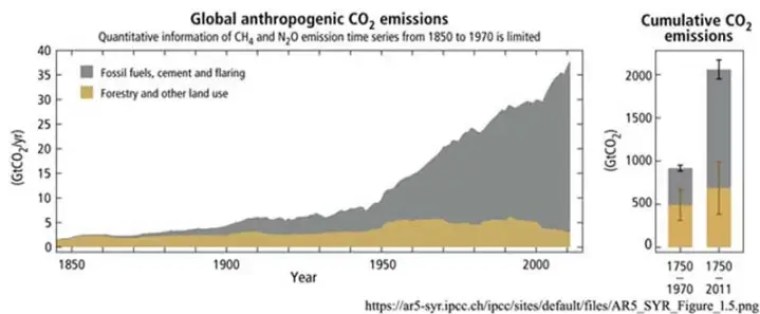
While it is not easy to measure atmospheric CO2 concentrations, it has been being done for quite some time….and we have been able to guess about human greenhouse-gas emissions and their sources. [These are naturally abject guesses, but we needn’t argue with them on that account — they are our “best guesses”).
We see that recent emissions are highest, at least in this history, but notice that cumulatively up to 1970 (see the right hand inset bar graph), Forestry and other land use accounts for more than 50% of all CO2 emissions.
This surprised even me — I was expecting a pretty big contribution from the clear-cutting and conversion into pasture and farmland of much of Europe and North America east of the Mississippi River — but I had no idea that Forestry and Land Use accounts for >50% all the way to 1970 –and that’s nineteen seventy, not eighteen seventy.
By some proxies, global surface temperature had been rising for 300 years by 1970.
Keeping that fact in mind, let’s see what else the IPCC has to say about causes:
IPCC AR5 SPM 1.2 —“Anthropogenic greenhouse gas emissions have increased since the pre-industrial era, driven largely by economic and population growth, and are now higher than ever. This has led to atmospheric concentrations of carbon dioxide, methane and nitrous oxide that are unprecedented in at least the last 800,000 years. Their effects, together with those of other anthropogenic drivers, have been detected throughout the climate system and are extremely likely to have been the dominant cause of the observed warming since the mid-20th century.”
This language is not found in AR6 – the most recent Assessment Report.
AR6 Summary for Policy Makers says “It is unequivocal that human influence has warmed the atmosphere, ocean and land.
Widespread and rapid changes in the atmosphere, ocean, cryosphere and biosphere have occurred.”
AR6 stands by the AR5 statement above without changes.
The IPCC in their synthesis report for policy makers says that human emissions of greenhouse gases and “other anthropogenic drivers,” are “extremely likely to have been the dominant cause of the observed warming since the mid-20th century.”
I would have used slightly different points and alternate wordings — but the essence would be the same.
The IPCC Consensus general position is shown on the left — CO2 (and other greenhouse gases) are the primary “forcing” of climate — with changes in CO2 causing changing climate (basically warming) — this warming amplified by feedbacks, like increased water vapor and clouds.
On the right is Dr. Curry’s general view — I share much the same viewpoint. I would have placed place more emphasis this:
Climate is Chaotic: It is composed of highly complex, globally coupled, spatio-temporal chaotic, resonant systems.
So far, I agree with all the facts, but don’t agree with recent CO2 (and other) emissions being “the dominant cause of the observed warming since the mid-20th century.” — I agree neither with the attribution or the effect size.
Today, five years later, I still find myself with the same position: There is no scientific reason to accept the IPCC position and the IPCC offers only that global temperatures have risen (stipulated: the factual matters are not in dispute) and CO2 concentrations have risen (also stipulated).
# # # # #
If you aren’t yet bored to tears, you can find out more on my reasons for that in Part 2, to be published in the next day or so.
The reprise of Part 2 should appear here in about a week.
# # # # #
Author’s Comment Policy:
I have tried to use examples, graphs, that would be generally acceptable to both sides of the Climate Divide, and to avoid controversial minor or fringe sources. I didn’t need to — I am happy with the data presented and that’s Why I Don’t Deny.
I suppose that many readers will disagree with my lack of denial or agree but have different reasons. That is how it should be in a new young field of science like Climate. Feel free to tell all in your comments. I may reply to rational, collegial remarks, questions and requests for clarification.
I am, however, too old to argue. (and five years older now)
The latest IPCC assessment report, AR6, adds nothing that changes my opinions from those of five years ago. There are no new facts that show anything other then the simple “the climate has warmed” and “atmospheric CO2 concentrations have risen” and “are higher than they have been in a long time” – both of which I am happy to agree with. In fact, I think that both are “good things”.
I invite your comments on anything I have written above or on the data presented.
Address comments to “Kip…” if you expect a response.
A recent article from Frontline News, written by Chris Morrison originally for The Daily Sceptic, describes the difficulties climate alarmists are having explaining why Antarctica is not warming as quickly—if at all—as climate models suggest it should.
A recent article from Frontline News, written by Chris Morrison originally for The Daily Sceptic, describes the difficulties climate alarmists are having explaining why Antarctica is not warming as quickly—if at all—as climate models suggest it should. There is a substantial amount of evidence that Antarctica is not warming as predicted or otherwise responding as climate models have projected during the period of recent climate change. There is also vigorous debate concerning why Antarctica is experiencing relatively little melting.
“The lack of warming over a significant portion of the Earth undermines the unproven hypothesis that the carbon dioxide humans add to the atmosphere is the main determinant of global climate,” explains Chris Morrison.
Morrison points out that a 2020 study of Antarctica climate data found that the continent has actually seen a modest expansion of sea ice over the past seven decades, as well as net-zero warming across most of the continent. The only area displaying any warming at all is the Antarctic Peninsula region in the western part of the continent, however sea ice coverage in that region, Morrison explains, “is running at levels seen around 50 years ago.” Included in the article is the graphic below, from the Singh and Polvani study, which visually demonstrates the isolated warming trend of the Peninsula amid the cooling trend the rest of the continent is experiencing.
Why Antarctica is not behaving as climate models suggest it should is an open question. Some researchers have suggested that the sheer depth and thickness of the ice across Antarctica dampens the continent’s sensitivity to atmospheric CO2 additions and the general warming trend. An explanation for the anomalous heating of the West Antarctic ice sheet and peninsula is discussed in the Climate Realism post, “Antarctic ‘Doomsday Glacier’ Is Really Doomsday for Climate Alarmism.” The rise in temperatures there may be due an increase in volcanic activity beneath the western ice sheet warming local waters.
As discussed in this Climate Realism post, here, multiple studies show that much of the continent has experienced cooling over the last few decades, with the exception of three temperature stations on the Antarctic Peninsula.
Despite data showing the contrary, mainstream media alarmists largely persist in pushing a climate-alarm narrative, hyping any ice calving that occurs along the vast coastline of the continent, without mentioning the full context of the ice loss.
In Climate at a Glance: Antarctic Ice Melt, the cumulative ice loss often publicized most widely is compared to the total ice mass of Antarctica. When the data is combined, total ice loss per year comes out to only 0.0003 percent of the total ice mass.
“Attempting to connect every natural variation in weather and long-term climate to just one trace gas produced by humans leads to some unconvincing explanations, not least when climate models are involved,” concludes Morrison, discussing how Antarctica’s behavior contradicts what climate model projections indicate should be occurring there. This is a lesson that could be applied elsewhere in discussions of climate change, as well.
The Earth’s climate is complex and nuanced, which is something that much of mainstream journalism fails to represent. It is always noteworthy when outlets like Frontline News acknowledge and discuss the fact that there is much uncertainty, indeed much unknown, concerning the how, why, and potential impacts of ongoing climate change. There is, or at least still should, be a lively debate concerning the causes and consequences of global warming in the press.
Linnea Lueken is a Research Fellow with the Arthur B. Robinson Center on Climate and Environmental Policy. While she was an intern with The Heartland Institute in 2018, she co-authored a Heartland Institute Policy Brief “Debunking Four Persistent Myths About Hydraulic Fracturing.”
A punitive industry carbon cap set to drop 30% by 2030 isn’t enough – “these biggest polluters account for only 28 per cent of Australia’s total emissions.”.
An apology to my grandkids for not fighting in the war of our times
Ross Gittins Economics Editor February 1, 2023 — 5.00am
While I was on holiday, I noticed a tweet that left me in no doubt about the subject of my first column back. It said: “I genuinely think the next generation will not forgive us for what we have done to them and the world they will have to live in.”
…
“Well, I was very busy writing about the shocking cost of living – oh, and rising interest rates.” Really? Is that the best excuse you can offer, Grandad?
…
While the rest of us were at the beach, Climate Change Minister Chris Bowen announced a few weeks ago that Australia’s 215 biggest industrial polluters – running coal mines, gas plants, smelters and steelworks – will have their emissions capped, with the caps lowered progressively by 30 per cent come 2030.
Businesses whose emissions exceed their cap will face heavy fines. To the extent they can’t use cleaner production processes to reduce their emissions, they’ll be allowed to buy “carbon credits” from other heavy polluters who’ve been able to reduce their emissions by more than required, or from farmers who’ve planted more trees.
Trouble is, it wasn’t long before the experts started pointing to all the holes in the scheme. For a start, the combined emissions of these biggest polluters account for only 28 per cent of Australia’s total emissions.
Between the lines, Ross seems to want the industry carbon cap extended to individuals or small businesses? Why else complain that the industry cap only covers 28% of emissions?
But the real question, what will be the impact of this new Aussie carbon cap one the economy?
Big businesses could stay in Australia and face the carbon cap and fines. Or they could stop investing in Australia, and relocate Australia’s remaining industry to nearby Asian industrial hubs. All the jobs would be sent offshore, and industry bosses would continue making uncapped profits and emitting as much as they want.
Gee that’s a hard one. I wonder which option company directors caught in the noose of the new carbon credit system will choose?
Of course the Aussie government is allowing industry to buy their way out of the cap, by purchasing carbon credits. Given the carbon credit industry is allegedly awash with cheap fake carbon credits, maybe the cap won’t be such a burden after all – just another piece of meaningless paperwork, and some payoffs to carbon fraudsters, to buy their cheap fake carbon credits.
The Biden administration signed a deal with countries rife with child labor nearly a week before blocking a major Minnesota mining project as part of its “green” push.
The Biden administration signed a deal with countries rife with child labor nearly a week before blocking a major Minnesota mining project as part of its “green” push.
On Thursday, the Biden administration announced it would prohibit mining in more than 200,000 acres of land from being mined for waterway protection, effectively canceling a major Minnesota mining project. But just one week prior, the administration agreed to a memorandum of understanding with Zambia and the Democratic Republic of the Congo, two countries known for mining rare metals cobalt and copper and using child labor to mine these metals.
The Memorandum of Understanding was signed to strengthen electric vehicle batteries, according to a State department press release. The adminstration has been pushing for electric vehicles to replace traditional gas ones.
The DRC produces over 70% of the world’s cobalt, and Zambia is the world’s sixth-largest copper producer, according to the department press release. These metals are vital in making electric vehicle batteries as well as other devices like cellphones.
The department’s press release states, “Through this MOU, the United States will support the commitment between the Democratic Republic of Congo (DRC) and Zambia to develop jointly a supply chain for electric vehicle batteries.”
But the mines producing the metals for these electric vehicle batteries are run largely by child labor, according to the Department of Labor. In Congo, “Thousands of children also work in cobalt and copper mines in the southern Copperbelt region,” the department says.
“Prevalence of child labor is highest in the country’s artisanal and small-scale mining (ASM) sector, which operates with minimal oversight.
Child labor has been detected at one in four ASM sites, with informal or illegal ASM operations leaving children uniquely exposed to hazardous working conditions and, in some instances, to forced labor.”
The department also notes that, while the exact numbers are unknown, between 5,000 and 35,000 children work in artisanal cobalt mines.
Vietnam of the 21st century is completely different from the war-ravaged country of the last century. An industrial hub, Vietnam now is a major exporter of finished goods and has cities that are thriving with economic activities.
By Vijay Jayaraj
Vietnam of the 21st century is completely different from the war-ravaged country of the last century. An industrial hub, Vietnam now is a major exporter of finished goods and has cities that are thriving with economic activities.
The major reason for the economic transformation is the country’s energy sector. However, this is now threatened by international climate policies that seek to transition the country’s affordable and dependable power sector into an unstable and expensive one.
At a crossroads, the country has a choice of opting between increased economic growth and pseudoscientific political agendas that have no regard for the welfare of its citizens. Recent developments in the country indicate that Vietnam will not give up its most reliable and affordable energy source: coal.
Vietnam’s Industrial Growth and Poverty
Vietnam has undergone significant economic progress in recent decades. The poverty rate in Vietnam has decreased significantly since the 1980s, although it remains higher than in many other Southeast Asian countries. Between 2010 and 2020, “the World Bank’s poverty rate ($3.20/day) dropped from 16.8 to five percent, and over 10 million people were lifted out of poverty.
One of the main drivers of economic growth in Vietnam has been a rapidly expanding export sector. Vietnam has become a major producer of textiles, footwear, and other manufactured goods.
In other words, Vietnam depends on its industrial sector for economic progress. In 2021, industry contributed 2.68 thousand trillion Vietnamese Dong to the gross domestic product, the largest contribution among all sectors according to Statista. What fuels these industries?
Coal Drove Economic Progress
Analysis of the economic growth points to a robust energy sector hallmarked by an increasing use of coal. Domestic coal consumption increased from 27.8 million tons in 2011 to 38.77 million tons in 2015 and to 53.52 million tons in 2021, thus doubling between 2011 and 2021. The correlation between coal consumption and poverty reduction is obvious.
This means that the supply of fossil fuels for those industries pretty much decide the degree to which the country’s people prosper. However, the country is far from achieving universal poverty reduction. The World Banks says that “there was significant progress in poverty reduction, but last mile challenges in tackling poverty remain.” For instance, nearly “40 percent of the middle class in 2016 slid to a lower economic group by 2018.” So, Vietnam cannot afford to abandon the energy mix of coal, oil and natural gas that made possible the economic progress thus far.
Hence, the country has made a U-turn from its earlier commitments to reduce coal consumption and is enroute to increasing the importation and use of coal.
Coal Spree to Continue
The Vietnam National Coal and Mineral Industries Group has forecast a growth of 6.1 percent in national coal demand between 2022 and 2025.
Around 90 percent of domestic coal consumption will be for power generation and industries that manufacture cement, fertilizers and metals. Electricity demand is expected to increase from less than 300 terawatt-hours (TWh) in 2020 to a range of 572-632 TWh in 2030. This requires a doubling of the country’s power generation.
The country is on a mission to build nearly a dozen new coal plants. According to Reuters, “Under the government’s latest baseline scenario, coal would remain Vietnam’s most important source of energy until 2030 with more than 36 gigawatts (GW) of installed capacity and up to 11 new coal-fired power plants to be built in coming years, up from about 21 GW in 2020 and 30 GW in 2025.”
Vietnam has entered into a partnership with the U.S., UK, Japan and Europe that seeks to reduce the use of fossil fuels. However, analysts say the $15.5 billion Just Energy Transition project is very vague and lacking information on how it is going to be achieved or what measures will be taken in the short term to have emissions from fossil fuels peak by 2030.
The reality – based on Vietnam’s trajectory of economic growth and its expansion of coal-fired generation – is that the use of fossil fuels will stretch beyond 2030 and far into the future.
Vijay Jayaraj is a Research Associate at the CO2 Coalition, Arlington, Virginia. He holds a master’s degree in environmental sciences from the University of East Anglia, UK and resides in India.
Reuters Supports Climate Change Partisan; Why, And Is Coverage Compromised?
“Since when did Reuters require an outside organisation to advise it on how to report on controversial issues?”
Reuters, the global news agency, has been accused in a new book* of joining an organisation which is dedicated to presenting a partisan view of climate change, and silences those who dare to disagree by activating the obnoxious “denier” assertion.
The organisation, Covering Climate Now (CCN) (CoveringClimateNow.org), has a formidable list of media supporters, with Reuters at the very top of the list. But anyone who abuses people with “climate denier” or “climate change denier” charges, betrays the fact they know little about climate science, or are too lazy to do their own research. They are more interested in forcing their views on the public and silencing debate.
The argument is not about “if” the climate is warming. It’s about “why” These zealots, and there are some very high-profile ones in politics and academia, say the science is decided and indisputable. This is untrue. Those opposing the warmists don’t doubt the climate is changing. Everybody knows the global climate has been gradually, and occasionally erractically, warming since the last ice age 10,000 years ago.
So the ugly “denier” label makes no sense. It’s just abuse, designed to shut down argument, with nasty echoes of holocaust denial. The argument is not about “if” the climate is warming. It’s about “why”.
Warmists say all of the increase is down to the impact of man, others say it’s smaller, and there are some who say it is entirely natural. Reporting on climate change should routinely include views to balance the story. Those that say the science is settled are wrong. It’s hard to believe Reuters has signed up to this, and what it hoped to achieve. After my comment was posted its The Baron website, silence reigned. Why hasn’t it explained itself?
Since when did Reuters require an outside organisation to advise it on how to report on controversial issues? I’m surprised Reuters hasn’t responded to this claim yet, because this book will likely have a high profile. It’s not as though it’s saloon bar tittle-tattle. It’s there, firmly on the record and raises the question – since when did Reuters require an outside organisation to advise it on how to report honestly and thoroughly on controversial issues?
The book accused Reuters (and many others including Bloomberg) of agreeing to add misleading or erroneous background to stories about, for example, hurricanes. “Remember, an extreme weather story that doesn’t mention climate change is incomplete and potentially even inaccurate”. Or “this comes at a time when human-caused climate change is consistently making storms more intense”. The author, Ross Clark, a freelance journalist working for The Telegraph, Daily Mail and The Spectator among others, said any reporter who bothered to do their own research would soon find this is contested by historical data to say the least. (This might help – headline-climate-science-built-on-shifting-sands-book-review
Does the Reuters style guide now demand its reporters follow these instructions?
These accusations go straight to the heart of Reuters’ DNA, which the last time I looked (admittedly 20+ years ago!) demanded fair, balanced and honest reporting. CCN knows better? CCN claims to be dedicated to more and better reporting about climate change, and on its front page says “Resources briefings, and tips to help report all angles of the climate story”.
Not a thing Reuters should be associated with, surely? If you dig deeper though you’ll find it uses weasel words only too familiar to those like me who’ve striven to provide real honesty and balance to the argument.
It reveals itself as just another arrogant, warmist outfit dedicated to shutting down those with whom it disagrees.
Not a thing Reuters should be associated with, surely?
CCN offers this advice. “10. For God’s sake, do not platform climate denialists. (my bold) We understand as well as anyone that opinion pages occasionally need to push the envelope with unpopular takes. But there is no longer any good faith argument against climate science — and if one accepts the science, one also accepts the imperative for rapid, forceful action.
Op-eds that detract from the scientific consensus, or ridicule climate activism, don’t belong in a serious news outlet.” says CCN.
Last chance saloon; unless we listen the earth will die Let’s be clear what this means exactly. The idea that the science is settled won’t last long if a reporter can be bothered to use Google.
A quick interrogation of sepp.org will reveal scores if not hundreds of highly qualified climate scientists who beg to differ.
The truth is, the science is far from decided, although the likes of CCN have convinced themselves that it is cast in concrete, and they are determined to silence dissenters.
They justify this by saying this is the last chance saloon and unless we listen to them the earth will die.
There is a huge amount of highly educated scientific opinion with the likes of Messrs Lindzen, Curry, Koonin and many, many more who are ignored by the mainstream media because this campaign to silence dissent has been so successful.
Does Reuters ignore experts if they’ve been labelled “deniers”?
Surely Reuters shouldn’t be a part of this. Its traditional principles of fairness truth and balance suffice, surely?
I’ve asked CCN and Reuters, these questions. So far they haven’t responded.
“CCN – What is the nature of your dealings with Reuters and Bloomberg?
Were there talks between you and Reuters/Bloomberg etc to thrash out a general approach to climate change reporting?
During my tenure in ‘90s the watchword always was balance, truth and fairness above all else.
Have you all agreed to be more partisan?
If so, what were the grounds for that?
And to Reuters – Why are you associated with CCN?
Do you insist your reporters follow its guidance?
Who decided that this was a good idea, and when?
So far, I’ve not heard a response from either CCN or Reuters.
*”Not Zero – How An Irrational Target Will Impoverish You, Help China (and Won’t Even Save the Planet” published by Forum.
As the third successive year of la Niña settles into its stride, the New Pause has lengthened by another month (and very nearly by two months). There has been no trend in the UAH global mean lower-troposphere temperature anomalies since September 2014: 8 years 5 months and counting.
As the third successive year of la Niña settles into its stride, the New Pause has lengthened by another month (and very nearly by two months). There has been no trend in the UAH global mean lower-troposphere temperature anomalies since September 2014: 8 years 5 months and counting.
As always, the New Pause is not a prediction: it is a measurement. It represents the farthest back one can go using the world’s most reliable global mean temperature dataset without finding a warming trend.
The sheer frequency and length of these Pauses provide a graphic demonstration, readily understandable to all, that It’s Not Worse Than We Thought – that global warming is slow, small, harmless and, on the evidence to date at any rate, strongly net-beneficial.
Again as always, here is the full UAH monthly-anomalies dataset since it began in December 1978. The uptrend remains steady at 0.134 K decade–1.
The gentle warming of recent decades, during which nearly all of our influence on global temperature has arisen, is a very long way below what was originally predicted – and still is predicted.
In IPCC (1990), on the business-as-usual Scenario A emissions scenario that is far closer to outturn than B, C or D, predicted warming to 2100 was 0.3 [0.2, 0.5] K decade–1, implying 3 [2, 5] K ECS, just as IPCC (2021) predicts. Yet in the 33 years since 1990 the real-world warming rate has been only 0.137 K decade–1, showing practically no acceleration compared with the 0.134 K decade–1 over the whole 44-year period since 1978.
IPCC’s midrange decadal-warming prediction was thus excessive by 0.16 [0.06, 0.36] K decade–1, or 120% [50%, 260%].
Why, then, the mounting hysteria – in Western nations only – about the imagined and (so far, at any rate) imaginary threat of global warming rapid enough to be catastrophic?








You must be logged in to post a comment.