


From SubStack
By Robert Bryce
Offshore wind projects threaten endangered whales; proposed wind projects in Wyoming “will exponentially impact Golden Eagles.”

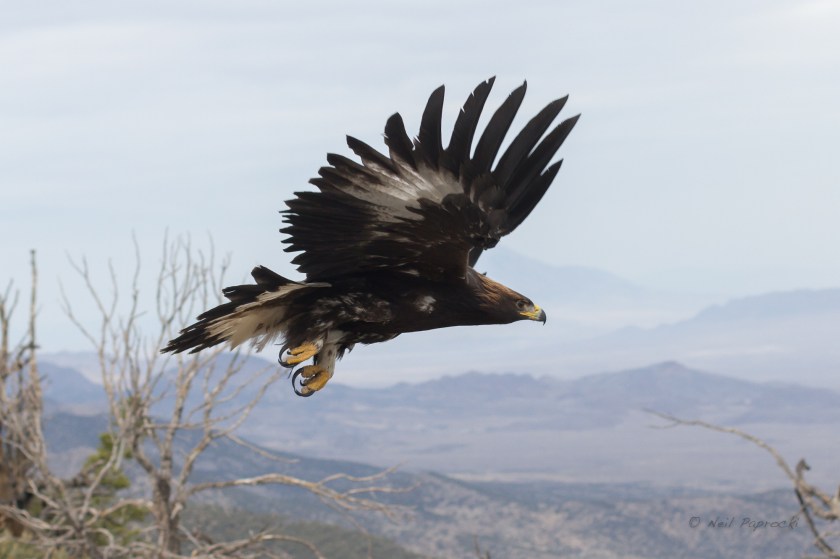
Golden Eagle, photo by Craig Hughes on Unsplash
Apologists for the wind industry — and there are legions of them at NGOs and on Wall Street — routinely claim that the hundreds of thousands of birds that are killed every year by wind turbines aren’t a big deal. They like to claim that the numbers aren’t that big and that other forms of energy production, and buildings, and cats, kill birds, too.
But Sylvester and Tigger aren’t killing our Bald Eagles and Golden Eagles. Wind turbines are — and they are killing them by the untold hundreds. That was proven last April, when the Department of Justice prosecuted ESI, a wholly owned subsidiary of Florida-based NextEra Energy, the world’s biggest renewable energy producer, for the deaths of at least 150 Bald and Golden Eagles at its wind projects in Wyoming. The DOJ prosecuted the company for what it called its “blatant disregard” for federal wildlife laws.
Indeed, the agency’s April 5, 2022 press release on the agreement with NextEra Energy, says that the company repeatedly ignored warnings from federal authorities that its proposed wind projects in Wyoming would kill eagles. Despite the warnings, the company went ahead with the projects. Why? So it could collect more in federal tax credits.
The DOJ said NextEra rushed to build the Wyoming wind projects known as Cedar Springs I and II so it could meet “deadlines for particular tax credits for renewable energy.” In other words, NextEra and ESI didn’t get federal permits because they were racing to collect even more subsidies. The DOJ said NextEra “received hundreds of millions of dollars in federal tax credits for generating electricity from wind power at facilities that it operated, knowing that multiple eagles would be killed and wounded without legal authorization, and without, in most instances, paying restitution or compensatory mitigation.” (A photo of the Cedar Springs project is featured prominently in NextEra’s ESG report.)
That’s essential background given the raging debate over offshore wind energy development and the recent deaths of numerous whales on the East Coast. As I reported on January 4, those whales are washing ashore in the same regions that are being targeted for massive offshore wind projects. In that piece, I quoted Sean Hayes, the chief of the protected species branch at the NOAA’s National Northeast Fisheries Science Center. In a letter to the Bureau of Ocean Energy Management, Hayes said that disturbance to the North Atlantic Right Whales’ foraging areas “could have population-level effects on an already endangered and stressed species.” Hayes’ conclusion was unequivocal: the “oceanographic impacts from installed and operating turbines cannot be mitigated for the 30-year lifespan of the project, unless they are decommissioned.”
Why are so many corporations vying to build offshore wind projects even though their turbines pose a clear threat to one of the most endangered mammals on the planet? The answer is simple: like NextEra, they want to collect federal tax credits. But unlike Florida-based NextEra, some of the biggest beneficiaries of the tax credits for offshore wind development are foreign companies. As I reported back in 2021, Britain’s BP, Norway’s Equinor, and Denmark’s Ørsted are pushing to develop a total of some 6.2 gigawatts of offshore wind capacity in US waters.
The history of NextEra’s egregious conduct in Wyoming and the travesty of offshore wind development by foreign corporations is relevant to the proposed Two Rivers Wind Energy Project, which is being pushed by Canada-based BluEarth Renewables. The proposed 420-megawatt facility would cover more than 20,000 acres near the town of Medicine Bow, in southeastern Wyoming. As Dustin Bleizeffer reported for WyoFile last month, BluEarth has applied to the Fish and Wildlife Service for permission to kill (the legal term is an Incidental Take Permit) up to 11 Bald Eagles and 217 Golden Eagles over the 30-year term of the permit.
But as Bleizeffer reports, “the cumulative impacts of the Two Rivers project when combined with nearby existing and planned wind and solar energy developments remain largely unknown, according to federal agencies.” Bleizeffer goes on to point out that there are already nearly 500 wind turbines within 10 miles of the proposed Two Rivers project and that the Power Company of Wyoming’s planned Chokecherry and Sierra Madre wind project, “will erect 600 wind turbines across a public-private checkerboard of 320,000 acres south of Sinclair.” (Sinclair is about 50 miles west of Medicine Bow.)
Power Company of Wyoming is a wholly owned affiliate of The Anschutz Corporation, which is owned by Denver-based magnate Philip Anschutz. Forbes puts Anschutz’s net worth at about $11 billion.
In 2016, the American Bird Conservancy — one of the few NGOs in America that’s truly interested in protecting wildlife — identified “10 of the worst sited wind energy projects for birds in the U.S.” It included Anschutz’s Chokecherry and Sierra Madre project on the list “primarily because of its potential impacts on Greater Sage-Grouse and Golden Eagles.” It continued, saying that the Wyoming location is “not a good place to put large-scale commercial wind energy and associated infrastructure from the perspective of wildlife conservation.”
In 2015, ABC noted that the Fish and Wildlife Service itself had determined that “Golden Eagle populations in the United States may not be able to sustain any additional, unmitigated mortality and the threshold for this species is zero.”

A Golden Eagle (Aquila chrysaetos), in the San Francisco Zoo, 2007. Credit: https://commons.wikimedia.org/wiki/File:Aquila_chrysaetos_Flickr.jpg
That history helps put the Two Rivers project in proper context for the comments filed with the Bureau of Land Management by Mike Lockhart, a veteran wildlife biologist. Lockhart tracks Golden Eagles in Wyoming for the U.S. Geological Survey and Conservation Science Global. Lockhart’s December 23, 2022 comments about the Two Rivers project (see letter #18) are blistering and deserve extensive quotation. He wrote:
- Given the overriding importance of the Two Rivers wind project area to breeding Golden Eagles, and the unfortunate reality that no reasonably adequate protections would prevent impacts to possibly as many as six territorial pairs of Golden Eagles, I am opposed to this project in its entirety. Moreover, given the exceptional importance of the Shirley and Laramie Basins to both resident, migratory, and overwintering Golden Eagles, I am opposed to additional, future wind projects in Albany and Carbon Counties… My strong opposition stems from an informed belief that current levels of eagle losses from wind projects in these counties is far worse than expected, and is well on a trajectory to exceed the Service’s own Golden Eagle “preservation standard”. Moreover, the native grasslands, shrublands, foothills, ridgelines, and extensive white-tailed prairie dog complexes found in these counties represent perhaps some of the best resident, migrant, and over-wintering Golden Eagle habitat found in N. America, the long-term loss of which would be largely irreversible.
- Wind turbines are a profoundly dangerous, additive human threat to Golden Eagles on Wyoming landscapes. For unknown reasons, Golden Eagles are especially vulnerable to turbine collisions and until somewhat recently, large-scale wind projects were not part of Wyoming’s energy infrastructure. Existing wind development is undoubtedly now killing significant numbers of Golden Eagles in Wyoming. But the rapid expansion and massive footprint of proposed, new projects will exponentially impact Golden Eagles and other wildlife to increased levels of additive loss never experienced before. In contrast to documented, enormous Bald Eagle population increases across North America in the last decade, Golden Eagle populations are thought to be holding their own at best, or are locally declining – perhaps significantly – in some parts of their range.
- I also believe that existing and proposed turbine setbacks and other conservation strategies designed to mitigate on-site eagle losses at Two Rivers, and other area wind projects, are inadequate and will not reasonably arrest an inescapable, spiraling population sink for resident Golden Eagles, nor will these measures prevent increasing, long-term impacts to both migrant and over-wintering Golden Eagles. Simply put, there are specific, exceptional value Golden Eagle habitats and migration corridors where species population risks are too great to justify wind project siting. Although I am a strong renewable energy advocate, the anticipated extent and rate of growth of improperly sited wind projects in Albany and Carbon counties (and elsewhere in Wyoming) will have devastating effects on Golden Eagles and a host of other airborne wildlife… Moreover, a major justification…that this project is necessary to support climate action, is a false equivalency. While I do agree that climate change represents the greatest environmental threat the world faces today, and that extraordinary measures are needed immediately, the high cost to nationally important wildlife resources in Albany and Carbon counties do not justify additional wind development at this specific locale, not while other siting alternatives are available!
That line is powerful: “a major justification…that this project is necessary to support climate action, is a false equivalency.”
A few other points. The Golden Eagle is among the most iconic animals on the planet. It’s the national symbol of Mexico, Albania, Germany, Austria, and Kazakhstan, a distinction that makes it the most common national animal in the world. And yet, now a Canadian company is trying to get permission for a project that will allow it to collect millions of dollars in subsidies courtesy of American taxpayers.
How much might Calgary-based BluEarth collect in U.S. tax credits thanks to the production tax credit, which was extended by Congress last year in the Inflation Reduction Act? My calculations, based on 420 megawatts of capacity and a PTC of $26 per megawatt-hour, show that BluEarth could collect about $32 million per year in federal tax credits each year. What about Anschutz’s Chokecherry and Sierra Madre project, which started construction last April? At 3,000 megawatts of capacity, and a PTC of $26 per megawatt-hour, the Denver billionaire’s company could end up collecting as much as $225 million per year in federal tax credits. Who knew that killing Bald and Golden Eagles could come with such lavish tax breaks?
A few days ago, here on Substack, Michael Shellenberger and Leighton Woodhouse underscored the “environmental betrayal” underway as some of the biggest NGOs in the country including the Audubon Society and National Wildlife Federation “betray the precautionary principle by risking the extinction of the North Atlantic Right Whale.”
An almost identical betrayal is afoot in Wyoming.
I have been saying the same thing for more than a decade, and I will say it again here: Killing our most-iconic wildlife in the hope that a few hundred (or thousand) wind turbines will have a measurable impact on climate change is nonsense on stilts. Federal authorities should heed what Lockhart said in his comments to the BLM: when it comes to the Golden Eagle, the “species population risks are too great to justify” permitting more wind projects in Wyoming. Federal authorities should reject the application for the Two Rivers wind project. And while they are at it, they should rescind the permit for the Chokecherry and Sierra Madre project.


You must be logged in to post a comment.