Global warming, climate change, all these things are just a dream come true for politicians. I deal with evidence and not with frightening computer models because the seeker after truth does not put his faith in any consensus. The road to the truth is long and hard, but this is the road we must follow. People who describe the unprecedented comfort and ease of modern life as a climate disaster, in my opinion have no idea what a real problem is.
They tried it with CLIMATE. They tried it with COVID. It’s all about CONTROL.
Now, they’re coming for PLASTIC.
Plastic is the great equalizer that made affordable goods available to all. Plastic is so ubiquitous, however, that the Left determined that if they can get a piece of it, they control everything.
In a statement, Uthmeier said, “Environmental groups are pressuring corporations to abandon free market principles and raise prices on consumers for products they don’t want.”
“Contrary to what green activists would like the public to believe,” Mooney reports, “plastics come with significant benefits as a direct result of human innovation. They keep food fresh, alleviate waste, make products lighter and therefore more affordable. They also contribute to life-saving medical devices.
“If environmental activists turned government bureaucrats were genuinely interested in environmental improvements, they would focus on more efficient waste management, enhanced recycling infrastructure, and biodegradable innovations. But none of those solutions are on the table. Instead, the radicals push a top-down policy approach that suffocates the free market.”
Mooney quotes CFACT’s own Bonner Cohen saying, “What needs to be understood about ‘sustainable development’ is that what is being peddled is itself unsustainable. Absent government mandates, industry collusion, and interminable lawsuits, the alternatives to plastics could not stand on their own two feet. The marketplace, which reflects consumer preferences, is the best place to separate the sheep from the goats. Just as the PC vanquished the electric typewriter, and internet transmissions quashed the fax machine, superior products prevail over inferior ones. But this is an arena the anti-plastics lobby does not dare to enter. They know they will lose. Florida’s attorney general sees this game for what it is and is to be applauded for taking appropriate action. May other state AGs follow his example.”
CFACT’s Melanie Collette concludes that, “The message to the environmental, social, and governance establishment is becoming clear: If your “voluntary” frameworks function as mechanisms for coordinating market behavior and suppressing competition, then state attorneys general are prepared to treat them that way.”
Public officials such as AG Uthmeier have had enough of false flag Green operations designed to accomplish nothing except the expansion of left-wing funding and control.
People cannot afford another phony Green crusade.
CFACT has been pushing back against the Left’s moves to control business through schemes such as climate, DEI, and ESG. CFACT’s Nate Myers just nailed three big energy companies during their annual shareholder meetings and demanded answers. Here’s the full story.
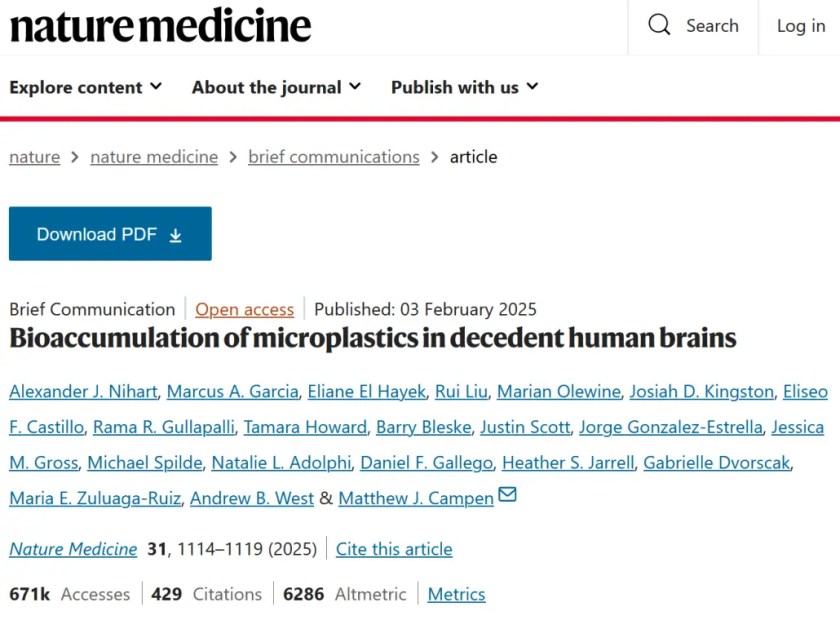
In early 2025, a University of New Mexico study published in Nature Medicine (February 2025). Researchers analyzed autopsy brain samples and found surprisingly high concentrations of tiny plastic particles, with levels roughly 50% higher in 2024 samples compared to 2016 ones. The brain showed higher plastic accumulation than organs like the liver or kidneys, and even more in cases involving dementia (though causation wasn’t proven).
Headlines often sensationalized this by noting the total plastic mass in an average brain could equate to about the weight of a plastic spoon (around 7–10 grams in some estimates), or roughly 0.5% of brain mass by weight.
The phrase was not metaphorical. It was literal, repeated across major outlets with the confidence usually reserved for gravity or photosynthesis.
Readers were assured that microplastics, and even nanoplastics, had accumulated in brain tissue at concentrations high enough to be weighed, compared, and graphed over time.
Some reports helpfully translated this into household imagery, offering estimates equivalent to spoons or teaspoons of plastic lodged in the mind. The implication was unmistakable: modern life had quietly transformed the brain into a synthetic landfill.
The press release did the rest. Few journalists paused to ask the most basic question in analytical science: how, exactly, was “plastic” identified inside one of the most lipid-rich organs in the human body?
Fewer still asked whether the methods used were capable of distinguishing polymer fragments from ordinary biological molecules that share similar chemical signatures when thermally decomposed. The story was too good to slow down for that.
And that is precisely where the embarrassment begins.
The central claim of the paper was straightforward enough on its face. Using pyrolysis gas chromatography–mass spectrometry (Py-GC-MS), the authors reported detecting polymer signatures-predominantly polyethylene-in samples of human brain tissue collected post-mortem.
Concentrations were reported as higher than those found in other organs, and higher than those reported in earlier decades, suggesting accumulation over time. This was framed not merely as detection, but as evidence of increasing exposure and retention in neural tissue.
That framing collapses under even modest scrutiny.
Py-GC-MS is not a magic “plastic detector.”
It is a powerful but blunt instrument. The method works by heating a sample until it decomposes, then analyzing the resulting fragments.
Those fragments are matched to reference spectra to infer what compounds were present before pyrolysis. This works well when the target material has a distinctive decomposition pattern and the surrounding matrix is simple or well-controlled. Brain tissue is neither.
Human brain tissue is composed largely of lipids- cholesterol, phospholipids, sphingolipids, long-chain fatty acids-many of which, when pyrolyzed, generate hydrocarbons and alkene fragments that overlap substantially with those produced by polyethylene.
This is not an obscure technical footnote. It is a known, documented limitation of the method. In lipid-rich matrices, pyrolysis products from biological material can mimic polymer signatures unless digestion, cleanup, and marker selection are exceptionally rigorous.
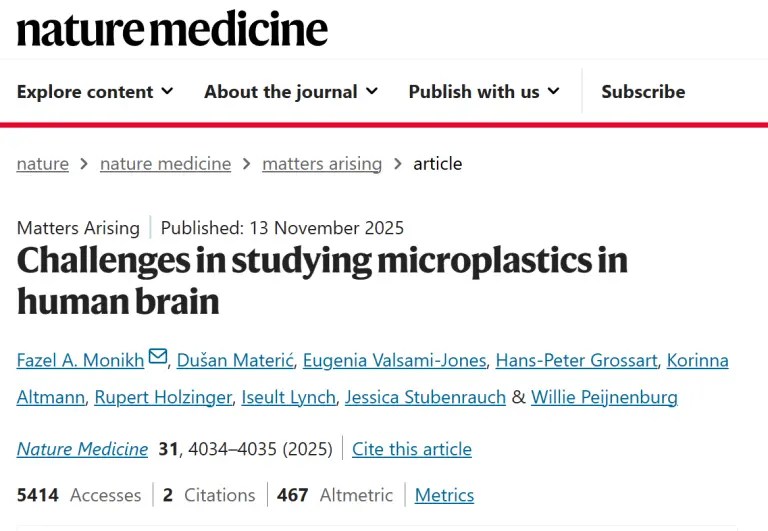
Specifically, it pointed out that the reported dominance of polyethylene in brain samples is exactly what one would expect if residual lipids were being misidentified as polymer fragments. The markers used to infer polyethylene presence are not uniquely diagnostic in the context of partially digested brain tissue.
Without exhaustive validation- using isotopically labeled controls, orthogonal analytical methods, and demonstrated exclusion of lipid interference- the conclusion that these signals represent plastic rather than biology is speculative at best.
Speculative is not the word used in headlines.
Equally troubling was the handling of contamination controls.
Microplastics research lives and dies on blanks. Airborne fibers, laboratory tubing, solvents, filters, gloves, and even lab coats are all sources of polymer contamination.
Serious studies devote enormous effort to procedural blanks, field blanks, recovery experiments, and transparent reporting of background levels.
The brain paper’s quality control reporting, while present, was insufficient to support the extraordinary claims made on its behalf. This is a methodological shortcoming. But when methodological shortcomings underpin claims of plastic-laden brains, the distinction matters.
Another red flag was the remarkable uniformity of polymer type. Across samples, across organs, across time, polyethylene dominated.
Real-world exposure does not work that way. Environmental microplastic mixtures are chemically diverse. Polypropylene, polystyrene, PET, PVC, and various copolymers are ubiquitous.
A biological accumulation process that somehow filters out nearly everything except polyethylene would require a mechanism so selective that it would itself be a major discovery. No such mechanism was demonstrated or even proposed.
The simpler explanation- that the analytical method preferentially “sees” polyethylene- like pyrolysis products in lipid-rich tissue- was never meaningfully addressed in the public narrative.
This is where the episode shifts from merely flawed to genuinely embarrassing.
Because once the technical critique appeared, it became clear that the most sensational aspect of the claim- the brain itself- was also the most analytically vulnerable.
The very property that makes brain tissue interesting for alarmist storytelling, its centrality and sensitivity, is what makes it uniquely difficult to analyze using pyrolysis-based methods. Fat looks like plastic when burned. That is chemistry.
None of this means that microplastics cannot, in principle, reach brain tissue. It means that this particular evidence does not establish that they have, let alone that they accumulate in meaningful quantities, let alone that they cause harm. Detection is not dose. Dose is not pathology. Pathology is not inevitability. Each step requires its own evidence, and skipping steps does not make the staircase shorter; it just makes the fall harder.
The media treatment of the study followed a depressingly familiar pattern. A technically complex paper with severe limitations was distilled into a single shocking sentence.
That sentence was repeated, embellished, and illustrated with stock photos of plastic waste.
Caveats, where they appeared at all, were buried deep in the text or outsourced to future research. By the time critical responses emerged, the narrative had already done its work. The image of plastic-stuffed brains had entered the cultural bloodstream, immune to correction.
To its credit, some mainstream outlets eventually noticed the problem.
Articles began to appear noting that key findings were being challenged, that analytical methods might be misfiring, and that false positives were a serious concern. This was presented as an update, not a reckoning. The original headlines were not retracted. The damage was simply allowed to age.
This is how advocacy ecosystems behave when the conclusion precedes the measurement.
The deeper issue exposed by the brain microplastics episode is a structural incentive problem.
There is enormous prestige in being first to claim that a new part of the human body has been “invaded” by modern pollution.
There is far less prestige in publishing a careful null result or a paper explaining why a method cannot yet answer the question being asked.
Journals reward novelty. Media rewards fear. And so, the system reliably produces dramatic claims perched on fragile analytical scaffolding.
Once that scaffolding is examined, the claims wobble.
The embarrassment, then, is not that scientists are studying microplastics in the body. That is a legitimate research question.
The embarrassment is that a claim as extraordinary as widespread plastic accumulation in the human brain was allowed to escape into public discourse without being anchored to analytical certainty.
The embarrassment is that chemistry was treated as a mere technicality rather than the foundation of the entire conclusion. The embarrassment is that skepticism- real skepticism, the disciplined refusal to accept claims without robust evidence- was framed as denial rather than diligence.
If the brain study had been reported honestly, the story would have been mundane: preliminary measurements using a challenging method in a difficult tissue type suggest possible signals that require extensive validation and independent replication.
That story would not have gone viral. It would not have justified sweeping narratives about modernity poisoning the mind. And it would not have served as rhetorical fuel for policy arguments that were already queued up in advance.
Instead, the public was handed a conclusion masquerading as a discovery.
When future readers look back on this episode, they are unlikely to remember the technical details of pyrolysis markers or lipid interference. They will remember the image. And when the image eventually dissolves under the weight of better measurement- and it will- the episode will stand as another example of how easily scientific restraint is abandoned when a frightening story is available for the telling.
EU Commission NGO manipulation highlights decade-long corruption in plastic policy, says Symphony Environmental
With NGO financing from the EC coming to light, plastic policy needs greater transparency to remove corruption and confusion from legislation.
Recent reports from the “Brussels Morning” newspaper said that the Dutch newspaper De Telegraaf had uncovered findings that are now shaking the entire European Union. They discovered that the European Commission had been financing non-governmental organizations (NGOs) lobbying for the policies of former EU Commissioner Frans Timmermans and influencing politicians to push through his “Green Deal.” It has now come to light that the EU commission gave €1 billion of public funds to green NGOs and lobbyists to promote the policies of the EU Commission.
The Report says, “We demand transparency from green NGOs. The European Commission must not use taxpayers’ money to fund studies from affiliated NGOs that conveniently produce results tailored to the Commission’s agenda. That is simply wrong. Studies must be professional and independent. European funds should never be used to serve a political faction or ideology, nor to manipulate MEPs or the public.”
Commenting on these revelations, Michael Laurier, CEO of Symphony Environmental, said, “Political manipulation of this kind undermines the credibility of NGOs who have been campaigning against plastic. We have never been able to understand until now how the EU could impose a ban on what they called ‘oxo-degradable plastic’ without any impact assessment or socio-economic analysis and without a dossier from the European Chemicals Agency (ECHA) showing any justification for any such ban. We have legal advice that the ban does not apply to “oxo-biodegradable” plastic, which is a different technology, but people have been confused into thinking that it does.”
“Political manipulation also explains the behaviour of the EU court when we sought to deal with that confusion. What other court in the world would dismiss our expert evidence because we paid for it (perhaps they think that Intertek and the other international test-houses are happy to work for nothing) whilst at the same time accepting the evidence of Eunomia for which the Commission had paid. Further, what other court in the world would accept that legislators must act on the best evidence available and then excuse the Commission’s premature termination of a scientific investigation of biodegradable plastic technology by the European Chemicals Agency.”
“As a result of this political manipulation, thousands of tonnes of plastic packaging escape into the European environment and its coastal waters every month, where it will lie or float around for decades. It will continue to do so until this legislation is clarified – or unless the EU bans plastic altogether, which would be a very foolish thing to do. Symphony has been trying for more than ten years to explain to the EU that the way to reduce pollution is not to ban plastic, which is the best material for the job, but to improve waste management and make the plastic biodegradable, as a fail-safe mechanism so that it will quickly biodegrade if it does get into the open environment.”
The Brussels newspaper Report continues, “Many of these lobbying contracts were classified, making them inaccessible, and it was only during an audit conducted by the Court of Auditors that some of them came to light. Others were exposed thanks to whistleblowers—insiders within these NGOs who decided to speak out. Every year, €2.6 billion was spent on questionable studies designed to justify the necessity of the Green Deal.”
“It is not surprising that this scandal is linked to the name of Frans Timmermans, who frequently promised impact assessments but either failed to deliver them or eventually produced studies based on data supplied by NGOs. These reports lacked solid data, thorough analyses, and credible sources.”
Laurier concludes: “One could clearly sense the strong ideological agenda that the architect of the Green Deal was pushing within the Commission—despite repeated objections. His influence was simply too great. He sought to push through his green policies at all costs, with no regard for their impact on the European economy and living standards. Shockingly, one-third of NGOs currently do not disclose who funds them, or who establishes them.”
Brussels Morning cover the story, which they call the EU’s biggest scandal in 20 years. They write:
“A few days ago, the Dutch newspaper De Telegraaf uncovered findings that are now shaking the entire European Union. The European Commission has long been financially supporting non-governmental organizations (NGOs) lobbying for the green policies of former EU Commissioner Frans Timmermans. Lobbyists, funded from the EU budget, were tasked with influencing politicians to push through the Green Deal. This is evidenced by secret contracts obtained by the Dutch newspaper.”
If green activists truly worried about atmospheric greenhouse gases (GHG) such as carbon dioxide, they would bring back plastic shopping bags tomorrow. But they wouldn’t – the whipped up plastic scare has been too useful a tool to batter people into accepting the relentless drive to embrace inferior products and technologies.
If green activists truly worried about atmospheric greenhouse gases (GHG) such as carbon dioxide, they would bring back plastic shopping bags tomorrow. But they wouldn’t – the whipped up plastic scare has been too useful a tool to batter people into accepting the relentless drive to embrace inferior products and technologies. The acceptance of reduced lifestyle choices, and the unlimited chance for middle class activists to virtue signal, is part of the all-important collectivisation under the planned Net Zero project. But now a recent science paper has revealed that in 15 out of 16 applications of plastic covering 90% of global volume, the alternatives actually produced more greenhouse gases.
And not just more, but significantly more. Over their lifetime cycle, paper bag substitutes produce at least four times more GHG emissions than their plastic counterparts. Paper bags are noted to weigh significantly more than plastic carriers leading to higher GHG emissions for production and transportation.
Talk about an inconvenient conclusion. The scientists found that in the 15 applications covering the five key sectors of packaging, building and construction, automobiles, textiles and consumer durable, plastic products released 10% to 90% fewer emissions across the product life cycle. “Furthermore,” the scientists observe, “in some applications, such as food packaging, no suitable alternatives to plastics exist.”
If carbon dioxide is your thing, and, of course, it is the crucial part of the reason for pursuing insane Net Zero policies, plastic needs to make a big comeback. But of course it will not. Despite revolutionising modern industrial life, it has the misfortune to be a hydrocarbon. Most plastics are a by-product from natural oil and gas production. Thus plastic bad, anything else good. The same blinkered thinking justifies the mass slaughter of any flying animal that is caught up in wind turbines, and the industrialisation of the seas at the expense of aquatic life such as whales and dolphins. In Germany, the hypocritical greens have even been in favour of tearing down parts of the forest setting for the mythical Brothers Grimm fairy tales. And we must not get started on road and bridge chomping EV cars. These are a true ecological disaster zone with a manufacturing requirement to turn over vast tracts of the Earth’s crust, and a small problem of insufficient children available to mine all the required cobalt in the Congo.
Of course, much play is made of the harmful disposal of plastic, but this is largely a waste management problem. There are plenty of ways to prudently recycle or dispose of plastic safely, but they come with some financial cost. If rich countries don’t want their plastic to end up in the oceans, they shouldn’t send it to poor countries who, out of sight, dump it in local rivers on their behalf. The scientists note that better disposal of plastics is an urgent challenge given the “threats to biodiversity and ecosystem health worldwide”.
The key table in the paper is reproduced below. It shows that the GHG emission impact in switching from plastic shopping bags to paper, the next best alternative, is 80% higher. The other 15 switches are also detailed with a note of the mostly much higher GHG impacts. The detailed methods used to calculate the plastic versus non-plastic alternatives are laid out in the paper, which is written by three scientists with expertise in sustainability and chemical and biological engineering from Sheffield and Cambridge Universities.
In arriving at their results, the authors considered many indirect impacts such as fuel saving in lighter cars, lower energy consumption in houses insulated with polyurethane and reduced food spoilage when using plastic packaging instead of butcher paper. Many advantages for the use of plastics were identified. Insulating with polyurethane is better than the alternatives and therefore reduces heating fuel consumption, while plastic tanks cut vehicle weight and thus are more fuel efficient. Meanwhile it is said that there are few alternatives to plastics in food production due to high levels of spoilage when using the alternatives. It might be noted that milkshakes and paper straws give an obvious illustration of the problems in using inferior substitutes.
It is reasonable to ask where all the virtuous green solutions to a politically-claimed ‘climate emergency’ will take us. Almost everything that is being forced through, whether it be demonising plastic to blanketing the land and seas with giant wind turbines, makes little sense. They often cause more ecological harm than good, while the fudged finances backing many of the projects might shame Charles Ponzi. It is becoming obvious that modern industrial society will collapse if the Net Zero tyranny is ever enforced.
Extremist greens from George Monbiot to Sir David Attenborough seem only too aware of the many inconsistencies in making changes to any human activity that has an ‘impact’ on the planet. Best, it seems, to have no impact at all, perhaps not be on the planet in the first place. At the moment their views seem to be shared by many influential elites pressing ahead with any number of decadent plans to drive those less well-off than themselves into abject poverty and depravation.
In 1999, Monbiot said flying across the Atlantic, “is now as unacceptable as child abuse”. The rhetoric has hardly diminished over 25 years with Monbiot recently ramping up his doomsday prose to call for an end to animal farming. Eating meat, eggs and milk is an “indulgence” the planet cannot afford, he claimed. How this Guardianista weirdo expects humans to survive on what is often a hostile planet is anyone’s guess.
Perhaps there ought to be fewer people on the planet for a start. This seems to be the opinion of the supreme middle class embodiment of green virtue, Sir David Attenborough. Supporting the neo-Malthusian Optimum Population Trust, he said in 2009 that he hadn’t seen a problem that “wouldn’t be easier to solve with fewer people”. In 2013, he was reported to have observed that sending food to famine-ridden countries is “barmy”. Using the example of Ethiopia, he said the famine there was caused by “too many people for too little piece of land”.
Chris Morrison is the Daily Sceptic’s Environment Editor.




You must be logged in to post a comment.