The Brain Microplastics Claim and the Collapse of Scientific Restraint

In early 2025, a University of New Mexico study published in Nature Medicine (February 2025). Researchers analyzed autopsy brain samples and found surprisingly high concentrations of tiny plastic particles, with levels roughly 50% higher in 2024 samples compared to 2016 ones. The brain showed higher plastic accumulation than organs like the liver or kidneys, and even more in cases involving dementia (though causation wasn’t proven).

Headlines often sensationalized this by noting the total plastic mass in an average brain could equate to about the weight of a plastic spoon (around 7โ€“10 grams in some estimates), or roughly 0.5% of brain mass by weight.

A hyper-realistic model of a brain covered in colorful pieces of plastic, set against a backdrop of litter and waste.

In early 2025, a University of New Mexico study published in Nature Medicine (February 2025). Researchers analyzed autopsy brain samples and found surprisingly high concentrations of tiny plastic particles, with levels roughly 50% higher in 2024 samples compared to 2016 ones. The brain showed higher plastic accumulation than organs like the liver or kidneys, and even more in cases involving dementia (though causation wasn’t proven).

Headlines often sensationalized this by noting the total plastic mass in an average brain could equate to about the weight of a plastic spoon (around 7โ€“10 grams in some estimates), or roughly 0.5% of brain mass by weight.

A realistic model of a human brain, decorated with colorful plastic pieces and confetti, set against a background of newspapers highlighting environmental issues.

_________________________________________________________________________________________________________

From Watts Up With That?

By Charles Rotter

An abstract illustration depicting a brain silhouette with wavy lines suggesting sound or waves radiating from it.

For a brief and revealing moment, the public was toldโ€”without ironyโ€”that the human brain is now โ€œfull of plastic.โ€

Screenshot of a New York Post article titled 'New study finds entire spoonful of microplastics in peopleโ€™s brains โ€” and 3 times as much in those with dementia' with an embedded video showing a gloved hand holding a syringe.

The phrase was not metaphorical. It was literal, repeated across major outlets with the confidence usually reserved for gravity or photosynthesis.

Readers were assured that microplastics, and even nanoplastics, had accumulated in brain tissue at concentrations high enough to be weighed, compared, and graphed over time.

Some reports helpfully translated this into household imagery, offering estimates equivalent to spoons or teaspoons of plastic lodged in the mind. The implication was unmistakable: modern life had quietly transformed the brain into a synthetic landfill.

The study responsible for this frenzy appeared in a prestigious medical journal, which lent it instant authority.
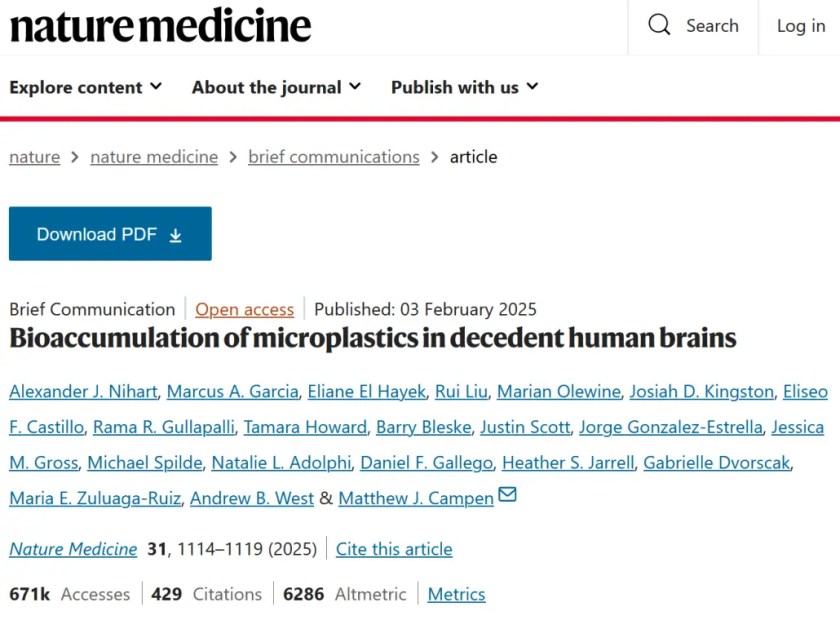
Screenshot of a research article titled 'Bioaccumulation of microplastics in decedent human brains' published in Nature Medicine. Includes author names and publication details.
Bioaccumulation of microplastics in decedent human brains | Nature Medicine

The press release did the rest. Few journalists paused to ask the most basic question in analytical science: how, exactly, was โ€œplasticโ€ identified inside one of the most lipid-rich organs in the human body?

Fewer still asked whether the methods used were capable of distinguishing polymer fragments from ordinary biological molecules that share similar chemical signatures when thermally decomposed. The story was too good to slow down for that.

And that is precisely where the embarrassment begins.

The central claim of the paper was straightforward enough on its face. Using pyrolysis gas chromatographyโ€“mass spectrometry (Py-GC-MS), the authors reported detecting polymer signatures-predominantly polyethylene-in samples of human brain tissue collected post-mortem.

Concentrations were reported as higher than those found in other organs, and higher than those reported in earlier decades, suggesting accumulation over time. This was framed not merely as detection, but as evidence of increasing exposure and retention in neural tissue.

That framing collapses under even modest scrutiny.

Py-GC-MS is not a magic โ€œplastic detector.โ€

It is a powerful but blunt instrument. The method works by heating a sample until it decomposes, then analyzing the resulting fragments.

Those fragments are matched to reference spectra to infer what compounds were present before pyrolysis. This works well when the target material has a distinctive decomposition pattern and the surrounding matrix is simple or well-controlled. Brain tissue is neither.

Human brain tissue is composed largely of lipids- cholesterol, phospholipids, sphingolipids, long-chain fatty acids-many of which, when pyrolyzed, generate hydrocarbons and alkene fragments that overlap substantially with those produced by polyethylene.

This is not an obscure technical footnote. It is a known, documented limitation of the method. In lipid-rich matrices, pyrolysis products from biological material can mimic polymer signatures unless digestion, cleanup, and marker selection are exceptionally rigorous.

The critique published in response to the study did not argue about policy, health impacts, or ideology. It argued about chemistry.
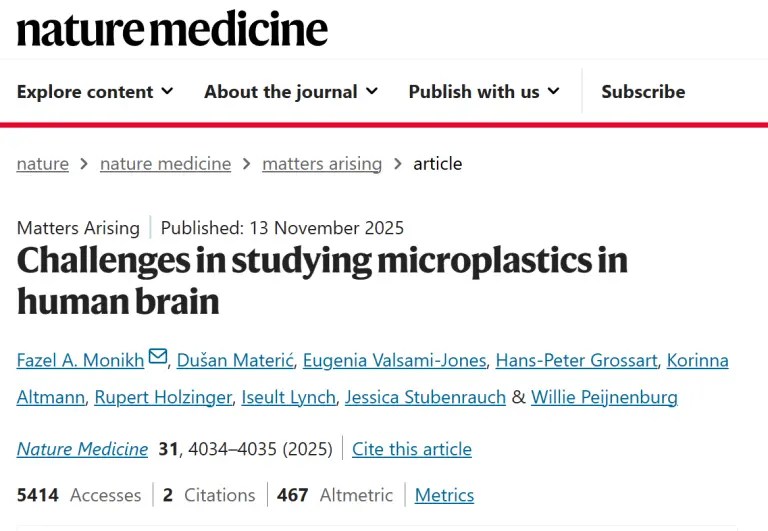
Screenshot of an article titled 'Challenges in studying microplastics in human brain' published in Nature Medicine on November 13, 2025, listing authors and metrics.
Challenges in studying microplastics in human brain | Nature Medicine

Specifically, it pointed out that the reported dominance of polyethylene in brain samples is exactly what one would expect if residual lipids were being misidentified as polymer fragments. The markers used to infer polyethylene presence are not uniquely diagnostic in the context of partially digested brain tissue.

Without exhaustive validation- using isotopically labeled controls, orthogonal analytical methods, and demonstrated exclusion of lipid interference- the conclusion that these signals represent plastic rather than biology is speculative at best.

Speculative is not the word used in headlines.

Equally troubling was the handling of contamination controls.

Microplastics research lives and dies on blanks. Airborne fibers, laboratory tubing, solvents, filters, gloves, and even lab coats are all sources of polymer contamination.

Serious studies devote enormous effort to procedural blanks, field blanks, recovery experiments, and transparent reporting of background levels.

The brain paperโ€™s quality control reporting, while present, was insufficient to support the extraordinary claims made on its behalf. This is a methodological shortcoming. But when methodological shortcomings underpin claims of plastic-laden brains, the distinction matters.

Another red flag was the remarkable uniformity of polymer type. Across samples, across organs, across time, polyethylene dominated.

Real-world exposure does not work that way. Environmental microplastic mixtures are chemically diverse. Polypropylene, polystyrene, PET, PVC, and various copolymers are ubiquitous.

A biological accumulation process that somehow filters out nearly everything except polyethylene would require a mechanism so selective that it would itself be a major discovery. No such mechanism was demonstrated or even proposed.

The simpler explanation- that the analytical method preferentially โ€œseesโ€ polyethylene- like pyrolysis products in lipid-rich tissue- was never meaningfully addressed in the public narrative.

This is where the episode shifts from merely flawed to genuinely embarrassing.

Because once the technical critique appeared, it became clear that the most sensational aspect of the claim- the brain itself- was also the most analytically vulnerable.

The very property that makes brain tissue interesting for alarmist storytelling, its centrality and sensitivity, is what makes it uniquely difficult to analyze using pyrolysis-based methods. Fat looks like plastic when burned. That is chemistry.

None of this means that microplastics cannot, in principle, reach brain tissue. It means that this particular evidence does not establish that they have, let alone that they accumulate in meaningful quantities, let alone that they cause harm. Detection is not dose. Dose is not pathology. Pathology is not inevitability. Each step requires its own evidence, and skipping steps does not make the staircase shorter; it just makes the fall harder.

The media treatment of the study followed a depressingly familiar pattern. A technically complex paper with severe limitations was distilled into a single shocking sentence.

That sentence was repeated, embellished, and illustrated with stock photos of plastic waste.

Caveats, where they appeared at all, were buried deep in the text or outsourced to future research. By the time critical responses emerged, the narrative had already done its work. The image of plastic-stuffed brains had entered the cultural bloodstream, immune to correction.

To its credit, some mainstream outlets eventually noticed the problem.

Articles began to appear noting that key findings were being challenged, that analytical methods might be misfiring, and that false positives were a serious concern. This was presented as an update, not a reckoning. The original headlines were not retracted. The damage was simply allowed to age.

This is how advocacy ecosystems behave when the conclusion precedes the measurement.

The deeper issue exposed by the brain microplastics episode is a structural incentive problem.

There is enormous prestige in being first to claim that a new part of the human body has been โ€œinvadedโ€ by modern pollution.

There is far less prestige in publishing a careful null result or a paper explaining why a method cannot yet answer the question being asked.

Journals reward novelty. Media rewards fear. And so, the system reliably produces dramatic claims perched on fragile analytical scaffolding.

Once that scaffolding is examined, the claims wobble.

The embarrassment, then, is not that scientists are studying microplastics in the body. That is a legitimate research question.ย 

The embarrassment is that a claim as extraordinary as widespread plastic accumulation in the human brain was allowed to escape into public discourse without being anchored to analytical certainty.ย 

The embarrassment is that chemistry was treated as a mere technicality rather than the foundation of the entire conclusion. The embarrassment is that skepticism- real skepticism, the disciplined refusal to accept claims without robust evidence- was framed as denial rather than diligence.

If the brain study had been reported honestly, the story would have been mundane: preliminary measurements using a challenging method in a difficult tissue type suggest possible signals that require extensive validation and independent replication.

That story would not have gone viral. It would not have justified sweeping narratives about modernity poisoning the mind. And it would not have served as rhetorical fuel for policy arguments that were already queued up in advance.

Instead, the public was handed a conclusion masquerading as a discovery.

When future readers look back on this episode, they are unlikely to remember the technical details of pyrolysis markers or lipid interference. They will remember the image. And when the image eventually dissolves under the weight of better measurement- and it will- the episode will stand as another example of how easily scientific restraint is abandoned when a frightening story is available for the telling.

That is the cost of ignoring it.

New Lawsuit Claims Ziploc Plastic Bags Dose Food with Microplastics

The complaint contends that despite the risk of microplastic exposure and food contamination, there is no warning, disclaimer or disclosure on product packaging.

A hand holding a Ziploc bag containing snacks, with another similar bag in the background, all placed on a dark granite surface.

From Watts Up With That?

From Legal Insurrection

Stack of various Ziploc plastic bag boxes including sandwich, sensalwich, quart, and gallon sizes.

The complaint contends that despite the risk of microplastic exposure and food contamination, there is no warning, disclaimer or disclosure on product packaging.

Posted by Leslie Eastman 

A stack of various Ziploc plastic bag boxes, including Sandwich, Sensational, Quart, and Gallon sizes, displayed on a kitchen countertop.

If you look in my pantry, you will find it stocked with plastic Ziploc bags of all sizes.

In part, itโ€™s because I find them helpful for food storage as well as some of my work activities. I am sure many Legal Insurrection readers use sealable plastic bags daily without trepidation.

Now, in the land of the setting Sun and lunatics, a California woman is suing the maker of these bags because they supposedly emit microplastics.

The lawsuit โ€” filed by Linda Cheslow of Santa Rosa, California, in the U.S. District Court for Northern California April 25 โ€” claims that Ziplocโ€™s assertion that its products are freezer- and microwave-safe is incorrect and misleading, causing customers to unknowingly expose themselves to dangerous microplastics โ€œduring routine kitchen practices.โ€

โ€œIn reality, these Products are made from polyethylene and polypropylene โ€” materials that scientific and medical evidence shows release microplastics when microwaved and frozen โ€” making them fundamentally unfit for microwave and freezer use,โ€ the lawsuit states.

The complaint names several specific products, including but not limited to: pint-, quart- and gallon-sized freezer bags; quart- and gallon-sized slider freezer bags; quart- and gallon-sized slider storage bags; and storage containers.

Image depicting a headline about a lawsuit against Ziploc, alleging harmful microplastics in their bags. Features the Ziploc logo and a gavel icon.

The lawsuit will focus on theย lack of warnings and looksย like it will encompass all impacted American residents.

The complaint contends that despite the risk of microplastic exposure and food contamination, there is no warning, disclaimer or disclosure on product packaging to inform consumers of the potential health hazards posed by using the items as directed. This is particularly dangerous given that the Ziploc products are meant to be used on a daily basis during routine kitchen activities, the filing argues.

โ€ฆReasonable consumers would not have paid as much for the Ziploc containers and bags, or bought them at all, had they known the products could leach harmful microplastics into their food, the case asserts.

The Ziploc bag lawsuit looks to represent all United States residents who, during the applicable statute of limitations period, purchased any of the Ziploc products listed on this page for purposes other than resale.

I have covered the topic of microplastics before, as it looked like it might be revving up to be the next big environmental cause to target big business and corporate dollars.

I suspect the arguments supporting this case will be countered with that from agencies that have asserted that microplastics are not known to cause harm to human health. For example, this is the current information on the subject from the Food and Drug Administration (FDA):

The presence of environmentally derived microplastics and nanoplastics in food alone does not indicate a risk and does not violate FDA regulations unless it creates a health concern. While many studies have reported the presence of microplastics in several foods, including salt, seafood, sugar, beer, bottled water, honey, milk, and tea, current scientific evidence does not demonstrate that the levels of microplastics or nanoplastics detected in foods pose a risk to human health.

Additionally, because there are no standardized methods for how to detect, quantify, or characterize microplastics and nanoplastics, many of the scientific studies have used methods of variable, questionable, and/or limited accuracy and specificity.

The case is interesting because of how ubiquitous plastic bags for food storage and preparation are. I suspect the debate over microplastics, and consumer safety will continue, despite existing evidence indicating that these particles pose no proven health risk.

Still, itโ€™s difficult for the public to trust the science when so much research and regulatory guidance have proven inconsistent or untrustworthy over time.

Image by perplexity.ai.

Microplastics, Global Greening, & the Dangers of Radical Alarmism | Dr. Patrick Moore | EP 439

Dr. Jordan B. Peterson sits down with industry consultant, science activist, and past president of Greenpeace Canada (1971 to 1986), Dr. Patrick Moore. They discuss his time in Greenpeace, the historic timeline of global ice ages and climate change, the clear lies being peddled to promote alarmism, and how the woke left manipulates science (and scientists) to promote a falsely perceived and politically incentivized future catastrophe.

Jordan B Peterson

Dr. Jordan B. Peterson sits down with industry consultant, science activist, and past president of Greenpeace Canada (1971 to 1986), Dr. Patrick Moore. They discuss his time in Greenpeace, the historic timeline of global ice ages and climate change, the clear lies being peddled to promote alarmism, and how the woke left manipulates science (and scientists) to promote a falsely perceived and politically incentivized future catastrophe.

Dr. Patrick Moore has been a leader in the international environmental field for more than 45 years. He is a co-founder of Greenpeace and served for nine years as President of Greenpeace Canada and seven years as a Director of Greenpeace International. As the leader of many campaigns Dr. Moore was a driving force shaping policy and direction for 15 years while Greenpeace became the world’s largest environmental activist organization.

In recent years, Dr. Moore has been focused on the promotion of sustainability and consensus building among competing concerns. He founded and chaired the BC Carbon Project, a group that worked to develop a common understanding of climate change.

In 2021 Dr. Moore published “Fake Invisible Catastrophes and Threats of Doom” exposing the fake news and fake science around 11 claims of disaster including climate change, coral reefs, polar bears, plastic, nuclear energy, and more.

This episode was filmed March 21st, 2024

Dr. Peterson’s extensive catalog is available now on DailyWire+: https://bit.ly/3KrWbS8

Paper citation as promised: https://x.com/jordanbpeterson/status/…

Righteous Risks Part 3: The Electric Vehicle Halo

It seems the automotive industry is suffering from the sins of its own zealots. Automotive leaders began to believe their piety and felt that transitioning to EVs would not only make them smell better, but they could also make a lot of money selling more cheaply manufactured cars at the higher prices that an ecological blessing would bestow upon them.

From Watts Up With That?

From the Risk Monger

David Zaruk

Just imagine if, in the coming months, the following studies would be published in peer-reviewed journals:

  • That battery technologies used in electric vehicles (EVs) have a much higher likelihood to spontaneously combust (and it is highly recommended that EVs be banned from underground or covered parking lots and container ships).
  • EV lithium batteries emit more elevated electro-magnetic fields (EMFs) that, at exposure levels exceeding 15 minutes, can lead to miscarriages or damage to human DNA which could trigger responses increasing the risk of certain cancers.
  • Studies in tire dust from automobile use show how they are the main cause of microplastics released into the sea (78% of all microplastics). As EVs are heavier, they emit much more tire dust.
  • A comparative Life Cycle Assessment showed, from cradle to cradle, that EVs are less sustainable and emit more CO2 than diesel cars.
  • An impact assessment revealed that present EV batteries cannot be sustainably recycled without a waste management energy and water demand far higher than that needed for recycling entire diesel vehicles.

Would regulators in developed countries, in reading these studies, be able to stop the political juggernaut pushing to replace fossil-fuel based internal combustion engines (ICEs) with EVs? Would regulators be able to introduce limits on where EVs could be parked or publish advice on which vulnerable people should avoid using them? Would they even be able to slow the conversion to an all-EV mobility market within the next decade?

Come on now, letโ€™s be serious. Regulators are helpless in the face the righteous perception of electric vehicles. As it is a moral imperative to replace fossil fuels and the internal combustion power train technologies, these studies would be ignored. Facts have little power when regulators see themselves acting along the path of exuberant righteousness.

Our leaders would be hard-pressed to reject the sleek, clean, quiet electric car of the future with yesterdayโ€™s noisy, belching, climate catastrophe on wheels. This is a good v evil decision and the facts have to be filtered likewise.

EVs have posed a righteous risk to the entire automotive industry. This is the first case study in the Righteous Risk series.

More Moral than Green

Since the 2003 Oscars, EVs have been associated with virtue signalling. The Toyota Prius hybrid model had been dubbed โ€œThe Piousโ€ and who could ever forget South Parkโ€™s memorable 2006 Smug Alert episode. Jokes aside, electric vehicles have been romanticised as the ethical solution to polluting, carbon-emitting transportation. The combustion engine, with its fossil fuel exhaust adding to climate change, air and noise pollution must be taxed for its sins while EVs must be incentivised โ€ฆ deified. We pay homage to EV owners, give them priority spaces near the mall entrances and attractive financial incentives.

Too bad this halo is built on false pretenses. With all of the moral accolades heaped on EVs, it is hard to imagine that they do not enjoy an impeccable environmental profile. You can believe what you really want to believe, but sometimes facts get in the way, and with righteous EVs, these facts overwhelm.

As far back as 2011, when I had given a series of speeches in Ann Arbor, Michigan and had the opportunity to speak with representatives from the Big Three automakers, I was apprehensive about their ethical exuberance and the level of moral cleansing they thought EVs would bring them. Following my discussions, I wrote an article: Donโ€™t Buy an Electric Car! that was met with ethical scorn by those wishing to sanctify their driving experience. My argument then against the rush to EVs, I feel, still resonates (at least with the agnostic).

Around a third of the CO2 a petrol or diesel car emits during its lifetime comes during the production process, before the car is driven off of the lot. Given the higher levels of resources and energy required in producing electric vehicles (from the minerals and rare earth processing to the electronics), aย comparative LCIย showed that EVs donโ€™t start catching up to diesel vehicles on CO2 emissions until after 100,000 km (assuming their battery lives can be extended). But this is without considering charging sources or post-use recycling.

EVs are so blessed that no one minds that their cables can trip up the elderly

Given the divination of EVs, this point is not widely discussed among activists waging a Holy War against fossil fuels. And while NGOs campaign against microplastic emissions into the ocean, they absolve themselves when tire dust (the main source of these emissions) proves to be far greater from EV tires. Not to mention the respiratory issues the added tire dust causes.

In a world with proper risk management processes, electric vehicles should be taxed higher to match their heavier consequences on the environment. In a world governed by righteous risks, we are subsidising these ecological pigs and admiring the beauty of their green lipstick.

With the righteousness of electric vehicles safely held high on the altar of our green self-esteem, no reasonable discussion on their risks compared to internal combustion engines could be had. Non-electric powered vehicles had not managed the righteous risks coming from the sanctifying of EVs. But some power chains were less blessed than others.

A Special Place in Hell โ€ฆ For Diesel

Ten years ago, clean diesel technologies were seen as a more climate-friendly solution with better mileage than gas/petrol alternatives. It was easier to blend biofuels into diesel with some kitchen-sink refiners even mixing in their used deep-fryer oil. With better filters catching more particulates, the future of motoring was black. But American manufacturers could not compete with the advanced European diesel technologies so they turned to their Californian regulators to create impossible emission standards for diesel cars and waited for the hammer to fall.

Dieselgate was not an environmental issue but, rather, a moral crisis. One company, Volkswagen, took the fall for the regulatory work-around (although most manufacturers were using the same Bosch technology). It was not that diesel was a major environmental problem but that it was not as clean as the industry claimed it was. They lied โ€ฆ and we were outraged, demanding our money back and demanding that our leaders take action.

Regulators took the opportunity to pose as righteous arbiters extracting justice from an evil industry (even though their unrealistic emission standards were the cause for what I have called the Al Caponisation of Industry). Fines were levied, VW managers hauled into courts and hearings to be harangued as moral shame was cast upon an entire industry.

Within a very short period in 2015, diesel power train technology shifted from being a more sustainable solution to a pariah and a righteous risk for any car manufacturer. Opportunistic virtue leaders radically upped excise taxes on diesel at the pumps, created a phase-out plan for diesel vehicles. Hell, why stop there? Because the automotive industry was evidently run by lying, thieving thugs and gangsters, letโ€™s phase out the entire internal combustion (fossil fuel) power train by 2030. This benediction of EVs as the righteous alternative was timed perfectly. Note that some leaders (like those in the UK and EU) realised their ethical inspiration had ignored basic infrastructure realities and have moved the transition date to 2035.

Within a year of Dieselgate, a new management at Volkswagen unveiled their strategy of transforming their fleet into, you guessed it, a fully electric line within a decade. While Iโ€™m sure the German engineers knew about the folly of such a โ€œsustainable transitionโ€, they also knew they could not fight such righteous risks with facts.

VW shareholders, however, were not impressed with such random acts of virtue as the companyโ€™s share value never recovered. Consumers are even less impressed, not buying an EV unless their governments pay them to. How much will this righteousness cost taxpayers?

I have written elsewhere that the word โ€œtransitionโ€ is interpreted differently. For industry, transition is an innovative, technological evolution. The EV transition is a long-term process where other technologies (eg, hydrogen) may overtake present research. For activist campaigners a transition is an event (not a process) that marks the beginning of a revolution away from something deemed bad and towards what has been defined as good. An activist transition is laden with moral imperatives. The EV transition is an immutable event and if this virtuous pilgrimage has negative consequences, so be it.

But this EV transition is part of a bigger shift in industry and a bigger threat to righteous risk management. Why did the automotive industry not stand up and fight the moral zealots? Why did they not defend the value of their technologies against the false green virtues being amplified by activist lobbyists as an essential part of the green transition?

The Downfall of Faux Righteousness

It seems the automotive industry is suffering from the sins of its own zealots. Automotive leaders began to believe their piety and felt that transitioning to EVs would not only make them smell better, but they could also make a lot of money selling more cheaply manufactured cars at the higher prices that an ecological blessing would bestow upon them. They started working with environmental activists to give them an (electric) ethical halo but in the process, strayed from responsible research and technology commitments.

Sustainability was once a key part of product stewardship โ€“ that a company should strive to continually improve their products and processes to the point where they were polluting less and having fewer accidents or emissions into the environment. At a certain point in the last few decades, as righteous risks grew more influential, sustainability was transformed into a marketing buzzword. Companies were making hollow ESG commitments to meet moral approval (from their consumers, regulators, stakeholders, investorsโ€ฆ), working to identify themselves within the green narrative, embracing transitions as opportunities for new technologies and markets (as it made marketing sense).

Rather than managing a righteous risk caused by the EV ethical juggernaut, automotive industry leaders amplified it. But will their moral deeds translate into economic success? In the next five to ten years, if sanity does not return to the cult compound, a large number of car companies and brands will disappear, unable to sow the seeds of their faux righteousness.

The automotive industry has not managed the righteous risks of EVs and will fall victim to markets and consumers with little ethical fidelity.


If you are an EV owner with a righteous moral outrage toward this article, please consider whether your comment is emotion or fact-based before clicking on the send button. I would prefer a rational discussion.


Enjoyed this read (free with no ads)? Support The Risk-Monger via Patreon. Become a Gold-Monger patron for 5 โ‚ฌ / $ per month and get Davidโ€™s newsletter.