Global warming, climate change, all these things are just a dream come true for politicians. I deal with evidence and not with frightening computer models because the seeker after truth does not put his faith in any consensus. The road to the truth is long and hard, but this is the road we must follow. People who describe the unprecedented comfort and ease of modern life as a climate disaster, in my opinion have no idea what a real problem is.
As I’ve said before, it is our duty to fight back against the wild claims of the rampant climate alarmism that permeates media, social and otherwise. Here’s an example of how you do it – writing a letters to the editor rebuttal. I urge readers to do the same when confronted with baseless scary claims.
As I’ve said before, it is our duty to fight back against the wild claims of the rampant climate alarmism that permeates media, social and otherwise. Here’s an example of how you do it – writing a letters to the editor rebuttal. I urge readers to do the same when confronted with baseless scary claims.
“July 4th was the hottest day in the history of humanity so far. … and when science proves you wrong you still deny the heat record’s connection to oil — this position is thick as a brick. We laugh at you. We’re all laughing at you.”
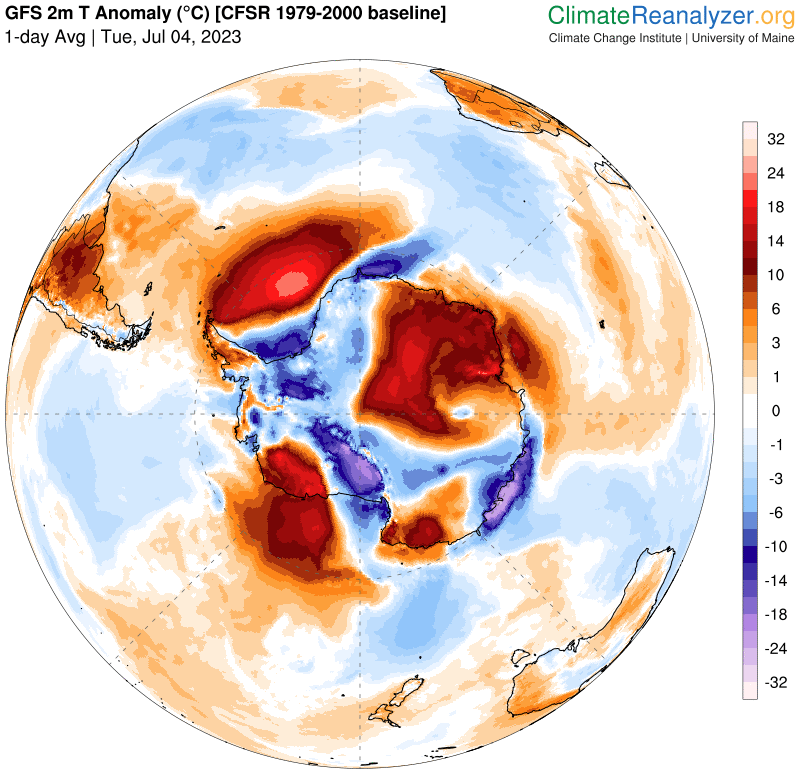
This shows Michael’s “thick” knowledge of the situation. That July 4th claim is false. It came from a website called climatereanalyzer.org using model data, not actual temperatures, and got picked up by know-nothing social media fools going viral, followed by the media that didn’t bother to check. Only two problems: it wasn’t an official temperature. In a July 5 Associated Press story, NOAA distanced itself:
“NOAA, whose figures are considered the gold standard in climate data, said in a statement Thursday that it cannot validate the unofficial numbers. It noted that the reanalyzer uses model output data, which it called “not suitable” as substitutes for actual temperatures and climate records.”
And there is the fact that the model only goes back to 1979, not “the history of humanity.”
Ooops!
The “excess heat” that spurred social media panic came from the waters off Antarctica, where apparently a computer model glitch made it look like shrimp were boiling in the ocean. Meanwhile, according to actual data, you know, from real measurements, the temperature of the Earth as of this writing is 57.47°F. That’s not “hot.”
I laugh at you Michael, in fact, we’re all laughing at you.
Here is the graphic that caused the social media panic. See the little uptick in the center to 17°C. Note that it only has data back to 1979.
I’m pretty sure there were heatwaves before 1979, like the big one in July 1936. So much for Michaels claim of “the hottest day in the history of humanity.”
Here’s the big “heat source” that caused the panic – an apparent glitch (or short term outlier anomaly) in model output that made it look like the waters off Antarctica were boiling hot, and when “averaged” over the entire globe, made that false 17°C uptick.
Dr. Ryan Maue weighs in on Twitter trying to put out the wrongheaded social media fire. It isn’t even an up to date climate model, circa 2009/2011:
The test of McKibben’s claim that green energy is economically viable will be whether green energy installations survive the coming withdrawal of government support.
We’ve crushed so many temperature records recently—the hottest day ever measured by average global temperature, the hottest week, the hottest June, …
So the crisis is everywhere—that’s why it’s called global warming. But the case of Canada is interesting, because it’s a liberal democracy with a strong environmental sentiment—polling earlier this year found that seventy-five per cent of Canadians were anxious about climate change; twenty-one per cent of the population was having fewer or no children as a result. …
Yet none of this has been enough to really change the political dynamic, which remains dominated by the fossil-fuel industry. Justin Trudeau’s government had been making noises about a plan to dramatically cut emissions—perhaps by forty-five per cent below 2005 levels by 2030, in line with what climate scientists have set as the necessary targets. But the government quickly began to back down after a meeting in June with officials in the oil-rich province of Alberta, when the Minister of Natural Resources, Jonathan Wilkinson, explained that “we have committed to a cap on oil and gas emissions. But there are lots of different ways to do that. There are flexibilities and how you design it.” The targets may shrink, the timetables may fade, and, incredibly, Canada may decide to count increased exports of fossil gas as a method of cutting carbon.
But it’s not fair to just pick on Canada. In the United States, President Biden has laid claim to a powerful environmental legacy by passing the Inflation Reduction Act, but his Administration also approved both a giant oil and a giant L.N.G. project, in Alaska; the Mountain Valley Pipeline, in the Virginias; and lots of offshore leasing—and it may back big L.N.G. terminals on the Gulf Coast. In Great Britain, the leader of the Labour Party, Keir Starmer, was quoted in the Times of London on Sunday as saying that he “hates tree-huggers,” probably because they keep pushing for more action than his party wants to commit to.
Note I am not accusing McKibben of financial wrongdoing. As far as I know McKibben has not broken any laws. And for what it’s worth, I think McKibben is a true believer when it comes to climate change.
McKibben claims government support is required because although simple economics is driving the green revolution, economics alone will not drive the transition quickly enough.
We may soon have a chance to test this theory. My crystal ball tells me 2024 will see a strong showing for America First Republicans. In the bloodbath of subsidies which will follow a likely Republican victory, I doubt green projects will continue to receive the same level of support they received under the Biden administration. The test of McKibben’s claim that green energy is economically viable will be whether green energy installations survive the coming withdrawal of government support.
“We’re all mad here. I’m mad. You’re mad.”The Cheshire Cat, Alice’s Adventures in Wonderland
When I look around me nowadays, I find it hard to disagree with the Cheshire Cat – and I say that in full knowledge that he lived down a fictitious rabbit hole and his party trick was to spontaneously morph into a disembodied smile. That said, ‘madness’ is such a maddeningly ambiguous term that I feel obliged to clarify what it is exactly that I am agreeing with. It isn’t that I believe that we are all suffering a mental illness, because that would be a mad thing to claim. What I mean instead is that we seem to live in a world where extremely foolish and irrational beliefs and actions seem to have become the new normal. Worse still, it seems that it is no longer possible to have two opposing, rational views on a given subject – instead there has to be one’s own view, and that held by your mad opponent. And since one can assume that your mad opponent feels the same way about you, that means we’re all mad here. I’m mad. You’re mad.
In the two great debates of our generation — climate change and covid-19 vaccination — such accusations and counter accusations of craziness have a strong tradition, heavily fuelled by acrimonious and largely fruitless internet exchanges. For the most part the accusations are born of frustration that the other guy just can’t seem to grasp the obvious. More worryingly, however, some of these accusations have been elevated to the status of pseudoscience by a vocal coterie of academics who should know better. Take, for example, the climate change debate, in which the so-called denier’s cognitive shortcomings and irrationality have been extensively analysed and pathologised by the psychology profession. It’s an analysis that is supposed to be founded upon expertise in cognitive bias, and yet the psychologists’ accusations of such biases are made in a manner that itself exhibits extreme cognitive bias. Unfortunately, the profession has been allowed to get away with this to such an extent that the received wisdom is now that climate change ‘denial’ goes beyond simple foolishness and ill intent and strays into the territory normally occupied by the psychotic.
A good example of such an accusation can be found in an article written by Australian activist, Jeff Sparrow. In a rambling diatribe, he accuses sceptics of engaging in ‘kettle logic’, which is an irrational ability to simultaneously entertain two contradictory conspiracies, usually to avoid having to admit having been wrong. Of course, in an individual, such irrationality would be a sign of madness. Nevertheless, the accusation is made in all seriousness and is intended to apply to all climate change sceptics. Interestingly, however, the only evidence Sparrow offers for the existence of this mass pathology is the ability of sceptics to disagree with each other at conferences and their ability to form conditional arguments (along the lines of ‚I don’t believe x but even if I did there would still be y‘). I think you would have to be mad to find any of this convincing, but such accusations are seriously entertained by psychologists. Somehow they are able to misinterpret incoherent thinking within a group as being multiple cases of incoherent thinking within the individual. This is known as a ‘category error’.
But where it really gets interesting, as far as I am concerned, is when the boot is on the other foot and the accusations of psychosis are made by the sceptic. That’s when the fun starts. That’s when the psychologists really adopt the rampant pose and start clawing at the sceptic’s throat.
Enter the ‘formerly’ reputable…
The theory that seems to have severely rattled the psychologists’ cage is the brainchild of Robert Malone MD, who chose to share his ideas with the world in a Joe Rogan podcast back in December 2021. Malone starts by asking “What the heck happened to Germany in the 20s and 30s? Very intelligent, highly educated population, and they went barking mad.” He suggests that similar mass behaviour can be discerned in the response to the covid-19 epidemic. He dubs it ‘Mass Formation Psychosis’, and he explains it thus:
When you have a society that has become decoupled from each other and has free-floating anxiety in a sense that things don’t make sense, we can’t understand it, and then their attention gets focused by a leader or series of events on one small point just like hypnosis, they literally become hypnotized and can be led anywhere.
The podcast went viral and the psychology profession went apoplectic. Typical of the negative response was that given in a New England Psychologist article written by John Grohol Psy. D.
If this doesn’t sound particularly scientific or based in psychological science, you’d be right. Malone isn’t a psychologist and doesn’t have any background or experience in psychology, human behavior, or psychiatric research. Instead, his description sounds like some sort of pop psychology mumbo-jumbo from someone who took Psychology 101 in college.
Grohol continues by doubling down on Malone’s lack of required qualifications:
None of his work touched upon psychology or psychological theory. Suddenly, however, Malone feels qualified to express his expertise about “mass formation psychosis.” He knows so little about the field, he basically invented a term (or repeated something he heard once somewhere), instead of using the already well-known and accepted terms, mass hysteria or mass psychogenic illness.
This all sounds rather damning, but before I go any further I think it would be worth my while to reflect upon one particular statement made by Grohol that he thinks gets to the heart of Malone’s failure to understand the basics:
Anyone who suggests there’s “free-floating anxiety” that’s “just like hypnosis” has a very limited understanding of what these things mean. People just can’t be hypnotized without their knowledge or consent — that’s not at all how hypnosis works. And while anxiety is indeed a significant issue for many people, it doesn’t “float” from person to person or otherwise become infectious.
My qualifications to discuss psychology may be no better than Malone’s, but I will venture to suggest that the above quote demonstrates, more than any other, just how seriously Grohol has failed to understand Malone’s ideas. As a psychologist, surely Grohol knows that free-floating anxiety is a technical term, defined by the American Psychological Association as “a diffuse, chronic sense of uneasiness and apprehension not directed toward any specific situation or object.” It is in that sense that it floats; it isn’t anchored to anything specific. By saying that it is free-floating, Malone isn’t suggesting that it is an anxiety that transmits from one individual to another; instead he is referring to a chronic and pervasive societal unease exhibited by a decoupled society. Furthermore, by virtue of its detachment from any specific and discernible cause, the unease can be readily co-opted by leaders with an agenda. The impression of hypnosis comes from the readiness by which the masses can be persuaded of the cause of the diffuse societal anxiety, and thereby led.
Anyone, such as I, who has been diagnosed with free-floating anxiety can attest to its irrational nature. The anxiety is intrinsic; it doesn’t need a trigger or explanation. And yet there will always be plenty of environmental factors upon which it can be pinned – if you are so inclined. Malone obviously knows this and adds the insight that societies can exhibit traits that are akin to an individual’s emotional states. But he doesn’t offer the rationale for this comparison and so leaves himself open to accusations of mumbo-jumbo from the likes of Grohol. Grohol simply dismisses the concept of societal anxiety as a category error and further proof of Malone’s incompetence. I think it is anything but, and I’ll tell you why.
Enter the ‘never has been’ reputable…
I would like to remind you at this point that some six months before Malone introduced the world to Mass Information Psychosis I had written an article here at Climate Scepticism espousing a very similar theory. The starting point was to suggest that, at its essence, emotion is the name we give to a complex, autonomous, adaptive, self-monitoring system’s cognition of its internal state. Our bodies are such a system and our central nervous system provides the self-monitoring. Emotion is what we experience as a result. Consequently, insofar as our decision-making relies upon an awareness of our internal state, we are doomed to rely upon emotion to make a decision. Furthermore, since societies are also complex, autonomous, adaptive, self-monitoring systems, they too will exhibit decision-making that is essentially emotion-based in the system theoretic sense, i.e. a society’s pre-occupation with its internal state constitutes an essential element of its decision-making. A consequence of this is that, just as individuals can suffer neurotic and phobic anxieties in a literal sense, so can societies in a more abstract sense.
This is not a category error, because in both cases we are dealing with the same class of object, i.e. a decision-making, complex, autonomous, adaptive, self-monitoring system. One can only start making a category error if one takes the analogy too far in believing an abstract concept such as ‘society’ can actually experience emotion in the same sense as a conscious entity can. The term ‘anxiety’ is used in an abstract manner when applied to societies, as indeed are terms like ‘panic’, ‘phobia’, ‘psychosis’ and ‘hypnosis’. But there is a legitimacy to the use of this terminology that goes beyond metaphor. Despite his remark about ‚literally‘ becoming hypnotised, I believe that is what Malone is doing. He didn’t use the ‘already well-known and accepted terms, mass hysteria or mass psychogenic illness’ because they are quite different to what he was talking about. They are group behaviours that emerge when the emotional states of individuals interact and feedback upon themselves. They result in collective emotional behaviour and, as such, are psychological phenomena. That’s not what I am talking about, and I don’t believe it is what Malone is getting at either. As I put it:
To be clear, I am not saying that societal decision-making is essentially emotional just because the decisions are being made by individuals who are acting emotionally. This may be true, but I am referring to a more profound sense in which society’s decisions are emotionally driven. They are emotional in the sense that the cognition of the internal state of a complex, autonomous, adaptive, self-monitoring system (i.e. society) is the driving force.
Whilst there are similarities between my thoughts on the matter and Malone’s, there are important differences. Firstly, I have chosen to focus upon the importance of internal monitoring as an essential component of emotional phenomena. In particular, I have pointed out that this can lead to phobic anxiety in the individual and, by analogy, to a legitimate concept of societal phobia. I speak, for example, of societies having panic attacks. Malone doesn’t do this, preferring instead to reflect upon free-floating anxiety in the individual and suggesting the possibility of an analogous societal free-floating anxiety. The propensity for society to ‘panic’ is therefore replaced in Malone’s version by a propensity for it to be persuaded to act in a tendentious manner, simply by offering it an after-the-fact rationalisation for its diffuse anxiety. This is a different emphasis to mine but, even so, it isn’t a major divergence. In fact, both theories entertain the idea of diffuse societal anxiety, albeit with different causations (hyper-sensitivity to internal states in my theory, or a ‘decoupled’ society in Malone’s). And both theories recognise a tendency for societies to rationalise such anxiety. As I said:
Having established [through hyper-sensitive self-monitoring] a self-inflicted sense of crisis we have compounded the error by then looking for external threats and causes of internal dysfunction that could possibly explain our extreme agitation.
Put another way, societies take their free-floating anxiety and anchor it to a causation. Furthermore, such anchorage can be easily facilitated by those with an agenda. Consequently:
One has to wonder, if we didn’t obsess so much over the ills of society, what appetite would remain for rebooting it to address climate change.
We band of disreputable brothers
It’s a funny thing, but when Grohol and his fellow professionals looked at Malone’s theory, all they could see was an unqualified charlatan attempting a psychological thesis without even understanding the basics of the subject. I, on the other hand, could see a kindred spirit, crossing disciplines in an effort to understand what seems on the face of it a quite incomprehensible phenomenon – why seemingly intelligent and sane people can be so easily swept up in an insane enterprise. I was not troubled by Malone’s use of non-standard terminology; one would not find it in the cannon of psychology because, at its essence, his wasn’t really a psychological thesis. It’s a theory about control, and the decision-making of what is actually a complex, autonomous, adaptive, self-monitoring system. As such, his thinking, whether he appreciates it or not, benefits from a paradigm that can apply to more than one application area. Moreover, his is an attempt to explain how individuals may find themselves able to entertain personal suboptimal thinking simply in order to fit in with decision-making at the societal level and yet, at no stage, experience any cognitive dissonance.
But let us not kid ourselves here. Malone’s greatest sin was not to overreach himself by proposing an inchoate theory in an area outside of his expertise. It was that he chose to apply himself to finding an explanation for a phenomenon that the orthodoxy does not willingly accept exists. He sought to explain why there was so much eagerness to engage in an irrational project when, as far as the powers that be are concerned, the project is perfectly rational. To those who get to decide who is mad and who is not, he was looking for an explanation for a madness when part of that madness is to declare that only the mad would think an explanation were necessary. That’s what made it so easy for Grohol to see the lack of academic grounding in Malone’s arguments and yet fail to see the wisdom in his metaphor.
When Stephan Lewandowsky and John Cook developed their ideas regarding the alleged madness of conspiracy theorists, none of their fellow professionals thought to step forward and point out the category errors upon which they were based. Far from it, they received European Cooperation in Science and Technology (COST) funding to write them up in a handbook. But when Malone only appears to commit a category error, the whole world explodes in an orgy of indignant rebuttal. At the end of the day, however, this is the asymmetry we have to deal with. Any opposition to the authorized view will be automatically branded as irrational in a way that compliance never will. We’re all mad here. I’m mad. You’re mad. But not everyone has keys to the asylum.
Alice wasn’t too impressed with the Cheshire Cat’s philosophy and objected to being called mad.
‚How do you know I’m mad?‘ said Alice.
‚You must be,‘ said the Cat, `or you wouldn’t have come here.‘
I think I know the feeling. Sometimes there is something irrationally futile about trying to make sense of the world.
All true believers of The Science™ of climate change have taken careful note of the lessonsoffered by the coronavirus pandemic during 2020–22 for managing the ‘climate emergency.’ The two agendas share nine items in common that should leave us worried, very worried.
1. Elites’ Hypocrisy
The first is the revolting spectacle of the hypocrisy of the exalted elites who preach to the deplorables the proper etiquette of abstinence to deal with the emergency, and their own insouciant exemption from a restrictive lifestyle. Most recently we witnessed the surreal spectacle of Britain’s Parliament interrogating disgraced former Prime Minister Boris Johnson on allegations that he serially broke the lockdown rules he had imposed on everyone else—but not questioning the anti-scientific stupidity of the rules themselves. Possibly the most notorious American example was California Governor Gavin Newsom and his cronies dining maskless in the appropriately named French Laundry restaurant at a time when this was verboten, being served by fully masked staff.
Similarly, Prince Harry, Meghan Markle, Al Gore, and John Kerry have all been widely mocked for jetting around the world to warn people about global warming. I wonder if anyone has done a calculation of the total carbon footprint of each annual Davos gathering where CEOs, prime ministers and presidents, and celebrities fly in on private jets, are driven around in gas-guzzling limousines and preach to us on the critical urgency of reducing emissions? I understand the hookers do quite well during that week, so perhaps there is a silver lining.
2. Data Challenged Models
A second common element between Covid and climate change is the mismatch between models that inform policy and data that contradict the models. The long track record of abysmally wrong catastrophist predictions on infectious diseases from the Pied Piper of Pandemic Porn, Professor Neil Ferguson, is if anything exceeded by the failures of climate change alarmist predictions. The most recent example of the drum roll of “The end is nigh and this is absolutely your last chance to avert the end of the world from climate collapse” is yet another Chicken Little Sixth Assessment Report from the indefatigable Intergovernmental Panel on Climate Change (IPCC).
At some point the IPCC morphed from a team of scientists into activists.
“There is a rapidly closing window of opportunity to secure a liveable and sustainable future for all,” the report warns us. UN Secretary-General Antonio Guterres called it a “survival guide for humanity.” But a one-time climate action journalist-turned-sceptic, Michael Shellenberger, described the UN as a “Climate Disinformation Threat Actor.”
Calls for urgent climate action based on the language of “edging towards ‘tipping points” have been made over many years. Atmospheric scientists and former IPCC members Richard McNider and John Christy note that climate modeling forecasts have “always overstated the degree to which the Earth is warming compared with what we see in the real climate.” A few examples:
♦ In 1982, UNEP Executive Director Mostafa Tolba warned of an irreversible environmental catastrophe by 2000 without immediate urgent action. ♦ In 2004, a Pentagon report warned that by 2020, major European cities would be submerged by rising seas, Britain would be facing a Siberian climate and the world would be caught up in mega-droughts, famine and widespread rioting. ♦ In 2007, IPCC chair Rajendra Pachauri declared: “If there’s no action before 2012, that’s too late.” ♦ Most hilariously, in Montana the Glacier National Park installed “Goodbye to the glaciers” plaques, warning: “Computer models indicate the glaciers will all be gone by the year 2020.” Come 2020, all 29 glaciers were still there but the signs were gone, taken down by embarrassed park authorities.
3. No Dissent Allowed
Third, the rapidly consolidating Censorship Industrial Complex covered both agendas until Elon Musk began releasing the Twitter Files to expose what was happening. This refers to the extraordinary censorship and suppression of dissenting voices, with extensive and possibly illegal collusion between governments and Big Tech—and, in the case of the pandemic, also Big Pharma and academia.
Even truth was no defence, for example with accounts of vaccine injuries, if their effect was to promote narrative scepticism. The social media Big Tech censored, suppressed, shadow banned and slapped labels of “false,” “misleading,” “lacking context” etc. to content at variance with the single source ministries of truth. “Fact-checking” was weaponized using fresh young graduates—with no training, skills or capacity to sift between authentic and junk science—to put such judgmental stamps on pronouncements from world-leading experts in their field.
4. We Want You to Panic
Fourth, an important explanation for the spread of Covid and climate catastrophism is the promotion of fear and panic in the population as a means to spur drastic political action. Both agendas have been astonishingly successful.
Polls have consistently shown the hugely exaggerated beliefs about the scale of the Covid threat. On climate change, the gap between the stringent actions required, the commitments made and the actual record thus far is used to create panic. The notion that we are already doomed promotes a culture of hopelessness and despair best epitomized by Greta Thunberg’s anguished cry: “How dare you” steal my dreams and childhood with empty words.”
5. Only Trust Science Authorities
A fifth common theme is the appeal to scientific authority. For this to work, scientific consensus is crucial. Yet, driven by intellectual curiosity, questioning existing knowledge is the very essence of the scientific enterprise. For the claim to scientific consensus to be broadly accepted, therefore, supporting evidence must be exaggerated, contrary evidence discredited, sceptical voices stilled and dissenters ridiculed and marginalized. This has happened in both agendas: just ask Jay Bhattacharya on one and Bjorn Lomborg on the other.
6. Government Empowers Itself
A sixth shared element is the enormous expansion of powers for the nanny state that bosses citizens and businesses because governments know best and can pick winners and losers. Growing state control over private activities is justified by being framed as minor and temporary inconveniences in the moral crusade to save Granny and the world.
Yet in both agendas, policy interventions have over-promised and under-delivered. The beneficial effects of interventions are exaggerated, optimistic forecasts are made and potential costs and downsides are discounted. Lockdowns were supposedly required for only 2-3 weeks to flatten the curve and vaccines, we were promised, would help us return to pre-Covid normalcy without being mandatory. Similarly, for decades we have been promised that renewables are getting less expensive and energy will get cheaper and more plentiful.
Yet increased subsidies are still needed, energy prices keep rising, and energy supply gets less reliable and more intermittent.
7. Self-Inflicted Damage
Seventh, the moral framing has also been used to discount massive economic self-harm. Alongside the substantial and lasting economic damage caused by savage lockdowns to businesses and the long-term consequences of a massive printing of money, the obstinate persistence of excess deaths is painful proof of collective public health self-harm.
Similarly, the world has never been healthier, wealthier, better educated, and more connected than today. Energy intensity played a critical role in driving agricultural and industrial production that underpin the health infrastructure and comfortable living standards for large numbers of people worldwide. High income countries enjoy incomparably better health standards and outcomes because of their national wealth.
8. Elites Thrive at Others’ Expense
Eighth, government policies in both agendas have served to greatly widen economic inequalities within and among nations with fat profits for Big Pharma and rent-seeking Green Energy. A lot of money was said to be required to keep Mahatma Gandhi in the style of poverty he demanded. Similarly, a lot of money is required to support Covid and climate policy magical thinking where governments can solve all problems by throwing more money that must neither be earned nor repaid.
In the triumph of luxury politics, the costs of the rich suffused in the golden glow of virtue are borne by the poor. Should a billion more Chinese and Indians have stayed poor and destitute over the last four decades, so Westerners could feel virtuous-green? Alternatively, for post-industrial societies, climate action will require cutbacks to living standards as subsidies rise, power prices go up, reliability comes down and jobs are lost.
Attempts to assess the balance of costs and benefits of Covid and climate policies are shouted down as immoral and evil, putting profits before lives. But neither health nor climate policy can dictate economic, development, energy and other policies. All governments work to balance multiple competing policy priorities. What is the sweet spot that ensures reliable, affordable and clean energy security without big job losses? Or the sweet spot of affordable, accessible and efficient public health delivery that does not compromise the nation’s ability to educate its young, look after the elderly and vulnerable and ensure decent jobs and life opportunities for families?
9. Global Bureaucrats Gut National Sovereignty
The final common element is the subordination of state-based decision-making to international technocrats. This is best exemplified in the proliferation of the global climate change bureaucracies and the promise—threat?—of a new global pandemic treaty whose custodian will be a mighty World Health Organisation.
In both cases, the dedicated international bureaucracy will have a powerful vested interest in ongoing climate crises and serially repeating pandemics.




You must be logged in to post a comment.