“Portlandia” phasing out diesel?

A petroleum distributor in Portland, Oregon, has sounded the alarm on a plan by the state to reduce the supply of gasoline, diesel, and jet fuel. In the name of seismic safety, they propose to decommission 20 percent of the storage capacity located in Portland that supplies 90 percent of the fuel for the entire state.

The problem? Oregon already has only a 3-5 day diesel supply at any given time — for the entire state.

Night Shot Portland Oregon reflection Columbia River

From CFACT

By Jeff Reynolds

Even for a blue city run by the DSA and tree hippies, this would be suicidal.

A petroleum distributor in Portland, Oregon, has sounded the alarm on a plan by the state to reduce the supply of gasoline, diesel, and jet fuel. In the name of seismic safety, they propose to decommission 20 percent of the storage capacity located in Portland that supplies 90 percent of the fuel for the entire state.

The problem? Oregon already has only a 3-5 day diesel supply at any given time — for the entire state. Reducing that by 20 percent puts the state at extreme risk of fuel shortages during periods of crisis, disaster, or heightened demand.

What this really represents is this deep blue state’s abiding commitment to completely phase out “fossil fuels” in order to save the planet, using “seismic safety” as a cover.

Mark Fitz, the president of StarOilco, posted this on LinkedIn:

Did you know that the terminals in the northwest side of Portland, Oregon only hold a 3-5 day supply of fuel. Also these terminals handle over 90% of the fuel flowing into Oregon. And oh yeah. The City of Portland is proposing these terminals get rid of 20% of their tanks. They say the fuel storage is dangerous. Clearly they aren’t aware of how dangerous it gets when there is no fuel due to a supply problem.

Blue State Extremism

The City of Portland has developed a program to require a 20 percent reduction in fuel storage capacity at the Critical Energy Infrastructure (CEI) Hub in northwest Portland by 2036. The move jeopardizes the region’s fuel supply security. The CEI Hub, a six-mile industrial corridor along the Willamette River, stores approximately 90% of Oregon’s liquid fuel supply — including gasoline, diesel, and jet fuel.

According to state emergency planning documents, the terminals there typically hold an average of only three to five days’ worth of regular unleaded gasoline and diesel under normal operating conditions. Fuel arrives primarily via pipeline from Washington refineries and marine vessels, then gets distributed across the state by truck and pipeline.

City planners argue the reduction is necessary due to the hub’s high seismic vulnerability. The area sits on liquefiable soils and is at significant risk from a major Cascadia Subduction Zone earthquake. Studies by the Oregon Department of Geology and Mineral Industries (DOGAMI) and Multnomah County have highlighted the potential for widespread tank failures, spills, fires, and environmental damage on a large scale.

But that is just a cover story for the true agenda.

Portland Dominates, the Rest of Oregon Gets Ignored

The environmental extremists really run the show in Portland. The proposal, developed through the CEI Hub Policy Project, includes limits on new storage expansion and requirements for safety upgrades. In March 2026, the Portland Planning Commission recommended a draft that incorporates the 20 percent capacity drawdown along with other restrictions.

The measure now moves to Portland City Council for public hearings and potential adoption later in 2026. Critics of the plan, including industry representatives and some community members, warn that reducing storage capacity could leave the Pacific Northwest more exposed during supply disruptions. They point to the hub’s already limited inventory buffer and the potential economic and public safety impacts of fuel shortages affecting transportation, heating, emergency services, and aviation.

Supporters of the proposal counter that modernizing infrastructure and reducing overall fuel dependence aligns with long-term climate goals and the “green energy transition.”

As Portland moves toward final deliberations, the outcome will shape energy reliability for the rest of Oregon and the broader region.

From Portland.gov FAQ page:

Q: What changes were adopted by City Council?
A: In December 2022, Portland City Council unanimously adopted code changes to PCC 16.60, also known as Renewable Fuel Standard (RFS) to further reduce dependence on nonrenewable fossil fuels and help meet the City’s 100% Renewable Energy resolution. The changes reflect the State’s new Clean Fuels Program, favorable market conditions, and advances in new renewable fuel products. The new RFS phases in increasing blends of low carbon biofuels over the next several years. The policy will shift Portland’s diesel fuel mix to 99% renewable in 2030. Portland’s policy is unique in that it includes a Carbon Intensity Standard to shift biofuels in Portland to fuels that are lower carbon across their entire lifecycle, like recycled waste grease.

Q: What is the phase-in schedule for the RFS? 
A: The phase-in schedule is shown in the table below:

Percentage of fuel type by volume
Fuel typeCurrentJuly 1, 2024July 1, 2026July 1, 2030
Diesel95%85%50%1%
Renewable fuel requirement (min)5%15%50%99%

Kyle Diesner, the environmental extremist who crafted this “phase-in” schedule, works for the City of Portland Bureau of Planning and Sustainability as a Climate Policy Analyst. In March 2026, Diesner testified that carbon emissions in Portland peaked in 2000 and have come down since then. He said, “emissions have declined 26% since 1990, while population has grown 38% and jobs have increased 35%.”

His proposal? Steeper declines. “Decarbonizing the electric grid is a top priority,” Diesner said. He noted that diesel power generation provides 16% of the electricity consumed in Oregon. The switch to biofuels will accomplish those goals, according to Diesner.

He also observed that Portland’s “low carbon concrete procurement policy” requires the city to use less concrete in construction projects, as it represents a source of emissions.

Minuscule Solutions for Global Numbers

According to Oregon’s own statistics, the state accounts for approximately 0.11-0.12 percent of total global greenhouse gas emissions.

Of course, the goal of these efforts is not to have a material impact on the environment, it’s to create a society more aligned with the narrative.

According to his LinkedIn profile, Diesner previously sat on the boards of directors for the Community Energy Project, Inc. (CEP), and Resolutions Northwest.

CEP is a 501(c)3 that describes itself as a social welfare organization that “empowers people to maintain healthier, more livable homes, control their utility costs, and conserve natural resources.”

Resolutions Northwest describes its mission as envisioning “inclusive and just communities,” and facilitating “honest dialogue to resolve conflict and advance racial & social justice.” Consulting services they provide include certification as a Practitioner of Restorative Justice.

In short, Diesner is a true believer. And so are most of the city councilors who witnessed his testimony.

So as always, Portland extremism puts the rest of the state at a massive disadvantage. Just as when forest mismanagement leads to devastating wildfires, or the gutting of rural county budgets due to the moratorium on logging activity.

The risk of supply interruptions is no mere abstraction. Just in November 2025, a leak in the Olympic Pipeline near Everett, Washington — which delivers 90 percent of Oregon’s gas, diesel, and jet fuel — led to multiple shutdowns over several weeks. Gov. Tina Kotek (D) declared a statewide fuel emergency in response, and fuel prices skyrocketed.

This followed a shorter pipeline shutdown on the same line a few months earlier.

In 2023, a leak in the pipeline led to another significant shutdown while repairs and cleanup took place. The region also feels effects when trains carrying fuel derail, weather interrupts flows, or global pandemics lead to panics and price spikes.

But none of that matters if Portland considers its contributions to “global warming” the greatest emergency it faces.

Nor does it matter if Portland drags the rest of the state down with it.

This article originally appeared at Restoration News

‘The River Is Essentially Dead’: How Enviros’ Push To Save Salmon Ended Up Killing ‘Hundreds Of Thousands’ Of Them

A well-funded environmentalist group played a key role in the push to remove dams in the Pacific Northwest’s Klamath River ahead of premature deaths of thousands of salmon.

From The Daily Caller

NICK POPE

CONTRIBUTOR

A well-funded environmentalist group played a key role in the push to remove dams in the Pacific Northwest’s Klamath River ahead of premature deaths of thousands of salmon.

American Rivers — an organization that has received millions of dollars from left-of-center environmentalist grantmaking organizations in recent years — was “the orchestrator of the Klamath dams removal project,” according to Siskiyou News, a local outlet in Northern California. The drawdowns of several reservoirs pursuant to the scheduled removal of four dams in the river preceded the deaths of “hundreds of thousands” of young salmon in the waterway, according to Oregon Public Broadcasting.

The push to remove the dams is often marketed as beneficial for salmon, as proponents of the plan — including American Rivers — have argued that the dams obstruct the natural movements of salmon as well as their access to habitat. However, weeks after beginning the process to remove one of the systems scheduled for deconstruction on the river, a large number of the 830,000 young salmon released into the river on Feb. 26 had died as of March 2, according to the California Department of Fish and Wildlife (CDFW). (RELATED: White House Won’t Confirm If Biden Will Visit East Palestine, Says He’s ‘Taking It Very Seriously’)

CDFW officials attributed the mass-death to gas bubble disease, which is caused by changes in water pressure, and stated that the changes in pressure driving the deaths was attributable to old dam infrastructure that is slated for removal. The agency further stated that water turbidity and dissolved oxygen levels do not appear to have contributed to the mass-death.

The young salmon that died travelled through a tunnel involved in the dam infrastructure that had previously not been accessible to the fish before officials altered the flow of water through the system as part of the removal process, Peter Tira, an information officer for the CDFW, explained to the Daily Caller News Foundation. The deaths were primarily a function of where the fish were released into the water, and the outcome, though unfortunate, is a learning opportunity for stakeholders who remain committed to making the Klamath River a free-flowing cold water river system again in the long-term, Tira told the DCNF.
Water from the Klamath River mixes with water from a different body in northern California. (Photo via the office of Republican California Rep. Doug LaMalfa)
Dead fish are pictured along the Klamath River system. (Photo via the office of Republican California Rep. Doug LaMalfa)

American Rivers is also closely involved with the Klamath River Renewal Corporation (KRRC), a nonprofit coalition that is playing a key role in the removals in accordance with its stated mission to “remove the Klamath hydroelectric dams and restore a free-flowing river.” Along with other organizations involved with the KRRC, American Rivers has appointed several officials to the group’s board of directors.

However, some officials and environmental policy experts are not buying the government’s explanation for the mass-death of salmon, asserting instead that it is clear that the removal of the dams set conditions for the mass-death.

“The risk of gas bubbles is well known, so the fact that one million salmon were killed is a failure of government staff to prevent their death. Rather than act as this is the fault of the dam, government staff should acknowledge their mistake and learn from it,” Todd Myers, the director of the Washington Policy Center’s Center for the Environment, told the DCNF. “It is unfortunately typical that when government actions harm the environment, agencies spend more time deflecting blame than addressing the problem or being held accountable.”

Regardless of whether or not dam removal is the right decision, poor planning or execution of the removals should not be excused, Myers emphasized.

Republican California Rep. Doug LaMalfa, whose district includes the river and a is a longtime opponent of removing the dams, agreed with Myers’ assessment of the causes for the deaths.

LaMalfa has been warning removal proponents “from day one” that moving to hastily remove the dams without a comprehensive plan to handle second-order effects could be catastrophic, he told the DCNF. He believes many proponents of removing dams are mostly interested in adding metaphorical “trophies” to their shelves rather than devising and implementing effective plans to remove the dams responsibly.

“This is about political scores. People like me and others have been warning them for two decades that when you do this and you have no plan for the silt — and they don’t have one — they have been exposed that they have no plan. They’re just doing it, doing it on the fly,” LaMalfa told the DCNF. “We see the destruction with the flume that has gone down the whole river and out in the ocean. I understand it’s even moved all the way up towards Crescent City, which is many miles up the coast.”

American Rivers, meanwhile, does not appear to have publicly addressed the high volume of salmon deaths in the river, despite having advocated for the removal of the Klamath River dams for years. American Rivers did not respond to requests for comment.

“I’ve been around natural disasters all of my life, and I’ve never seen anything like this,” Siskiyou County Supervisor Ray Haupt told the California Globe. “The river is essentially dead, as is everything in it.” (RELATED: Scientists Look To Fight Climate Change By Dumping 6,000 Gallons Of Chemicals Into Ocean Near Martha’s Vineyard)

Water samples collected by locals demonstrate the condition of water extracted from affected segments of the Klamath River. (Photo via the office of Republican California Rep. Doug LaMalfa)

American Rivers has received at least $3.6 million from left-of-center grantmaking and environmentalist organizations — including the Charles Stewart Mott Foundation, the Resources Legacy Fund, the William and Flora Hewlett Foundation and the Water Foundation — since 2020, according to a review of tax filings. The New Venture Fund, one of the grantmaking nonprofits overseen by left-wing dark money behemoth Arabella Advisors, gave American Rivers nearly $400,000 between 2020 and 2022, according to tax filings.

There are still several other dams on the river that are set to come down as part of the removal project. Many property owners are seeing the values of their property along the water drop because of changes driven by the dam removal, LaMalfa told the DCNF.

“People with homes in the area are seeing their home values drop, even in one case their actual house might drop into the canyon because the water table has shifted,” LaMalfa told the DCNF. “And people with loans on their homes no longer have the value to keep their equity up.”

For its part, KRRC has established a mitigation fund to pay locals who may be adversely impacted by the consequences of dam removal.

“The California Department of Fish and Wildlife (CDFW) manages the Fall Creek Fish Hatchery,” which is the facility that released the ill-fated salmon into the waterway, a KRRC spokesperson told the DCNF. “The Department determined the mortality of salmon fry was caused by remaining dam infrastructure, not by dam removal. Fortunately, that infrastructure will be removed along with the rest of the dam this year. In the meantime, CDFW will be trucking fish around the dam to avoid this occurring with upcoming releases from the hatchery. “

All content created by the Daily Caller News Foundation, an independent and nonpartisan newswire service, is available without charge to any legitimate news publisher that can provide a large audience. All republished articles must include our logo, our reporter’s byline and their DCNF affiliation. For any questions about our guidelines or partnering with us, please contact licensing@dailycallernewsfoundation.org.

Another Deceptive Front-Page Climate Story in the Seattle Times

Another highly deceptive and error-filled climate story in the ST.  One predicting more than a doubling of wildfires over western Washington and Oregon by mid-century.

From The Cliff Mass Weather Blog

Cliff Mass

The Seattle’s Times ClimateLab writers have done it again.

Another highly deceptive and error-filled climate story in the ST.  One predicting more than a doubling of wildfires over western Washington and Oregon by mid-century.

The trouble is that this story is based on a highly problematic paper published in February in JGR Biogeosciences (see below).   A paper that is missing the key element of Westside wildfires and makes predictions that are unsupported and highly exaggerated.

Before anyone suggests I should not comment on this work, let me note that I am doing research on EXACTLY this topic.  I have read all the relevant papers.  The authors of this paper cite several of my previous papers on the topic.

The Key Control of Westside Fires Was Ignored

Both this article and the Seattle Times article ignore the central fact about major wildfires occurring west of the Cascade Crest.  

Let me explain.

Westside fires are infrequent for a reason:  the region west of the Cascade crest is generally too moist to burn.   Precipitation is abundant west of the crest (see below) and for most of the year cool, moist marine air from off the Pacific (whose temperature is about 50F) floods over western Washington and Oregon.

Moisture vegetation and ground surfaces, as well as cool/moist air.    Wildfires don’t have a chance and are thus rare.

But there is an atmospheric “trick” that can make Westside wildfires possible:  strong easterly (from the east) winds.   Winds that are generally dry and warm, and capable of pushing the moist/cool marine air out to sea.

Virtually all major Westside fires are associated with strong easterly winds.  

The air starts relatively dry over eastern Washington and Oregon.  As it descends the western slopes of the Cascades and coastal mountains, it is warmed by compression, causing relative humidity to plummet.

The warm, dry air associated with powerful downslope winds can rapidly dry surface fuels, no matter how moist they were days or weeks before.  The strong winds can also start fires, by damaging electrical infrastructure. among other ways.

I have looked at every one of the Westside fires of the past 120 years– all of them were associated with powerful easterly winds.   

Examples include the Yacolt Burn near Vancouver, WA in 1902, the Tillamook Fires of the 1930s, and the 2020 fires over western Oregon (there are more).  Being a little warmer or drier the days before would have made little difference to these fires:  the easterly winds were the key.

Tillamook Burn, Clatsop County Oregon

So if you want to know how Westside fires will change over the next century, you MUST determine how the easterly winds will change.

Unfortunately, the JGR paper does not examine this issue at all.  The Seattle Times article ignores the issue as well.

You probably are asking yourself:  Will strong easterly winds strengthen or weaken under global warming?   

I have examined this question with high-resolution regional climate models (and published the results in the peer-reviewed literature).  It appears easterly winds will WEAKEN, which would reduce Westside fires.    The Seattle Times article doesn’t provide that critical information.

But the problem with the Seattle Times article and paper it cites does not end there.

The paper assumes the same distribution and frequency of fire starts as today and then uses the output from global climate models to see how the fires would change as the earth warms.

Unfortunately, they used a highly unrealistic and aggressive global warming scenario (RCP 8.5) that greatly exaggerates any global warming impacts.   

The global model also is far too coarse to get the local meteorology correct. For example, THERE ARE NO CASCADES in the simulation at all.

Finally, let me note there are many other problems with the paper and even more in the Seattle Times story.

The ClimateLab series in the Seattle Times is pushing incorrect and hyped climate information.  The reporters do not evaluate the validity of the exaggerated claims they report.  This is not quality journalism and misinforms citizens who need accurate information about climate change.  

Oregon’s Climate Program Overruled

The Oregon Court of Appeals struck down the state’s ambitious Climate Protection Program. This decision, hailed by utilities and industry groups, is a stark reminder of the overreach often seen in state-level environmental regulations.

From Watts Up With That?

The Oregon Court of Appeals struck down the state’s ambitious Climate Protection Program. This decision, hailed by utilities and industry groups, is a stark reminder of the overreach often seen in state-level environmental regulations. The court found that the Environmental Quality Commission, the policy and rule-making board for Oregon’s Department of Environmental Quality, failed to meet heightened disclosure requirements, a fundamental aspect of lawful and transparent governance.

https://www.msn.com/en-us/news/us/oregon-court-strikes-down-state-climate-program-rules-in-favor-of-utilities-industry/ar-AA1lOdfK

The Climate Protection Program, approved in December 2021, mandated significant cuts in emissions from various sectors, including natural gas utilities and large industrial plants. However, the program’s ambitious goals overlooked the practical implications and feasibility of such drastic measures. The court’s decision to invalidate the program underscores the necessity of realistic environmental policies, and following the law rather than blatantly ramming through illegal, idealistic, and unattainable targets.

Oregon’s three gas utilities, an oil-industry group, and several local trade organizations challenged the program’s rules last year. Their victory in court is not just a win for these industries but also a win for common sense. It highlights the importance of balanced, legal, and fair rule-making processes that consider the economic and practical aspects of environmental regulations.

The court’s decision focused on a clear disclosure requirements of the statute – the failure of the Environmental Quality Commission to meet disclosure requirements. This focus on procedural integrity is crucial. It ensures that any significant regulatory changes, especially those impacting major industries and the economy, are made transparently and with due diligence. The court rightly prioritized the rule of law over the substance of the program itself, much to the chagrin of the end justifies the means activists.

The state acknowledged that the notice it submitted did not include an explicit statement about additional federal requirements. The state said it “substantially complied” with state rules by posting the notice of proposed rulemaking on its website, sending it to over 20,000 recipients and conducting 18 months of public outreach.

They argued industries had ample time to understand that the program would impose additional requirements, why the rules were needed and what alternatives it had considered.

But the court ruled that is not enough.

“Substantial compliance … is not sufficient. The statute requires actual compliance,” the court wrote.

https://www.msn.com/en-us/news/us/oregon-court-strikes-down-state-climate-program-rules-in-favor-of-utilities-industry/ar-AA1lOdfK

Very understated of the court: “The statute requires actual compliance.”

The court rightly noted that “substantial compliance” is not sufficient. Actual compliance with statutory requirements is non-negotiable, especially when it comes to regulations that have far-reaching implications for industries and consumers alike.

The challengers of the program praised the court’s decision, viewing it as a constructive step towards addressing climate change in a more balanced and effective manner. On the other hand, environmental advocates expressed disappointment, seeing the decision as a setback.

The Oregon Court of Appeals’ decision to strike down the Climate Protection Program highlights the importance of procedural integrity and balanced rule-making that considers the economic realities and practical limitations of ambitious environmental goals, and following the law. This ruling should serve as a precedent for other states, encouraging them slow down the insane ideological rush to ignore laws, procedural, rules, and regulations.

The court’s decision underscores the importance of legal and procedural rigor in the formulation of such policies and serves as a cautionary tale against overzealous regulatory ambitions that fail to account for practical realities.

H/T James P (a link would have been nice)

CFACT to BOEM: Oregon’s “floating wind” experiment likely to topple over

The principal reason that there are no commercially viable, floating wind facilities that exist in
the world today is because the cost to build, operate and maintain them is simply too exorbitant.
Each turbine requires a massive “float” to support the turbine tower. Each tower float must be
moored to the bottom in all directions so that it does not blow over.

FILE – This Oct. 30, 2002 file photo shows a speed boat passing by offshore windmills in the North Sea offshore from near Esbjerg, Denmark. On Wednesday Feb. 5, 2014, Oregon’s Governor, John Kitzhaber and other officials announced plans to develop a similar farm, as the West Coast’s first offshore wind energy farm. (AP Photo/Heribert Proepper, file)

From  CFACT

The Committee For A Constructive Tomorrow (CFACT) recently weighed in on the Bureau of Ocean Energy Management’s (BOEM) proposal to site two “Wind Energy Areas” (WEA) off the coast of Oregon.  President Craig Rucker, who submitted CFACT’s official comments, noted “BOEM should not create administrative “Wind Energy Areas” because the technology being deployed, namely floating wind turbines, have not yet been proven economically viable.”

Rucker went on to note that, to date, the 88 MW Hywind Tampen facility in the North Sea is the only major floating wind project in the world, and it merely services two offshore oil rigs.  To put faith in a technology that has yet to prove itself scalable to service hundreds of thousands of homes and business is foolish and needs more time.  In addition, the costs are likely to be substantively higher than for turbines planted into the seabed, Rucker adds, and will require the construction of specialized vessels that are not even in existence yet.

To read the CFACT’s official comments in their entirety, click here.

CFACT, founded in 1985 by Craig Rucker and the late (truly great) David Rothbard, examines the relationship between human freedom, and issues of energy, environment, climate, economics, civil rights and more.

Portland, Oregon climate slush fund no help in addressing city’s real problems

From  CFACT

By Bonner Cohen, Ph. D

Once known as the “City of Roses,” Portland has fallen from grace, joining its West Coast counterparts Seattle, San Francisco, and Los Angeles in becoming a cesspool of crime, homelessness, drug addiction, and other contemporary urban maladies.

Not to worry, though. Portland is tackling climate change and doing so in a big way. In 2018, the city’s voters approved the creation of a “Portland Clean Energy Community Benefits Fund” (PCEF), which would spend taxpayer money on projects said to “reduce carbon emissions, create economic opportunity, and help make our city more resilient as we face a changing climate.” Originally projected to raise $50 million annually from a tax on large retailers, the PCEF – aided by inflation – is now bringing in over twice that amount.

“The primary reason for establishing the Clean Energy Fund in the first place was simply to redistribute wealth – from retailers and their customers, to a small group of politically preferred non-profits groups. More than 99% of Portland residents will never benefit from the fund,” the Cascade Policy Institute notes.

While the coffers of the PCEF are regularly replenished, essential city services have broken down. In his Sept. 28 testimony before the Portland City Council, economist Eric Fruits, Ph. D., pointed to the woeful state of affairs in a city he calls home:

  • “The Portland Bureau of Transportation claims it has a $32 million budget shortfall;
  • Portland Parks and Recreation claims it does not have enough money for basic maintenance, such as maintaining the Grant High School practice fields, tennis courts, or light poles;
  • The city’s information technology system is in shambles;
  • 911 response times are a national disgrace and may never recover to pre-pandemic levels;
  • Almost every resident has had their car stolen or knows someone who has.”

Meanwhile, the Portland City Council is figuring out ways to spend $750 million the PCEF is expected to generate over the next couple of years. The council refers to the scheme as “a historic program that centers equity in climate action.” But Todd Myers of the Washington Policy Center points out that the PCEF bears all the hallmarks of a slush fund tailor-made to line the pockets of political allies. Categories slated to receive their share of the largess include “clean energy in regulated multifamily affordable housing,” “equitable tree canopy,” “increasing urban farming opportunities – planning and land acquisition,” and “comprehensive e-bike access and support.”

Another Climate Boondoggle

The word “boondoggle” doesn’t begin to do justice to what the city is up to. As Myers writes:

“For example, the program provides $60 million for ‘Clean energy in regulated multifamily affordable housing.’ Writing, ‘It is imperative that these buildings are built and operated in a way that reduces carbon emissions, reduces operating costs, and improves resilience and health for tenants,’ the description does not explain how carbon reduction will be achieved. Instead, it promises the city will work with ‘community partners to define Phase II program parameters to see greater carbon reduction, benefit to tenants, and additional or different workforce contractor equity requirements.’”

Got that?

Inserting fashionable woke terms such as “equity’ into the climate debate was perhaps inevitable because it opens opportunities to funnel taxpayer money to so-called “frontline communities,” said to be at the greatest climate risk.

“If the people of Portland believe that spending taxpayer dollars on these projects is worthwhile, that is their choice, but given the large amount of money, there seems to be little certainty that the program will achieve its intended goals,” Myers writes.

As Portland – along with many other U.S. cities – descends further into chaos and lawlessness, the city continues to pursue climate goals that will have no effect on the climate while turning a blind eye to public safety and the things that really matter to everyday people

Author


Bonner Cohen, Ph. D.

Bonner R. Cohen, Ph. D., is a senior policy analyst with CFACT, where he focuses on natural resources, energy, property rights, and geopolitical developments.

Articles by Dr. Cohen have appeared in The Wall Street Journal, Forbes, Investor’s Busines Daily, The New York Post, The Washington Examiner, The Washington Times, The Hill, The Epoch Times, The Philadelphia Inquirer, The Atlanta Journal-Constitution, The Miami Herald, and dozens of other newspapers around the country.

He has been interviewed on Fox News, Fox Business Network, CNN, NBC News, NPR, BBC, BBC Worldwide Television, N24 (German-language news network), and scores of radio stations in the U.S. and Canada.

He has testified before the U.S. Senate Energy and Natural Resources Committee, the U.S. Senate Environment and Public Works Committee, the U.S. House Judiciary Committee, and the U.S. House Natural Resources Committee.

Dr. Cohen has addressed conferences in the United States, United Kingdom, Germany, and Bangladesh.

He has a B.A. from the University of Georgia and a Ph. D. – summa cum laude – from the University of Munich.

What Oregon Teaches Us About The “Climate Crisis”

The Cornwall Alliance

By Gregory Wrightstone

I traveled to Oregon last week at the invitation of a CO2 Coalition supporter. Besides being completely off the grid at a lodge on the scenic Rogue River, I gave a presentation to about 50 people from southern Oregon after returning from the wilderness.

As you can imagine, the climate zealots are in full-on crisis mode in the Beaver State. For my talk, I examined Oregon-specific temperature data. The top image shows the annual mean temperature that reveals about a 1-degree Fahrenheit (F) increase since 1895, which is hardly a crisis.

Interestingly, maximum temperatures were basically flat going back 125 years, while the low-temperature readings had increased by 2.0 degrees F. Increasing night-time low temperatures benefit agriculture by extending growing seasons.

Sleep well, Oregonians. There is no climate crisis.

So, what will the citizens of Oregon get for going to net zero? Analysis using the MAGICC simulator indicates that had the state attained zero emissions in 2010, the warming averted in 2050 and 2100 would be 0.0007 and 0.0018 degrees Fahrenheit, respectively. These are theoretical effects that could not be measured and would make no difference.

Taking the offensive against eco-activism in Oregon

On Saturday, August 26th, as the air filled with smoke from local wildfires, CFACT’s National Grassroots Coordinator, Tom DeWeese, traveled to the rural community of Grants Pass, Oregon. He was invited there because citizens of the community found themselves caught on the frontlines of several battles over intrusive environmental policies that are smothering their local economy.

From CFACT

By CFACT Ed 

On Saturday, August 26th, as the air filled with smoke from local wildfires, CFACT’s National Grassroots Coordinator, Tom DeWeese, traveled to the rural community of Grants Pass, Oregon. He was invited there because citizens of the community found themselves caught on the frontlines of several battles over intrusive environmental policies that are smothering their local economy.

Taking the offensive against eco-activism in Oregon 1

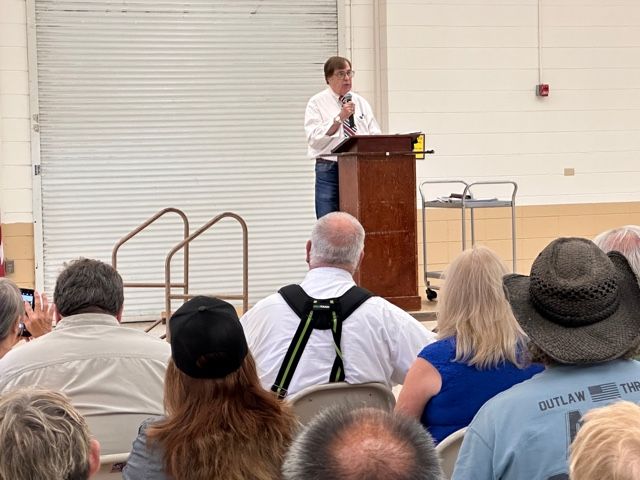
DeWeese addressed an event sponsored by several local groups, including the county Republican Women’s Club and the Farm Bureau, and attended by almost 500 people. DeWeese explained in detail precisely what they are facing: namely, a determined, well-funded, and politically-powerful cadre of Green ideologues dedicated to enforcing a radical environmental agenda. “Individual efforts by a few in opposition to this agenda simply will not stop it,” DeWeese explained.

Grants Pass faces the federal Forest Service and the Bureau of Land Management’s (BLM) ongoing effort to destroy the local timber industry. The county once had thirty lumber sawmills. Today, it has none. As a result of the closures, the community lost revenue and struggles to fund local services. Meanwhile, the wildfires burn almost unabated.

In addition, the Oregon State Legislature has mandated severe environmental policies that foster “sustainable development” must be included in every local comprehensive development plan. This has led to the inability of local communities to autonomously choose how best to meet the needs of their residents — as elected city councils and county commissions simply, without question, follow the state dictates.

Taking the offensive against eco-activism in Oregon 2

As DeWeese spoke to the gathering of determined, but frustrated activists, he explained the origins of the policies and the powers behind them. In addition, he revealed how Green nongovernmental organizations (NGOs) virtually surround state and local representatives to pressure them to pursue far-reaching eco-policies. Said DeWeese, “They have a radical agenda, and they fully intend to see it enforced.”

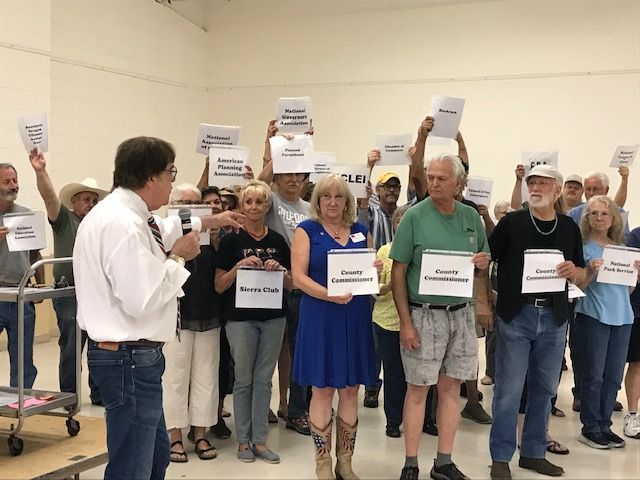
DeWeese then presented a dramatic depiction, using over 35 members of the audience, to showcase how NGOs surround and pressure local government officials. The audience ate it up! “But,” said DeWeese, “you aren’t there, and our side has no clear agenda of our own to present for policy ideas. We must get off of the defense and take the offence to change the debate.”

To counteract the influence of Green NGOs, DeWeese put forth a plan to create a permanent infrastructure of citizen activists in the community to “keep up our own pressure” on local officials. He called it “building a Freedom Pod,” … focused on protecting local property rights, small businesses, and individual liberties.

DeWeese finished by telling the gathering they must stand up and be heard. To dramatize the point, he called on all of them to stand up and say NO! As all 500 shouted: “NO” and the room shook, DeWeese concluded, “That’s what your local and state representatives must hear from you!”