A Curious Correlation -Sunspots vs. Major Hurricane Frequency

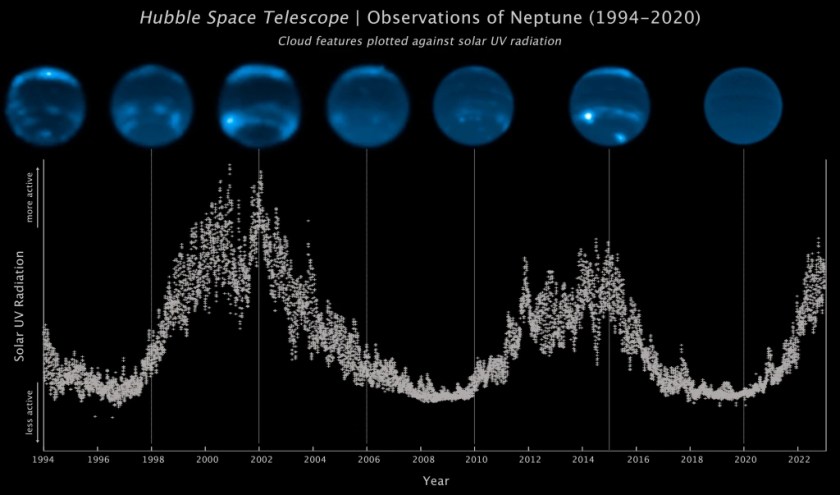
How about the weather on the other planets in our solar system? Might it be influenced by galactic cosmic rays just like here on Earth? The clouds of Neptune captured by the Hubble Space Telescope were obtained over nearly 30 years over which is plotted the solar UV radiation during the solar cycle.

The clouds of Neptune

From Watts Up With That?

Kirby Schlaht,

From Andy May (2024): “Roger Pielke Jr. posted this plot (below) of the 3-year frequency of global major hurricanes (he uses a simple count of them) created by Ryan Maue (@RyanMaue). Dr. Maue also posted this plot on his twitter. Looks like an inverse sunspot plot and overlaid the SILSO monthly sunspot count. In the figure, the blue is Maue’s plot, and the orange is a plot of monthly SILSO sunspots. The correlation, or strictly speaking, the anti-correlation is obvious and very interesting. I don’t think Ryan Maue’s plot has been formally published yet.”

Here is my speculation:

It appears that some extreme weather here on Earth might be influenced by changes in solar activity. If the Svensmark cloud hypothesis is correct, increased solar activity deflects more Cosmic Rays (CR) away from the inner solar system producing less ionization in the troposphere, producing fewer clouds with more solar radiation reaching the oceans. Warming oceans leads to a greater temperature differential between the poles and the equator which promotes more hurricane activity.  The oceans have a significant thermal lag – it takes time to heat and cool this huge mass of water so we see a time lag of about 3 years after solar maximum until the hurricane frequency reaches its maximum. As we approach solar minimum more CR ionization occurs producing more clouds and a cooling ocean.  The pole/equator temperature differential then, begins to decline with hurricane frequency also decreasing.

How about the weather on the other planets in our solar system? Might it be influenced by galactic cosmic rays just like here on Earth? The clouds of Neptune captured by the Hubble Space Telescope were obtained over nearly 30 years over which is plotted the solar UV radiation during the solar cycle. We see maximum cloudiness at solar maximum. Just the opposite of the Svensmark hypothesis, which says maximum cloudiness should occur at solar minimum where CR intensity is maximum.  Seems a paradox here.

This sequence of Hubble Space Telescope images chronicles the waxing and waning of cloud cover on Neptune. This nearly-30-year-long set of observations shows that the number of clouds grows increasingly following a peak in the solar cycle – where the Sun’s level of activity rhythmically rises and falls over an 11-year period. The Sun’s level of ultraviolet radiation is plotted in the vertical axis. The 11-year cycle is plotted along the bottom from 1994 to 2022. The Hubble observations along the top, clearly show a correlation between cloud abundance and solar peak of activity. One theory says that the increased ultraviolet radiation from the Sun, during its peak of activity, causes chemical changes deep in Neptune’s atmosphere. After a couple years this eventually percolates into the upper atmosphere to form clouds.

NASA, ESA, LASP, Erandi Chavez (UC Berkeley), Imke de Pater (UC Berkeley)

https://www.sciencedirect.com/science/article/abs/pii/S0019103523002440?via%3Dihub

Neptune’s atmosphere is made up mostly of hydrogen and helium with a bit of methane. The clouds are primarily composed of ammonia and methane. Temperatures are cold, around -170 C. Green and blue areas are where the red light from the sun is absorbed by methane. The planet has hundreds of times more methane, ethane and acetylene at the equator than at the poles. Ammonia ice, water ice, ammonia hydrosulfide, and methane ice are also present.

Just above Neptune’s rocky surface lies the troposphere. As altitude increases, temperature in the troposphere decreases. But in the next layer, the stratosphere, temperatures increase with altitude. This is related to the motion inside of the planet’s core, which heats Neptune more than the rays from the distant sun. The next layer is the thermosphere, where pressures are lower. The very outer edge of the atmosphere is known as the exosphere.

The clouds of Neptune vary with the altitude. Cold temperatures allow methane clouds to condense in the highest layers of the troposphere.  Farther down where pressures are higher, clouds of hydrogen sulfide, ammonium sulfide, ammonia, and water could exist. Clouds of water-ice may be found at pressures of 50 bars, with clouds of hydrogen sulfide and ammonia beneath them.

Neptune also contains a couple of haze layers at very high altitudes of the troposphere and the stratosphere. These smog-like clouds are made up of hydrocarbons. Much like smog over major cities on Earth, the face of Jupiter has an umber tone which waxes and wanes. The lower stratosphere of Neptune is foggy because of the condensation of hydrocarbons such as acetylene and ethane. The thermosphere of Neptune is very high and hot. The temperature is around 750 K. Scientists haven’t figured out how this heat gets generated as Neptune is very far from the Sun and hard to observe in detail.

If Svensmark’s cloud hypothesis works on Earth it should work on Neptune. Here we see a reverse phase, where minimum cloudiness occurs at solar minimum. This concurrence brings maximum cosmic radiation which should promote more clouds not less. Something else might be going on here.

” High-energy galactic cosmic rays (CR)can penetrate to deep levels within Neptune’s atmosphere to form a substantial ionospheric layer in the lower stratosphere and upper troposphere of the planet. Because cosmic ray modulation in the interplanetary medium creates an inverse relationship between cosmic-ray intensity and solar activity, the ionization rate in the lower atmosphere will vary with the 11-year solar cycle in such a way that maximum ionization will occur at sunspot minimum and minimum ionization at sunspot maximum. This variable ionization may, by the process of ion-induced nucleation, regulate the formation and optical properties of an upper tropospheric haze in the atmosphere of Neptune and could thus provide a mechanism for modulating the planet’s visual brightness over a solar cycle.”

https://agupubs.onlinelibrary.wiley.com/doi/abs/10.1029/GL016i012p01489

Both clouds and haze may be formed by a UV photochemical reaction, cosmic ray-initiated reactions or both.  As the sun gets more active and builds up to its maximum, it begins to emit more powerful and intense ultraviolet (UV) light. It has been found that around two years after this UV emission begins, Neptune’s clouds begin to appear, indicating that this UV is perhaps responsible for cloud formation. The cloud-forming aerosols created by cosmic ray interactions are formed further down in the troposphere and may be slowly transported to higher altitudes within the atmosphere.

Question: During solar maximum, is solar UV light the primary catalyst for cloud condensation and responsible for the progress of the observed cloud modulation?  Svensmark says that the cosmic radiation intensity at solar maximum is at the minimum thus producing less tropospheric aerosols and haze. At solar maximum we observe solar UV is at the maximum but assume centrality of CR in the creation of tropospheric haze which would then be significantly reduced. This would lead to increasing upper troposphere transparency revealing the clouds that had been there the whole time. It is not the clouds that are changing it is the modulation of the haze opacity by cosmic rays.

UV and CR exposure of the upper troposphere and stratosphere of Neptune ionizes methane which undergoes chemical reactions creating aerosols of complex hydrocarbons. These aerosols can form a complex network of obscuring haze. These aerosols can also act as cloud condensation nuclei which facilitate cloud formation. During high CR periods during the solar cycle (solar minimum) aerosol formation increases as the UV contribution decreases. During low CR periods (solar maximum) aerosol formation decreases while the UV contribution increases. White methane clouds predominate during solar maximum and disappear during solar minimum. If the haze is reduced during solar maximum the clouds would be revealed. The decreased CR during solar maximum generates significantly less aerosols in the troposphere decreasing the haze formation there. Cosmic Rays seem to be the primary driver of cloud and haze forming aerosols in the troposphere of Neptune.

Cosmic radiation induced ionization is the main mechanism for ionizing the lower atmosphere of Neptune. Their higher penetration power, in comparison with solar UV photons, allows cosmic rays to penetrate deep into the atmosphere, ionizing the neutral molecules and generating an ionosphere similar in magnitude to the ionosphere produced by solar radiation in the upper atmosphere. UV will be absorbed by the haze layers as it passes through the atmosphere, whereas highly energetic secondary cosmic rays, typically muons of several GeV, can readily penetrate the deep Neptunian troposphere.

Notes:

(above) Global-average temperature–pressure profile of the atmospheres of Uranus and Neptune, with major regions of the atmosphere labelled (modified from Moses et al. Thermochemical equilibrium prediction of the upper-tropospheric cloud structure on Uranus (modified from Hueso & Sánchez-Lavega. The predicted mass mixing ratios of condensable gases are shown as colored solid lines, and the maximum cloud density as solid black lines with color-shaded regions.

Do Sunspots Make Clouds on Neptune?

The big surprise: The planet is Neptune, 2.5 billion miles from the sun. Images taken by the Hubble Space Telescope over a period of 28 years show bright clouds forming in sync with the 11-year solar cycle

From Spaceweather.com

From DR.TONY PHILLIPS

Aug. 23, 2023 (Spaceweather.com): A new paper in the research journal Icarus offers dramatic proof that solar activity can affect planetary weather. The big surprise: The planet is Neptune, 2.5 billion miles from the sun. Images taken by the Hubble Space Telescope over a period of 28 years show bright clouds forming in sync with the 11-year solar cycle:

The connection between Neptune and solar activity is surprising to planetary scientists because Neptune is our solar system’s farthest major planet. It receives only 0.1% of the sunlight we get on Earth. Yet Neptune’s cloudy weather seems to be driven by solar activity, and not the planet’s four seasons, which each last approximately 40 years.

Other planets in our solar system don’t behave this way. While clouds on Earth may be influenced by the solar cycle, the modulation is no more than a few percent; and even that small amount is controversial. Neptune’s clouds, on the other hand, are bright, flamboyant and global. Their correlation with the solar cycle is obvious at a glance.

Chavez and her colleagues believe they have an explanation.

“Our findings support the theory that the sun’s ultraviolet rays, when strong enough, may be triggering a photochemical reaction that ultimately leads to high-altitude clouds on Neptune,” says Imke de Pater, emeritus professor of astronomy at UC Berkeley and a senior co-author of the study.

Their paper describes how UV rays from the sun (which are strongest when the sunspot number is high) penetrate Neptune’s upper atmosphere and break apart molecules of methane gas. This sets off a chemical reaction yielding hydrocarbons (C𝑥H𝑦). If these hydrocarbons sink into the atmosphere, they could condense to form hazes and clouds.

Above: 21 years of images from the Keck Observatory in Hawaii confirm Hubble’s observations. [more]

Why doesn’t this happen on every planet? “Neptune is unique,” says de Pater. Unlike other planets in our solar system, Neptune has a lot of methane in its stratosphere. (How it gets there is a mystery, but that’s another story.) Solar UV rays have little trouble reaching the gas and kick-starting cloud formation.

Based on the data so far, it seems to take about two years for Neptune’s clouds to fully form once the solar cycle reaches its peak. Solar Cycle 25 is rising now with a peak expected in 2024. This means Neptune’s cloudy season is about to begin. Stay tuned.

Neptune’s Disappearing Clouds Linked to the Solar Cycle

Weather forecast for Neptune: After sunny weather for the past few Earth years, we’ll see increasingly more clouds over the next few years.

From NASA/Hubblesite

Summary

As Sunspots Come and Go, So Does the Cloudy Weather on the Blue Giant Planet

Weather forecast for Neptune: After sunny weather for the past few Earth years, we’ll see increasingly more clouds over the next few years.

In 1989, NASA’s Voyager 2 spacecraft provided the first close-up images of linear, bright clouds, reminiscent of cirrus clouds on Earth, seen high in Neptune’s atmosphere. They form above most of the methane in Neptune’s atmosphere and reflect all colors of sunlight, which makes them white.

On that frozen frontier the Sun is still influential regarding the Neptunian weather that produces cloud cover. At Neptune’s distance of nearly 3 billion miles, the Sun appears starlike at 1/30th the diameter of the full Moon. This feeble radiation is 1% the amount of starlight as received on Earth

Yet the Sun’s influence on Neptune became increasingly obvious when astronomers looked at 30 years of Neptune observations with the Hubble and Keck telescopes. Neptune’s abundance of clouds waxes and wanes over an 11-years cycle. The Sun also has an 11-year cycle where it becomes stormy as its magnetic fields become entangled, increasing sunspot number and rate of violent outbursts.

Neptune Cloud Cover Over Three Decades

Astronomers have uncovered a link between Neptune’s shifting cloud abundance and the 11-year solar cycle, in which the waxing and waning of the Sun’s entangled magnetic fields drives solar activity.

This discovery is based on three decades of Neptune observations captured by NASA’s Hubble Space Telescope and the W. M. Keck Observatory in Hawaii, as well as data from the Lick Observatory in California.

The link between Neptune and solar activity is surprising to planetary scientists because Neptune is our solar system’s farthest major planet and receives sunlight with about 0.1% of the intensity Earth receives. Yet Neptune’s global cloudy weather seems to be driven by solar activity, and not the planet’s four seasons, which each last approximately 40 years.

At present, the cloud coverage seen on Neptune is extremely low, with the exception of some clouds hovering over the giant planet’s south pole. A University of California (UC) Berkeley-led team of astronomers discovered that the abundance of clouds normally seen at the icy giant’s mid-latitudes started to fade in 2019.

“I was surprised by how quickly clouds disappeared on Neptune,” said Imke de Pater, emeritus professor of astronomy at UC Berkeley and senior author of the study. “We essentially saw cloud activity drop within a few months,” she said.

“Even now, four years later, the most recent images we took this past June still show the clouds haven’t returned to their former levels,” said Erandi Chavez, a graduate student at the Center for Astrophysics | Harvard-Smithsonian (CfA) in Cambridge, Massachusetts, who led the study when she was an undergraduate astronomy student at UC Berkeley. “This is extremely exciting and unexpected, especially since Neptune’s previous period of low cloud activity was not nearly as dramatic and prolonged.”

To monitor the evolution of Neptune’s appearance, Chavez and her team analyzed Keck Observatory images taken from 2002 to 2022, the Hubble Space Telescope archival observations beginning in 1994, and data from the Lick Observatory in California from 2018 to 2019.

In recent years, the Keck observations have been complemented by images taken as part of the Twilight Zone program and by Hubble’s Outer Planet Atmospheres Legacy (OPAL) program.

The images reveal an intriguing pattern between seasonal changes in Neptune’s cloud cover and the solar cycle – the period when the Sun’s magnetic field flips every 11 years as it becomes more tangled like a ball of yarn. This is evident in the increasing number of sunspots and increasing solar flare activity. As the cycle progresses, the Sun’s tempestuous behavior builds to a maximum, until the magnetic field beaks down and reverses polarity. Then the Sun settles back down to a minimum, only to start another cycle.

When it’s stormy weather on the Sun, more intense ultraviolet (UV) radiation floods the solar system. The team found that two years after the solar cycle’s peak, an increasing number of clouds appear on Neptune. The team further found a positive correlation between the number of clouds and the ice giant’s brightness from the sunlight reflecting off it.

“These remarkable data give us the strongest evidence yet that Neptune’s cloud cover correlates with the Sun’s cycle,” said de Pater. “Our findings support the theory that the Sun’s UV rays, when strong enough, may be triggering a photochemical reaction that produces Neptune’s clouds.”

Scientists discovered the connection between the solar cycle and Neptune’s cloudy weather pattern by looking at 2.5 cycles of cloud activity recorded over the 29-year span of Neptunian observations. During this time, the planet’s reflectivity increased in 2002 then dimmed in 2007. Neptune became bright again in 2015, then darkened in 2020 to the lowest level ever observed, which is when most of the clouds went away.

The changes in Neptune’s brightness caused by the Sun appear to go up and down relatively in sync with the coming and going of clouds on the planet. However there is a two-year time lag between the peak of the solar cycle and the abundance of clouds seen on Neptune. The chemical changes are caused by photochemistry, which happens high in Neptune’s upper atmosphere and takes time to form clouds.

“It’s fascinating to be able to use telescopes on Earth to study the climate of a world more than 2.5 billion miles away from us,” said Carlos Alvarez, staff astronomer at Keck Observatory and co-author of the study. “Advances in technology and observations have enabled us to constrain Neptune’s atmospheric models, which are key to understanding the correlation between the ice giant’s climate and the solar cycle.”

However, more work is necessary. For example, while an increase in UV sunlight could produce more clouds and haze, it could also darken them, thereby reducing Neptune’s overall brightness. Storms on Neptune rising up from the deep atmosphere affect the cloud cover, but are not related to photochemically produced clouds, and hence may complicate correlation studies with the solar cycle. Continued observations of Neptune are also needed to see how long the current near-absence of clouds will last.

The research team continues to track Neptune’s cloud activity. “We have seen more clouds in the most recent Keck images that were taken during the same time NASA’s James Webb Space Telescope observed the planet; these clouds were in particular seen at northern latitudes and at high altitudes, as expected from the observed increase in the solar UV flux over the past approximately 2 years,” said de Pater.

The combined data from Hubble, the Webb Space Telescope, Keck Observatory, and the Lick Observatory will enable further investigations into the physics and chemistry that lead to Neptune’s dynamic appearance, which in turn may help deepen astronomers’ understanding not only of Neptune, but also of exoplanets, since many of the planets beyond our solar system are thought to have Neptune-like qualities.

The findings are published in the journal Icarus.

The Hubble Space Telescope is a project of international cooperation between NASA and ESA. NASA’s Goddard Space Flight Center in Greenbelt, Maryland, manages the telescope. The Space Telescope Science Institute (STScI) in Baltimore conducts Hubble science operations. STScI is operated for NASA by the Association of Universities for Research in Astronomy, in Washington, D.C.

About This Release

Credits

Release

NASA, ESA, STScI, UC Berkeley, Keck Observatory