Global warming, climate change, all these things are just a dream come true for politicians. I deal with evidence and not with frightening computer models because the seeker after truth does not put his faith in any consensus. The road to the truth is long and hard, but this is the road we must follow. People who describe the unprecedented comfort and ease of modern life as a climate disaster, in my opinion have no idea what a real problem is.
If there was one thing that characterised the year 2020, it was not a global pandemic, it was not forced lockdowns and the loss of liberties and freedoms, but the stark unravelling of a hidden world and the realisation that nothing is as it seems. Governments lie, scientists misinform, and we must always look for an ulterior motive in everything.
If there was one thing that characterised the year 2020, it was not a global pandemic, it was not forced lockdowns and the loss of liberties and freedoms, but the stark unravelling of a hidden world and the realisation that nothing is as it seems. Governments lie, scientists misinform, and we must always look for an ulterior motive in everything.
Until 2020, I personally believed that climate science, while imperfect, was carried out by well-meaning people who sought objective truth, and that climate lobby groups acted in our best interests and were there to hold governments and corporations to account. I saw through the pandemic, and this realisation that the government could leverage such scale of deception changed for ever the way I looked at the world.
In 2006, I graduated from the University of Glamorgan with a PhD in social policy. Breaking into the labour market can be difficult for new graduates. Going outside my intellectual comfort zone became the experience when I was successfully interviewed for a research fellowship in the University of Surrey’s Centre for Environmental Strategy. Created by Professor Roland Clift in 1992, this department was housed in the university’s School of Engineering as part of the shift into interdisciplinary research.
Climate change, we are told, is a ‘wicked problem’ which requires collaborative thinking, i.e. involving as many different disciplines and stakeholders as possible.
When I arrived, the Centre for Environmental Strategy was comprised of working alliances between the economics, sociology, psychology, the environmental sciences and the engineering departments. I was employed to work on a five-year project known as RESOLVE – Research Group on Lifestyles, Values and Environment. It was led by Professor Tim Jackson and was aimed at capitalising on his extensive track record and burgeoning profile in the area of ‘sustainable consumption’.
The aim of RESOLVE was to explore various pathways in which the role of the citizen consumer might be integrated more directly into the UK government’s expanding environmental policy suite. Successive energy White Papers, particularly since 2003’s Our Energy future:Creating a Low Carbon Economy, had already signposted acquiescence with UN climate and sustainability goals. It was envisioned that RESOLVE would transcend supply side i.e. production facing measures to curtail fossil fuels, to shed light on the micro-economics of energy in housing, mobility, and the ‘embedded carbon’ in products, services, and individual purchasing choices.
I had relatively little knowledge of climate change when I started work at Surrey, but what immediately became apparent was the clear absence of any discussion on counter-narratives or dissenting views on the science of climate change itself. All research was based upon solving problems within this carefully constructed paradigm, one which largely referenced Mann’s ‘hockey stick’ iconic representation of rising carbon emissions since the 1960s, and 350.org’s argument that we are already well past the threshold of GHG emissions in our environment. One has only to consider the draconian measures of our current Net Zero policies to understand the longer-term implications of these arguments.
In the first few months of my tenure at Surrey, Channel 4 showed ‘The Great Global Warming Swindle’.
In their book Cults, Baker, McLaughlin and Rojak have argued that such groups are characterised by a religious fervour which encourages a distinct ingroup-outgroup dynamic. Within my department, there were many who were keen to demonstrate their loyalty and prove their devotion to ‘the cause’ by virtue signalling their life choices to everyone else. Those who cycled, walked or used public transport for example, were often quick to criticise or look down on those who travelled to work by car. In fact, I never mentioned to anyone that I drove into work! Those who flew were often mocked or guilt-tripped for their choices by some in the department. This rule was applied differently to those in higher positions and air miles were seen as an acceptable trade-off in ‘furthering the cause’, particularly if you held an esteemed position at the university.
Fitting Morin’s description of the ‘charismatic leader’, Professor Jackson seemed to be someone who could justifiably take a few liberties when flying all over the world to promote his book Prosperity without Growth. Most were prepared to overlook this as Professor Jackson was held in reverence by many, due to his knowledge and reputation in the field of sustainability (and particularly by the university for his research grant record and media profile). Indeed, Professor Jackson was seen as something of a rebel against the establishment.
Prosperity without Growth began life as a report written for the Sustainable Development Commission. It appeared ahead of a G7 Summit in 2009, and Professor Jackson was taken to task by the UK Treasury – required to defend its message of ‘de-growth’ by the economist Dieter Helm and some of his peers.
At COP15 in 2009, which I attended, Professor Jackson and a few renegade climate lobbyists did not talk at the main meeting but at the Klimaforum09, a ‘grassroots’ event that was supposed to represent the people. He spoke alongside such luminaries as Vandana Shiva, Naomi Klein and George Monbiot. While the intention of this event was to challenge the corporate culture of orthodox UN policy, the primary message remained the same: manmade climate change – the Anthropocene – remains the paradigm within which we all must think and act.
Perhaps the main difference is that these players were calling for more urgent changes than governments were prepared to engage in at that point. These activities offered Professor Jackson a remarkable level of kudos and credibility.
The Mark Steyn v Michael Mann case in the US last year is a perfect demonstration of how the ideology of climate change legitimates itself through the dynamics of a cult membership, reinforces the bounded realities of ‘groupthink’, and works to discredit all dissenters and counter narratives.
Universities provide a unique vantage point for understanding the pervasive influence of manmade climate change on our world. They are increasingly dependent on research funding rather than student numbers, and a vast amount of money has been made available for climate research over the last three decades.
This has meant that a whole culture has emerged around the manmade climate change agenda, suggesting that much of this research serves to reinforce ideological purposes rather than the true pursuit of scientific truth.
Australia’s four remaining aluminium smelters account for 10% of the power demand on the east coast National Electricity Market. Almost all their production is exported. Power is their biggest operating cost. Neville Wran, when Premier of New South Wales, said that ‘aluminium is solidified electricity’.
Following is a lecture given on 13th March at the Energy Exchange Australia convocation in Perth. It was a 20-minute slot.
This graph shows the last 26 years of the National Electricity Market which is the power grid on the east coast of Australia. The vertical blue bars are generating capacity. The orange line is demand. Demand used to closely track capacity up to 15 years ago. Now capacity is 80% higher than demand. The increased supply should have resulted in lower prices due to oversupply. Prices should have gone down, surely?
Power prices didn’t go down though, they doubled instead. The blue line is Australia’s Consumer Price Index from 1980. The red line is the Power Prices Index. They used to track closely up to 2008 where they parted company. We are now paying twice as much for power as we should be. And this is for stuff that is going straight to landfill. A power price twice as high as it should be is the price of stupidity.
The result of that is that Australia’s economy is shrinking. We have had three years now of declining GDP per capita. We are getting a lower standard of living.
This was entirely predictable, because it was predicted by a bloke called Brian Fisher in 2019. He predicted a GDP contraction of at least 10% for Labor’s then Net Zero target of 45%. We are feeling that contraction now.
Australia’s four remaining aluminium smelters account for 10% of the power demand on the east coast National Electricity Market. Almost all their production is exported. Power is their biggest operating cost. Neville Wran, when Premier of New South Wales, said that ‘aluminium is solidified electricity’.
So how do the aluminium smelters keep going after doubling the price of power? They are kept going by enormous subsidies paid by taxpayers.
With the result that our trading partners view those subsidies as an assault on their economies. Thus the US has applied tariffs on Australian aluminium equivalent to the subsidies. The same has happened to steel made in Wollongong. This hasn’t been explained to the Australian public.
The jerry-rigged power market fantasy of Net Zero has been smacked by reality. Net Zero is a house of cards.
Why are renewables and Net Zero so cursed? One reason might be that renewable energy is an ideology invented by the Nazis in Germany. Renewables was a major plank of Nazi ideology.
What you see on the left is the cover of a book published in Germany in 1933, the year that Hitler came to power.
The title says ‘Technif und Wirtschaft im Dritten Reich’ which translates as ‘Technology and the Economy in the Third Reich’.
On page 47 you read “The renewable energy is flowing and free.” You read exactly the same thing in today’s renewables propaganda. The opposite is true of course. Renewables may cost us everything.
And just like today’s renewables freaks, the Nazis were also big hydrogen enthusiasts. On page 60 you read the Nazi plan to use wind power to make hydrogen.
And why, why are we destroying our economy and the country? Ostensibly it is all about reducing our carbon dioxide output. The graph shows the carbon dioxide output of China, the United States and the EU since 1850.
What you see is China going flat out at putting carbon dioxide into the atmosphere, now outproducing the US and the EU together.
China knows that the carbon dioxide scare is a sham or they couldn’t care less, or both.
To add insult to injury, we export coal to China but don’t burn it ourselves.
In World War Two, former Prime Minister Robert Menzies was known as Pig Iron Bob because he allowed pig iron exports to Japan despite Japan’s invasion of Manchuria. We got some of that pig iron back in the form of bombs dropped on Darwin.
Next time round we will be getting some of the coal we export to China back in the form of the explosive filler of the bombs China will drop on Darwin.
China uses cheap coal power to make solar panels to sell to us. Solar panels last 20 years before going to land fill. They don’t have enough value to be worth recycling and the cadmium loading of up to 10 grams per square metre means that they have to go to an engineered repository.
Windmills are the same.
Has anyone thought this through, really? Solar panels are made in China using cheap power from coal at five cents per kilowatt hour.
Under the most ideal conditions on the planet, in the deserts of Australia, the same panels produce power at a cost of 20 cents per kilowatt hour. Then the panels go to landfill.
If you wanted to make solar panels using power from that first generation of solar panels, what would be the cost of power from that second generation of panels? It would be at least 80 cents per kilowatt hour and so on to infinity. And all the panels end up in landfill.
Solar panels are neither renewable or sustainable. They are simply an artefact of cheap Chinese coal power.
And that coal won’t remain cheap for much longer. This is a diagram from a Chinese paper of a couple of years ago. It shows how much of China’s initial coal reserves have been mined to date, by depth.
Down to 600 metres, they have mined 80% of what they started with.
From 600 metres to 1,000, 60% is now gone.
Typically in resource extraction, once you have exhausted half of what you started with, the cost of mining starts rising.
China has now burnt through half of its initial coal reserves and the cost of doing everything in China will now rise. It follows that to rely upon China as a source of solar panels to replace the ones going to landfill would be unwise.
A bloke called Santayana said way back in 1905 that “Those who cannot remember the past are condemned to repeat it.”
So what is the best historic analogy that we can draw guidance from in terms of what Australia is doing to itself with Net Zero?
That would be the cattle-killing frenzy of the Xhosa tribe of South Africa in 1858.
A teenage girl called Nongquause had gone down to the river to fetch water. When she got back, she told the tribal elders that spirits had told her that if the Xhosa killed all their cattle, the spirits would replace them with bigger and better cattle.
So the Xhosa tribe killed all their cattle and three quarters of them promptly died. These are people who had been farming cattle for thousands of years but it did not stop them from doing something very stupid with their food supply.
We are doing the same with doing the same with our energy supply and it is within the realms of possibility that the result could be the same with 75 percent of Australians dead.
That is because Australia won’t be able to defend itself when the economy keeps shrinking due to an idiotic cost burden.
Two hundred years after the Enlightenment, we have chucked over science and gone back to a form of paganism.
And for what? We can quantify what would be achieved in destroying our economy.
This is a graph I popularised 20 years ago. The greenhouse gasses, water and carbon dioxide, keep the planet 30 degrees warmer than it would otherwise be.
So the average temperature of the Earth is 15 degrees instead of minus 15 degrees. Carbon dioxide contributes 10 percent of that which is three degrees.
The graph shows the heating effect of carbon dioxide in 20 ppm increments. Lo and behold, the first 20 ppm is worth half the heating effect to date. The heating effect of carbon dioxide is logarithmic, not arithmetic, so it drops away rapidly after that.
From the current level of 421 ppm in the atmosphere, each extra 100 ppm is only good for 0.1 degrees of heating.
When we have dug up all the rocks we can burn, and burnt them, that will add another 200 ppm to atmospheric carbon dioxide. That will be only 0.2 degrees of warming. If you are scared by that prospect, you are beyond saving and I can’t help you.
So, we have established that renewables and Net Zero are ultra-stupid and we should be doing something else. The situation is a bit more complicated than simply going back to fossil fuels. The fossil fuels are running out and we need to leave fossil fuels faster than they leave us.
Take the case of oil which lubricates every activity in our economy. What this graph shows is US tight oil production since 2007. It started out with the Bakken Formation in North Dakota and now most production is from the Permian Basin of Texas and two counties in New Mexico.
Peak oil was supposed to arrive in 2005 but the supply increase from tight oil kept the oil price cheap for another 20 years.
Let’s look at Texas in particular. This graph shows the production profile of the top eleven oil-producing counties of Texas along with the rest of Texas. The biggest producing counties have tipped over into decline while total Texan production continued to rise.
In particular, Howard County tipped over into decline from May 2023. And the rate of its production decline is a lot faster than the rate of production increase up to May 2023. There was no production plateau for Howard County and that implies no production plateau for the whole of the Permian Basin.
This graph shows why Howard County tipped over into decline so abruptly. The X access shows the monthly gas/oil ratio from January 2018 to November 2024. This is the amount of gas that has come out of solution in the oil, in thousands of cubic feet of gas per barrel of oil produced. The Y axis measures total oil production for Howard County.
The gas/oil ratio was rising slowly until oil production peaked and then broke the trend shown by the red line. After that the gas/oil ratio rose rapidly as oil production fell. All this is explained by the reservoir pressure falling below the bubble point after which gas bubbles form in the reservoir. The energy that pushes oil out of the formation starts dropping faster and oil production falls.
And this is another graph of Howard County showing that gas production, the red line, held up for a while as oil production, the blue line, plunged. The two biggest oil producing counties in Texas, Midland and Martin counties, have now also broken through their bubble points.
The implication of all this that US tight oil production, which kept oil cheap for the last 20 years, has tipped over into decline and that there will be no happy plateau in production. The decline will be as fast as the rise at about one million barrels per day per year. As someone who lived through the oil shock of 1973, I can tell you that this has profound implications.
Now look at a bigger picture in terms of the energy available to humanity. This graph shows US oil and production, and Chinese coal production, from 1900. All in oil equivalent barrels so that apples can be compared with apples.
The US tight oil and gas phenomenon, big as it is, is dwarfed by the increase in energy supply due to Chinese coal production. In energy equivalent terms, Chinese coal production equates to oil production of 55 million barrels of oil per day. This is almost twice the energy from US oil and gas production. The rest of the world gets some enjoyment from Chinese coal production in the form of cheap goods. That will be no longer and standards of living will effectively fall.
Going back to coal won’t help much even for those countries, like Australia, that have a lot of coal. We know this because of a lesson from the 2008 commodities boom.
In 2008 there was a cargo of LNG that was imported into Thailand at above the then oil price. And the lesson learnt was that during tight oil supply, things that can substitute for oil will go to the oil price less the cost of conversion.
For a big chunk of the world, the cost of natural gas, imported as LNG, has gone to the oil price in energy content terms.
Coal is destined to also go to the oil price one day because coal can be converted to diesel and petrol using the Bergius process. So, if you are relying on coal to keep the lights on and the wheels of industry turning, you will end up with a cost of doing that much the same as if you were burning diesel.
Now we need diesel to keep the economy lubricated and so making it from coal is a good thing to do. Bergius discovered how to do that via hydrogenation in 1913 and this figure is from his 1931 Nobel Prize acceptance speech. Simply, adding 5 kilos of hydrogen to 100 kilos of coal produces 100 litres of liquid fuel and another 20 kilos of hydrocarbon gasses.
A big chunk of the capital and operating cost is the steam reforming of part of the product stream to make hydrogen.
Thanks to nuclear power, we can skip that bit and make hydrogen from the electrolysis of water instead. This will make our coal reserves last 20 percent longer. We should do what we can to conserve our coal so that we can convert it to what which is most precious – liquid hydrocarbon fuels.
In the 1960s, Australian taxpayers used to subsidise oil exploration because everyone knew that having your own oil supply was essential to national survival. When the Bass Strait oilfields were discovered in the late 1960s, they weren’t competitive against cheap crude from the Middle East so Australian motorists happily paid a levy on petrol to get them developed. That paid off in spades during the oil crisis of 1973 when the rest of the world had shortages and Australia didn’t.
The last time we were near self-sufficient was 25 years ago as shown in this graph. The green is Australian oil production in millions of barrels per day and the orange is the balance of demand that is imported. Most of those refined product imports come from the same region where our next war will be fought, which is a very stupid situation to be in.
Note that once we start making enough for ourselves, we can start exporting diesel and petrol to our friends. Instead of being just another mendicant begging for supply, we can be a saviour to our neighbouring countries in the Pacific, which will bring a lot of diplomatic leverage with it.
In fact, if Australia’s current level of coal exports were converted to diesel and petrol, that would amount to seven million barrels per day – over half the rate that Saudi Arabia is producing oil at.
This graph illustrates how it would be achieved for the lowest capital cost and operating cost. In hydrogenating a reactive coal such as the Latrobe Valley lignite, you are adding another 5 percent hydrogen to something that is already 8 percent hydrogen to make diesel which is 13 percent hydrogen. Diesel is 13 percent hydrogen by weight but contributes 39% of diesel’s energy content.
The electrolysers which will convert nuclear power to hydrogen can be turned down to 25% of capacity without affecting conversion efficiency. That allows us to run our nuclear reactors at a steady state despite the big diurnal fluctuation in demand from the power grid. As demand from the grid drops off with the setting of the Sun, the electrolysers can step up and store hydrogen in gasometers.
This graph isn’t diagrammatic. It is scaled to Australia’s daily power demand and current fuel demand. We need 50 gigawatts of nuclear.
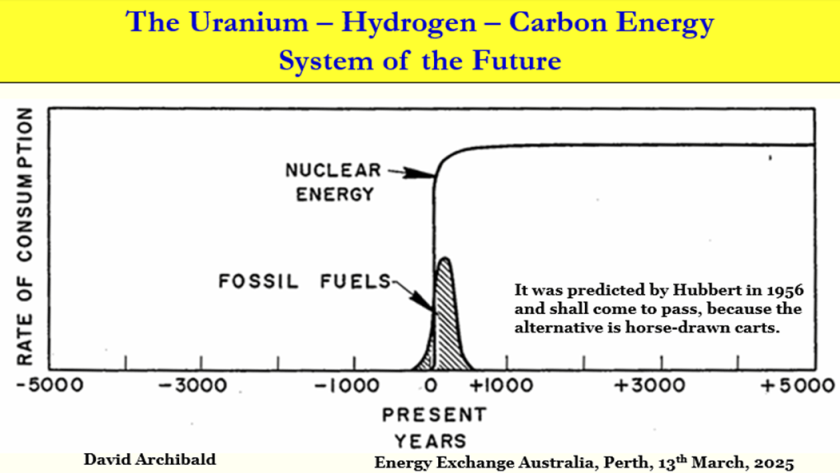
We have established that what we need is our nuclear future as soon as possible. There is no alternative, as a famous lady once said. It is a case of either going nuclear or it’s back to horse drawn carts and a seventeenth century standard of living at best.
But what sort of nuclear? It should not be the current dominant nuclear technology of U235-burning light water reactors. These have dominated since the original one in the first nuclear submarine, the USS Nautilus of 1956. The technology of nuclear reactors hasn’t changed much in the last 70 years.
This graph shows why that is such a bad thing. Producing one gigawatt of power continuously over a year requires the fissioning of one tonne of something. To achieve that in light water reactors, you start with 250 tonnes of uranium as mined out of the ground.
You then concentrate the U235 component up from 0.7 percent to 3.5 percent in 35 tonnes of what you started with. This is done at some expense and relies upon the 1.1 percent mass difference between U235 and U238. Nevertheless, 29 percent of the U235 you started with gets thrown out in the other 215 tonnes of uranium which is then called depleted uranium.
The 35 tonnes of enriched uranium are made up into fuel rods clad in zirconium. After three years in a reactor, they are pulled and put into long term storage. They contain one tonne of fission products, 300 kilos of unburnt U235 and another 300 kilos of plutonium that has bred from uranium atoms capturing a neutron. By the time the rods are pulled, half the energy being produced is coming from the plutonium created in the rods.
The whole process only uses 0.4 percent of the energy contained in the 250 tonnes of as-mined uranium. This is one two hundred and fiftieth.
Nobody could be proud of such a wasteful technology. Thankfully, there is a better way.
Before we get to that, there are two problems with nuclear energy that nobody on either side seem to want to talk about.
The big one is that once a reactor has settled down to a continuous power output, seven percent of that power is coming from nuclei that have absorbed a neutron but have yet to split and release energy. They will split, perhaps months or years later. That means you can shut a reactor down by with its control rods but it will still be producing heat.
So a 1,000 MW thermal reactor, which would produce 300 MW of electrical power, will be producing 70 MW of heat from delayed fission reactions. That drops away rapidly but remains significant. If the coolant pipes are broken or the coolant pumps have lost power, or the generators to power those pumps have run out of diesel, then the core heats up and the remaining steam reacts with the zirconium of the fuels rods to produce hydrogen. The hydrogen accumulates in the containment building and explodes.
That is what happened to the three operating reactors at Fukushima after the earthquake and tsunami on 11th March, 2011. Reactor No 1 exploded the following day with No2 and No 3 a couple of days later. Making your reactors bigger to achieve economies of scale makes the problem of shedding heat harder to overcome.
Also, most of the spent fuel rods produced each year around the world are not reprocessed. In the United States they are piling up at 2,000 tonnes per annum with the total now at 98,000 tonnes.
There is one reactor type that solves both those problems as well as the problem that the current dominant technology only uses 0.4 percent of our uranium endowment.
This is the plutonium breeder reactor which has been successfully operated in Russia for decades, and also successfully put into operation in France.
There is no waste. Everything is recycled until it is burnt up. They can be online two years after the concrete foundations have been laid. There are several designs available. We should install them all and see what works best.
The economics of plutonium breeder reactors are competitive with current coal-fired costs.
Adopting plutonium breeder reactors will unlock an even bigger energy resource. As well as breeding U238 to plutonium, thorium can be bred to U233.
Breeding U238 to plutonium has a theoretical margin of 30 percent. That is, under ideal conditions, you will produce 30% more nuclear fuel than you started with. Breeding U233 from thorium has only an eight percent margin which might disappear with neutron losses to the containment vessel and so on.
Every spare neutron from breeding plutonium from uranium should be applied to breeding from thorium. This means that our nuclear endowment would last 1,250 times longer than if just used the current U235-burning technology.
There is a better future, and there is an even better future. That is the promise of thorium.
Nuclear technology hasn’t changed for 70 years. We are just using variations of the first nuclear reactor that went to sea. The space business was the same with cost of getting stuff into orbit unchanged for decades. Then Space X came along and dropped costs by 90 percent. The same potential for much lower costs also occurs in nuclear power.
How fast can we do the nuclear reactor rollout we need to do as soon as possible? Let’s take the example of France after they decided to go all-in on nuclear in the 1970s.
This graph shows the contribution from hydro power in blue, yellow is the nuclear component, brown is fossil fuels and green represents the hopeless renewables. The blue bar is 245 terra watt hours which is Australia’s current power consumption.
France was able to install 245 terrawatt hours of nuclear capacity over the twelve years from 1980 to 1992. To suggest that Australia couldn’t also install 245 terrawatt hours of nuclear capacity over twelve years would mean that the French are better than us, even the French of 40 years ago before all the improvements in manufacturing technology since. That is just not possible so we can also do it in twelve years.
The four pillars of civilisation are diesel, plastics, steel and concrete. All those things need carbon if made with current technology. So, when the fossil fuels run out, where will the carbon come from? That will require plantation forests of eucalypts. This graph shows the square metres of eucalypt plantation required per capita for each pillar of civilisation. All up it is about 300 square metres or less than a small suburban block, and eminently doable.
In summary, we will be going to Net Zero whether we like it or not. Because one day we will run out of coal and oil and all the other good stuff from the Earth.
But we have a perfectly wonderful future to look forward to with nuclear power by the breeder reactor route.
Instead of burning coal in power plants, it should be saved for making synthetic diesel. Our motto should be ‘conserve to convert”.
Hydrogen enables the conversion of electric power from nuclear reactors to chemical potential. Hydrogen will be a big part of our future.
Carbon is the carrier molecule that enables hydrogen to be used at room temperature and pressure. The sooner we start down that route, the safer we will be.
What happens when ideology hijacks science? You get articles like Scientific American’s recent gem, “How Feminism Can Guide Climate Change Action.” Spoiler: it’s yet another attempt to inject a political narrative into a domain that’s already drowning in bad policy, shaky science, and unworkable solutions. Feminism is the latest player in the climate theater, but the real show here isn’t how feminism can save the planet—it’s how the planet doesn’t need saving at all.
What happens when ideology hijacks science? You get articles like Scientific American’s recent gem, “How Feminism Can Guide Climate Change Action.” Spoiler: it’s yet another attempt to inject a political narrative into a domain that’s already drowning in bad policy, shaky science, and unworkable solutions. Feminism is the latest player in the climate theater, but the real show here isn’t how feminism can save the planet—it’s how the planet doesn’t need saving at all.
The article argues that feminism has the tools to guide climate change action because—wait for it—the current economic system
… rooted in the extraction of natural resources and exploitation of cheap or unpaid labor, often done by women and marginalized communities.
This curious fusion of gender politics and environmentalism is not only absurd; it’s irrelevant. Whether or not economic systems “exploit labor” has nothing to do with global temperature changes. But don’t expect Scientific American to let facts get in the way of a good narrative.
Here’s the reality: the models and measurements underpinning climate alarmism are fraught with uncertainties. Predicting global temperatures decades into the future requires assumptions about everything from solar cycles to cloud dynamics to technological advancement. And yet, the article barrels ahead, proposing to dismantle capitalism based on flawed projections and untested theories. Feminism is just the latest garnish on this overcooked dish.
Feminism’s “Solutions” to a Nonexistent Problem
The article offers a laundry list of feminist-flavored fixes for the supposed climate crisis:
Redistribute resources: Translation: punish industries that create value and jobs, and funnel those resources into vaguely defined “regenerative” projects. How this reduces global temperatures remains a mystery.
Representation of women’s voices: The authors claim diverse representation will lead to better environmental decisions. But here’s the thing: climate policies based on bad science remain bad policies, no matter who proposes them.
Reparations and corporate taxes: Wealthy nations and corporations, they argue, owe reparations to the Global South for their supposed climate sins. This ignores the fact that industrialized economies have lifted billions out of poverty, including in those very nations. Penalizing success will do nothing to stabilize the climate—it will only hinder innovation.
None of these proposals address the glaring uncertainties in climate science. Instead, they assume we can predict the future with precision and that drastic, economy-destroying measures are the only option. Newsflash: they’re not.
Cherry-Picked Suffering
The authors claim that climate change disproportionately harms women, citing figures like
…globally, climate change may push up to 158 million more women and girls into poverty, and 236 million more women and girls into food insecurity, by 2050…
Let’s set aside the implausibility of these projections (seriously, who’s calculating poverty rates three decades out?). What they don’t mention is that poverty, drought, and disaster affect everyone. Men, women, and children all suffer when economic opportunities are stifled by misguided climate policies—like forcing developing nations to forego cheap, reliable energy in favor of expensive renewables.
The authors also link climate change to child marriage and girls dropping out of school. This is a masterclass in misdirection. Climate change isn’t driving these social issues—poverty and cultural norms are. And poverty is exacerbated when developing countries are told they can’t use their natural resources to fuel their economies. The feminist angle here is not only misleading; it’s counterproductive.
Romanticizing the Unrealistic
The article fawns over concepts like “Buen Vivir” (Living Well), a philosophy from Bolivia and Ecuador that emphasizes harmony with nature. Sounds lovely, until you remember that Bolivia’s economy is heavily dependent on lithium mining—one of the most environmentally destructive industries on the planet. That lithium, by the way, is essential for the batteries powering the solar panels and electric vehicles so beloved by climate activists. The hypocrisy is almost too rich.
Ignoring Reality: The Problem With Climate Policies
Let’s be honest: the problem isn’t that feminism is being used to shape climate policy. The problem is climate policy itself. The science behind catastrophic climate predictions is riddled with uncertainties. Models struggle to account for natural variability, feedback loops, and the sheer complexity of the Earth’s climate system. Yet, we’re expected to gamble trillions of dollars on policies that, at best, might reduce global temperatures by a fraction of a degree by the end of the century.
The authors call for dismantling capitalism, redistributing resources, and taxing corporations—all under the guise of “feminist climate justice.” But even if you buy into the alarmist climate narrative (and you shouldn’t), these proposals would do little more than tank economies and exacerbate poverty. Ironically, the very people feminism claims to champion—women and marginalized groups—would suffer the most.
The Bigger Picture: Climate Uncertainty
At its core, this article is yet another distraction from the inconvenient truth: climate policies are pointless because the underlying science is far from settled. We don’t know what the climate will look like in 10 years, let alone 100. The Earth’s climate has always changed—it’s been warmer, it’s been colder, and humans have survived and thrived through it all. Betting the global economy on unreliable models and untested policies is not only reckless; it’s unnecessary.
Instead of embracing uncertainty and focusing on resilience, climate activists double down on their dogma. And now, they’re dragging feminism into the fray, hoping the veneer of social justice will mask the flaws in their argument. Spoiler alert: it doesn’t.
Conclusion: Feminism Won’t Save the Climate, and Neither Should We
The real takeaway from this article isn’t that feminism can guide climate change action—it’s that climate change action doesn’t need guiding at all. The uncertainties in climate science make sweeping policies pointless at best and destructive at worst. Feminism, which in earlier incarnations may have been a worthy cause in its own right, has no business being shoehorned into this debate. And frankly, neither does any other ideology.
Instead of wasting time on “feminist climate justice” frameworks, perhaps it’s time to embrace a simpler truth: the climate will continue to change, as it always has. Our focus should be on adapting to those changes, not on indulging ideological fantasies. Anything else is just hot air.




You must be logged in to post a comment.