Global warming, climate change, all these things are just a dream come true for politicians. I deal with evidence and not with frightening computer models because the seeker after truth does not put his faith in any consensus. The road to the truth is long and hard, but this is the road we must follow. People who describe the unprecedented comfort and ease of modern life as a climate disaster, in my opinion have no idea what a real problem is.
Elon Musk’s DOGE crew continues to shine a light on how our federal government operates, and it is exposing more climate grift than even the most cynical among us could have imagined. The latest involves the EPA giving failed Georgia gubernatorial candidate Stacey Abrams $2 billion to expand “clean energy by prioritizing housing, equity, and resilience.”
Elon Musk’s DOGE crew continues to shine a light on how our federal government operates, and it is exposing more climate grift than even the most cynical among us could have imagined. The latest involves the EPA giving failed Georgia gubernatorial candidate Stacey Abrams $2 billion to expand “clean energy by prioritizing housing, equity, and resilience.” Her organization, Power Forward Communities, says it will install heat pumps, solar panels, EV chargers, and other “green” technology. Does Abrams have any expertise in this field? No. In fact, her organization incorporated itself with $100 in the bank just months before receiving $2 billion of our tax money. The Washington Free Beacon also reported this week that the man Biden put in charge of the EPA’s “Greenhouse Gas Reduction Fund” funneled $5 billion to his former employer, something called the Coalition for Green Capital.
The climate grifters are being exposed, and the EPA is trying to claw these billions of dollars back. But how deep does the corruption go? We’re bringing in Steve Milloy of the Energy and Environmental Legal Institute, an EPA transition team member in Trump’s first term, to get a handle on it. The Heartland Institute’s Anthony Watts, H. Sterling Burnett, Linnea Lueken, and Jim Lakely will also cover some of the Crazy Climate News of the Week, including a look at NOAA data showing the second-biggest month-to-month temperature drop since 2009.
Join us LIVE at 1 p.m. ET in the chat, where you can have some fun with fellow viewers and get your questions answered from the best climate and energy experts streaming anywhere.
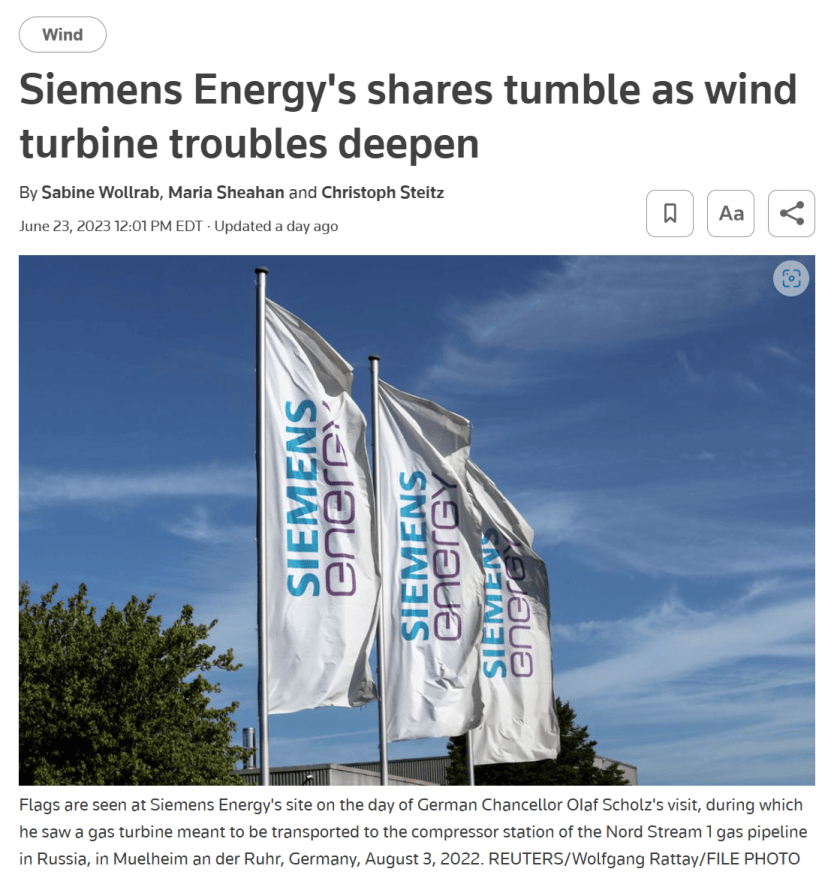
The stunning 37% plunge in Siemens Energy’s stock value should serve as a reality check for climate change alarmists. The cause, an escalating crisis in their wind turbine division, shows us that massive resources are being poured into a sector that is, in many ways, still uncertain and unproven.
The stunning 37% plunge in Siemens Energy’s stock value should serve as a reality check for climate change alarmists. The cause, an escalating crisis in their wind turbine division, shows us that massive resources are being poured into a sector that is, in many ways, still uncertain and unproven. Instead of funneling resources towards potentially flawed green technology to tackle a problem that might not even exist, we should be focusing on optimizing reliable and efficient energy sources that have served us well for centuries, and a greater reliance on nuclear to provide base-load power.
The scale of these costs serves as a stark reminder of the vast amounts of money currently being funneled into green energy technology. While it might be considered commendable to explore new ways to generate power, it becomes problematic when the resources allocated towards these efforts are massively disproportionate to the measurable benefits they deliver, as well as proving to be unsustainable without massive government subsidies.
A significant portion of these investments is driven by the perceived need to combat climate change. However, there’s considerable debate around the magnitude and urgency of this issue. Is it truly necessary to disrupt entire sectors of the economy, invest trillions of dollars, and place our faith in unproven technologies to address a problem whose severity is far from unanimously agreed upon?
Siemens Energy’s troubles highlight the potential pitfalls of this approach. Despite enormous investments in wind energy, the technology is still prone to significant failures, leading to massive unforeseen costs. This raises questions about the overall effectiveness of this green transition and the wisdom of prioritizing these technologies over traditional energy sources.
Focusing on optimizing our existing energy infrastructure could lead to more immediate and cost-effective results. For example, improving the efficiency of traditional power plants, modernizing the electricity grid, and expanding nuclear power could all contribute to cleaner, more reliable energy without the risks and uncertainty associated with renewable technology.
Moreover, focusing on economic growth and technological innovation can also deliver environmental benefits. Prosperous societies have more resources to allocate towards environmental conservation, and technological advancements often lead to more efficient use of resources. Rather than rushing headlong into a green transition, if only saner heads could prevail, we could reconsider our approach to energy policy.
In conclusion, the fall in Siemens Energy’s stock value is a sobering reminder of the risks and costs associated with the foolhardy rush towards renewable energy. Instead of investing vast resources into a potentially overhyped climate change problem, we should take a more balanced approach, focusing on tried-and-tested technologies, economic growth, and innovation. This would ensure reliable, affordable energy for all, while still addressing environmental concerns in a realistic and economically sustainable way.


You must be logged in to post a comment.