Global warming, climate change, all these things are just a dream come true for politicians. I deal with evidence and not with frightening computer models because the seeker after truth does not put his faith in any consensus. The road to the truth is long and hard, but this is the road we must follow. People who describe the unprecedented comfort and ease of modern life as a climate disaster, in my opinion have no idea what a real problem is.
A recent column by William Murray, former chief speechwriter for the Environmental Protection Agency (EPA) and a past editor of RealClearEnergy, lays bare how promises made by far-left environmentalists fell far short of their assurances. Murray points out that $20 trillion – that’s $20 trillion – has been spent (over the last couple of decades, according to his source), largely by the U.S. and Europe, to “decarbonize” the global economy. Murray notes that the expenditure is “pretty much the total present value of America’s GDP.”
Nearly all of us have fallen prey to schemes, scams, or even well-intentioned projects that come up short of the results promised for the money spent.
For instance, the new year has undoubtedly brought the annual rush of gym memberships from Americans convinced they’ll shed those holiday pounds and get back into shape. Or there’s that extended warranty we were talked into on a large kitchen appliance that wouldn’t go bad unless it was dropped from the top of a 10-story building. How ‘bout that costly monthly charge we incur for a streaming service so we can enjoy the one show we’re really going to watch?
Time and again, Americans find themselves on the short end of the stick, paying through the nose for services that never live up to their promise. Nowhere is that more evident than in the decades-long climate-based hoax that promised a revolution in the energy industry to save us all from extinction.
A recent column by William Murray, former chief speechwriter for the Environmental Protection Agency (EPA) and a past editor of RealClearEnergy, lays bare how promises made by far-left environmentalists fell far short of their assurances. Murray points out that $20 trillion – that’s $20 trillion – has been spent (over the last couple of decades, according to his source), largely by the U.S. and Europe, to “decarbonize” the global economy. Murray notes that the expenditure is “pretty much the total present value of America’s GDP.”
The result?
“Hydrocarbon consumption continued to increase anyway. All that was achieved was a tiny reduction, just 2%, in the share of overall energy supplied by hydrocarbons. Put simply, as the energy pie got bigger and all forms of energy supply increased, hydrocarbons ended up with a slightly smaller share of a larger pie.”
If such a pitiful return on investment happened in any other walk of life, companies pushing the scheme would go bankrupt and reputations would be in shambles. But the “climate warriors” just grow more emboldened.
Haven’t renewables made great strides? That’s what we read in the mainstream media, parroting the renewables industries. But read the careful wording used by most advocates of renewables when they boast about advancements.
For instance, The Renewable Energy Institute featured a story headlined, “Renewables Account for 90% of US Power Generation in 2024.” Wow! But the details were a little less impressive, clarifying that “renewable energy made up nearly 90% of the total U.S. power generation capacity added during the first 3 quarters of 2024, as per a review conducted by the SUN DAY Campaign using Federal Energy Regulatory Commission (FERC) data.”
At first glance, readers not carefully parsing the language – or relying only on the headline – might think that renewable energy accounted for 90 percent of total power generation in the first three quarters of 2024. Of course, that’s not the case. The story was merely claiming that 90 percent “of the total U.S. power generation capacity added (emphasis added)” was from renewable energy.
In fact, as reported by the U.S. Energy Information Administration, “In 2024, the United States produced a record amount of energy, according to data in our Monthly Energy Review. U.S. total energy production was more than 103 quadrillion British thermal units in 2024, a 1% increase from the previous record set in 2023.” In other words, the renewable industry is claiming responsibility for 90% of the 1% added (at least during the first three quarters). Fine.
In reality, the top sources for energy in 2024 continued to be natural gas and natural gas plant liquids (47% combined), crude oil (27%), and coal (10%). In fact, natural gas plant liquids (9% of total energy production when broken out alone) were up 7% from 2023.
“Domestic NGPL production have increased every year since 2005 as U.S. natural gas production and processing capacity have increased,” according to the report. Meanwhile, all “renewables” (wood, waste, wind, solar, geothermal) combined accounted for the remaining 16% of total U.S. energy produced. Wind blew in at just over 1.5% of all energy produced, with solar just over 1%.
Here’s the kicker: Even just a 1% capacity increase from 2023 to 2024 meant that the U.S. produced record levels of total energy capacity. However, electricity capacity powered by wind and solar provides “almost no reliability to the grid.”
That’s according to Mitch Rolling and Isaac Orr of the “Energy Bad Boys” Substack, who point out that “wind and solar capacity is not the same as dispatchable capacity due to their intermittency. Intermittent generators are inferior to dispatchable resources for a number of reasons, but mainly because operators cannot control when they produce electricity and when they won’t.”
As an example, “Despite having more capacity installed than ever before, reliable capacity in PJM (the Pennsylvania-New Jersey-Maryland regional transmission organization) has actually decreased by 2 gigawatts (GW) since 2016, from 198 GW to 196 GW, and is down 6.8 GW since firm capacity peaked in 2018. This comes at a time when peak demand hit new records in 2025 at over 160 GW, according to data from the EIA Hourly Electric Grid Monitor.”
The $20 trillion investment in “decarbonization” in the U.S. and Europe has been an abject failure. It would be a wiser expenditure of tax dollars for governments to subsidize lifetime gym memberships for every citizen. At least then there’d be a slight possibility of some return on investment.
A whole world of trouble will come your way if your plans are built on averages but you cannot live with the extremes. Or even with substantial variations. Europe, and other progressive energy parts of the world, are finding this out the hard way.
I’m not sure about you, but the last thing I want to talk about is elections. When I think of how much of my precious time has been wasted hearing about politics in the last year, I want to puke. No more from pollsters, talking heads, or statisticians.
Well, maybe I’d like to talk about statisticians, as in the old joke about the one that drowned because he forded a river that was only three feet deep, on average. See, isn’t that better than politics already? However, as funny as a drowned statistician may be, there is a serious side to the problem with relying on averages. You really can die, for starters.
Before getting back to death and/or politics again (redundancy, I know), let’s think about the use of averages. A car may be designed for the average – one doesn’t find the tallest person on earth and design an interior to accommodate them. The exceptions get to either bang their shins or dangle their feet, but that’s the way it has to be.
In other areas, it can’t work that way. Do you insulate your house for average conditions? No, of course not. Do you install an air conditioner for average conditions? Same. And on it goes. When the risk of harm goes up, we design for the extremes, not the averages. Or we should.
A whole world of trouble will come your way if your plans are built on averages but you cannot live with the extremes. Or even with substantial variations. Europe, and other progressive energy parts of the world, are finding this out the hard way.
In the race to decarbonize the energy system, wind and solar have taken a dominant lead. Nuclear is widely despised. Hydrogen has potential, but is a long way out, as a major player. On the assumption that Hydrocarbons Must Go At Any Cost, wind and solar are the winners. Bring on the trillions. Throw up wind turbines everywhere. Blanket the countryside in solar panels.
The media loves the wattage count as fodder for headlines; big numbers dazzle people. “The United States is on pace to install record amounts of wind and solar this year, underscoring America’s capacity to build renewables at a level once considered impossible…The U.S. Energy Information Administration expects the U.S. will install 37 gigawatts of new wind and solar capacity this year, obliterating the previous record of almost 17 GW in 2016,” bleated the ironically named Scientific American website. Wow, gigawatts. No idea what those are but they sound huge.
What is the problem with all that capacity? Well, how good is it? Let’s see…at a 33 per cent capacity factor (used by the US government as apparently reasonable), that 37 GW is just over 12 GW of power contributed to the grid, on average. The assumption seems to be then that 12 GW of dirty old hydrocarbons have been rendered obsolete, and, for the energy rube, the number is an even more righteous 37 GW, because, you know, some days it is really windy all over.
But, what happens when that load factor is…zero? Because it happens.
The current poster child for the issue is Great Britain. The UK has 24 GW of wind power installed. The media loves to talk about total renewable GW installed as proof of progress, and the blindingly rapid pace of the energy transition.
However over the past few weeks wind dropped almost to zero, and output from that 24 GW of installed capacity fell to about 1 or 2 GW.
Ordinarily, that would be no problem – just fire up the gas fired power plants, or import power from elsewhere.
But what happens when that isn’t available?
More pertinently, what happens when the likelihood of near-zero output happens to coincide with the times when that power is needed most – in heat waves, or cold spells? That brings us to the current grave situation facing Europe as it heads towards winter. Gas storage is supposed to be filling rapidly at this time of year, but it’s not, for a number of reasons.
Natural gas isn’t supposed to be on anyone’s roadmap, though. The culturally hip website Wired talked (in early September) about the imperative to limit global warming: “To make the switch we need to switch to renewable energy, such as solar, wind and geothermal, right now. We’re making good progress on this; solar and wind energy are now cheaper than fossil fuels, and renewable energy was responsible for around a third of global electricity production in 2020.” The first glimmer into the damage of relying on averages starts to show.
A few weeks later, Wired shows that a few light bulbs may be going on: “There’s a tendency for the government to say the power sector is done, the sector has been decarbonised, the renewables transition is going at pace and all of that good stuff,” the article quotes the head of Energy UK.
The article’s author, after musing that seven UK energy supply firms have gone out of business so far this year (a result of having to pay more to generate/acquire power than their locked in sales values), makes one of those profound British understatements of the my-arms-are-cut-off-and-I-appear-to-be-in-a-spot-of-trouble-old-chap variety: “And we’re reliant on gas more generally than we thought.” No, foul dullard, we are more reliant than you thought. Anyone in the business of providing energy could have told you that, but the simpleton army wouldn’t listen. And now you pay.
They could easily have asked experts, like providers of hydrocarbons. But those people are today’s lepers. No one is interested in their opinion for fear of the appearance of collaboration. (Trudeau set up a “Net Zero Advisory Body” with the mandate to identify net-zero pathways; NZAB has posted the records of meetings to date (24); only once – once – has ‘oil and gas’ been mentioned in the records, and the context is dumbfounding: “Members received a foundational briefing on the oil & gas sector from federal officials.” FROM FEDERAL OFFICIALS. Meanwhile, the NZAB also heard a presentation directly from the David Suzuki Foundation. This should end well.)
Let’s drive this energy conundrum home a little better for all these people who are, as Principal Skinner put it on the Simpsons, “furrowing their brows in a vain attempt to comprehend the situation.”
The world has been sold a faulty bill of goods, based on a pathetically simplistic vision of how renewable energy works. A US government website highlights the problem with this example: “The mean turbine capacity in the U.S. Wind Turbine Database is 1.67 megawatts (MW), At a 33% capacity factor, that average turbine would generate over 402,000 kWh per month – enough for over 460 average U.S. homes.”
Thus armed, bureaucrats and morons head straight to the promised land by multiplying the number of wind turbines by 460 and shocking-and-awing themselves with the results. Holy crap, we don’t need natural gas anymore (as they tell me in exactly those words).
So they all start dismantling the natural gas system – not directly by ripping up pipelines, but indirectly by blocking new ones, by championing ‘fossil-fuel divestment campaigns’, by taking energy policy advice from Swedish teenagers – and then stand there shivering in dim-witted stupor when the wind stops blowing, and the world’s energy producers are not in any position to bring forth more natural gas.
It’s not just Britain that is squirming. A Bloomberg article (which I cannot link to as I will never willingly send Bloomberg a cent) notes the following unsettling news: “China is staring down another winter of power shortages that threaten to upend its economic recovery as a global energy supply crunch sends the price of fuels skyrocketing. The world’s second biggest economy is at risk of not having enough coal and natural gas – used to heat households and power factories – despite efforts over the past year to stockpile fuel as rivals in North Asia and Europe compete for a finite supply.”
It is profoundly important to recognize that these comments come from Bloomberg – a ‘news’ institution that is going far, far out of its way to demonize, deprecate, and decapitate the hydrocarbon industry. That hydrocarbon industry, by the way, is making major inroads in ways these demonizers deem impossible – developing carbon capture/storage, reducing methane emissions, working on hydrogen solutions, and even succeeding at First Nations inclusion such as demonstrated by groups like Project Reconciliation (trying to buy TransMountain) and the recent purchase of an oil sands pipeline by 8 local First Nations and Suncor. That same hydrocarbon industry is working overdrive to solve emissions problems and engage First Nations.29dk2902lhttps://boereport.com/29dk2902l.html
A lot of the global energy-transition-now madness stems from such a basic inability to grasp certain fundamentals, which are not at all hard to understand if one wants to, but are impossible for those who require an energy villain to add righteousness to their campaign. You can install all the wind and solar you want, but if their output can go to zero, and more importantly if their output is more likely to go to zero when most needed (extreme heat (low wind, inefficient solar panels) or extreme cold (low wind, obvious solar shortcomings)), then you don’t have an energy system at all. And don’t put up your hand to say batteries are coming someday soon. The math on that as a NG replacement is even more laughable.
Yeah, yeah, I can hear it already, how terrible, coming down so hard on a bunch of hapless bandwagon-jumping commentators. Yeah, about that. That bandwagon is cutting off the world’s fuel supply at its knees. There will be consequences. Serious ones.
Hundreds of millions of people without adequate heating fuel in the dead of winter is not particularly funny. If a cold winter strikes, all the yappiest energy-transition-now dogs will fade into the woodwork, distancing themselves from the disinformation they’ve propagated and the disaster they’ve engineered. People in position of responsibility will have no choice but to speak out loud the words they’ve dared not utter for a decade: you need hydrocarbons, today, tomorrow, and for a very long time yet. So start acting like it.
Buy it while it’s still legal! Before the book burnin’ starts…pick up “The End of Fossil Fuel Insanity” at Amazon.ca, Indigo.ca, or Amazon.com. Thanks for the support.
Read more insightful analysis from Terry Etam here, or email Terry here.
Steel is essential in modern society, providing us with homes, factories, bridges, vehicles and all manner of other machines and infrastructure. Since 2001, global crude steel production has doubled and the demand will continue to rise in the coming decades.
Steel is essential in modern society, providing us with homes, factories, bridges, vehicles and all manner of other machines and infrastructure. Since 2001, global crude steel production has doubled and the demand will continue to rise in the coming decades.
In the climate obsessed’s rush to “decarbonize” heavy industry, hydrogen-based steel manufacturing is being touted as a “clean” alternative to the traditional coal-based process for steelmaking. With seemingly little thought being applied, policymakers, environmentalists, and some industry leaders are promoting hydrogen-fueled manufacturing with an enthusiasm once reserved for solar panels.
However, a shift towards hydrogen steelmaking risks undoing a century of progress in efficient production. The high costs, technological challenges, and limited scalability of hydrogen-based processes are guaranteed to render it less viable than steelmaking relying on coal.
The Evolution of Steelmaking Efficiency
The steel industry has been a cornerstone of industrial development, and its evolution is a testament to human ingenuity and technological advancement. In the early 20th century, the introduction of the basic oxygen furnace revolutionized steel production.
Over the decades, continuous improvements in blast furnace technology, process control and energy recovery have led to significant gains in productivity and energy efficiency. China continues to dominate in production capacity and exports, with industry giants like Baowu Group at the forefront. Other significant steel producers include Japan’s Nippon Steel & Sumitomo Metal Corp., India’s Tata Steel, South Korea’s POSCO and Europe’s ArcelorMittal.
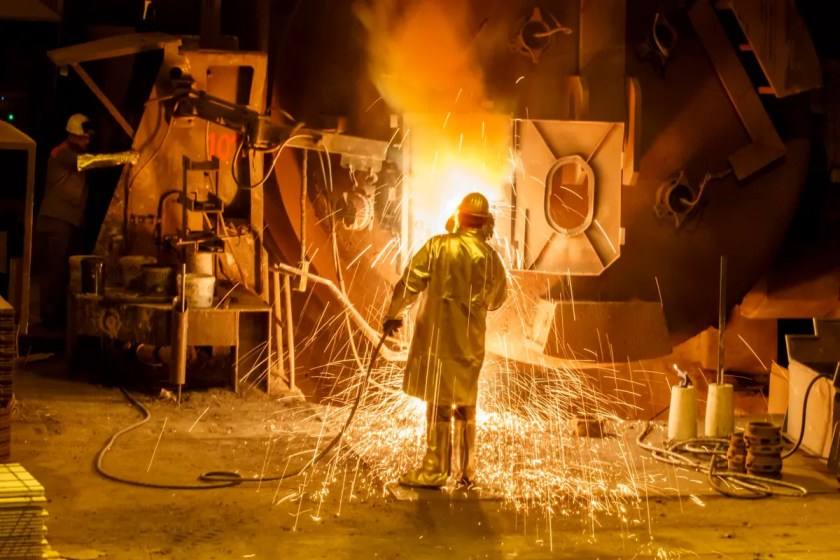
Today’s integrated steel mills are marvels of engineering, capable of producing millions of tons annually with remarkable efficiency. The best-performing blast furnaces can achieve energy efficiencies of up to 70%, a figure that seemed unattainable just a few decades ago. The risk of abandoning this tried-and-true method for a relatively untested hydrogen-based process cannot be overstated.
The Perils of Hydrogen Steelmaking
Hydrogen-based steel production, particularly the direct reduced iron process using hydrogen, is presented as a solution to climate change. But the production of so-called green hydrogen, which is produced with “renewable” energy, can cost twice as much as coal.
Conservative estimates suggest that hydrogen-based steel production could be 20-30% more costly than traditional methods. This cost differential is not trivial in an industry with tight margins and intense global competition.
The increased costs would ripple through the economy, affecting construction, automotive manufacturing, and countless other industries that rely on affordable steel.
Rystad Energysays “green” steel can be made competitive only by imposing heavy taxes on coal-based steel or by allocating huge subsidies to steel makers.
Moreover, hydrogen made through electrolysis is energy intensive. To produce enough to meet the steel industry’s needs would require a massive expansion of renewable energy capacity, far beyond current projections.
While pilot green hydrogen projects exist, it has not been proven at industrial scales. In contrast, one of the most significant advantages of coal-based steelmaking is its ability to operate at massive scales.
Modern blast furnaces can produce up to 400 tons of steel per hour, operating continuously for years between major maintenance periods. This scale of production is crucial for meeting global steel demand, which stood at 1.95 billion tons in 2021 and is projected to grow.
Coal’s abundance and established supply chains make possible this sustained level of production. Capable of supplying the steel sector with the approximately one billion tons of coal annually, the industry’s infrastructure for mining, transporting and utilizing coal in steelmaking has been developed and refined over more than a century.
On the other hand, hydrogen-based steelmaking is one more absurd proposal of those fearmongering about global warming that would have virtually no effect on Earth’s temperature but would slow the economic growth and infrastructure development of our modern world.
This commentary was first published at RealClearMarkets on August 23, 2024.
Vijay Jayaraj is a Research and Science Associate at the CO2 Coalition, Arlington, Virginia. He holds a master’s degree in environmental sciences from the University of East Anglia, U.K., and a postgraduate degree in energy management from Robert Gordon University, U.K.
Right when they are meant to be growing by double digits German EV car sales are down an astonishing 30% compared to a year ago. Their market share is actually shrinking. EV’s are not much good at reducing carbon dioxide over their lifetime but they are very useful for pretending to “decarbonise” the transport sector.
Electric cars and carbon target fantasies are hitting the wall
Right when they are meant to be growing by double digits German EV car sales are down an astonishing 30% compared to a year ago. Their market share is actually shrinking. EV’s are not much good at reducing carbon dioxide over their lifetime but they are very useful for pretending to “decarbonise” the transport sector. So this creates a vast hole in the German government’s so-called transition, which has fixed targets for every sector. Problematically, the transport sector just doesn’t seem to run on wind and solar panels, or pumped hydro. It’s hard to decarbonize. Liquid fuel is just too convenient.
It seems the German Transport Minister is threatening to ban weekend driving as an ambit claim to expose the absurdity of the Green’s position. He is warning that if the Greens don’t sign a change in legislation to average emission across all sectors, he will have to take drastic action to meet the transport sector goals, which means banning driving on weekends. (Trap set.)
The Greens responded like any petty tyrants would, saying he shouldn’t aggravate people unnecessarily, because there were other ways to fix the climate, like forcing everyone to drive slower. (Trap sprung.) The Greens stepped right into it:
“This claim is simply wrong,” Green parliamentary group leader Julia Verlinden told the German Press Agency, referring to Wissing’s threat of a weekend driving ban. She added that Wissing should not aggravate people unnecessarily because there are other ways to tackle climate issues, such as a speed limit. — Politico
Naturally, at the next election, policies that make people drive slower to stop storms 80 years from now will sink like a boat full of burning cars.
Volker Wissing (the Transport Minister) is a member of the Free Democratic Party (FDP) which is theoretically a centre right party. Because the German government is a “traffic light coalition” of three different parties, he needs to work with the Greens to get legislation passed, but he doesn’t have to help them win the next election.
As Pierre Gosselin at NoTricksZone points out the German government are not even close to hitting their EV targets: “The massive sales drop is bad news for the current German socialist-green government, which aims to have 15 million vehicles on the road by 2030. Currently there are just 1.4 million!”
So they’re 13.6 million cars short with only 5 years and 9 months to get there. At the current rate of sales they’re going miss their target by 11 million cars.
Germany’s ambitions to take a leading role in electromobility suffered a severe setback in the first quarter of this year. A significant drop in sales is emerging. Only 31,384 electric vehicles were newly registered in March, a drastic decrease of 28.9 percent compared to the previous year. The collapse in registrations contrasts with the political goals and underlines the gap between political planning and actual market conditions. The challenge lies in whether political measures are effective enough to counter consumer preferences and market dynamics
Electric car shock: market share falls to 11.9% – end of subsidies exposes Germany’s dilemma
The abolition of the electric bonus at the end of 2023 has revealed another problem. The sector’s dependence on government subsidies became visible. This has further exacerbated the crisis of confidence in the electric car market.
And so we arrive at the ugly point where the planned economy meets the real one:
By Šejla Ahmatović Politico, [Translated by Google]
The ruling coalition has been fighting over legislation that sets out binding climate targets.
Germany’s transport minister is threatening to ban driving on weekends to meet climate goals if the ruling coalition does not pass reforms to the Climate Protection Act by July.
A reduction in traffic to help meet the climate goals would only be possible through measures that are difficult to communicate to the public, such as “comprehensive and indefinite driving bans on Saturdays and Sundays,” Wissing added.
All Wissing is asking for is to spread the emissions reductions over other sectors:
The planned amendment to the emissions-reduction law allows climate goals to be reviewed for compliance by looking at all sectors together instead of individually. If the overall target is missed two years in a row, then the federal government is to decide in which sector and with which measures the permitted total amount of carbon dioxide emissions is to be achieved by 2030.
If the planned reforms are not passed through parliament by July 15, Wissing warned, the Ministry for Digital and Transport would be obliged to submit an “immediate action program that ensures compliance with the annual emission levels of the transport sector” until 2030 — which would include a driving ban on weekends.
Wissing has already said the government is not looking to put speed limits on highways. He’d probably quite like it if the Greens adopt that policy at the next election. The Greenpeace mobility expert (as if there is such a thing) is Clara Thompson who said that Wissing was coming up with “horror” scenarios to distract from his own failures. But at least as far as Politico reports it, she didn’t have any suggestions of how to solve electric vehicle nightmares with frozen batteries, slow charging, expensive repairs, car sickness, combustible materials, and holiday hell stories.
Politico: The health sector is responsible for 8.5 percent of U.S. emissions of greenhouse gases including carbon dioxide, methane and ozone — an outsized impact compared to the rest of the world. (Globally, health care systems contribute roughly 4.6 percent of total greenhouse gas emissions.) Without huge new efforts, the U.S. will have trouble reaching its ambitious emissions reduction goals. … The drive to reimagine anesthesia is part of a broader if belated effort to decarbonize U.S. health care, from the operating room to the cafeteria to the gardens and grounds. It’s a push spurred on by both medical professionals and Washington policymakers, who feel increased pressure to act amid the dangers of climate change and who acknowledge health care has been slow to engage on sustainability. …
The Veterans Administration and the Indian Health Service, which deliver health care to millions of people across the country, have been directed to reduce emissions and energy use as part of the Biden White House’s overall government climate policy.
For the rest of the health care system, HHS unveiled a Climate Pledge on Earth Day 2022 to spur more action. … About 116 health organizations, representing 872 hospitals as well as other health care sectors, have signed on. Along with the federal health systems, that represents about 15 percent of U.S. hospitals, HHS officials said.
#
‘Your Doctor will treat the climate first — & you will be happy’
Excerpts: Sometimes they’ll use more Earth-friendly drugs when appropriate. They’ve already stopped using another common anesthetic gas, called desflurane, which remains in the atmosphere for a decade or more, according to Shira Abeles, an infectious disease physician at UCSD, who recently became its medical director of sustainability.
She’s got plenty of science backing these shifts. The American Society of Anesthesiologists has identified alternatives that are better for the planet, just as safe for patients — and often cheaper.
“One hour of that volatile agent (desflurane) is equivalent to driving a car 250 miles, a gasoline car, I should say. And there’s very little we do in one hour,” said Joanne Donnelly, who, as director of the nurse anesthesia program at the University of Minnesota, has trained personnel in sustainable practices in hospitals across Minnesota and Wisconsin.
“Extrapolate that across an urban area, a region, a nation,” she said. “It’s an incredible impact.”
The drive to reimagine anesthesia is part of a broader if belated effort to decarbonize U.S. health care, from the operating room to the cafeteria to the gardens and grounds. It’s a push spurred on by both medical professionals and Washington policymakers, who feel increased pressure to act amid the dangers of climate change and who acknowledge health care has been slow to engage on sustainability.
The health sector is responsible for 8.5 percent of U.S. emissions of greenhouse gases including carbon dioxide, methane and ozone — an outsized impact compared to the rest of the world. (Globally, health care systems contribute roughly 4.6 percent of total greenhouse gas emissions.) Without huge new efforts, the U.S. will have trouble reaching its ambitious emissions reduction goals.
Within American health care, hospitals are the biggest source of emissions, not to mention generators of enormous amounts of nonrecyclable trash from all the single-use, disposable devices and supplies that head swiftly into landfills and incinerators.
Not every hospital is on board with transformation. Change can be expensive, and it’s always hard to overcome the inertia of the status quo. But health leaders see progress, and the Biden administration is doing its own part to push hospitals to overhaul their practices — with some success. The question is, will it be enough?
…
Hospitals in Vermont and Boston are growing vegetables in rooftop gardens; Seattle Children’s Hospital is planting conifers in greenery-starved poor neighborhoods. In drought-prone Los Angeles, a UCLA plastic surgeon suggested timers for operating room sinks; everyone still scrubs in, of course, but without wasting water. Some hospitals offer more plant-based meal options; New York Mayor Eric Adams, who follows a mostly vegan diet, saw to that in the city’s 11 public hospitals. Meanwhile, recycling medical waste is neither easy nor inexpensive; it’s more complicated than tossing a tuna can or yesterday’s newspaper into a blue bin. But that’s slowly changing as more health systems turn to FDA-certified companies that can recycle, sanitize or reprocess such waste.
… It’s become harder to ignore how extreme climate events and pollution endanger human health, with poor people, minority groups and elderly people particularly vulnerable. Extreme weather exacerbates heart, lung and kidney disease; it makes asthma worse. Mental health deteriorates. Heat waves kill people — directly, or by aggravating chronic conditions. Power outages in patient homes mean no refrigeration for insulin or electricity to keep oxygen tanks flowing.
…
“What excites me is that health professionals are starting to connect the reason why they’re there in the first place, which is to take care of patients, with the health impacts that are happening because of climate [which] their health systems are contributing to,” said Shanda Demorest, a nurse who is associate director for climate engagement and education at Health Care Without Harm, which along with its Practice Greenhealth arm, is a major force in pushing for new health and climate work.
The Veterans Administration and the Indian Health Service, which deliver health care to millions of people across the country, have been directed to reduce emissions and energy use as part of the Biden White House’s overall government climate policy.
For the rest of the health care system, HHS unveiled a Climate Pledge on Earth Day 2022 to spur more action. … About 116 health organizations, representing 872 hospitals as well as other health care sectors, have signed on. Along with the federal health systems, that represents about 15 percent of U.S. hospitals, HHS officials said.
…
The climate pledge is voluntary, but hospital sustainability experts insist it’s not the usual feel-good exercise. Signatories commit to specific actions and must publicly report progress toward cutting emissions by 50 percent by 2030 and cutting net emissions by 100 percent by 2050.
…
If hospital leaders start to perceive climate action as unavoidable — either because they anticipate it will be mandated or because they will face mounting pressure from within, particularly from younger doctors and nurses — they may start sooner rather than later.
HHS is aware that not all health systems are committed, and that even those that are may need help. McCannon said HHS is rolling out technical assistance and some grants.
…
But activists and sustainability teams want more. More tools. More metrics. More financial help.
…
Some advocates would like to see the federal government impose tough regulations and requirements to force change. Others suggest building incentives into Medicare payments to hospitals, which would give a government-imprimatur on health care greening without creating a new mandate. Climate benchmarks could be included in HHS’ “conditions for participation,” the practices that health providers must follow to be eligible for Medicare or Medicaid payments.
NY Post: Dr. Mohamed Fayed, a senior anesthetist at Detroit’s Henry Ford Health, made the suggestion during the American Society of Anesthesiologists’ annual conference last Friday in Orlando, Florida. “Global warming is affecting our daily life more and more, and the reduction of greenhouse gas emissions has become crucial,” he said. Dr. Fayed added, “No matter how small each effect is, it will add up. As anesthesiologists, we can contribute significantly to this cause by making little changes in our daily practice — such as lowering the flow of anesthetic gas — without affecting patient care.”
Study press release:“Anesthesiologists can play a role in reducing the greenhouse gas emissions that contribute to global warming by decreasing the amount of anesthetic gas provided during procedures without compromising patient care, suggests new research being presented at the American Society of Anesthesiologists’ ADVANCE 2023, the Anesthesiology Business Event.” [Climate Depot Note: The American Society of Anesthesiologists’ website appears to have pulled the article. but it is available here. & here.]
Research notes that inhaled anesthesia accounts for up to 0.1% of the world’s carbon emissions, which are regarded as the primary driver of global climate change. An hour of surgery using an inhaled anesthetic is equivalent to driving as many as 470 miles, according to a 2010 study.
#
Flashback 2020 Study in American Cancer Society Journal in 2020 Fretted over ‘carbon footprint of cancer care’ – ACS Journal: “Climate change and cancer” – Excerpt: “To date, no studies have estimated the carbon footprint of cancer care…The energy expenditure associated with operating cancer treatment facilities and medical devices, as well as the manufacturing, packaging, and shipment of devices and pharmaceuticals, contributes significantly to greenhouse gas emissions in cancer care…Some cancer treatment facilities have begun to consider their own carbon footprint and started a process to achieve carbon neutrality.”
Climate Depot’s Morano: “Here is a question for the American Cancer Society: If you need cancer treatment, would you go to a cancer treatment center that was worried about its carbon footprint? Or one that was worried about delivering the best possible modern care possible?”
Claim: Surgical General Anesthetic is Contributing to Climate Change– Switching from general to regional anaesthetics may help cut greenhouse emissions and ultimately help reduce global warming, a new study claims. While regional anaesthetics numb a certain part of the body, general anaesthetics make patients totally unconscious for what tend to be more serious procedures. But unlike regional anaesthetics, generals use volatile and environmentally-unfriendly halogenated agents, such as desflurane, or nitrous oxide. … ‘Green-gional’ anesthesia: the non-polluting benefits of regional anesthesia to decrease greenhouse gases and attenuate climate change
Claim: Surgical General Anesthetic is Contributing to Climate Change– Switching from general to regional anaesthetics may help cut greenhouse emissions and ultimately help reduce global warming, a new study claims. While regional anaesthetics numb a certain part of the body, general anaesthetics make patients totally unconscious for what tend to be more serious procedures. But unlike regional anaesthetics, generals use volatile and environmentally-unfriendly halogenated agents, such as desflurane, or nitrous oxide. … ‘Green-gional’ anesthesia: the non-polluting benefits of regional anesthesia to decrease greenhouse gases and attenuate climate change
Flashback 2019: Canadian Medical Association Journal: How health care contributes to climate change – Climate change is a growing health threat around the world — contributing to heat stroke, food insecurity, cardiorespiratory ailments and many other issues — and the health care industry is part of the problem. “It’s almost like the process of healing causes harm,” said Kent Waddington, cofounder of the Canadian Coalition for Green Health Care. Health care in Canada was responsible for 4.6% of national greenhouse gas emissions in 2009–2015, according to a recent study in PLOS Medicine. … The Canadian Coalition for Green Health Care has led projects to reduce the environmental impact of providing health care, such as promoting sustainable food in hospitals and reducing toxic chemicals used for cleaning.
2022: Operating rooms are the climate change contributor no one’s talking about – Two surgeons-in-training suggest some sustainable solutions for their energy-intensive discipline. ... Cancer care is an obvious target for greener efforts within surgery, Berlin notes, because it often involves intense levels of care over a short period of time. Plus, minimally invasive surgeries that require a lot of energy, including robotic-assisted operations, have become common treatments for cancers ranging from colorectal and uterine cancer to head and neck cancer. A robotic-assisted hysterectomy, for example, produces as much carbon as driving more than 2,200 miles in a car — the equivalent of a road trip from Ann Arbor, Mich., to Los Angeles. … Cancer care is an obvious target for greener efforts within surgery, Berlin notes, because it often involves intense levels of care over a short period of time. But perhaps the broadest way the oncology space could cut down on its greenhouse gas emissions is to change how surgical care is delivered, starting with permanently offering telemedicine.
2021 Royal College of Physicians: Study: Does telemedicine reduce the carbon footprint of healthcare? A systematic review – In the rapidly progressing field of telemedicine, there is a multitude of evidence assessing the effectiveness and financial costs of telemedicine projects; however, there is very little assessing the environmental impact despite the increasing threat of the climate emergency. … In the rapidly progressing field of telemedicine, there is a multitude of evidence assessing the effectiveness and financial costs of telemedicine projects; however, there is very little assessing the environmental impact despite the increasing threat of the climate emergency. This report provides a systematic review of the evidence on the carbon footprint of telemedicine. The identified papers unanimously report that telemedicine does reduce the carbon footprint of healthcare, primarily by reduction in transport-associated emissions.
Linnea Lueken: “Recommends that hospital staff mitigate this alleged danger, primarily by using less anesthesia, or opting for the use of less effective topical or more dangerous intravenous methods because “they have less of a negative environmental impact.” …. Doctors don’t use anesthesia for fun, they do it to reduce pain during medical procedures. These misanthropic M.D.s are advocating nothing more nor less than allowing people to suffer in the name of sustainability. …
We have protocols in place to limit medical tests on human subjects without their consent. Hospitals should be devoted to healing patients, not experimenting in loony sustainability projects on captive subjects.”
“CCS has been slow to take off due to the cost of capture and the limited salability of carbon dioxide as a product. Thirty-nine CCS facilities capture CO2 around the world today, totaling 45 million tons per year, or about one-tenth of one percent (0.1%) of industrial emissions produced globally.”
The Environmental Protection Agency is working on a new rule that would set stringent limits on carbon dioxide (CO2) emissions from US power plants. Utilities would be required to retrofit existing plants with carbon capture and storage (CCS) technology or to switch to hydrogen fuel. Others call for the use of CCS to decarbonize heavy industry. But the cost of capture and the amount of CO2 that proponents say needs to be captured crush any ideas about feasibility.
Carbon capture and storage is the process of capturing carbon dioxide from an industrial plant before it enters the atmosphere, transporting it, and storing it for centuries to millennia. Capture may be accomplished by filtering it from combustion exhaust streams. Pipelines are proposed to transport the captured CO2. Underground reservoirs could be used for storage. For the last two decades, advocates have proposed CCS to reduce emissions from coal plants and steel, chemical, and other hard-to-decarbonize industries in order to fight human-caused climate change.
CCS has been slow to take off due to the cost of capture and the limited salability of carbon dioxide as a product. Thirty-nine CCS facilities capture CO2 around the world today, totaling 45 million tons per year, or about one-tenth of one percent (0.1%) of industrial emissions produced globally. Of these, 20 reside in the US or Canada, six in Europe, and five in China. Twenty-four of these facilities use captured CO2 for enhanced oil recovery. Captured CO2 is injected into oil wells to boost oil output,
The news from these facilities is mixed. Many are not meeting their carbon-capture goals or are incurring costs well over budget. Nevertheless, Australia, Canada, China, Japan, the US, and nations of Europe now offer billions in direct subsidies or tax breaks to firms for capture of CO2 emissions and to build pipelines and storage. Over 300 large and small capture projects are in planning around the world which, after completion, may be able to boost capture to 0.5 percent of man-made emissions.
Illinois, Iowa, and other states are struggling with issues involving plans for CO2 pipelines. Ethanol plants and other facilities propose to capture CO2 and need a new network of pipelines to transport the gas to underground storage sites. These pipelines face strong opposition from local communities over farmland use and safety concerns in the case of a pipeline rupture.
Carbon capture and storage is very expensive. An example concerns plans for CCS in Wyoming, the leading US coal state. Wyoming mined 41 percent of US coal in 2020 and coal-fired plants produced about 85 percent of the state’s electricity. With abundant coal resources and good opportunities to store CO2 underground, Wyoming appeared to be an excellent candidate to use CCS. The state passed House Bill 200 in March 2020, directing utilities to produce 20 percent of electricity from coal plants fitted with CCS by 2030.
In response to the statute, Rocky Mountain Power and Black Hills Energy, Wyoming’s two major power companies, analyzed alternatives for their operations and provided comments to the Wyoming Public Service Commission in March 2022. But the comments were not favorable for CCS. Black Hills Energy determined that adding CCS to two existing coal plants would cost an estimated $980 million, or three times the capital cost expended to build the plants. Rocky Mountain Power stated that adding CCS to its existing plants was “not economically feasible at this time.”
Beyond cost, the amount of carbon dioxide that advocates say must be captured is vast. The amount of CO2 produced by industry is small in global terms, only about five percent of what nature releases into and absorbs from the atmosphere every day. But the amount of industrial CO2 produced is still huge in human terms.
For example, an empty Boeing 747 jumbo jet weighs 412,300 pounds (187,000 kg). Its maximum fuel weight is 433,195 pounds (196,494 kg), more than the empty weight of the aircraft. During fuel combustion, two oxygen atoms are taken from the atmosphere and combined with each carbon atom. For each kilogram of jet fuel burned, 3.16 kilograms of carbon dioxide are created.
Consider the Drax Power Station in North Yorkshire, England, the third-largest power plant in Europe, which has been converted to using two-thirds biomass fuel. The plant is experimenting with CCS to reduce emissions. Each day, the plant uses about 20,000 tons of wood pellets delivered by 475 railroad cars. Picture the volume that these railroad cars would carry and then more than double it to get an idea of the amount of CO2 to be captured and stored each day.
The world’s heavy industries use vast amounts of coal, natural gas, and petroleum. Ammonia, cement, plastics, steel, and other industries produce billions of tons of materials each year for agriculture, construction, health care, industry, and transportation. Capturing, transporting, and storing CO2 from these processes would involve trillions of dollars and many decades of investment.
The International Energy Agency calls for 9 percent of the world’s CO2 emissions to be captured and stored by 2050. Today we have a mix of 39 major and minor capture facilities in operation. The IEA estimates that 70 to 100 major capture facilities will need to come online each year until 2050 to achieve this goal. It’s unlikely that even 20 percent of the goal will be achieved, despite hundreds of billions of dollars in spending.
——————–
Steve Goreham is a speaker on energy, the environment, and public policy and author of three books on energy, sustainable development, and climate change.




You must be logged in to post a comment.