May Day: Appeals Court Rules Against Kids’ Climate Lawsuit

The proposed right to a “stable climate system” is nothing like any fundamental right ever recognized by the Supreme Court. The state of the climate is a public and generalized issue, and so interests in the climate are unlike the particularized personal liberty or personal privacy interests of individuals the Supreme Court has previously recognized as being protected by fundamental rights.

From Science Matters

By Ron Clutz

Update May 1, 2024

Ninth Circuit Court of Appeals grants Federal government’s petition for writ of mandamus in the case of Juliana v. United States, originally filed in 2015.  Ruling excerpts are below in italics with my bolds.

In the underlying case, twenty-one plaintiffs (the Juliana plaintiffs) claim that—by failing to adequately respond to the threat of climate change—the government has violated a putative “right to a stable climate system that can sustain human life.” Juliana v. United States, No. 6:15-CV-01517-AA, 2023 WL 9023339, at *1 (D. Or. Dec. 29, 2023). In a prior appeal, we held that the Juliana plaintiffs lack Article III standing to bring such a claim. Juliana v. United States, 947 F.3d 1159, 1175 (9th Cir. 2020). We remanded with instructions to dismiss on that basis. Id. The district court nevertheless allowed amendment, and the government again moved to dismiss. The district court denied that motion, and the government petitioned for mandamus seeking to enforce our earlier mandate. We have jurisdiction to consider the petition. See 28 U.S.C. § 1651. We grant it.

In the prior appeal, we held that declaratory relief was “not substantially likely to mitigate the plaintiffs’ asserted concrete injuries.” Juliana, 947 F.3d at 1170. To the contrary, it would do nothing “absent further court action,” which we held was unavailable. Id. We then clearly explained that Article III courts could not “step into the[] shoes” of the political branches to provide the relief the Juliana plaintiffs sought. Id. at 1175. Because neither the request for declaratory relief nor the request for injunctive relief was justiciable, we “remand[ed] th[e] case to the district court with instructions to dismiss for lack of Article III standing.” Id. Our mandate was to dismiss.

The district court gave two reasons for allowing amendment. First, it concluded that amendment was not expressly precluded. Second, it held that intervening authority compelled a different result. We reject each.
The first reason fails because we “remand[ed] . . . with instructions to dismiss for lack of Article III standing.” Id. Neither the mandate’s letter nor its spirit left room for amendment. See Pit River Tribe, 615 F.3d at 1079.

The second reason the district court identified was that, in its view, there was an intervening change in the law. District courts are not bound by a mandate when a subsequently decided case changes the law. In re Molasky, 843 F.3d 1179, 1184 n.5 (9th Cir. 2016). The case the court identified was Uzuegbunam v. Preczewski, which “ask[ed] whether an award of nominal damages by itself can redress a past injury.” 141 S. Ct. 792, 796 (2021). Thus, Uzuegbunam was a damages case which says nothing about the redressability of declaratory judgments. Damages are a form of retrospective relief. Buckhannon Bd. & Care Home v. W. Va. Dep’t of Health & Human Res., 532 U.S. 598, 608–09 (2001). Declaratory relief is prospective. The Juliana plaintiffs do not seek damages but seek only prospective relief. Nothing in Uzuegbunam changed the law with respect to prospective relief.

We held that the Juliana plaintiffs lack standing to bring their claims and told the district court to dismiss. Uzuegbunam did not change that. The district court is instructed to dismiss the case forthwith for lack of Article III standing, without leave to amend.

Background July 2023: Finally, a Legal Rebuttal on the Merits of Kids’ Climate Lawsuit

As reported last month, the Oregon activist judge invited the plaintiffs in Juliana vs US to reopen that case even after the Ninth Circuit shot it down.  Now we have a complete and thorough Motion from the defendant (US government) to dismiss this newest amended complaint.  Most interesting is the section under the heading starting on page 30.  Excerpts in italics with my bolds and added images.

Plaintiffs’ Claims Fail on the Merits

Because Plaintiffs’ action fails at the jurisdictional threshold, the Ninth Circuit never reached—and this Court need not reach—the merits of the claims. . . Plaintiffs’ second amended complaint, which supersedes the first amended complaint, asserts the same claims that were brought in the first amended complaint, which this Court addressed in orders that the Ninth Circuit reversed. Defendants thus renew their objection that Plaintiffs’ claims fail on the merits and should be dismissed pursuant to Fed. R. Civ. P. 12(b)(6).

A. There is no constitutional right to a stable climate system.

The Supreme Court has repeatedly instructed courts considering novel due process claims
to “‘exercise the utmost care whenever . . . asked to break new ground in this field,’… lest the liberty protected by the Due Process Clause be subtly transformed” into judicial policy preferences. More specifically, the Supreme Court has “regularly observed that the Due Process Clause specially protects those fundamental rights and liberties which are, objectively, ‘deeply rooted in this Nation’s history and tradition.’”  Plaintiffs’ request that this Court recognize an implied fundamental right to a stable climate system contradicts that directive, because such a purported right is without basis in the Nation’s history or tradition.

The proposed right to a “stable climate system” is nothing like any fundamental right ever recognized by the Supreme Court. The state of the climate is a public and generalized issue, and so interests in the climate are unlike the particularized personal liberty or personal privacy interests of individuals the Supreme Court has previously recognized as being protected by fundamental rights.  “[W]henever federal courts have faced assertions of fundamental rights to a ‘healthful environment’ or to freedom from harmful contaminants, they have invariably rejected those claims.”. Plaintiffs’ First Claim for Relief must be dismissed.

B.  Plaintiffs fail to allege a cognizable state-created danger claim.

The First Claim for Relief must also be dismissed because the Constitution does not impose an affirmative duty to protect individuals, and Plaintiffs have failed to allege a cognizable claim under the “state-created danger” exception to that rule.
As a general matter:

[The Due Process Clause] is phrased as a limitation on the State’s power to act, not as a guarantee of certain minimal levels of safety and security. It forbids the State itself to deprive individuals of life, liberty, or property without “due process of law,” but its language cannot fairly be extended to impose an affirmative obligation on the State to ensure that those interests do not come to harm through other means.

Thus, the Due Process Clause imposes no duty on the government to protect persons from harm inflicted by third parties that would violate due process if inflicted by the government.

Plaintiffs contend that the government’s “deliberate actions” and “deliberate indifference” with regard to the dangers of climate change amount to a due process violation under the state-created danger exception.

First, Plaintiffs have identified no harms to their “personal security or bodily integrity” of the kind and immediacy that qualify for the state-created danger exception. . . But here, Plaintiffs allege that general degradation of the global climate has harmed their “dignity, including their capacity to provide for their basic human needs, safely raise families, practice their religious and spiritual beliefs, [and] maintain their bodily integrity” and has prevented them from “lead[ing] lives with access to clean air, water, shelter, and food.”  Those types of harm are unlike the immediate, direct, physical, and personal harms at issue in the above-cited cases.

Second, Plaintiffs identify no specific government actions—much less government actors—that put them in such danger. Instead, Plaintiffs contend that a number of (mostly unspecified) agency actions and inactions spanning the last several decades have exposed them to harm. This allegation of slowly-recognized, long-incubating, and generalized harm by itself conclusively distinguishes their claim from all other state-created danger cases recognized by the Ninth Circuit.

Third, Plaintiffs do not allege that government actions endangered Plaintiffs in particular. . . As explained above, Plaintiffs’ asserted injuries arise from a diffuse, global phenomenon that affects every other person in their communities, in the United States, and throughout the world.

For all these reasons, there is no basis for finding a violation of Plaintiffs’ due process right under the state-created danger doctrine, and Plaintiffs’ corresponding claim must be dismissed.

C. No federal public trust doctrine creates a right to a stable climate system.

Plaintiffs’ Fourth Claim for Relief, asserting public trust claims, should be dismissed for two independent reasons. First, any public trust doctrine is a creature of state law that applies narrowly and exclusively to particular types of state-owned property not at issue here. That doctrine has no application to federal property, the use and management of which is entrusted exclusively to Congress. . .Consequently, there is no basis for Plaintiffs’ public trust claim against the federal government under federal law.

Second, the “climate system” or atmosphere is not within any conceivable federal public trust.

1. No public trust doctrine binds the federal government.

Plaintiffs rely on an asserted public trust doctrine for the proposition that the federal government must “take affirmative steps to protect” “our country’s life-sustaining climate system,” which they assert the government holds in trust for their benefit.  But because any public trust doctrine is a matter of state law only, public trust claims may not be asserted against the federal government under federal law. . . The Supreme Court has without exception treated public trust doctrine as a matter of state law with no basis in the United States Constitution.

2. Any public trust doctrine would not apply to the “climate system” or the atmosphere.

Independently, any asserted public trust doctrine does not help Plaintiffs here. Public trust cases have historically involved state ownership of specific types of natural resources, usually limited to submerged and submersible lands, tidelands, and waterways. . . The climate system or atmosphere is unlike any resource previously deemed subject to a public trust. It cannot be owned and, due to its ephemeral nature, cannot remain within the jurisdiction of any single government. No court has held that the climate system or atmosphere is protected by a public trust doctrine. Indeed, the concept has been widely rejected.

For all these reasons, the Court should dismiss Plaintiffs’ Fourth Claim for Relief.

Background Post Update on Zombie Kids Climate Lawsuits: (Juliana vs. US) (Held vs Montana)

Finally, a Legal Rebuttal on the Merits of Kids’ Climate Lawsuit

As reported last month, the Oregon activist judge invited the plaintiffs in Juliana vs US to reopen that case even after the Ninth Circuit shot it down. 

From Science Matters

By Ron Clutz

As reported last month, the Oregon activist judge invited the plaintiffs in Juliana vs US to reopen that case even after the Ninth Circuit shot it down.  Now we have a complete and thorough Motion from the defendant (US government) to dismiss this newest amended complaint.  Most interesting is the section under the heading starting on page 30.  Excerpts in italics with my bolds and added images.

Plaintiffs’ Claims Fail on the Merits

Because Plaintiffs’ action fails at the jurisdictional threshold, the Ninth Circuit never reached—and this Court need not reach—the merits of the claims. . . Plaintiffs’ second amended complaint, which supersedes the first amended complaint, asserts the same claims that were brought in the first amended complaint, which this Court addressed in orders that the Ninth Circuit reversed. Defendants thus renew their objection that Plaintiffs’ claims fail on the merits and should be dismissed pursuant to Fed. R. Civ. P. 12(b)(6).

A. There is no constitutional right to a stable climate system.

The Supreme Court has repeatedly instructed courts considering novel due process claims
to “‘exercise the utmost care whenever . . . asked to break new ground in this field,’… lest the liberty protected by the Due Process Clause be subtly transformed” into judicial policy preferences. More specifically, the Supreme Court has “regularly observed that the Due Process Clause specially protects those fundamental rights and liberties which are, objectively, ‘deeply rooted in this Nation’s history and tradition.’”  Plaintiffs’ request that this Court recognize an implied fundamental right to a stable climate system contradicts that directive, because such a purported right is without basis in the Nation’s history or tradition.

The proposed right to a “stable climate system” is nothing like any fundamental right ever recognized by the Supreme Court. The state of the climate is a public and generalized issue, and so interests in the climate are unlike the particularized personal liberty or personal privacy interests of individuals the Supreme Court has previously recognized as being protected by fundamental rights.  “[W] henever federal courts have faced assertions of fundamental rights to a ‘healthful environment’ or to freedom from harmful contaminants, they have invariably rejected those claims.”. Plaintiffs’ First Claim for Relief must be dismissed.

B.  Plaintiffs fail to allege a cognizable state-created danger claim.

The First Claim for Relief must also be dismissed because the Constitution does not impose an affirmative duty to protect individuals, and Plaintiffs have failed to allege a cognizable claim under the “state-created danger” exception to that rule.


As a general matter:[The Due Process Clause] is phrased as a limitation on the State’s power to act, not as a guarantee of certain minimal levels of safety and security. It forbids the State itself to deprive individuals of life, liberty, or property without “due process of law,” but its language cannot fairly be extended to impose an affirmative obligation on the State to ensure that those interests do not come to harm through other means.

Thus, the Due Process Clause imposes no duty on the government to protect persons from harm inflicted by third parties that would violate due process if inflicted by the government.

Plaintiffs contend that the government’s “deliberate actions” and “deliberate indifference” with regard to the dangers of climate change amount to a due process violation under the state-created danger exception.

First, Plaintiffs have identified no harms to their “personal security or bodily integrity” of the kind and immediacy that qualify for the state-created danger exception. . . But here, Plaintiffs allege that general degradation of the global climate has harmed their “dignity, including their capacity to provide for their basic human needs, safely raise families, practice their religious and spiritual beliefs, [and] maintain their bodily integrity” and has prevented them from “lead[ing] lives with access to clean air, water, shelter, and food.”  Those types of harm are unlike the immediate, direct, physical, and personal harms at issue in the above-cited cases.

Second, Plaintiffs identify no specific government actions—much less government actors—that put them in such danger. Instead, Plaintiffs contend that a number of (mostly unspecified) agency actions and inactions spanning the last several decades have exposed them to harm. This allegation of slowly-recognized, long-incubating, and generalized harm by itself conclusively distinguishes their claim from all other state-created danger cases recognized by the Ninth Circuit.

Third, Plaintiffs do not allege that government actions endangered Plaintiffs in particular. . . As explained above, Plaintiffs’ asserted injuries arise from a diffuse, global phenomenon that affects every other person in their communities, in the United States, and throughout the world.

For all these reasons, there is no basis for finding a violation of Plaintiffs’ due process right under the state-created danger doctrine, and Plaintiffs’ corresponding claim must be dismissed.

C. No federal public trust doctrine creates a right to a stable climate system.

Plaintiffs’ Fourth Claim for Relief, asserting public trust claims, should be dismissed for two independent reasons. First, any public trust doctrine is a creature of state law that applies narrowly and exclusively to particular types of state-owned property not at issue here. That doctrine has no application to federal property, the use and management of which is entrusted exclusively to Congress. . .Consequently, there is no basis for Plaintiffs’ public trust claim against the federal government under federal law.

Second, the “climate system” or atmosphere is not within any conceivable federal public trust.

1. No public trust doctrine binds the federal government.

Plaintiffs rely on an asserted public trust doctrine for the proposition that the federal government must “take affirmative steps to protect” “our country’s life-sustaining climate system,” which they assert the government holds in trust for their benefit.  But because any public trust doctrine is a matter of state law only, public trust claims may not be asserted against the federal government under federal law. . . The Supreme Court has without exception treated public trust doctrine as a matter of state law with no basis in the United States Constitution.

2. Any public trust doctrine would not apply to the “climate system” or the atmosphere.

Independently, any asserted public trust doctrine does not help Plaintiffs here. Public trust cases have historically involved state ownership of specific types of natural resources, usually limited to submerged and submersible lands, tidelands, and waterways. . . The climate system or atmosphere is unlike any resource previously deemed subject to a public trust. It cannot be owned and, due to its ephemeral nature, cannot remain within the jurisdiction of any single government. No court has held that the climate system or atmosphere is protected by a public trust doctrine. Indeed, the concept has been widely rejected.

For all these reasons, the Court should dismiss Plaintiffs’ Fourth Claim for Relief.

Background Post Update on Zombie Kids Climate Lawsuits: (Juliana vs. US) (Held vs Montana)

Here they come, blaming deep ocean warming on CO2 input

Given about a billion Americans have lived since the start of the fossil fuel era, say 1930,  how is your individual carbon footprint of .00000000000000125 of the system helping to cause the warming at the bottom of the ocean?

From CFACT

By Joe Bastardi

Check this out.

https://www.commondreams.org/opinion/ocean-temperatures-heating-up. .

In deceptive fashion, they are lining up their arguments, as I have been trying to show with the assistance of Dr. Arthur Viterito supplying me data, that deep ocean warming has substantial natural sources.  Is team warming twisting ocean temperature into a man-made event to double down on their narrative?

How is this different than what you have been witnessing in other aspects unrelated to climate and weather?

They will go to the ends of the earth to ignore the facts when they come out, and if they do, say it is because of what they are saying, It is the common link of zealots trying to gain control of the many by the few.

I have been desperately trying to get the attention of people on my side of the issue that if you do not seize this high ground, they will get away with it, and you are seeing them do it.,

The article above is called

Big Trouble in the Deep: World’s Oceans Are Now Heating Up Very, Very, Very Fast

No less than  three “Verys!”

Let me try to be as kind as possible.  I will ask the reader to at be open to this.  If less than .01 of the total energy budget of the climate system is actually the air, it’s mainly the energy supplied by the oceans ( we are talking ocean/air interaction, the sun of course is supplying the input but once the radiation is received the lions share of the energy is in the ocean), how is .0042 ( amount of CO2 in the atmosphere) of  .01 supposed to push the entire system around?  Now let us take it a step further. If man’s input is only .03 of that, how is man’s responsibility of .00000125 of the atmosphere being CO2 causing warming at the bottom of the ocean?  Let us take it a step further. Given about a billion Americans have lived since the start of the fossil fuel era, say 1930,  how is your individual carbon footprint of .00000000000000125 of the system helping to cause the warming at the bottom of the ocean?

Just how close to 0 do you have to be, to essentially be 0?

Their entire missive should be blown out of the water, or at least questioned sufficiently that insane policies that will damage human progress, and subjugate many to the few, can be halted in favor of rational thought.

I will again show what should be very easy to see,  so you will have to be in  COMPLETE AND TOTAL DENIAL of the entire picture to see this, it is not cherry-picking. It goes direct to the point

There is no change in SST from the 50s thru the 80s when co2 was in a march up and being introduced to the system in a way that should have jolted it.  In any given equilibrium the introduction of the intruding variable has the system react. If it’s co2,  we should see a reaction and then a leveling off. Since co2 feedback only penetrates the top mm or 2 of the ocean it means it’s next to impossible for it to be responsible for any ocean warming, yet alone the bottom of the ocean. The air warming above would be limited by the oceans below not warming, If the ocean does not warm, the air does not warm. If the earth’s surface temperature does not increase, outgoing Longwave radiation does not, which is what co2 uses in its contribution to the system, therefore the warming of the oceans is important to all this.  If the oceans do not warm, co2 is next to nothing in all this ( which it may very well be anyway, if one would quantify and then correlate the rise in temperature to water vapor increase from the oceanic warming, another aspect DENIED by CAGW proponents). And the cause can not be what is reacting.  It reacts TO THE CAUSE. It is dependent on the warming of the system supplying the source. So that is why the ocean is so crucial.

and is correlated nicely to what observed increase ( remember there is a willingness to ignore this and not even try to research it)

in the geothermal activity that shows up wonderfully in the warming

I wrote the previous 2 blogs on deception, distortion, and delusion and the Hunter Biden Laptop cover-up idea so you can see my point.  Blogs have been dealing with this geothermal link since last year.   Remember what that is.  It is not that I have to be right. I may not be.  But how do we know if you have an entrenched scientific community that dismisses what looks to be obvious, or will not look?  My stance is not “Everyone follows me and I have the answers”. It is that I am showing you there are questions that have to be addressed.  And for them to not at least stop and question their own ideas, which is the exercise I am showing you in these blogs, the questioning of the idea by showing parts of the picture that they want to hide once it is obvious, then simply put out a deceptive double down,  should speak volumes as to their true motives.

For the rest of the scientists out there that believe this is mainly natural or something we progress and adapt to without destroying our freedoms, at the very least, this may be the last wake-up call as to how far gone this issue is and what the real motive behind it is. So while we all want to argue the “science” with our facts, sad to say the high-minded halls of debate on this issue are long gone.  It’s the destruction of man’s progress that is at stake here.   And that is a level above saying we are right, they are wrong, end of the story, while they continue to wage successfully with one volley after another, given the abyss we are staring at now, a war of deception, distortion, and delusion.  We are not “winning”. If we were why are we where we are now compared to where we were 20 years ago?  And the punching bag mentality that has been adopted across the board that we simply wait and counter the issue is not working. You have to get out in front in a predictive manner so that when these things come up, you simply have laid a trap for them to walk into. By ignoring such things, you simply cede the high ground to them in what is a war of open-minded attempts at finding the truth, vs deception, distortion, and delusion.

Author

  • Joe BastardiJoe Bastardi
  • Joe Bastardi is a pioneer in extreme weather and long-range forecasting.
  • He is the author of “The Climate Chronicles: Inconvenient Revelations You Won’t Hear From Al Gore — and Others” which you can purchase at the CFACT bookstore.
  • His new book The Weaponization of Weather in the Phony Climate war can be found here. phonyclimatewar.com

Claim: Now Heat Extremes Are “Statistically Impossible.”

Looking at historical data from 1959 to 2021, we found that 31% of Earth’s land surface has already experienced such statistically implausible heat (though the Pacific Northwest heatwave is exceptional even among these events). These regions are spread all across the globe with no clear spatial pattern.

From Science Matters

By Ron Clutz

There’s a lot of buzz about a current article:  ‘Statistically Impossible’ Heat Extremes Are Here.   The authors state: 

Looking at historical data from 1959 to 2021, we found that 31% of Earth’s land surface has already experienced such statistically implausible heat (though the Pacific Northwest heatwave is exceptional even among these events). These regions are spread all across the globe with no clear spatial pattern.

In the summer of 2021, Canada’s all-time temperature record was smashed by almost 5℃. Its new record of 49.6℃ is hotter than anything ever recorded in Spain, Turkey or indeed anywhere in Europe.  The record was set in Lytton, a small village a few hours’ drive from Vancouver, in a part of the world that doesn’t really look like it should experience such temperatures. Lytton was the peak of a heatwave that hit the Pacific Northwest of the US and Canada that summer and left many scientists shocked. From a purely statistical point of view, it should have been impossible.   Overall, our work raises two important points:

The first is that statistically implausible heatwaves can occur anywhere on the Earth, and we must be very cautious about using the historical record in isolation to estimate the “maximum” heatwave possible. Policymakers across the globe should prepare for exceptional heatwaves that would be deemed implausible based on current records.

The second is that there are a number of regions whose historical record is not exceptional, and therefore is more likely to be broken. These regions have been lucky so far, but as a result, are likely to be less well prepared for an unprecedented heatwave in the near future. It is especially important that these regions prepare for more intense heatwaves than they have already experienced.

My Comment:

So the conclusion is a familar alamist meme:  If you’ve had a heat extreme, there will be more; If not you’d best get ready for them.  What is left out are the simple lessons in the image at the top. The 2021 Pacifc Northwest heat wave happened all right, but it was a cold spot in 2019, when the East coast was hot.  Since the overall average temperatures change very little, hot spots in some places will be offset by cold spots in others. But by obsessing on the heat and ignoring the cold, the narrative of a burning planet is proclaimed.  

Furthermore, as a previous post below explains, average temperatures hide a particular Northern Hemisphere pattern, namely the concurrence of warm summers and cold winters in the same year.

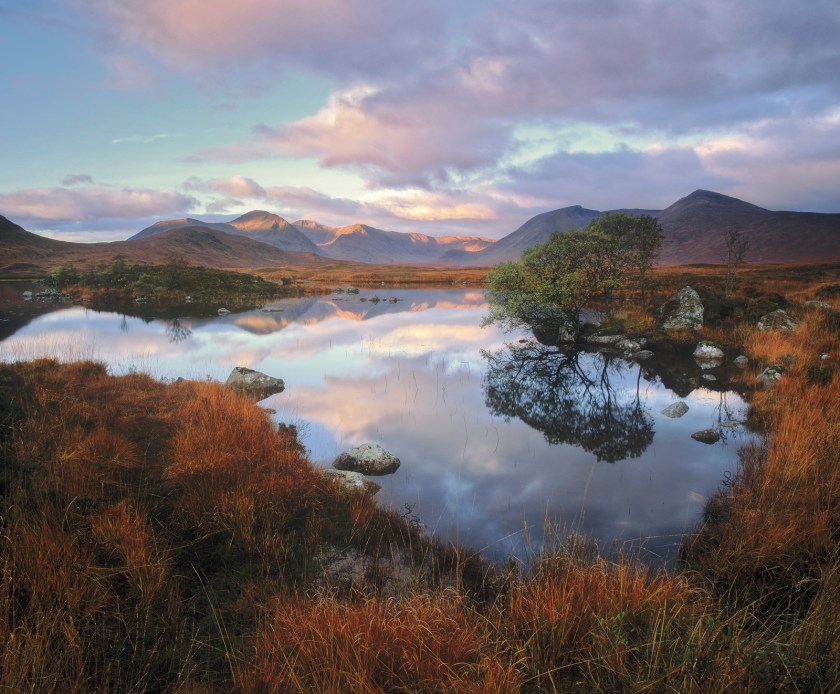
Rannoch Moor, Scotland

Previous Post: Heat Waves: Historical, not Hysterical Context

Alarms are being sounded about heat waves in the Northern Hemisphere, noting heat waves in Eastern Canada and US, wildfires in N. Sweden and Siberia.  The recent (2018) UK lawsuit featured the advocate claiming the Arctic is burning, so global warming is no longer in doubt.  Thus UK needs to up its carbon reduction targets.

The High Court disagreed.  And for good reasons not cited by the judge.  The hot dry weather this summer in Siberia was preceded by extreme cold and massive snowfall, unusual winter conditions even for that climate zone.  Similarly, there have been cold winters across Eurasia, while Northern Europe enjoys a BBQ summer.  BTW, I recall seeing on TV May and June tennis matches in Spain where spectators were wearing jackets and head covering against the cold.

What is going on?  Fact: Concurrent warm summers and cold winters are a feature of the North Atlantic climate system.  It has gone on periodically throughout history, and long before humans burned fossil fuels.  Below is evidence providing insight into our present experience of 2018 weather.

Concurrent Warming and Cooling

This post highlights recent interesting findings regarding past climate change in NH, Scotland in particular. The purpose of the research was to better understand how glaciers could be retreating during the Younger Dryas Stadia (YDS), one of the coldest periods in our Holocene epoch.

The lead researcher is Gordon Bromley, and the field work was done on site of the last ice fields on the highlands of Scotland. 14C dating was used to estimate time of glacial events such as vegetation colonizing these places. Bromely explains in article Shells found in Scotland rewrite our understanding of climate change at siliconrepublic. Excerpts in italics with my bolds.

By analysing ancient shells found in Scotland, the team’s data challenges the idea that the period was an abrupt return to an ice age climate in the North Atlantic, by showing that the last glaciers there were actually decaying rapidly during that period.

The shells were found in glacial deposits, and one in particular was dated as being the first organic matter to colonise the newly ice-free landscape, helping to provide a minimum age for the glacial advance. While all of these shell species are still in existence in the North Atlantic, many are extinct in Scotland, where ocean temperatures are too warm.

This means that although winters in Britain and Ireland were extremely cold, summers were a lot warmer than previously thought, more in line with the seasonal climates of central Europe.

“There’s a lot of geologic evidence of these former glaciers, including deposits of rubble bulldozed up by the ice, but their age has not been well established,” said Dr Gordon Bromley, lead author of the study, from NUI Galway’s School of Geography and Archaeology.

“It has largely been assumed that these glaciers existed during the cold Younger Dryas period, since other climate records give the impression that it was a cold time.”

He continued: “This finding is controversial and, if we are correct, it helps rewrite our understanding of how abrupt climate change impacts our maritime region, both in the past and potentially into the future.”

The recent report is Interstadial Rise and Younger Dryas Demise of Scotland’s Last Ice Fields
G. Bromley A. Putnam H. Borns Jr T. Lowell T. Sandford D. Barrell  First published: 26 April 2018.(my bolds)

Abstract

Establishing the atmospheric expression of abrupt climate change during the last glacial termination is key to understanding driving mechanisms. In this paper, we present a new 14C chronology of glacier behavior during late‐glacial time from the Scottish Highlands, located close to the overturning region of the North Atlantic Ocean. Our results indicate that the last pulse of glaciation culminated between ~12.8 and ~12.6 ka, during the earliest part of the Younger Dryas stadial and as much as a millennium earlier than several recent estimates. Comparison of our results with existing minimum‐limiting 14C data also suggests that the subsequent deglaciation of Scotland was rapid and occurred during full stadial conditions in the North Atlantic. We attribute this pattern of ice recession to enhanced summertime melting, despite severely cool winters, and propose that relatively warm summers are a fundamental characteristic of North Atlantic stadials.

Plain Language Summary

Geologic data reveal that Earth is capable of abrupt, high‐magnitude changes in both temperature and precipitation that can occur well within a human lifespan. Exactly what causes these potentially catastrophic climate‐change events, however, and their likelihood in the near future, remains frustratingly unclear due to uncertainty about how they are manifested on land and in the oceans. Our study sheds new light on the terrestrial impact of so‐called “stadial” events in the North Atlantic region, a key area in abrupt climate change. We reconstructed the behavior of Scotland’s last glaciers, which served as natural thermometers, to explore past changes in summertime temperature. Stadials have long been associated with extreme cooling of the North Atlantic and adjacent Europe and the most recent, the Younger Dryas stadial, is commonly invoked as an example of what might happen due to anthropogenic global warming. In contrast, our new glacial chronology suggests that the Younger Dryas was instead characterized by glacier retreat, which is indicative of climate warming. This finding is important because, rather than being defined by severe year‐round cooling, it indicates that abrupt climate change is instead characterized by extreme seasonality in the North Atlantic region, with cold winters yet anomalously warm summers.

The complete report is behind a paywall, but a 2014 paper by Bromley discusses the evidence and analysis in reaching these conclusions. Younger Dryas deglaciation of Scotland driven by warming summers  Excerpts with my bolds.

Significance: As a principal component of global heat transport, the North Atlantic Ocean also is susceptible to rapid disruptions of meridional overturning circulation and thus widely invoked as a cause of abrupt climate variability in the Northern Hemisphere. We assess the impact of one such North Atlantic cold event—the Younger Dryas Stadial—on an adjacent ice mass and show that, rather than instigating a return to glacial conditions, this abrupt climate event was characterized by deglaciation. We suggest this pattern indicates summertime warming during the Younger Dryas, potentially as a function of enhanced seasonality in the North Atlantic.

Surface temperatures range from -30C to +30C

Fig. 1. Surface temperature and heat transport in the North Atlantic Ocean.  The relatively mild European climate is sustained by warm sea-surface temperatures and prevailing southwesterly airflow in the North Atlantic Ocean (NAO), with this ameliorating effect being strongest in maritime regions such as Scotland. Mean annual temperature (1979 to present) at 2 m above surface (image obtained using University of Maine Climate Reanalyzer, http://www.cci-reanalyzer.org). Locations of Rannoch Moor and the GISP2 ice core are indicated.

Thus the Scottish glacial record is ideal for reconstructing late glacial variability in North Atlantic temperature (Fig. 1). The last glacier resurgence in Scotland—the “Loch Lomond Advance” (LLA)—culminated in a ∼9,500-km2 ice cap centered over Rannoch Moor (Fig. 2A) and surrounded by smaller ice fields and cirque glaciers.

Fig. 2. Extent of the LLA ice cap in Scotland and glacial geomorphology of western Rannoch Moor. (A) Maximum extent of the ∼9,500 km2 LLA ice cap and larger satellite ice masses, indicating the central location of Rannoch Moor. Nunataks are not shown. (B) Glacial-geomorphic map of western Rannoch Moor. Distinct moraine ridges mark the northward active retreat of the glacier margin (indicated by arrow) across this sector of the moor, whereas chaotic moraines near Lochan Meall a’ Phuill (LMP) mark final stagnation of ice. Core sites are shown, including those (K1–K3) of previous investigations (14, 15).

When did the LLA itself occur? We consider two possible resolutions to the paradox of deglaciation during the YDS. First, declining precipitation over Scotland due to gradually increasing North Atlantic sea-ice extent has been invoked to explain the reported shrinkage of glaciers in the latter half of the YDS (18). However, this course of events conflicts with recent data depicting rapid, widespread imposition of winter sea-ice cover at the onset of the YDS (9), rather than progressive expansion throughout the stadial.

Loch Lomond

Furthermore, considering the gradual active retreat of LLA glaciers indicated by the geomorphic record, our chronology suggests that deglaciation began considerably earlier than the mid-YDS, when precipitation reportedly began to decline (18). Finally, our cores contain lacustrine sediments deposited throughout the latter part of the YDS, indicating that the water table was not substantially different from that of today. Indeed, some reconstructions suggest enhanced YDS precipitation in Scotland (24, 25), which is inconsistent with the explanation that precipitation starvation drove deglaciation (26).

We prefer an alternative scenario in which glacier recession was driven by summertime warming and snowline rise. We suggest that amplified seasonality, driven by greatly expanded winter sea ice, resulted in a relatively continental YDS climate for western Europe, both in winter and in summer. Although sea-ice formation prevented ocean–atmosphere heat transfer during the winter months (10), summertime melting of sea ice would have imposed an extensive freshwater cap on the ocean surface (27), resulting in a buoyancy-stratified North Atlantic. In the absence of deep vertical mixing, summertime heating would be concentrated at the ocean surface, thereby increasing both North Atlantic summer sea-surface temperatures (SSTs) and downwind air temperatures. Such a scenario is analogous to modern conditions in the Sea of Okhotsk (28) and the North Pacific Ocean (29), where buoyancy stratification maintains considerable seasonal contrasts in SSTs. Indeed, Haug et al. (30) reported higher summer SSTs in the North Pacific following the onset of stratification than previously under destratified conditions, despite the growing presence of northern ice sheets and an overall reduction in annual SST. A similar pattern is evident in a new SST record from the northeastern North Atlantic, which shows higher summer temperatures during stadial periods (e.g., Heinrich stadials 1 and 2) than during interstadials on account of amplified seasonality (30).

Our interpretation of the Rannoch Moor data, involving the summer (winter) heating (cooling) effects of a shallow North Atlantic mixed layer, reconciles full stadial conditions in the North Atlantic with YDS deglaciation in Scotland. This scenario might also account for the absence of YDS-age moraines at several higher-latitude locations (12, 36–38) and for evidence of mild summer temperatures in southern Greenland (11). Crucially, our chronology challenges the traditional view of renewed glaciation in the Northern Hemisphere during the YDS, particularly in the circum-North Atlantic, and highlights our as yet incomplete understanding of abrupt climate change.

Summary

Several things are illuminated by this study. For one thing, glaciers grow or recede because of multiple factors, not just air temperature. The study noted that glaciers require precipitation (snow) in order to grow, but also melt under warmer conditions. For background on the complexities of glacier dynamics see Glaciermania

Also, paleoclimatology relies on temperature proxies who respond to changes over multicentennial scales at best. C14 brings higher resolution to the table.

Finally, it is interesting to consider climate changing with respect to seasonality.  Bromley et al. observe that during Younger Dryas, Scotland shifted from a moderate maritime climate to one with more seasonal extremes like that of inland continental regions. In that light, what should we expect from cooler SSTs in the North Atlantic?

Note also that our modern warming period has been marked by the opposite pattern. Many NH temperature records show slight summer cooling along with somewhat stronger warming in winter, the net being the modest (fearful?) warming in estimates of global annual temperatures.  Then of course there are anomalous years like this one where cold winters combine with warm summer periods.