Emissions and CO2 Concentration: An Evidence Based Approach

When we make predictions with hypothetical future CO2 emissions, we do not know the future temperatures.

From Climate Etc.

by Joachim Dengler and John Reid

A new way of looking at the the atmospheric carbon budget.

Climate science is usually concerned about the question “How much CO2 remains in the atmosphere?”, given the anthropogenic emissions and the limited capability of oceans and biosphere to absorb the surplus CO2 concentration. This has led to conclusions of the kind that a certain increasing part of anthropogenic emissions will remain in the atmosphere forever. The frequently used notion of “airborne fraction”, which is the part of anthropogenic emissions remaining in the atmosphere, seems to suggest this.

We change the focus of attention by posing the logically equivalent question “How much CO2 does not remain in the atmosphere?”.

Why is this so different?

The amount of CO2 that does not remain in the atmosphere can be calculated from direct measurements. We do not have to discuss each absorption mechanism from the atmosphere into oceans or plants. From the known global concentration changes and the known global emissions, we have a good estimate of the sum of actual yearly absorptions.

These are related to the CO2 concentration, motivating the guiding hypothesis for a linear model of absorption. It turns out that we do not need to know the actual coefficients of the individual absorption mechanisms—it is sufficient to assume their linear dependence on the current CO2 concentration.

This is a short summary of a recently published paper, where all statements expressed here are derived in detail and backed up with references and a mathematical model.

Mass Conservation of CO2

As in a bank account, the atmospheric CO2 balance results from total emissions reduced by total absorptions:

Concentration growth = Emissions – Absorptions

The total emissions (blue) come to exceed the yearly CO2 concentration growth (green), implying the growing effective absorption (red) with growing CO2 concentration:

The assumption of approximate linearity of the relevant absorption processess is visualized with a scatter plot, relating the effective CO2 absorption to the CO2 concentration.

We see a long term linear dependence of the effective absorption on the atmospheric CO2 concentration with significant short term deviations, where the effective zero-absorption line is crossed at appr. 280 ppm. This is considered to be the pre-industrial equilibrium CO2 concentration where natural yearly emissions are balanced by the yearly absorptions.

The average yearly absorption is appr. 2% of the CO2 concentration exceeding 280 ppm. As the data before 1950 are subject to large uncertainty, the following calculations were done based on data after 1950, resulting in a slightly smaller absorption percentage of 1.6%.

CO2 concentration as a temperature proxy

When we make predictions with hypothetical future CO2 emissions, we do not know the future temperatures. Without diving into the problematic discussion about the degree, how strong the influence of CO2 concentration is on temperature , we assume the “worst case” of full predictability of temperature effects by CO2 concentration.

Without making any assumptions about C->T causality, the estimated functional dependence of the temperature proxy from the regression on CO2 concentration C was found to be:

Tproxy = -16.0 + 2.77*log(C) = 2.77* log(C/(235ppm))

This corresponds to a sensitivity of 1.92° C.

Model validation

The model with the assumption of constant absorption parameter and constant natural emissions is validated with a prediction of the CO2 concentration 2000-2020 based on emission data 1950-2020 and Concentration data 1950-2000.

This is an excellent prediction of concentrations on the basis of emissions and the above model assumptions. There are only small apparently variations between the predictions and the actual data. Although the model allows for varying absorptions over time, the data of the last 70 years, which is the period of the bulk anthropogenic CO2 emissions, leads to the conclusion that the CO2 absorption parameter has no significant temperature or other time-dependent component, and a current CO2 emission pulse is absorbed with a 42 year half-life time.

Future Emission Scenario

The most likely future emission scenario is the IEA stated policies emission scenario of approximately constant, slightly decreasing global emissions. The actually used data set for a realistic future projection is created by trend extrapolating the stated policies beyond 2050 and assuming that the land use change

data will follow the current trend and decrease to 0 by the year 2100 . Emissions will not be reduced to zero in the year 2100, but will remain close to the 2005 level.

Prediction of Future CO2 Concentration

From this realistic emission scenario the future CO2 concentration is recursively predicted with our model.

With the IEA stated policies scenario, i.e., no special CO2 reduction policies, a CO2 concentration equilibrium of approx. 475 ppm will be reached during the second half of this century.  Based on the empirical CO2 temperature proxy equation above, this increase of CO2 concentration from 410 ppm (in 2020) to 475 ppm corresponds to a temperature increase of 0.4 _C from 2020, or 1.4°C from 1850.

Concluding, we can expect a maximum CO2  concentration level of approximately 475 ppm in the second half of this century. At this point, the emissions will be fully balanced by the absorptions, which is by definition the “net zero” situation.

Assuming the unlikely worst case that CO2 concentration is fully responsible for all global temperature changes, the maximum expected rise of global temperature caused by the expected CO2 concentration rise is 0.4 _C from now or 1.4°C from the beginning of industrialisation.

Therefore, if we keep living our lives with the current CO2 emissions – and a 3%/decade efficiency improvement, then the Paris climate goals are fulfilled.

Harvard Law Accepts a Paper Advocating Homicide Charges for Big Oil Execs

Environmental activists have written a paper on a computer made of coal and oil products, to demand the prosecution of big oil execs.

From Watts Up With That?

Essay by Eric Worrall

h/t mark1w, Cam_s; Environmental activists have written a paper on a computer made of coal and oil products, to demand the prosecution of big oil execs.

New climate paper calls for charging big US oil firms with homicide

Brian Kahn Wed 22 Mar 2023 21.00 AEDT

Authors of paper accepted for publication in Harvard Environmental Law Review argue firms are ‘killing members of the public at an accelerating rate’

Oil companies have come under increasing legal scrutiny and face allegations of defrauding investors, racketeering, and a wave of other lawsuits. But a new paper argues there’s another way to hold big oil accountable for climate damage: trying companies for homicide.

The striking and seemingly radical legal theory is laid out in a paper accepted for publication in the Harvard Environmental Law Review. In it, the authors argue fossil fuel companies “have not simply been lying to the public, they have been killing members of the public at an accelerating rate, and prosecutors should bring that crime to the public’s attention”.

“What’s on their ledger in terms of harm, there’s nothing like it in human history,” said David Arkush, the director of the climate program at consumer advocacy group Public Citizen and one of the paper’s authors.

The paper is rooted in part in the growing body of evidence fossil fuel companies knew of the harm their products caused and misled the public about them.

…Read more: https://www.theguardian.com/environment/2023/mar/22/big-oil-companies-homicide-harvard-environmental-law-review

The abstract of the paper;

Climate Homicide: Prosecuting Big Oil For Climate Deaths

Harvard Environmental Law Review, Vol. 48, No. 1, 2024

70 Pages Posted: 25 Jan 2023 Last revised: 2 Mar 2023

David Arkush
Public Citizen

Donald Braman
George Washington University – Law School; Justice Innovation Lab; DC Justice Lab
Date Written: January 23, 2023

Abstract

Prosecutors regularly bring homicide charges against individuals and corporations whose reckless or negligent acts or omissions cause unintentional deaths, as well as those whose misdemeanors or felonies cause unintentional deaths. Fossil fuel companies learned decades ago that what they produced, marketed, and sold would generate “globally catastrophic” climate change. Rather than alert the public and curtail their operations, they worked to deceive the public about these harms and to prevent regulation of their lethal conduct. They funded efforts to call sound science into doubt and to confuse their shareholders, consumers, and regulators. And they poured money into political campaigns to elect or install judges, legislators, and executive officials hostile to any litigation, regulation, or competition that might limit their profits. Today, the climate change that they forecast has already killed thousands of people in the United States, and it is expected to become increasingly lethal for the foreseeable future. Given the extreme lethality of the conduct and the awareness of the catastrophic risk on the part of fossil fuel companies, should they be charged with homicide? Could they be convicted? In answering these questions, this Article makes several contributions to our understanding of criminal law and the role it could play in combating crimes committed at a massive scale. It describes the doctrinal and social predicates of homicide prosecutions where corporate conduct endangers much or all of the public. It also identifies important advantages of homicide prosecutions relative to civil and regulatory remedies, and it details how and why prosecution for homicide may be the most effective legal remedy available in cases like this. Finally, it argues that, if our criminal legal system cannot focus more intently on climate crimes—and soon—we may leave future generations with significantly less for the law to protect.Read more: https://papers.ssrn.com/sol3/papers.cfm?abstract_id=4335779

For starters I want to state I’m OK with Harvard Law publishing this paper. Such accusations should be discussed and rebutted.

And the obvious rebuttal is the impact of industrialisation on life expectancy. Thanks to fossil fuel, we don’t work ourselves to death by our 40s. We have the wealth to heat our homes in winter and cool them in Summer. Our children are well cared for and receive high quality food. Parents have the wealth to send children to school, to let them enjoy their childhood, instead of making them work the fields at a young age, to join the daily battle for survival as soon as they are able to do useful work.

So whatever harm fossil fuel has done, and I’m not denying it produces toxic pollutants which kill people, by any rational measure this harm is far outweighed by the good access to cheap energy provides.

What about the charge that fossil fuel companies concealed information from the public? Every charge I have examined to date in my opinion turned out to be nonsense. The “secret” internal memos I’ve seen to date were derivative, derived from publicly available data.

If anyone is unconvinced, the remedy is obvious – stop using their product. If fossil fuel is so evil, switch it off. Reject it. Stop using it. Such lifestyles are entirely possible, groups like the Amish reject modern technology for religious reasons. Yet somehow most anti-fossil fuel advocates seem to find reasons to keep using the evil.

Until anti-fossil fuel advocates personally take the step of expelling evil fossil fuel products from their lives, in my opinion their protestations of harm must be viewed as hypocritical and absurd.

Jacob Nordangård: UN/WEF openly planning to use the CO2 scam to control us | Tom Nelson

Jacob Nordangård is a Swedish researcher, author, lecturer, and musician.

Tom Nelson

Jacob Nordangård is a Swedish researcher, author, lecturer, and musician.

Ph.D. in Technology and Social Change at Linköping University. Master of Social Science in Geography, and Master of Social Science in Culture and Media Production.

Founder and chairman of the Swedish foundation Stiftelsen Pharos and CEO of the independent publishing and media production company Pharos Media Productions.

Has previously worked as graphic designer, editor, media producer, press officer, politician, and Senior lecturer at the universities of Linköping, Jönköping, and Stockholm.

He is also the band leader, singer and songwriter of the doom metal band Wardenclyffe, with lyrics inspired by his research. His dissertation was issued with a soundtrack and his latest books are available with optional CD singles as soundtrack.

Jacob’s blog: https://blog.jacobnordangard.se/
Jacob’s books (not on Amazon): https://www.pharosmedia.se/shop#!/jac…
Jacob at Northern Light Convention, 2022, 54 minutes: • Jacob Nordengård …
Twitter: https://twitter.com/JacobNordangard
UN: Our Common Agenda https://www.un.org/en/common-agenda

This and many other videos available on our Climate TV page.

Greta Thunberg, PhD Theology

It’s not a report from Babylon Bee, or an April first joke.  It’s an upcoming ceremony at University of Helsinki.

From Science Matters

By Ron Clutz

It’s not a report from Babylon Bee, or an April first joke.  It’s an upcoming ceremony at University of Helsinki.

At least they get the field of knowledge right, no one outdoes her as a true believer, despite being a school dropout. From Daily Caller Greta Thunberg To Receive Honorary Doctorate Degree In Theology From University Of Helsinki.  Excerpts in italics with my bolds and added images.

Swedish climate activist Greta Thunberg will receive an honorary doctorate degree in theology from the University of Helsinki in Finland on June 9, the school announced in a press release.

DUSSELDORF, GERMANY – MARCH 04: A float featuring an effigy of climate activist Greta Thunberg makes its way through the annual Rose Monday Carnival parade on March 4, 2019 in Dusseldorf, Germany. The Dusseldorf Rose Monday parade is known for its political satire. Cities in western Germany are celebrating the traditional Rhineland Carnival this week with today’s Rose Monday as the highpoint. (Photo by Lukas Schulze/Getty Images)

Thirty “distinguished individuals” from around the world will be awarded the university’s “highest recognition,” according to a March 20 press release. The Faculty of Philosophy, the Faculty of Veterinary Medicine, the Faculty of Theology and the Faculty of Law will all give out honorary doctorates. Thunberg is the only individual listed as an “activist” who is receiving a degree, the announcement shows.

Thunberg, 20, gained popularity in 2018 when she refused to attend class until the Swedish general elections took place due to her concerns about climate change. She made international headlines again when she spoke at the United Nations in 2019, accusing politicians of stealing her childhood. Most recently, Thunberg came under scrutiny for deleting a years-old Tweet citing a claim that humans would go extinct if fossil fuels were still being used by 2023. [ So much for her prophetic credentials.]

Thunberg previously received an honorary doctorate law degree in 2021 from the University of British Columbia. [Yikes! A Preacher and a Lawyer.]

The University of Helsinki did not immediately respond to the Daily Caller’s request for comment.

Footnote:  Climate Religion

It should be clear that when climate alarmists appeal to saving the planet for future generations, they are applying contextual ethics. Less obvious is the ancient religious notion that by making sacrifices, we humans can assure more favorable weather.

These days, fossil fuels have become the sacrificial lamb required by Mother Nature to play nice with human beings. In the past, people made images and worshiped them, thinking that they could control nature in that way. These days, we make computer models whose projections are sure to scare the Be-Jesus out of us.

New “disappearing bottle” to be made from potato starch

The product, called “GoneShells,” is made from potato, and can be composted, disposed of under tap water, or even eaten.

From CFACT

By Adam Houser 

In an intriguing development, a new biodegradable bottle has been invented that disintegrates once torn up and placed under water.

The product, called “GoneShells,” is made from potato, and can be composted, disposed of under tap water, or even eaten.

As reported by World Bio Market Insights:

“The innovative biodegradable packaging material is made from potato.

“What makes GoneShells innovative is the speed of and the multiple alternatives of degradation. With a bottle that can be home composted, eaten or dissolved under the water tap in the kitchen sink, the objectives are to create less strain on recycling systems and reduce problems associated with packaging materials ending up in nature. With a bottle designed to be torn apart after it has been used, the idea is that oneself can speed up the decomposition process. When you break the packaging and then put it in contact with water, a natural reaction starts to break down the bottle immediately – and that’s how we created a bottle with the ability to disappear by itself.

“GoneShells aim to address the need for new biobased packaging materials. Together with Eckes-Granini and Brämhults, we have explored the possibility to use the material for their juices and smoothies. Supported by BioInnovation, a joint venture by Vinnova, Formas and Swedish Energy Agency – development is carried out along with the design of prototypes.”

Some obvious questions arise from the bottling idea, mainly, that could such an easily destructible bottle be safe for packaging and transport? How does the bottle not decompose when carrying liquids if it is so easily destroyed via water or saliva? Does the material effectively keep the food or beverages safe from germs and bacteria?

Only time will tell if this prototype shows real commercial promise for recycling and waste solutions.

Read the full story in World Bio Market Insights here.

Author

  • Adam HouserAdam Houser
  • Adam Houser coordinates student leaders as National Director of CFACT’s collegians program and writes on issues of climate and energy.

We’re Doomed… Again! IPCC and Media Jump the Shark

Earlier this week, the Intergovernmental Panel on Climate Change (IPCC) released its AR6 climate change report.

The Heartland Institute

Earlier this week, the Intergovernmental Panel on Climate Change (IPCC) released its AR6 climate change report. Expectedly, the report is defined by serial doomcasting and claims of impending catastrophe despite the growing mountain of failed predictions that are conveniently ignored.

One of the most controversial claims made in the report is that anthropogenic emissions of carbon dioxide (CO2) is the main driver of temperature change. Real-world data has proven this false, yet it’s the main takeaway in each IPCC report.

First released on Monday was the “Summary for Policymakers,” a section intended to guide policymaking decisions across the globe.

The AR6 report continues to omit key information in favor of sensationalized claims that are easily refuted.

For example, the 36-page summary doesn’t include a single mention of the logarithmic relationship between atmospheric CO2 concentrations and global temperature.

Surely, policymakers should know that each unit of CO2 added to the atmosphere has a decreasing effect on temperature.

The IPCC’s omission of this relationship implies that the warming effect of CO2 concentrations is linear, leading policymakers to overestimate the impact of CO2 emissions on global temperature and overcommit to emissions reduction strategies that are expensive and ineffective.

Dutch farmers on collision course with Brussels over compulsory farm buyouts

Brussels has warned furious Dutch farmers that compulsory farm buyouts are the only way for the Netherlands to meet its EU climate targets.

From NOT A LOT OF PEOPLE KNOW THAT

By Paul Homewood

h/t Ian Magness

I might have known the EU were behind this!

Brussels has warned furious Dutch farmers that compulsory farm buyouts are the only way for the Netherlands to meet its EU climate targets.

Climate chief Frans Timmermans said the European Commission would explain the green laws to Caroline van der Plas, the leader of the Farmers-Citizen Movement (BBB).

The BBB triumphed in regional elections last week after months of tractor protests that drew global attention and the support of former US president Donald Trump.

Farmers oppose prime minister Mark Rutte’s plans to reduce livestock numbers and buy up farms to cut nitrogen emissions, which are caused by manure and fertiliser.

“The Netherlands can only achieve the targets by buying out farmers and greening agriculture”, Mr. Timmermans, who is Dutch, said.

“Let’s invest a lot in that. Above all, we have to give young farmers a perspective for the future,” the commission vice president told the NOS broadcaster.

The Dutch government says it must reduce nitrogen emissions by 50 per cent by 2030 to meet EU targets.

The BBB’s opposition to both the climate commitment and the compulsory purchase of farms put it on a collision course with the ruling four-party coalition and the EU.

Caroline van der Plas, the leader of the Farmers-Citizen Movement (BBB) which triumphed in regional elections last week CREDIT: REMKO DE WAAL/ANP/AFP via Getty Images

Mr. Timmermans, a commission vice-president, said Ms. van der Plas would be “very welcome” to visit Brussels after her landslide victory.

“We will then do exactly the same thing we have done before with officials, which is to explain what the European rules are,” the socialist and former foreign minister said.

Mr. Timmerman’s comments are likely to fuel online conspiracy theories that the nitrogen row is a globalist pretext to steal the farmers’ land.

Ms. van der Plas called for a meeting with Mr Timmermans after reports his department had backed the farm buyouts in advice to the government.

But the former journalist, who only founded the BBB in 2019, demanded he comes to meet her rather than her travel to Brussels.

“I understand that Timmermans also often comes to The Hague, so it can be done very quickly,” she said and demanded to know what solutions Brussels was offering to the nitrogen issue.

The BBB came from nowhere to become the largest party in all 12 Dutch provinces in an electoral triumph that raised questions over the survival of Mr. Rutte’s ruling coalition.

The vote became a de facto referendum on M.r Rutte’s leadership, who became leader in 2010 and is the Netherlands longest-serving prime minister.

The tractor demonstration by farmers drew global attention and the support of Donald Trump. CREDIT: Hollandse Hoogte/Shutterstock

The BBB can now use its 17 seats in the Dutch senate to try and block farm expropriations, which Mr. Rutte says are needed to lift a court-ordered stop on nitrogen-emitting construction of roads and housing.

Its protests have spawned similar tractor demonstrations in Dutch-speaking Flanders in neighbouring Flanders.

M.s van der Plas has said the movement is about more than just nitrogen and said voters are “fed up” with traditional politicians and politics. 

https://www.telegraph.co.uk/world-news/2023/03/23/dutch-farmers-collision-course-brussels-compulsory-farm-buyouts/

Challenging the NSTA’s Position Statement on Climate Change

The CO2 Coalition has reviewed the National Science Teaching Association’s Position Statement on Climate Change and has found that it has serious problems, which we address in this assessment.

From Watts Up With That?

The CO2 Coalition has reviewed the National Science Teaching Association’s Position Statement on Climate Change and has found that it has serious problems, which we address in this assessment. Our objections to this document are many but can be separated into two major categories. Our detailed rebuttal, Challenging NSTA Position Statement on Climate Change, was published March 23, 2023.

• Reliance on “consensus” science and a rejection of critical thinking skills and the scientific method.
• NSTA’s embrace of the hypothesis of “harmful man-made warming” despite its basis in flawed science and government opinions and its rejection of all contradictory science.

A primary role for the NSTA should be to develop critical thinking skills for students and to instill in them knowledge and use of the scientific method. Students should be encouraged to review all facts on a subject (in this case climate change) and make up their own minds rather than be indoctrinated into an established political agenda.

Unfortunately, the NSTA has taken a strong position that is antithetical to the scientific method, critical thinking and open scientific debate. Its position is one of censorship of any scientist or science that does not support the NSTA-approved “science.” The NSTA Position Statement on Climate Change fails to delineate between real science and political science.

Background

In early 2021, a group of CO2 Coalition members decided to act on their concerns about the state of science education in America. They recognized that the teaching of science had strayed from the 400-plus-year-old scientific method and was less inclined to encourage inquisitiveness in students and more prone to require conformity to the opinions of teachers. At present, much of the instruction on climate
change resembles an indoctrination into a political agenda rather than the provision of necessary tools for critical thinking.

It is our knowledge of science and commitment to the scientific method – not political narratives – that make the CO2 Coalition uniquely qualified to lead in the development of a fact-based program of climate-science education.

Read the Complete Report Here:

Challenging NSTA Position Statement on Climate Change

The CO2 Coalition is attending and exhibiting our findings at the National Science Teaching Association’s Annual Convention in Atlanta, GA (March 23 to 25, 2023). We are proudly promoting the teaching of sound science and the scientific method to those who wish to indoctrinate our children and grandchildren.

This commentary was first published by the CO2 Coalition March 23, 2023.

New Study: Atmospheric CO2 Residence Time Is Only 5 Years – Too Short To ‘Affect The Climate’

An actual residence time that is 20 to 40 times shorter in duration than what an AGW modeled thought experiments allow undermines the dangerous greenhouse gas accumulation talking points, as “if the residence time is below 30 years, injections of CO2 in the atmosphere would, just as water, not affect the climate”

From NoTricksZone

By Kenneth Richard on 23. March 2023

Since the early 1990s the conventional assumption, aligned with modeling, has been that a molecule of human CO2 emission stays in the atmosphere –  its residence time – for centuries. This fits the anthropogenic global warming (AGW) narrative. But empirical evidence contradicts these model-based assumptions. Residence time is closer to 5-10 years.

In Table 1 of a new study, Stallinga (2023) compiled a list of 36 published estimates of CO2 residence time spanning the decades 1957-1992. All of these scientists determined CO2’s atmospheric residence time is about 5 to 10 years or less.

Image Source: Stallinga, 2023

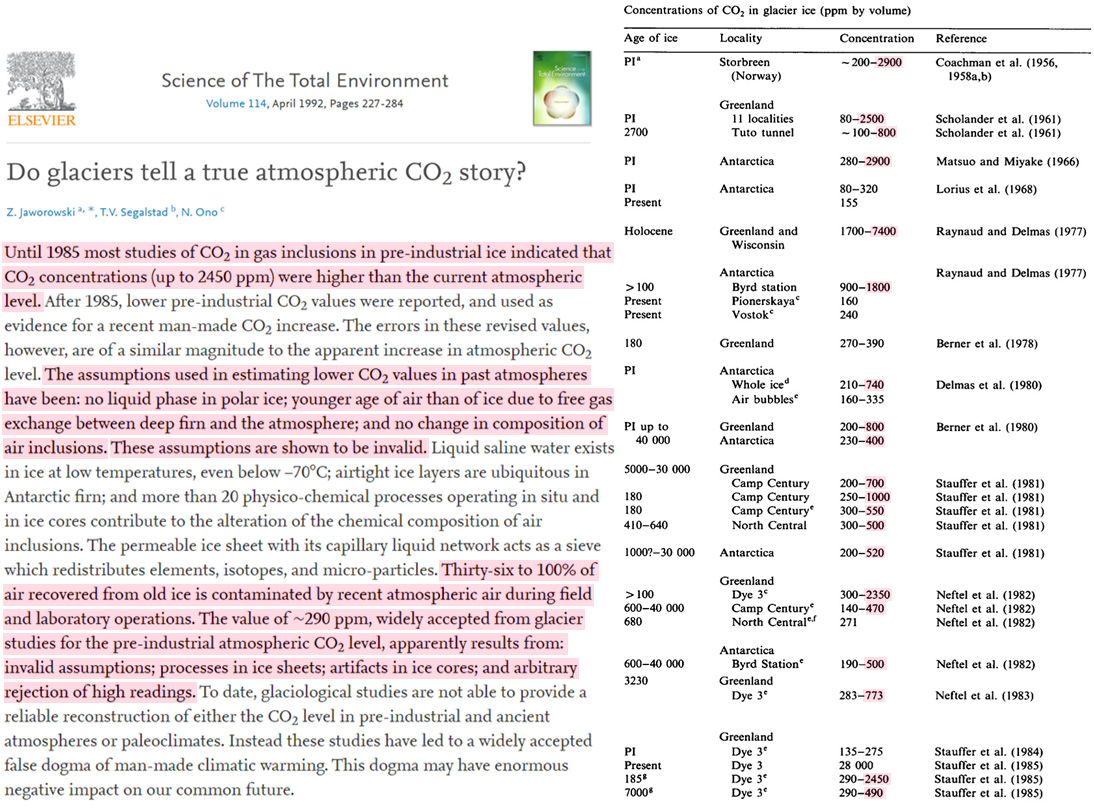
Of course, these were the pre-IPCC decades in climate research, when “the science” was pursued independent of government interference. For example, it was still acceptable in the 1950s to early 1990s for scientists to publish actual ice core measurements showing the atmospheric CO2 content ranged up to 700 ppm, even 2,450 ppm, in the ice sheets and glaciers examined throughout the last 10,000 years (Jaworowski et al., 1992).

An actual residence time that is 20 to 40 times shorter in duration than what an AGW modeled thought experiments allow undermines the dangerous greenhouse gas accumulation talking points, as “if the residence time is below 30 years, injections of CO2 in the atmosphere would, just as water, not affect the climate” (Stallinga, 2023).

In addition to compiling an exhaustive list of past estimates supporting a 5-10 year residence time, Dr. Stallinga cites the evidence from atomic bomb tests, the lack of any atmospheric CO2 effect from the pandemic lockdowns and associated sharp drop in  emissions, and the lead-lag relationship CO2 emission has with temperature as evidence supporting the once commonly-accepted conclusion that CO2 residence is closer to 5 years, not centuries.

And if residence time is only 5 years, nearly “90% of all anthropogenic carbon dioxide has already been removed from the atmosphere.”

Image Source: Stallinga, 2023

Stallinga’s conclusions are very similar to that of Dr. Chauncey Starr (1993), a nuclear physicist who emphasized that a centuries-long residence time claims are derived from “global carbon cycle models which are adjusted to fit the assumption that anthropogenic emissions are primarily the cause of the observed rise in atmospheric CO2.”

Starr provided empirical support for the conclusion residence time is 4-5 years. For example, the high altitude 1964 nuclear bomb testing revealed how quickly (3-11 years) the atmosphere cycled through these perturbations. The constancy of the amplitude of seasonal cycle of CO2 and the magnitude of the swing in annual concentrations are both consistent with photosynthesis as the driver of CO2 variability, further affirming a residence time of 5 years or less.

Also, similar to Dr. Stallinga’s analysis, Starr reported “only about 15% of the fossil-fuel emissions remain in the atmosphere.”

Image Source: Starr, 1993

Media Regurgitates IPCC’s ‘Final Warning’ on Climate Change – Without Realizing We’ve Already Passed 1.5°C

The Intergovernmental Panel on Climate Change (IPCC) published the final part of its sixth assessment report (AR6) on Monday, March 20. Predictably, the media rushed to repeat the claims made in the report with their own scary, woefully overwrought, headlines.

From ClimateRealism

By Anthony Watts

The Intergovernmental Panel on Climate Change (IPCC) published the final part of its sixth assessment report (AR6) on Monday, March 20. Predictably, the media rushed to repeat the claims made in the report with their own scary, woefully overwrought, headlines.

Here is a sample: The Washington Post – World is on brink of catastrophic warming, U.N. climate change report says; NBC News – Now or never: One of the biggest climate reports ever shows time is running out; The Guardian – Scientists deliver ‘final warning’ on climate crisis: act now or it’s too late; and finally Inside Climate News, with inarguably the worst headline New IPCC Report Shows the ‘Climate Time Bomb Is Ticking,’ Says UN Secretary General António Guterres.

Each of mainstream media outlets predict that “climate doom” is just around the corner, and they’re all wrong.

The reason?

The newest IPCC report laments the fact that Earth will soon pass the 1.5°C level of temperature rise, seen in the projection in Figure 1. The current extrapolation is to reach 1.5°C by April 2035.

Figure 1. Extrapolation of temperature trend, predicting 1.5°C by April 2035. Source: ECMWF/Copernicus.

Based on that projection, the IPCC and the media predict very bad things will happen if we don’t “act now before it’s too late.” The most recent report in the AR6 series contains no new information, rather it reiterates the warnings made the physical science portion of the report issued in the summer of 2021, which also mentioned approaching 1.5°C.

Interestingly, the “before it’s too late” language has been used since 2005, when worry about just 1°C was the big doomsday news:

NASA scientist Jim Hansen introduced the “too late” language about climate change in 2005, arguing that “We have to stabilize emissions of carbon dioxide within a decade, or temperatures will warm by more than one degree [C]… we don’t have much time left”.

We heard the same type of language in 2014, when the IPCC released their Fifth Assessment Report. The headlines in The Guardian said “time is running out” and warming “could be irreversible.”

Sound familiar?

Back to the present, the data used to generate Figure 1 above, indicates that the Earth has already experienced a temperature rise of  1.21°C, with none of the doomsday predictions made in 2005 having occurred. In fact, what the IPCC and media all don’t realize, is that Earth already surpassed that 1.5°C threshold, and it and society are doing just fine. As seen in Figure 2, an analysis of Berkeley Earth global surface temperature data by Willis Eschenbach shows that not only has Earth passed the arbitrary 1.5°C threshold set by the IPCC, we’ve actually warmed from 4.0°C since 1750.

Figure 2: Analysis of Berkeley Earth global surface temperature data since 1750, showing markers for 2°C, 3°C, and 4°C of warming. Graph by Willis Eschenbach.

Bottom line, as documented by Willis Eschenbach, Earth has already warmed well past 1.5°C and nothing terrible has happened.

In addition, virtually all of the claims made by media in the past about the dire future we can expect with a modestly warming world have been disproven by time, actual data, and events. For example, claims of crop failures due to warming are common in the media, but looking at actual data in Global Temperatures vs. Global Crop Yields, “Yields have been increasing, in fits and starts, despite increasing temperatures over the period of that record.”

Another common claim, that global warming has worsened floods and droughts, has proven equally untrue. The fact is, almost any media claim of worsening weather or the human condition related to warming one examines, be it hurricanes, tornadoes, sea level rise, food production, coffee, maple syrup, apples, atmospheric rivers, or other apocalyptic predictions made over the past 50 years has failed to materialize.

Most telling is the fact that the human condition has actually improved; deaths from extreme weather events are down dramatically in the last century, approaching zero, as seen in Figure 3, below.

Figure 3: Plotted by Bjørn Lomborg. peer-reviewed article by Bjørn Lomborg: Welfare in the 21st century: Increasing development, reducing inequality, the impact of climate change, and the cost of climate policies Data: The International Disaster Database, http://emdat.be/emdat_db/

It is also a fact that temperature related deaths have declined dramatically as the climate has warmed, as discussed on Climate Realism, here and here, for example.

All of this evidence clearly refutes what the IPCC climate alarmists are shouting about, indeed its own physical science report refutes the hyperbolic claims made by IPCC representatives that have been uncritically parroted by the mainstream media, since Monday. Rather than a climate change induced doomsday being in the offing, data show the human condition has actually improved amid global warming.

With all this contrary evidence of a doom-laden present and future, isn’t it time we simply stop listening to these unproven claims?

Anthony Watts

Anthony Watts is a senior fellow for environment and climate at The Heartland Institute.

Watts has been in the weather business both in front of, and behind the camera as an on-air television meteorologist since 1978, and currently does daily radio forecasts.

He has created weather graphics presentation systems for television, specialized weather instrumentation, as well as co-authored peer-reviewed papers on climate issues.

He operates the most viewed website in the world on climate, the award-winning website wattsupwiththat.com.