Wash. State’s New Climate Law Is Causing Gas Prices To Skyrocket

Gas prices in the state of Washington have surged 40 cents since the new year, when a new law designed to penalize greenhouse gas emissions went into effect, according to the U.S. Department of Energy’s Energy Information Administration (EIA).

From  Daily Caller

By JOHN HUGH DEMASTRI

Gas prices in the state of Washington have surged 40 cents since the new year, when a new law designed to penalize greenhouse gas emissions went into effect, according to the U.S. Department of Energy’s Energy Information Administration (EIA).

Washington businesses that produce more than 25,000 metric tons of carbon dioxide emissions per year will either need to purchase allowances from the state’s Department of Ecology at quarterly auctions, or trade for them with another business later, a practice commonly known as “cap-and-trade,” Axios reported. Since the law was implemented, the cost of gas in the state has skyrocketed from nearly $3.70 to just over $4.10, according to the EIA. (RELATED: China Is Approving New Coal Plants At Break-Neck Speed As The Biden Admin Pushes To Shut US Generators Down)

The final cost of the allowances will be announced March 7, and will be determined by the results of the state’s first auction, hosted Tuesday, Axios reported. The state legislature anticipates that the allowance program will generate more than $1.7 billion through 2024, which will be reinvested into efforts to reduce greenhouse gasses, The Washington Post reported.

“Whatever the cost, fuel distributors are liable for the cost of allowances for fuel they’ve already sold in the first two months of the year,” Todd Myers, director of the Center for the Environment at the Seattle-based think tank Washington Policy Center, said in a Feb. 23 blog post. “The price being charged is a guess on the part of fuel distributors because although the law took effect at the beginning of the year, the Department of Ecology was not able to put the auction system in place on time.”

SAN FRANCISCO, CALIFORNIA – OCTOBER 06: (L-R) British Columbia Premier John Horgan, Washington Gov. Jay Inslee, San Francisco Mayor London Breed California Gov. Gavin Newsom and Oregon Gov. Kate Brown before the start of a press conference on October 06, 2022 in San Francisco, California. (Photo by Justin Sullivan/Getty Images)

Discounting California, the average price of gas in Washington is more than 27 cents higher than the rest of the West Coast, which is defined as Oregon, Washington, Oregon, Nevada, Arizona, Alaska and Hawaii, the EIA reported. The average price of a gallon of gas in California, which also has a cap-and-trade law, is more than $4.58 at time of writing.

Fuel suppliers will not incur any compliance obligations until November, 2024, so any surcharge on fuel is “strictly a decision made by fuel suppliers,” the Department of Ecology said in a January FAQ. The department said it was “not true” to consider the new law a tax on gasoline “although there may be costs of compliance for regulated entities associated with the program.”

“Washington’s Climate Commitment Act is a market-based policy,” Andrew Wineke, deputy communications director at the Washington Department of Ecology, told the Daily Caller News Foundation. “Large sources of carbon pollution are required to comply with the law, but they have the ability to determine the best strategy for their business. … The Department of Ecology does not tell businesses what they should charge for their products, and there is no set price for complying with the law.”

“The Washington legislature has never had the opportunity to invest this amount of money in climate and clean energy,” Kelly Hall, Washington state director for nonprofit energy transition advocacy group Climate Solutions, told the Post. “So this is a really exciting opportunity.”

The Washington Department of Revenue did not immediately respond to a Daily Caller News Foundation request for comment.

Reuters science correspondent: “I was wrong” on climate

Neil Winton worked at Reuters for 32 years, including as global science and technology correspondent.

From CFACT

By Craig Rucker

Neil Winton worked at Reuters for 32 years, including as global science and technology correspondent.

Winton recently admitted he “was wrong” for going along and not putting in the journalistic effort to question the media’s prevailing climate narrative.

Marc Morano posted details at CFACT’s Climate Depot.

Reuters science correspondent: "I was wrong" on climate 3

Winton said:

When I became Reuters global Science and Technology Correspondent in the mid-1990s, the global warming story was top of my agenda. Already by then the BBC was scaring us saying we would all die unless humankind mended its selfish ways. Carbon dioxide (CO2) was the culprit and had to be tamed, then eliminated. I had no reason to think this wasn’t established fact. I was wrong.

My Reuters credentials meant that I had easy access to the world’s finest climate scientists. To my amazement, none of these would say categorically that the link between CO2 and global warming, now known as climate change, was a proven scientific fact. Some said human production of CO2 was a probable cause, others that it might make some contribution; some said CO2 had no role at all. Everybody agreed that the climate had warmed over the last 10,000 years as the ice age retreated, but most weren’t really sure why. The sun’s radiation, which changes over time, was a favoured culprit.

My reporting reflected the wide range of views, with Reuters typical “on the one hand this, on the other, that” style. But even then, the mainstream media seem to have run out of the energy required, and often lazily went along with the BBC’s faulty, opinionated thesis. It was too much trouble to make the point that the BBC’s conclusion was challenged by many impressive scientists.

Winton went on to make an essential point about the threat Green radicalism poses to freedom that has been essential to CFACT’s mission since our founding:

The Left had lost all of the economic arguments by the 1990s, and its activists eagerly grabbed the chance to say free markets and small government couldn’t save us from climate change; only government intervention could do that.

Thank you Neil Winton for this important peek inside the world of media groupthink and your insight as to how Reuters, and so many others, lost the plot on climate.

At the dawn of the 20th century, the humorist Finley Peter Dunne wrote about newspapers that “comfort the afflicted and afflict the comfortable.”

No one has grown more fat and comfortable, and no one more deserving of a little journalistic affliction, than those accumulating vast power and fortunes by cashing in on climate.  Just ask Reuters.

Reporters, do your job.  Ask the tough questions and fully vet the climate narrative and the myriad conflicts that flow from it.

The public deserves to know.

Author

  • Craig RuckerCraig Rucker
  • Craig Rucker is a co-founder of CFACT and currently serves as its president.

Ireland rues mistakes of the past as it struggles to keep the lights on

The Ireland grid still depends on gas and coal for two thirds of its power, along with 15% from GB interconnectors.  The island is particularly vulnerable because it cannot tap into European supply.

From NOT A LOT OF PEOPLE KNOW THAT

By Paul Homewood

h/t Philip Bratby

Blimey, I did not see this coming!!


image

Back-up power generators have started to arrive in Ireland to help it keep the lights on during the next few winters.
The mobile turbines, described as “effectively jet engines”, are set to be installed in areas including Dublin and nearby County Meath.
The €350m (£308m) temporary capacity was ordered by environment minister Eamon Ryan last year as a “last resort”, after regulators flagged a looming shortfall in generation.


“This is an electricity emergency,” minister of state Ossian Smyth told its parliament in October. 

 
“It is a national scandal,” retorted Darren O’Rourke, the Teachta Dála for Meath East. 

.

Yet concerns about the future remain: in Ireland, surging demand for electricity and the closure of ageing gas-fired power stations have left the country vulnerable next winter and beyond.

Critics have also warned that Ireland is becoming too reliant on imports of gas, as domestic fossil fuel generation is sidelined in pursuit of green goals. 

The problems highlight the challenges of transitioning the energy system away from fossil fuels, while still maintaining security of supply.

Kathryn Porter, a consultant at energy analysts Watt-Logic, said: “I’m not sure [Ireland’s] sums [on energy supply and demand in Ireland] have been adding up.

“It echoes concerns that have been arising in other markets.”


Former top civil servant Dermot McCarthy has been asked to independently examine the circumstances behind the immediate squeeze, while the Government has also opened its own energy security review.


In October, politician Barry Cowen called for a fix to the “Cold War state of our energy infrastructure”, piling pressure on Leo Varadkar, the taoiseach, to find a more permanent solution to the problem of keeping the lights on long-term.


Ireland’s single electricity market covers both the Republic and Northern Ireland.


It trades electricity with Britain via two electricity cables from England, and imports gas via pipelines from Scotland.


It has evolved rapidly in recent years to 
incorporate more wind power, as part of the global shift towards renewable energy: renewables accounted for 42pc of Ireland’s electricity mix in 2020, compared to just 7pc in 2005.

Demand for electricity has leapt over the same period, driven in part by the growing number of energy-hungry data centres set up in Dublin, attracted in part by low corporation tax rates.

This hunger for power is only set to grow as electric cars and heat pumps start to replace petrol cars and gas boilers.

Rising demand at a time of insecure supply has started to trigger alarm bells as to how well the system can manage. Problems were apparent even before the acute energy crisis of the last 12 months.


There were eight “system alerts” between January 2020 and September 2021, indicating tight power supplies.  


In September 2021, 
Ireland had to block exports of electricity to Britain to preserve supplies on the island. That month, EirGrid, which operates its electricity grid, warned of a potential shortfall in coming years.

Its report predicted that about 1.6GW of generation would be retired in Ireland over the next five years and 600MW in Northern Ireland, as gas-fired power plants were phased out.

Gas-fired plants are getting old but are also being pushed off the system by the growth of wind power. However, wind is by its nature unpredictable.

“We expect system alerts to be a feature of the system over the coming winters and this winter is likely to be challenging,” Mark Foley, chief executive of EirGrid, said back in 2021.

New gas-fired generation would be needed to help fill in the gaps in intermittent wind and solar supplies, he said, calling for a “clear signal” for investors to build new plants.

Plans to cut national carbon emissions to net zero by 2050 do call for about 2GW of generation from new flexible, gas-fired power stations to help fill the gaps left by intermittent wind supplies.

Last February, the Government secured contracts for back-up power supplies from October 2024, which are expected to lead to 1.1MW of new gas-fired generation being built, as well as 120MW of battery storage.

However, supplies procured in this way are not as certain as many would like – some generators that had agreed to supply back-up for 2022/23 dropped out, piling pressure on the electricity network this winter.

It adds up to an uncertain picture for future electricity generation that has left industry and homeowners concerned. In November, the Irish Academy of Engineering claimed that a lack of government energy planning was deterring international investors.

“Irish energy supply reliability is below standard and is threatening to deteriorate further unless rapid practical action is taken,” it added.


The Irish Academy of Engineering has also raised concern about the security of gas supplies, which are needed for power stations as well as for heating and industrial uses.  


Around three-quarters of Ireland’s gas demand is met by imports from Britain, via Scotland, with the rest coming from its Corrib gas field, off the north-west coast of County Mayo.

The Irish government is no longer issuing new gas exploration licences, as part of a move away from oil and gas to cut carbon emissions. Existing licence-holders can continue to apply for extensions to keep a well in production. However, the situation leaves Ireland increasingly reliant on imports.

The UK’s exit from the EU means it no longer has to supply Ireland under the EU’s “solidarity” rule, meaning that, in theory, supplies to Ireland could be restricted if the UK was facing shortages of its own.

Gas supply shortages had been feared this winter after Russia cut off supplies to Europe following its invasion of Ukraine.

As Ireland confronts challenges on the supply side, politicians and regulators have been looking at ways to manage demand.
Data centres must now “deliver strong economic benefits” and be willing to promote Ireland’s “national decarbonisation objectives”, the government has said.

https://www.telegraph.co.uk/business/2023/02/28/irelands-energy-crisis-threatens-blackouts/

The Ireland grid still depends on gas and coal for two thirds of its power, along with 15% from GB interconnectors.  The island is particularly vulnerable because it cannot tap into European supply.

image

https://www.smartgriddashboard.com/#all

The idea that they can rely primarily on renewables is ridiculous. As with the UK, it makes you wonder whoever thought that they could.

Yet the official Irish government plan still wants 80% of its electricity to come from renewables by 2030:

image

https://www.gov.ie/en/policy-information/62d81a-electricity/#electricity-generation-in-ireland

China’s Climate Pledges At Odds with ramping up coal plant: Report

“That is the case with the rest of the world, but China’s need for energy security has led to growth in wind, solar and coal all at the same time.”

From AFP

President Xi Jinping has pledged that China will peak its carbon dioxide emissions between 2026 to 2030 and reduce them to net zero by 2060. (Photo: AFP/File/JOHANNES EISELE)

BEIJING: China last year approved the largest expansion of coal-fired power plants since 2015, according to a study published Monday (Feb 27), despite its vow to begin phasing down the use of the fossil fuel in just three years.

The coal power capacity that China began building in 2022 was six times as much as that in the rest of the world combined, the report by the Centre for Research on Energy and Clean Air (CREA) in Finland and the Global Energy Monitor (GEM) added.

“China continues to be the glaring exception to the ongoing global decline in coal plant development,” GEM research analyst Flora Champenois said.

“The speed at which projects progressed through permitting to construction in 2022 was extraordinary.”

China is one of the world’s biggest emitters of the greenhouse gases driving climate change, such as carbon dioxide (CO2).

President Xi Jinping has pledged that China will peak its CO2 emissions between 2026 to 2030 and reduce them to net zero by 2060, moves seen as essential for keeping global temperature rise well below two degrees Celsius.

The report warned that even if Beijing sticks to those commitments, the current coal power expansion will make meeting them “more complicated and costly”.

A total of 106 GW of new coal power projects were approved in 2022 – the equivalent of two large coal plants per week – it said.

Plants accounting for around a third of that capacity have already begun construction, with some gaining permits, securing financing and breaking ground “within a matter of months”.

“This kind of a process leaves little room for … consideration of alternatives,” GEM’s Champenois added.

China relies on coal for nearly 60 per cent of its electricity. (Photo: AFP/File/GREG BAKER)

VICIOUS CYCLE

China relies on coal for nearly 60 per cent of its electricity.

Most of the new coal projects have been approved in provinces hit by crippling electricity shortages due to record heatwaves in the last two years.

This creates a vicious cycle with increased greenhouse gas emissions accelerating climate change resulting in more frequent extreme weather events, researchers said.

The rush for approvals started after China’s cabinet in May announced 10 billion yuan (US$1.5 billion) of investment in coal power generation.

“This is the same dynamic that we saw during the previous boom in 2015,” Lauri Myllyvirta, Lead Analyst at CREA, told AFP.

“No one knows how long the floodgates will stay open, so local governments try to rush as many projects through as they can.”

Local officials say new coal plants will serve as a backup to ensure stable supplies when renewables fail.

But provinces such as Guangdong, Jiangsu and Anhui, where the new coal plants are mushrooming, were “laggards” in investing in clean energy to meet demand growth, the study found.

The continued investment in coal “implies insufficient emphasis on overcoming the power system and power market constraints that perpetuate dependence on coal”, it added.

China has ramped up its investments in renewable power including solar, wind, hydro and nuclear plants in recent years. (Photo: AFP/File/STR)

RENEWABLE GROWTH?

China has ramped up its investments in renewable power including solar, wind, hydro and nuclear plants in recent years.

If that growth continues to accelerate, the report said, and electricity demand stabilises, “the massive additions of new coal-fired capacity don’t necessarily mean that coal use or CO2 emissions from the power sector will increase”, the report said.

However, renewable energy projects in China are struggling to get access to land, while in some areas, the grid cannot absorb all the power generated, the head of the China Photovoltaic Industry Association said this month.

The role of coal in ensuring energy security means developing more renewable power does not necessarily lead to a reduced reliance on the fossil fuel, analysts said.

“The biggest misconception is the idea that an increase in renewables will replace coal,” Li Shuo, an activist at Greenpeace China, told AFP.

“That is the case with the rest of the world, but China’s need for energy security has led to growth in wind, solar and coal all at the same time.”

Normal Arctic Ice End of Feb. 2023

With the end of February, nearly all of the Arctic ocean basins are frozen over, so the growth of ice extent slows down, reaching its annual maximum mid-March. 

From Science Matters

By Ron Clutz

With the end of February, nearly all of the Arctic ocean basins are frozen over, so the growth of ice extent slows down, reaching its annual maximum mid-March.  According to MASIE February on average adds 500k km2, and this year the growth was 880k km2, erasing a starting deficit and matching the month end average. The few basins that can grow ice this time of year tend to fluctuate and alternate waxing and waning, which appears as a see saw pattern in these images.  For example, this year the two Pacific basins combined were slightly above average, but Okhotsk is 33% in surplus, while Bering is 26% in deficit to their last March maximums.

The month of February 2023 was remarkable for a wobbly Polar vortex, which cycles freezing polar air south, replacing it with incursions of warmer air into the Arctic, and then reverses the effect. This results in rising and falling freezing rates.  The graph below shows the ice recovery for February 2023, the 17-year average and some recent years.

The graph (cyan) shows February 2023 starting with a 284k km2 deficit to average, several up and downs in the growth rate, until matching average at month end. 2020 also ended average with a steady refreezing rate.   SII (Sea Ice Index) tracked well below MASIE this month showing 400k km2 lower extent than MASIE yesterday.

February Ice Growth Despite See Saws in Atlantic and Pacific

As noted above, this time of year the Arctic adds ice on the fringes since the central basins are already frozen over.  The animation above shows the Okhotsk (upper left) and Bering (lower left) see saw.  Okhotsk grew steadily to reach 133% of its last maximum, while Bering waffled up and down, ending the month ~100k km2 higher and 74% of its max.

On the right, Atlantic side Barents at the top fluctuated and added little ice ending at 56% of its max.  On the lower right, Baffin Bay, and Greenland Sea (center right) show another see saw.  Greenland Sea waffled adding`80k km2, ending  at 96% of max, while Baffin Bay steadily added 300k km2 to reach 90% of maximum.

The table below presents ice extents in the Arctic regions for day 31 (Jan. 31) compared to the 17 year average and 2018.

Region2023059Day 59 Average2023-Ave.20180592023-2018
 (0) Northern_Hemisphere1487863114899627-2099614485052393579
 (1) Beaufort_Sea107096610703146521070445521
 (2) Chukchi_Sea96600696537463296597135
 (3) East_Siberian_Sea1087137108710632108712018
 (4) Laptev_Sea89784589783698978450
 (5) Kara_Sea884398926234-41836922905-38507
 (6) Barents_Sea442032631999-189967544938-102906
 (7) Greenland_Sea745952611275134677473064272889
 (8) Baffin_Bay_Gulf_of_St._Lawrence162485915191621056971786606-161747
 (9) Canadian_Archipelago85484385333115118531091734
 (10) Hudson_Bay12609031260417487126083866
 (11) Central_Arctic31855083213856-283493065181120326
 (12) Bering_Sea627138664021-36884336065291073
 (13) Baltic_Sea8157198009-16437123280-41709
(14) Sea_of_Okhotsk1132332105841373919106989862433

The table shows the only major deficit to average appears in Barents seas, more than offset by surpluses in Greenland Sea and Baffin Bay. These few peripheral basins are the only remaining regions with additional ice extent to add.

The polar bears have a Valentine Day’s wish for Arctic Ice.

And Arctic Ice loves them back, returning every year so the bears can roam and hunt for seals.

Footnote:

Seesaw accurately describes Arctic ice in another sense:  The ice we see now is not the same ice we saw previously.  It is better to think of the Arctic as an ice blender than as an ice cap, explained in the post The Great Arctic Ice Exchange.

Gas Power Is Cheaper Than Wind, Despite Carbon Brief’s Claims

If we had more gas-fired power and less wind power, our energy bills would be lower, not higher.

From NOT A LOT OF PEOPLE KNOW THAT

By Paul Homewood

h/t Joe Public

OFGEM have just announced the latest energy cap, which will apply to the period April to June. Technically it has fallen from £4279 to £3280, although reductions in government support mean that households won’t see any savings immediately.

The cap is based on wholesale prices between November and January. But as I have been reporting in recent weeks, market prices for both gas and electricity have been falling sharply since November, and this means that the cap should be much less come July, maybe to around £2100, assuming wholesale prices remain where they are now.

https://www.ofgem.gov.uk/publications/ofgem-announces-latest-quarterly-price-cap-update

But the announcement brought a ton of misinformation from Simon Evans, deputy editor at Carbon Brief (the renewable lobby group funded by the far-left European Climate Foundation):

Nobody would deny that gas prices are higher than two years ago, or that electricity prices are also higher as a result. However Evans is not telling the whole story, and has conflated the two graphs to mislead people.

TRICK 1

He has deliberately conflated the two graphs for gas and electricity to imply they are directly comparable. To be fair the graphs are OFGEM’s, but you will note that the y-axis is exactly the same on each. But closer examination shows that one is per therm and the other per MWh, something that some commenters on his Twitter have pointed out.

One therm equals 29.3071 KWh, so the January gas price of around 150p/therm equates to about £51/MWh, which is substantially less than the price of electricity. Since then gas prices have dropped further to 120 pence.

Evans claims that energy bills are high because of the price of gas, but clearly they would be much higher if we all had to use electricity instead.

TRICK 2

But the real dishonesty is his failure to mention that offshore and even onshore wind power is considerably more expensive than gas-fired power, despite the currently high price of gas.

 Market prices of electricity averaged £121/MWh, and this price usually reflects the price of gas-fired power. However offshore wind farms subsidised under CfDs were paid an average of £167/MWh.

And offshore wind subsidised via ROCs, which account for about half of the offshore sector, earn £100/MWh on top of the market price, a total of £221/MWh.

The weighted average cost for all offshore farms was therefore £194/MWh.

Even onshore wind farms receive a subsidy of £52/MWh on top of the market price.

And these costs don’t even include the extra costs incurred by the grid associated with intermittent wind power.

If we had more gas-fired power and less wind power, our energy bills would be lower, not higher.

32-year Reuters veteran reporter comes clean on ‘climate change’: ‘I had no reason to think this wasn’t established fact. I was wrong’

To my amazement, none of these would say categorically that the link between CO2 and global warming, now known as climate change, was a proven scientific fact.

From Climate Depot

Neil Winton worked as a journalist at Reuters for 32 years, including as global Science and Technology Correspondent. He writes at Winton’s World.

Winton: “When I became Reuters global Science and Technology Correspondent in the mid-1990s, the global warming story was top of my agenda. Already by then the BBC was scaring us saying we would all die unless humankind mended its selfish ways. Carbon dioxide (CO2) was the culprit and had to be tamed, then eliminated. I had no reason to think this wasn’t established fact. I was wrong.

My Reuters credentials meant that I had easy access to the world’s finest climate scientists. To my amazement, none of these would say categorically that the link between CO2 and global warming, now known as climate change, was a proven scientific fact. Some said human production of CO2 was a probable cause, others that it might make some contribution; some said CO2 had no role at all. Everybody agreed that the climate had warmed over the last 10,000 years as the ice age retreated, but most weren’t really sure why. The sun’s radiation, which changes over time, was a favoured culprit.”

By: Admin – Climate Depot

From Neil Winton’s blog WintonsWorld: Climate Change; An Alternative View But Backed By Top Experts

Excerpt– Jan 23, 2023:

Winton: When I first started writing about human-induced climate change (or global warming as it was then known) as Reuters’ Science & Technology Correspondent back in the mid-90s, I turned to a subject I knew from headlines rather than research.

But I had expectations. After all, even then, the BBC was reporting as fact global warming was upon us, it was all our fault, and we’d all die soon if we didn’t listen to those that know best and act.

Imagine my amazement when I started talking to the world’s top climate scientists and found a completely different story. The science wasn’t even close to being proven, and I had great difficulty finding anyone to say the link between excessive human-made carbon dioxide (CO2) and a changing climate was clear. There were many assumptions, but no proof. Yet the BBC and the mainstream media (MSM) constantly reported a proven doom scenario.

#

Neil Winton worked as a journalist at Reuters for 32 years, including as global Science and Technology Correspondent. He writes at Winton’s World.

Excerpt:

When I became Reuters global Science and Technology Correspondent in the mid-1990s, the global warming story was top of my agenda. Already by then the BBC was scaring us saying we would all die unless humankind mended its selfish ways. Carbon dioxide (CO2) was the culprit and had to be tamed, then eliminated. I had no reason to think this wasn’t established fact. I was wrong.

My Reuters credentials meant that I had easy access to the world’s finest climate scientists. To my amazement, none of these would say categorically that the link between CO2 and global warming, now known as climate change, was a proven scientific fact. Some said human production of CO2 was a probable cause, others that it might make some contribution; some said CO2 had no role at all. Everybody agreed that the climate had warmed over the last 10,000 years as the ice age retreated, but most weren’t really sure why. The sun’s radiation, which changes over time, was a favoured culprit.

My reporting reflected the wide range of views, with Reuters typical “on the one hand this, on the other, that” style. But even then, the mainstream media seem to have run out of the energy required, and often lazily went along with the BBC’s faulty, opinionated thesis. It was too much trouble to make the point that the BBC’s conclusion was challenged by many impressive scientists.

Fast forward 20 years and firm proof CO2 was warming the climate still hasn’t been established, but politics has taken over. Sure, there are plenty of computer models with their hidden assumptions ‘proving’ man is guilty as charged, and the assumption that we had the power and knowledge to change the climate became embedded.

The Left had lost all of the economic arguments by the 1990s, and its activists eagerly grabbed the chance to say free markets and small government couldn’t save us from climate change; only government intervention could do that. Letting capitalism run free was a certain way to ensure the end of the planet; smart Lefties should take charge and save us from ourselves.

The debate about climate change is far from over. I’m not a scientist so I don’t know enough to say it’s all man-made or not. But politicians and lobbyists have decided that we are all guilty. They are in the process of dismantling our way of life, ordering us to comply because it’s all for the future and our children. If we are going to give up our civilization, at the very least we ought to have an open debate. Journalists need to stand up and be counted. The trouble is that requires bravery and energy, and an urge to question conventional wisdom.

Reuters should be leading this movement. All it has to do is stand by its 10 Hallmarks. And maybe tell CCN thanks but no thanks; it needs to apply Reuters principles to its climate reporting.

Neil Winton worked as a journalist at Reuters for 32 years, including as global Science and Technology Correspondent. He writes at Winton’s World.

Sowell Explains How Newspeak Works

As with swamps, what was once messy and smelly was now
turned into something we had a duty to protect.

From Science Matters

By Ron Clutz

Thomas Sowell expounds on the contemporary pervasive use of newspeak to confuse public discourse by changing the meaning of words to advance a political agenda.  Below is an excerpt from his Thomas Sowell Reader.

The Left’s Vocabulary

A recent angry e-mail from a reader said that certain issues should not be determined by “the dictates of the market.” With a mere turn of a phrase, he had turned reality upside down. Decisions by people free to make their mutual accommodations with other free people were called “dictates” while having third parties tell all of them what they could and couldn’t do was not.

Verbal coups have long been a specialty of the left. Totalitarian countries on the left have called themselves “people’s democracies” and used the egalitarian greeting “comrade”—even though some comrades had the arbitrary power of life and death over other comrades.

In democratic countries, where public opinion matters, the left has used its verbal talents to change the whole meaning of words and to substitute new words, so that issues would be debated in terms of their redefined vocabulary, instead of the real substance of the issues. Words which have acquired connotations from the actual experiences of millions of human beings over generations, or even centuries, have been replaced by new words that wipe out those connotations and substitute more fashionable notions of the left.

The word “swamp,” for example, has been all but erased from the language. Swamps were messy, sometimes smelly, places where mosquitoes bred and sometimes snakes lurked. The left has replaced the word “swamp” with “wetlands,” a word spoken in pious tones usually reserved for sacred things.  The point of this verbal sleight-of-hand is to impose the left’s notions of how other people can use their own land. Restrictive laws about “wetlands” have imposed huge costs on farmers and other owners of land that happened to have a certain amount of water on it.

Another word that the left has virtually banished from the language is “bum.” Centuries of experience with idlers who refused to work and who hung around on the streets making a nuisance—and sometimes a menace—of themselves were erased from our memories as the left verbally transformed those same people into a sacred icon, “the homeless.”

As with swamps, what was once messy and smelly was now
turned into something we had a duty to protect.

It was now our duty to support people who refused to support themselves. Crimes committed by bums are covered up by the media, by verbally transforming “the homeless” into “transients” or “drifters” whenever they commit crimes. Thus “the homeless” are the only group you never hear of committing any crimes.

More to the point, third parties’ notions are imposed by the power of the government to raise our taxes to support people who are raising hell on our streets and in parks where it has often become too dangerous for our children to play. The left has a whole vocabulary devoted to depicting people who do not meet standards as people who have been denied “access.” Whether it is academic standards, job qualifications or credit requirements, those who do not measure up are said to have been deprived of “opportunity,” “rights” or “social justice.”

The word games of the left—from the mantra of “diversity”
to the pieties of “compassion”—are not just games.

They are ways of imposing power by evading issues of substance through the use of seductive rhetoric. “Rights,” for example, have become an all-purpose term used for evading both facts and logic by saying that people have a “right” to whatever the left wants to give them by taking from others.

For centuries, rights were exemptions from government power, as in the Bill of Rights. Now the left has redefined rights as things that can be demanded from the taxpayers, or from private employers or others, on behalf of people who accept no mutual obligations, even for common decency.

At one time, educators tried to teach students to carefully define words and systematically analyze arguments. They said, “We are here to teach you how to think, not what to think.” Today, they are teaching students what to think—political correctness. Instead of knowledge, students are given “self-esteem,” so that they can vent their ignorance with confidence.

Footnote on Equivocation

A related wordplay frequently appears concerning the Global Warming/Climate Change issue.  Equivocation is a logic violation when in the course of an argument (making a case), one or more words change their meanings, rendering a nonsensical conclusion.  For example, the switching back and forth between weather and climate:

Then the media refers to climate model outputs as dire predictions of the future.  But buried in the fine print are legal disclaimers talking about scenarios and projections of possibilities.  Of course there is the labelling of carbon dioxide as a “pollutant”, when in fact it is the stuff of life for the biosphere.

Even the term “climate” was always used to describe distinctive local and regional patterns (Climates), but now refers only to a singular global abstraction. And so on.

Challenging Net Zero with Science: Lindzen-Happer-CO2 Coalition Paper Released

Net Zero Plans Are Dangerous and Unsupported by Science and the Scientific Method

By budbromley

February 23, 2023

Net Zero Plans Are Dangerous and Unsupported by Science and the Scientific Method

Net Zero initiatives of governments and private organizations are scientifically invalid and will lead to worldwide impoverishment and starvation if implemented, according to a paper published by the CO2 Coalition.

The 46-page paper details how the objectives of Net Zero to eliminate the use of fossil fuels and the emissions of greenhouse gases are based on analytical methods that violate fundamental tenets of the scientific method which originated more than 300 years ago.

“Reliable scientific knowledge is determined by the scientific method, where theoretical predictions are validated by observations or rejected by failing to do so,” say the paper’s authors – two renowned physicists and a geologist of more than 40 years.

“Agreement with observations is the measure of scientific truth,” continues the paper. “Scientific progress proceeds by the interplay of theory and observation. Theory explains observations and makes predictions of what will be observed in the future. Observations anchor understanding and weed out theories that don’t work.”

The paper predicts global starvation if fossil fuels are eliminated. At risk in coming decades would be half of the world’s 8.5 billion to 10 billion people who are fed by crops grown with fertilizers derived from fossil fuels. Listed as an example of Net Zero’s potential consequences is the economic and social calamity of Sri Lanka which had banned the use of fertilizers and pesticides made from fossil fuels.

“The recent experience in Sri Lanka provides a red alert. The world has just witnessed the collapse of the once bountiful agricultural sector of Sri Lanka as a result of government restrictions on mineral fertilizer,” the paper says.

The paper says that 600 million years of geological evidence shows that CO2 levels are near a record low and that atmospheric increases of the gas follow warming periods rather than precede them.

These data “are good enough to demolish the argument that atmospheric CO2 concentrations control Earth’s climate and the theory that fossil fuels and CO2 will cause catastrophic global warming. They will not.”

The paper’s authors are Dr. William Happer, Professor of Physics, Emeritus, Princeton University; Dr. Richard Lindzen, Alfred P. Sloan Professor of Atmospheric Science Emeritus, Massachusetts Institute of Technology; and Gregory Wrightstone, a geologist and executive director of the CO2 Coalition.

The paper says Net Zero regulations and actions are scientifically invalid because they:

  • Fabricate data or omit data that contradict their conclusions. Net Zero proponents regularly report that extreme weather is more severe and frequent because of climate change while the evidence shows no increase – and, in some cases, a decrease – in such events.
  • Rely on computer models that do not work An analysis of 102 computer models used by Net Zero proponents found that 101 of them had failed to match real-world observations. “Simply stated, the (computer) model essential to every government Net Zero regulation, action and the trillions of dollars subsidizing renewables and electric cars, trucks, home heating, appliances and many other products do not work,” said the paper.
  • Rely on findings of the Intergovernmental Panel on Climate Change (IPCC) that are government opinions, not science – The paper says that the conclusions of IPCC scientists that contradict the narrative of catastrophic global warming from fossil fuels are rewritten by government bureaucrats for public reports to support the false narrative of Net Zero proponents.
  • Omit the extraordinary social benefits of CO2 and fossil fuels. Carbon dioxide, including that from the burning of fossil fuels, serves as plant food that increases crop production and enables the feeding of more people. CO2, as well as the greenhouse gases of methane and nitrous oxide, help to keep Earth at temperatures conducive to life; without them, people would suffer. Fossil fuels are economical and abundant sources of energy necessary for modern societies and are critical feedstocks for fertilizers and pesticides that support the lives of billions of people.
  • Omit the disastrous consequences of reducing fossil fuels and CO2 emissions to Net Zero. “It cannot be overemphasized that eliminating fossil fuels and implementing Net Zero policies and actions mean the elimination of fossil fuel-derived nitrogen fertilizers and pesticides that will result in about half the world’s population not having enough food to eat,” says the
  • Reject the science that demonstrates there is no risk of catastrophic global warming caused by fossil fuels and CO2. “We are not aware of any reliable science that supports the National Climate Assessment’s or others’ theory that fossil fuels and CO2 will cause catastrophic global warming,” said the paper’s authors, “We have written extensively on this issue for decades.”

The Arlington-based CO2 Coalition is a nonprofit organization of more than 100 scientists and researchers engaged in educating the public and policymakers on the benefits of carbon dioxide and on the role of the gas in climate dynamics.

You may download a printable version of Challenging Net Zero with Science here

Warming Globe? Then Why Haven’t Winters In Tokyo Been Warming Since the 1980s?

Japan is still waiting for warmer winters…

From NoTricksZone

By P Gosselin on 1. March 2023

Japan is still waiting for warmer winters…

Charts by Kirye

The December 1 to February 28 so-called meteorological winter has just ended and the latest data for the mean winter temperature are available for Tokyo and its island Hachijō-jima.

Tokyo winters have been cooling since 1984

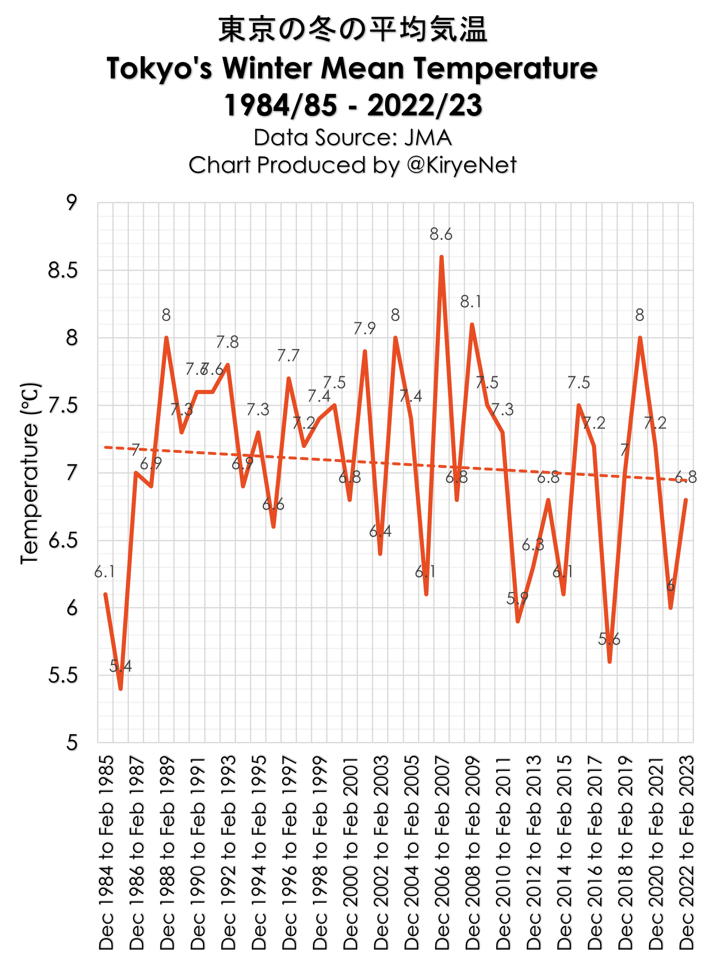
With all the news about global warming, surely the decades long winter-trend for the city of Tokyo must be one of strong warming. Yet, looking at the mean DJF winter temperature trend for Tokyo going back 39 years using the untampered data from the Japan Meteorological Agency (JMA), we see a trend that has to surprise the global warming bedwetting dolts:

Data source: JMA. 

As the chart shows, instead of warming, winters in Tokyo have been cooling (modestly) since the global warming scare began in the 1980s. The average of the last 10 years have definitely been colder than the two preceding ten-year periods. Citizens in Tokyo who have been hearing warming doom for decades have in fact not experienced it. Where’s the warming?

Rural Pacific island Hachijō-jima: no warming in75 years!

Next we look at the mean winter temperature trend of the Tokyo island of Hachijō-jima, located in the Pacific some 287 kilometers south of Tokyo – away from all the heat absorbing urban sprawl of concrete and asphalt we see in cities like Tokyo:

Data source: JMA. 

Winter mean temperatures on this Pacific island haven’t risen in over 75 years, this according to the meticulously collected data from the JMA. We suspect the news is also similar at other locations across the northern hemisphere where the data have not been tampered with.