โ€˜Ever-wrong Ehrlichโ€™sโ€™ Greatest Hits (er, misses)

His famous 1968 book, โ€œThe Population Bomb,โ€ changed the world. He famously predicted that human โ€œoverpopulationโ€ would soon outstrip food supplies, leading to catastrophic famines, and societal collapse. He predicted that hundreds of millions of people would starve to death in the 1970s and 1980s, that India would be unable to feed its population by 1980, and that major countries like England would no longer exist by the year 2000.

From Watts Up With That?

By Dave Burton with a postscript by Anthony Watts

Biologist Paul Ehrlich died on Friday, March 13, 2026, at the age of 93.

His famous 1968 book, โ€œThe Population Bomb,โ€ changed the world. He famously predicted that human โ€œoverpopulationโ€ would soon outstrip food supplies, leading to catastrophic famines, and societal collapse. He predicted that hundreds of millions of people would starve to death in the 1970s and 1980s, that India would be unable to feed its population by 1980, and that major countries like England would no longer exist by the year 2000.

The New York Times tactfully wrote that, โ€œhis predictions proved premature.โ€

When Ehrlich wrote his book, in 1968, the worldโ€™s human population was between 3.5 and 3.6 billion people. Today it is over 8 billion. Yet famine deaths, which were common when Ehrlich wrote his book, have become rare, as population and CO2 levels have risen:

Itโ€™s mainly because crop yields have risen even faster than population:

Several factors have contributed to that (surprising to Ehrlich!) improvement, but three of the most important factors are all thanks to fossil fuels:

  1. One important way that fossil fuels contribute to rising crop yields and save us from famines is by โ€œCO2 fertilization.โ€ CO2 emissions slowly raise the CO2 level in the atmosphere, which makes plants healthier, faster growing, and more productive.

The large benefits of elevated CO2 for crops have been known to science (though perhaps not to Ehrlich) for more than a century. The benefits are so dramatic that in 1920 Scientific American called anthropogenic CO2 emissions โ€œthe precious air fertilizer.โ€

Gradenwitz A. (1920). โ€œCarbonic Acid Gas to Fertilize the Air.โ€ Scientific American, Nov 27, 1920. doi:10.1038/scientificamerican11271920-549

2. Elevated CO2 not only benefits crops by CO2 fertilization, it also improves water use efficiency & drought resilience of crops, through reduced stomatal conductance. Here are some papers about it:

De Souza, A.P. et al. (2015). โ€œChanges in Whole-Plant Metabolism during the Grain-Filling Stage in Sorghum Grown under Elevated CO2 and Drought.โ€ Plant Physiology, 169(3), Nov 2015, 1755โ€“1765. https://doi.org/10.1104/pp.15.01054

Fitzgerald GJ, et al. (2016). โ€œElevated atmospheric [CO2] can dramatically increase wheat yields in semi-arid environments and buffer against heat waves.โ€ Glob Chang Biol. 22(6), 2269-84. https://doi.org/10.1111/gcb.13263

Chun, J.A. et al. (2021). โ€œEffect of elevated carbon dioxide and water stress on gas exchange and water use efficiency in corn.โ€ Agricultural and Forest Meteorology, 151(3), 378โ€“384, ISSN 0168-1923. https://doi.org/10.1016/j.agrformet.2010.11.015

EXCERPT: โ€œThere have been many studies on the interaction of CO2 and water on plant growth. Under elevated CO2, less water is used to produce each unit of dry matter by reducing stomatal conductance.โ€

Note that wheat is a C3 crop, but corn and sorghum are C4 crops. Both benefit, but C3 crops benefit more. (Most crops are C3.)

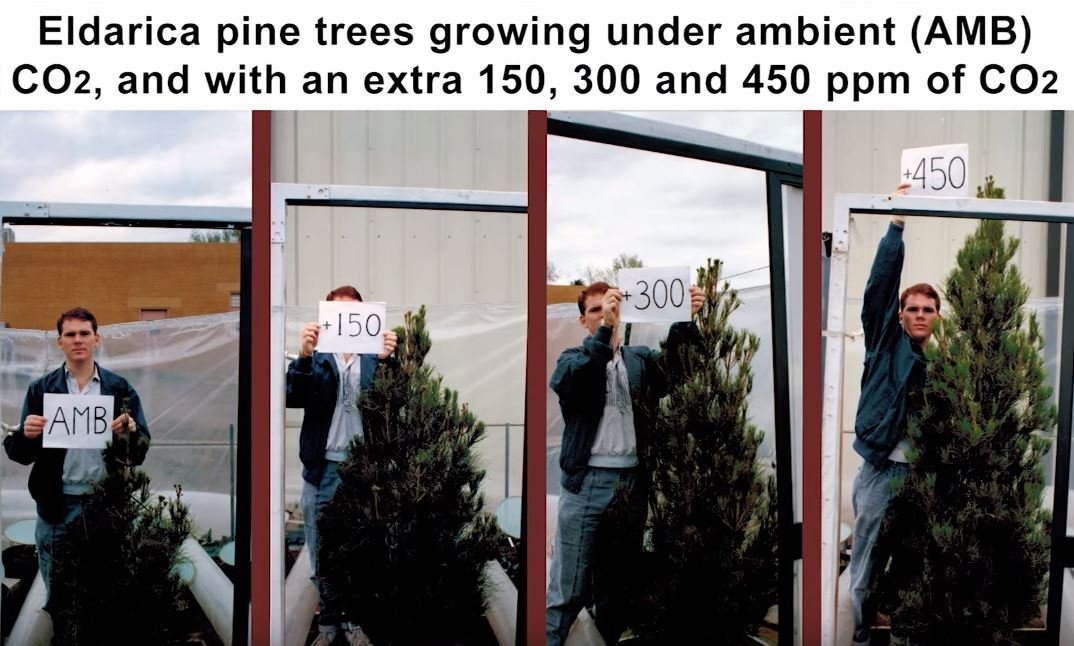
Trees are also C3 plants:

Idso & Kimball (1994). โ€œEffects of atmospheric CO2 enrichment on biomass accumulation and distribution in Eldarica pine trees.โ€ Journal of experimental botany. 1994 Nov., v. 45, no. 280 p.1669-1672. (preprint here)

Eldarica_pine_trees_vs_CO2.jpg (1074ร—646)

3. The third way that fossil fuels save us from famines is by enabling the creation of synthetic nitrogen fertilizer, from fossil fuels (mostly natural gas), using the Nobel-winning Haber-Bosch process.

Manure, compost, and bird & bat guano can also provide fertilizer, but not nearly enough to feed the world. The Haber-Bosch process eliminated that agricultural bottleneck.

As a bonus, when nitrogen fertilizer is made from natural gas, the carbon is released as CO2, just as it is when the natural gas is burned for heat.

There are other factors which have also helped, but itโ€™s mostly thanks to fossil fuels that you can afford to buy food for your family.

4. Agricultural mechanization is one of the other things which have helpedโ€ฆ but thatโ€™s also powered by fossil fuels

5. Pesticides have also helped a lotโ€ฆ but theyโ€™re also mostly made from petrochemicals.

6. Improved hybrid & GMO crops have also helped a lot.

The people who are crusading against fossil fuels might not realize it, but they are campaigning for a world in which parents watch their children starve.

To understand a contentious, politicized issue like climate change, you need balanced information. Iโ€™m here to help:

Learn More About Climate Change – resources

Thatโ€™s my resource list with:

โ— accurate introductory climatology info
โ— in-depth science BOTH from scientists who are worried about man-made climate change, and from scientists who are not.
โ— links to balanced debates between experts on BOTH sides of the issue
โ— info about climate impacts
โ— links to the best blogs on BOTH sides (and WUWT is top of the list, of course)


Postscript by Anthony Watts

Where to start? It is such a target rich environment.

Some WUWT posts worth revisiting:

Friday Funny: Paul Ehrlich Discredits the Peer Review Process

That post was in response to this (because peer review is perfect, ya know)โ€ฆthe hubris is off-the-scale.

Friday Funny โ€“ Paul Ehrlichโ€™s review of Steynโ€™s book on Michael Mannโ€™s work

Paul Ehrlich Claims Vindication for his Climate Catastrophe Prediction

SMH: Paul Ehrlich Got Almost Everything Wrong, but We Should have Listened to his Climate Warning

The social media platforms have been rife with commentary. Here are some examples:

And this says so much, with so few words:

To Mr. Ehrlich, wherever you are,ย I wish you exactly what you deserve.

From Manure Mountains to Train Terrors: 4 Bizarre Fears Humans Left Behind

Human beings are a panicky species โ€“ quick to fear and slow to understand. Over much of our evolutionary history, this ingrained alarm served us well, keeping us alive in a wild world brimming with dangers.

From Watts Up With That?

By Ross Pomeroy

Human beings are a panicky species โ€“ quick to fear and slow to understand. Over much of our evolutionary history, this ingrained alarm served us well, keeping us alive in a wild world brimming with dangers. But as humans came to dominate the globe and render the Earth more and more harmless (at least to us, mostly), we started to fret about increasingly innocuous things.

In his 2024 book, Fear/Less: Why Your Lifelong Fears Are Probably Groundless, Professor Wojciech Janicki, whoโ€™s based at the University of Maria Curie-Sklodowska in Poland, recounted some of the things humans once feared that probably seem silly to us today. His ultimate point? โ€œEven though humans have solved problem after problem, averting the obliteration of the species, it is still widely believed that catastrophe is almost inevitable.โ€ Itโ€™s time to consciously allay our fears and deal with threats as challenges rather than reasons for dejection and doomism.

Here are four formerly widespread fears, many of which were dispelled through innovation:

1. Train Travel. As railway travel proliferated in the 19th century, worries spread in media, scientific literature, and popular culture that this futuristic form of transportation could wreak havoc on passengersโ€™ physical and mental health. It was claimed that jarring movements and loud noises at unnaturally-fast speeds of sixty miles per hour resulted in chronic inflammation, impaired vision, and a nauseating host of other physical ailments. Worse, some people could suffer from โ€œrailway neurosisโ€, driving them temporarily or permanently insane. Habituation to train travel, along with improvements to tracks and locomotives, gradually assuaged travelersโ€™ concerns.

2. Electric Wires. Today, electric wires fade into the background of modern life in much of the world, but in the late 1800s, residents of New York City looked up at them with trepidation. Though fewer than 10 percent of households were connected to the grid at the time, the metropolis was one of the first to see rising adoption. In 1889, when Western Union lineman John Feek was electrocuted on the job, the publicโ€™s unease turned into mass panic.

In an article recounting the saga in IEEE Xplore, J.P. Sullivan explained Americansโ€™ thinking more than a century ago. โ€œThey believed that new technology would improve society, but at the same time worried that they had no control over the pace and direction of this changeโ€ฆ The tension between technological enthusiasm and pessimism created a profound anxiety about electricity and the new urban world it was creating.โ€

We know what happened. Electrical safety improved, and the benefits of electricity grew too large to relinquish.

3. โ€˜Drowningโ€™ in Horse Manure. In the 1890s, residents, officials, and planners living in London and New York worried that their streets would eventually become impassible and their cities unlivable from a build-up of horse manure. The hundreds of thousands of horses traversing city blocks to move freight and passengers left behind millions of pounds of fresh feces and urine each day. City cleaners would pile and move the gathered loads to designated locations, but sludgy excrement still caked the streets. As the citiesโ€™ populations rose, so, too would the mountains of dung!

Worries quickly evaporated when motorcars and electric streetcars arrived on the scene. โ€œA kind of paradox, donโ€™t you think? A car with a combustion engine was a solution, not a problem!โ€ Janicki commented.

4. Global Population Crash. From Paul Ehrlich in the 1968, to Thomas Malthus 170 years prior, to Confucius in the 6th Century BC, esteemed thinkers have fretted over human population growth. Many portended imminent and catastrophic crashes, often through widespread famine. Thus far, on a global scale, theyโ€™ve always been wrong. There are roughly 8.1 billion humans living on Earth today, and global poverty continues to fall, albeit not as fast as it could. Eating too many calories is a more common problem than eating too few. Human population growth will likely halt later this century, but not because of mass death โ€“ rather, due to higher living standards and voluntary contraception.

This article was originally published by RealClearScience and made available via RealClearWire.

Plus รงa change, plus รงโ€™est la mรชme chose

From the medieval climate optimum to the modern climate optimum, the weather in these islands has changed scarcely at all. The drought of March, the sweet April showers, the birdsong day and night, the bursting forth of primroses, bluebells, daffodils and other spring flowers, all are today just as Chaucer described them in the Middle Ages.

From Watts Up With That?

By Christopher Monckton of Brenchley

Here in England this spring, there was dry, sunny weather through most of March, followed by gentle showers in April. And here is the opening couplet of Geoffrey Chaucerโ€™s Tales of Caunterbury, written more than six centuries ago in 1387:

From the medieval climate optimum to the modern climate optimum, the weather in these islands has changed scarcely at all. The drought of March, the sweet April showers, the birdsong day and night, the bursting forth of primroses, bluebells, daffodils and other spring flowers, all are today just as Chaucer described them in the Middle Ages.

The wine-dark sea

One can even go back to Homer, in the 8th Century BC, who talked of the Mediterranean as โ€œthe wine-dark seaโ€. And here am I, almost three millennia later, recently recovered from a long illness caused by defective medication with no active ingredient in it, having climbed to the 1230ft summit of the Akamas peninsula in Cyprus, doing a Canute and challenging the wine-dark sea not to rise. The sea was wine-dark in Homerโ€™s time. It is still wine-dark today.

Where then, are the drastic changes in climate and consequent catastrophes and cataclysms so luridly predicted by the climate Communists? Where are the mass extinctions? Why is the climate much as it was in the Middle Ages? Why are ten times as many dying of cold as of heat? Why are crop yields at record highs? Why is the planet greening so fast?

Cold, not heat, is the real killer

Silvio Canto Jr., at the splendid American Thinker blog, reminds us that โ€œEarth Dayโ€ began on Leninโ€™s birthday, 22 April. He sets out some examples of the half-witted predictions made by the totalitarian far Left in the early 1970s, when the โ€œgreen holy dayโ€ started:

Paul Ehrlich, in a 1969 essay entitled Eco-Catastrophe!, wrote: โ€œMost of the people who are going to die in the greatest cataclysm in the history of man have already been born. By [1975] some experts feel that food shortages will have escalated the present level of world hunger and starvation into famines of unbelievable proportions. Other experts, more optimistic, think the ultimate food-population collision will not occur until the decade of the 1980s.โ€

In April 1970 he wrote in Mademoiselle: โ€œPopulation will inevitably and completely outstrip whatever small increases in food supplies we make. The death rate will increase until at least 100-200 million people per year will be starving to death during the next ten yearsโ€.

In the 1970 Earth Day issue of The Progressive, he sketched out his most alarmist scenario, telling readers that between 1980 and 1989 some 4 billion people, including 65 million Americans, would perish in what he called the โ€œGreat Die-Off.โ€

In the May 1970 issue of Audubon, he wrote that DDT and other chlorinated hydrocarbons โ€œmay have substantially reduced the life expectancy of people born since 1945.โ€ He said that Americans born since 1946 now had a life expectancy of only 49 years, and he predicted that if current patterns continued this expectancy would reach 42 years by 1980, when it might level out. According to the most recent CDC report, life expectancy in the US is 78.6 years.

That year he predicted that โ€œair pollutionโ€ฆis certainly going to take hundreds of thousands of lives in the next few years aloneโ€. He predicted that 200,000 Americans would die by 1973 during โ€œsmog disastersโ€ in New York and Los Angeles.

Five years later he predicted that โ€œSince more than nine-tenths of the original tropical rainforests will be removed in most areas within the next 30 years or so [i.e., by 2005], it is expected that half of the organisms in these areas will vanish with it.โ€

Kenneth Watt, an ecologist, said: โ€œBy the year 2000, if present trends continue, we will be using up crude oil at such a rate โ€ฆ that there wonโ€™t be any more crude oil. Youโ€™ll drive up to the pump and say, โ€˜Fill โ€™er up, buddy,โ€™ and heโ€™ll say, โ€˜Iโ€™m very sorry, there isnโ€™t any.โ€™โ€ Global oil production in 2024, at about 95 million barrels per day, was double the global oil output of 48 million barrels per day at the time of the first Earth Day in 1970.

He gave a speech predicting a pending Ice Age: โ€œThe world has been chilling sharply for about 20 years. If present trends continue, the world will be about four degrees colder for the global mean temperature in 1990, but eleven degrees colder in the year 2000. This is about twice what it would take to put us into an Ice Age.โ€

He also told Time that โ€œAt the present rate of nitrogen buildup, itโ€™s only a matter of time before light will be filtered out of the atmosphere and none of our land will be usable.โ€

Barry Commoner, a Washington University biologist, wrote in the Earth Day issue of Environment: โ€œWe are in an environmental crisis that threatens the survival of this nation, and of the world as a suitable place of human habitation.โ€

He also predicted that decaying organic pollutants would consume all of the oxygen in Americaโ€™s rivers, suffocating freshwater fish.

George Wald, a Harvard biologist, estimated that โ€œCivilization will end within 15 or 30 years [by 1985 or 2000] unless immediate action is taken against problems facing mankind.โ€

The New York Times, on its editorial page the day after the first Earth Day, wrote: โ€œMan must stop pollution and conserve his resources, not merely to enhance existence but to save the race from intolerable deterioration and possible extinction.โ€

Denis Hayes, the chief organizer for Earth Day, wrote in the Spring 1970 issue of The Living Wilderness: โ€œIt is already too late to avoid mass starvation.โ€

Peter Gunter, a professor at North Texas State University, wrote in 1970: โ€œDemographers agree almost unanimously on the following grim timetable: by 1975 widespread famines will begin in India; these will spread by 1990 to include all of India, Pakistan, China, the Near East and Africa. By the year 2000, or conceivably sooner, South and Central America will exist under famine conditionsโ€ฆ By the year 2000, thirty years from now, the entire world, with the exception of Western Europe, North America, and Australia, will be in famine.โ€ The prediction of famine in South America has come to pass only in Venezuela and only due to socialism, not due to environmental reasons.

Life Magazine reported in January 1970: โ€œScientists have solid experimental and theoretical evidence to supportโ€ฆthe following predictions: In a decade, urban dwellers will have to wear gas masks to survive air pollution โ€ฆ by 1985 air pollution will have reduced the amount of sunlight reaching Earth by one half.โ€

Harrison Brown, a member of the National Academy of Sciences, published a chart in Scientific American that looked at metal reserves and estimated that humanity would totally run out of copper shortly after 2000, while lead, zinc, tin, gold, and silver would be gone before 1990.

Senator Gaylord Nelson wrote in Look: โ€œDr. S. Dillon Ripley, secretary of the Smithsonian Institute, believes that in 25 years somewhere between 75 and 80 percent of all the species of living animals will be extinct.โ€

None of these lurid fantasies, mere pretexts for totalitarian control measures, has materialized.

While I have been ill, I have been quietly working on our teamโ€™s climatological research. For an update on our result, now published as an extended abstract after peer review, search YouTube for โ€œTom Nelson Moncktonโ€.

I have also had long and detailed conversations with two Fellows of the Royal Society, who are justifiably concerned at the Societyโ€™s propensity to promulgate only the official narrative on questions such as global warming and are preparing to do something about it.

We have already notched up a useful initial victory. Several Communist Fellows had decided that now that Elon Musk is for some reason no longer a hero of the Left they should call a meeting of the Royal Society to strip him of his Fellowship.

Elon Musk (image by Grok3)

Removing a Fellow would only be permissible if he had first been duly warned, and if he had had his chance to be heard, and if he were not named at any meeting until those preconditions in natural justice had been duly complied with.

However, the Communists at the meeting could not resist naming the new target for their perpetual hatred. In doing so, they unwittingly and witlessly debarred the Society from taking any further steps against Musk, either now or in the future.

For it is a settled principle of administrative law, dating back to the Courts of Equity in the 14th century, that in any judicial or quasi-judicial proceeding every stage of the process must be fair and just. If there is unfairness at any stage, then the process is tainted at every stage. That principle is also embodied in the European Human Rights Convention.

Once the Communists at the meeting had named Musk, they destroyed forever their attempt at dislodging him from the Fellowship.

The question now arises whether another Fellow, recently named by a judge in the United States as having overstated the financial damage he had suffered in consequence of an alleged libel, should have his Fellowship withdrawn. He should never have been granted a Fellowship in the first place, for the science for which he became infamous was at best inept (see the Wegman Report for the U.S. House of Representatives in 2006). Now, he may lose his Fellowship.

Meanwhile, the two sound Fellows and I have been working quietly to persuade the Reform Party that it should strengthen its opposition to the utter destruction of the British economy being wrought by the Department for Energy Security and Nut Zero.

Nigel Farage has now declared that Reformโ€™s opposition to the economic hara-kiri being wrought by our far-Left government will be on a par with his earlier opposition to the sullen Brussels tyranny-by-clerk. Brexit is done. On to Zexit! Nigelโ€™s propensity to upset the establishmentโ€™s rotten applecart should not be underestimated. Good times are ahead.

Meanwhile, enjoy the springtime as Chaucer described it โ€“

Whan that Aprile with his shoures swotรจ,

The droghte of March hath perced to the rootรจ,

And bathรจd every veyne in swich licรณur

Of which vertรบ engendred is the flour;

Whan Zephirus eek with his swetรจ breeth

Inspirรจd hath in every holt and heeth

The tendrรจ croppรจs, and the yongรจ sonnรจ

Hath in the Ram his halfรจ cours yronnรจ,

And smalรจ fowelรจs maken melodye,

That slepen al the nyght with open eye โ€ฆ

Environmentalism or Individualism? (Part 6: The โ€œIdealโ€ of Primitivism)

โ€œEnvironmentalism reflects an antipathy for a complex, technological, and free society where survival is bought at the cost of ambition, learning, thinking, taking risks, and working hard, within a free, competitive marketplace.โ€

From Master Resource

By Robert Bidinotto

Ed. Note. This concludes our six-part series on the incompatibility of environmentalist ideology with the foundational individualist philosophy of the United States. Previous posts were โ€œAmericaโ€™s Enlightenment Heritageโ€ (Part 1); โ€œConservation vs. Preservationโ€ (Part 2); โ€œInhuman Rightsโ€ (Part 3); โ€œPhilosophic Conflictโ€ (Part 4); and โ€œThe Value of Natureโ€ (Part 5).

โ€œEnvironmentalism reflects an antipathy for a complex, technological, and free society where survival is bought at the cost of ambition, learning, thinking, taking risks, and working hard, within a free, competitive marketplace.โ€

Despite all the benefits of modernity, the primitive tribal โ€œidealโ€ of self-denial still persists, most explicitly within the environmentalist movement.

Because of its enduring popularity, many view its environmentalist advocates as sincere idealists, but simply too extreme. Nothing could be further from the truth. In fact, their supposed โ€œidealโ€ isnโ€™t ideal at all. No, Iโ€™m not criticizing them for being too committed to a principle. Iโ€™m accusing them of being committed to the wrong principle.

Ask yourself the following question: Where is there a place for humans and their works in a world where pristine nature is deemed ideal, and the productive use of nature for human gain is deemed immoral?

In essence, environmentalists are attacking our very right to live, period. That position permits no compromise. To concede an inch of ground to it is to surrender, in principle, the entire battle for our lives, well-being, and happiness.

For too long, defenders of modernity have tacitly conceded the realm of philosophyโ€”and the mantle of moral idealismโ€”to its critics. Too few have demanded that the environmentalists answer such philosophical questions as:

  • Whyย does untouched nature have โ€œvalueโ€ in itself?
  • What, exactly, does that mean?
  • By what standardsย do you maintain that the human use of a natural resource constitutes an illegitimate claim, or an aesthetic desecration?
  • Andย by what standardย is a life of scarcity and self-denial virtuous?

So long as the โ€œidealโ€ of a pristine nature unspoiled by self-interested human use remains unchallenged, that ideal will remain the compass that sets the direction of national debate and policy. And its logic will demand that we slowly, inexorably surrender more and more of our property and profits, more and more of our rights and freedoms.

Thatโ€™s certainly the vision of environmentalist leaders. โ€œWe must make the rescue of the environment the central organizing principle of civilization,โ€ declares Al Gore. The changes demanded by this organizing principle, he says, will be โ€œwrenchingโ€ and โ€œwill affect almost every aspect of our lives together on this planet.โ€1

Yet that prospect doesnโ€™t appear to faze him or his environmentalist colleagues in the least. Paul Ehrlich, for example, makes it clear that the environmentalist goal isnโ€™t to make poor people better off. Since he believes that rich people, by using more resources, cause many times more โ€œecological destructionโ€ than poor people, Ehrlich concludes: โ€œActually, the problem in the world is that there are too many rich people.โ€2

Environmentalism reflects an antipathy for a complex, technological, and free society where survival is bought at the cost of ambition, learning, thinking, taking risks, and working hard, within a free, competitive marketplace. One sees the true environmentalist motive clearly captured in the book title Returning to Edenโ€”a woozy yearning for an egalitarian garden, where fruit drops from the tree into oneโ€™s lap, where the struggle to survive ceases, where all animals lie down in peace and harmony. The Eden of environmentalism is a risk-free place where idle wishes will be the coin of the realm.

Defending the Human Quest

But we donโ€™t live in a mythical Eden. We live on a planet where the struggle to survive is an implacable fact of nature. And those of us who do wish to surviveโ€”and thriveโ€”can no longer afford to remain on the moral defensive. We can no longer afford to remain agnostic and mute about the philosophical issues at the root of the attacks on our lives and livelihoods. We canโ€™t expect to rally public support against the environmentalists if we fail to challenge, openly and unapologetically, the moral assumptions underlying their efforts.

No, a moral assault must be met head-onโ€”with a moral response. To clarify the public debate, we must do two things. First, we must begin to understand and uphold the moral rightness of the human use of nature. Second, we must begin to understand and uphold our own moral right to do our work, and to profit from it.

So far, the critics of modernity have been winning the public relations battle. But thereโ€™s nothing inevitable about that. I donโ€™t believe that the public is fundamentally predisposed against a rational view of Man and nature. Theyโ€™re merely confused by arguments that pit the alleged moral claims of nature against the moral claims of human nature.

But defenders of Man have one huge advantage over their adversaries. The anti-human premises of environmentalism clash with every personโ€™s life, well-being, happiness, andโ€”perhaps above allโ€”his self-esteem.

As a case in point, science writer Jeremy Burgess, himself an environmentalist, wondered aloud: โ€œIs it just me, or does everyone else feel guilty for being alive too? โ€ฆEventually, and probably soon, we shall all be reduced to creeping about in disgrace, nervous of our simplest pleasures.โ€3

This, then, is the emotional reward of environmentalism: a metaphysical inferiority complex.

And how could it be otherwise? If untouched nature is the ideal, then, in logic, our lives, interests, well-being, and pleasures must be sacrificed to the โ€œgreaterโ€ interests of our surroundings. And if they arenโ€™tโ€”if our selfish, life-serving acts impinge on the โ€œidealโ€ in any way, as they mustโ€”then we will come to feel guilty about being alive.

But no one is born spitting into his own face. A metaphysical inferiority complex has to be acquired. It clashes with everything in the human spirit: the desires to learn, to grow, to do, to succeed, to be happy.

Itโ€™s time that we reject the environmentalistsโ€™ degrading view of human nature, and go on the moral offensive.

Itโ€™s time that we, as human beings, assert our right to exist as our nature demands.

Itโ€™s time that we stop apologizing for our every footprint, for our every fence, for our every meal.

Itโ€™s time that we stop regarding our homes as morally inferior to the trees they came from, or our childrenโ€™s needs as less morally important than Bambiโ€™s.

Itโ€™s time that we recapture the Enlightenment legacy, and build upon the philosophical work begun so nobly by Americaโ€™s Foundersโ€”those heroic achievers who โ€œexalted Reason and worshipped at the altar of Liberty.โ€ Itโ€™s time that we define and defend a new vision: an inspiring individualist vision of human potential, in which each human being is honored as an end in himself, with reason as his guide to action, and his own life, well-being, and happiness as his ultimate reward.

_____________________________

  1. Al Gore,ย Earth in the Balance: Ecology and the Human Spiritย (New York: Plume edition/Penguin Books, 1993), p. 269.ย โ†ฉ๏ธŽ
  2. Quoted inย โ€œPopulation Expert Says Americans Most Destructive,โ€ย Associated Press, April 6, 1990.ย โ†ฉ๏ธŽ
  3. Jeremy Burgess,ย โ€œExcuse Me for Being Alive,โ€ย Forum,ย New Scientistย 130, no. 1770 (June 8, 1991), p. 52.ย โ†ฉ๏ธŽ

About the Author

Robert Bidinotto is an award-winning journalist, editor, lecturer, and novelist who reports on cultural and political issues from the perspective of principled individualism. Over three decades he has established a reputation as a leading critic of environmentalism.

As a former Staff Writer for Readerโ€™s Digest, Bidinotto authored high-profile investigative reports on environmental issues, crime, and other public controversiesโ€”including articles on global warming and the 1989 Alar scare. His Alar article was singled out for editorial praise by Barronโ€™s and by Priorities, the journal of the American Council on Science and Health. He authored a monograph, The Green Machine,and for several years ran a website (โ€œecoNOTโ€), both critically examining the environmentalist philosophy and movement.

Bidinottoโ€™s many articles, columns, and reviews also appeared in Success, Writerโ€™s Digest, The Boston Herald, The American Spectator, City Journal, The Freeman, and Reason. He served as the award-winning editor of The New Individualist, a political and cultural magazine, and as editor of publications for the Capital Research Center, a nonprofit watchdog group.

In 2011, Bidinotto began writing political thrillers. HUNTERโ€”the debut novel in his Dylan Hunter seriesโ€”soared to the top of the Amazon and Wall St. Journal bestseller lists. BAD DEEDS, the first sequel, dramatizes the evils and dangers of environmentalism. A number-one best-selling Audible political thriller, BAD DEEDS was named โ€œBook of the Yearโ€ by the Conservative-Libertarian Fiction Alliance. Bidinottoโ€™s thrillers are available on Amazon.

Learn more about Robert Bidinotto at his fiction website, โ€œThe Vigilante Authorโ€ and at his nonfiction blog.  

The Age of Underpopulation is Here

The age of overpopulation is over. The age of underpopulation is here.ย  After decades of warnings and fear about an overpopulation crisis, population is now rapidly declining in most of the world. The overpopulation disaster predicted by world elites did not occur.

From Watts Up With That?

By Steve Goreham

Originally published in WND.

The age of overpopulation is over. The age of underpopulation is here.  After decades of warnings and fear about an overpopulation crisis, population is now rapidly declining in most of the world. The overpopulation disaster predicted by world elites did not occur.

Total fertility rate is the average number of children born per woman. Demographers tell us that a countryโ€™s fertility rate must be at least 2.1 children per woman to sustain the current level of population.

According to data from the United Nations, total world population still continues to rise, but population is declining in all major nations, where fertility rates have fallen below the minimum population replacement rate. Africa is the only continent where the population continues to grow. According to birth rates and without counting immigration flows, population is now falling in Australia, Brazil, Canada, China, India, Japan, Mexico, New Zealand, Russia, the United States, and all European nations except Monaco and the Faroe Islands.

For the last four decades of the 20th Century, world leaders warned of a coming catastrophe from an uncontrolled rise in global population. In 1950, the average woman was birthing about five children during her lifetime. Global population was growing at a rate of about two percent per year by 1955.

The Population Bomb, written by Paul Ehrlich in 1968, became a worldwide best seller. The prologue of the book stated, โ€œThe battle to feed all of humanity is over. In the 1970s and 1980s hundreds of millions of people will starve to death in spite of any crash programs embarked upon now.โ€ The author warned of coming famines and resource shortages and advocated for compulsory population control.

The fear of overpopulation produced a population control movement by the early 1970s. A consistent theme of the movement was that population growth was unplanned. Ehrlich stated: โ€œA cancer is an uncontrolled multiplication of cells; the population explosion is an uncontrolled multiplication of people.โ€

The United Nations indicated that people were not intelligent enough to plan their own families. James Grant, Undersecretary General for the UN, wrote in 1992: โ€œFamily planning could bring more benefits to more people at less cost than any other single technology available to the human race.โ€

Convinced by the overpopulation elites, governments of the world endorsed tragic population control measures. By the 1970s, it became US government policy to grant foreign aid only if population control measures were implemented. The World Bank and the UN also established policies requiring population control in exchange for loans or aid.

During the last decades of the 20th Century, population programs proposed by Western intellectuals and the UN were implemented in the form of anti-human policies by the governments of China, India, and dozens of other nations. The government of India established sterilization and intrauterine device insertion quotas in 1966. Over 40 million people were sterilized between 1965 and 1985, most coercively.

The Peopleโ€™s Republic of China implemented population policies in 1970 and adopted a one-child policy for all families in 1979. By March 2013, the China government reported that 336 million abortions and 222 million sterilizations had been carried out since 1971. Sex-selection abortion became common and even the killing of girl babies was practiced in both China and India.

Population control policies typically disproportionally impacted disadvantaged races or social classes. In India, coercive policies often targeted people of lower castes. In 1966, sterilization programs were set up at federally funded Indian Health Service hospitals in the US. Thousands of Native American women were sterilized between 1966 and 1976, often without informed consent. In Peru, sterilizations targeted rural natives of Incan descent.

But the overpopulation intellectuals were wrong. Famine did not kill hundreds of millions of people as Ehrlich predicted. Instead, an agricultural revolutionย increasedย global output of corn, rice, and wheat by a factor of five from 1960 to 2023. The malnourished portion of world population declined from 30 percent in 1950 to 10 percent today and continues to fall.

The world fertility rateย droppedย from about five children per woman in 1950 to 2.3 children per woman in 2021 and continues to fall. The population growth rate dropped to 0.82 percent per year by 2021 and is declining rapidly.

Nations moved from agricultural, to industrial, to technological societies, achieving the elimination of infectious disease, improved sanitation, improved food supply, a decline in infant mortality, and rising levels of education. Women entered the work force in larger numbers and family sizes declined.

But despite tragic implementation of population control policies in several nations, todayโ€™s families are having fewer children, the world population is stabilizing, and the predicted overpopulation disaster did not happen. Governments now pursue programs to boost family size in China, Japan, South Korea, and many nations of Europe.

But didnโ€™t population control programs cause the drop in fertility rates? The answer is โ€œno.โ€ Fertility rates dropped faster in South Korea than in China, driven by economic development, rising incomes, and increased levels of education and workforce participation for women, without forced population control measures. Fertility rates dropped faster in Brazil and Mexico due to demographic changes, than in India where forced population control was employed.

What is the lesson from the overpopulation crisis that did not occur? The United Nations, the intellectuals, and strident political leaders were dead wrong about overpopulation. People do not multiply like cancer cells. Rather than being a species โ€œout of control,โ€ humans plan their own families and react to changing societal conditions. The lesson from the overpopulation debacle is that people adapt to their environment.

But the United Nations and world elites now warn of a coming climate catastrophe. They demand a costly energy transition to Net Zero emissions. They demand that we change our transportation and our home appliances, that we stop eating meat, and that we adopt hundreds of other proposed climate-saving remedies. Will we have a climate disaster, or will the global elites be wrong again?

Steveย Gorehamย is a speaker on energy, the environment, and public policy and the author of the new bestsellingย bookย Green Breakdown: The Coming Renewable Energy Failure.

Resourceful Earth Day: Fred Smith on Julian Simon

On this Resourceful Earth Day, we may hope that Gore and his fellow foot soldiers in the environmental brigades will ponder these points and rethink the wisdom of the current policy of placing all oneโ€™s faith in federal political solutions.

Fromย Master Resource

By Robert Bradley Jr.

Ed. Note: April 22nd (tomorrow) has been celebrated since 1970 as Earth Day. However, this day needs an update by the simple addition of one word: Resourceful Earth Day. Human ingenuity has proven in the last 53 years that optimist/realist Julian Simon was right and the neo-Malthusians were wrong on the human condition and its prospects. This suggestion, and tribute to Simon, by the founder and longtime head of the Competitive Enterprise Institute (CEI), Fred Smith, remains as relevant as when it was published in 1999.

April 22, once associated with the optimism of revolutionary Marxism (as the birthday of Lenin) and then with the pessimism of modern Malthusianism (environmentalistโ€™s Earth Day since 1970), merits redemption.

A new label, Resourceful Earth Day, is appropriate as we enter the 21st century, a title selected to honor mankindโ€™s increasing ability to solve environmental as well as economic problems.

This title, of course, is inspired by the late Julian Simon, author of โ€œThe Resourceful Earth,โ€ who combated with passion and power those who viewed man as the cancer of this planet and his future as bleak and austere.

Resourceful Earth Day also signals a hope more appropriate to spring, marking a return to a positive view of manโ€™s role on this planet. Indeed the old Marxists, convinced that they would dominate the future, optimistically favored economic and technological change. The forces of change, they believed, would move man toward heaven here on Earth.

That optimistic element has disappeared. The environmental establishment has grown increasingly gloomy, convinced that the Earth is suffering from the โ€œTerrible Toosโ€ โ€” too many people, too much consumption, too great a reliance on technology which is understood too little. Earth Day has become a day of atonement for manโ€™s criminal assault on our planet. That pessimism reflects, in part, their realization that history is no longer on their side; thus, change is no longer in their interest. Stasis must be the order of the day.

With attacks on things like biotechnology, automobiles, suburban opportunity and trade, they now seek only, as Aaron Wildavsky noted, โ€œan egalitarian society based on rejection of economic growth in favor of a smaller population eating lower on the food chain, consuming a lot less, and sharing a much lower level of resources much more equally.โ€

Had God not expelled man from the Garden of Eden, so the story goes, the โ€œgreensโ€ certainly would have. And, indeed, their ideal land use is โ€œwilderness,โ€ defined as an area from which man is excluded.

Simon was a wonderful critic of all this foolishness. He investigated and refuted the gloomy projections that Western Civilization was a failure, that our civilization was non-sustainable and doomed to inevitable decline as the planetโ€™s finite resources were depleted.

But the finite nature of the Earthโ€™s material resources pose no great problem, he argued, because the Earthโ€™s most precious resource is infinite and organic. It is its people, contributing to  the ever-growing stock of useful human knowledge. When people have been free to apply their intellect, they have always found ways to meet needs and answer crises, and always will.

Simon pointed out that, while people are born with stomachs, they are born with brains and hands as well. The latter allow them to create far more than they consume. People, after all, are not ciphers, which helps explain how the growth in the worldโ€™s food supply has outstripped the growth in the worldโ€™s population.

The problems of famine, overpopulation, poverty and disease are resolvable. In fact, they have been resolved in the United States and other places where human ingenuity is free to solve them. The calamity criers of the green movement predicted great disasters afflicting the planet by the year 2000. The Carter administrationโ€™s Global 2000 Report forecast global calamity, and Paul Ehrlich claimed on the โ€œJohnny Carson Show,โ€ โ€œIf I were a gambler, I would bet even money that England will not exist in the year 2000.โ€

Unfortunately for the eco-catastrophists, as we approach their due date for disaster, the planet is in increasingly good shape. This point was recently conceded by Americaโ€™s arch-druid. โ€œNot only do we have the healthiest economy in a generation,โ€ said Vice President Al Gore, โ€œwe also have the cleanest environment.โ€

On this Resourceful Earth Day, we may hope that Gore and his fellow foot soldiers in the environmental brigades will ponder these points and rethink the wisdom of the current policy of placing all oneโ€™s faith in federal political solutions. The greensโ€™ constant calls for massive government controls, forced population limits, harsh curbs on economic activity, and a curtailing of technology threaten to produce exactly the results that such actions seek to avoid โ€”a world of ecological and economic disaster. On this April 22, let us commit to both a freer and a cleaner world; they go together after all.