America at 250: A Salute to the Workers Who Keep Freedom Moving

For two and a half centuries, our country has been tested by war and want, depression and disaster, division and doubt. Yet generation after generation, Americans have answered the call. They have built, planted, drilled, welded, farmed, taught, served, prayed, and sacrificed so that the promise of 1776 endured.

From Watts Up With That?

By Scott A. Angelle

On July 4, 2026, America will mark 250 years since a bold generation signed the Declaration of Independence and launched the greatest experiment in liberty the world has ever known. For two and a half centuries, our country has been tested by war and want, depression and disaster, division and doubt. Yet generation after generation, Americans have answered the call. They have built, planted, drilled, welded, farmed, taught, served, prayed, and sacrificed so that the promise of 1776 endured.

As founder of USA Energy Workers, I believe this anniversary is more than a celebration of dates and documents. It is a tribute to the people who made America work. It is a moment to recognize the men and women whose names may never appear in a history book, but whose labor powers the homes, hospitals, churches, schools, factories, farms, bases, and small businesses that form our nation’s backbone.

Among them are America’s energy workers.

From the Gulf of America to the Permian Basin, from Appalachia’s natural gas fields to the Bakken, from refineries and pipelines to power plants, ports, wind farms, solar fields, nuclear facilities and service yards, USA energy workers have helped transform a young republic into the world’s foremost economic power. They wear steel-toe boots, hard hats, safety glasses and work gloves. They rise before daylight, miss birthdays, brave storms, and work 24/7/365 because America cannot run on wishes. America runs on reliable energy, delivered by skilled American workers.

When we flip a switch, fill a tank, cool a home, heat a church, refrigerate medicine, manufacture food, move freight, or connect by phone to someone we love, we are receiving the benefits of their labor. Energy is not an abstract policy debate to the people who produce it. It is a calling, a craft, and a contribution to the common good.

America’s founders understood that freedom requires more than words. It requires the capacity to act, to defend ourselves, to feed our people, to build our own future, and to remain independent from those who do not share our values. In the 21st century, energy security is national security. A nation that cannot power itself cannot fully govern itself.

That is why this America 250 celebration should include a salute to the Americans who have kept our country moving through every season. Energy workers helped fuel victory in war, prosperity in peace, and innovation in every generation. Today, they are powering a new era of opportunity—from advanced manufacturing and agriculture to data centers, artificial intelligence, space exploration, and the daily life of every community.

At USA Energy Workers, our purpose is to elevate and celebrate the contributions of these men and women. We should honor the electrician and the roughneck, the welder and the engineer, the offshore worker and the lineworker, the refinery operator and the technician maintaining tomorrow’s energy technologies. The strength of America has always come from people who build.

We also reject the false choice that says America must choose between energy and conservation. The American energy worker loves the outdoors, too. We hunt, fish, boat, hike, camp, birdwatch, gather at the lake, and take our families to the beach. We want clean air, clean water, healthy marshes, abundant wildlife, and protected public lands. Conservation is not the enemy of energy. It is part of our duty as Americans.

The right path is balance: energy, environment, and economy working together. We can produce energy here at home under strong safety and environmental standards. We can invest in innovation that reduces emissions, improves efficiency, restores coastlines, protects habitats, and supports parks and public lands. We can strengthen families and communities without surrendering our energy future to nations that do not share our commitment to worker safety, environmental stewardship, or human freedom.

America has never advanced by retreating from its own strengths. We advanced because free people, blessed by God-given rights and abundant natural resources, had the courage to work, create, conserve, and build. The same spirit that carried pioneers across rivers and mountains lives today in the crews who head offshore before sunrise, the workers who maintain pipelines in winter cold, the technicians who keep the grid reliable, and the innovators developing dependable energy for the next 250 years.

As fireworks light the sky for America’s 250th birthday, let us remember that freedom has always required work. It required the courage of the founders, the sacrifice of soldiers, the wisdom of statesmen, the faith of families, and the sweat of workers whose hands turned promise into prosperity.

To America’s energy workers: thank you. You have helped power the American story. You have made our nation stronger, safer, more prosperous, and more free.

And to our beloved country: Happy 250th birthday. May we honor our past, protect the land and waters we love, celebrate the workers who keep America strong, and pass to the next generation a nation still worthy of the Declaration’s promise—life, liberty, and the pursuit of happiness.

Scott A. Angelle is Founder, USA Energy Workers.

This article was originally published by RealClearEnergy and made available via RealClearWire.

Fusion Fantasy (Nature Energy report)

Fusion energy — yielding enormous amounts of heat from the violent combination of elements — has long been touted as the holy grail of energy future. That’s wrong, according to a new article in the prestigious Nature Energy.

From Master Resource

By Kennedy Maize

“All the recent flurry of fusion fascination prompted one long-time observer of the story to quip, anonymously, ‘The folks who brought us the most expensive way in the world to boil water, fission, now want to double down with fusion.’”

Fusion energy — yielding enormous amounts of heat from the violent combination of elements — has long been touted as the holy grail of energy future. That’s wrong, according to a new article in the prestigious Nature Energy.

“While nuclear fusion power is often hailed as a future source of abundant, clean energy, current dominant fusion designs, magnetic and laser inertial, are unlikely to become competitive due to their expected low experience rates,” concludes the article by a team of researchers led by Lingxi Tang of the Energy and Technology Policy Group, Swiss Federal Institute of Technology in Zurich.

The policy implication? “[P]olicymakers should not rely on, or fund, fusion power as a core pillar of future clean energy systems unless designs with different characteristics are developed.”

Analysis

The article focuses on the current mainstream approaches to fusion — combining atoms through magnetic confinement or laser-induced confinement — concluding that they are “inherently large in unit size, extremely complex in design, and require moderate to high customization.”

Estimates of fusion’s costs, based on their research, range from $1,400 per kilowatt to $43,000 per kilowatt. These wildly divergent estimates lead the researchers to conclude that

fusion power is likely to remain uncompetitive relative to other low-carbon electricity supply technologies. This casts considerable doubt on the future role of fusion power in a net-zero energy system and whether current investment levels from both the public and private sectors are justified.

The article is a direct shot at the long-running, often-troubled, multi-billion-dollar, 34-nation ITER project in France. The “International Thermal Energy Reactor” project, the tokamak magnetic confinement machine, has been under construction since 2013 and now hopes to achieve its first plasma in 2036.

The analysis also targets the Department of Energy’s National Ignition Facility at Lawrence Livermore National Laboratory in California. In 2022, researchers were able to use focused lasers to achieve “break even,” producing more power output than the energy input by a tiny margin. That event generated a lot of publicity and optimism at the time, but little has been heard from Livermore since.

More recently, several startups claiming they are on the cusp of achieving practical fusion energy have raised a lot of venture capital, without actually delivering energy. All aim for smaller projects, with potentially multiple sales. None have reached the point of having a licensing proceeding at the U.S. Nuclear Regulatory Commission, a requirement before they can be commercially deployed.

Among them:

Helion Energy, based in Everett, Wash., founded in 2013. The company claims it has a smaller approach to fusion, which it terms “aneutronic fusion,” minimizing the production of neutrons with a pulsed linear magnetic confinement technology. It has backing from Open AI’s Sam Altman. The company has a 2023 agreement with nearby Microsoft to supply 50 MW of power in 2028 for a data center.

Commonwealth Fusion Systems, a Boston spin-off from MIT’s fusion energy program, developing a down-sized tokamak using high-temperature superconduction magnets to, the company claims, lead to “high performing, fusion systems at significantly lower cost.”

The company has a deal, details unspecified, with Google, an investor, for “an offtake agreement for 200 megawatts (MW) of clean fusion power” in Chesterfield County, Virginia.

General Fusion, headquartered in British Columbia, with subsidiaries in the U.S. and the U.K., and founded in 2002. The company’s technology, magnetized target fusion, combines both conventional approaches to achieving high-temperature plasma as a fusion starting point. In January, the company announced it is going public on the NASDAQ through a deal with a special purpose acquisition company, Spring Valley Acquisition Corp. III, to eventually become listed as NASDQAQ:GFUZ.

TAE Technologies, based in California and founded in 1998. The company bases its fusion technology on a hydrogen-boron process, known as known as proton-boron or p-11B. rather than the conventional merging of hydrogen isotopes deuterium and tritium. This reduces production of neutrons. It aims for a prototype commercial reactor by 2030, which it plans to be in the 350–500 MW scale. The company recently merged with the Trump family’s Trump Media and Technology Group Corp. with a self-proclaimed value of $6 billion and a CNN warning of “serious ethics concerns.”

Conclusion

The recent flurry of fusion fascination prompted one long-time observer of the story to quip, anonymously, “The folks who brought us the most expensive way in the world to boil water, fission, now want to double down with fusion.”

Always controversial and often outrageous commentator and mega-billionaire Elon Musk, no friend of fusion, commented on Twitter last December:

The Sun is an enormous, free fusion reactor in the sky. It is super dumb to make tiny fusion reactors on Earth. Even if you burned 4 Jupiters, the Sun would still round up to 100% of all power that will ever be produced in the solar system!!

Investors and public policy experts should heavily discount fusion hyperbole. Nuclear fission for new capacity is full of challenges–nuclear fusion has far more ground to cover.

California’s Looming Fuel Crisis: Refiners Are Trying to Warn the State

California is steadily dismantling the fuel infrastructure that keeps its economy running. At the same time, demand for that fuel remains enormous. That mismatch is now reaching a point where the companies actually producing the fuel are beginning to issue increasingly blunt warnings.

From Watts Up With That?

By Charles Rotter

California is steadily dismantling the fuel infrastructure that keeps its economy running. At the same time, demand for that fuel remains enormous. That mismatch is now reaching a point where the companies actually producing the fuel are beginning to issue increasingly blunt warnings.

The message is simple: if current policy continues, more refineries will close. When refineries close, gasoline does not disappear. It simply comes from somewhere else—usually farther away, at higher cost, and often from facilities operating under looser environmental standards.

The warnings are arriving while California is already losing refining capacity.

And the losses are not small.

Phillips 66 shut down its Los Angeles refinery in late 2025. The facility processed roughly 140,000 barrels of crude oil per day. Another major refinery is preparing to follow. Valero has announced plans to idle its Benicia refinery by April 2026, removing another 145,000 barrels per day from California’s fuel system.

Taken together, those two closures eliminate nearly 300,000 barrels per day of refining capacity. In practical terms, that is close to one-fifth of the state’s total capacity disappearing within a short period.

This is not a trivial adjustment in a market that is already unusually fragile.

California’s fuel system operates almost like an island. The state requires a specialized gasoline blend that few refineries outside the region produce. It also lacks major pipeline connections to the large refining centers in Texas or the Midwest. When a California refinery shuts down, replacement fuel must often arrive by ship from overseas.

That system works when everything is stable. It becomes far less comfortable when supply begins to shrink.

Petroleum refiners appear to understand this risk. Several companies are now warning California officials that additional regulatory pressure could accelerate the trend.

In a recent letter to Governor Gavin Newsom and state regulators, Marathon Petroleum outlined the problem in direct terms. The letter concerns proposed amendments to California’s Cap-and-Invest program administered by the California Air Resources Board.

According to Marathon, the proposal would dramatically increase the cost of operating refineries inside the state.

“California refineries are already among the most expensive refineries to operate in the world,” the company wrote. “As written, CARB’s proposal would further widen the cost disparity, forcing refineries to reconsider whether operations in California remain viable.”

That sentence should attract attention because refinery closures are already occurring without the additional policy changes.

Marathon also emphasized the scale of economic activity tied to refining operations.

“Petroleum refineries are vital to California’s economy supporting high-quality union and non-union jobs. Marathon alone employs over 2,000 workers in California and contracted approximately 5,300 full-time-equivalent contractors across 2024 and 2025.”

Refineries are not just fuel producers. They are large industrial hubs supporting maintenance contractors, equipment suppliers, transportation networks, and surrounding communities.

The company also pointed out the role refineries play in the state’s broader economy.

“Refineries pay state and local taxes that fund essential public services and ensure a reliable supply of transportation fuel to California consumers and businesses. This fuel keeps goods moving through complex supply chains across agriculture, manufacturing, logistics, and consumer markets.”

That last point often disappears in climate policy discussions. Modern supply chains rely heavily on transportation fuels. Trucks, ships, trains, aircraft, farm equipment, and construction machinery all depend on petroleum products.

California’s economy has not suddenly stopped needing those fuels.

In fact, demand remains substantial. Roughly ninety percent of vehicles registered in the state still run on gasoline.

This is where the policy problem becomes visible.

If California reduces its refining capacity while demand remains high, the state becomes more dependent on imported fuel. That introduces price volatility and supply risk.

Marathon summarized the consequences of the proposed regulatory changes in a short list.

“If CARB finalizes these proposed amendments as written, they will impose costs on in-state refineries so significant they risk higher transportation fuel prices for California residents, loss of high-quality jobs, declines in state and local tax revenues, increased dependence on imports, reducing security of gasoline, diesel, and jet fuel supply, and compromised military fuel availability and national security.”

That final item deserves particular attention.

California refineries produce large quantities of jet fuel and diesel used by the United States military. Numerous naval and aviation installations operate along the West Coast, and those operations require dependable fuel supply chains.

Marathon explained the concern clearly.

“California refineries supply significant volumes of fuel to the U.S. military supporting operations along the West Coast and at major defense installations.”

If domestic production declines further, the military will increasingly rely on imported fuel shipments.

“In such a scenario, the military will be forced to rely on more imported jet and diesel fuel creating unpredictable supply conditions during emergencies or heightened geopolitical risk.”

Energy supply has always been a strategic consideration during periods of conflict. Domestic refining capacity historically served as a buffer against disruptions in international fuel markets.

Reducing that capacity introduces uncertainty into systems that traditionally avoided uncertainty whenever possible.

Marathon’s letter also highlights an irony embedded in many climate policies.

California’s refineries operate under some of the strictest environmental regulations in the world. If those facilities close, fuel production does not disappear. It shifts to other refineries operating under different regulatory frameworks.

“This will simply lead to imported fuel produced by refineries in other states and countries with less stringent regulations and lower regulatory costs,” the company wrote. “The net effect will be an increase in global greenhouse gas emissions.”

Economists often describe this process as carbon leakage. Industrial activity relocates to jurisdictions with lower regulatory costs while global emissions remain largely unchanged.

Sometimes they increase.

Meanwhile the jurisdiction that implemented the regulation loses the industry.

The warnings are not limited to Marathon.

Chevron executives have also begun sounding alarms about California’s regulatory environment. In a recent interview, Chevron vice president Andy Walz described the situation in unusually blunt terms.

“I know Chevron and my competitors are having trouble running a business in the state of California,” Walz said. “If they add this burden of a tax on our refineries, I think it’s a matter of time. It’s not whether or not they’ll close, it’s when.”

Statements like that are easy to dismiss as industry lobbying. But when refinery closures are already occurring, the warnings start to look less theoretical.

California once had around forty refineries. Today the number is roughly a dozen.

Each closure makes the remaining system tighter. Each tightening makes supply disruptions more likely.

The companies operating those refineries appear to be trying to communicate this reality before additional capacity disappears.

Whether policymakers choose to treat those warnings as useful information or inconvenient noise will shape California’s energy future.

The fuel system the state currently relies on was built over many decades. It cannot be replaced quickly, and it cannot function without the infrastructure that produces the fuel.

Ignoring that constraint will not eliminate it.

It will simply make the consequences arrive sooner.

The Unreported Story of Grid Scale Battery Fires

The geniuses who are planning New York’s energy future think that they can make intermittent wind and solar generators work to power the electrical grid by the simple device of providing some battery storage. The idea is that when there are abundant wind and sun, they can store up the power for use during those calm and dark periods in the winter. How much battery storage will that take? It’s a simple arithmetic calculation, but none of our supposed experts have taken the trouble to crunch the numbers.

An illustration of a renewable energy facility featuring wind turbines, solar panels, and a storage building, set against a green hillside backdrop.

From Manhattan Contrarian

By Francis Menton

The geniuses who are planning New York’s energy future think that they can make intermittent wind and solar generators work to power the electrical grid by the simple device of providing some battery storage. The idea is that when there are abundant wind and sun, they can store up the power for use during those calm and dark periods in the winter. How much battery storage will that take? It’s a simple arithmetic calculation, but none of our supposed experts have taken the trouble to crunch the numbers.

Nevertheless, without any kind of feasibility study of whether this will work, they soldier forth building large grid-scale battery storage facilities. The battery building program is under way, at least to some degree, and a few such facilities are actually complete and operating out in the rural parts of the state. Meanwhile, there are plans for some much larger such facilities in New York City, including right in some of its most densely populated sections. Is there any problem with this that we ought to know about?

In a post back in March 2024, I reported on the progress of our two “climate leader” states with developing grid-scale battery storage. It turned out that the big problem was that these facilities were subject to large and dangerous fires on a regular basis. In some cases, the same facility would catch fire multiple times. That post reported on major fires in California at a site called Valley Center in San Diego County in September 2023, and at another one called Moss Landing south of San Francisco in September 2022. In January 2025, the Moss Landing facility had another major fire. From the EPA website:

On January 16, 2025, the Moss Landing 300 battery energy storage system at the Moss Landing Vistra power plant (Monterey County, Calif.) caught fire.

  • The 300-megawatt system held about 100,000 lithium-ion batteries.
  • About 55 percent of the batteries were damaged by the fire.

There were prior fires at the Moss Landing facility in September 2021 and February 2022.

Back here in New York, my March 2024 post reported on no fewer than three major fires at grid battery storage facilities in this state that had taken place during 2023. The following quote came from a piece at Canary Media from August 2023:

New York state is grappling with how to adjust its ambitious buildout of clean energy storage after fires broke out at three separate battery projects between late May and late July [2023]. . . . First, on May 31, a battery that NextEra Energy Resources had installed at a substation in East Hampton caught fire. . . . Then, on June 26, fire alarms went off at two battery units owned and operated by Convergent Energy and Power in Warwick, Orange County; one of those later caught fire. On July 27, a different Convergent battery at a solar farm in Chaumont caught fire and burned for four days straight.

Might you have the idea that these fires are becoming less frequent over time? If so, that’s only because these fires are one of those things — like the Somali welfare fraud in Minnesota — that the liberal media just don’t choose to report. It turns out that the Convergent Energy facility in Warwick, New York had another big fire just last week. From Etica AG, December 22:

Late on the evening of December 19, 2025, a fire occurred at the Church Street Battery Storage Facility in Warwick, New York, operated by Convergent Energy & Power. While no injuries were reported and the fire was confined to a single container, the incident remained active into the following day and prompted a multi-agency response, air quality monitoring, and renewed scrutiny of battery energy storage system (BESS) safety in the community.  For Warwick residents and local leaders, the fire carried added weight. The town has experienced multiple battery storage incidents in recent years, and each new event raises difficult questions about risk, emergency response, and whether existing BESS designs are suitable for locations near homes, schools, and small businesses. 

I can’t find any mention of this battery fire at the New York Times or at major media sites like CNN or the major television networks.

The Convergent Energy Warwick energy storage facility has a capacity of 12 MW and 57 MWh. Meanwhile, back here in New York City, there are plans, well advanced (although not quite yet under construction), to build a much larger grid battery storage facility in Ravenswood, Queens. That would be right on the East River, directly across from East Midtown and the Upper East Side of Manhattan:

Map showing the location of the Ravenswood Generating Station in Queens, New York, near the East River.

You can see on the map how close much of Manhattan is to this facility. To be fair, the wind usually blows the other way, but the parts of Queens near this facility are also very densely populated. Something called Queensbridge Houses — the largest public housing project in the country — is immediately adjacent.

The planned capacity of the battery storage facility in Ravenswood is 316 MW/2528 MWh — some 25 or more times the size of the facility in Warwick that has now caught fire at least twice.

A New York agency going by the name NYSERDA (New York State Energy Research and Development Authority) is leading the charge to build these energy storage facilities, including in densely populated areas like Queens. On their website, they have a page touting the new battery storage project at the Ravenswood location. Believe it or not, their sales pitch is that the new battery facility is cleaner and greener than the prior natural gas power plants on the site. Here is a quote they take from Queens Borough President Donovan Richards:

“The days of environmental and economic injustice in Western Queens, especially for our historically marginalized public housing families, are coming to an end. As we prepare to transform the Ravenswood Generating Station into a clean energy producer, it’s critical that the surrounding community reaps the benefits of that transition,” said Borough President Richards.

Somehow, both NYSERDA and Donovan omit to mention the issue of the fires.

Canada Provinces Defy Climatists, Opt for Energy Freedom

“Today marks an important step forward in uniting our country as Saskatchewan jumps on board with Alberta and Ontario to pursue our shared goals of economic growth, opportunity, and prosperity.” Alberta Premier Danielle Smith

Aerial view of a renewable energy facility featuring large wind turbines and extensive solar panel fields, alongside industrial structures in the background.

From Science Matters

 By Ron Clutz

BREAKING! Alberta DROPS BOMBSHELL After Canada REJECTS U.S. Pipeline Deal! 

The video explains how ordinary Canadians are taking action to reject climatism ideology in favor of energy realism and freedom. The transcript is below in italics with my bolds and added images.

What happens when a single province challenges an entire nation? Alberta just dropped a political bombshell after Ottawa rejected its 10 billion US dollar pipeline deals.

“Today marks an important step forward in uniting our country as Saskatchewan jumps on board with Alberta and Ontario to pursue our shared goals of economic growth, opportunity, and prosperity.” Alberta Premier Danielle Smith

But Premier Danielle Smith isn’t backing down. She’s fighting back with her crossborder energy corridor, striking partnerships with US states and challenging the decision and power of Ottawa.

“Today, we’re signing a memorandum of understanding that makes Saskatchewan an official signatory and partner as we work together on building oil and gas pipelines and expanding trade corridors to global markets.”

This fight isn’t about a single pipeline anymore. It’s a full-blown showdown over the economic soul of Canada. Who really controls the future? Federal climate crusaders in Ottawa or the oil-driven defiance in Alberta? It started quietly. For months Alberta had been negotiating with US refiners and private investors on a bold plan, a new pipeline corridor linking the oil sands to refineries in Montana, North Dakota, and ultimately to the Gulf Coast.

This wasn’t a revival of Keystone XL, but the logic was the same: move more bitumen and synthetic crude, cut rail dependency, and deliver secure Canadian energy to the hungry markets in America. The numbers told the story. This agreement will see our three provinces advance pipelines and pathways to boost exports of homegrown energy, potash, critical minerals, and agricultural products to markets across Canada and across the world.

The proposed cost was between 8 and 10 billion, almost entirely financed by private industry. There were no bailouts and no federal funding. All Alberta asked from Ottawa was a green light on crossborder approval. For Premier Danielle Smith, this wasn’t just about energy. It was about survival.

And if Prime Minister Mark Carney doesn’t want to work with us, it’s not just myself and Scott Moe he’ll have to worry about. He’ll also have to contend with Premier Doug Ford, who has said many times he’ll be all over him like an 800lb gorilla.

So, it’s time to get rid of the bad laws that have harmed Canada’s ability to grow the energy sector and other industries such as mining and manufacturing. The economy of Alberta is built on oil exports. But without enough pipeline capacity, producers were forced to rely on rail. Rail is slower, more expensive, and more dangerous. The delay of one day meant millions lost. Thousands of jobs at risk, and the Albertan communities paying the price.

Industry leaders were optimistic. US refiners in the Midwest and Gulf were eager for Canadian heavy crude, a more stable and cleaner alternative compared to politically volatile suppliers abroad. The environmental analysts even argued the project would cut per barrel emissions by replacing rail transport with efficient modern pipelines. Everything was lined up perfectly.

But then Ottawa said no. The Canadian Prime Minister Mark Carney rejected the deal outright. He made it clear no new crossborder pipelines would be approved. But why? The answer was climate. Carney and his government had pledged to lead Canada into a net zero future. New pipelines, federal ministers argued, would lock in emissions, heavy oil production for decades. That was incompatible with the climate commitments and international reputation of Canada.

Map showing the estimated percentage of the population in Canada that believes human activities are causing global warming, with shades of blue indicating varying levels of belief across provinces.

Behind the scenes, politics also played a role. Quebec and large parts of Ontario, crucial bases of support for federal liberals and centrists, have long opposed the construction of new fossil fuel infrastructure. The approval of pipeline in Alberta risked urban climate conscious voters in Montreal, Toronto, and Ottawa.

Rejecting it sent a signal the energy future of Canada will be hydrogen,
renewables, and critical minerals, not the oil sands in Alberta.

For Alberta, the message was brutal. It wasn’t just a policy decision. It was a blockade. But Danielle Smith didn’t wait. Within 48 hours, she called an emergency press conference. Standing beside industry leaders and ministers, she declared Alberta would move ahead with or without Ottawa. Smith announced a bold new plan, a provincially backed pipeline corridor fast-tracked under Albertan jurisdiction, financed by private investors, and supported by 1.2 $2 billion in provincial loan guarantees. The construction preparation is expected to begin within 12 months.

Danielle Smith revealed exploratory agreements with the governors of Montana and North Dakota to coordinate crossborder energy projects, trade facilitation, and infrastructure planning. In short, if Ottawa won’t help, Alberta will work directly with the states in the United States. The message was clear. Alberta wasn’t asking anymore. It was acting.

A superhero character posing confidently, with the words 'CO2' and 'Freedom' prominently displayed on his body.

The stakes are enormous. Albertian oil sands directly support over 140,000 jobs and billions of dollars in export earnings. Without pipelines, producers such as Suncor, Cenovis, and Meg Energy face rising transportation costs, reduced competitiveness, and shrinking investment. For workers, the uncertainty is devastating. Thousands of pipe fitters, welders, truck drivers, and construction crews were counting on jobs tied to the $10 billion project. The communities along potential routes were preparing for growth. Now they’re caught between the rejection of Ottawa and Albertan defiance.

A cartoon depicting a whimsical 'Just Transition' machine resembling a factory, with workers in safety gear entering on one side and a fast-food worker outside, asking, 'Would you like fries with that?'

But the ripple effects don’t stop in Canada. Smith framed it bluntly. This wasn’t ideology. It was survival. Alberta wasn’t going to stand by while Ottawa, in her words, choked our future. Once she doubled down by raising the stakes even higher. Alberta would consider tapping the Alberta pension plan to finance its energy infrastructure. The logic? If Ottawa won’t support their priorities, then Albertans’ money should.

The bombshell ignited fury across the West. Saskatchewan and Ontario quickly signed memorandums of understanding with Alberta, pledging to expand pipelines, rail exports, and energy trade. Wexit groups, which had been dormant for a long time, roared back online. Conservative premiers in Saskatchewan and BC echoed the defiance of Smith, accusing Ottawa of sabotaging resource provinces. The Ottawan response was predictable. Federal ministers doubled down on climate goals. So, no more pipelines and no more fossil expansion, only renewables, critical minerals, and electrification. The Canadian government painted Albertan response as reckless and accused Smith of manufacturing a crisis for political gain.

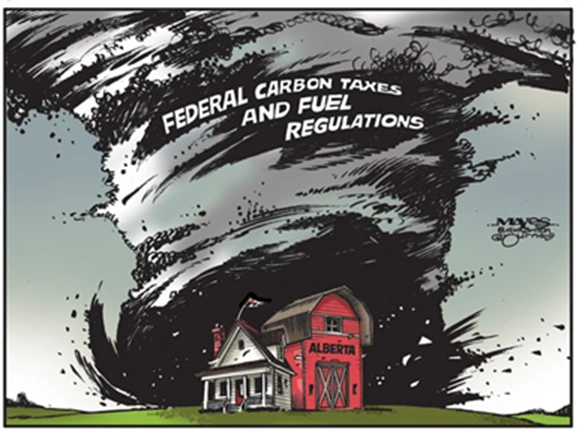
A political cartoon depicting a tornado overwhelming a house and barn labeled 'Alberta', with the text 'FEDERAL CARBON TAXES AND FUEL REGULATIONS' above it.

But here’s the truth. This isn’t just a policy dispute anymore. It’s a battle for the Canadian economic soul. The question is, how far will this go? Because what happens next could reshape Canada forever. The fallout is already shaking the political map of Canada. In Western Canada, calls for autonomy are louder than ever. Saskatchewan’s premier joined Smith in declaring that energy independence is no longer optional. It’s survival. Even Ontario, often aligned with Ottawa, signed agreements to boost pipeline and mineral trade with Alberta.

For many, this is more than economics. It’s about fairness. Albertans see the wealth of their province generated from oil exports funding national programs while Ottawa refuses to support the very industry that creates that wealth. The rejection crystallized a long-standing grievance that the federal government takes from Alberta but never gives back.

The tension is spilling into Parliament. Conservative MPs accused Carney of abandoning Canadian workers to please foreign investors and climate lobbyists. They warned that the stance of Ottawa weakens national unity and strengthens separatist sentiment. Meanwhile, Block Quebecois MPs cheered the rejection, saying Alberta should stop holding Canada hostage with oil. The divide is sharper than ever.

A political cartoon depicting tall smokestacks on people's heads labeled 'Saudi Arabia,' 'U.S.,' 'Russia,' and 'Canada,' with Canada wearing a cone hat, highlighting the topic of emission caps.

South of the border, the reaction is more pragmatic. Governors in Montana and North Dakota see opportunity. By partnering directly with Alberta, they can secure stable energy supplies and create jobs in pipeline construction, refining, and logistics. Quietly, US officials are already signaling support.

But this puts Ottawa in a bind. If Alberta succeeds in striking crossborder deals without federal blessing, it challenges the very structure of Canadian federalism. The energy and trade are constitutionally shared powers. But what happens if a province pushes ahead anyway? The legal challenges are inevitable. Ottawa may try to block Alberta in court, but that could trigger an even deeper political backlash.

So, for now, Ottawa is betting on a green future. Alberta is betting on oil. Both sides are digging in. If Alberta pulls this off, it could change the balance of power in Canada forever. If it fails, the province risks isolation, lost investment, and a deeper rift with Ottawa.

A political cartoon depicting a speaker at a podium labeled 'Alberta' arguing that CO2 is essential for life, with an audience member expressing outrage.

The Energy Trifecta: Nuclear, Fossil Fuels…and Geothermal Energy

The Geothermal Energy Opportunity (GEO) Act has recently been introduced in congress to help clear the regulatory burdens hindering the development of this potentially important resource.

From Watts Up With That?

From Legal Insurrection

The Geothermal Energy Opportunity (GEO) Act has recently been introduced in congress to help clear the regulatory burdens hindering the development of this potentially important resource.

by Leslie Eastman

The Energy Trifecta: Nuclear, Fossil Fuels…and Geothermal Energy

The Geothermal Energy Opportunity (GEO) Act has recently been introduced in congress to help clear the regulatory burdens hindering the development of this potentially important resource.

Posted by Leslie Eastman Monday, June 30, 2025 at 03:00pm 3 Comments

The U.S. stands at a pivotal crossroads in its energy future. As artificial intelligence (AI) accelerates its transformation of industries and daily life, the nation’s appetite for electricity is surging to unprecedented levels.

AI data centers are already consuming about 4% of U.S. electricity, with projections indicating this could rise to 12–15% by 2030. The explosive growth of AI, from large language models to autonomous vehicles, is placing strains on the power grid.

Based on some recent discussions I have had with friends and my geologist husband, I assert that geothermal energy deserves urgent and serious consideration alongside fossil fuels and nuclear power as the perfect “trifecta” for America’s energy strategy. Unlike intermittent renewables, geothermal offers stable, 24/7 baseload power… reliability that is essential for supporting the always-on demands of AI-driven data centers, our critical infrastructure, and the electricity needs of U.S. consumers.

Also, and most importantly, it leverages existing American expertise in drilling and subsurface engineering, providing a pathway for oil and gas workers use their talents to expand our nation’s energy options.

There have been some critical breakthroughs in recent years that make utilizing geothermal energy more effective and efficient. There have been significant advances in enhanced geothermal systems (EGS), which enable geothermal energy production in areas previously deemed unsuitable due to a lack of natural permeability or water resources.  A DOE-funded project conducted by the University of Utah demonstrates the enormous potential for developing this particular energy source.

A major University of Utah-led geothermal research project, funded by the U.S. Department of Energy (DOE), achieved a critical breakthrough in April after hydraulically stimulating and circulating water through heated rock formations a mile and a half beneath its drill site in the Utah desert and bringing hot water to the surface. The test results are seen as an important step forward in the search for new ways to use Earth’s subsurface heat to produce hot water for generating emissions-free electricity. The successful well stimulations and a nine-hour circulation test were the fruits of years of planning and data analysis at the Utah FORGE facility near Milford, 175 miles southwest of Salt Lake City.

As highlighted in the recent Issues & Insights article, new geothermal projects are coming online with greater efficiency and lower costs, thanks to innovations such as closed-loop systems and enhanced geothermal systems.

These common drilling techniques should enable geothermal developers to reach “hot spots” located deeper below the surface than thought possible just a few years ago. They could also expand the map for geothermal development far beyond the Western states.

Small wonder that investor interest in geothermal energy has surged in recent years, with more than $1 billion raised since 2022. Tech companies on the hunt for suppliers of baseload electricity to power their data centers see the potential of geothermal energy. Amazon, Google, Microsoft, and Meta – all heavyweights in the booming AI/data center sector – have all inked contracts with geothermal developers.

…Geothermal’s potential to join fossil fuels and nuclear energy in powering America’s economy in the years to come far exceeds anything weather-dependent wind and solar could ever match. With the House version of the budget reconciliation bill accelerating the phase-out of the subsidies that prop them up, these once-coddled industries are scrambling to stay relevant.

Congrats to @QuaiseEnergy on the completion of their first geothermal drilling demonstration on a full-scale oil rig developed at @MIT. This technique can drill up to 12 miles, surpassing conventional geothermal wells that typically don’t exceed ~2 miles.https://t.co/QlWV0gkQrB— ARPA-E (@ARPAE) June 27, 2025

As the article notes, bureaucratic bungling has been the biggest hurdle for geothermal energy to overcome. Therefore, Rep. Celeste Maloy (R-UT) has introduced the Geothermal Energy Opportunity Act (GEO Act, H.R. 301), which aims to expedite the federal permitting process for geothermal energy projects.

She is also pairing it with another piece of legislation to help peel back the layers of regulatory tape.

…[T]he permitting process for geothermal energy production itself needs to be shortened, Garfield said, calling out the National Environmental Policy Act, or NEPA, a 1970 law that requires the federal government to conduct an environmental review before moving forward with infrastructure projects.

{Deputy Director of the Utah Office of Energy Development Jake] Garfield said offering geothermal projects certain exemptions under NEPA would help the industry — like what’s being proposed by Maloy through her Geothermal Energy Opportunity Act, which requires the U.S. Department of Interior to process a geothermal drilling permit within 60 days.

Maloy is also sponsoring the Streamlining Thermal Energy through Advanced Mechanisms Act, which gives the geothermal industry the same flexibility as the oil and gas industry, cutting some of the regulations when pursuing a project on public land that’s already been studied or disturbed by industry.

With governments and private investors increasingly recognizing the potential of geothermal energy, I believe the sector is poised for significant growth in the coming years. As an added bonus, geothermal plants are not known to kill whales or bald eagles.

Image by perplexity.ai.

Germany’s energy future threatened: Biden stops LNG exports

Germany is facing a devastating energy crisis that is seriously threatening its security of supply. US President Joe Biden has unexpectedly halted the expansion of liquefied natural gas (LNG), putting Germany in a precarious position.

From Blackout News

Germany is facing a devastating energy crisis that is seriously threatening its security of supply. US President Joe Biden has unexpectedly halted the expansion of liquefied natural gas (LNG), putting Germany in a precarious position.

The country has relied heavily on LNG from the US to become independent of Russian pipeline gas. Biden’s decision now has far-reaching implications that could pose serious problems for German energy policy (berliner-zeitung: 26.01.24).

Germany in Energy Crisis: How Biden’s Decision Threatens Germany’s Energy Supply

Biden has halted construction projects for new LNG terminals for the time being, stressing the importance of climate protection in the face of the climate crisis. The U.S. is the world’s largest exporter of LNG, but the U.S. government has put new export terminals on hold for now.

Germany in Energy Crisis: How US President Biden’s Decision Threatens Germany’s Energy Supply

This has implications for Germany, as it has sourced most of its LNG from the US, especially after saying goodbye to Russian gas. Representatives of the U.S. energy industry have turned to the U.S. government about Europe’s jobs and security of supply, but the focus is on climate protection.

Permits have already been issued for some terminal projects, but new export licenses will not be issued for the time being. This affects four ongoing projects and could affect Germany’s energy supply.

Germany in the LNG crisis – hedge funds are already betting on price losses of German companies

Much of Germany’s LNG comes from the US, where it is often extracted using fracking. However, the origin and composition of the LNG are not always clear.

Investors have raised concerns about Germany’s energy policy before Biden made his decision. A hedge fund founder criticized German policies and sees favorable conditions for energy companies such as RWE AG, Engie SA and SSE Plc.

Anglo-Saxon hedge funds have placed short positions against German companies, fearing a slump in global demand and price losses. Qube Research & Technologies has bet more than $1 billion against German companies, including Volkswagen and Deutsche Bank.

Germany must act urgently to secure its energy future

Some market observers point out that short selling must be reported, while betting on rising prices does not have to. In addition, many funds use short positions to hedge their investments.

Deutsche Umwelthilfe and Greenpeace welcome Biden’s decision and demand that Germany also review and stop LNG projects, as they are incompatible with climate protection.

Overall, Germany is facing challenging times in terms of energy policy, as it must look for new solutions for its energy supply, while at the same time looking at the environmental impact.

Extraordinary Costs Of Green Energy Creeping Slowly Into Public Awareness

Skyrocketing electricity bills and power prices are the result of green energy policies.

From The MANHATTAN CONTRARIAN

Francis Menton

A key claim of the green energy movement has long been that the intermittent “renewables” — wind and solar — provide the cheapest form of energy. Therefore, the advocates say, just build enough wind turbines and solar panels, convert all use of energy to electricity, and sit back and enjoy a future of affordable energy without adverse environmental consequences.

Meanwhile a key theme at this blog has been exposing the incompetence and chicanery of the claims of low cost for electricity from wind and sun. Although it may often seem as if nobody is listening, I reassure myself that when the full costs of wind and solar electricity eventually get exposed, the people will catch on and not allow themselves to be impoverished.

Over in Europe, it looks like enough of the costs have now gotten exposed to cause the beginning of a public awakening. In August I had a post on how the costs of “green” energy were starting to change the “net zero” debate in the UK. Now, add to that report the results of the elections this past weekend in Germany and Luxembourg. In both countries, parties now standing at least somewhat against the green transition scored gains, while Greens lost ground. The process of ultimate political transformation looks to be long and slow; but I have faith that reality will eventually win out.

First, a short refresher on the claims of green energy advocates that the wind and sun provide the cheapest power. If you only read this blog, or other climate skeptic sources, you may find it incredible that anyone could believe such assertions. But you must remember that the self-designated climate advocates repeat these claims to themselves endlessly in an echo chamber where no one ever pushes back. Eventually, it appears, they come to believe that the claims are true.

And thus, here is my blog post from August 16, 2022, reporting on a Soho Forum debate on the energy future, between Steven Koonin and Andrew Dessler. Dessler, arguing for a future of wind and solar power, had as his main contention that those are cheaper than the fossil fuel alternatives, and therefore they will inevitably sweep the fossil fuel infrastructure away. Although he is some kind of leader in the climate alarm movement, Dessler appeared to have no clue that there was any counter-information to his contentions about the costs of wind and solar power. In support of his position, Dessler used as his main metric the “Levelized Cost of Energy” (LCOE) as published by investment bank Lazard. The LCOE metric is ridiculously flawed, and should not fool anybody, but seems to have fooled not just Dessler but also the entire green energy movement (and for that matter the entire Democratic Party and the President of the United States).

And nothing about LCOE and fraudulent advocacy based on it is going away. Long after the Soho Forum debate last August, Lazard went right ahead and came out with a new and updated Report in April titled “2023 Levelized Cost of Energy+.” Here is the key chart from that Report:

You can see right there that the cost (measured by LCOE) of solar PV is $24-96/MWh, onshore wind is even less at $24-75/MWh, and the cheapest fossil fuel alternative is combined cycle natural gas at $39-101/MWh. So wind and solar are cheaper — QED! But, as I wrote in my August 16, 2022 post:

[A]n LCOE calculation completely omits the dominant costs of generating reliable electricity using mostly or entirely wind and solar generators. These dominant costs are the costs of energy storage and/or backup, the costs of overbuilding, and the costs of additional transmission.

Meanwhile over in Europe, I doubt that many people are abandoning the green movement based on complex spreadsheet calculations of the costs involved. Rather, most of them are starting to face up to reality because of some combination of skyrocketing electricity bills and plans to ban gas heat and internal combustion cars.

The BBC reports here on the results of yesterday’s regional elections in the German states of Bavaria and Hesse. The swings in voter preferences were not huge, but still enough to be meaningful on the climate issue. For example, in Bavaria the BBC reports that the long-dominant CSU got 36.7% of the vote, and a second conservative party, the Free Voters (Freie Währen) expanded to 15%, while the Greens “slipped slightly” to 15% and the SPD (party of Chancellor Olaf Scholz) got only a “catastrophic” 8%. The BBC has this to say about the issues in the Bavarian election:

In an unusually ferocious campaign in Bavaria, conservatives and right-wingers railed against Berlin’s plans to phase out fossil fuel boilers and high levels of migration.

While this was not a one-issue referendum on green energy, still it is clear from the results that opposing green energy in at least some respects was definitely a positive rather than a negative among the electorate.

In Luxembourg, the swings were also mostly small, but included a gain for the conservatives matched with a dramatic loss for the Greens. Bloomberg reports on October 8 that the long-time ruling coalition of Democrats, Socialists and Greens got “toppled.” In a parliament of 60, the Conservatives upped their total to 21 seats, while the Greens went from 9 seats to just 4. The result is likely to be a governing coalition of the conservatives with other parties, but excluding the Greens, which could mean a significant shift in green energy policies.

Back here in the U.S., the Biden administration continues with its wrecking ball approach to destroying our energy economy. But as Europe is showing us, small changes voter preferences can change that quickly after the next election.