Earth Day News: The planet is still doing great. It’s the climate cult that’s broken

The routine never changes: The planet is dying, humans are to blame, and only surrendering your freedom, your car, and your paycheck to the green elites will save it. Fifty-six years later, they’re still wrong.

From Science Matters

By Ron Clutz

Jason Isaac and Steve Milloy bring tidings of great joy in 2026 in their Washington Examiner article with the title as above.

Every April, like clockwork, a predictable ritual unfolds. Earth Day rolls around with the same tired apocalyptic sermon from the climate catastrophe cult.

The routine never changes: The planet is dying, humans are to blame, and only surrendering your freedom, your car, and your paycheck to the green elites will save it. Fifty-six years later, they’re still wrong.

The planet is fine. It’s the climate cult that’s cracked.

You’d think after all the busted prophecies, they’d tone it down. Instead, they double down.

Remember when the “experts” said the Arctic would be ice-free by 2013? The ice is still there, just as thick and stubborn as ever.

We were told hurricanes would grow “more frequent and more powerful.” Instead, there were near-normal seasons in 2023 and 2024.

So now they move the goalposts: Every weather event, hot or cold, wet or dry, is “caused by climate change.” It’s not science. It’s superstition plotted on graphs. They said snow would vanish from ski resorts — remember that “End of Snow” panic? Instead, skiers in the Northeast this year were digging out from record blizzards.

The 2023-2024 warming spike was caused by a natural El Nino. When the El Nino ended, the spike ended. February 2026 was cooler, in fact, than February 1998 despite a trillion tons of emissions.

Time after time, the “experts” predict apocalypse. And year after year, Mother Nature refuses to corroborate their stories.

Air Quality – National Summary EPA

Meanwhile, the actual data tell a different story. U.S. air quality today is the cleanest it’s been in 50 years.

My Mind is Made Up, Don’t Confuse Me with the Facts. H/T Bjorn Lomborg, WUWT

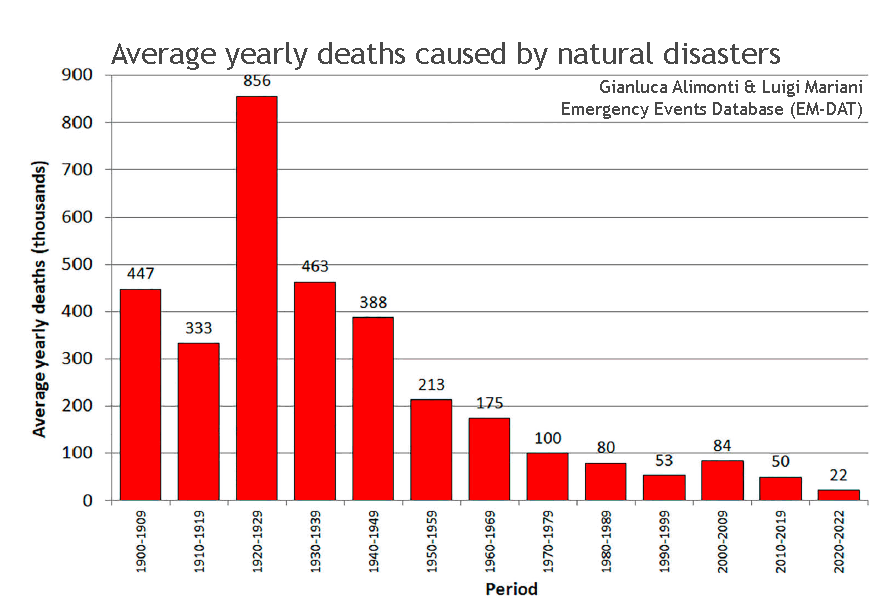
Global deaths from natural disasters have plummeted over 90% since the early 20th century. Crop yields worldwide keep hitting records.

Humans are safer, wealthier, and more energy-secure than at any time in history.
The planet isn’t gasping for breath — it’s very healthy.

That’s exactly what George Carlin was getting at in his legendary bit, “The Planet Is Fine.” Over three decades ago, long before “climate anxiety” was a diagnosis, Carlin, perhaps the most famous comedian of his time, saw through the sanctimony.

The planet’s been through ice ages, asteroid strikes, and supervolcanoes — and it’s still spinning. Yet today’s enviroactivists think your SUV is going to do what Mount Tambora couldn’t? Please. Their arrogance is nauseating.

The self-appointed saviors of Earth don’t really care about the planet.
They care about control.

Earth Day has turned into a political holiday — a green May Day for those who want to remake society in their image. Their “solutions” invariably mean more regulation, higher taxes, and fewer choices.

Shut down the power plants, outlaw gas stoves, ban plastic straws while flying private jets to elitist conclaves dressed up as ‘‘climate conferences.”

It’s not about saving Earth. It’s about saving face.

When the predictions fail, the excuse shifts. Sea levels were supposed to swallow Manhattan, but the only thing underwater now is former Vice President Al Gore’s credibility.

Polar bears were “going extinct” until the population hit record highs. Every “climate emergency” gets debunked, but the headlines roll on because fear sells.

Carlin joked that people crave bad news. The legacy media just industrialized it.

And the public is getting wise. Net-zero mandates
are collapsing under their own absurdity.

Europe ran headfirst into the wall of “green reality” and came crawling back to coal and nuclear. Even California’s self-inflicted energy shortages have people asking whether energy policy should be based on cockamamie models or common sense.

The answer should be obvious: If your plan can’t keep the lights on, it’s not saving the planet — it’s sabotaging it.

“Follow the science” is their mantra. Fine.
The science says carbon dioxide is plant food.

The science says climate models have blown past reality for decades. The science says mankind thrives in warmer eras.

None of this fits the narrative, so it gets buried under the next climate scare of the month. The apocalypse never arrives — but the grant money does.

Here’s the part Earth Day activists really hate: The planet isn’t fragile — we are.

Nature doesn’t need our policies, our pledges, or our petitions. It will outlast every last panel discussion in Davos, Switzerland.

So instead of groveling over our collective “climate guilt,” maybe they should celebrate what we’ve actually accomplished: clean air, longer lives, record food production, and energy that works at the flick of a switch.

The planet doesn’t care about your compost bin or your latest electric car mandate. It’s been around for 4.5 billion years, and cooling for the last 485 million years, and it will still be here when the last climate model is rotting on an obsolete hard drive.

It’s humans who need perspective. As Carlin famously said, “The planet is doing great.” The hysterical people who keep screaming that it isn’t are the problem.

Global deaths and disasters down: UN shameless lies, up

Despite a galactic rise in Headlines of Doom, the world is a safer place than ever. The United Nations however is an absolute danger to our quality of life and our children’s mental health. They’ve shamelessly concocted the myth that disasters are increasing due to “climate change”.

From JoNova

By Jo Nova

To solve the increase in global disasters just axe the UN

Despite a galactic rise in Headlines of Doom, the world is a safer place than ever. The United Nations however is an absolute danger to our quality of life and our children’s mental health. They’ve shamelessly concocted the myth that disasters are increasing due to “climate change”.

NetZeroWatch report on a new paper on natural disasters and find that yearly deaths are down. Somehow satellites, phones, antibiotics, bulldozers and fire trucks are better at saving lives than horse drawn carts and hessian bags. Who would have guessed, apart from everyone?

From Alimonti and Mariani.:

Below the graph of natural disaster events shows a huge increase in the reporting of disasters, at least up until the turn of the century. But there is, if anything, a decline since then. There are three very different trends. But the giant bureaucratic sponge that is the United Nations can shamelessly draw a straight linear trend through this graph and tell the world that disasters are getting worse, even as they are obviously not.

In the last twenty years, humans have put out 40% of all the CO2 emissions they’ve ever put out since they lived in caves, but disasters have decreased 20%. It used to be that 20 year trends were enough to launch a new UN committee, but now the only trend-length that matters is the one that goes “up”.

Another pair of analysts  point out the CRED (Centre on the Epidemiology of Disasters) was only set up in 1973 and the EM-DAT database was only established in 1988. (Ritichie and Rosado).  Even the CRED team itself has warned people about reading too much into these trends, yet practically every separate wing of the UN has done exactly that. The FAO said “disaster events have increased from 100 per year in the 1970s to around 400 events per year worldwide in the past 20 years.” The UN Chief said “natural disasters have quadrupled since 1970.” The the UNFCC took his misinformation and repeated it. A few years ago the WMO said “The number of disasters has increased by a factor of five over the 50-year period.” The  BBC and The Economist lapped it up. Too many mistakes is never enough.

In 2019, the UN Office for Disaster Risk Reduction (UNDRR) opined about the “‘staggering rise in climate-related disasters over the last twenty years’” proving only that lying UN agencies are a bigger threat to the science than the entire fossil fuel industry ever was.

The rise in all of these disasters is mostly because people got better at reporting disasters.  Back in 1901 if a cyclone landed in Ecuador, nobody rang up the UN, which didn’t exist, on phones that weren’t installed, to tell them about it. And when global population was five times smaller in 1900 tornados could wander the prairies and sometimes no one would notice. Droughts could strike rivers and unless the fish complained, who would know?

Suspiciously geophysical disasters (like earthquakes and volcanoes) have also increased “since 1900” and at about the same rate and with the same “break point” in the trend. Obviously our gas guzzling cars are not causing earthquakes and beef-steak doesn’t set off volcanoes. So the rapid increase in these sorts of disasters in the 1970s and 1980s supports the theory that the  rapid rise an artefact of data collection. There’s a lot more detail on that in the paper.

Meanwhile, the relentless good news on global crops continues.

If there really were more storms and frosts and devastating floods, you’d think the rice paddies and cornfields of the world would have noticed.

Yet here they go again, growing 2 to 4% more grain year after year.

Alimonti and Mariani don’t mince their words — the increase is just “better reporting”:

We conclude that the patterns observed are largely attributable to progressively better reporting of natural disaster events, with the EM-DAT dataset now regarded as relatively complete since ∼2000. The above result sits in marked contradiction to earlier analyses by two UN bodies (FAO andUNDRR), which predicts an increasing number of natural disasters and impacts in concert with global warming. Our analyses strongly refute this assertion as well as extrapolations published by UNDRR based on this claim.

The claim that the increase in disasters registered in EM-DAT in the final part of the twentieth century is mostly, if not completely, caused by better reporting and not by a real events increase, is supported by three independent lines of evidence: (a) several CRED reports (Guha-Sapir et al., 2004; Scheuren et al., 2008; CRED, 2015); (b) best fit analysis that found an important breakpoint and even a change in the trend sign of natural disasters at the beginning of the 21th century, in agreement with what is written and justified in point a; (c) the same trend change and breakpoint for geophysical disasters that have very little, if anything, to do with human activities or global warming.

But it’s also “better blindness”. If the BBC, The Economist, and all the other sycophant agents of groupthink and power-mongers asked for “a graph” (with all the data) the facade would fall over in a week.

REFERENCES

Gianluca Alimonti & Luigi Mariani (2024) Is the number of global natural disasters increasing?, Environmental Hazards, vol 23: No 2, 186-202, DOI:
10.1080/17477891.2023.2239807

Emergency Events Database (EM-DAT) from the Center for Research on the Epidemiology of Disasters (CRED).

Hannah Ritchie and Pablo Rosado (2024) – “Is the number of natural disasters increasing?” Published online at OurWorldInData.org.

The GWPF helpfully provides a list of references, including their work refuting these claims: