Global warming, climate change, all these things are just a dream come true for politicians. I deal with evidence and not with frightening computer models because the seeker after truth does not put his faith in any consensus. The road to the truth is long and hard, but this is the road we must follow. People who describe the unprecedented comfort and ease of modern life as a climate disaster, in my opinion have no idea what a real problem is.
The Associated Press (AP) released a story claiming climate change is causing windstorms to worsen, threatening corn production, leading farmers to consider a new short corn variety. This story is false on almost every front. If farmers are considering a newly developed corn variety, its due to clever marketing by the company developing the crop, not changing climate conditions. Wind speeds and storms haven’t been increasing, aren’t forecast to at any time in the foreseeable future, and corn yields and production continue to set records with existing corn types.
The Associated Press (AP) released a story claiming climate change is causing windstorms to worsen, threatening corn production, leading farmers to consider a new short corn variety. This story is false on almost every front. If farmers are considering a newly developed corn variety, its due to clever marketing by the company developing the crop, not changing climate conditions. Wind speeds and storms haven’t been increasing, aren’t forecast to at any time in the foreseeable future, and corn yields and production continue to set records with existing corn types.
Taking a late-summer country drive in the Midwest means venturing into the corn zone, snaking between 12-foot-tall green, leafy walls that seem to block out nearly everything other than the sun and an occasional water tower.
. . .
But soon, that towering corn might become a miniature of its former self, replaced by stalks only half as tall as the green giants that have dominated fields for so long.
The short corn developed by Bayer Crop Science is being tested on about 30,000 acres (12,141 hectares) in the Midwest with the promise of offering farmers a variety that can withstand powerful windstorms that could become more frequent due to climate change. (emphasis mine)
The facts tell a different story, however. Long corn is in no way being “steamrolled.” Corn yields and production continue to set new records, with some regularity, and there is no evidence that windstorms are becoming more frequent, or that wind speeds are increasing.
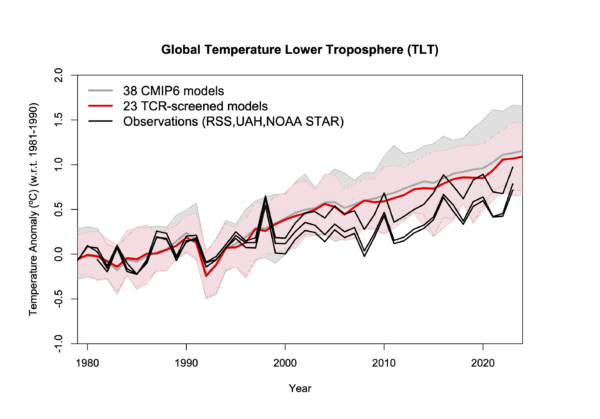
To the latter point first. The AP and other mainstream media outlets usually treat reports and pronouncements of the U.N. Intergovernmental Panel on Climate Change (IPCC) as authoritative on climate change. The IPCC’s latest report is clear concerning the impacts of climate change on wind speeds and damaging windstorms: no change has been detected at present; and, under the even the most extreme climate scenario, no change is anticipated in the foreseeable future, through 2100 at least. (see the figure, below)
So much for the AP’s claim that worsening winds pose a threat to corn production.
Data from the U.S. Department of Agriculture (USDA) and the U.N. Food and Agriculture Organization (FAO) also show no climate change impacts on corn yields or production in the United States or globally.
A recently updated USDA report says that corn yields are expected to set a new record in 2024, increasing by 0.5 bushels per acre over the previous estimate, and by a full six bushels per acre of the previous record set in 2023. (See the graph, below)
Data from the FAO confirm the USDA’s findings concerning U.S. corn production and also determine that corn production and yields are regularly setting records around the world as well. Between 1990 and 2022 (the last full year of FAO records), spanning the three decades climate alarmists commonly assert have been the warmest on record:
Corn yields in the United States have increased by nearly 60 percent’
Corn yields globally have increased by more than 54 percent.
On record yields, crop production has similarly set new records repeatedly as well between 1990 and 2022. (See the graph, below)
Even if, contrary to the AP’s suggestion, corn production is not being harmed by worsening climate conditions, Bayer’s short corn variety may prove beneficial for farmers. It seems that, per the AP, “[t]he smaller plants also let farmers plant at greater density, so they can grow more corn on the same amount of land, increasing their profits.” The shorter corn may also use less water. Both conditions should, in theory, make corn production more profitable, regardless of climate change, so there is a bit of good news in the AP’s otherwise unjustifiably foreboding climate change tale.
What follows is a response to Gavin Schmidt’s blog post at RealClimate.org entitled Spencer’s Shenanigans in which he takes issue with my claims in Global Warming: Observations vs. Climate Models. As I read through his criticism, he seems to be trying too hard to refute my claims while using weak (and even non-existent) evidence.
What follows is a response to Gavin Schmidt’s blog post at RealClimate.org entitled Spencer’s Shenanigans in which he takes issue with my claims in Global Warming: Observations vs. Climate Models. As I read through his criticism, he seems to be trying too hard to refute my claims while using weak (and even non-existent) evidence.
To summarize my claims regarding the science of global warming:
Climate models relied upon to guide public policy have produced average surface global warming rates about 40% greater than observed over the last half-century (the period of most rapid warming)
The discrepancy is much larger in the U.S. Corn Belt, the world-leader in corn production, and widely believed to be suffering the effects of climate change (despite virtually no observed warming there).
In the deep-troposphere (where our weather occurs, and where global warming rates are predicted to be the largest), the discrepancy between models and observations is also large based upon multiple satellite, weather balloon, and multi-data source reanalysis datasets.
The global energy imbalance involved in recent warming of the global deep oceans, whatever its cause, is smaller than the uncertainty in any of the natural energy flows in the climate system. This means a portion of recent warming could be natural and we would never know it.
The observed warming of the deep ocean and land has led to observational estimates of climate sensitivity considerably lower (1.5 to 1.8 deg. C here, 1.5 to 2.2 deg. C, here) compared to the IPCC claims of a “high confidence” range of 2.5 to 4.0 deg. C.
Climate models used to project future climate change appear to not even conserve energy despite the fact that global warming is, fundamentally, a conservation of energy issue.
In Gavin’s post, he makes the following criticisms, which I summarize below and which are followed by my responses. Note the numbered list follows my numbered claims, above.
1.1 Criticism: The climate model (and observation) base period (1991-2020) is incorrect for the graph shown (1st chart of 3 in my article). RESPONSE: this appears to be a typo, but the base period is irrelevant to the temperature trends, which is what the article is about.
1.2 Criticism: Gavin says the individual models, not the model-average should be shown. Also, not all the models are included in the IPCC estimate of how much future warming we will experience, the warmest models are excluded, which will reduce the discrepancy. RESPONSE: OK, so if I look at just those models which have diagnosed equilibrium climate sensitivities (ECS) in the IPCC’s “highly likely” range of 2 to 5 deg. C for a doubling of atmospheric CO2, the following chart shows that the observed warming trends are still near the bottom end of the model range:
And since a few people asked how the results change with the inclusion of the record-warm year in 2023, the following chart shows the results don’t change very much.
Now, it is true that leaving out the warmest models (AND the IPCC leaves out the coolest models) leads to a model average excess warming of 28% for the 1979-2022 trends (24% for the 1979-2023 trends), which is lower than the ~40% claimed in my article. But many people still use these most sensitive models to support fears of what “could” happen, despite the fact the observations support only those models near the lower end of the warming spectrum.
1.3 Criticism: Gavin shows his own comparison of models to observations (only GISS, but it’s very close to my 5-dataset average), and demonstrates that the observations are within the envelope of all models. RESPONSE: I never said the observations were “outside the envelope” of all the models (at least for global average temperatures, they are for the Corn Belt, below). My point is, they are near the lower end of the model spread of warming estimates.
1.4 Criticism: Gavin says that in his chart “there isn’t an extra adjustment to exaggerate the difference in trends” as there supposedly is in my chart. RESPONSE: I have no idea why Gavin thinks that trends are affected by how one vertically align two time series on a graph. They ARE NOT. For comparing trends, John Christy and I align different time series so that their linear trends intersect at the beginning of the graph. If one thinks about it, this is the most logical way to show the difference in trends in a graph, and I don’t know why everyone else doesn’t do this, too. Every “race” starts at the beginning. It seems Gavin doesn’t like it because it makes the models look bad, which is probably why the climate modelers don’t do it this way. They want to hide discrepancies, so the models look better.
2.1 Criticism: Gavin doesn’t like me “cherry picking” the U.S. Corn Belt (2nd chart of 3 in my article) where the warming over the last 50 years has been less than that produced by ALL climate models. RESPONSE: The U.S. Corn Belt is the largest corn-producing area in the world. (Soybean production is also very large). There has been long-standing concern that agriculture there will be harmed by increasing temperatures and decreased rainfall. For example, this publication claimed it’s already happening. But it’s not. Instead, since 1960 (when crop production numbers have been well documented), (or since 1973, or 1979…it doesn’t matter, Gavin), the warming has been almost non-existent, and rainfall has had a slight upward trend. So, why did I “cherry pick” the Corn Belt? Because it’s depended upon, globally, for grain production, and because there are claims it has suffered from “climate change”. It hasn’t.
3.1 Criticism: Gavin, again, objects to the comparison of global tropospheric temperature datasets to just the multi-model average (3rd of three charts in my article), rather than to the individual models. He then shows a similar chart, but with the model spread shown. RESPONSE: Take a look at his chart… the observations (satellites, radiosondes, and reanalysis datasets) are ALL near the bottom of the model spread. Gavin makes my point for me. AND… I would not trust his chart anyway, because the trend lines should be shown and the data plots vertically aligned so the trends intersect at the beginning. This is the most logical way to illustrate the trend differences between different time series.
4. Regarding my point that the global energy imbalance causing recent warming of the deep oceans could be partly (or even mostly) natural, Gavin has no response.
5. Regarding observational-based estimates of climate sensitivity being much lower than what the IPCC claims (based mostly on theory-based models), Gavin has no response.
6. Regarding my point that recent published evidence shows climate models don’t even conserve energy (which seems a necessity, since global warming is, fundamentally, an energy conservation issue), Gavin has no response.
Gavin concludes with this: “Spencer’s shenanigans are designed to mislead readers about the likely sources of any discrepancies and to imply that climate modelers are uninterested in such comparisons — and he is wrong on both counts.”
I will leave it to you to decide whether my article was trying to “mislead readers”. In fact, I believe that accusation would be better directed at Gavin’s criticisms and claims.
P.S. For those who haven’t seen it, Gavin and I were interviewed on John Stossel’s TV show, where he refused to debate me, and would not sit at the table with me. It’s pretty revealing.
Granite Falls, Minnesota, a tranquil prairie town of about 2,700 residents, has found itself in the eye of a storm. A seemingly peaceful town, known for its old-school hydroelectric plant, is on the brink of a transformation with plans for carbon dioxide (CO2) pipelines spreading across the Midwest. While proponents see economic opportunity, a multitude of opponents fear disastrous consequences.
A uncovered pipeline construction site with soil around.
Reader resource guy (H/T) writes: “We have our own special interest-driven troubles as it is.”
Granite Falls, Minnesota, a tranquil prairie town of about 2,700 residents, has found itself in the eye of a storm. A seemingly peaceful town, known for its old-school hydroelectric plant, is on the brink of a transformation with plans for carbon dioxide (CO2) pipelines spreading across the Midwest. While proponents see economic opportunity, a multitude of opponents fear disastrous consequences.
These pipelines are planned to link dozens of ethanol plants, creating a vast network to transport CO2, a byproduct of ethanol production. This industry has become a critical component of state economies across the Midwest, consuming 45% of U.S. corn production.
However, these pipelines are not welcomed by all. For some, like farmers, tribal groups, and environmental activists,
Landowners fear threats to their property rights, potential effects on productivity, and land value degradation. Tribal groups are concerned about disruption of ancestral grounds, and environmentalists cite potential hazards of highly pressurized liquid carbon dioxide and fear that the use of ethanol merely delays the transition to carbon-free energy.
Despite the formidable and well-funded opposition, pipeline proponents continue to push forward, arguing the benefits of carbon capture and storage. Summit Carbon Solution’s $5.5 billion Midwest Carbon Express, one such proposed project, is touted to be the largest of its kind. The project
As reported by Stateline, the project aims to store 18 million tons of CO2 underground, an amount equivalent to removing 3.9 million vehicles from U.S. roads.
One of the most significant challenges faced by landowners in this situation revolves around the concept of eminent domain, the right of the government to expropriate private property for public use. Landowners and their representatives have fought similar battles before, learning valuable lessons from protests against the Keystone XL and Dakota Access oil pipelines. However, the outcome of this battle is far from clear. In states like Iowa and South Dakota,
Pipeline companies like Summit, Navigator, and Wolf see a promising future. Pipeline proponents also reference the federal 2022 Inflation Reduction Act, which raised the tax credit for carbon sequestration to $85 per ton. Monte Shaw, executive director of the Iowa Renewable Fuels Association, argues that “ethanol plants that don’t capture and store CO2 will not be competitive,” indicating a potential ripple effect through the state’s economy if the projects are not implemented.
Nonetheless, the safety concerns raised by the critics of the project cannot be ignored. CO2 pipelines operate under high pressure and pose significant safety challenges. Critics cite incidents like the 2020 pipeline rupture in Satartia, Mississippi, which resulted in 49 hospitalizations. Despite these concerns, Summit assures on its website that its proposal “goes above and beyond” federal standards on pipeline depth, clearance, and setbacks.
As the battle over CO2 pipelines in the Midwest heats up, the conflicting interests of economic growth, environmental preservation, and property rights will continue to collide. As Joy Hohn, a farmer from South Dakota, remarked,
“It’s David vs. Goliath,” hinting at the complex and formidable challenge that awaits all the competitive interests in the region.


You must be logged in to post a comment.