

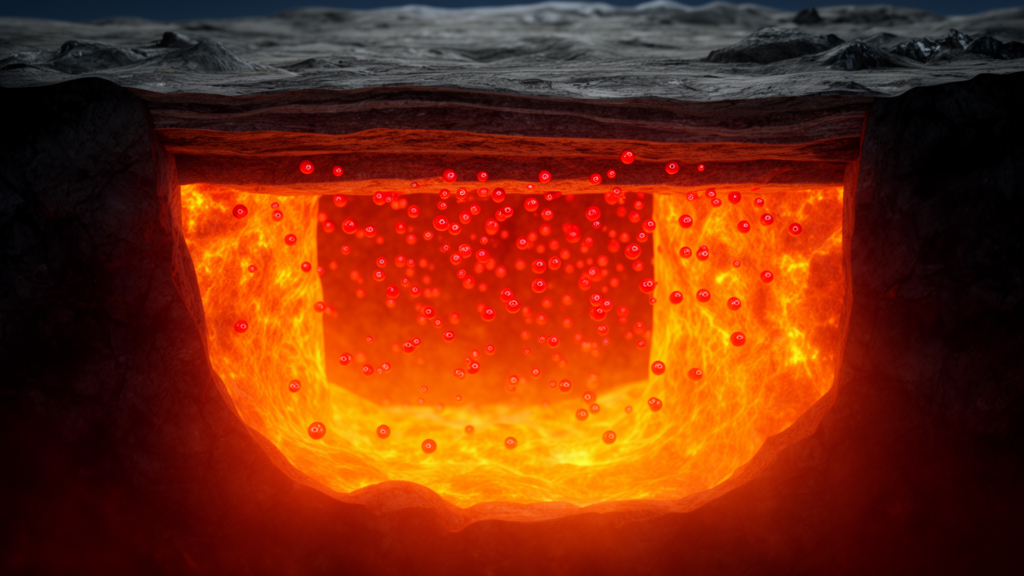
A new study shows that silicate magma (molten rock) in Earth’s deep interior can store substantial “excess oxygen” beyond conventional chemical (stoichiometric) limits, acting like a volatile that is released upon ascent and potentially helping oxidize the shallow Earth and atmosphere.
The research, published in National Science Review (DOI: 10.1093/nsr/nwag539) and announced by Science China Press (via EurekAlert, 15 October 2026), was led by Dr. Yanhao Lin and Dr. Ho-kwang Mao (Center for High Pressure Science and Technology Advanced Research / HPSTAR), with collaborators including Prof. Haiyang Niu (Northwestern Polytechnical University) and Prof. Wim van Westrenen (Vrije Universiteit Amsterdam).
Key findings
- Traditionally, oxygen in magma was assumed to be fixed solely by the amounts and valence states of cations (Si, Mg, Fe, etc.). Unlike H₂O or CO₂, it was not treated as an independent volatile.
- High -pressure and high- temperature experiments melted synthetic mid- ocean ridge basalt at 1 atm to 7 GPa (depths of hundreds of km) and 1200- 1800 °C, using an oxygen source (PtO₂). After quenching to glass, researchers measured major elements, H₂O, and CO₂, then calculated residual “excess oxygen” after accounting for stoichiometric needs and oxygen bound in water and CO₂.
- Excess oxygen was near zero at 1 atm but rose to >5 wt% at 7 GPa. Controls without PtO₂ showed only 0.2- 0.5 wt%. Raman spectroscopy indicated the excess is incorporated into the melt and glass structure (not free O₂ bubbles). Measured amounts are likely lower limits due to possible loss during quenching.
- Molecular dynamics simulations (using deep neural network potentials with ab initio accuracy) on a simplified Mg- Si- O system reproduced the pressure- dependent uptake. As oxygen content rises, oxygen charges become more variable and some peroxide- like O–O bonds form, allowing storage beyond traditional limits. Capacity increases with pressure in a manner analogous to H₂O and CO₂ solubility.
Implications for Earth’s atmosphere
Magma generated in oxidized deep- mantle regions could carry excess oxygen. As it rises and pressure drops, solubility decreases and O₂ is released, potentially oxidizing the shallow mantle, crust, and atmosphere. This offers a direct physical link between deep melting and surface oxidation.
The timing aligns with major atmospheric oxygen rises ~2.5- 2.0 billion years ago (Great Oxidation Event and aftermath), which overlapped with some of Earth’s largest large igneous provinces (LIPs) from deep-sourced magmatism. A rough estimate indicates that release of only ~0.27 wt% excess oxygen from magma erupted in that period could account for all the oxygen in today’s atmosphere.
The work reframes magma as an active, pressure- sensitive reservoir in planetary oxygen cycles. It has implications for magma- ocean evolution, volatile degassing, atmospheric evolution on Earth, and long- term habitability of other terrestrial planets.
This is a recent experimental and computational result proposing a previously unrecognized mechanism; it complements (rather than replaces) other processes involved in Earth’s oxygenation history, such as biological photosynthesis, changes in volcanic gas composition, and subduction- related recycling.

It proposes a previously unrecognized geological mechanism that could have helped oxygenate Earth’s atmosphere, linking deep- mantle melting events to surface oxidation, especially around the time of the Great Oxidation Event.
Core idea
Silicate magma deep in the Earth can dissolve substantial “excess” (non- stoichiometric) oxygen as a pressure- dependent volatile, near zero at surface pressure but rising to more than ~5 wt% at pressures above ~5 GPa (hundreds of kilometers depth).
When this oxygen- rich magma rises and pressure drops, the excess oxygen is released as O₂. This provides a direct pathway for transporting oxidizing power from the deep interior to the shallow mantle, crust, and atmosphere.
Relevance to Earth’s history
- Timing with atmospheric oxygen rise: Major increases in atmospheric oxygen roughly 2.5- 2.0 billion years ago (the Great Oxidation Event and its aftermath) overlap with the emplacement of some of Earth’s largest large igneous provinces (LIPs)—massive volcanic outpourings fed by deep mantle plumes. The new mechanism offers a physical link between these deep magmatic events and surface oxidation.
- Scale of the effect: A rough estimate in the study indicates that if magma erupted during that period released just ~0.27 wt% excess oxygen, the total amount liberated could equal all the oxygen present in today’s atmosphere. Experimental storage capacities at high pressure are an order of magnitude higher, so even partial degassing could have been geologically significant.
- Broader oxygen cycle: Magma is reframed as an active, dynamic reservoir in planetary oxygen cycles rather than a passive carrier of fixed chemistry. This complements (does not replace) other well-known factors in Earth’s oxygenation history, such as:
- Biological oxygen production by cyanobacteria (photosynthesis).
- Changes in the redox state of volcanic gases.
- Burial of organic carbon.
- Subduction and recycling of oxidized surface materials.
- Earlier processes such as iron disproportionation in magma oceans that oxidized the mantle after core formation.
Additional historical and planetary implications
- It supplies a new way to evaluate early Earth magma- ocean evolution and volatile degassing.
- The same physics could apply to other rocky planets, affecting whether they develop or retain oxygen- rich atmospheres and long- term habitability.
- It highlights how deep interior processes can influence surface conditions over billions of years, reinforcing the interconnected nature of Earth’s interior- surface- atmosphere system.
In short, the finding does not overturn the biological or surface- driven explanations for the rise of oxygen, but it adds a plausible deep- Earth contribution that helps explain the coincidence of major atmospheric oxygen increases with large-scale mantle melting events in the Paleoproterozoic. It is a recent experimental and computational result (published 2026 in National Science Review), so further work will test how quantitatively important this process was relative to other mechanisms.

Magma as a carrier of non- stoichiometric oxygen linking Earth’s interior and atmosphere
This is the full open- access research article corresponding to the news story discussed earlier.
Abstract (key points)
Magma generation and transport govern planetary evolution. Although oxygen is the most abundant anion in Earth’s silicate interior, its role in magma has conventionally been ignored, with oxygen contents assumed to be fixed solely by cation stoichiometry.
High- pressure and high- temperature experiments combined with molecular dynamics simulations demonstrate that silicate magma can incorporate substantially more oxygen than traditional valence- state constraints allow. This “excess oxygen” behaves as a previously unrecognized volatile component: its concentration rises from near zero at 1 atm to > ∼5 wt% above 5 GPa, more than five times the maximum oxygen increase possible in Earth’s solid mantle via iron redox changes.
As oxygen- rich magmas ascend and decompress, their capacity to hold excess oxygen decreases, driving release of O₂. This provides a direct mechanism potentially linking mantle melting to oxidation of Earth’s shallow interior and atmosphere and identifies magma as a dynamic reservoir in planetary oxygen cycles.
Context from the study and press coverage
- Experiments used synthetic mid- ocean ridge basalt melted at 1 atm, 7 GPa and 1200- 1800 °C (with PtO₂ as an oxygen source). Excess oxygen was quantified in quenched glasses after accounting for stoichiometric requirements plus H₂O and CO₂. Values exceed 5 wt% at the highest pressures; controls without the oxygen source showed only 0.2- 0.5 wt%. Raman data indicate structural incorporation rather than free O₂ bubbles.
- Simulations (deep neural-network potentials) on a simplified Mg- Si- O system reproduce the pressure- dependent uptake and show broader oxygen charge distributions plus some peroxide- like O–O bonds.
- Implications include a possible contribution to atmospheric oxygenation ~2.5–2.0 billion years ago (Great Oxidation Event period), overlapping with major large igneous provinces. Rough estimates suggest release of only ~0.27 wt% excess oxygen from relevant magmas could supply the amount of O₂ in the modern atmosphere.
- Broader relevance: magma- ocean evolution, volatile degassing, and habitability of terrestrial planets.
The article is short (9 pages). The publisher page (academic.oup.com) and institutional repositories (e.g., Vrije Universiteit Amsterdam) host it under the open- access license.
Journal: National Science Review, Volume 13, Issue 18, Article nwag539
DOI: 10.1093/nsr/nwag539
License: Creative Commons Attribution 4.0 (open access)
Provided: Science China Press
Authors: Yongjiang Xu,

Share this:

Discover more from Climate- Science.press
Subscribe to get the latest posts sent to your email.