

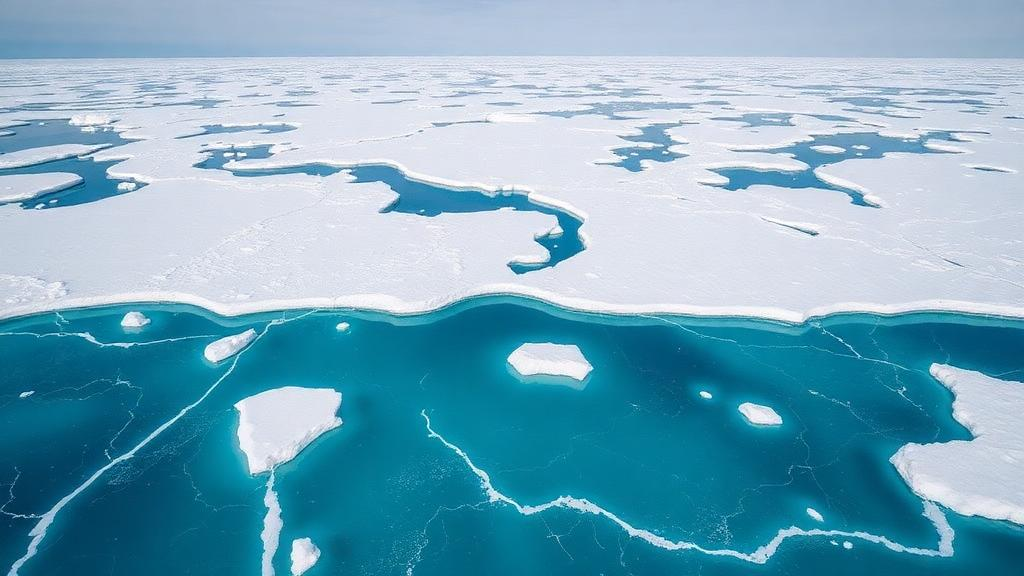
Future Arctic winter sea ice is projected to shrink by roughly 1 million km² more than earlier estimates suggested. This comes from a recent study (reported in Nature Geoscience) that used mid- Holocene paleoclimate data (~6,000 years ago) to better constrain and weight climate models.
Researchers from the University of Cambridge and Mexico’s Centro de Investigación en Matemáticas compiled the largest database yet of a key biomarker produced by sea- ice algae, extracted from ocean sediment cores.
During the mid- Holocene, orbital changes caused warmer Arctic conditions and reduced sea ice, providing an independent “out- of- sample” test of how models handle warmer climates comparable to projected future greenhouse- gas forcing.
Models generally over- predicted the amount of winter sea ice that should have existed under those past conditions. By weighting the models according to how well they matched the paleodata (and historical observations), the positive bias was largely eliminated. This also narrowed projection uncertainty by as much as 85%.
When the same weights were applied to future scenarios (SSP1/SSP2/SSP5), the multi- model mean winter sea- ice extent for 2090- 2099 came out consistently lower, by about 4- 6%, than the unweighted average. The extra loss is concentrated in regions such as the Barents, Greenland, and Labrador Seas, with possible ice- edge shifts of several degrees of latitude.
Why it matters
- Winter ice sets the stage for the rest of the seasonal cycle; underestimating its retreat also understates effects on ocean circulation, regional weather, and the timing of summer melt.
- The revised projections hint at larger knock- on impacts, including potentially more snowfall over southeast Greenland and more rainfall in the Mediterranean, with implications for ice- sheet stability and flood risk in southern Europe.
- Winter conditions in the UK and across Europe could therefore be affected more than previously expected.
In short, paleoclimate evidence from a naturally warmer Arctic indicates that standard climate models have been too conservative about future winter sea- ice loss. The study emphasizes that past warm periods can provide stronger constraints on model reliability than the relatively short instrumental record alone.

Palaeoclimate constraints narrow uncertainty in future Arctic winter sea ice projections
This is the peer- reviewed scientific paper underlying the recent news reports about greater- than- expected future Arctic winter sea- ice loss.
Key findings
Climate models show their largest biases and uncertainties for Arctic sea ice in winter (especially March), when ice cover strongly influences air- sea heat exchange, ocean mixing, and atmospheric circulation.
The authors address this by compiling the largest Arctic-wide database of mid- Holocene (MH; 5- 7 thousand years ago) sea- ice biomarkers (46 ln(PIP₂₅) observations based on the IP₂₅ biomarker and associated phytoplankton sterols from sediment cores spanning ~54- 83° N).
They use a Bayesian proxy system model (BaySIC) to translate model- simulated sea- ice concentrations into the same proxy units, accounting for non- stationary proxy seasonality (tied to local ice-breakup timing rather than fixed calendar months). A Bayesian weighting scheme then adjusts the contribution of each of 27 PMIP3/PMIP4 and CMIP models based on how well they match the MH proxies (and, in a joint analysis, historical observations). The scheme also accounts for model interdependence.
- The weighted multi- model mean (WMMM) eliminates the positive winter sea- ice extent (SIE) bias and reduces uncertainty by ~85% (≈6.3 million km²), bringing it down to the level of interannual variability.
- Applying the same weights to future projections (SSP1/SSP2/SSP5, corresponding to RCP2.6/4.5/8.5) yields winter SIE that is consistently ~4- 6% lower than the unweighted multi- model mean for 2090- 2099, nearly 1 million km² lower across scenarios.
- Spatially, the weighted projections show higher probabilities of ice loss (and northward ice- edge shifts of up to 5.5° latitude) in the Barents, Greenland, and Labrador Seas.
Implications
Greater winter ice loss could amplify mid- latitude impacts already linked to reduced winter SIE, including colder and wetter winters in parts of Eurasia and North America, altered storm tracks, and extreme precipitation.
The revised projections suggest late- winter and early- spring snowfall over southeastern Greenland may be underestimated by >30%, and Mediterranean winter, spring precipitation could be roughly twice as high as previously projected under high- emissions scenarios, with consequences for Greenland Ice Sheet mass balance and flood risk.
The mid- Holocene provides a particularly useful out- of- sample test because orbital changes produced Arctic radiative forcing comparable in magnitude (though different in seasonality and mechanism) to anticipated future greenhouse -gas forcing. Models that perform well under those past warm conditions are expected to be more reliable for future projections.
In short, quantitative palaeoclimate constraints from a warmer Arctic indicate that standard multi- model estimates have been too conservative about the magnitude of future winter sea-ice retreat and its cascading effects.
Journal: Nature Geoscience
DOI: 10.1038/s41561-026-02123-w
Published: 16 October 2026
Provided: University of Cambridge
Authors: C. Y. Fu,
M. B. Osman &
M. A. Aquino-López
Abstract
Arctic sea ice decline has been observed across all seasons and is projected to continue in the future. Relative to historical observations, climate models show their largest biases and uncertainties during winter, when ice cover strongly regulates air–sea heat exchange, ocean mixing and atmospheric circulation. Palaeoclimate records offer opportunities to evaluate model performance beyond the historical period, but applications have remained largely qualitative. Here we compile an Arctic-wide database of mid-Holocene (5–7 thousand years ago) biomarkers to assess sea ice simulations of this past warm period. Using a recently developed proxy system model, we present a Bayesian palaeoclimate model weighting scheme that refines the multi-model mean winter sea ice extent through fully quantitative proxy-model comparisons, accounting for model interdependence and non-stationary proxy seasonality. We demonstrate that, by adjusting the contribution of each model to the ensemble mean based on proxy evidence, model weights can eliminate biases and reduce uncertainties by 85%, to the level of interannual variability. Weighted projections using the same climate models indicate that future winter sea ice extent may be nearly 1 million km2 lower than prior estimates across forthcoming decades and possible emissions scenarios, with broad implications for Arctic ecosystems, mid-latitude weather, and cryosphere stability.
Share this:

Discover more from Climate- Science.press
Subscribe to get the latest posts sent to your email.