Vineyard Wind’s Troubles Mount Despite Political Victory Lap

Vineyard Wind 1, the first large-scale U.S. offshore wind farm (800 MW, 62 turbines off Massachusetts), has faced persistent technical, contractual, and operational challenges even after completing physical installation in March 2026.

From Watts Up With That?

From Legal Insurrection

Troubled windfarm is producing less than half the promised output, sensors are repeatedly tripping offline, and it’s engaged in a legal battle with its turbine manufacturer.

Posted by Leslie Eastman

Two summers ago, we began following the saga of the Vineyard Farms offshore wind project and its blade failure near Nantucket.

After one blade failed and fell into the water, the beaches were littered with sharp fiberglass shards, creating a suboptimal condition at the height of the summer tourist season.  The continuing investigation into the cause of this environmental contamination incident determined that a manufacturing flaw in the blade was responsible for the failure.

Subsequently, residents of Nantucket began demanding the end of these mammoth offshore wind farms, and fishermen protested at the site of the blade failure.

Massachusetts Governor Maura Healey declared victory last month, celebrating the completion of Vineyard Wind as a shining beacon of “energy independence” that would slash electricity costs.

“Vineyard Wind is a key part of our all-of-the-above strategy to lowering energy prices,” Healey said. “Throughout one of the coldest winters in recent history, Vineyard Wind turbines powered our homes and businesses at a low price and now that price goes even lower with the activation of these contracts. Especially as President Trump is taking energy sources off the table and increasing prices with his war in Iran, we should be leaning into more American-made wind power to lower costs, create jobs, and make our country more energy independent.”

This past winter, Vineyard Wind lowered electricity prices by competing in wholesale electricity markets. In those markets, it consistently offered lower prices than other sources of electricity. This activation of the utilities’ contracts further lowers the price of electricity generated by Vineyard Wind.

However, the celebration may have been premature. Apparently, the wind farm is producing barely 300 megawatts (less than half the promised output), and sensors are repeatedly tripping offline.

In a May 1 court filing, Vineyard Wind CEO Klaus Moeller said the project’s current average output is roughly 300 megawatts, and 13 of the 62 turbines are not yet activated.

Significant remedial and repair work is needed to address “recurrent operational issues,” Vineyard Wind officials said in court documents.

The problems include sensors that repeatedly trip, causing the turbines to shut off and curtailing their performance and power generation.

Furthermore, the developer is locked in a bitter $853 million lawsuit to stop turbine-maker GE Vernova from walking away from the project, which would essentially leave it a “dormant wind farm graveyard”.

A Boston judge has affirmed his own ruling that temporarily blocks GE Renewables from exiting its contract with Vineyard Wind, compelling the subsidiary of GE Vernova to continue servicing and maintaining the wind farm southwest of Nantucket.

Judge Peter Krupp this week rejected a pair of motions from GE Renewables that asked him to reconsider his previous order and send the case to arbitration. GE Renewables, the manufacturer of the offshore wind turbines used by Vineyard Wind, has been trying to leave the project, arguing that the offshore wind company owes them $300 million.

Vineyard Wind has countered by claiming that it is actually GE Renewables that owes them $500 million stemming from the collapse of a GE-manufactured turbine blade in July of 2024, which littered Nantucket’s beaches with debris and forced the wind farm to temporarily shut down while the cause of the break was identified. Ultimately, more than 60 blades had to be replaced. Vineyard Wind has also said that GE Renewables’ exit would endanger the very existence of the project, possibly leaving behind a “dormant wind farm graveyard”. So far, the courts have sided with Vineyard Wind.

Meanwhile, Massachusetts’ latest offshore wind procurement round has been delayed yet again, pushing the contract completion deadline to January 29, 2027, and leaving the process roughly two and a half years behind schedule.

Massachusetts selected 2,678 megawatts of offshore wind power spread across three projects in September 2024, kicking off contract talks that are expected to result in higher prices for power than past projects. During the repeated delays, one of the selected projects has removed itself from consideration and another raised the potential for a multi-year delay.

Officials say contract negotiations are still ongoing and are expected to result in higher power prices than in previous rounds, extending uncertainty for developers, ratepayers, and the region’s climate and energy planning.

It appears that when you build a $4.5 billion monument to green ideology on the Massachusetts coast, break a 351-foot turbine blade and dump 57 tons of fiberglass debris onto Nantucket’s beaches, then run out of money to pay the contractor who installed your turbines, the laws of physics and finance remain very strongly in place.

Here’s hoping the good people of the region have enough energy for both “heat domes” and the winter season.

Wind Power Pollution and Hypocrisy in New England

A fractured turbine’s blade in Nantucket is causing
ongoing problems and frustrating local residents.

From Science Matters

By Ron Clutz

Emmett Hare reports in City Journal Wind Power Debacle in New England.  Excerpts in italics with my bolds and added images.

A fractured turbine’s blade in Nantucket is causing
ongoing problems and frustrating local residents.

In mid-July, a blade from an offshore wind turbine operating 15 miles southwest of Nantucket fractured. A large amount of fiberglass, foam, and plastic debris fell into the ocean and began washing up on the island’s shores. The incident led to the closure of several beaches and a suspension of operations and construction for the massive Vineyard Wind project, a joint venture of Avangrid and foreign-owned Copenhagen Infrastructure Partners that has installed and operated ten of 62 planned turbines in the country’s largest wind farm.

At local meetings, Nantucket residents expressed concerns about officials’ handling of the turbine breakage and the environmental hazards of enormous fiberglass blades tumbling into the sea. In the past, they have also cited the project’s impact on marine wildlife and its visual impact on the town’s scenic beaches. A CNN report describing this “unusual and rare” event noted that the Coast Guard had retrieved a 300-foot piece of the shattered blade from local waters. The outlet reported that a spokesperson for GE Vernova, the wind-blade manufacturer, “couldn’t provide officials with the precise number of times something similar has happened at other wind farms around the world.”

Environmental groups, realizing the potential political implications of the fractured blade, downplayed the episode. The National Wildlife Federation (NWF), which avidly supports offshore wind farms, insisted that the damage was minor. “Compared to other energy disasters in the ocean like oil spills, this incident is fairly contained and easily cleaned up to prioritize the safety of marine life,” said Amber Hewett, senior director of offshore wind energy for the NWF. The Sierra Club emphasized that “the failure of a single turbine blade does not adversely impact the emergence of offshore wind as a critical solution for reducing dependence on fossil fuels and addressing the climate crisis.”

Whether the incident is “contained” remains in question. Debris from the broken turbine has been reported beyond Nantucket—in Martha’s Vineyard, Cape Cod, Rhode Island, and off the coast of Montauk, Long Island. The debris is breaking up into smaller pieces resembling shattered glass, with yet-unknown effects on Nantucket’s marine habitat. Vineyard Wind cautioned that “[m]embers of the public should avoid handling debris” and promised to “bag, track, and transport all debris to proper storage as soon as possible.” It remains to be seen whether simple avoidance will suffice, especially given the possibility of debris entering the human food chain through area fish.

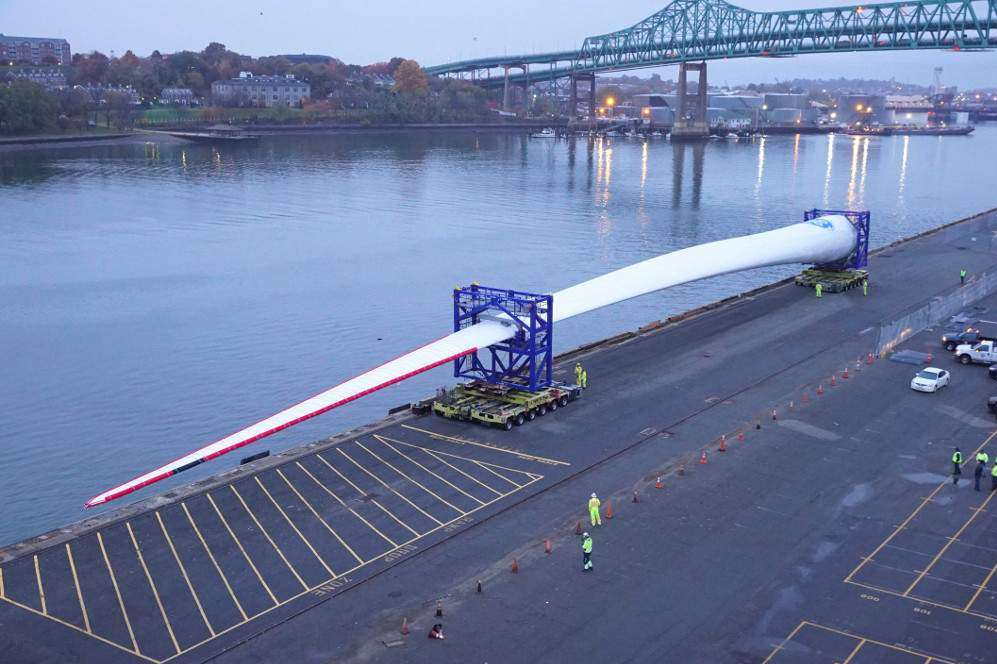
The Massachusetts Clean Energy Center (MassCEC) Wind Technology Testing Center in Boston has taken delivery of a 107-meter wind turbine blade designed for GE Renewable Energy’s Haliade-X offshore wind turbine.

While this event may be “unusual and rare” in an absolute sense, many wind farms have seen broken turbines, fires, and sea-floor damage. And Nantucket’s situation is particularly dire, given that Vineyard Wind’s turbines are by far the largest ever constructed in the United States: the blade that fragmented on July 13 was over 350 feet long and weighed 57 tons.

Even when functioning as intended, wind farms can negatively affect the surrounding environment. Wildlife advocates have claimed that sonic and subsonic vibrations from the construction and operation of turbines disrupt the navigational senses of marine mammals like whales and dolphins and can cause beachings. Turbines are also responsible for the deaths of countless birds. Clammers and fishermen are wary of working in areas close to wind farms, out of concern for equipment snags on buried power lines and risks to their vessels of navigating between the turbines in bad weather.

French Fishermen Join U.S. Fishermen in Fighting Offshore Wind – IER

The Nantucket residents questioning the safety of wind turbines generally support alternative energy. Indeed, in an FAQ post on the town government’s webpage, officials made the point that allowing wind projects to avoid scrutiny might allow traditional fossil fuel producers to evade similar oversight: “If [the Bureau of Ocean Energy Management] guts the provisions of these longstanding federal laws protecting culturally and environmentally significant places to facilitate expedient green energy projects, fossil fuel developers will exploit the bad precedent to undercut regulation of harmful projects for decades to come.”

Nonetheless, the Nantucket residents have seen themselves branded as tools of the fossil-fuel industry by well-financed lobbyists and promoters of richly subsidized wind power. They have also been subject to physical attacks. At a city council meeting in Newport, Rhode Island, a field director for Climate Jobs Rhode Island, David Booth, was charged with simple assault and disorderly conduct after accosting a speaker and seizing a bag of turbine fragments that she had brought for her testimony. Booth allegedly appeared prominently in a photo on the campaign website of Rhode Island senator Sheldon Whitehouse, which was subsequently removed without comment.

Debris in the water from Vineyard turbine blade

The wind-power industry has seen some of its planned projects cancelled in recent years due to swelling production costs and local opposition to the environmental and aesthetic impact of the colossal windmills. A report published by Brown University’s Climate and Development Lab in early 2024 suggested that much of the opposition to offshore wind was rooted in “misinformation,” “[c]onspiracy theories,” and cherry-picked information supplied by “right-wing think tanks.” It might prove beyond the powers of an academic paper to convince the residents of New England and coastal states that the fiberglass and foam washing up on their beaches is nothing more than a conservative talking point.

‘Bunch Of Suits Trying to Cover Their Tracks’: Beach Town Locals Slam Offshore Wind Developer for Polluting Shores

Residents of Nantucket, Massachusetts, spoke out on Wednesday at a town hall against a wind power company for a “turbine blade failure incident” that resulted in debris washing up along the beach.

From Watts Up With That?

THE DAILY CALLER

Owen Klinsky
Contributor

Residents of Nantucket, Massachusetts, spoke out on Wednesday at a town hall against a wind power company for a “turbine blade failure incident” that resulted in debris washing up along the beach.

Officials of the small island town located 30 miles off the coast of Cape Cod were forced to shut down beaches on the south shore on Tuesday due to “large floating debris and sharp fiberglass shards,” according to a statement posted to Facebook by the Nantucket Harbormaster’s office. During the town hall, locals accused Vineyard Wind — an offshore wind development company that operates near the island — of taking too long to notify the community and clean up the site, according to videos of the event posted on X by the Nantucket Current.

“This happened Saturday night… There was no notice to mariners until Monday; that’s unacceptable. The town wasn’t informed until Monday,” Nantucket charter boat captain Bobby DeCosta said during the town hall. “There’s nobody in this room that’s been to that sight. I guarantee it. We’ve got a bunch of suits here trying to cover their tracks,” DeCosta continued, gesturing towards the Vineyard Wind representatives present at the meeting.

DeCosta also said that the cleanup response should have occurred much sooner, stating that anyone with prior knowledge of the prevailing winds in the area knew the wind would ultimately reach Nantucket’s shores. (RELATED: Major Enviro Orgs Shack Up With Foreign Oil Giants To Industrialize The Ocean)

“Anyone with any kind of water knowledge knows that the tide out there around this wind farm goes northeast/southwest and the prevailing wind in the summer is southwest, and this stuff was going to end up on the beach,” DeCosta said. “They had to do a tide analysis before they even started this project, so this is a bunch of crap when they say, ‘Oh, we had to do a [National Oceanic and Atmospheric Administration] study to see where this stuff was going to go’… They were hoping it wasn’t going to go on the beaches so they wouldn’t have to deal with it as much.”

Nantucket charter boat captain Bobby DeCosta, owner of the Albacore, from the top rope:

“We’ve got a bunch of suits here trying to cover their tracks” pic.twitter.com/XFzsYc4zty— Nantucket Current (@ACKCurrent) July 18, 2024

Local lobsterman Dan Pronk lamented the effects the debris has had on his business and the environment during the town hall meeting while holding a piece of fiberglass that had washed up on the beach, while also addressing Vineyard Wind CEO Klaus Moeller personally, according to another video posted on X by the Nantucket Current.

“I fish 800 lobster traps right where you’re putting these tombstones, which is also the end of my business… When you apply [fiberglass]… you have to wear respirators. For what reason? Because it’s toxic. If you breathe those fumes… you’ll get higher than a rat,” he continued. “So, it is toxic. What do you have to say about that, Klaus?”

🦞

Following the incident, Vineyard Wind’s operations were “shut down until further notice,” a spokesperson for the Bureau of Safety and Environmental Enforcement told NBC Boston on Tuesday.

The town of Nantucket on Thursday referred to the turbine debris as a “crisis” and stated that “Vineyard Wind vessels are collecting fiberglass pieces on the site; a very large piece of debris is below the surface, in the water column,” according to a post from the Nantucket Current on X.

The Biden administration has pushed for greater construction and utilization of offshore wind farms as part of his broader green agenda in order to reduce the use of fossil fuels. Recent wind farm projects have been plagued with issues and delays due to high costs and component failures as the industry rapidly develops.

Vineyard Wind did not immediately respond to a request for comment.

All content created by the Daily Caller News Foundation, an independent and nonpartisan newswire service, is available without charge to any legitimate news publisher that can provide a large audience. All republished articles must include our logo, our reporter’s byline and their DCNF affiliation. For any questions about our guidelines or partnering with us, please contact licensing@dailycallernewsfoundation.org.